Europe Raisins Market Size, Share, Trends & Growth Forecast Report, Segmented By Type (Natural Seedless, Sultanas, Munakka, Currants, Others), Application, And Country (Uk, France, Spain, Germany, Italy, Russia, Sweden, Denmark, Switzerland, Netherlands, Turkey, Czech Republic & Rest Of Europe) - Industry Analysis From (2026 To 2034)
Market Size, 2025
$0.640 BnMarket Estimate, 2026
$0.649 BnMarket Forecast, 2034
$0.72 BnCAGR, 2026–2034
1.37%Europe Raisins Market Report Summary
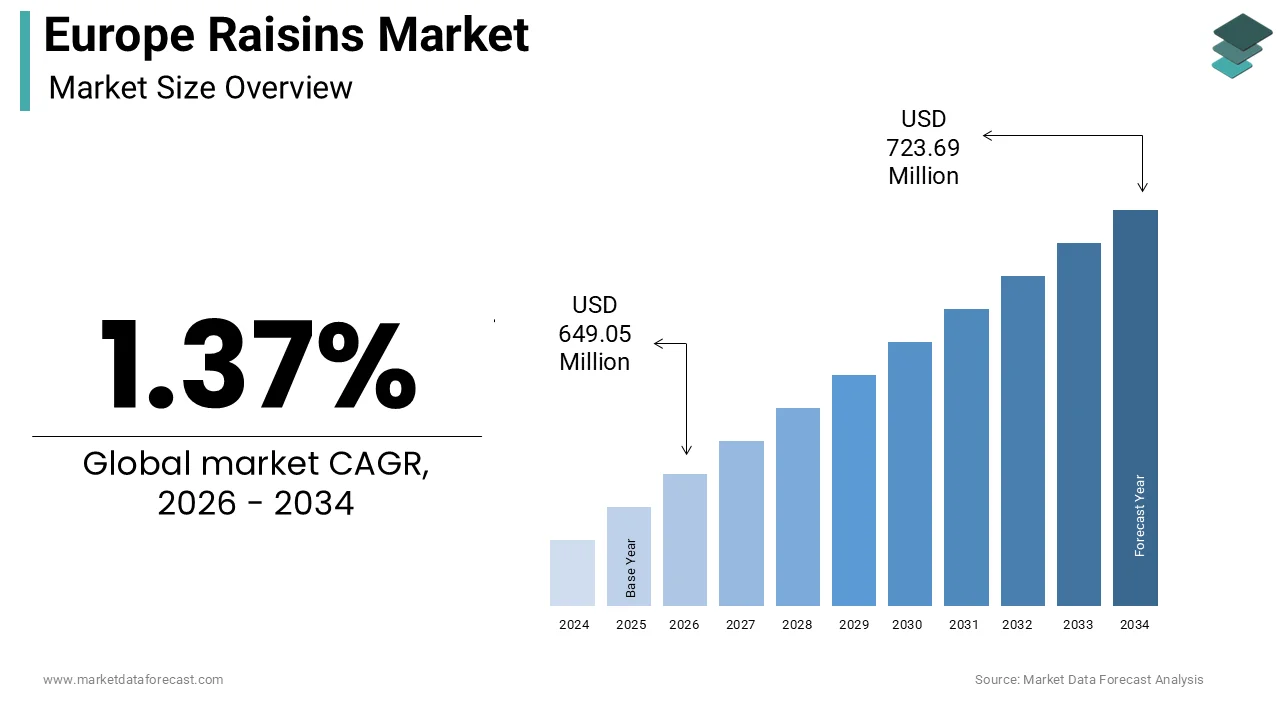
The Europe raisins market was valued at USD 640.28 million in 2025, is estimated to reach USD 649.05 million in 2026, and is projected to reach USD 723.69 million by 2034, growing at a CAGR of 1.37% during the forecast period. The growth of the Europe raisins market is relatively moderate, driven by steady demand from traditional food applications such as bakery, confectionery, and cereals. Raisins continue to be widely consumed due to their natural sweetness, long shelf life, and nutritional benefits, including fiber and antioxidants. However, market growth is somewhat constrained by the maturity of the category and competition from alternative dried fruits and snack options. Despite this, increasing demand for healthy snacking and clean-label ingredients is supporting consistent market expansion across Europe.
Key Market Trends
- Stable demand for traditional bakery and confectionery applications, sustaining raisin consumption.
- Increasing preference for natural sweeteners and clean-label ingredients, boosting usage in processed foods.
- Growing demand for healthy snack options, particularly among health-conscious consumers.
- Rising interest in organic and premium dried fruits supports niche market growth.
- Expansion of raisins in cereal, snack bars, and ready-to-eat food products.
Segmental Insights
- Based on type, the sultanas segment dominated the Europe raisins market by accounting for 48.3% of the market share in 2025, driven by their soft texture, sweetness, and widespread use in bakery and snack products.
- Based on application, the food processing segment held a significant share of the Europe raisins market in 2025, supported by extensive use in baked goods, cereals, confectionery, and packaged food products.
Regional Insights
- Germany dominated the Europe raisins market in 2025, accounting for 22.3% of the regional market share, driven by strong consumption of bakery products and a well-established food processing sector.
- The United Kingdom is witnessing steady growth, supported by a strong culture of fruit-based baking and increasing demand for healthy snack options.
- France is expected to experience notable growth opportunities, driven by demand for premium and gourmet food products.
- Italy’s raisin market is influenced by its strong agricultural base and grape production, supporting both domestic consumption and regional trade.
- Spain is a key market, supported by high-quality sun-dried raisin production and strong alignment with Mediterranean dietary habits.
Competitive Landscape
- The Europe raisins market is moderately competitive, with the presence of global dried fruit producers and regional suppliers. Market players are focusing on quality, organic certification, and expanding product offerings to maintain competitiveness. Strategic partnerships and distribution expansion are key approaches adopted by leading companies.
- Prominent players in the Europe raisins market include Sun-Maid Growers of California, Lion Raisins Inc, National Raisin Company, Dole Food Company, Inc, Traina Foods Inc, Bergin Fruit and Nut Company, Del Monte Foods, Inc, Olam Group, Sunbeam Foods Pty Ltd, Geobres Nemean Currants S.A, Paradise Fruits Solutions GmbH & Co. KG, Dried Fruits International, Kiantama Oy, Graceland Fruit, Inc, and Besana Group.
Europe Raisins Market Size
The Europe raisins market size was calculated to be USD 640.28 million in 2025 and is anticipated to be worth USD 723.69 million by 2034, from USD 649.05 million in 2026, growing at a CAGR of 1.37% during the forecast period.
The raisins are dried grapes, primarily derived from Vitis vinifera varieties such as Sultana, Thompson Seedless, and Corinthian currants. In 2024, the European Union imported approximately 285000 tons of raisins to meet domestic demand, with Turkey and the United States serving as the primary external suppliers, according to data from the International Trade Centre. Domestic production within Europe remains concentrated in Greece and Italy, where traditional sun-drying methods persist alongside modern mechanical dehydration facilities. The per capita consumption of dried fruit in Europe reached 1.8 kg in 2024, with raisins accounting for nearly 60% of this volume as per statistics from the European Dried Fruit Association. Regulatory frameworks regarding pesticide residues and labeling transparency further shape the operational landscape, compelling importers and processors to adhere to stringent safety standards established by the European Food Safety Authority.
MARKET DRIVERS
Integration into Health Conscious Snack Formulations
The escalating consumer preference for natural, nutrient-dense snacks that align with holistic wellness lifestyles is propelling the growth of Europe raisins market. Raisins are increasingly recognized not merely as sweeteners but as functional food ingredients rich in dietary fiber, potassium, and polyphenols, which support cardiovascular health and digestive regularity. According to recent nutritional surveys conducted by the European Food Information Council, 68% of European consumers actively seek snack options with no added sugars or artificial preservatives, a demographic that naturally gravitates toward whole dried fruits. This shift has prompted major food manufacturers to reformulate product lines, replacing refined sugars with raisin paste in cereal bars, yogurt toppings, and baked goods. Data from the Global Nutrition Report indicates that fiber intake recommendations in Europe remain unmet by 70% of the population, driving demand for high-fiber ingredients like raisins, which contain up to 3.7 grams of fiber per 100 grams. Furthermore, the rise of the "clean label" movement has elevated the status of raisins as a recognizable and trusted ingredient, with sales of organic raisin-based snacks growing since 2022.
Expanding Utility in Plant-Based and Vegan Product Development
The surging adoption of plant-based diets, which has positioned raisins as a versatile ingredient for texture enhancement and natural sweetening in vegan formulations, is substantially elevating the growth of Europe raisins market. Raisins provide a unique functional profile, offering moisture retention and chewiness in plant-based meat analogs and dairy-free desserts without altering the flavor profile negatively. Raisins serve as a cost-effective and clean-label solution for reducing sugar content while maintaining palatability in gluten-free and vegan products, addressing two major dietary restrictions simultaneously. Additionally, the fermentation of raisins for use in plant-based probiotic beverages is an emerging trend by leveraging the fruit's natural sugars to foster beneficial bacterial growth.
MARKET RESTRAINTS
Stringent Regulatory Limits on Pesticide Residues
The increasingly rigorous regulatory environment concerning maximum residue levels (MRLs) for pesticides and contaminants in dried fruits is restricting the growth of Europe raisins market. The European Union maintains some of the strictest food safety standards globally, frequently updating its list of prohibited substances and lowering acceptable thresholds for existing ones. According to the Rapid Alert System for Food and Feed, dried grapes consistently rank among the top commodities flagged for non-compliance due to detected residues of fungicides and insecticides used during cultivation and drying. The European Food Safety Authority emphasizes that the concentration process of drying grapes can amplify residue levels by making compliance even more challenging for growers who rely on conventional agricultural practices. This regulatory pressure forces suppliers to invest heavily in testing and certification, increasing the final cost of goods and limiting the pool of eligible exporters. Small-scale farmers in key producing regions often lack the resources to transition to fully compliant organic or integrated pest management systems, leading to supply shortages and volatility in pricing that dampens market stability.
Climatic Volatility Impacting Grape Yield and Quality
The heightened vulnerability of grape cultivation to erratic weather patterns and extreme climatic events, which directly threaten the consistency of raisin supply, is also hampering the growth of Europe raisins market. Raisin production requires specific climatic conditions during the drying phase, typically needing hot, dry weather to prevent mold growth and ensure proper dehydration. Excessive humidity during the drying period can lead to fungal contamination, such as ochratoxin A, rendering entire crops unsuitable for human consumption and necessitating costly disposal. These environmental instabilities not only reduce the total volume of available raw material but also compromise the quality uniformity required by industrial buyers. The inability to guarantee stable supply volumes discourages long-term contracting by large food manufacturers, who may opt for more resilient ingredients, thereby capping the growth potential of the raisin market.
MARKET OPPORTUNITIES
Valorization of Raisin By-Products for the Circular Economy
The comprehensive utilization of processing by-products, such as stems, seeds, and pomace, to create high-value bioactive ingredients is setting up new opportunities for the growth of Europe raisins market. Traditionally discarded as waste, these residues are now recognized as rich sources of antioxidants, dietary fiber, and tartaric acid, which can be extracted for use in nutraceuticals, cosmetics, and functional foods. The European Commission's Circular Economy Action Plan encourages the food industry to minimize waste, providing a regulatory and financial impetus for companies to invest in extraction technologies. Furthermore, the development of raisin-based bioplastics and packaging materials represents an innovative frontier by aligning with the EU's strategy to replace fossil-fuel-based plastics. Pilot projects in Spain and Italy have already demonstrated the feasibility of extracting polyphenols from raisin pomace for use in anti-aging skincare formulations, opening a lucrative new market segment. This holistic approach to resource utilization not only reduces environmental impact but also diversifies income sources, strengthening the resilience of the entire value chain.
Expansion into Functional Bakery and Clean Label Sweeteners
The evolving European bakery sector to serve as a primary clean-label sweetener and texturizer in reformulated products is expected to promote new opportunities for the growth of Europe raisins market. As consumers increasingly demand a reduction in added sugars, food technologists are turning to concentrated fruit ingredients like raisin paste to provide natural sweetness and moisture without compromising taste or texture. The European Bakery Association reports that 45% of new bakery product launches in 2024 featured "no added sugar" claims, with dried fruits playing a central role in achieving these formulations. Raisins offer a unique advantage over other sweeteners due to their ability to retain moisture and extend shelf life in baked goods by reducing the need for synthetic preservatives. This functional benefit is particularly valuable in the gluten-free segment, where texture issues often plague product quality. Additionally, the trend toward ancient grains and heritage recipes has revived interest in traditional raisin breads and cakes, driving demand in the artisanal bakery niche.
MARKET CHALLENGES
Prevalence of Mycotoxin Contamination and Safety Concerns
The risk of mycotoxin contamination, particularly ochratoxin A, which poses significant health risks and regulatory hurdles, is one of the challenges for the Europe raisins market. Ochratoxin A is a toxic secondary metabolite produced by fungi that can develop on grapes during improper drying or storage conditions, and its presence is strictly monitored by European authorities. According to the European Food Safety Authority, dried vine fruits remain one of the highest risk categories for ochratoxin A exposure, with periodic spikes in detection rates triggering widespread product recalls and import bans. The formation of this toxin is highly dependent on microclimatic conditions during the sun-drying process, which are becoming increasingly unpredictable due to climate change. Managing this risk requires sophisticated monitoring systems and controlled drying environments, which can be prohibitively expensive for small-scale producers in key exporting regions. The economic impact of contamination incidents is profound, as a single detection can lead to the rejection of entire shipments and long-term reputational damage for supplying regions. Furthermore, the analytical methods for detecting mycotoxins are becoming more sensitive, lowering the threshold for compliance and increasing the likelihood of false positives or minor exceedances. Ensuring consistent safety standards across a fragmented global supply chain remains a logistical and technical nightmare that constrains market fluidity and consumer confidence.
Intense Price Volatility and Supply Chain Disruptions
The extreme price volatility inherent is driven by fluctuations in global supply, currency exchange rates, and geopolitical tensions affecting key trade routes, which will also hamper the growth of Europe raisins market. The heavily dependent on imports from Turkey, the United States, and Central Asia, which is making it susceptible to disruptions caused by political instability, trade tariffs, or logistics bottlenecks. The concentration of production in specific geographic zones means that any local adverse event, such as a frost or labor strike, can ripple through the global supply chain by causing sudden shortages and price surges. This unpredictability complicates inventory management and pricing strategies for European manufacturers, who often operate on thin margins and struggle to pass costs onto price-sensitive consumers. Additionally, the competition for raw grapes between the wine, table grape, and raisin sectors adds another layer of complexity, as farmers may switch crops based on relative profitability, further destabilizing supply.
REPORT COVERAGE
| REPORT METRIC | DETAILS |
| Market Size Available | 2025 to 2034 |
| Base Year | 2025 |
| Forecast Period | 2026 to 2034 |
| CAGR | 1.37% |
| Segments Covered | By Type, Application, And Region |
| Various Analyses Covered | Global, Regional & Country Level Analysis; Segment-Level Analysis; DROC, PESTLE Analysis; Porter’s Five Forces Analysis; Competitive Landscape; Analyst Overview of Investment Opportunities |
| Regions Covered | UK, France, Spain, Germany, Italy, Russia, Sweden, Denmark, Switzerland, Netherlands, Turkey, and the Czech Republic |
| Market Leaders Profiled | Sun-Maid Growers of California, Lion Raisins Inc., National Raisin Company, Dole Food Company, Inc., Traina Foods Inc., Bergin Fruit and Nut Company, Del Monte Foods, Inc., Olam Group, Sunbeam Foods Pty Ltd, Geobres Nemean Currants S.A., Paradise Fruits Solutions GmbH & Co. KG, Dried Fruits International, Kiantama Oy, Graceland Fruit, Inc., Besana Group |
SEGMENTAL ANALYSIS
By Type Insights
The sultanas segment accounted in holding 48.3% of the Europe raisins market share in 2025. The growth of the segment is likely to grow with a versatility in the industrial food processing sector, particularly within the bakery and confectionery industries, where consistency in size, color, and moisture content is important. As per data from the European Bakery Association, over 65% of all dried fruit used in commercial bakery production across the continent consists of Sultanas, amounting to approximately 140000 tons annually. The thin skin of the Sultana grape allows for faster rehydration and better integration into mixtures, a technical advantage that streamlines manufacturing processes and reduces production time. Furthermore, the mild sweetness of Sultanas complements rather than overpowers other flavors, allowing them to be used in savory dishes, salads, and dairy products without altering the intended flavor profile. This broad applicability ensures that Sultanas remain the default choice for food technologists and product developers, securing their leading position through sheer volume of usage in both mass-market and artisanal sectors.
The natural seedless segment is projected to register a CAGR of 7.2% during the forecast period from 2026 to 2034. The rapid expansion of the Natural Seedless segment is primarily propelled by the robust clean label movement sweeping across Europe, where consumers increasingly scrutinize ingredient lists for artificial additives and preservatives. Natural Seedless raisins, often marketed as "sun-dried" or "unsulfured," perfectly align with this trend as they undergo a purely physical dehydration process that retains their natural dark color and intense flavor without chemical intervention. Furthermore, major retail chains like Aldi and Lidl have expanded their "free-from" ranges, dedicating significant shelf space to natural dried fruit options, which has drastically improved accessibility and visibility.
By Application Insights
The food Processing application segment held a significant share of the Europe raisins market in 2025, with the entrenched role of raisins as a staple ingredient in the European bakery and confectionery sectors, which are among the largest food manufacturing industries on the continent. Raisins are integral to a wide array of traditional and modern baked goods, from daily breakfast breads and muffins to seasonal specialties like Christmas puddings and Easter cakes, creating a consistent and high-volume demand cycle. The functional properties of raisins, such as their ability to retain moisture and extend shelf life, make them invaluable to industrial bakers seeking to reduce waste and maintain product freshness without synthetic preservatives. Furthermore, the cost-effectiveness of raisins as a natural sweetener allows manufacturers to reduce added sugar content while maintaining palatability, a factor in meeting current regulatory and consumer pressure for healthier formulations. The sheer scale of industrial baking operations, combined with the necessity of raisins in countless recipes, ensures that the Food Processing segment captures the lion's share of market volume, far outstripping direct household purchases or food service usage.
The household application segment is anticipated to witness a CAGR of 5.8% from 2026 to 2034. The segment is propelled by the sustained resurgence of home baking and cooking as popular leisure activities, a trend that was initially sparked by pandemic lockdowns but has evolved into a lasting lifestyle choice for many Europeans. Consumers are increasingly experimenting with traditional recipes and artisanal baking at home, driving demand for high-quality baking ingredients, including raisins, which are essential for cakes, breads, and desserts. The rise of social media platforms like Instagram and TikTok has further fueled this trend, with viral baking challenges and recipe tutorials often featuring raisins as key components, inspiring millions of home cooks to purchase packs for their own creations. Additionally, the desire for "clean label" home-cooked meals has led families to replace store-bought processed snacks with homemade alternatives using natural ingredients like raisins. Retailers have responded by expanding their range of baking-specific raisin products, including organic and fair-trade options, making them more accessible and appealing to the hobbyist baker.
REGIONAL ANALYSIS
Germany Raisins Market Analysis
Germany was the top performer of the Europe raisins market by capturing 22.3% of the share in 2025, owing to its massive food processing industry and high per capita consumption of baked goods and breakfast cereals. The country serves as the central distribution node for the continent, with its sophisticated logistics network facilitating the re-export of significant volumes to neighboring nations. The insatiable demand from its industrial bakery sector, which is the largest in Europe, producing billions of units of bread and pastries annually, that heavily rely on raisin inclusions. The strong presence of discount retailers like Aldi and Lidl has democratized access to high-quality raisins, offering both conventional and organic varieties at competitive prices that drive volume sales. Furthermore, the German consumer's acute awareness of health and wellness has spurred demand for organic and fair-trade certified raisins, prompting importers to diversify their sourcing to meet these stringent standards. The country's robust R&D sector in food technology also leads to innovative applications of raisins in functional foods and sports nutrition products by expanding the market beyond traditional uses.
United Kingdom Raisins Market Analysis
The United Kingdom raisins market is growing with a strong tradition of fruit-based baking and a rapidly growing demand for healthy snacking options among its diverse population. According to data from Kantar Worldpanel, household purchases of dried fruit in the UK increased by 12% in 2024, with raisins leading the category due to their versatility in both sweet and savory cooking. The "free-from" and natural food movements have gained significant traction in the UK, with consumers increasingly opting for unsulfured and organic raisins, driving premiumization in the retail sector. The school snack culture has also played a role, with raisins being a recommended component of healthy lunchboxes, boosting sales of small portable packs. Additionally, the UK's vibrant food service sector, including pubs and cafes, utilizes raisins extensively in desserts and breakfast menus, contributing to steady B2B demand.
France Raisins Market Analysis
France's raisin market growth is likely to witness a prominent growth opportunity in the coming years, with its unique blend of traditional gastronomy and a burgeoning interest in natural, high-quality ingredients for both professional and home cooking. The underpinned by the integral role of raisins in its patisserie and confectionery sectors, where they are used in iconic products like pain aux raisins and various regional specialties that drive consistent demand throughout the year. The French consumer's emphasis on terroir and quality has led to a preference for premium raisin varieties, often sourced from specific regions known for superior growing conditions, fostering a market for high-end gourmet dried fruits. Furthermore, the rise of the "manger sain" (eating healthy) movement has encouraged the inclusion of raisins in salads, tagines, and vegetarian dishes, expanding their usage beyond sweets. The hospitality industry in France, being a global tourism destination, also contributes significantly to demand, as hotels and restaurants incorporate raisins into breakfast buffets and dessert menus to cater to international tastes. Government initiatives promoting balanced diets in schools and workplaces have further normalized the consumption of dried fruits as a healthy alternative to sugary snacks.
Italy Raisins Market Analysis
Italy's raisin market growth is likely to be influenced by its rich agricultural heritage and status as a major producer of grapes to influence both domestic consumption and regional trade dynamics. While Italy produces significant quantities of currants and sultanas domestically, it also imports specific varieties to meet the diverse needs of its food industry. According to data from the Italian National Institute of Statistics, the seasonal spike in raisin demand during the fourth quarter accounts for nearly 40% of annual sales, highlighting the cultural significance of these ingredients. The Italian food processing industry is highly export-oriented, producing vast quantities of baked goods and confectionery that are shipped globally, thereby indirectly driving raisin imports to feed this production engine. The growing trend of "km 0" (zero kilometers) and local sourcing has boosted the consumption of domestically grown Corinthian currants and Sultanas, supporting local farmers while reducing carbon footprints. Additionally, the Italian consumer's appreciation for high-quality, authentic ingredients has fostered a market for protected geographical indication (PGI) raisin products, adding value to the segment.
Spain Raisins Market Analysis
Spain's raisin market is driven by the high-quality sun-dried raisins and a key consumption with a strong affinity for Mediterranean dietary patterns. The unique role as a supplier to the rest of Europe and a domestic consumer of traditional raisin-based products. The integration of raisins into the Mediterranean diet, where they are commonly used in rice dishes, stews, and desserts, reflects a culinary versatility that spans the entire meal spectrum. The tradition of consuming raisins during festivals and as part of tapas culture ensures a steady baseline demand, while the modern health trend towards natural sugars has boosted their popularity in breakfast cereals and smoothies. The Spanish food industry is also a major exporter of processed foods containing raisins, such as turrón and other nougats, which drives industrial procurement. Furthermore, the government's support for the dried fruit sector through modernization grants has improved drying technologies and quality standards, enhancing the competitiveness of Spanish raisins in the global market. The rising awareness of the cardiovascular benefits of the Mediterranean diet has further validated the consumption of raisins among health-conscious Spaniards.
COMPETITION OVERVIEW
The competition in the Europe raisins market is characterized by a dynamic mix of large multinational exporters, regional processors, and specialized organic suppliers vying for dominance in a mature yet evolving landscape. Major global players leverage their extensive supply networks and brand equity to secure contracts with large industrial bakeries and retail chains, while smaller niche competitors focus on premium organic and fair-trade segments to differentiate themselves. The market sees intense rivalry based on price, quality consistency, and adherence to strict European food safety standards regarding pesticide residues and mycotoxins. Suppliers from Turkey and the United States compete fiercely with Mediterranean producers to offer the best value propositions to European importers. Innovation in product formats such as ready-to-use pastes and customized cuts has become a key battleground as companies seek to add value beyond raw commodity sales. The threat of substitution from other dried fruits like cranberries or goji berries adds pressure on raisin suppliers to maintain competitive pricing and highlight unique nutritional benefits.
KEY MARKET PLAYERS
A few major players of the Europe raisins market include
- Sun-Maid Growers of California
- Lion Raisins Inc
- National Raisin Company
- Dole Food Company, Inc
- Traina Foods Inc
- Bergin Fruit and Nut Company
- Del Monte Foods, Inc
- Olam Group
- Sunbeam Foods Pty Ltd
- Geobres Nemean Currants S.A
- Paradise Fruits Solutions GmbH & Co. KG
- Dried Fruits International
- Kiantama Oy
- Graceland Fruit, Inc
- Besana Group
Top Strategies Used by the Key Market Participants
Key players in the Europe raisins market primarily focus on securing sustainable supply chains by establishing long term contracts with growers to ensure consistent quality and volume amidst climatic volatility. Companies are increasingly investing in organic certification and clean label credentials to meet the stringent demands of European consumers who prioritize natural and additive-free products. Another major strategy involves vertical integration, where processors acquire drying facilities or logistics networks to reduce costs and improve efficiency. Market participants are also diversifying their product portfolios by introducing value-added formats such as raisin paste, diced raisins, and infused varieties to cater to industrial bakery and snack manufacturers. Furthermore, firms are leveraging advanced sorting and processing technologies to enhance product uniformity and safety, thereby complying with strict European food safety regulations. Strategic partnerships with local distributors and retailers help these companies penetrate niche markets and maintain strong brand visibility across diverse European regions.
Leading Players in the Europe Raisins Market
- Sun-Maid Growers of California stands as a global leader in the dried fruit industry with a substantial presence in the European raisins market through its extensive export network and brand recognition. The cooperative represents thousands of grape growers and supplies high-quality Sultana and Thompson Seedless raisins to major European retailers and food manufacturers. Their contribution to the global market is defined by rigorous quality control standards and sustainable farming practices that set industry benchmarks. Recently, the company has strengthened its position by launching new organic product lines specifically tailored to European consumer preferences for clean-label snacks. They have also invested in advanced sorting technology to ensure uniformity and purity, which appeals to industrial buyers in the bakery sector. By maintaining direct relationships with European distributors, Sun-Maid ensures consistent supply chains despite global logistical challenges. Their commitment to educational campaigns about the health benefits of raisins further solidifies their brand loyalty among health-conscious consumers across the continent.
- The National Raisin Company operates as a premier Turkish exporter and plays a pivotal role in supplying the Europe raisins market, given Turkey's status as a top global producer of sultanas. The company specializes in processing and exporting sun-dried and golden raisins to key European destinations, including Germany and the United Kingdom. Their global contribution involves bridging the gap between Anatolian farmers and international food processors through efficient logistics and competitive pricing strategies. They have also expanded their production capacity to include value-added products such as raisin paste and diced raisins, which cater to the industrial baking sector.
- Adriatic Fruit is a leading European dried fruit processor and distributor based in Italy that significantly influences the Europe raisins market through its specialized sourcing and blending capabilities. The company sources premium raisins from Mediterranean regions and processes them into various formats for the confectionery and cereal industries across the continent. Their contribution to the global market lies in their ability to customize products to meet the specific technical requirements of large food manufacturers. Recent actions to strengthen their position include the acquisition of state of the art optical sorting equipment to enhance product quality and reduce defects. They have also developed innovative packaging solutions that extend shelf life and maintain moisture level,s which are critical for industrial clients. Adriatic Fruit has actively pursued organic certification for its entire product range to align with the growing demand for natural ingredients in Western Europe.
MARKET SEGMENTATION
This research report on the Europe raisins market has been segmented and sub-segmented based on type, application & region.
By Type
- Natural Seedless
- Sultanas
- Munakka
- Currants
- Others
By Application
- Food Service
- Food Processing
- Bakery & Confectionery
- Dairy Products
- Savory Snacks
- Others
By Region
- UK
- France
- Spain
- Germany
- Italy
- Russia
- Sweden
- Denmark
- Switzerland
- Netherlands
- Turkey
- Czech Republic
- Rest of Europe
Frequently Asked Questions
1. What factors are driving the Europe raisins market?
Rising health awareness, demand for natural sweeteners, and growth in bakery and confectionery sectors are key drivers.
2. What are raisins commonly used for?
Raisins are widely used in bakery products, cereals, snacks, desserts, and savory dishes.
3. What types of raisins are popular in Europe?
Sultanas, currants, and golden raisins are the most popular varieties.
4. Why are raisins considered healthy?
They are rich in fiber, antioxidants, iron, and natural sugars, making them a nutritious snack.
5. What are the main distribution channels?
Supermarkets, hypermarkets, convenience stores, and online platforms dominate distribution.
6. What are the major challenges in the market?
Price fluctuations, supply chain issues, and dependency on imports are key challenges.
7. What trends are shaping the Europe raisins market?
Organic raisins, clean-label products, and sustainable packaging are major trends.
8. How is the demand for organic raisins evolving?
Demand is increasing due to growing consumer preference for natural and chemical-free products.
9. What opportunities exist in the Europe raisins market?
Product innovation, expansion into functional foods, and premium product offerings create opportunities.
10. What is the future outlook of the Europe raisins market?
The market is expected to grow steadily due to increasing demand for natural, nutritious, and convenient food options.
Related Reports
Access the study in MULTIPLE FORMATS
Purchase options starting from
$ 2000
Didn’t find what you’re looking for?
TALK TO OUR ANALYST TEAM
Need something within your budget?
NO WORRIES! WE GOT YOU COVERED!
Call us on: +1 888 702 9696 (U.S Toll Free)
Write to us: sales@marketdataforecast.com