Europe Real Estate Market Size, Share, Trends & Growth Forecast Report Segmented By Business Model (Sales, and Rental), Property Type, End-User, and Country (UK, France, Spain, Germany, Italy, Russia, Sweden, Denmark, Switzerland, Netherlands, Turkey, Czech Republic & Rest of Europe), Industry Analysis From 2026 to 2034
Market Size, 2025
$757 BnMarket Estimate, 2026
$798 BnMarket Forecast, 2034
$1,223 BnCAGR, 2026–2034
5.48%Europe Real Estate Market Report Summary
The European real estate market was valued at USD 757.20 billion in 2025, is estimated to reach USD 798.69 billion in 2026, and is projected to reach USD 1,223.88 billion by 2034, growing at a CAGR of 5.48% during the forecast period. The growth of the European real estate market is driven by increasing urbanization, rising disposable incomes, and expanding infrastructure development across major economies. The demand for residential properties remains strong, supported by low interest rates, foreign investments, and government-backed housing initiatives. Meanwhile, the commercial and industrial property segments continue to expand due to the growth of e-commerce logistics, flexible workspaces, and cross-border investments.
Key Market Trends
- Strong demand for affordable and sustainable housing projects driven by growing urban populations.
- Expansion of commercial and logistics real estate due to the rise of e-commerce and last-mile delivery services.
- Growing adoption of proptech (property technology) to enhance efficiency, transparency, and digital transactions.
- Increasing focus on green buildings and energy-efficient developments aligned with the EU’s climate objectives.
- Surge in foreign investments and REIT activity, particularly in Western and Northern European real estate hubs.
Segmental Insights
- Based on business model, the property sales segment dominated the European real estate market in 2025, driven by continued housing demand, cross-border property purchases, and investments in both residential and commercial assets.
- Based on property type, the residential real estate segment captured the largest share of the European real estate market in 2025, supported by population growth, migration to urban areas, and ongoing housing modernization projects across EU member states.
- Based on end user, the individuals and households segment led the market by accounting for a substantial share in 2025, reflecting the increasing preference for homeownership and the rising number of first-time buyers benefiting from low-interest mortgage policies.
Regional Insights
The European real estate market is showing diversified growth across major economies, supported by urban renewal projects and favorable regulatory reforms.
- Germany dominated the European real estate market, accounting for 24.6% of the regional share in 2025, driven by strong demand in residential and commercial spaces, stable economic conditions, and growing investor confidence.
- The United Kingdom remains one of the most active markets, with significant foreign investment in commercial and office spaces post-Brexit.
- France is witnessing robust growth in urban housing and hospitality real estate, supported by government urbanization programs.
- Spain and Italy continue to see rising demand for tourism-related properties, luxury homes, and real estate investments in major cities and coastal regions.
- Nordic countries such as Sweden and Denmark are leading in sustainable real estate development, emphasizing low-carbon construction and green architecture.
Competitive Landscape
The European real estate market is fragmented yet competitive, with leading global and regional firms expanding their portfolios through mergers, acquisitions, and digital transformation. Market participants are focusing on strategic property development, technology adoption, and sustainability-driven investments to enhance operational efficiency and long-term profitability. Prominent players in the European real estate market include Keller Williams Realty, Inc., Simon Property Group, RE/MAX, Colliers, Coldwell Banker, Brookfield Asset Management, Prologis, and CBRE Group Inc.
Europe Real Estate Market Size
The European real estate market size was valued at USD 757.20 billion in 2025 and is projected to reach USD 1,223.88 billion by 2034, growing from USD 798.69 billion in 2026 at a CAGR of 5.48%.
Real estate refers to land and any permanent structures or improvements attached to it, whether natural or human-made, such as buildings, roads, or water systems. It operates within a complex framework of national land laws, urban planning regulations, and supranational sustainability directives that shape investment patterns and asset utilisation. Unlike more homogenous markets, Europe’s real estate landscape is defined by linguistic, legal, and fiscal fragmentation alongside strong public oversight of housing and land use. As per Eurostat, over 69 per cent of Europeans owned their homes in 2023, reflecting deeply rooted cultural preferences for property ownership. Furthermore, the European Commission’s Renovation Wave Strategy targets the retrofitting of 35 million buildings by 2030 to meet climate neutrality goals, which directly influences asset values and redevelopment incentives. National policies also play a decisive role. This interplay of cultural norms, regulatory intervention, and environmental mandates distinguishes the European real estate market as a socially embedded and policy-driven sector rather than a purely speculative domain.
MARKET DRIVERS
Persistent Housing Shortages in Urban Centres Fuel Residential Demand
Chronic undersupply of housing in major European cities fuels the growth of the European real estate market. This is due to population growth and internal migration outpacing new construction. In Germany alone, the Federal Institute for Research on Building, Urban Affairs and Spatial Development estimates that 400000 new dwellings must be built annually to meet demand, yet only 280000 were completed in 2023. This imbalance has intensified competition for available stock, with waiting lists for social housing in Amsterdam exceeding seven years, as reported by the Dutch Ministry of the Interior. Municipalities are responding with densification policies such as France’s Loi Elan, which streamlines permitting for multi-family buildings near transit hubs. These structural supply constraints ensure a sustained burden on residential real estate across high-growth urban corridors.
Strong Cultural Preference for Homeownership Sustains Market Resilience
Homeownership remains a deeply ingrained social norm across much of the region also accelerates the expansion of the European real estate market. This is supporting long-term demand despite economic headwinds. Homeownership remains a common choice across the European Union, with higher rates typically seen in Southern and Eastern European nations, according to sources. This cultural attachment translates into intergenerational wealth transfer and resistance to rental dependence even among younger cohorts. National policies further entrench this preference. Even in traditionally rental-dominant markets like Germany, efforts to boost ownership are gaining traction. This socio-cultural foundation provides a buffer against market volatility and sustains transactional activity across economic cycles.
MARKET RESTRAINTS
Stringent Zoning Regulations and Bureaucratic Permitting Delay Supply Response
Excessive land use restrictions and protracted approval processes constrain the European real estate market growth. This limits the market’s ability to respond to demand. For some projects, particularly those affected by heritage protection laws or environmental assessments, permit issuance can be delayed beyond the standard 2- or 3-month period, with few urban projects facing delays of over three years due to heritage or environmental reviews. Germany’s Federal Building Code mandates minimum plot sizes and setbacks that reduce developable density, particularly in suburban areas. These systemic inefficiencies deter small developers and inflate land premiums, ultimately reducing housing affordability and exacerbating supply shortages in high-demand regions.
Rising Interest Rates and Mortgage Affordability Constraints Dampen Transaction Volumes
Monetary tightening by the European Central Bank has sharply increased borrowing costs, which hampers the expansion of the European real estate market. As a result, this reduces purchasing power and cooling transaction activity across residential segments. First-time buyers are disproportionately affected, with affordability ratios deteriorating across major cities. Even in markets with strong fundamentals like Sweden, mortgage applications fell. This credit environment suppresses demand, particularly among younger and lower-income households, slowing market turnover and price growth.
MARKET OPPORTUNITIES
Urban Regeneration and Brownfield Redevelopment Unlock Underutilised Land
The strategic redevelopment of obsolete industrial sites and underused urban parcels offers a growth opportunity for the European real estate market. It can be used to expand housing and commercial supply without encroaching on greenfield areas. A large portion of urban land across the European Union has been identified as suitable for redevelopment into residential or mixed-use areas, according to sources. At the European level, various regeneration programs continue to support city transformation projects, including efforts to create affordable housing in Lisbon and other major cities, as per research. These initiatives align with sustainability goals by reusing infrastructure and reducing urban sprawl while addressing important housing gaps.
Growth of Build to Rent and Institutional Rental Models Addresses Tenure Gaps
The expansion of professionally managed build-to-rent and single-family rental portfolios gives a scalable solution to the region’s evolving housing needs, particularly in markets with high urbanisation and transient populations, which serves as a key prospect for the European real estate market growth. Institutional investors are increasingly allocating capital to purpose-built rental assets. In Sweden, policy changes have been introduced to accelerate the approval process for rental-focused projects, as per research. France continues to support developers through tax-based initiatives that encourage long-term rental housing, according to sources. In Ireland, the government’s national housing plan outlines significant efforts to expand both public and private rental housing, with a share reserved for institutional investors, as per research. These models improve rental quality, security, and management standards while offering investors stable long-term yields in a maturing real estate landscape.
MARKET CHALLENGES
Climate Risk Exposure Threatens Long-Term Asset Viability
Increasing physical risks from climate change pose a systemic challenge to the European real estate market. This affects valuations and insurability across Europe, particularly in coastal and flood-prone regions. According to the European Environment Agency, over 17 million Europeans live in areas at high risk of river flooding, with property exposure exceeding 1.2 trillion euros. In the Netherlands, 26 per cent of the country lies below sea level, requiring continuous investment in dykes and pumping systems, yet insurance premiums in vulnerable provinces rose, as per sources. Southern Europe faces escalating wildfire threats. The European Central Bank has begun stress testing banks on climate-related real estate exposure, emphasising potential loan defaults. Without adaptive retrofitting and updated risk modelling, these environmental burdens could trigger localised market corrections and financing constraints.
Fragmented Legal and Tax Frameworks Hinder Cross-Border Investment
The absence of harmonised real estate regulations across European jurisdictions remains a barrier to portfolio strategies and capital mobility, and thereby holds back the growth of the European real estate market. Each country maintains distinct rules on foreign ownership, property taxation, lease durations, and tenant protections, which increase due diligence costs and legal complexity. Inheritance laws also vary widely, with forced heirship rules in civil law countries complicating estate planning for international owners. As per a 2023 survey by the Urban Land Institute, 68 per cent of institutional investors cited regulatory fragmentation as the top obstacle to scaling European real estate allocations. This legal patchwork reduces market efficiency and limits the flow of capital to regions with the greatest need for development.
REPORT COVERAGE
| REPORT METRIC | DETAILS |
| Market Size Available | 2025 to 2034 |
| Base Year | 2025 |
| Forecast Period | 2026 to 2034 |
| CAGR | 5.48% |
| Segments Covered | By Business Model, Property Type, End-User, and Region |
| Various Analyses Covered | Global, Regional, & Country Level Analysis; Segment-Level Analysis; DROC; PESTLE Analysis; Porter’s Five Forces Analysis; Competitive Landscape; Analyst Overview of Investment Opportunities |
| Regions Covered | UK, France, Spain, Germany, Italy, Russia, Sweden, Denmark, Switzerland, Netherlands, Turkey, Czech Republic, Rest of Europe |
| Market Leaders Profiled | Keller Williams Realty, Inc., Simon Property Group, RE/MAX, Colliers, Coldwell Banker, Brookfield Asset Management, Prologis, CBRE Group Inc., Class A, and others. |
SEGMENTAL ANALYSIS
By Business Model Insights
In 2025, the property sales segment led the European real estate market and is projected to retain its leading position between 2026 and 2034. The deeply entrenched cultural norms favouring asset ownership as a form of intergenerational wealth and financial security have fueled the growth of the property sales segment. According to Eurostat, 69.2 per cent of European households owned their homes in 2023, with rates exceeding 8 per cent in Southern and Eastern Europe. This preference is strengthened by national fiscal policies such as Spain’s mortgage interest tax deductions. Apart from these, inheritance laws in civil law countries often facilitate direct property transfer within families, reducing resale friction. The sales model also aligns with pension planning. These socio-economic and policy drivers sustain sales as the dominant transactional model across the continent.
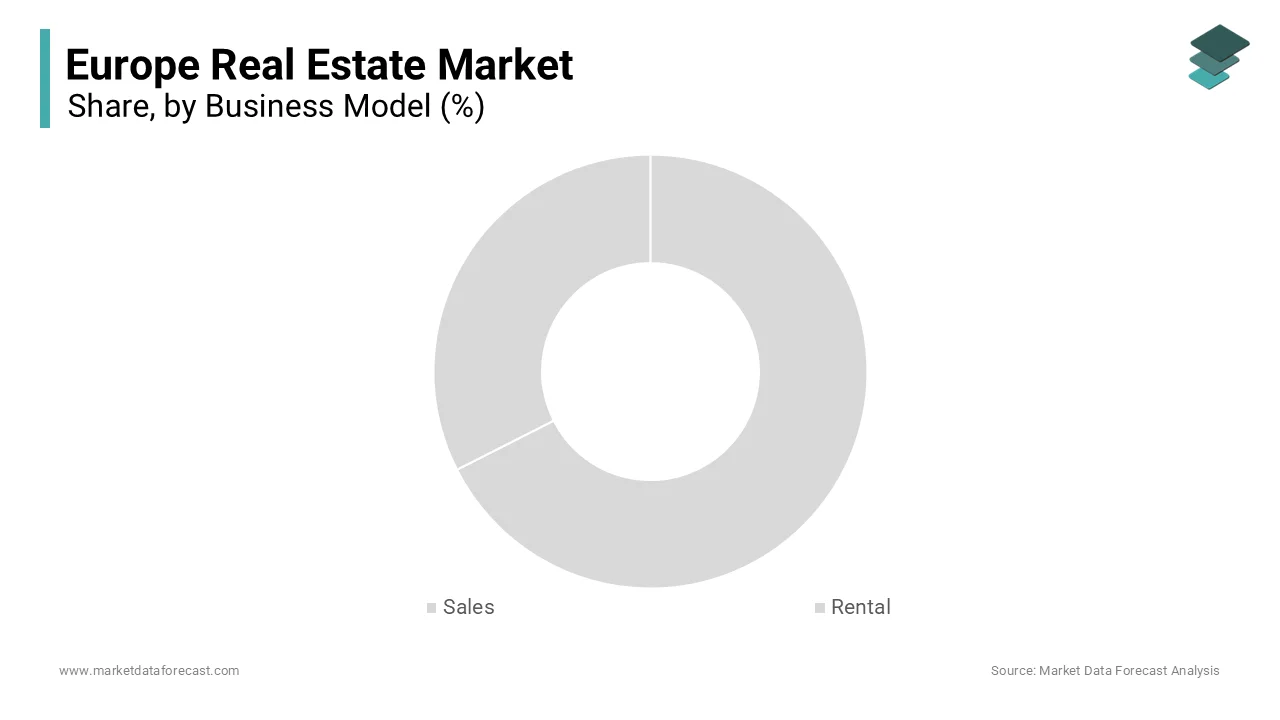
The rental segment is anticipated to witness the fastest CAGR of 7.8% from 2026 to 2034, owing to urbanisation, demographic shifts, and the rise of institutional build-to-rent models. Young professionals and mobile workers increasingly prioritise flexibility over ownership. Institutional investors are responding with large-scale purpose-built rental developments. European build-to-rent investment reached 18.4 billion euros in 202, as per the Urban Land Institute. France’s Loi Pinel+ provides tax incentives for developers who hold properties for nine years by accelerating supply in Lyon and Bordeaux. These structural and policy tailwinds position rental as the fastest-growing segment, particularly in high-demand urban corridors.
By Property Type Insights
The residential real estate segment captured the largest share of the European real estate market. Persistent housing shortages, population growth, and policy emphasis on social stability through shelter access have contributed to the growth of the residential real estate segment. The European housing market continues to experience a significant shortage, particularly in major cities such as Berlin, Paris, and Madrid, according to sources. In Germany, the number of newly completed homes remains below the estimated annual requirement, highlighting the gap between supply and demand, as per research. National initiatives across Europe are also driving greater housing activity. Spain has expanded its public housing programs to improve affordability, while Italy’s tax-based schemes have encouraged homeowners to upgrade and renovate existing properties, according to sources. Homeownership remains culturally central. Even in rental-dominant markets, new construction includes mixed tenure models to satisfy ownership aspirations. This confluence of supply gaps, policy support, and cultural preference ensures residential real estate’s continued dominance.
The commercial real estate segment is likely to experience the fastest CAGR of 6.9% during the forecast period due to the expansion of logistics, data centres, and flexible workspaces amid structural economic shifts. E-commerce growth has driven warehouse demand. The digital economy is also fueling data centre development. Meanwhile, hybrid work models are reshaping office demand toward high-quality flexible spaces. A growing share of corporate tenants in Europe are now prioritising environmentally certified office spaces, as per research. In France, the government continues to invest in large-scale innovation zones that combine workplaces, research facilities, and residential spaces, according to sources. These trends reflect a redefinition of commercial real estate beyond traditional retail and offices toward tech-enabled, sustainable, and adaptive assets.
By End User Insights
The individuals and households segment led the European real estate market by accounting for a substantial share in 2025. The continent’s strong cultural and policy orientation toward residential ownership as a pillar of social stability fuels the growth of the individuals and households segment. According to sources, a portion of EU households owned their homes, with intergenerational property transfer common in countries. National support mechanisms amplify this trend. This deep integration of housing into personal finance and family planning ensures households remain the dominant end user across transaction types and property categories.
The corporate and SME segment is on the rise and is expected to be the fastest-growing segment in the global market by witnessing a CAGR of 8.1% from 2026 to 2034,, owing to digital transformation, supply chain restructuring, and evolving workplace strategiesE-commercece and nearshoring have spurred industrial space demand, with SMEs accounting for a portion of new logistics leases, according to studies. Corporations are also reconfiguring office portfolios toward flexible, sustainable spaces. The European Green Deal further accelerates this shift. Furthermore, the rise of innovation districts integrates SMEs into mixed-use ecosystems with subsidised rents and shared infrastructure. These strategic and regulatory forces position corporates and SMEs as the most dynamic end user segment.
REGIONAL ANALYSIS
Germany Market Analysis
Germany dominated the European real estate market and occupied a 24.6%share in 2025. Its dual tenure model, strong tenant protection, and dominance in sustainable urban development add to the domination of Germany in the regional market. A growing number of Germans are becoming homeowners, a shift supported by government incentives, although renting remains a popular option for a significant portion of the population. The country faces acute housing shortages with a deficit in major cities. Berlin and Munich lead in ESG-certified office development. Industrial real estate is booming due to nearshoring, with logistics take-up in the Rhine Ruhr region growing year on year. Germany’s strict rent control laws and social housing mandates ensure market stability while its Energiewende policy drives building retrofits. This balance of regulation, innovation, and demand sustains Germany’s market dominance.
United Kingdom Market Analysis
The United Kingdom followed closely in the European real estate market, accounting.6% share in 2025. Its mature investment landscape, dynamic private rental sector, a nd post-Brexit regulatory evolution fuel the expansion of the United Kingdom. London remains a global capital magnet.t. The private rented sector houses a large number of households, with institutional build-to-rent portfolios growing annually, as per research. Outside London, cities like Manchester and Birmingham are emerging as logistics and data centres due to lower costs and strong connectivity. The UK’s Future Homes Standard mandates net zero carbon emissions, which accelerates green construction. This blend of global appeal,, al domestic policy, and sectoral diversification secures the UK’s influential position.
France Market Analysis
France is growing steadily in the European real estate market and is propelled by proactive urban planning, a strong social housing mandate, and a cultural emphasis on architectural heritage. The Loi Elan streamlines permitting multi-family housing near transit hubs, while the Loi Pinel+ incentivises long-term rental investments. Paris continues to set the benchmark for sustainable office development, with most top-grade properties adhering to recognised environmental standards, as per research. Through its national investment program, France is promoting the growth of innovation campuses that blend housing, research, and commercial spaces, according to sources. Social housing remains an important part of the country’s residential framework, with ongoing efforts to expand its share in major cities, as per research. In the logistics sector, the growing influence of e-commerce continues to boost demand for warehouses across key regions such as Île-de-France, according to sources. France’s balanced approach to preservation, modernisation, and affordability ensures its continued relevance in the European real estate ecosystem.
Spain Market Analysis
Spain expanded gradually in the European real estate market, with strong tourism-driven demand, robust homeownership culture, and ambitious urban regeneration. The growth of Spain is fueled by both domestic buyers and foreign investors attracted by the Golden Visa program. Coastal regions like Costa del Sol and the Balearics account for a portion of international purchases, according to the source. Madrid and Barcelona are leading office decarbonization. Apart from these, Spain’s high solar irradiance is accelerating net-zero building adoption. These factors position Spain as a dynamic and resilient market.
Italy Market Analysis
Italy is anticipated to grow in the European real estate market during the forecast period, owing to historic urban fabric, strong familial ownership patterns, ns apolicy-drivenven renovation incentives. Milan leads in commercial innovation. Logistics is expanding rapidly in the Po Valley due to e-commerce, with warehouse take-up growing. Southern regions benefit from the National Recovery and Resilience Plan, which allocated funds for urban regeneration and digital infrastructure. Italy’s blend of heritage preservation, economic stimulus, and demographic stability ensures its enduring role in the European real estate landscape.
COMPETITIVE LANDSCAPE
KEY MARKET PLAYERS
Some of the notable key players in the European real estate market include
-
Keller Williams Realty, Inc.
-
Simon Property Group
-
RE/MAX
-
Colliers
-
Coldwell Banker
-
Brookfield Asset Management
-
Prologis
-
CBRE Group Inc. Class A
TOP STRATEGIES USED BY THE KEY MARKET PLAYERS
Key players in the European real estate market prioritise environmental sustainability by retrofitting existing assets to meet EU energy performance standards and constructing new developments with net-zero carbon targets. They are actively diversifying property portfolios toward logistics data centres and mixed-use urban hubs to align with structural economic shifts. Strategic partnerships with municipal governments and technology firms enable smart city integrations and adaptive reuse of obsolete spaces. Companies also adopt flexible leasing models and digital tenant platforms to enhance user experience and occupancy stability. Besides, they leverage green financing instruments such as sustainability-linked bonds to fund large-scale renovation and development programs in compliance with EU taxonomy regulations.
COMPETITION OVERVIEW
The European real estate market features intense competition among large integrated developers, institutional landlords, specialised REITs, and agile local operators. Vonovia Unibail Rodamco Westfield and Segro lead through sc, ale sustainability credentials and strategic asset positioning in high-growth sectors such as residential, logistic, and experiential retail. They compete not only on location and pricing but also on ESG performance, tenant services, and digital innovation. At the same time, private equity firms and sovereign wealth funds exert significant influence on cross-border order acquisitions, particularly in gateway cities like London,n Paris, and Berlin. Regulatory complexity, including rent control, heritage preservation, and energy mandates, creates both barriers and opportunities, favouring players with local expertise and policy fluency. Competition is further intensified by the rise of proptech platforms that disrupt traditional brokerage and property management models. Success increasingly depends on the ability to balance financial returns with social impact, climate resilience, and regulatory compliance across fragmented national markets.
TOP PLAYERS IN THE MARKET
-
Vonovia SE is a leading residential real estate company in Europe with a dominant presence in Germany, Sweden, and Austria. It owns and manages over two million residential units, making it one of the continent’s largest private landlords. The company plays a pivotal role in shaping urban housing policy through its commitment to energy-efficient retrofits and affordable rental models. It also expanded its digital tenant services platform, enhancing user experience and operational efficiency. These initiatives strengthen Vonovia’s contribution to sustainable urban living while setting benchmarks for large-scale residential asset management globally.
-
Unibail Rodamco Westfield is a major force in European commercial real estate, specialising in premium retail destinations and mixed-use urban hubs across France,, he NeNetherland Germany, and Spain. The company is redefining post-pandemic retail by transforming malls into experiential lifestyle centres, integrating leisure dining, entertainment services. It also partnered with local authorities to repurpose underutilised spaces into innovation districts and affordable housing. These actions demonstrate its prominence in adaptive reuse and sustainable placemaking, aligning commercial viability with social and environmental responsibility on a global scale.
-
Segro plc is a key player in the European real estate market with a strategic focus on logistics and industrial properties in high-demand corridors across the United Kingdom and Continental Europe. The company supports the digital economy by developing state-of-the-art distribution centres near major transport gateways. It also introduced flexible lease structures to accommodate SMEs and e-commerce startups. These moves position Segro at the forefront of sustainable industrial real estate and emphasise its role in enabling resilient supply chains across the continent.
MARKET SEGMENTATION
This research report on the European real estate market has been segmented and sub-segmented based on categories.
By Business Model
-
Sales
-
Rental
By Property Type
-
Residential
-
Commercial
By End-User
-
Individuals/Households
-
Corporates & SMEs
-
Others
By Country
-
UK
-
France
-
Spain
-
Germany
-
Italy
-
Russia
-
Sweden
-
Denmark
-
Switzerland
-
Netherlands
-
Turkey
-
Czech Republic
-
Rest of Europe
Frequently Asked Questions
1. What factors are driving the growth of the Europe Real Estate Market?
Rising urbanization, growing commercial infrastructure, and increased foreign investments are key factors driving market growth.
2. What are the main types of real estate properties in Europe?
The market is broadly categorized into residential, commercial, industrial, and retail properties.
3. Which countries are the major real estate markets in Europe?
The United Kingdom, Germany, France, and Spain are among the leading markets due to strong economic performance and investor confidence.
4. What are the emerging trends in the Europe Real Estate Market?
Trends include green buildings, smart homes, flexible workspaces, and increased adoption of proptech solutions.
5. How is sustainability influencing real estate development in Europe?
Developers are focusing on energy-efficient designs, renewable energy integration, and eco-friendly construction materials to meet sustainability goals.
6. What are the major investment opportunities in the Europe Real Estate Market?
Opportunities are emerging in logistics facilities, student housing, co-working spaces, and affordable residential projects.
7. How is the commercial real estate segment performing in Europe?
The commercial segment, especially office and retail spaces, is evolving with hybrid work models and demand for flexible leasing options.
8. What challenges does the Europe Real Estate Market face?
Challenges include rising construction costs, regulatory complexities, and fluctuating interest rates affecting property affordability.
Related Reports
Access the study in MULTIPLE FORMATS
Purchase options starting from
$ 2000
Didn’t find what you’re looking for?
TALK TO OUR ANALYST TEAM
Need something within your budget?
NO WORRIES! WE GOT YOU COVERED!
Call us on: +1 888 702 9696 (U.S Toll Free)
Write to us: sales@marketdataforecast.com