- Product Description Description
- Table of Contents TOC
- List of Table & Figure LOT
- Get Free Sample PDF Sample PDF
Market Size, 2025
$0.43 BnMarket Estimate, 2026
$0.45 BnMarket Forecast, 2034
$0.66 BnCAGR, 2026–2034
4.86%Europe Recycled Metal Market Report Summary
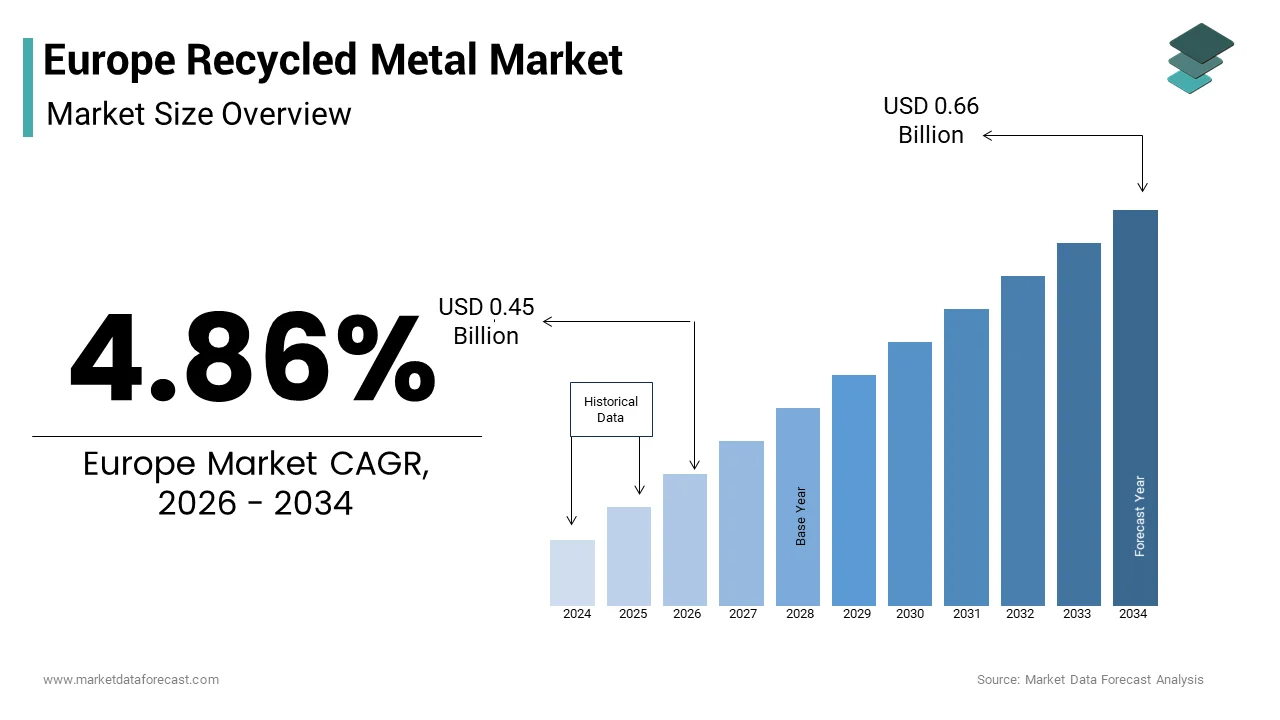
The Europe recycled metal market was valued at USD 0.43 billion in 2025, is estimated to reach USD 0.45 billion in 2026, and is projected to grow to USD 0.66 billion by 2034, expanding at a CAGR of 4.86% during the forecast period from 2026 to 2034. Market growth is primarily driven by Europe’s strong focus on circular economy practices, rising demand for low-carbon raw materials, and stringent EU regulations promoting metal recycling to reduce industrial emissions and dependence on primary metal extraction. Increasing adoption of recycled metals in construction, automotive, aerospace, and manufacturing sectors is further supporting market expansion.
Key Market Trends
Growing preference for recycled metals as a cost-effective and energy-efficient alternative to virgin metals is a major trend shaping the market. Increasing regulatory pressure to reduce carbon footprints in steel and aluminum production is accelerating recycled metal usage. Advancements in scrap collection, sorting, and processing technologies are improving material recovery rates and quality. Rising demand from the automotive and infrastructure sectors is also strengthening long-term market growth across Europe.
Segmental Insights
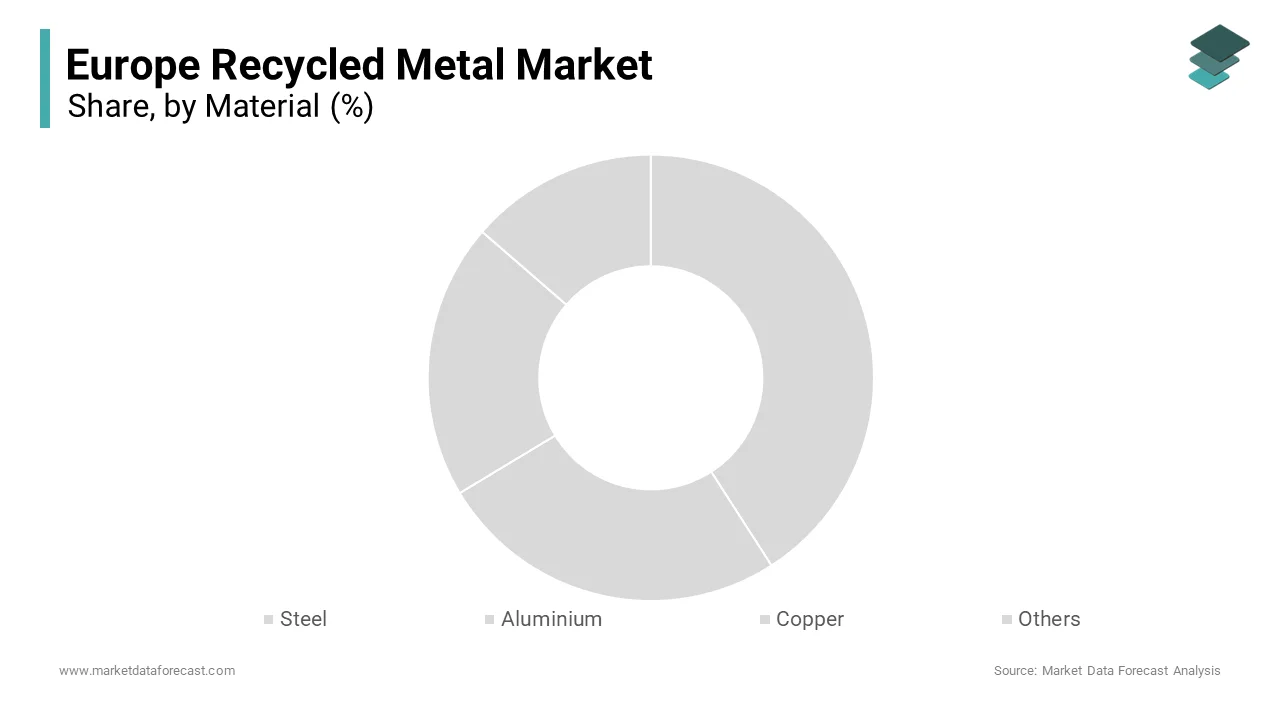
Based on material, the steel segment dominated the Europe recycled metal market by holding 62.1% of the market share in 2025. This dominance is attributed to steel’s high recyclability, widespread availability of scrap, and extensive use in construction, automotive, and industrial manufacturing. Recycled steel significantly reduces energy consumption and CO₂ emissions compared to primary steel production, reinforcing its strong market position.
Country Insights
- Germany was the largest contributor to the Europe recycled metal market in 2025, accounting for 20.3% of the regional share, supported by its strong industrial base and advanced recycling infrastructure.
- France is witnessing growth driven by demand from the automotive and aerospace manufacturing sectors.
- Italy is expected to grow at a notable CAGR due to rising industrial recycling initiatives.
- The United Kingdom is anticipated to record significant growth supported by sustainability targets and construction demand.
- The Netherlands continues steady expansion, benefiting from its strategic role as Europe’s logistics and recycling hub.
Competitive Landscape
The Europe recycled metal market is moderately consolidated, with key players focusing on capacity expansion, advanced recycling technologies, and strategic partnerships to strengthen supply chains and meet sustainability goals. Major companies operating in the market include **Commercial Metals Company (CMC), European Metal Recycling Ltd, Norsk Hydro ASA, GFG Alliance, Novelis, and Tata Steel. These players are emphasizing sustainable metal sourcing, closed-loop recycling models, and alignment with Europe’s decarbonization objectives.
Europe Recycled Metal Market Size
The Europe recycled metal market size was valued at USD 0.43 billion in 2025 and is anticipated to reach a valuation of USD 0.45 billion in 2026 and USD 0.66 billion by 2034, growing at a CAGR of 4.86% from 2026 to 2034.
The recycled metal is the organized collection,n processing, and redistribution of ferrous and non-ferrous metals recovered from end of life vehicles, electronic waste, construction debris,s and industrial scrap. This sector functions as an enabler of the European Union’s circular economy strategy by reducing reliance on primary extraction and lowering industrial carbon footprints. According to Eurostat, waste electrical and electronic equipment wasgenerated across the EU in 2024, containing significant quantities of copper, aluminium,m and rare earth elements. Furthermore, the EU’s End of Life Vehicles Directive mandates a minimum recycling rate by weight for all scrapped automobiles. As per the European Commission, the construction sector alone accounts for over 35% of Europe’s total waste stream,,m with metal recovery from demolition sites rising steadily due to stricter landfill diversion targets. These regulatory and environmental imperatives position recycled metal not merely as a commodity but as a strategic resource for industrial decarbonization and supply chain resilience.
MARKET DRIVERS
Stringent EU Circular Economy Legislation Drives Scrap Utilization
The binding circular economy action plan mandates that all member states achieve a recycling rate of for municipal waste and packaging waste by 2030. The stringent EU circular economy legislation is driving the growth of Europe's recycled metal market. According to the European Commission, this framework explicitly prioritizes high-quality metal recovery through extended producer responsibility schemes and eco-design requirements. In Germany, the Closed Substance Cycle Waste Management Act requires automotive and electronics manufacturers to finance and operate certified take-back systems recovering non-ferrous metals annually, as confirmed by the German Environment Agency. These legal instruments transform compliance into a commercial opportunity, accelerating investment in advanced sorting and refining infrastructure across the region.
Decarbonization Pressures in Steel and Automotive Sectors Boost Demand
Europe’s industrial sectors are under intensifying pressure to reduce Scope One and Scope Two emissions, with recycled metal offering one of the most immediate pathways to carbon mitigation. The decarbonization pressures inthe steel and automotive sectors are gearing up the growth of Europe's recycled metal market. Major automakers,,s including Volvo and B, have committed to using at least recycled steel and aluminum in all new vehicle models by 2025, as per a source. As per the European Automobile Manufacturers Association, over modern cars’ mass is metal, with end-of-life vehicles supplying nearly four million tons of aluminum and steel scrap to European foundries in 2024. Additionally, the EU’s Carbon Border Adjustment Mechanism imposes financial penalties on imports with high embedded emissions, creating a cost advantage for domestically produced recycled metal.
MARKET RESTRAINTS
Contamination in Mixed Metal Streams Reduces Recycling Efficiency
A significant portion of Europe’s metal scrap remains contaminated with plastic,,s resins, oil,,s or hazardous substances that compromise melt quality and increase refining costs. The contamination in mixed metal scrapsreduces recycling efficiency, limiting the growth of Europe's recycled metal market. The revised EU Battery Regulation now requires lithium-ion batteries to be dismantled before metal extraction, but collection facilities across Southern Europe have the necessary robotic disassembly capacity. Contamination also triggers stricter customs controls under the Basel Convention amendments, which classify impure metal shipments as hazardous waste. These quality and compliance barriers fragment the scrap supply chain,n inflate processing expenses, and discourage high-value remanufacturing,g particularly for specialty alloys used in aerospace and medical devices.
Fragmented Collection Infrastructure Across Member States Limits Scale
The absence of a harmonized scrap collection and sorting framework across the European Union results in uneven feedstock availability and inconsistent material quality. The fragmented collection infrastructure across member states is limiting the growth of the Europe recycled metal market. In the automotive sector, over 40% of end of life vehicles in Eastern Europe are processed by informal dismantlers, who recover only high-value components and discard remaining metal as landfill, according to the United Nations University’s Global E Waste Monitor. This fragmentation prevents economies of scale in preprocessing and deters investment in large-scale shredding and eddy current separation plants.
MARKET OPPORTUNITIES
Green Public Procurement Policies Favor Recycled Metal Content
The European Commission’s updated Green Public Procurement now requires that all metal-based infrastructure projects funded by EU budgets contain minimum thresholds of recycled content. The green public procurement policies favor recycled metal content, which, whicht is certain to pose new opportunities for the growth of Europe's recycled metal market. As per the 2023 EU GPP Handbook, steel used in bridges and public buildings must include at least a few recycledmaterialssl, while aluminum components. This policy directly stimulates demand from public works contractors, who were awarded in metal-intensive tenders in 2024, according to the EU Tenders Electronic Daily. Cities like Amsterdam and Copenhagen have gone further, mandating that municipal construction projects use only steel certified under the European Steel Certification Scheme, which verifies recycled content and carbon intensity. These procurement levers create a stable offtakeagreement for recyclers and incentivize traceability systems that document material origin and environmental impact.
Expansion of Urban Mining in E Waste Unlocks Critical Metal Reserves
The growing stock of discarded electronics is a vast above-ground inventory of high-purity copper, gold, and cobalt that can reduce import dependency on geopolitically sensitive regions. The expansion of urban mining in e-waste is expected to elevate the growth ofEurope'se recycled metal market. According to the European Commission, the EU generates over 12 million tons of waste electrical and electronic equipment annually,y containingan worth of recoverable metals. The Urban Mining Platform, launched under Horizon Europe,e has funded pilot projects in Belgium and Finland that use AI-powered robotic arms to disassemble smartphones and recover embedded copper and rare earths. In 2024, Sweden’s Stockholm Royal Seaport became the first district to mandate that all new buildings incorporate wiring made from recycled copper sourced from local e-waste streams, as stated by the Swedish Environmental Protection Agency.
MARKET CHALLENGES
Volatile Global Scrap Price Indexes Disrupt Domestic Pricing Stability
The sensitive to fluctuations in international benchmark indices, such as the London Metal Exchange and Fastmarkets, which are influenced by non-European supply-demand imbalances. The volatile global scrap price index, which disrupts domestic pricing stability, is likely to degrade the growth of Europe's recycled metal market. According to the European Metal Recyclers Association, Europe’s scrap pricing contracts are linked to floating indexes that can swing within a quarter due to shifts in Chinese import policies or US tariff actions. In early 2024, a sudden drop in Turkish rebar demand triggered a decline in European ferrous scrap prices within 6 weeks, destabilizing cash flow for small and medium recyclers, as reported by Eurometaux. This volatility discourages long-term offtake agreements with foundries that prefer fixed price contracts to manage production costs. Additionally, the lack of a pan-European scrap price reference system comparable to Platts or Argus leaves regional players exposed to arbitrage and speculative trading.
Shortage of Skilled Labor in Advanced Sorting and Refining Facilities
The transition toward high-purity metal recovery requires specialized technicians trained in sensor-based sorting spectroscopy and pyrometallurgical refining, to inhibit the growth of the Europe recycled metal market. According to the European Centre for the Development of Vocational Training, EU member states offer certified training programs in advanced metal recycling. In Germany, the Federal Institute for Vocational Education estimates a shortfall of over 8000 skilled operators for AI-driven scrap yards by 2027. This talent deficit slows adoption of technologies like LIBS optical emission spectrometry and eddy current separators that are essential for recovering high-value alloys from complex waste streams.
REPORT COVERAGE
| REPORT METRIC | DETAILS |
| Market Size Available | 2025 to 2034 |
| Base Year | 2025 |
| Forecast Period | 2026 to 2034 |
| CAGR | 4.86% |
| Segments Covered | By Material, And By Country |
| Various Analyses Covered | Global, Regional & Country Level Analysis; Segment-Level Analysis, DROC, PESTLE Analysis, Porter’s Five Forces Analysis, Competitive Landscape, Analyst Overview of Investment Opportunities |
| Regions Covered | UK, France, Spain, Germany, Italy, Russia, Sweden, Denmark, Switzerland, Netherlands, Turkey, Czech Republic, & Rest of Europe |
| Market Leaders Profiled | CMC, European Metal Recycling Ltd, Norsk Hydro ASA, GFG Alliances, Novelis, Tata Steel |
SEGMENTAL ANALYSIS
By Material Insights
The steel segment was the largest by holding 62.1% of the Europe recycled metal market share in 2025, eanchored in steel’s infinite recyclability without loss of quality and its ubiquitous presence in end-of-life vehicles, construction debris, and industrial machinery. In 2025, the EU recycled over 95 million metric tons of steel more than all other recycled metals combined due to well-established collection networks and regulatory mandates, such as the End of Life Vehicles Directive, ve which enforces a minimum recycling rate. Furthermore, steel’s role in green infrastructure, including wind turbine towers and EV charging stations, amplifies demand folow-carbonon recycled content. The EU Emissions Trading System also indirectly favors scrap-based production by pricing carbon allowances that make virgin steel significantly more expensive.
The aluminum segment is anticipated to witness the fastest CAGR of 8.7% throughout the forecast period, due to its role in lightweighting transportation and packaging to meet EU climate targets. According to the European Aluminium Association, recycling aluminum saves the energy required for primary production and avoids twelve tons of carbon dioxide per ton of metal. Additionally, the EU Packaging and Packaging Waste Regulation requires that all aluminum packaging contain recycled content by 2030. These regulatory and industrial imperatives transform aluminum scrap from waste into a strategic decarbonization enabler.
COUNTRY ANALYSIS
Germany Recycled Metal Market Analysis
Germany was the largest contributor to the Europe recycled metal market by capturing 20.3% of the share in 2025 from a mature circular economy framework, industrial ddensityy and stringent waste legislation. The country recycles over 22 million metric tons of metal annually, ly with over 90% of end-of-life vehicles processed through certified dismantling centers. Germany’s Closed Substance Cycle Act mandates producer responsibility formetal-containingg goods, ensuring a consistent scrap supply. Additionally, Germany hosts major secondary aluminum smelters, such as Trimet and Hydro, that serve automotive giants like BMW and Mercedes. These systemic advantages position Germany as Europe’s premier hub for high-quality recycled metal production and innovation.
France Recycled Metal Market Analysis
France'se recycled metal market growth is likely tobe driven by the robust automotive and aerospace manufacturing demand. According to France’s Ministry of Ecological Transition, the country recycled metal in 202,4 with aluminum scrap from aircraft and beverage cans growing at double-digit rates. The Anti-Waste for a Circular Economy Law bans landfilling of all metal waste from 2025 and requires manufacturers to declare recycled content in product environmental passports. Major players like Constellium operate advanced recycling hubs in Normandy that supply low-carbon aluminum to Airbus and Renault with verified carbon footprints below four tons of CO2 per ton of metal.
Italy Recycled Metal Market Analysis
Italy's recycled metal market growth is anticipated to grow with a significant CAGR during the forecast period by a dense network of small and medium metal recyclers, particularly in the Emilia Romagna and Lombardy regions, where enterprises process non-ferrous scrap. Additionally, Italy’s shipbreaking industry in Genoa and Naples supplies significant volumes of steel and aluminum from decommissioned vessels. The Ministry of Enterprises mandates that public infrastructure projects use only steel with certified recycled content w, which further stimulates domestic demand.
United Kingdom Recycled Metal Market Analysis
The United KKingdom'srecycled metal market growth is anticipated to witness aignificant growth in the coming years. As per the source, 95% of structural steel from demolition is recovered due to deconstruction best practices. The government’s Net Zero Strategy prioritizes secondary aluminum for EV battery enclosures with incentives for closed-loop partnerships between Jaguar, Land Rover, and Novelis. Additionally, the UK hosts Europe’s largest copper rod mill in Wrexham, which uses one recycled feedstock. These industrial linkages and fiscal instruments ensure the UK remains a significant and efficient player in the European recycled metal landscape.
Netherlands Recycled Metal Market Analysis
The Netherlands recycled metal market is growing steadily, with the strategic position as Europe’s logistics gateway enabling it to aggregate and process metal scrap from across the continent. The Port of Rotterdam alone handles imported and exported non-ferrous scrap annually. The Dutch Circular Economy Programme mandates that all metal processing facilities implement real-time material flow tracking to ensure compliance with EU purity standards. Companies like Apera and Tata Steel, IJmuiden operate integrated recycling loops where end-of-life material is remelted within hours of arrival. The government’s Green Deal with Metal Recycling provides subsidies for hydrogen-powered smelting, which could further reduce carbon intensity.
COMPETITIVE LANDSCAPE
Competition in the Europe recycled metal market is defined by vertical integration, technological capability, type ty and regulatory compliance rather than price alone. The market features a mix of global industrial giants like ArcelorMittal and specialized recyclers such as Aurubis, each competing on certified low-carbon output and material traceability. Differentiation increasingly hinges on the ability to supply high-purity recycled content with verified environmental credentials to meet corporate and public procurement mandates. Mid-sized players focus on niche streams like e-waste or aerospace alloys, where technical expertise commands premium margins. The EU’s Carbon Border Adjustment Mechanism and Ecodesign for Sustainable Products Regulation raise the compliance bar,r favoring established players with robust monitoring systems. At the same time, the fragmented collection infrastructure in Southern and Eastern Europe creates regional arbitrage opportunities.
KEY MARKET PLAYERS
A few of the market players in the Europe recycled metal market are
- CMC
- Aurubis AG
- ArcelorMittal
- Hydro Extrusion
- European Metal Recycling Ltd.
- Norsk Hydro ASA
- GFG Alliances
- Novelis
- Tata Steel
Top Players In The Market
- Aurubis AG is a leading European copper recycler headquartered in Germany with significant global operations spanning North America and Asia. The company processes over one million tons of metal-bearing recycling materials annually, converting complex scrap streams into high-purity copper and precious metals. Aurubis supplies refined copper cathodes and rods to European automotive and electronics manufacturers requiring certified low carbon content. In recent actions, the company expanded its Hamburg recycling hub with a new sensor-based sorting line capable of processing mixed electronic waste at fifty tons per hour. It also launched the “CircuMet” certification program to trace recycled content and carbon footprint across its value chain. These initiatives reinforce Aurubis’s role as a sustainability enabler in global circular supply chains while strengthening its compliance with EU green procurement standards.
- Hydro Extrusia, a Norway-based aluminum producer, operates one of the world’s largest recycled aluminum portfolios with major facilities across GeGermanyan ce, nd Italy. The company supplies low-carbon extruded aluminum to European construction, transport,t and renewable energy sectors using scrap from end of life vehicles and building materials. Hydro’s CIRCAL series contains at least seventy five% post consumer recycled aluminum with verified carbon emissions below four kilograms CO2 per kilogram of metal. Hydro commissioned a new recycling plant in Grevenbroich,h Germany, co-located with a solar park to power melting operations with renewable electricity. It also partnered with BMW to close the loop on automotive aluminum scrap. These actions position Hydro as a pioneer in clean industrial metals aligned with Europe’s decarbonization trajectory.
- ArcelorMittal is a global steel leader with deep integration in Europe’s recycled metal ecosystem through its extensive electric arc furnace network. The company uses nearly twelve million tons of scrap annually across its European mills to produce high-grade steel for automotive infrastructure and packaging. Recent developments include the conversion of its Ghent,t Belgium, facility to a hybrid direct reduced iron and scrap model and the launch of certified recycled steel coils for wind turbine towers.
Top Strategies Used By the Key Market Participants
Key players in the Europe recycled metal market pursue integrated strategies centered on decarbonization, digital traceability,ity, and circular partnerships. They invest in advanced sorting and refining technologies such asAI-enabledd optical sorters and hydrogen-based melting to enhance purity and reduce emissions. Companies establish closed-loop agreements with automotive and electronics brands to securehigh-qualityy scrap feedstock. They also develop environmental product declarations and digital material passports to comply with EU sustainability regulations. Geographic expansion through the co-location of recycling and remelting facilities minimizes transport emissions and energy loss. Additionally, firms actively participate in EU-funded circular economy initiatives to shape standards andaccess green financireinforcing their position as strategic enablers of industrial sustainability.
MARKET SEGMENTATION
This research report on the Europe recycled metal market is segmented into the following categories.
By Material
- Steel
- Aluminium
- Copper
- Others
By Country
- UK
- France
- Spain
- Germany
- Italy
- Russia
- Sweden
- Denmark
- Switzerland
- Netherlands
- Turkey
- Czech Republic
- Rest of Europe