- Product Description Description
- Table of Contents TOC
- List of Table & Figure LOT
- Get Free Sample PDF Sample PDF
Market Size, 2025
$74.88 BnMarket Estimate, 2026
$80.26 BnMarket Forecast, 2034
$139.76 BnCAGR, 2026–2034
7.18%Europe Refrigerators Market Report Summary
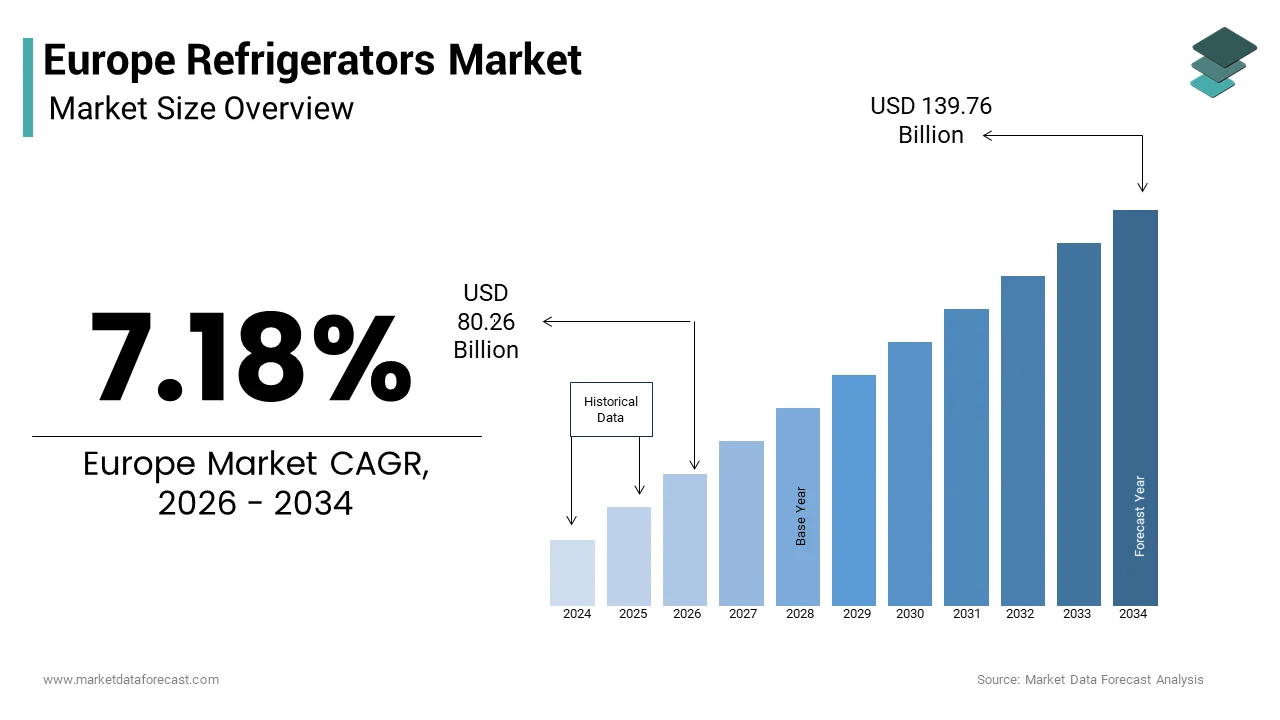
The Europe refrigerators market was valued at USD 74.88 billion in 2025 and is projected to grow from USD 80.26 billion in 2026 to USD 139.76 billion by 2034, expanding at a CAGR of 7.18% during the forecast period (2026–2034).
Market growth is driven by rising demand for energy-efficient appliances, increasing adoption of smart home technologies, and growing replacement sales across developed European economies. Changing consumer lifestyles, urbanization, and the expansion of modular kitchens are further supporting the demand for advanced refrigerator models. Additionally, stricter EU energy efficiency regulations and sustainability initiatives are encouraging manufacturers to introduce eco-friendly and technologically advanced refrigeration solutions.
The increasing popularity of multi-door, frost-free, and smart-connected refrigerators is reshaping purchasing behavior across residential and commercial sectors in Europe.
Key Market Trends
- Growing adoption of energy-efficient and eco-friendly refrigerators is aligned with EU sustainability standards.
- Rising demand for smart refrigerators with IoT connectivity, touch displays, and AI-powered temperature control.
- Increasing consumer preference for multi-door and large-capacity refrigerators due to changing household structures.
- Expansion of organized retail and e-commerce platforms is boosting product accessibility.
- Technological advancements in inverter compressors and cooling efficiency.
Segmental Insights
- By Product: The top freezer refrigerator segment dominated the Europe refrigerators market, accounting for 47.4% of the regional market share in 2025. Its leadership is attributed to affordability, energy efficiency, and suitability for small to mid-sized households, making it a preferred choice among price-sensitive consumers.
- By Distribution Channel: The offline segment commanded the largest share of 71.6% in 2025. Physical retail stores, specialty appliance outlets, and hypermarkets continue to dominate due to the importance of in-store product comparison, installation services, and after-sales support. However, online channels are gradually gaining momentum due to convenience and competitive pricing.
Regional Insights
- Germany emerged as the largest and most technologically advanced market in Europe, holding 20.6% of the regional market share in 2025. The country’s strong consumer purchasing power, advanced manufacturing base, and early adoption of energy-efficient appliances contribute to its dominance.
- The United Kingdom accounted for the second-largest share of the European refrigerators market in 2025, supported by strong retail networks and rising smart appliance adoption.
- France is expected to maintain a prominent market share during the forecast period due to increasing demand for premium and eco-friendly refrigeration products.
- Italy is projected to witness a healthy CAGR, driven by the modernization of residential infrastructure and growing consumer interest in energy-saving appliances.
- Spain is anticipated to hold a notable share of the market, supported by expanding housing projects and improving household income levels.
Competitive Landscape
The Europe refrigerators market is highly competitive, characterized by the presence of global appliance manufacturers focusing on innovation, energy efficiency, and smart connectivity. Companies are investing in R&D to develop advanced cooling technologies, inverter-based compressors, and AI-enabled smart refrigeration systems. Strategic partnerships, product launches, and sustainability-driven product portfolios are key competitive strategies in the region.
Leading players operating in the European refrigerators market include Haier Inc., LG Electronics Inc., Samsung, Whirlpool Corporation, Voltas Limited, Electrolux AB, Panasonic Holdings Corporation, Sharp Corporation, Hitachi, Ltd., and Toshiba Corporation.
Europe Refrigerators Market Size
The Europe refrigerators market size was valued at USD 74.88 billion in 2025 and is anticipated to reach USD 80.26 billion in 2026 to USD 139.76 billion in 2034, growing at a CAGR of 7.18% during the forecast period from 2026 to 2034.
Current Introduction and Definition of the Europe Refrigerators Market
Refrigerators represent a mature yet dynamic segment of the home appliances industry that is defined by a continuous evolution toward energy efficiency, advanced food preservation technologies, and integrated smart features. A refrigerator in the European context is no longer merely a cooling appliance but a sophisticated system designed to minimize food waste, reduce environmental impact, and seamlessly integrate into modern kitchen ecosystems. This market operates within a regulatory framework that is among the world’s most stringent, with the European Union setting ambitious benchmarks for energy consumption and the use of environmentally friendly refrigerants. A critical non-market statistic underpinning this sector is the scale of household food waste. As per the European Commission’s Joint Research Centre, food waste at the household level in the EU is a significant issue each year. This has elevated the role of the refrigerator from a simple storage unit to a key tool in sustainable living, which is driving demand for models equipped with precision temperature zones, humidity control, and ethylene filtration systems that actively extend the shelf life of perishables.
MARKET DRIVERS
Stringent EU Energy Efficiency and Environmental Regulations Drive Product Innovation
The comprehensive and progressively tightening regulatory landscape established by the European Union is majorly driving the growth of the Europe refrigerators market. The Ecodesign Directive and the EU Energy Label have systematically raised the bar for energy performance, effectively phasing out inefficient models and compelling manufacturers to innovate. The latest energy label, reintroduced in 2021, uses a simplified A to G scale where initially no products were allowed to hold an A rating, creating a clear pathway for future efficiency gains. As per the European Environment Agency, residential appliances account for a notable portion of household electricity use, and refrigerators, being always-on devices, are a primary target for savings. The regulations also mandate the use of natural refrigerants with low global warming potential, such as R600a, which has become the standard across Europe. This top-down approach shapes product design and provides consumers with a clear, trustworthy metric for making sustainable purchasing decisions.
Rising Consumer Awareness of Food Waste and Demand for Advanced Preservation Features
Beyond regulatory compliance, a profound shift in consumer behavior is fuelling demand for sophisticated refrigerator technologies and further boosting the regional market expansion. European households are increasingly conscious of their environmental footprint and the economic cost of food spoilage. This awareness has transformed the refrigerator from a passive appliance into an active participant in food management. Consumers now seek models with specialized compartments that offer precise control over temperature and humidity to cater to different food types, such as crisper drawers for leafy greens, dedicated meat zones, and zero-degree freshness compartments. As per a leading European consumer research institute, a majority of respondents in Western Europe consider advanced food preservation features a critical factor when purchasing a new refrigerator. This demand is further amplified by the trend of less frequent but larger grocery shopping trips, which necessitates appliances capable of keeping a wide variety of foods fresh for extended periods.
MARKET RESTRAINTS
High Initial Purchase Price of Premium Models Limits Mass Market Adoption
A significant restraint on the market’s growth, particularly for cutting-edge models, is the substantial upfront cost associated with premium refrigerators featuring advanced preservation, connectivity, and built-in designs. While these appliances offer long-term savings through lower energy bills and reduced food waste, their initial price tag can be two to three times higher than that of a basic model. This financial barrier is especially pronounced in Southern and Eastern European countries where average household disposable income is lower. For many consumers, the payback period, though favorable, extends beyond their immediate budgeting horizon. Consequently, a large segment of the market remains confined to entry-level or mid-tier products, slowing the overall penetration rate of the most innovative and sustainable technologies.
Complexity of Installation and Space Constraints in Older European Housing Stock
The physical characteristics of Europe’s residential architecture present a persistent challenge to the adoption of modern and larger-capacity refrigerators, which is further hindering the refrigerators market growth in Europe. A vast proportion of the housing stock, particularly in historic city centers of countries like Italy, France, and Spain, consists of older buildings with narrow doorways, tight stairwells, and small kitchens. These spatial constraints make the installation of contemporary side-by-side or American-style refrigerators logistically difficult and often impossible without costly structural modifications. As per Eurostat, a significant share of the EU’s residential buildings were constructed before 1970, predating modern kitchen design standards. This legacy infrastructure forces many consumers to choose smaller, less feature-rich models that fit their existing space, regardless of their desire for advanced functionality. This physical limitation acts as a brake on the market’s ability to fully transition to larger, more efficient, and feature-laden appliances.
MARKET OPPORTUNITIES
Integration of Smart Home Ecosystems and AI Driven Food Management
A major opportunity for the Europe refrigerators market lies in the deep integration of appliances into the expanding smart home ecosystem. Modern European consumers are increasingly adopting connected home platforms, creating a demand for refrigerators that can do more than just cool. The next frontier is AI driven food management, where refrigerators use internal cameras and image recognition software to track inventory, suggest recipes based on available ingredients, and automatically add items to a shopping list. This technology directly addresses the issue of food waste by providing real-time visibility into what is inside the appliance. Companies that can successfully partner with popular European smart home platforms and deliver a seamless, privacy-conscious user experience will unlock a high-value segment willing to pay a premium for convenience and sustainability.
Growth of Built-In and Fully Integrated Kitchen Appliance Design Trends
The strong cultural preference in many European countries, particularly in Germany, Scandinavia, and the Benelux region, for sleek, minimalist, and fully integrated kitchen designs presents a significant opportunity. In this aesthetic, the refrigerator is concealed behind cabinetry panels, becoming an invisible part of the kitchen architecture rather than a standalone object. This trend drives demand for high-end built-in refrigerator columns that offer superior performance and customization while maintaining a seamless visual profile. The market for these integrated solutions is growing as consumers invest in kitchen renovations that prioritize both form and function. Manufacturers who can offer a wide range of customizable panel-ready models with advanced features like dual compressors for independent temperature control in fridge and freezer columns are well positioned to capture this premium segment.
MARKET CHALLENGES
Intense Competition from Private Label and Value Brands
One of the most pressing challenges facing established refrigerator brands in Europe is the relentless competition from private label offerings by major retail chains and low-cost value brands, primarily from Asia. Large retailers have developed their own appliance lines that offer basic functionality at highly competitive prices, capturing a significant share of the entry-level market. This price pressure forces major brands to either compete on cost, which erodes margins, or retreat further into the premium segment. The result is a market that is increasingly polarized, with innovation concentrated at the high end while the volume middle ground is squeezed. This dynamic makes it difficult for mid-tier brands to sustain profitability and invest in the R&D needed to meet future regulatory standards.
Evolving and Complex Regulatory Landscape for Refrigerants and Materials
The Europe refrigerators market faces a continuous and complex challenge in navigating the EU’s evolving environmental regulations, particularly concerning refrigerants and the use of materials. While the shift to natural refrigerants like R600a is now standard, future regulations may impose stricter limits on flammability or push for new alternatives. Simultaneously, directives such as REACH and RoHS place stringent controls on the chemical composition of all components, from insulation foam to interior plastics. Complying with these overlapping and frequently updated regulations requires significant investment in R&D, testing, and supply chain management. For manufacturers, this creates a constant state of adaptation, where a product compliant today may need redesign tomorrow. This regulatory uncertainty increases time to market, raises development costs, and poses a significant barrier to entry for smaller players, ultimately concentrating the market among a few large corporations with the resources to manage compliance.
REPORT COVERAGE
| REPORT METRIC | DETAILS |
| Market Size Available | 2025 to 2034 |
| Base Year | 2025 |
| Forecast Period | 2026 to 2034 |
| CAGR | 7.18% |
| Segments Covered | By, Product, Distributional Channel, and By Country |
| Various Analyses Covered | Global, Regional & Country Level Analysis, Segment-Level Analysis, DROC, PESTLE Analysis, Porter’s Five Forces Analysis, Competitive Landscape, Analyst Overview on Investment Opportunities |
| Regions Covered | UK, France, Spain, Germany, Italy, Russia, Sweden, Denmark, Switzerland, Netherlands, Turkey, the Czech Republic, and the Rest of Europe |
| Market Leaders Profiled | Haier Inc. (China), LG Electronics Inc. (South Korea), Samsung (South Korea), Whirlpool Corporation (U.S.), Voltas Limited (India), Electrolux AB (Sweden), Panasonic Holdings Corporation (Japan), Sharp Corporation (Japan), Hitachi, Ltd. (Japan), Toshiba Corporation (Japan) |
SEGMENTAL ANALYSIS
By Product Insights
The top freezer refrigerator segment held the dominant share of 47.4% of the regional market in 2025. The dominance of top freezer segment in the European market is driven by its alignment with the economic realities and spatial constraints of a large portion of the European consumer base. A primary driver of this dominance is the segment’s combination of affordability, energy efficiency, and compact footprint. Top freezer models are the most cost-effective to manufacture and purchase, making them the default choice for budget-conscious households, students, and secondary kitchens. Their simple mechanical design also translates to lower energy consumption and easier maintenance. As per a consumer appliance survey by a leading European retail analytics firm, a majority of first-time refrigerator buyers in countries such as Spain and Poland selected a top freezer model due to its low entry price and proven reliability. Furthermore, their narrower width makes them ideal for fitting into the smaller kitchens that are common in Europe’s older urban housing stock.
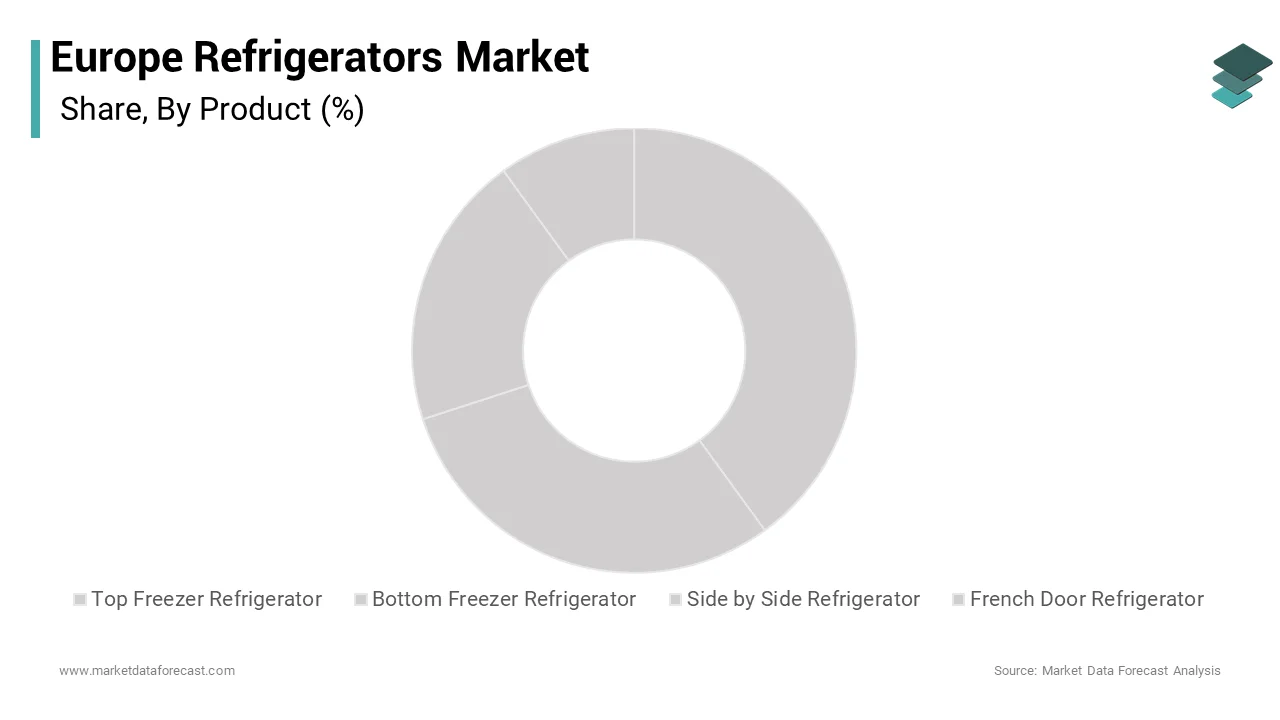
The French door segment is expected to exhibit a CAGR of 10.2% over the forecast period owing to the growing demand for premium kitchen appliances among affluent urban consumers in Western and Northern Europe. A key factor is the superior ergonomics and food preservation capabilities offered by the French door design. By placing the wide, accessible refrigerator compartment at eye level and the freezer drawers below, it eliminates the need to bend for frequently used items. Moreover, these models often come equipped with advanced features like dual compressors, precise humidity-controlled crisper drawers, and water dispensers. As per the same institute, the share of high-end kitchen renovations featuring integrated French door refrigerators has increased significantly since 2020, driven by a cultural shift towards viewing the kitchen as the central hub of the home.
By Distribution Channel
The offline segment commanded for the major share of 71.6% of the regional market in 2025. The growth of the offline segment in the European market can be credited to the high-value, complex nature of the purchase and the importance of physical inspection and professional installation. Refrigerators are large, expensive, and long-lasting purchases where factors like build quality, internal layout, noise level, and door swing mechanics are difficult to assess online. Physical retail stores, from large electronics chains to specialized kitchen showrooms, provide a tactile environment where consumers can open doors, test drawers, and visualize the appliance in their space. Furthermore, offline retailers offer immediate expert advice and bundled services such as old appliance removal and professional installation, which are essential for built-in or large-capacity models.
Conversely, the online segment is the fastest growing and is anticipated to register a CAGR of 13.3% over the forecast period owing to the increasing consumer comfort with purchasing high-value goods digitally, coupled with the evolution of e-commerce platforms. A major catalyst is the development of sophisticated online tools that mitigate the drawbacks of buying large appliances online. Leading retailers now offer augmented reality apps that allow customers to virtually place a refrigerator in their kitchen, detailed 360-degree product views, comprehensive comparison matrices, and transparent delivery and installation scheduling. Additionally, the convenience of home delivery and competitive online pricing, especially for standard freestanding models, is attracting a younger, tech-savvy demographic. Data from the association shows that online sales of major appliances grew significantly year on year in 2023, a trend expected to continue as logistics networks improve and consumer confidence solidifies.
COUNTRY-LEVEL ANALYSIS
Germany Refrigerators Market Analysis
Germany stood as the largest and most technologically advanced market for refrigerators in Europe by holding 20.6% of the regional market share. Its position is fortified by a strong economy, high consumer spending power, and a deep cultural emphasis on engineering quality and energy efficiency. German consumers are early adopters of premium features, with a strong preference for fully integrated, panel-ready refrigerators that blend into minimalist kitchen designs. As per the German Energy Agency, a majority of new refrigerators sold in 2023 carried an energy efficiency rating of B or better on the EU scale. This focus on sustainability, combined with a robust housing renovation sector, drives consistent demand for high-end, innovative models.
United Kingdom Refrigerators Market Analysis
The United Kingdom accounted for the second largest share of the European market in 2025. The UK market is defined by a blend of a strong housing market, a culture of home improvement, and growing interest in smart home technology. UK consumers increasingly seek refrigerators that offer intelligent food management alongside cooling. The market features a mix of freestanding and built-in models, with notable demand for American-style side-by-side and French door units in larger suburban homes. As per the UK’s Office for National Statistics, a high proportion of adults made online purchases in 2023, extending to major appliances. This digital readiness accelerates adoption of new models and features, positioning the UK as a testing ground for innovative products before wider European rollout.
France Refrigerators Market Analysis
France is estimated to account for a prominent share of the Europe refrigerators market over the forecast period owing to a large population, a tradition of culinary excellence, and government incentives for energy-efficient home upgrades. French consumers place high value on food freshness and organization, driving demand for refrigerators with multiple temperature zones and specialized compartments. The “MaPrimeRénov” subsidy program provides financial support for energy-saving home renovations, including appliance replacement. As per the French Environment and Energy Management Agency, this program has supported the replacement of hundreds of thousands of household appliances annually, creating a stable demand stream that benefits both domestic and international manufacturers.
Italy Refrigerators Market Analysis
Italy is expected to witness a healthy CAGR in the European refrigerators market during the forecast period. Its market dynamics are influenced by strong design heritage and a large stock of older urban apartments with spatial limitations. While premium built-in refrigerators are in demand for new constructions and high-end renovations, compact and stylish freestanding models dominate the broader market. Italian consumers are known for brand loyalty and appreciation of craftsmanship, benefiting both local and international brands. As per Eurostat, Italy has among the highest electricity prices in the EU, making energy efficiency a primary purchase criterion and driving steady replacement of older units.
Spain Refrigerators Market Analysis
Spain is anticipated to hold a notable share of the European market over the forecast period. Factors such as a recovering economy, a strong tourism-driven rental market, and a cultural shift toward modern kitchen aesthetics are contributing to the Spanish market growth. The market shows high demand for value-oriented appliances, with top freezer and bottom freezer models popular in primary residences. However, premium French door and side-by-side models are rapidly growing in vacation rental and new construction sectors. As per Spain’s National Statistics Institute, the country has one of the highest rates of second home ownership in Europe, creating a substantial market for secondary refrigerators that cater to transient and experience-seeking clientele.
COMPETITIVE LANDSCAPE
The competitive environment in the Europe refrigerators market is characterized by a clear hierarchy dominated by a few global giants who leverage their brand strength, technological prowess, and extensive distribution networks. The rivalry is intense but largely bifurcated between the premium segment, where competition is based on innovation, design, and food care performance, and the value segment, where price and basic reliability are the primary factors. European champions like BSH and Electrolux hold a strong advantage in the built in and high-end markets due to their deep understanding of local kitchen culture and renovation trends. Meanwhile, global players like Whirlpool compete across the entire spectrum. The market faces pressure from private label brands in the entry level segment, but the complexity of meeting EU regulations and the importance of brand trust in a high consideration purchase create a relatively high barrier to entry, consolidating power among the established leaders.
KEY MARKET PLAYERS
A prominent player that are dominated the Europe refrigerators market
- Haier Inc. (China)
- LG Electronics Inc. (South Korea)
- BSH Hausgeräte GmbH
- Samsung (South Korea)
- Whirlpool Corporation (U.S.)
- Voltas Limited (India)
- Electrolux AB (Sweden)
- Panasonic Holdings Corporation (Japan)
- Sharp Corporation (Japan)
- Hitachi, Ltd. (Japan)
- Toshiba Corporation (Japan)
Top Players In The Market
- Whirlpool Corporation is a global leader in home appliances with a deeply entrenched presence across the European refrigerators market. The company’s portfolio spans from value-oriented freestanding models under its Whirlpool brand to premium built in solutions under its KitchenAid and Bauknecht labels. Whirlpool’s contribution to the global market is its scale and its focus on core cooling technologies that prioritize energy efficiency and food preservation. To strengthen its European position, the company has heavily invested in localizing its product development to meet specific regional preferences, such as compact dimensions for urban apartments and advanced crisper systems for fresh food markets. It has also expanded its manufacturing footprint within the EU to ensure supply chain resilience and faster response to market demands.
- Electrolux Group, headquartered in Sweden, is a major European champion in the premium appliance segment, renowned for its design led and technologically advanced refrigerators sold under the Electrolux and AEG brands. The company’s global contribution lies in its innovation in food care, particularly its TasteLock and Freshness Control systems that extend produce shelf life. In Europe, Electrolux leverages its strong heritage and deep understanding of European kitchen culture to offer fully integrated and panel ready refrigerators that cater to the high-end renovation market. Its recent actions include a strategic focus on sustainability, launching refrigerators with next generation natural refrigerants and recyclable materials to align with the EU’s Green Deal and appeal to environmentally conscious consumers.
- BSH Hausgeräte, the German manufacturer behind the Bosch and Siemens brands, is a powerhouse in the European built in appliance market. The company is synonymous with engineering precision, reliability, and seamless integration into modern kitchen cabinetry. BSH’s global contribution is its leadership in developing intelligent home appliances, including its Home Connect ecosystem that allows users to manage their refrigerator remotely. To fortify its European stronghold, BSH has intensified its investment in smart food management features, such as internal cameras and AI driven inventory tracking. The company also continues to expand its network of brand stores and premium retail partnerships to provide an immersive customer experience that showcases the full potential of its high-end integrated refrigeration solutions.
Top Strategies Used by the Key Market Participants
Key players in the Europe refrigerators market are primarily focused on differentiating their offerings through advanced food preservation technologies and seamless integration into smart home ecosystems. They invest heavily in research and development to create innovative features like humidity-controlled compartments and ethylene filters that directly address consumer concerns about food waste. A core strategy involves tailoring product portfolios to specific national preferences, offering compact models for Southern Europe and premium built in solutions for Northern Europe. Companies also prioritize compliance with the EU’s stringent energy and environmental regulations as a key selling point. Furthermore, they are strengthening their direct-to-consumer channels and premium retail partnerships to enhance brand experience and capture value in the high-end segment.
MARKET SEGMENTATION
This research report on the Europe refrigerators market is segmented and sub-segmented into the following categories.
By Product Type
- Top Freezer Refrigerator
- Bottom Freezer Refrigerator
- Side by Side Refrigerator
- French Door Refrigerator
By Distribution Channel
- Online
- Offline
By Country
- UK
- France
- Spain
- Germany
- Italy
- Russia
- Sweden
- Denmark
- Switzerland
- Netherlands
- Turkey
- Czech Republic
- Rest of Europe