Europe Restaurant Equipment Market Size, Share, Trends & Growth Forecast Report By Equipment Type, By Application, and By Country (Germany, France, Italy, United Kingdom, Spain & Rest of Europe) – Industry Analysis and Forecast, 2026 to 2034
Market Size, 2025
$1.26 BnMarket Estimate, 2026
$1.34 BnMarket Forecast, 2034
$2.25 BnCAGR, 2026–2034
6.67%Europe Restaurant Equipment Market Summary
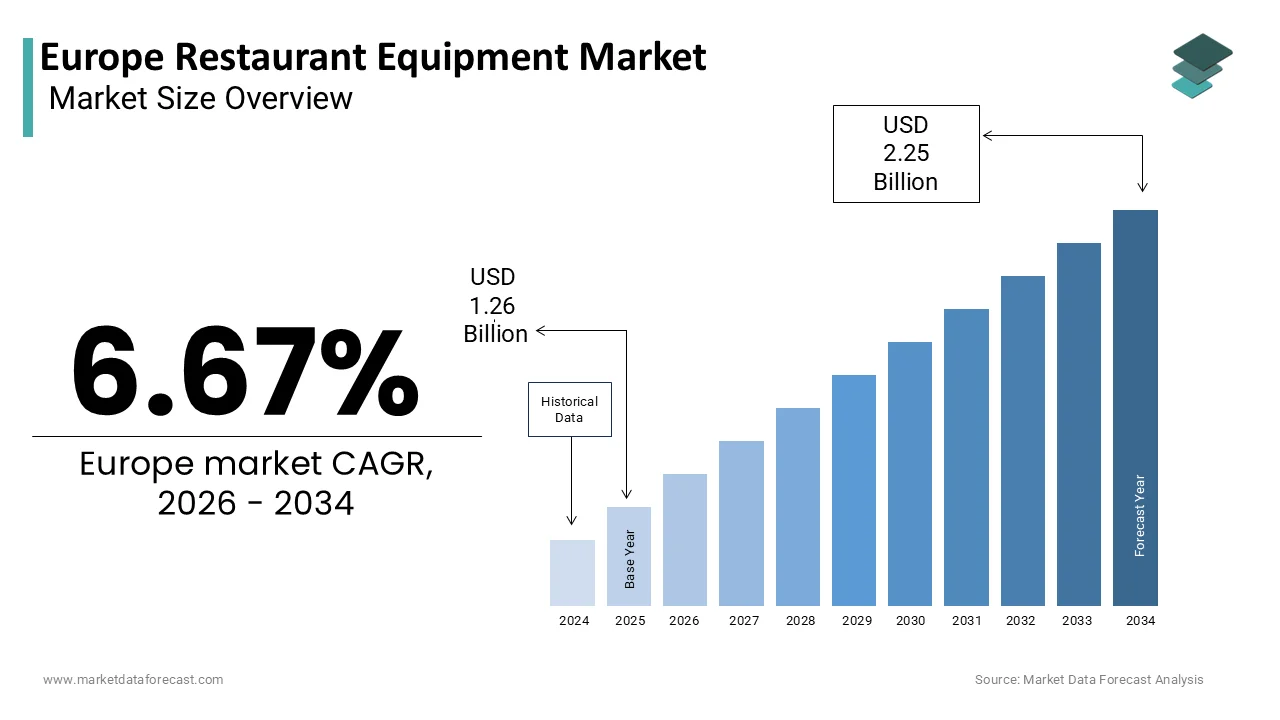
The Europe restaurant equipment market was valued at USD 1.26 billion in 2025, is estimated to reach USD 1.34 billion in 2026, and is projected to reach USD 2.25 billion by 2034, growing at a CAGR of 6.67% from 2026 to 2034.
Key Market Players
- 2025 Market Size: USD 1.26 Billion
- 2034 Forecast: USD 2.25 Billion
- CAGR (2026–2034): 6.67%
- Largest Equipment Segment: Cooking Equipment (37.7%)
- Fastest Growing Equipment Segment: Food Preparation Equipment (7.17% CAGR)
- Largest Application: Hotels (29.1%)
- Fastest Growing Application: Food Trucks & Carts (8.5% CAGR)
- Leading Country: Germany (19.1%)
Quick Growth Drivers
- EU Ecodesign & F-Gas regulations driving appliance replacement
- Expansion of compact urban micro-restaurants
- Tourism rebound across Southern Europe
- ESG-driven hotel kitchen retrofits
- Growth of IoT-connected commercial kitchen ecosystems
Principal Restraints
- Labor shortages limiting adoption of complex automation
- Fragmented national safety certifications
- High compliance testing costs
- Skilled technician scarcity
High-Value Opportunities
- IoT-enabled predictive maintenance platforms
- Circular refurbishment & equipment take-back programs
- Energy analytics dashboards for ESG reporting
- Modular kitchens for ghost & cloud kitchens
Key Market Challenges
- Stainless steel price volatility
- Nickel supply disruptions
- Historic building electrical limitations
- Long permitting timelines for infrastructure upgrades
What Wins Commercially
- Ecodesign-compliant, IE-rated appliances
- IoT-connected predictive maintenance systems
- Modular & compact kitchen solutions
- Natural refrigerant integration
- Circular refurbishment capabilities
Top Strategic Ask for Executives
- Develop pan-EU certification strategies to reduce compliance friction
- Expand predictive maintenance subscription models
- Invest in electric-ready compact appliances for urban markets
- Hedge stainless steel volatility through diversified sourcing
- Build refurbishment centers aligned with EU Circular Economy Action Plan
Leading Players
Some of the companies that are playing a dominating role in the Europe restaurant equipment market include:
- Rational AG
- Middleby Corporation
- Hoshizaki Corporation
- Electrolux Professional AB
- Franke Group
- Welbilt, Inc.
- Fagor Industrial
- UNOX S.p.A.
Europe Restaurant Equipment Market Size
The Europe restaurant equipment market was valued at USD 1.26 billion in 2025, is estimated to reach USD 1.34 billion in 2026, and is projected to reach USD 2.25 billion by 2034, growing at a CAGR of 6.67% from 2026 to 2034.
Restaurant equipment is commercial-grade appliances, fixtures, and systems used in foodservice establishments, including cooking, refrigeration, dishwashing, ventilation, and food preparation units. This market serves a diverse ecosystem of full-service restaurants, quick-service outlets, cafés, hotels, and institutional kitchens across the European Union and associated nations. Its trajectory is intrinsically linked to Europe’s vibrant gastronomic culture and evolving consumer expectations. As per Eurostat, the European Union hosted a large number of foodservice establishments in 2025, employing millions of people, according to their official data. As per the European Commission, food away from home accounted for a significant portion of total household food expenditure in 2025, which is showing a cultural preference for dining out. These structural indicators underscore the market’s foundational role in supporting Europe’s social fabric and service economy, where equipment reliability, energy performance, and compliance with hygiene regulations are not optional but essential operational imperatives.
MARKET DRIVERS
Stringent EU Energy Efficiency Regulations Are Accelerating Replacement of Legacy Appliances
The European Union’s Ecodesign for Energy-Related Products framework has imposed progressively tighter energy consumption limits on commercial refrigeration and cooking equipment, which is a major factor driving the growth of the European restaurant equipment market. As per the European Commission’s 2024 regulatory update, new refrigerated display cabinets must now meet stricter energy efficiency requirements, effectively phasing out older models. This mandate compels restaurants to upgrade their equipment to avoid non-compliance penalties and reduce operational costs. In an industry where energy accounts for 6% to 10% of total expenses, the financial incentive to adopt high-efficiency combi ovens, blast chillers, and LED-lit refrigerators is compelling. The impact is particularly pronounced in countries like Germany and France, where municipal energy audits for commercial kitchens have become routine. This regulatory push is transforming capital expenditure from a discretionary cost into a strategic necessity for sustainability and profitability.
Rising Demand for Compact and Multifunctional Equipment in Urban Micro-Restaurants
Europe’s urban centers are witnessing a proliferation of small-format dining concepts such as ghost kitchens, wine bars, and specialty cafés operating in limited spaces, which is further boosting the expansion of the European restaurant equipment market. According to the European Urban Development Network, a significant share of new foodservice licenses issued in cities like Amsterdam, Barcelona, and Berlin in 2025 were for venues with smaller footprints. This spatial constraint has created intense demand for compact, stackable, and multifunctional equipment that maximizes utility without sacrificing performance. Manufacturers are responding with innovations like countertop combi steamers that replace multiple appliances, undercounter refrigerated prep tables with integrated sinks, and modular induction cooktops that can be reconfigured daily. These solutions enable operators to maintain culinary versatility while adhering to strict footprint limitations, a critical factor in high-rent districts where every centimeter translates into direct cost. This trend reflects a fundamental shift from volume-based to density-optimized kitchen design.
MARKET RESTRAINTS
Persistent Labor Shortages Are Limiting Investment in Complex, High-Tech Systems
Despite technological advancements, many European restaurants are hesitant to adopt sophisticated equipment requiring specialized training due to chronic staffing shortages, which is impeding the restaurant equipment market growth in Europe. As per the European Federation of Food Services, there was a notable deficit in qualified kitchen personnel across the EU in 2025, with high turnover rates in Southern Europe. In this context, operators prioritize simplicity and ease of use over automation. A fully automated dishwashing system with chemical dosing and water recycling may offer long-term savings, but its operation demands trained technicians, a resource most independent restaurants lack. Consequently, demand remains strongest for intuitive, manual, or semi-automated units that can be operated by transient or minimally trained staff. This human capital constraint acts as a brake on innovation adoption, forcing manufacturers to balance advanced features with foolproof usability.
Fragmented National Safety and Hygiene Certification Standards Increase Compliance Costs
While the EU provides overarching directives on food safety, the certification and testing of restaurant equipment remain governed by national notified bodies, which is resulting in a patchwork of requirements and hampering the growth of the regional market. For example, a refrigerated prep table approved under Germany’s DVGW standards may require additional validation to meet Italy’s UNI 11320 or France’s NF certification protocols. As per the European Committee for Standardization, only a portion of commercial kitchen equipment categories benefit from fully harmonized EN standards as of 2025. This fragmentation forces manufacturers to maintain multiple product variants or undergo redundant testing, inflating R&D and inventory costs. For small and medium-sized equipment suppliers, these barriers can be prohibitive, limiting cross-border sales and stifling competition. The absence of a single EU-wide conformity mark for restaurant equipment continues to hinder market fluidity and innovation scalability.
MARKET OPPORTUNITIES
Integration of IoT and Remote Diagnostics Is Enabling Predictive Maintenance Services
Leading manufacturers are embedding sensors and connectivity modules into commercial kitchen equipment to monitor performance metrics in real time, which is a promising opportunity in the European restaurant equipment market. As per the Fraunhofer Institute, restaurants using connected fryers and refrigeration units benefited from reduced downtime and extended equipment life through early fault detection. This data-driven approach allows service providers to dispatch technicians only when needed, shifting from reactive repairs to predictive maintenance contracts. The opportunity extends beyond hardware, as cloud platforms now offer analytics dashboards that track energy use per appliance, helping operators optimize workflows and comply with corporate sustainability reporting. This transformation turns static equipment into dynamic service nodes, creating recurring revenue streams and deepening vendor-client relationships in an otherwise transactional market.
Growing Emphasis on Circular Design Is Opening New Aftermarket Revenue Channels
The EU’s Circular Economy Action Plan is driving demand for restaurant equipment designed for disassembly, refurbishment, and component reuse, which is another potential opportunity in the regional market. Forward-looking manufacturers are now offering take-back programs where end-of-life fryers or ovens are returned, stripped of usable parts, and remanufactured to like-new condition. As per the Ellen MacArthur Foundation, remanufactured commercial kitchen equipment can significantly reduce embodied carbon compared to new production. This model appeals strongly to environmentally conscious chains in regions such as Scandinavia and the Netherlands, where ESG commitments are central to brand identity. By establishing certified refurbishment centers and digital passports that track material origins and service history, equipment suppliers can capture value from the secondary market while aligning with Europe’s net-zero industrial strategy.
MARKET CHALLENGES
Volatility in Stainless Steel Prices Is Squeezing Margins and Disrupting Pricing Stability
Stainless steel constitutes a major portion of the material cost in commercial kitchen equipment, and its price has exhibited extreme volatility in recent years, which is a significant challenge to the growth of the European restaurant equipment market. According to the European Steel Association, benchmark prices for stainless steel fluctuated significantly between 2024 and 2025 due to global nickel market swings and energy-driven production costs. This instability makes it difficult for manufacturers to offer fixed-price contracts, forcing them to implement surcharge clauses that erode customer trust. For small independent restaurants operating on razor-thin margins, sudden price hikes can delay or cancel planned kitchen upgrades. The challenge is compounded by limited alternatives, as substituting lower-grade materials risks corrosion and violates EU food contact material regulations. Until supply chains stabilize or alternative alloys gain regulatory approval, this raw material dependency will remain a systemic vulnerability.
Inadequate Electrical Infrastructure in Historic Urban Buildings Limits Adoption of High-Power Equipment
Many restaurants in Europe operate in centuries-old buildings whose electrical systems were never designed to support modern high-demand appliances, which further challenges the regional market expansion. As per the European Historic Cities Initiative, a large share of commercial kitchens in cities like Rome, Prague, and Lisbon are housed in structures built before 1950. Upgrading electrical capacity often requires costly permits, structural modifications, and coordination with municipal utilities, processes that can take months to complete. This infrastructure gap forces operators to either forgo energy-efficient electric equipment in favor of gas alternatives or settle for underpowered units that compromise throughput. While the EU’s Renovation Wave aims to modernize building stock, commercial kitchens remain a low priority, leaving a significant portion of the market technologically constrained despite a strong willingness to invest in modernization.
REPORT COVERAGE
| REPORT METRIC | DETAILS |
| Market Size Available | 2025 to 2034 |
| Base Year | 2025 |
| Forecast Period | 2026 to 2034 |
| Segments Covered | By Equipment Type, Application, and Region. |
| Various Analyses Covered | Global, Regional, and Country-Level Analysis, Segment-Level Analysis, Drivers, Restraints, Opportunities, Challenges; PESTLE Analysis; Porter’s Five Forces Analysis, Competitive Landscape, Analyst Overview of Investment Opportunities |
| Countries Covered | UK, France, Spain, Germany, Italy, Russia, Sweden, Denmark, Switzerland, Netherlands, Turkey, Czech Republic, Rest of Europe |
| Market Leaders Profiled | Rational AG, Middleby Corporation, Hoshizaki Corporation, Alto-Shaam, Inc., Electrolux Professional AB, Franke Group, Welbilt, Inc., Fagor Industrial (Fagor Group), Samsung Electronics Co., Ltd., LG Electronics Inc., Beverage Air, LLC, Merrychef (by Middleby), Hatco Corporation, Blodgett Oven Company, Imperial Commercial Cooking Equipment, BKI Limited, Infrico S.A., UNOX S.p.A., Vollrath Company LLC |
SEGMENTAL ANALYSIS
By Equipment Type Insights
The cooking equipment segment commanded the largest share of the European restaurant equipment market with 37.7% of the regional market share in 2025. This dominance is driven by two fundamental operational imperatives. The first is the centrality of cooking performance to culinary identity, as restaurants across Europe rely on precision-controlled appliances like combi ovens, induction ranges, and griddles to deliver consistent quality. As per the European Commission’s 2025 energy benchmarking report, modern cooking equipment now integrates energy recovery systems and smart temperature zoning, offering efficiency advantages compared to legacy models. The second driver is regulatory pressure. The EU’s Ecodesign Directive mandates that all new gas-fired cooking appliances meet minimum seasonal efficiency standards, effectively retiring older, inefficient units. This has triggered a wave of replacements, particularly in Germany and the Netherlands, where municipal inspections enforce compliance rigorously, ensuring sustained demand for advanced, certified cooking systems.
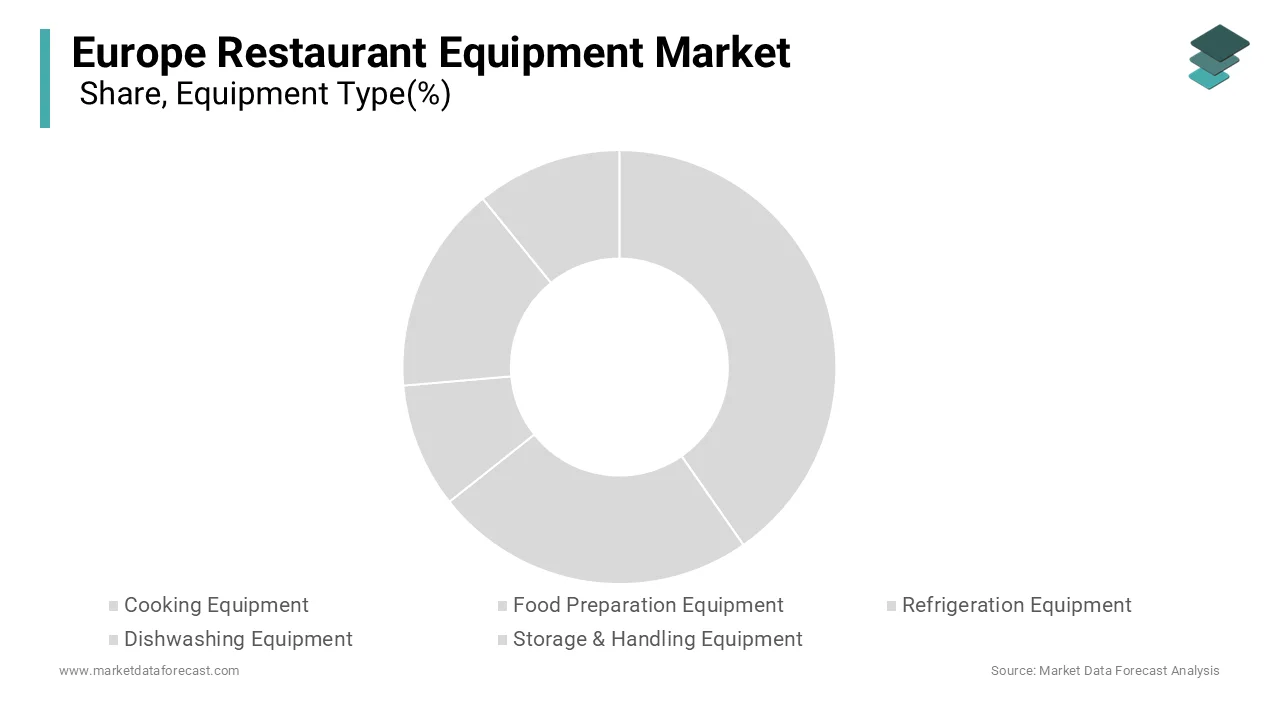
The food preparation equipment segment is estimated to witness a CAGR of 7.17% over the forecast period, owing to the industry’s urgent need to address labor scarcity and hygiene compliance. As per the European Federation of Food Services, there was a notable deficit in skilled kitchen staff across the EU in 2025, which has driventhe adoption of automation solutions such as robotic vegetable peelers, portioning slicers, and automated dough dividers. These machines reduce reliance on manual labor and minimize cross-contamination risks, a priority under the EU’s updated food hygiene regulation (EC) No 852/2004. A second key factor is the rise of standardized fast-casual concepts. Chains like Pret A Manger and Leon require uniform ingredient cuts and weights across hundreds of outlets, making programmable prep tables with integrated scales essential. This convergence of labor economics, food safety, and brand standardization is propelling food preparation equipment into the forefront of kitchen modernization.
By Application Insights
The hotels segment held 29.1% of the regional market share in 2025. The growth of the hotels segment in the European market is driven by their multifaceted foodservice operations, which typically include full-service restaurants, banquet halls, room service kitchens, and executive lounges, all requiring duplicate or specialized equipment sets. As per Eurostat, international tourist arrivals to EU countries in 2025 surpassed pre-pandemic levels, driving hotel occupancy rates higher in major destinations like Spain and Italy. This surge necessitates kitchen upgrades to handle higher volumes while maintaining service quality. The second factor is sustainability mandates. Major hotel groups such as Accor and NH Hotel Group have committed to net-zero operations by 2040, compelling them to replace aging refrigeration and cooking units with ENERGY STAR-rated models. In France and Germany, many four- and five-star hotels undertook comprehensive kitchen retrofits in 2024–2025 to align with corporate ESG targets, creating a steady, high-value demand stream for premium, efficient equipment.
The food truck, cart, or stand segment is the fastest-growing application in the European restaurant equipment market and is anticipated to record a CAGR of 8.5% over the forecast period, owing to the urban policy shifts and entrepreneurial innovation. As per the European Urban Development Network, municipal initiatives in cities like Berlin, Lisbon, and Copenhagen have streamlined licensing and provided utility hookups, reducing startup costs for mobile vendors and encouraging formalization of the sector. A second critical factor is the demand for compact, low-emission equipment. New EU noise and emissions regulations for mobile food units, effective January 2024, have spurredthe adoption of electric-powered grills, induction cooktops, and battery-operated refrigeration units. This regulatory and infrastructural tailwind, combined with consumer appetite for diverse, affordable dining, is transforming street food from a niche into a mainstream channel with outsized equipment demand.
COUNTRY LEVEL ANALYSIS
Germany Restaurant Equipment Market Analysis
Germany dominated the restaurant equipment market in Europe in 2025 by capturing 19.1% of the regional market share. The strong preference for precision, durability, and energy efficiency in commercial kitchens and the country’s rigorous enforcement of the Energieeinsparverordnung (EnEV) that mandates energy audits for commercial kitchens are propelling the growth of the German market. This has accelerated the adoption of heat-recycling combi ovens and variable-speed ventilation hoods. Additionally, Germany’s robust vocational training system produces highly skilled chefs who demand professional-grade equipment, sustaining demand for brands like Rational and Gaggenau. The rise of zero-waste gastronomy in cities like Munich and Hamburg has further fueled investment in blast chillers and sous-vide systems to extend ingredient shelf life.
France Restaurant Equipment Market Analysis
France commanded the second-largest share of the European market in 2025. The growth of France in the European market is attributed to the deep respect for traditional cooking methods, with aggressive modernization. The key driver is the government’s Plan de Relance hospitality stimulus, which allocated significant funding for kitchen equipment upgrades, with bonuses for energy-efficient purchases. This has led to widespread replacement of gas-fired charbroilers with induction alternatives in bistro kitchens across Paris and Lyon. Simultaneously, France’s strict adherence to the Label Rouge quality certification requires precise temperature control during preparation, boosting demand for programmable sous-vide circulators and blast chillers. The coexistence of heritage-focused bistros and tech-forward neo-bistros creates a uniquely layered demand profile.
Italy Restaurant Equipment Market Analysis
Italy is predicted to hold a promising share of the European restaurant equipment market over the forecast period, owing to the hyper-localized culinary traditions and a fragmented but passionate operator base. The dominant driver is the preservation of regional authenticity, with Neapolitan pizzerias demanding wood-fired ovens certified by the Associazione Verace Pizza Napoletana and Emilia-Romagna pasta makers investing in bronze-die extruders. Concurrently, Italy’s National Recovery Plan includes tax credits for businesses adopting energy-efficient appliances, spurring upgrades in refrigeration and dishwashing. In Sicily and Sardinia, tourism-driven seasonal peaks necessitate modular, stackable prep tables and rapid-cook ovens.
United Kingdom Restaurant Equipment Market Analysis
The United Kingdom is estimated to witness a healthy CAGR in the European restaurant equipment market during the forecast period. The UK is one of pragmatic innovation, driven by the need to operate efficiently with fewer staff. As per the British Hospitality Association, there was a notable shortfall in kitchen personnel in 2025, which accelerated the adoption of automated fryers, robotic dishwashers, and AI-powered inventory systems. Additionally, the UK’s Streamlined Energy and Carbon Reporting framework compels chains to disclose kitchen energy use, pushing operators toward induction cooking and heat-recovery ventilation. The rise of cloud kitchens has also created demand for compact, stackable, and remotely monitored equipment.
Spain Restaurant Equipment Market Analysis
Spain is expected to exhibit a steady CAGR in the European market during the forecast period, owing to the high-volume, seasonal demand concentrated in coastal regions like Catalonia and Andalusia. As per Spain’s National Statistics Institute, international tourist arrivals in 2025 surpassed pre-pandemic levels, driving demand for durable, high-throughput equipment. Paella pans, large-capacity fryers, and walk-in refrigerators see massive deployment ahead of the summer season. Furthermore, Spain’s Plan de Choque for tourism recovery allocated substantial funding for restaurant modernization, with emphasis on energy-efficient refrigeration to combat high ambient temperatures. In Barcelona and Valencia, many seaside restaurants upgraded their cold storage in 2025 to reduce spoilage.
COMPETITIVE LANDSCAPE
The competition in theEuropeane restaurant equipment market is highly dynamic, featuring a mix of premium engineering-focused brands and cost-competitive regional manufacturers. Global leaders dominate the high-end segment with technologically advanced, connected appliances, while local fabricators compete on price and customization for small independent venues. Differentiation increasingly hinges on digital capabilities, energy performance, and compliance with evolving EU regulations on emissions, refrigerants, and food safety. The rise of labor shortages has shifted buyer priorities toward ease of use and automation, favoring companies that offer intuitive interfaces and integrated workflows. Meanwhile, the proliferation of small-format dining concepts has intensified demand for space-efficient solutions, pressuring all players to innovate in modularity and multifunctionality. This environment fosters continuous product evolution but also demands significant investment in R&D, service infrastructure, and regulatory expertise, creating a high barrier to entry for new competitors.
KEY MARKET PLAYERS
Some of the companies that are playing a dominating role in the global europe restaurant equipment market include
- Rational AG
- Middleby Corporation
- Hoshizaki Corporation
- Alto-Shaam, Inc.
- Electrolux Professional AB
- Franke Group
- Welbilt, Inc.
- Fagor Industrial (Fagor Group)
- Samsung Electronics Co., Ltd.
- LG Electronics Inc.
- Beverage Air, LLC
- Merrychef (by Middleby)
- Hatco Corporation
- Blodgett Oven Company
- Imperial Commercial Cooking Equipment
- BKI Limited
- Infrico S.A.
- UNOX S.p.A.
- Vollrath Company LLC
TOP LEADING PLAYERS IN THE MARKET
- Rational AG is a German engineering leader renowned for its iCombi and iVario series of multifunctional cooking appliances used in high-end restaurants, hotels, and institutional kitchens across Europe and globally. The company’s contribution lies in redefining commercial cooking through precision climate control, energy recovery systems, and cloud-connected recipe management. Recently, Rational launched its ConnectedCooking 2.0 platform, enabling remote diagnostics, predictive maintenance, and real-time energy consumption analytics for its equipment fleet. This digital ecosystem strengthens its position by transforming hardware into an intelligent service offering, aligning with Europe’s push for sustainable and data-driven foodservice operations while reinforcing its global reputation for innovation and reliability.
- Ali Group is an Italian multinational that operates a vast portfolio of specialized restaurant equipment brands, including Carpigiani, Fimar, and Lainox. It serves diverse segments from gelato shops to fine dining kitchens worldwide. The company’s strength stems from its decentralized brand strategy, allowing each subsidiary to maintain deep expertise in niche applications. In recent years, Ali Group has accelerated its sustainability initiatives by introducing refrigeration units using natural refrigerants and induction-based cooking lines compliant with EU Ecodesign standards. It also expanded its service network across Eastern Europe to support rapid urbanization and hospitality growth, enhancing its ability to deliver localized solutions on a global scale.
- Electrolux Professional is a Swedish manufacturer offering a comprehensive range of cooking, refrigeration, and dishwashing equipment for commercial kitchens throughout Europe and international markets. The company is known for its focus on energy efficiency, hygiene, and user-centric design. To strengthen its market position, Electrolux Professional recently integrated its entire product line with its KitchenConnect IoT platform, which provides real-time performance monitoring and automated compliance reporting for food safety regulations. This move supports operators in meeting stringent EU hygiene and sustainability mandates while creating recurring revenue through digital services, solidifying its role as a full-solution provider in the global foodservice ecosystem.
TOP STRATEGIES USED BY THE KEY MARKET PARTICIPANTS
Key players in the Europe restaurant equipment market are prioritizing the integration of Internet of Things technology to enable remote monitoring, predictive maintenance, and energy optimization across commercial kitchens. They are developing compact and modular equipment designs to cater to the growing number of micro-restaurants and ghost kitchens in dense urban areas. Companies are also reformulating product lines to comply with stringent EU Ecodesign and F-Gas regulations by adopting natural refrigerants and high-efficiency motors. Strategic expansion of after-sales service networks ensures rapid technical support and parts availability, enhancing customer retention. Additionally, firms are launching circular economy programs that include equipment take-back, refurbishment, and component reuse to align with the European Union’s sustainability directives and capture value from the secondary market.
MARKET SEGMENTATION
This research report on the europe restaurant equipment market is segmented and sub-segmented into the following categories.
By Equipment Type
- Cooking Equipment
- Food Preparation Equipment
- Refrigeration Equipment
- Dishwashing Equipment
- Storage & Handling Equipment
- Others
By Application
- Hotels
- Restaurants
- Cafés & Bars
- Food Trucks, Carts & Stands
- Institutional Catering
- Others
By Country
- Germany
- France
- Italy
- United Kingdom
- Spain
- Rest of Europe
Frequently Asked Questions
1. What are the main segments in the Europe Restaurant Equipment Market?
Key segments include kitchen purpose equipment like ovens and ranges, refrigeration equipment, warewashing systems, food holding and storage units, and serving counters tailored for Europe's hospitality industry
2. Which countries lead the Europe Restaurant Equipment Market?
Germany, UK, France, Italy, and Spain dominate due to robust hospitality sectors, strict hygiene standards, and demand for innovative kitchen solutions in restaurants and hotels.
3. What drives growth in the Europe Restaurant Equipment Market?
Expansion of hotels and fast-food chains, rising focus on food safety, hygiene regulations, and adoption of advanced appliances fuel demand across Europe's food service landscape.
4. What trends shape the Europe Restaurant Equipment Market?
Energy-efficient and sustainable equipment, smart IoT-integrated kitchens, and precision cooking devices like combi ovens are key trends responding to eco-policies and operational efficiency needs.
5. Who are major players in the Europe Restaurant Equipment Market?
Leading companies include Electrolux, Middleby Corp, Ali Group, Smeg, and Haier, supplying high-performance gear for commercial kitchens throughout Europe.
6. What equipment is essential for restaurants in the Europe Restaurant Equipment Market?
Core items cover ovens, fryers, grills, refrigerators, freezers, dishwashers, and prep stations designed for high-volume use in compliance with EU standards.
7. How does sustainability impact the Europe Restaurant Equipment Market?
Demand surges for green-certified ovens, induction cookers, and low-energy units aligning with EU emissions policies and hospitality sustainability goals.
8. What regulations apply to the Europe Restaurant Equipment Market?
CE marking, RoHS compliance, and EU food safety directives mandate hygiene, energy efficiency, and safety for all commercial kitchen equipment sold in Europe.
9. What is the role of hotels in the Europe Restaurant Equipment Market?
Hotels drive demand for multi-purpose cooking, refrigeration, and precision systems to handle diverse menus and high guest volumes efficiently.
10. How to choose suppliers in the Europe Restaurant Equipment Market?
Select suppliers offering ISO 9001 certified, durable stainless steel gear with strong after-sales support and EU compliance for reliable hospitality operations.
Related Reports
Access the study in MULTIPLE FORMATS
Purchase options starting from
$ 2000
Didn’t find what you’re looking for?
TALK TO OUR ANALYST TEAM
Need something within your budget?
NO WORRIES! WE GOT YOU COVERED!
Call us on: +1 888 702 9696 (U.S Toll Free)
Write to us: sales@marketdataforecast.com