- Product Description Description
- Table of Contents TOC
- List of Table & Figure LOT
- Get Free Sample PDF Sample PDF
Market Size, 2025
$3.18 BnMarket Estimate, 2026
$3.60 BnMarket Forecast, 2034
$9.67 BnCAGR, 2026–2034
13.15%Europe Retail Automation Market Report Summary
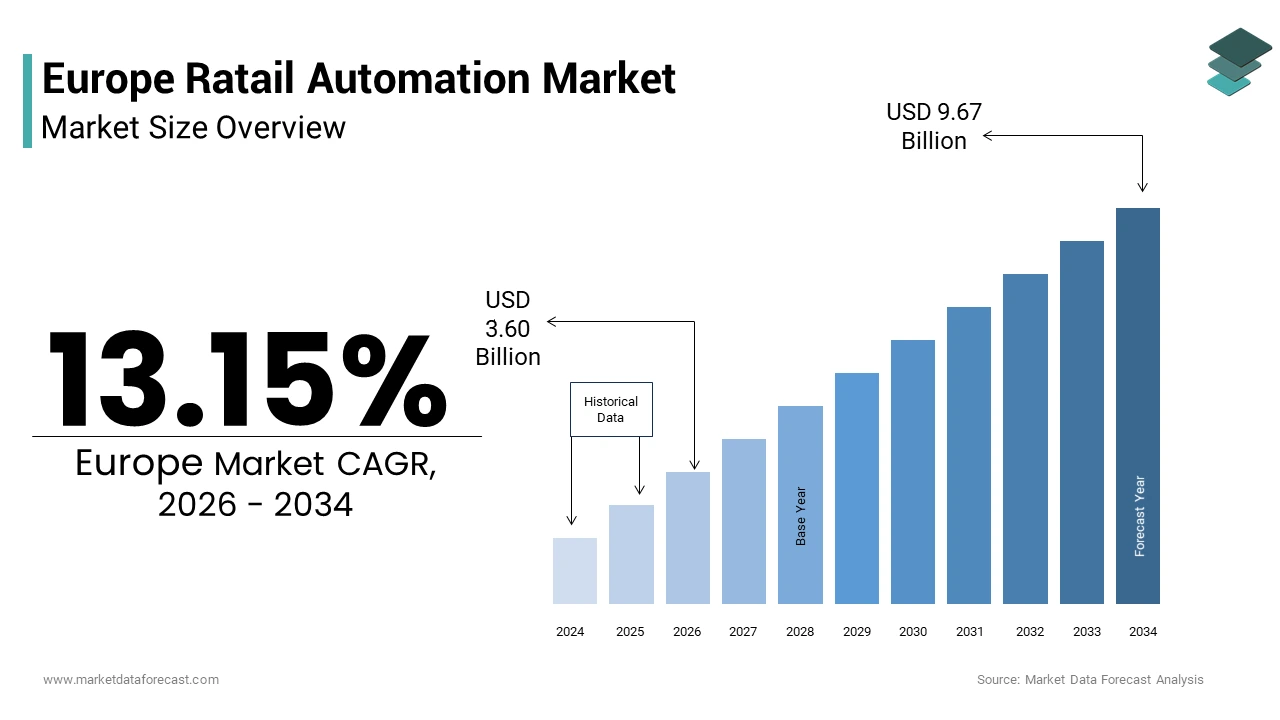
The European retail automation market was valued at USD 3.18 billion in 2025, is estimated to reach USD 3.60 billion in 2026, and is projected to reach USD 9.67 billion by 2034, growing at a CAGR of 13.15% during the forecast period from 2026 to 2034.
The growth of the European retail automation market is driven by rising demand for contactless shopping experiences, increasing adoption of AI-powered checkout systems, and the need for operational efficiency and cost optimization among retailers. Rapid digital transformation, labor shortages, and the expansion of omnichannel retail models are accelerating the deployment of self-checkout systems, smart shelves, RFID solutions, and automated inventory management technologies. Moreover, the growing emphasis on real-time data analytics, dynamic pricing, and personalized customer engagement is further strengthening market growth across Europe.
Key Market Trends
- Increasing adoption of self-checkout kiosks, smart POS systems, and cashier-less store technologies.
- Rising integration of AI, computer vision, and RFID for real-time inventory tracking and theft prevention.
- Growing demand for dynamic pricing and digital shelf labels to enhance in-store efficiency.
- Expansion of omnichannel retail strategies requires automated backend operations.
- Increasing use of data-driven customer engagement platforms and automated loyalty solutions.
Segmental Insights
- Based on end user, the grocery segment dominated the EEuropeanretail automation market in 2025, accounting for 58.2% of the total market share.
- The segment’s leadership is attributed to high transaction volumes, thin operating margins, and the need for faster checkout, accurate inventory management, and reduced labor costs in supermarkets and hypermarkets.
Regional Insights
The European retail automation market is experiencing rapid growth across major retail-driven economies due to digitalization, labor constraints, and changing consumer shopping behaviors.
- The United Kingdom was the largest contributor, accounting for 21.6% of the market share in 2025, supported by early adoption of automated retail systems and strong investments in smart store technologies.
- Germany followed closely with a 19.2% share, driven by advanced retail infrastructure and strong demand for self-service technologies.
- France continues to hold a significant position, supported by large retail chains and digital transformation initiatives.
- Italy is witnessing steady growth due to its vast network of small and independent retailers adopting cost-effective automation solutions.
- Sweden is expected to grow rapidly from 2026 to 2034, supported by high digital readiness and innovation in retail technology.
Competitive Landscape
The European retail automation market is highly competitive, with leading companies focusing on AI-driven retail platforms, integrated POS ecosystems, and smart store solutions. Strategic partnerships, product innovation, and cloud-based retail software adoption are shaping the competitive environment.
Prominent players in the European retail automation market include:
Datalogic SpA, Diebold Nixdorf Incorporated, Toshiba Global Commerce Solutions Inc., Emarsys eMarketing Systems AG, First Data Corporation, Fujitsu Limited, Honeywell International Inc., NCR Corporation, RapidPricer BV, and Zebra Technologies Corp.
Europe Retail Automation Market Size
The European retail automation market size was valued at USD 3.18 billion in 2025 and is anticipated to reach USD 3.60 billion in 2026 and USD 9.67 billion by 2034, growing at a CAGR of 13.15% during the forecast period from 2026 to 2034.
Current Introduction of theEuropeane Retail Automation Market
Retail automation is the integration of advanced technologies like AI, robotics, and software to streamline, digitize, and manage manual, repetitive retail tasks, improving operational efficiency and the customer experience. This includes self-checkout kiosks, smart shelves, es automated replenishment systems, cashierless stores, es and AI-powered analytics dashboards. The market is propelled by structural shifts in consumer behavior, labor economics, and supply chain transparency demands. European consumers increasingly expect a seamless blend of digital and physical shopping experiences, including the ability to check product availability in real-time and use a variety of convenient payment methods, such as contactless options. The aging demographic of the European workforce, including in the retail sector, is a significant trend that is anticipated to contribute to labor challenges and drive greater investment in automated solutions. Urbanization further intensifies pressure. A large majority of Europe's population resides in densely populated urban centers, creating conditions of limited physical space and high volumes of customer traffic that emphasize the need for streamlined and highly efficient business operations. Unlike generic digitization, retail automation specifically targets the physical point of sale, transforming stores from transactional venues into data-rich, responsive environments aligned with circular economy and digital sovereignty principles.
MARKET DRIVERS
Persistent Labor Shortages and Rising Wage Costs Accelerate Technology Substitution
Retailers across the region face acute staffing problems, which contribute to the growth of the European retail automation market. These are driven by demographic aging, declining interest in frontline roles, and competition from e-commerce fulfillment centers offering higher pay. The retail sector is experiencing historically high levels of unfilled positions, with particular demand for cashiers and stock clerks. This trend in labor shortages persists even during periods when the overall unemployment rate remains low. Certain regions are observing a significant volume of open roles within retail, suggesting a localized challenge in filling these roles. The data indicate a persistent gap between the demand for retail workers and the available workforce supply. Concurrently. Statutory minimum wages have risen sharply. France and Spain are increasing their hourly floor, as per research. These pressures compel retailers to deploy automation to maintain service levels without expanding payroll. Retailers in various European markets are deploying self-checkout technologies to manage labor requirements during high-traffic periods. Automated, intelligent systems are being utilized in stores to handle inventory monitoring and stock management tasks, reducing the reliance on manual auditing processes. The integration of these technologies suggests a broader shift toward optimizing in-store operational efficiency and automating routine tasks. Automation thus functions not as a luxury but as an operational necessity to offset human capital scarcity and control rising labor expenditures.
Consumer Demand for Frictionless and Personalized In-Store Experiences
Modern European shoppers increasingly expect retail environments to mirror the speed, convenience, and personalization of digital platforms, which is another factor that drives the growth of the European retail automation market. Many younger shoppers prefer retail environments with self-service capabilities and instant access to product details via mobile tools or in-aisle displays. An increased focus on hygiene has led many consumers to avoid long queues and adopt alternative, contactless shopping methods. Retailers respond by integrating computer vision and mobile integration to enable walk-out shopping as seen in Amazon Fresh stores in London and Berlin, where sensors track item selection and charge accounts automatically. Additionally, ly smart shelves equipped with weight and RFID sensors notify staff when restocking is needed while feeding data to loyalty apps that push personalized discounts based on past purchases. These innovations transform passive shopping into interac,,tive tailored journeys, aligning physical retail with evolving experiential expectations.
MARKET RESTRAINTS
High Initial Investment and Integration Complexity Deter Small Retailers
Deploying advanced retail automation requires substantial capital expenditure for hardware, software customization, and system integration, which hampers the growth of the European retail automation market. This poses a significant barrier for small and medium enterprises that constitute a significant share of EU retail businesses, according to sources. Upgrading retail locations with advanced technology, such as automated inventory systems and digital shelving, involves significant capital expenditure, separate from operational or subscription costs. Independent retailers often face financial constraints when attempting to implement even fundamental self-service technologies due to narrow profit margins. The widespread adoption of comprehensive automated solutions in smaller grocery businesses is limited by the high initial investment required. Moreover, legacy point of sale infrastructure often lacks application programming interfaces compatible with modern automation platforms, necessitating complete replacement rather than incremental upgrades. In Eastern Europe,, pe interoperability issues are exacerbated by fragmented IT ecosystems where cash registers run on outdated operating systems incompatible with current security protocols. Sources indicate that slow disbursement and complex bureaucracy hinder SMEs from fully utilizing EU digital transition funds. Consequently, automation remains concentrated among large chains, widening the competitiveness gap and limiting market democratization.
Data Privacy and Regulatory Uncertainty Around Biometric and Behavioral Tracking
The use of facial recognition, emotion detection, and movement tracking in retail automation faces intense scrutiny under the General Data Protection Regulation and emerging AI Act provisions, which inhibitthe expansion of the European retail automation market. Data protection authorities are increasing scrutiny on the use of biometric technologies for purposes like marketing or loss prevention in retail environments. Retailers often face difficulties in establishing a valid, compliant legal basis, such as legitimate interest, when utilizing visitor analytics. Regulatory actions indicate that video analytics designed to be anonymous can still inadvertently capture identifiable biometric data, violating purpose limitation principles. The use of in-store cameras for tracking customer movements, such as heat mapping, often requires explicit, granular consent from individuals. Emerging regulatory frameworks increasingly classify real-time biometric identification technologies as high-risk, limiting their application to authorized scenarios with strict oversight. These legal ambiguities force vendors to offer region-specific firmware, disabling certain features in sensitive markets, thereby fragmenting product development and increasing compliance costs. Innovation will continue to move cautiously and unevenly across member states, driven by a lack of clear sector-specific guidelines.
MARKET OPPORTUNITIES
Public Funding Through National Digitalization Programs Lowers Adoption Barriers
EU member states are leveraging recovery funds to subsidize retail automation among small businesses, which offers new opportunities for the European retail automation market. This strategy is broadening market penetration beyond corporate chains. National recovery initiatives in Europe are increasingly prioritizing financial support for the digital modernization of smaller retail businesses. These programs help small shops adopt technologies like self-checkout systems and inventory management software by covering a significant part of the implementation expenses. This broad adoption of digital tools allows smaller, local stores to use technological solutions that were once more typical in larger retail chains. These public investments not only stimulate demand but also create standardized implementation frameworks that reduce vendor onboarding complexity. These programs drive inclusive, continent-wide technological transformation by lowering the risks of innovation for small-scale retailers.
Integration with Circular Economy and Food Waste Reduction Mandates
Retail automation is increasingly aligned with EU sustainability directives, particularly those targeting food waste and resource efficiency, a trend that provides fresh prospects for theEuropeane retail automation market. Under the Farm to Fork Strategy, member states must halve per capita food waste at retail and consumer levels by 20,30, prompting grocers to deployAI-poweredd dynamic pricing and spoilage prediction systems. Retailers represent a notable segment of total food waste, with perishable items like produce, bread, and dairy experiencing the highest rates of spoilage. Certain retailers are utilizing dynamic, data-driven pricing systems that adjust costs for items nearing expiration based on factors like sales pace and environmental conditions. Image recognition technology is being employed in retail settings to monitor inventory freshness, facilitating automated alerts for markdowns or food donations. Impending regulations are shifting toward requiring accessible, digitized product information to verify sustainability metrics, such as origin and recyclability. This convergence positions retail automation not merely as an efficiency tool but as an enabler of regulatory compliance and environmental stewardship, creating new value streams beyond labor savings.
MARKET CHALLENGES
Interoperability Gaps Between Legacy and Modern Systems Impede Scalability
Most European retailers operate heterogeneous technology stacks comprising decades-old point-of-sale terminals, enterprise resource planning modules, and inventory databases that lack standardized communication protocols, thereby slowing down the growth of the European retail automation market. Many mid-sized retailers have not achieved complete integration between their backend systems and customer-facing interfaces, which challenges the synchronization of live data for automated processes. The reliance on manual inventory verification persists in a significant portion of stores equipped with self-checkout technology, as their software often cannot directly incorporate data from modern scanning systems. Retail operations are experiencing a gap between the deployment of advanced store technology and the backend infrastructure required to fully leverage that technology for inventory management. The synchronization of real-time inventory data with customer engagement tools remains an operational hurdle for a considerable segment of the retail sector. This disconnect forces costly middleware development or complete system overhauls that disrupt operations. Vendors exacerbate the issue by promoting proprietary ecosystems, such as exclusive cloud analytics or closed hardware interfaces, that lock customers into single-supplier models. Interoperability will remain a major hurdle for scaling automation from pilots to national rollouts unless industry-wide standards like GS1 or OPC UA are broadly adopted.
Consumer Resistance and Trust Deficits Around Autonomous Checkout
Many European shoppers remain skeptical of fully automated checkout experiences, citing concerns over accuracy, fairness, and loss of human interaction, which challenge the expansion of the European retail automation market. Consumers have expressed concerns regarding potential inaccuracies in billing and the lack of immediate assistance in fully automated retail environments. The complexity and technical issues associated with self-service technology can lead to higher abandonment rates, particularly among certain demographics. Preferences for traditional, assisted shopping experiences remain strong in some regions, driven by a desire for personal interaction rather than automated service. Moreover, incidents of algorithmic bias, such as misidentifying skin tones in camera-based systems,s have eroded trust in AI-driven retail. Vendors must therefore balance automation with human oversight, hybrid LAN,, es and transparent error resolution protocols. Autonomous retail will struggle with adoption, regardless of infrastructure, until user experience emphasizes inclusivity and psychological safety.
REPORT COVERAGE
| REPORT METRIC | DETAILS |
| Market Size Available | 2025 to 2034 |
| Base Year | 2025 |
| Forecast Period | 2026 to 2034 |
| CAGR | 13.15% |
| Segments Covered | By Type, End-User, And By Country |
| Various Analyses Covered | Global, Regional & Country Level Analysis; Segment-Level Analysis, DROC, PESTLE Analysis, Porter’s Five Forces Analysis, Competitive Landscape, Analyst Overview of Investment Opportunities |
| Regions Covered | UK, France, Spain, Germany, Italy, Russia, Sweden, Denmark, Switzerland, Netherlands, Turkey, Czech Republic,c & Rest of Europe |
| Market Leaders Profiled | Datalogic SpA, Diebold Nixdorf Incorporated, Toshiba Global Commerce Solutions Inc., Emarsys eMarketing Systems AG, First Data Corporation, Fujitsu Limited, Honeywell International Inc., NCR Corporation, RapidPricer BV, Zebra Technologies Corp. |
SEGMENTAL ANALYSIS
By End User Insights
The grocery segment dominated Europeanrope retail automation market by accounting for a 58.2% share in 2025. The dominance of the grocery segment is driven by the sector’s high transaction volume, perishable inventory complexity,y and thin profit margins, which collectively create intense pressure for operational efficiency. Supermarkets process thousands of daily transactions requiring rapid checkout solutions while managing hundreds of stock-keeping units with short shelf lives, necessitating real-time inventory visibility. The consistent frequency of consumer grocery shopping in Europe provides a rationale for investing in automated technology. A significant portion of major retail chains in Germany has integrated self-checkout terminals, with substantial unit deployment across key market players. Regulatory focus on reducing food waste within the European Union is driving the adoption of intelligent, automated systems for dynamic pricing. The integration of automated replenishment robots like those from Trigo and AiFi in Carrefour and Tesco stores further underscores the segment’s leadership in deploying end to end automation to address labor shortages and reduce shrinkage.
The hospitality segment is on the rise and is expected to be the fastest growing segment in the market by witnessing a CAGR of 16.4% from 2026 to 2034 due to post pandemic labor scarcity, rising guest expectations for contactless service, and the need for operational agility in hotels, restaurants,,s and cafes. The hospitality sector in certain European regions has faced challenges in filling roles, which is linked to factors such as wage perceptions and seasonal demand patterns. In response to these staffing challenges, some businesses are incorporating digital tools like kiosks, tableside tablets, and automated room service options. Investment in restaurant automation, including AI-powered kitchen display systems, has increased in certain locations to help optimize food preparation and order sequencing. The hospitality industry is increasingly integrating mobile key access and voice-controlled room features to streamline guest experiences and reduce reliance on front-desk staffing. Technological funding initiatives are supporting projects that connect reservation systems with inventory and payment platforms to facilitate more seamless service workflows. As experiential hospitality converges with smart technology, this segment is redefining service delivery through automation.
COUNTRY ANALYSIS
United Kingdom Retail Automation Market Analysis
The United Kingdom outperformed other countries in the European retail automation market by capturing a 21.6% share in 2025. The supremacy of the UK market is propelled by early adoption of self-checkout systems, widespread deployment of contactless payment,s and pioneering cashierless store formats. Amazon Fresh operates multiple Just Walk Out stores in Lond, on, leveraging ceiling-mounted cameras and sensor fusion to enable frictionless shopping, a model now replicated by domestic chains like Sainsbury’s. Many large retail locations have adopted automated checkout options, which now manage a significant portion of total transactions. Labor challenges following political shifts have increased the focus on automation in retail settings. Initiatives are available to assist smaller retail businesses with implementing digital tools, such as inventory robots and analytical software. This blend of consumer readiness, regulatory support, rt and workforce constraints positions the UK as Europe’s most advanced retail automation laboratory.
Germany Retail Automation Market Analysis
Germany was the next prominent player in the European retail automation market by accounting for a 19.2% share in 2025. The nation’s approach combines industrial engineering rigor with strict data privacy compliance, resulting in highly reliable yet GDPR conscious systems. Major retailers like Aldi and Lidl have rolled out standardized self-checkout platforms across thousands of stores, featuring tactile feedback and multilingual interfaces tailored to diverse urban populations. Many grocery chains in Germany have adopted shelf-scanning robots to assist with inventory accuracy. The approach in this market often focuses on hybrid models, where technology is implemented to support employees rather than replace them, partly due to the role of labor representatives. Initiatives for sovereign cloud infrastructure are supported to keep retail data within regional jurisdiction. Germany is a global leader in scalable, sustainable automation, leveraging its reputation for precision engineering and systematic process optimization to deploy technology rooted in ethical principles.
France Retail Automation Market Analysis
France holds a significant share of the European retail automation market. The country benefits from concentrated urban populations. High urban population density creates a favorable environment for automated retail solutions, driven by substantial store traffic. Government recovery initiatives support the modernization of retail, facilitating the adoption of automated kiosks and predictive forecasting tools. Major retailers have implemented extensive automated checkout infrastructure and utilized computer vision technologies to streamline the identification of fresh produce. Regulatory guidelines regarding anonymized video analytics have facilitated the deployment of systems for tracking customer traffic and behavior. Preparations for major international events have accelerated the integration of smart retail technologies, combining ticketing and payment into unified, touchless experiences. This synergy of public investment, demographic density, ty, and regulatory clarity fuels France’s structured automation rollout.
Italy Retail Automation Market Analysis
Italy is moving ahead steadfastly in tEuropeanope retail automation market due to a vast network of small independent retailers. The Italian retail landscape includes a vast number of, often traditional, physical outlets that have historically operated without advanced digital infrastructure. A government initiative is underway to support the modernization of these businesses by providing financial incentives for implementing digital tools. These incentives encourage adoption of solutions such as improved point-of-sale systems, inventory management software, and e-commerce integration. A significant number of small and medium-sized enterprises have begun adopting cloud-based technologies for inventory tracking and checkout processes. These technological adoptions indicate a shift toward a hybrid model, merging traditional physical storefronts with digital functionalities. Southern regions like Sicily saw pilot programs installing shared kiosks in historic centers serving multiple vendors. Despite initial resistance, cultural pride in artisanal retail is now merging with technology to enhance authenticity through QR code storytelling and origin verification. This grassroots digitization wave makes Italy a distinctive model of inclusive automation driven by public subsidy and local entrepreneurship.
Sweden Retail Automation Market Analysis
Sweden is likely to grow in the European retail automation market from 2026 to 2034. The country distinguishes itself by embedding automation within circular economy and climate action frameworks. Stores feature energy-efficient self-checkout units powered by renewable electricity and built with recycled materials, aligning with national carbon neutrality goals. Sweden’s high digital literacy enables seamless adoption of mobile wallets, ts scan and go, apps, and personalized loyalty offers. Moreover, labor agreements support reskilling cashiers as customer experience ambassadors rather than eliminating roles, fostering social acceptance. Sweden demonstrates how to balance economic efficiency with social welfare by grounding automation in ethical, human-centric, and sustainable principles.
COMPETITIVE LANDSCAPE
Competition in the European retail automation market is characterized by a mix of global technology providers, specialized European vendors, rs and emerging startups offering niche solutions. Established players like CR, Toshiba, and Zebra dominate through proven reliability, regulatory compliance, and end-to-end integration capabilities across hardware, software, and services. Meanwhile, agile entrants compete on innovation in areas such as cashierlestechnologyogy computer vision, and roroboticss often piloted in urban innovation hubs. The market is highly fragmented by country due to varying labor laws, consumer preferences, and data privacy interpretations under the General Data Protection Regulation. Large retailers drive standardization through centralized procurement, while small businesses rely on government-funded digitization schemes, creating dual demand streams. Differentiation increasingly hinges on the ability to deliver unified platforms that merge checkout automation, inventory accuracy, and sustainability analytics within a secure, ethical framework that respects European social and legal norms.
KEY MARKET PLAYERS
A Powerful dominating players are in thEuropeanpe retail automation market
- Datalogic SpA
- Diebold Nixdorf Incorporated
- Toshiba Global Commerce Solutions Inc.
- Emarsys eMarketing Systems AG
- First Data Corporation
- Fujitsu Limited
- Honeywell International Inc.
- NCR Corporation
- RapidPricer BV
- Zebra Technologies Corp.
Top Players In The Market
- NCR Corporation is a global leader in retail automation with a strong presence across Europe, offering self-checkout systems, point of sale terminals, and cloud-based store management software. The company enables retailers to streamline operations, reduce labor dependency, nd enhance customer throughput through scalable hardware and analytics platforms. NCR contributes to the global market by integrating artificial intelligence into its self-service kiosks for real-time fraud detection and item recognition, particularly for fresh produce. This solution reduces installation time and supports rapid deployment in both grocery and general merchandise enenvironmentsreinforcing NCR’s role as a key enabler of frictionless retail experiences across the region.
- Toshiba Global Commerce Solutions provides integrated retail automation technologies, including self-service kiosks, point of sale system,s, and inventory management software tailored for the European grocery and hospitality sectors. The company leverages its deep retail expertise to deliver solutions that balance automation with human oversight,t ensuring compliance with local labor practices and data privacy laws. GloGloballyoshiba supports major retailers with end-to-end digital transformation from checkout to back office analytics. It also introduced a compact self-checkout unit designed for small-format stores in urban centers across Italy and Spain e, enabling independent retailers to adopt automation without extensive floor space. These innovations strengthen Toshiba’s position as a flexible partner for diverse European retail landscapes.
- Zebra Technologies Corporation plays a pivotal role in the EEuropeanretail automation market through its portfolio of enterprise asset intelligence solutions, including fixed industrial scanners,s mobile computers, and AI-powered shelf analytics. The company enables real-time inventory accuracy, automated replenishment, nd loss prevention by connecting physical store operations to digital supply chains. Zebra’s contribution to the global market lies in its edge computing platforms that process data on-premises, ensuring GDPR compliance while delivering actionable insights. The company also partnered with major European grocery chains to deploy handheld devices that guide staff to misplaced items using augmented reality overlays. These actions solidify Zebra’s leadership indata-driven in-storee automation that bridges operational efficiency and customer satisfaction.
Top Strategies Used By The Key Market Participants
Key players in the European retail automation market focus on developing modular, scalable solutions that cater to both large chains and small independent retailers through cloud-based deployment models. They prioritize compliance with EU data protection and cybersecurity regulations by embedding privacy by design and on-premises processing capabilities. Companies invest in artificial intelligence for item recognition, dynamic pricing, ng and inventory forecasting to address food waste and labor shortages. Strategic partnerships with local system integrators and payment providers ensure seamless adoption and interoperability with existing retail infrastructure. Additionally, many firms emphasize sustainability by designing energy-efficient hardware using recycled materials and supporting circular economy initiatives through take-back and refurbishment programs aligned with the European Green Deal.
MARKET SEGMENTATION
This research report on the European retail automation market is segmented and sub-segmented into the following categories.
By Type
- Hardware
- POS System
- Self-checkout System
- RFID and Barcode Scanners
- Other Hardware Types
- Software
By End User
- Grocery
- General Merchandise
- Hospitality
By Country
- UK
- France
- Spain
- Germany
- Italy
- Russia
- Sweden
- Denmark
- Switzerland
- Netherlands
- Turkey
- Czech Republic