- Product Description Description
- Table of Contents TOC
- List of Table & Figure LOT
- Get Free Sample PDF Sample PDF
Market Size, 2025
$7.94 BnMarket Estimate, 2026
$8.26 BnMarket Forecast, 2034
$11.36 BnCAGR, 2026–2034
4.06%Europe Salt Market Size, Growth, Trends & Forecast (2026–2034)
The Europe salt market size was calculated to be USD 7.94 billion in 2025, reached USD 8.26 billion in 2026, and is anticipated to be worth USD 11.36 billion by 2034, growing at a compound annual growth rate (CAGR) of 4.06% during the forecast period from 2026 to 2034. Driven by mandatory winter road de-icing policies and essential raw material demand from the chlor-alkali chemical industry, the market underpins critical public safety, infrastructure resilience, and chemical manufacturing across the continent.
Key Executive Metrics (At-a-Glance)
- 2025 Base Valuation: USD 7.94 Billion
- 2026 Current Valuation: USD 8.26 Billion
- 2034 Forecast Valuation: USD 11.36 Billion
- Compound Annual Growth Rate (CAGR): 4.06% (2026–2034)
- Dominant Regional Market: Germany (holding a 28.6% market share in 2025, anchored by dense chlor-alkali chemical manufacturing and comprehensive winter road maintenance infrastructure)
- Key Growth Segments: Rock and Vacuum pan salt, Brine-based extraction, and Chemical processing/Water treatment applications
Core Market Drivers & Growth Triggers
- Mandatory Road De-Icing: Public safety regulations requiring non-discretionary bulk salt consumption by national transport authorities during snow and ice events.
- Chlor-Alkali Chemical Processing: Essential reliance on high-purity salt as the foundational feedstock for producing chlorine and caustic soda used in PVC, pharmaceuticals, and municipal water disinfection.
Primary Market Restraints & Challenges
- Environmental & Health Constraints: Stringent European regulations on brine discharge, land subsidence risks from solution mining, and government sodium reduction public health campaigns.
- Supply Concentration & Pricing: Geopolitical and operational vulnerability due to concentrated rock mine production alongside compressed profitability in bulk commodity segments.
Europe Salt Market Segmentation Breakdown
| Segment Category | Largest Segment / Leader | Fastest-Growing Segment |
|---|---|---|
| By Type | Rock Salt (Captured a 55.8% share in 2025 due to cost efficiency and indispensability in winter road de-icing and bulk handling) | Vacuum Pan (Estimated at a 4.7% CAGR driven by high-purity food, pharmaceutical, and clean-label application demands) |
| By Source | Salt Mines (Held 65.6% share in 2025, leveraging Europe's rich Permian and Triassic-era geological endowments) | Brine (Projected at a 5.1% CAGR propelled by solution mining expansion and ultra-pure requirements in modern chlor-alkali cells) |
| By Application | Chemical Processing (Led with a 35.3% share in 2025 as the core feedstock for chlor-alkali electrolysis) | Water Treatment (Anticipated at a 5.8% CAGR driven by tightening EU drinking water quality rules and ion-exchange resin softeners) |
| By Region | Germany (Held 28.6% share in 2025, anchored by heavy chemical industrial integration and comprehensive winter maintenance networks) | Netherlands / Poland (Expanding via advanced brine-based solution mining, subsurface hydrogen storage, and industrial modernization) |
Major Industry Players Profiled
Key corporations shaping the Europe salt market include K+S AG, Tata Chemicals Limited, CIECH S.A., Solvay S.A., Compass Minerals International Inc., Salins Group, Südsalz GmbH, ESCO – European Salt Company GmbH & Co. KG, INEOS Enterprises, and Akzo Nobel N.V.
Europe Salt Market Size
The Europe salt market size was calculated to be USD 7.94 billion in 2025 and is anticipated to be worth USD 11.36 billion by 2034, from USD 8.26 billion in 2026, growing at a CAGR of 4.06% during the forecast period.

Salt is a white, crystalline mineral, scientifically known as Sodium Chloride (NaCl), that is sourced from evaporated seawater or underground mines. It acts as an essential seasoning that enhances flavor by suppressing bitterness and historically serves as a vital preservative by drawing moisture out of food to inhibit bacterial growth. Unlike commodity perceptions, salt in Europe functions as a strategic mineral underpinning public health, infrastructure resilience, and chemical manufacturing. According to research, Salt production within the European Union is concentrated among a few key nations, with Germany leading output, followed by France and the Netherlands. The European Food Safety Authority mandates strict purity standards for food-grade salt, requiring iodine fortification in several member states to prevent micronutrient deficiencies. Simultaneously, a significant portion of European salt consumption is driven by winter road maintenance, with demand directly tied to winter severity and regional transport safety policies. Industrial applications are equally critical: salt is the primary feedstock for chlorine and caustic soda production via chlor-alkali electrolysis, supporting PVC, pharmaceuticals, and water treatment sectors. The chemical industry’s chlor-alkali sector links its production security to the consistent supply of high-purity salt, which is essential for producing chlorine and caustic soda. Production occurs through rock mining, solution mining, and solar evaporation, with environmental permits increasingly scrutinizing brine discharge and land subsidence. This multifaceted role, spanning nutrition, mobility, and industrial chemistry, positions salt as an indispensable yet often overlooked pillar of Europe’s material infrastructure.
MARKET DRIVERS
Mandatory Road De-Icing and Winter Transport Safety Policies
Public safety mandates for winter road maintenance constitute a key accelerator of industrial salt demand across the region and the Europe salt market. National transport authorities enforce minimum de-icing protocols on highways and urban networks to prevent accidents and ensure economic continuity during snow and ice events. European Union member states manage, in fluctuating amounts depending on winter severity, large quantities of salt for road de-icing, with efforts increasingly focused on optimizing consumption through better techniques rather than increasing overall usage. Germany and France, through their respective road agencies, consume substantial amounts of salt each winter, with usage levels varying significantly based on weather conditions and local environmental regulations restricting excessive application. The European Commission’s Directive on Minimum Safety Requirements for Tunnels and Major Roads implicitly endorses salt-based de-icing as a cost-effective standard, discouraging alternatives like beet juice blends due to inconsistent performance. Climate variability further amplifies demand. Despite an overall warming trend, the Copernicus Climate Change Service indicates that central Europe continues to experience occasionally severe cold episodes, complicating winter road maintenance efforts. This non-discretionary, policy-backed need ensures stable bulk salt consumption regardless of economic cycles, making de-icing the most predictable and volume-intensive segment in the European salt market.
Essential Role in Chlor-Alkali Chemical Production
Salt serves as the foundational raw material for the chlor-alkali industry, which acts as a major driver of the Europe salt market. This industry produces chlorine, sodium hydroxide, and hydrogen, which are key inputs for countless downstream sectors. According to Euro Chlor, European chlor-alkali producers operating across numerous sites throughout the region utilize high-purity salt for production, with output showing a positive recovery trend through 2024. This trend reflects a stabilization in regional production activity despite recent economic pressures. This chlorine is indispensable for manufacturing polyvinyl chloride (PVC) used in construction pipes and medical devices, as well as for disinfecting most of Europe’s municipal drinking water supplies. The European Environment Agency confirms that without salt-derived chlorine, compliance with the EU Drinking Water Directive would be unattainable at scale. Furthermore, caustic soda from the same process is critical in alumina refining, pulp and paper production, and soap manufacturing. Unlike food or de-icing grades, chlor-alkali salt must meet stringent purity thresholds, less than 0.1 percent calcium and magnesium, to prevent membrane fouling in modern electrolytic cells. This technical dependency creates a captive, high-volume demand stream that anchors Europe’s salt industry to the continent’s chemical sovereignty and public health infrastructure.
MARKET RESTRAINTS
Environmental Regulations on Brine Discharge and Land Subsidence
Salt production, particularly through solution mining, faces increasing regulatory constraints due to its environmental footprint, which restrains the supply expansion and the Europe salt market growth. Solution mining involves injecting water into underground salt deposits to create brine, which is then evaporated to yield salt, a process that generates residual brine requiring disposal. European environmental authorities have highlighted that improper brine discharge raises salinity levels in freshwater ecosystems, which harms aquatic life; in response, the Netherlands has faced regulatory action halting certain salt mining activities due to rising chloride levels in regional groundwater. Additionally, rock salt mining can cause surface subsidence, as seen in the 2021 sinkhole incident near a mine in Northwich, UK, which damaged residential infrastructure. The European Union's Water Framework Directive now requires detailed hydrogeological evaluations for new salt extraction projects, leading to significantly longer permitting processes for industry projects. In Germany, the Federal Institute for Geosciences requires continuous ground deformation monitoring for active mines. These measures increase capital costs, delay capacity additions, and discourage investment in regions with sensitive ecosystems, thereby constraining the industry’s ability to respond to rising demand from de-icing or chemical sectors.
Public Health Campaigns Against Excessive Dietary Sodium
Government-led initiatives to reduce population-level sodium intake are significantly dampening demand for food-grade salt within the Europe salt market. The World Health Organization recommends a maximum daily intake of 5 grams of salt, yet average consumption in many EU countries exceeds 8 to 10 grams, contributing to hypertension and cardiovascular disease. In response, the European Commission’s Joint Action on Nutrition and Physical Activity has spurred national programs. The United Kingdom utilizes a voluntary industry partnership to set targets for reducing salt levels in processed foods, while France utilizes a front-of-pack, traffic-light style labeling system that penalizes products with high salt, sugar, or saturated fat content to encourage healthier choices. Voluntary reformulation efforts by the food industry across Europe have led to a noticeable decline in the average salt content of commonly consumed processed meats and bread products. Retailers like Carrefour and Tesco now promote “low-sodium” private-label lines, further shifting consumer behavior. Despite substantial overall salt intake, the upward trend in Western Europe is flat or declining. This secular trend pressures producers to diversify into specialty salts or industrial segments, limiting upside potential in what was historically a stable consumer market
MARKET OPPORTUNITIES
Development of Specialty Salts for Premium Food and Wellness Markets
The rise of gourmet, functional, and mineral-enriched salts offers a significant opportunity within the Europe salt market. Consumers are increasingly seeking artisanal products like fleur de sel from Guérande, smoked sea salt from Denmark, or Himalayan pink salt blends fortified with magnesium and potassium. Consumer demand for premium and artisanal salts is increasing across Europe, driven by a growing interest in gourmet home cooking, healthier, clean-label ingredients, and wellness-focused, natural products. Iodized salt remains mandatory in several countries, including Germany and Switzerland, but new formulations now include selenium, iron, or folic acid to address specific micronutrient gaps. The European Commission’s Farm to Fork Strategy supports such innovations through funding for small-scale salt harvesters practicing sustainable solar evaporation. Additionally, kosher and halal-certified salts are gaining traction in multicultural urban centers. Unlike bulk industrial salt, these products command price premiums, enabling small producers to thrive despite overall sodium reduction trends. This niche aligns with Europe’s broader shift toward traceable, story-driven food products that emphasize origin, tradition, and health functionality.
Integration of Salt Caverns for Energy Storage and Carbon Sequestration
The region’s extensive network of underground salt caverns, formed through solution mining, is being repurposed for strategic energy and climate applications. This repurposing serves as a top prospect for the European salt market and creates a novel revenue stream for salt operators. These geologically stable voids are ideal for storing natural gas, hydrogen, and compressed air due to their impermeability and pressure resistance. Salt cavern storage sites located in key North Sea countries are essential, high-deliverability components of the European Union's strategy to manage gas supply security. More significantly, pilot projects are testing their use for carbon capture and storage. The Northern Lights project in Norway plans to inject CO₂ into saline aquifers adjacent to salt formations. German energy companies are actively repurposing existing infrastructure to develop pilot hydrogen storage projects, specifically within salt caverns in Lower Saxony, to test operational feasibility. Large salt caverns offer significant capacity for storing hydrogen, providing a flexible, high-capacity solution for seasonal energy storage and renewable energy balancing. Salt companies are shifting from mineral extraction to critical, underground storage providers, supporting Europe’s net-zero transition by converting geological sites into hydrogen infrastructure.
MARKET CHALLENGES
Geopolitical Vulnerability in Rock Salt Supply Chains
The region’s reliance on a concentrated number of domestic rock salt mines creates systemic supply risks during extreme weather or labour disruptions, which hampers the growth of the Europe salt market. A small number of massive underground facilities in countries like Germany, France, and the United Kingdom traditionally dominated the supply of road salt across Western Europe. However, many historic sites have transitioned into museums or innovation centers, leaving production concentrated in fewer active, high-capacity mines. Leading regional road infrastructure and pavement associations monitor the availability of winter maintenance materials, as disruptions at primary production sites in the United Kingdom can lead to regional supply shortages and require local authorities to prioritize which routes receive treatment. Similarly, flooding in German mines during the 2021 Rhine basin deluge temporarily halted production, causing spot prices to double. Unlike agricultural commodities, salt cannot be rapidly imported due to bulk transport limitations and port handling constraints. The European Commission’s Critical Raw Materials Act does not classify salt as strategic, leaving no coordinated reserve system. This geographic and operational concentration means that localized disruptions can cascade into regional shortages, undermining winter road safety and industrial continuity. Diversification into alternative sources remains limited by geology and permitting, making the supply chain inherently fragile despite the mineral’s abundance.
Declining Profitability in Bulk Segments Due to Price Pressure
Intense competition and commoditization have eroded margins in the region’s bulk salt landscapes, which poses a structural challenge to producers within the Europe salt market. De-icing and industrial salt are traded as undifferentiated commodities, with public tenders often awarded solely on the lowest price. European rock salt producers have faced intense downward pressure on real prices due to substantial production capacity and highly competitive bidding environments. Municipal tender prices for road salt in Southern Europe have reached exceptionally low levels, forcing suppliers to operate at margins that provide minimal return above costs. Simultaneously, energy prices, which account for a notable share of evaporation-based production costs, have remained volatile post-Ukraine invasion, squeezing profitability further. Smaller producers lacking scale or integrated logistics are exiting the market. This pressure discourages investment in modernization, environmental compliance, or workforce retention, risking long-term supply reliability. The bulk salt sector faces an existential race to the bottom in the absence of differentiation or policy intervention, undermining its viability despite its critical societal function.
REPORT COVERAGE
| REPORT METRIC | DETAILS |
| Market Size Available | 2025 to 2034 |
| Base Year | 2025 |
| Forecast Period | 2026 to 2034 |
| CAGR | 4.06% |
| Segments Covered | By Type, Source, Application, And Region |
| Various Analyses Covered | Global, Regional & Country Level Analysis; Segment-Level Analysis; DROC, PESTLE Analysis; Porter’s Five Forces Analysis; Competitive Landscape; Analyst Overview of Investment Opportunities |
| Regions Covered | UK, France, Spain, Germany, Italy, Russia, Sweden, Denmark, Switzerland, Netherlands, Turkey, and the Czech Republic |
| Market Leaders Profiled | K+S AG, Tata Chemicals Limited, CIECH S.A., Solvay S.A., Compass Minerals International Inc., Salins Group, Südsalz GmbH, ESCO – European Salt Company GmbH & Co. KG, INEOS Enterprises, Akzo Nobel N.V. |
SEGMENTAL ANALYSIS
By Type Insights
The rock salt segment was the largest in the Europe salt market by accounting for a 55.8% share in 2025. The supremacy of the rock salt is primarily driven by its indispensable role in winter road de-icing and industrial applications. Mined from extensive underground deposits across Central and Northern Europe, rock salt is cost-effective, readily available, and suitable for bulk handling. According to sources, driven by the need for winter road safety, significant quantities of rock salt are applied on EU road networks annually, with Germany being a major consumer, though overall consumption trends for de-icing are influenced by fluctuating winter severity. Its coarse granular form provides immediate traction and gradual melting action, making it the preferred choice for national transport agencies. Beyond de-icing, rock salt serves as a feedstock for chemical production when crushed and purified. The segment’s dominance is further reinforced by established mining infrastructure in regions like Cheshire in the UK, Lorraine in France, and Lower Saxony in Germany, where centuries-old operations ensure supply security. Unlike processed salts, rock salt requires minimal energy input post-extraction, aligning with cost and carbon efficiency goals in public procurement.
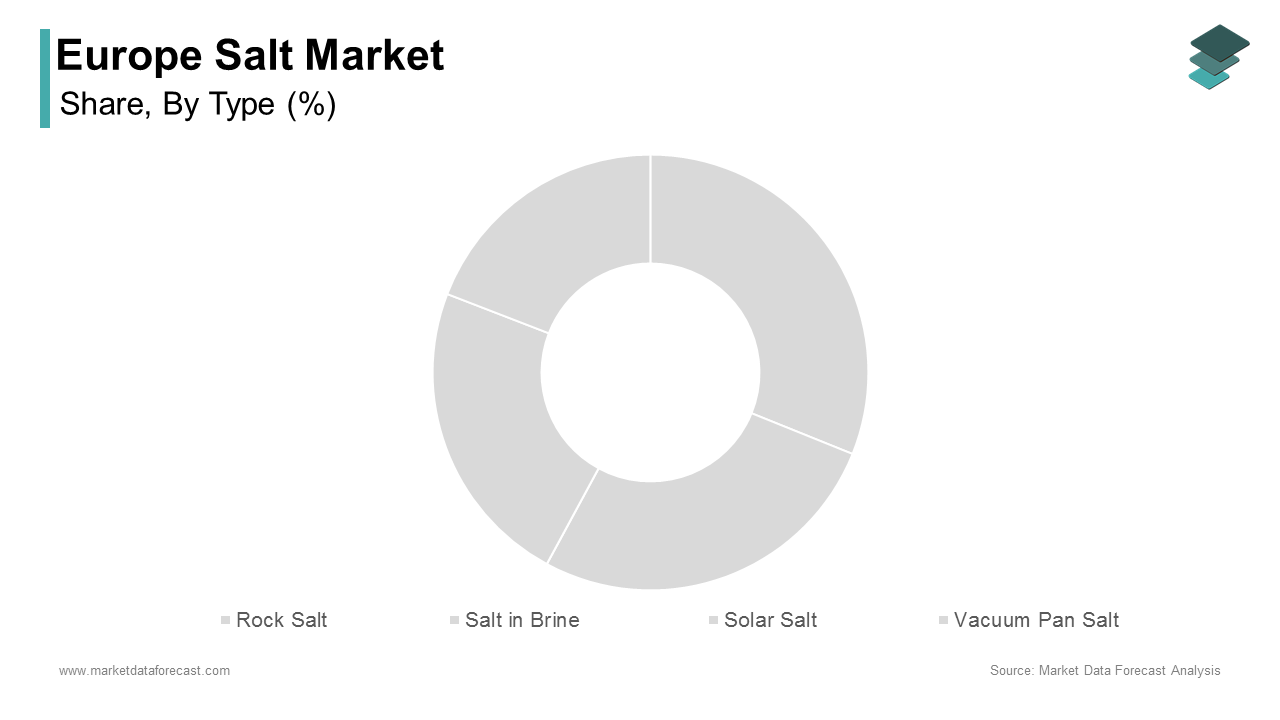
The vacuum pan segment is likely to experience the fastest CAGR of 4.7% from 2026 to 2034 due to rising demand for high-purity, food-grade salt with consistent crystal size and low impurity levels. Produced by evaporating brine under vacuum and controlled temperatures, this salt meets stringent standards for table use, baking, dairy processing, and pharmaceutical applications. According to a study, vacuum pan refined salt is a growing segment within the food-grade market, favored for its high purity and capability to uniformly incorporate nutritional additives like iodine and fluoride. The clean-label movement has further boosted its appeal, as consumers reject anti-caking agents found in some solar salts. Major producers like Salzgewinnungsgesellschaft Süd GmbH in Germany and Salins Group in France have invested in energy-efficient multi-effect evaporators to reduce carbon intensity. Stricter health regulations and a focus on clean-label ingredients are driving the growing relevance of vacuum pan salt, valued for its purity and consistent, precise quality.
By Source Insights
The salt mines segment held the majority share of 65.6% of the Europe salt market in 2025. The prominence of the salt mines is attributed to the continent’s rich geological endowment of Permian and Triassic-era salt formations, particularly in Germany, Poland, and the UK. According to research, Europe hosts numerous active rock salt mines, with the Bexbach mine in Germany alone producing millions of tons annually. Mined salt is essential for de-icing and chlor-alkali feedstock due to its high sodium chloride content and logistical advantages in bulk transport. Unlike brine-based sources that require significant energy for evaporation, mined salt can be crushed and screened with minimal processing, reducing both cost and carbon footprint. National strategic stockpiling policies, such as France’s large winter reserve, further anchor demand for mine-derived salt. This geological advantage, coupled with mature extraction infrastructure, ensures that salt mines remain the backbone of Europe’s salt supply chain.
The brine segment is on the rise and is expected to be the fastest-growing segment in the market by witnessing a CAGR of 5.1% during the forecast period, owing to the expansion of solution mining and natural brine extraction for high-purity applications in food, pharmaceuticals, and water softening. Unlike rock salt, brine allows for precise control over mineral composition, enabling the production of ultra-pure sodium chloride with less than 0.01 percent impurities, critical for dialysis solutions and infant formula. Modern membrane-cell chlor-alkali facilities increasingly use highly purified, brine-derived salt to prevent calcium and magnesium fouling from damaging sensitive ion-exchange membranes. Additionally, solution mining creates underground caverns that can be repurposed for hydrogen or CO₂ storage, adding strategic value beyond salt production. Companies like K+S AG in Germany are investing in closed-loop brine circuits that minimize freshwater use and wastewater discharge. Europe's focus on resource efficiency and circularity is turning brine-based salt production from a niche method into a flexible, forward-looking resource.
By Application Insights
The chemical processing segment led the Europe salt market by capturing a 35.3% share in 2025. The leading position of the chemical processing segment is credited to its consumption as feedstock for chlor-alkali electrolysis. Salt is the sole raw material for producing chlorine and caustic soda, essential inputs for PVC, polyurethane, pharmaceuticals, and water disinfection. The European chlor-alkali industry continues to produce significant amounts of chlorine, requiring high volumes of salt, with production volumes showing a recovery trend in the first half of 2024 compared to previous years. This demand is non-discretionary and structurally embedded in Europe’s chemical value chain. Without salt, critical sectors like healthcare (for IV fluids and disinfectants) and construction (for PVC pipes) would face severe disruption. The segment’s dominance is further reinforced by long-term offtake agreements between salt producers and chemical giants like BASF and Solvay, ensuring stable demand regardless of economic cycles. Unlike seasonal applications such as de-icing, chemical processing operates year-round with predictable consumption patterns, making it the most reliable and volume-intensive pillar of the European salt economy.
The water treatment segment is expected to exhibit a noteworthy CAGR of 5.8% from 2026 to 2034. The swift expansion of the water treatment segment is propelled by tightening EU regulations on drinking water quality and wastewater reuse. Salt is essential for regenerating ion-exchange resins in domestic and municipal water softeners, which remove hardness-causing calcium and magnesium ions. Due to the prevalence of hard water and increasing consumer awareness regarding water quality, the adoption of water softening systems is increasing across Europe, resulting in growing demand for salt in this sector. The revised Urban Wastewater Treatment Directive mandates nutrient removal and water recycling, further increasing demand for salt in tertiary treatment processes. Additionally, the European Commission’s Zero Pollution Action Plan promotes decentralized water purification in rural areas, driving adoption of small-scale softening units. Climate change and aging pipes are driving a surge in water management needs. In response, salt is becoming an indispensable tool for ensuring safety and efficiency across all sectors.
REGIONAL ANALYSIS
Germany Salt Market Analysis
Germany dominated the Europe salt market by accounting for a 28.6% share in 2025. The dominance of the German market is driven by its dual role in chemical manufacturing and winter road safety. The country’s market status reflects deep integration into the chlor-alkali industry, with BASF and Covestro relying on domestic salt from mines like Sigmundshall and Bexbach for chlorine production. According to a study, Germany produces over 18 million metric tons of salt annually, with 40 percent dedicated to chemical feedstock and 30 percent to de-icing. The nation manages a comprehensive winter maintenance infrastructure, applying large amounts of salt to keep road networks operational during cold seasons. Recent investments in solution mining in Lower Saxony also support emerging hydrogen storage projects. Strict adherence to REACH and food safety standards ensures high-quality output for pharmaceutical and food applications. This combination of industrial scale, infrastructural necessity, and regulatory rigor solidifies Germany’s position as the cornerstone of Europe’s salt economy.
France Salt Market Analysis
France followed closely in the Europe salt market and captured a 19.1% share in 2025. The growth of the French market is attributed to its vast road network, historic salt marshes, and state-backed stockpiling policies. The market status is defined by a balanced mix of sources: rock salt from the Varangéville mine, solar salt from Guérande and Camargue, and vacuum pan salt for food use. France maintains extensive strategic reserves of de-icing salt, distributed across numerous depots nationwide to ensure road accessibility. The country is also Europe’s largest producer of gourmet sea salt, with Guérande’s fleur de sel protected under EU geographical indication. Large-scale chemical production operations, particularly in the soda ash sector, consume significant amounts of salt annually for raw material requirements. France’s dual identity, as both a heritage salt producer and a modern industrial user, ensures resilient and diversified demand across culinary, infrastructural, and chemical domains.
United Kingdom Salt Market Analysis
The United Kingdom holds a significant position in the Europe salt market due to the Winsford mine in Cheshire, the largest rock salt mine in Europe, which produces millions of tons annually, supplying a large portion of the UK’s de-icing demand. According to the UK Department for Transport and national guidance, local authorities and highway agencies are required to maintain substantial salt stockpiles to ensure road safety during winter, designed to withstand prolonged periods of severe weather. Beyond infrastructure, the UK is a major consumer of water softening salt, with millions of households in hard-water areas using ion-exchange systems. Tate & Lyle’s London facility refines vacuum pan salt for food and pharmaceutical use, meeting stringent British Pharmacopoeia standards. Despite Brexit, the UK continues to align with EU food safety norms, ensuring seamless integration into European specialty salt supply chains.
Poland Salt Market Analysis
Poland grew steadily in the Europe salt market owing to strong domestic demand for de-icing and chemical applications, with Poland’s substantial kilometers of roads requiring significant tons of salt annually. It accounts for a notable portion of regional production, primarily from the Wieliczka and Bochnia mines, UNESCO World Heritage sites that still operate commercially. Poland leverages its extensive underground rock salt deposits and competitive pricing to remain a key supplier of salt products to neighboring European, German, and Baltic markets. The domestic chemical sector, with key operators such as Anwil SA, drives significant demand for industrial-grade salt for the production of chlorine and plastic materials. Poland’s accession to the EU harmonized its salt standards, opening export opportunities while modernizing mining safety protocols. Though less visible than Western producers, Poland’s geological wealth and strategic location make it a vital supply buffer for Central and Eastern Europe.
Netherlands Salt Market Analysis
The Netherlands is predicted to expand in the European salt market from 2026 to 2034 due to its advanced brine-based production and subsurface infrastructure. The market status is also supported by solution mining in the Groningen and Limburg regions, where companies like Nedmag extract brine not only for salt but also to create caverns for gas and hydrogen storage. According to the Dutch Ministry of Infrastructure and Water Management, although substantial amounts of salt are used annually to maintain safe road conditions during winter, the material's most critical importance is found in its extensive application within chemical processing and water treatment sectors. AkzoNobel’s chlor-alkali plants rely on ultra-pure brine-derived salt, while millions of households use water softeners in one of Europe’s hardest-water nations. The Port of Rotterdam facilitates salt imports for re-export, enhancing logistical reach. This fusion of subsurface engineering, water technology, and chemical integration positions the Netherlands as a high-value, innovation-driven node in Europe’s evolving salt landscape.
COMPETITION OVERVIEW
The Europe salt market features a mix of large integrated producers and regional specialists competing on reliability, purity, and sustainability rather than price alone. Incumbents like K+S Salins and Tata Chemicals dominate through control of geological assets, advanced processing capabilities, and long-standing relationships with chemical and public sector customers. Competition is segmented between bulk industrial salt, where logistics and volume matter, and specialty salts, where origin certification and micronutrient formulation drive value. New entrants face high barriers, including capital intensity permitting delays for new mines and stringent food and environmental regulations. The market is not highly dynamic but evolves through regulatory shifts such as sodium reduction policies and climate initiatives that repurpose salt infrastructure for energy storage. Collaboration rather than rivalry characterizes relationships, particularly in the chlor-alkali and road safety sectors, where supply security is paramount. Innovation focuses on decarbonization, cavern utilization, and functional salts rather than product substitution. This environment rewards operational excellence, regulatory compliance, and strategic foresight over aggressive pricing or marketing.
KEY MARKET PLAYERS
A few major players of the Europe salt market include
- K+S AG
- Tata Chemicals Limited
- CIECH S.A
- Solvay S.A
- Compass Minerals International Inc
- Salins Group
- Südsalz GmbH
- European Salt Company GmbH & Co. KG
- INEOS Enterprises
- Akzo Nobel N.V
Top Strategies Used by the Key Market Participants
Key players in the Europe salt market are investing in renewable energy integration to power evaporation and mining operations, reducing carbon intensity across production chains. They are expanding solution mining not only for salt but to create underground caverns for hydrogen and CO₂ storage, supporting EU energy transition goals. Companies are developing premium specialty salts fortified with minerals or certified under geographical indications to capture higher margins in food and wellness segments. Strategic partnerships with chlor-alkali producers ensure long-term offtake agreements for high-purity salt, securing stable industrial demand. Modernization of road salt logistics through smart stockpile monitoring and just-in-time delivery enhances public sector service reliability. Compliance with REACH and food safety regulations is prioritized through rigorous impurity testing and traceability systems. Diversification into water softening and pharmaceutical grades opens resilient, non-seasonal revenue streams. Adoption of closed-loop brine circuits minimizes freshwater consumption and wastewater discharge, aligning with circular economy principles. Geographic consolidation of mining assets improves operational efficiency and reduces transport emissions. Innovation in low-sodium salt blends addresses public health mandates without compromising functionality in food applications.
Leading Players in the Europe Salt Market
- K+S AG is a German multinational and one of Europe’s largest integrated salt producers, operating mines in Germany, France, and the UK while serving global markets in food, chemical, and de-icing sectors. The company contributes to the worldwide salt industry through its advanced solution mining technology and extensive logistics network for bulk distribution. In Europe, K+S supplies high-purity rock and vacuum pan salt to chlor-alkali plants, municipal road agencies, and food processors under strict EU safety standards. Recently, the company expanded its brine extraction capacity in Lower Saxony to support both salt production and hydrogen storage cavern development, aligning with Germany’s energy transition goals. It also launched a low-carbon vacuum pan salt line powered by renewable electricity, reinforcing its commitment to sustainable mineral extraction.
- Salins Group is a leading European producer of sea salt and specialty salts, headquartered in France with operations across Portugal, Spain, and Italy. The company is globally recognized for its artisanal solar salt harvested from traditional salterns like Guérande and Camargue, which hold protected geographical indications. In Europe, Salins supplies gourmet, iodized, and functional salts to premium food brands, health institutions, and water softening markets. To strengthen its position, Salins recently invested in automated harvesting systems that reduce freshwater usage and improve crystal consistency while preserving traditional methods. It also introduced a line of mineral-enriched salts fortified with magnesium and selenium, targeting the growing wellness segment and enhancing its value proposition beyond basic sodium chloride.
- Tata Chemicals Europe, formerly Brunner Mond, operates the UK’s largest salt mine at Winsford and is a key supplier of industrial and food-grade salt across Northern Europe. The company plays a critical role in the global chlor-alkali supply chain, providing high-purity salt to chemical manufacturers and water treatment facilities. In Europe, it serves national road agencies, dairy processors, and pharmaceutical companies requiring British Pharmacopoeia-compliant products. Recently, Tata Chemicals Europe commissioned a carbon capture and utilization pilot at its Cheshire site, aiming to store CO₂ in adjacent salt caverns—a first-of-its-kind integration of salt infrastructure with climate mitigation. This innovation positions the company as a pioneer in transforming mineral extraction into a climate solution.
MARKET SEGMENTATION
This research report on the europe salt market has been segmented and sub-segmented based on type, source, application & region.
By Type
- Rock Salt
- Salt in Brine
- Solar Salt
- Vacuum Pan Salt
By Source
- Brine
- Salt Mines
By Application
- Chemical Processing
- De-icing
- Water Treatment
- Oil & Gas
- Agriculture
- Flavoring Agent
- Others
By Region
- UK
- France
- Spain
- Germany
- Italy
- Russia
- Sweden
- Denmark
- Switzerland
- Netherlands
- Turkey
- Czech Republic
- Rest of Europe