Europe Self Driving Cars Market Size, Share, Trends & Growth Forecast Report – Segmented By Components, Automation Level, Connectivity, and Country (UK, France, Spain, Germany, Italy, Russia, Sweden, Denmark, Switzerland, Netherlands, Turkey, Czech Republic & Rest of Europe), Industry Analysis From 2026 to 2034
Market Size, 2025
$20.94 BnMarket Estimate, 2026
$25.27 BnMarket Forecast, 2034
$113.42 BnCAGR, 2026–2034
20.65%Europe Self Driving Cars Market Report Summary
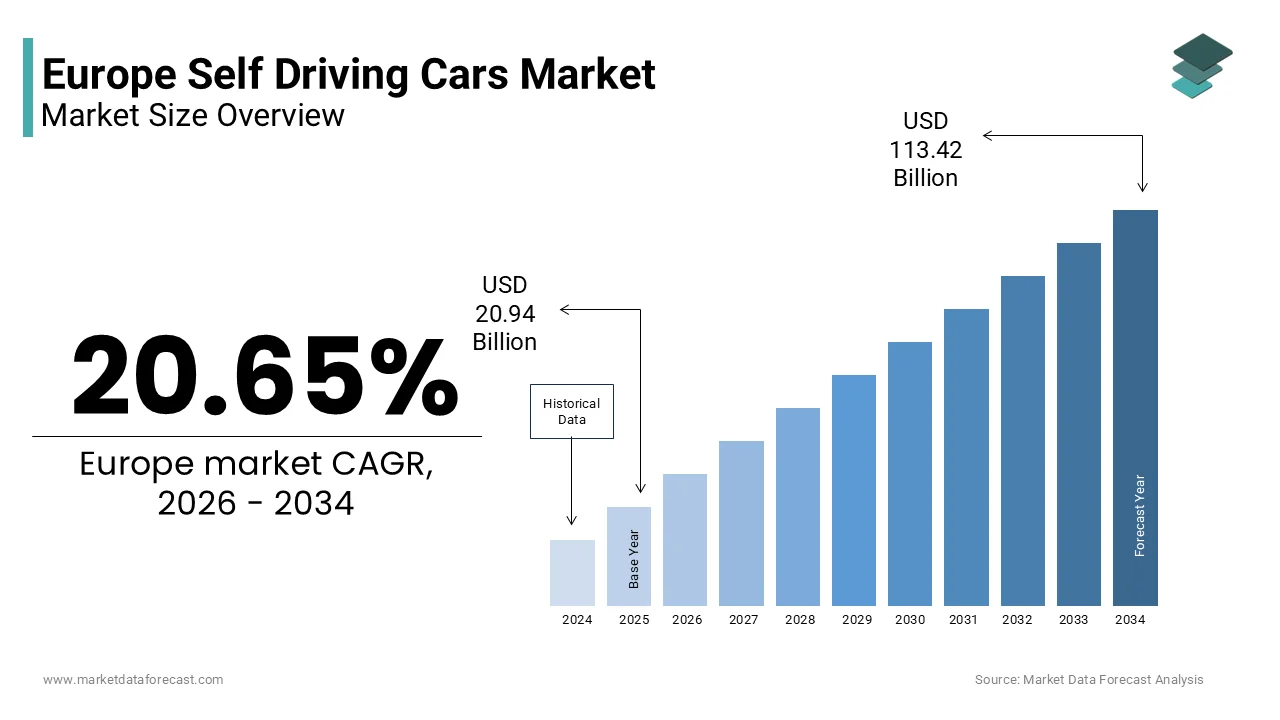
The Europe self driving cars market was valued at USD 20.94 billion in 2025, is estimated to reach USD 25.27 billion in 2026, and is projected to reach USD 113.42 billion by 2034, growing at a CAGR of 20.65% during the forecast period. Market growth is driven by rapid advancements in autonomous driving technologies, increasing investments in artificial intelligence and sensor systems, and rising demand for enhanced vehicle safety and convenience. Strong regulatory support, along with the expansion of smart mobility solutions and connected infrastructure, is further accelerating market development. In addition, collaborations between automotive manufacturers and technology companies are supporting innovation and large scale deployment across Europe.
Key Market Trends
- Rapid advancements in artificial intelligence and sensor technologies are driving autonomous vehicle development.
- Increasing adoption of advanced driver assistance systems is supporting transition toward higher automation levels.
- Growing integration of connected vehicle technologies such as V2X is enhancing real time communication and safety.
- Rising investments in smart mobility and intelligent transportation systems are boosting market growth.
- Strong regulatory support and pilot programs are accelerating adoption across Europe.
Segmental Insights
- Based on components, the hardware segment was the largest and held 55.1% of the Europe self driving cars market share in 2025. This dominance is attributed to high demand for sensors, cameras, radar, and LiDAR systems required for autonomous driving.
- Based on automation level, the Level 2 segment accounted for 60.2% of the Europe self driving cars market share in 2025. The segment’s growth is driven by widespread adoption of partial automation features such as adaptive cruise control and lane keeping assistance.
- Based on connectivity, the vehicle to everything segment dominated with 45.3% of the Europe self driving cars market share in 2025, supported by increasing need for real time communication between vehicles, infrastructure, and networks.
Regional Insights
- The Europe self driving cars market is experiencing rapid growth across key countries, supported by technological advancements and strong automotive industry presence.
- Germany was the largest contributor, accounting for 25.1% of the Europe self driving cars market share in 2025, driven by leading automotive manufacturers, advanced R and D capabilities, and supportive regulatory environment.
Competitive Landscape
The Europe self driving cars market is highly competitive, with major players focusing on innovation, partnerships, and technology integration to strengthen their market position. Companies are investing in autonomous driving software, sensor technologies, and connected mobility solutions. Prominent players in the Europe self driving cars market include Volkswagen AG, BMW AG, Mercedes Benz Group AG, Volvo Car Corporation, Stellantis N V, Renault Group, Continental AG, Mobileye, Oxbotica Ltd, Wayve, Oxa, and MOIA.
Europe Self Driving Cars Market Size
The Europe self driving cars market size was valued at USD 20.94 billion in 2025 and is projected to reach USD 113.42 billion by 2034 from USD 25.27 billion in 2026, growing at a CAGR of 20.65%.
A self-driving car, also known as an autonomous vehicle (AV) or driverless car, is a vehicle capable of sensing its environment and navigating without human involvement. This market spans various levels of automation, from Level 2 driver assistance systems to fully autonomous Level 5 vehicles, although current commercial activities primarily focus on Level 3 and Level 4 capabilities in controlled environments. The market is characterized by intense collaboration between traditional automotive original equipment manufacturers, technology giants, and specialized software developers. According to the European Commission's 2025 preliminary figures, road accidents claim approximately 19,400 lives annually in the European Union, with human error contributing to 95 percent of these incidents, underscoring the urgent safety imperative for autonomous solutions. Furthermore, the European Commission estimates that urban congestion costs European economies approximately €110 billion each year in lost productivity and fuel waste, creating a strong economic case for automated mobility services. The regulatory landscape is evolving rapidly, with the European Union introducing specific type approval frameworks for automated vehicles to ensure safety and cybersecurity standards. Germany has emerged as a pioneer by legalizing Level 4 autonomous driving on public roads, setting a precedent for other member states. The market definition extends beyond passenger cars to include autonomous shuttles, logistics trucks, and last mile delivery robots, reflecting a holistic transformation of urban and interurban mobility ecosystems driven by technological innovation and societal needs.
MARKET DRIVERS
Stringent Safety Regulations and Government Initiatives for Accident Reduction
Stringent safety regulations and proactive government initiatives aimed at reducing road fatalities accelerate the growth of the Europe self driving cars market. The European Union has established ambitious goals under its Vision Zero strategy, which aims to eliminate road deaths by 2050. Autonomous vehicles are perceived as a critical technology to achieve this target by eliminating human errors such as distracted driving, fatigue, and impaired judgment. The European Road Safety Observatory monitors the integration of assisted and automated driving technologies, noting their potential to reduce traffic risks. While these systems aim to minimize human error, the overall decline in road incidents is attributed to a combination of vehicle safety standards, improved infrastructure, and enhanced driver awareness. Under the European Commission’s General Safety Regulation, new vehicle models must incorporate advanced safety technologies designed to protect passengers and vulnerable road users. These requirements establish a baseline for vehicle safety across the European Union, mandating features that intervene in critical situations to prevent accidents. Governments across Europe are also investing heavily in smart infrastructure projects that support vehicle to infrastructure communication, enhancing the operational reliability of autonomous systems. For instance, the Netherlands and France have designated specific zones for autonomous vehicle testing, providing real world data to refine algorithms. These regulatory pressures compel automotive manufacturers to accelerate the development and integration of autonomous technologies to remain compliant and competitive. The alignment of public policy with technological capability creates a favorable environment for market growth, as stakeholders recognize the potential of self driving cars to transform road safety standards and reduce the societal burden of traffic related injuries and fatalities.
Rising Demand for Mobility as a Service and Shared Transportation Models
The rising demand for Mobility as a Service (MaaS) and shared transportation models is significantly driving the expansion of the European self-driving cars market. Urbanization trends and changing consumer preferences, particularly among younger demographics, are shifting focus from vehicle ownership to access based mobility solutions. Autonomous vehicles are integral to the viability of MaaS platforms, as they reduce operational costs by eliminating driver wages, which constitute a substantial portion of ride hailing expenses. Eurostat projections indicate that a vast majority of the European Union's population will reside in urban regions and clusters by the middle of the century. This demographic shift highlights the importance of developing robust and adaptable transport networks to manage the increasing density of metropolitan areas. Besides, the International Association of Public Transport (UITP) suggests that automated mobility solutions, when integrated into existing public transit frameworks, can enhance service reach and operational efficiency. By serving as a complement to high-capacity networks, these technologies can help address transport needs in areas with lower connectivity. Cities like Paris, Helsinki, and Berlin are actively piloting autonomous shuttle services to complement existing transport networks, demonstrating the practical application of this technology. The integration of self driving cars into MaaS ecosystems offers users seamless, cost effective, and convenient travel options, reducing the reliance on private car ownership. This shift is further supported by environmental concerns, as shared autonomous fleets are predominantly electric, aligning with sustainability goals. The economic efficiency of driverless operations enables service providers to offer competitive pricing, thereby attracting a broader customer base. Consequently, the synergy between autonomous technology and shared mobility models accelerates market penetration and fosters innovation in urban transport solutions.
MARKET RESTRAINTS
Complex Regulatory Frameworks and Liability Issues
Complex regulatory frameworks and unresolved liability issues hamper the growth of the Europe self driving cars market. While some countries like Germany have introduced legislation for Level 4 autonomous driving, the lack of harmonized regulations across the European Union creates uncertainty for manufacturers and operators. Each member state has different legal interpretations regarding vehicle certification, data privacy, and operational permissions, complicating cross border deployment. The European Parliamentary Research Service (EPRS) continues to assess the need for harmonised liability rules to ensure legal certainty for autonomous systems. While existing directives are being adapted to cover digital and AI components, a fully integrated civil liability framework remains a focal point for legislative updates to protect consumers and reduce transaction costs for manufacturers. Determining whether the manufacturer, software provider, or user is responsible in the event of a system failure poses significant legal challenges. The European Insurance and Occupational Pensions Authority (EIOPA) provides guidance on how insurers can adapt their governance and risk management to account for autonomous technologies. Current trends show that insurance companies are actively developing and implementing AI-specific policies to address emerging risks while maintaining robust protection standards for policyholders. This legal ambiguity discourages investment and slows down commercialization efforts, as companies hesitate to launch services without clear liability protections. Furthermore, the rigorous type approval process for automated systems requires extensive validation and documentation, increasing time to market. The fragmented regulatory landscape forces manufacturers to navigate a patchwork of rules, increasing compliance costs and operational complexity. A cohesive European framework addressing liability, insurance, and cross-border operations is not yet established. Consequently, the market will face substantial barriers to widespread adoption and scalability.
High Development Costs and Technological Complexity
High development costs and technological complexity further hinder the expansion of the Europe self driving cars market. Developing fully autonomous vehicles requires substantial investment in research and development, particularly in sensors, computing hardware, and artificial intelligence algorithms. The integration of LiDAR, radar, cameras, and high performance processors entails significant manufacturing expenses, making initial vehicle prices prohibitive for mass market adoption. Sources identify that the total investment required for market-ready autonomous systems remains substantial, particularly for software validation and industrialization. While some hardware components benefit from manufacturing efficiencies, the rigorous requirements for safety and complex traffic scenarios continue to influence the overall cost structure of advanced mobility solutions. According to the Society of Motor Manufacturers and Traders (SMMT), the transition to software-defined mobility requires significant investment in complex system integration and real-world testing environments. These efforts are viewed as essential for maintaining a competitive automotive sector and ensuring the safety and reliability of next-generation vehicles. Training AI models to handle diverse and unpredictable driving scenarios requires millions of miles of data collection and simulation, which is resource intensive. Additionally, the rapid pace of technological obsolescence means that hardware and software must be continuously updated, further increasing lifecycle costs. Small and medium sized enterprises struggle to compete with tech giants and established automakers who have deeper pockets for sustained innovation. The high capital expenditure required for infrastructure upgrades, such as smart traffic lights and connected road units, also falls on public authorities with limited budgets. These financial and technical barriers limit the speed of market entry and restrict the availability of affordable autonomous solutions, thereby slowing down overall market growth and consumer acceptance.
MARKET OPPORTUNITIES
Integration with Smart City Infrastructure and Vehicle to Everything Technology
The integration of autonomous vehicles (AV) or driverless cars with smart city infrastructure and Vehicle to Everything (V2X) technology opens doors for expansion of the Europe self driving cars market. Smart cities leverage Internet of Things sensors and connectivity to optimize traffic flow, enhance safety, and improve urban living conditions. Autonomous vehicles can communicate with traffic lights, road signs, and other vehicles to receive real time information about road conditions, hazards, and traffic patterns. The EU Mission for Climate-Neutral and Smart Cities involves over 100 European cities working to implement sustainable urban solutions. This initiative supports the integration of advanced digital technologies and smart mobility frameworks, including vehicle-to-infrastructure communication, to improve urban efficiency and reduce environmental impact. According to the 5G Automotive Association (5GAA), the deployment of advanced cellular networks and dedicated V2X communication is vital for the development of connected mobility. These technologies aim to provide the high-speed data exchange and reliability necessary to support complex traffic management and enhanced vehicle safety features. This connectivity allows self driving cars to make faster and more informed decisions, enhancing safety and efficiency. Municipalities are increasingly investing in digital infrastructure to support autonomous mobility, offering partnerships and pilot programs for technology providers. The synergy between autonomous vehicles and smart infrastructure facilitates optimized route planning, reduced congestion, and lower emissions. Furthermore, V2X technology enables new services such as remote parking and automated valet services, enhancing user convenience. By collaborating with city planners and telecommunications providers, automotive companies can create integrated mobility ecosystems that offer superior value propositions. This holistic approach not only accelerates the adoption of self driving cars but also positions them as key components of future urban mobility strategies.
Expansion of Autonomous Logistics and Last Mile Delivery Solutions
The expansion of autonomous logistics and last mile delivery solutions provides a lucrative opportunity for the Europe self driving cars market. The surge in e commerce has increased demand for efficient and cost effective delivery methods, particularly in urban areas where labor shortages and congestion are prevalent. Autonomous delivery vehicles and robots can operate continuously without breaks, reducing delivery times and operational costs. Eurostat indicates a continued upward trend in e-commerce activity across the European Union, with a rising percentage of consumers purchasing goods online. This shift in commerce patterns significantly influences the volume of transport and delivery activities within the regional market. Companies are piloting autonomous vans and sidewalk robots in cities like London, Berlin, and Zurich to test feasibility and consumer acceptance. These vehicles can navigate complex urban environments to deliver packages directly to customers’ doors, enhancing convenience. The use of autonomous trucks for long haul freight on highways also presents significant potential, addressing driver shortages and improving supply chain efficiency. Regulatory support for automated logistics is growing, with several countries allowing trials on public roads. By focusing on commercial applications, technology providers can generate revenue streams while refining their systems for broader passenger vehicle deployment. This segment offers a pragmatic pathway to commercialization, leveraging the immediate economic benefits of automation in the logistics sector.
MARKET CHALLENGES
Cybersecurity Risks and Data Privacy Concerns
Cybersecurity risks and data privacy concerns impede the growth of the Europe self driving cars market. Autonomous vehicles rely heavily on software and connectivity, making them vulnerable to cyber attacks that could compromise safety and functionality. Hackers could potentially take control of vehicle systems, leading to dangerous situations or data breaches. Ensuring compliance with these regulations while maintaining robust security protocols is complex and costly. Any security breach can result in severe reputational damage, legal liabilities, and loss of consumer trust. The interconnected nature of V2X systems expands the attack surface, requiring comprehensive security measures across multiple touchpoints. Manufacturers must invest in advanced encryption, intrusion detection systems, and regular security updates to protect against evolving threats. However, the rapid pace of technological change makes it difficult to stay ahead of sophisticated cyber attacks. The lack of standardized cybersecurity frameworks across Europe further complicates compliance efforts. Addressing these vulnerabilities is essential for gaining public acceptance and ensuring the safe operation of autonomous vehicles, but it remains a persistent and challenging obstacle for industry stakeholders.
Public Skepticism and Lack of Trust in Autonomous Technology
Public skepticism and lack of trust in autonomous technology are holding back the expansion of the European self-driving car market. Despite the potential safety benefits, many consumers remain hesitant to relinquish control to machines due to fears of malfunction or accidents. High profile incidents involving autonomous vehicles globally have amplified these concerns, influencing public perception. The complexity of autonomous systems makes it difficult for users to understand how decisions are made, leading to a black box effect that erodes confidence. Negative media coverage often highlights failures rather than successes, reinforcing negative stereotypes. Overcoming this psychological barrier requires extensive public education and transparent communication about the capabilities and limitations of the technology. Demonstrating consistent safety records through prolonged pilot programs is crucial for building trust. However, achieving widespread social acceptance is a gradual process that may lag behind technological advancements. Without public confidence, regulatory progress and commercial deployment may face resistance, hindering the market’s growth potential and delaying the realization of autonomous mobility benefits.
REPORT COVERAGE
| REPORT METRIC | DETAILS |
| Market Size Available | 2025 to 2034 |
| Base Year | 2025 |
| Forecast Period | 2026 to 2034 |
| CAGR | 20.65% |
| Segments Covered | By Components, Automation Level, Vehicle Type, Connectivity, and Region |
| Various Analyses Covered | Global, Regional, & Country Level Analysis; Segment-Level Analysis; DROC, PESTLE Analysis; Porter’s Five Forces Analysis; Competitive Landscape; Analyst Overview of Investment Opportunities |
| Regions Covered | UK, France, Spain, Germany, Italy, Russia, Sweden, Denmark, Switzerland, Netherlands, Turkey, and the Czech Republic |
| Market Leaders Profiled | Volkswagen AG, BMW AG, Mercedes-Benz Group AG, Volvo Car Corporation, Stellantis N.V., Renault Group, Continental AG, Mobileye, Oxbotica Ltd., Wayve, Oxa, and MOIA. |
SEGMENTAL ANALYSIS
By Components Insights
The hardware segment dominated the Europe self driving cars market and accounted for a 55.1% share in 2025. This dominance is driven by the critical necessity of advanced sensor suites to enable autonomous navigation and environmental perception. Cameras, LiDAR, radar, and ultrasonic sensors form the physical foundation of any autonomous vehicle, requiring substantial capital investment for manufacturing and integration. A study indicates that the integration of advanced sensor suites, including LiDAR, radar, and high-resolution cameras, increases the manufacturing cost of Level 3 autonomous vehicles compared to conventional models. This investment reflects the necessity for redundant systems and high-precision data processing to ensure safe operation in complex environments. Research shows that the global automotive LiDAR market is expanding as manufacturers incorporate more advanced safety features. While different regions are adopting these technologies at varying rates, the trend is driven by the increasing availability of high-performance components and evolving safety assessment protocols. The proliferation of high resolution cameras is essential for object detection and lane keeping, while radar provides reliable performance in adverse weather conditions. The integration of these diverse hardware components requires sophisticated engineering and calibration, creating a high barrier to entry that sustains the value of the hardware segment. Furthermore, the ongoing miniaturization and cost reduction of solid state LiDAR are making these technologies more accessible for mass production. Automotive original equipment manufacturers are increasingly partnering with specialized sensor suppliers to secure supply chains and ensure quality. The physical durability and reliability of hardware components are paramount for consumer trust and regulatory approval, reinforcing the segment's market leadership. Continuous innovation in sensor technology, such as 4D imaging radar and thermal cameras, further drives demand and maintains the hardware segment's dominant position in the ecosystem.
The end to end autonomous driving software segment is anticipated to witness the fastest CAGR of 28.5% from 2026 to 2034 due to the shift from modular software architectures to unified neural network based systems that process sensor data directly into control commands. This approach reduces latency and improves decision making efficiency, which is crucial for safe autonomous operation. Sources emphasize a fundamental shift toward software-defined vehicles, where digital architecture plays a central role in vehicle functionality. As this transition progresses, the value contributed by software and electronics is expected to represent a larger share of the total vehicle cost compared to traditional mechanical components. Major automotive manufacturers in Europe are making substantial investments in artificial intelligence and machine learning to advance their autonomous driving capabilities. These efforts focus on developing integrated software stacks and proprietary algorithms to enhance vehicle perception, decision-making, and overall performance in real-world traffic. This software paradigm allows for continuous over the air updates, enabling vehicles to improve their driving capabilities over time without hardware changes. The ability to learn from vast amounts of real world driving data gives companies a competitive edge in algorithm refinement. Major technology firms and startups are collaborating with car manufacturers to accelerate development cycles. The scalability of end to end software across different vehicle models and platforms enhances its economic viability. Regulatory bodies are also beginning to recognize the importance of software validation, creating frameworks that support its deployment. The transition to this advanced software architecture represents a fundamental shift in automotive engineering, driving unprecedented growth in this segment as companies race to achieve higher levels of autonomy and operational efficiency.
By Automation Level Insights
The Level 2 automation segment led the Europe self driving cars market and captured a share of 60.2% in 2025. This leading position of the segment is attributed to the widespread availability and regulatory acceptance of advanced driver assistance systems that require constant driver supervision. Features such as adaptive cruise control, lane centering, and automatic emergency braking are now standard in many new vehicles sold in Europe. According to sources, the inclusion of these safety features has become a prerequisite for achieving high safety ratings, influencing consumer purchasing decisions. Consumers perceive Level 2 systems as a practical balance between convenience and safety, without the legal and ethical complexities associated with higher levels of autonomy. The lower cost of implementation compared to Level 3 or 4 systems makes them accessible to a broader range of vehicle segments, from economy to luxury cars. Automotive manufacturers have refined these systems to provide smooth and reliable performance in highway and urban environments. The familiarity of drivers with Level 2 functionalities builds trust and prepares the market for future advancements. Additionally, insurance companies often offer discounts for vehicles equipped with these safety technologies, further incentivizing adoption. The robust infrastructure support for Level 2 systems, including clear lane markings and traffic signs, ensures effective operation. This segment's dominance is sustained by continuous improvements in sensor accuracy and software algorithms, enhancing user experience and safety outcomes.
The Level 4 automation segment is likely to experience the fastest CAGR of 32.1% during the forecast period owing to the deployment of fully autonomous vehicles in controlled environments such as robotaxi services, logistics hubs, and public transport shuttles. Unlike Level 5, Level 4 vehicles operate without human intervention within specific operational design domains, making them commercially viable today. According to research, several European cities have launched pilot programs for autonomous shuttles, demonstrating the feasibility of Level 4 technology in urban settings. Companies like Waymo, Zoox, and local European startups are scaling their fleets to provide on demand mobility services. The economic benefits of eliminating driver costs in logistics and transportation are a major catalyst for adoption. Regulatory frameworks are evolving to accommodate these deployments, providing clarity on liability and safety standards. The focus on specific use cases allows for optimized vehicle design and infrastructure integration. Partnerships between technology providers and municipal authorities facilitate the creation of smart zones conducive to autonomous operations. Rising technological confidence and reduced regulatory hurdles will accelerate the expansion of Level 4 services. Consequently, urban mobility and freight transport across Europe will be transformed.
By Connectivity Insights
The Vehicle to Everything (V2X) segment held the majority share of 45.3% of the Europe self driving cars market in 2025 because of the comprehensive nature of V2X technology, which encompasses vehicle to vehicle, vehicle to infrastructure, vehicle to pedestrian, and vehicle to network communications. V2X enables holistic situational awareness, allowing autonomous vehicles to anticipate hazards and optimize traffic flow beyond the line of sight of onboard sensors. According to sources, the rollout of 5G networks in Europe is accelerating the adoption of C V2X technology due to its low latency and high reliability. The ability to communicate with traffic lights, road signs, and other road users enhances safety and efficiency, which are critical for autonomous operations. Automotive manufacturers are increasingly embedding V2X modules in new vehicles to future proof their fleets. Standardization efforts by the European Telecommunications Standards Institute ensure interoperability across different brands and regions. The integration of V2X with cloud based services enables real time data analytics and remote monitoring. Government investments in smart city infrastructure further propel the adoption of V2X technologies. The comprehensive connectivity offered by V2X makes it indispensable for achieving higher levels of autonomy and realizing the full potential of smart mobility ecosystems in Europe.
The Vehicle to Infrastructure (V2I) segment is on the rise and is expected to be the fastest growing segment in the market by witnessing a CAGR of 26.8% between 2026 and 2034. This swift growth is fueled by extensive government initiatives to upgrade road infrastructure with smart sensors and communication units. V2I allows autonomous vehicles to receive real time information about traffic signals, road conditions, and construction zones, enabling proactive decision making. According to studies, billions of euros are being invested in digital infrastructure projects across the EU to support smart mobility. Municipalities are recognizing the value of V2I in enhancing public safety and optimizing urban planning. The deployment of smart traffic lights that communicate with approaching vehicles helps reduce idle time and emissions. Autonomous shuttles and buses benefit greatly from V2I connectivity, ensuring precise stopping and scheduling. The standardization of communication protocols facilitates seamless interaction between vehicles and infrastructure elements. Private sector partnerships with local governments are accelerating the deployment of V2I units in key corridors. The tangible benefits of improved traffic flow and safety make V2I an attractive investment for public authorities. As more cities adopt smart infrastructure solutions, the demand for V2I connectivity will continue to surge, driving rapid market expansion.
REGIONAL ANALYSIS
Germany Self Driving Cars Market Analysis
Germany was the top performer in the Europe self driving cars market and accounted for a 25.1% share in 2025. The demand for these cars in Germany is supported by its robust automotive industry and progressive regulatory framework. In 2021, Germany became the first country to allow Level 4 autonomous vehicles on public roads, setting a global precedent. The presence of major technology hubs in Munich and Berlin fosters innovation and collaboration between startups and established manufacturers. Government funding for research and development projects supports the testing and validation of autonomous systems. The country’s dense highway network and advanced digital infrastructure provide ideal conditions for real world testing. Public acceptance of autonomous technology is relatively high, supported by extensive educational campaigns. The integration of autonomous vehicles into industrial logistics and public transport is actively pursued to enhance efficiency. Germany’s commitment to maintaining its leadership in automotive innovation ensures continued growth and influence in the European self driving cars market.
United Kingdom Self Driving Cars Market Analysis
The United Kingdom was the next prominent country in the European market and occupied a 18.9% share in 2025. This position of the UK market is fuelled by a vibrant technology ecosystem and strong academic research institutions. Cities like London and Manchester are hosting large scale pilot programs for autonomous shuttles and delivery robots. The regulatory environment is evolving to support safe deployment, with the Automated Vehicles Act providing a clear legal framework. The country’s expertise in software development and data analytics complements its automotive manufacturing capabilities. Collaborations between universities and industry partners facilitate knowledge transfer and talent development. Public engagement initiatives aim to build trust and address safety concerns. The UK’s strategic focus on becoming a global leader in autonomous mobility attracts international investment and partnerships. The combination of technological prowess and supportive policy creates a dynamic environment for market growth and experimentation.
France Self Driving Cars Market Analysis
France continues to be a major player in the Europe self driving cars market due to a strategic national plan aimed at developing autonomous mobility solutions for urban and interurban transport. Paris is a key hub for smart mobility initiatives, with projects focusing on autonomous shuttles and ride hailing services. The country’s emphasis on sustainability aligns with the electrification of autonomous fleets. Regulatory frameworks are being updated to address liability and safety standards. Public transport operators are exploring autonomous solutions to improve service efficiency and coverage. The presence of research centers and innovation clusters supports technological advancement. Consumer interest in shared mobility services drives demand for autonomous options. France’s commitment to reducing carbon emissions and improving urban livability supports the adoption of self driving cars. The integration of autonomous technology into existing transport networks is a priority, ensuring seamless user experiences.
Sweden Self Driving Cars Market Analysis
Sweden held a promising share of the European self driving cars market owing to its strong tradition of automotive innovation and focus on safety. According to sources, Sweden has established itself as a leading test bed for autonomous vehicles, with dedicated facilities and public road trials. The cold climate and varied road conditions provide valuable data for refining autonomous systems. Government support for research and development encourages experimentation and innovation. Stockholm and Gothenburg are implementing smart city projects that integrate autonomous mobility. The high level of digital literacy among the population facilitates acceptance of new technologies. Safety remains a paramount concern, with rigorous testing protocols in place. The country’s commitment to sustainability promotes the use of electric autonomous vehicles. Sweden’s proactive approach to regulation and infrastructure development creates a favorable environment for market growth. The focus on practical applications in logistics and public transport demonstrates the viability of autonomous solutions.
Netherlands Self Driving Cars Market Analysis
The Netherlands is likely to grow significantly in the European self driving cars market from 2026 to 2034 due to advanced smart infrastructure and numerous pilot projects. Rotterdam and Amsterdam are leading cities in deploying autonomous shuttles and delivery services. The flat terrain and well maintained roads provide ideal conditions for testing. The government collaborates with private sector partners to develop standards and regulations. Public acceptance is fostered through transparent communication and demonstration projects. The focus on multimodal transport integrates autonomous vehicles with cycling and public transit. The Netherlands’ expertise in logistics and port automation drives demand for autonomous trucks. The commitment to innovation and sustainability positions the country as a key player in the European market. Continuous investment in digital infrastructure supports the scaling of autonomous solutions.
COMPETITIVE LANDSCAPE
The competition in the Europe self driving cars market is characterized by intense rivalry among established automotive original equipment manufacturers and emerging technology companies. Traditional automakers leverage their manufacturing expertise and brand loyalty to integrate autonomous features into existing vehicle lines. They focus on incremental advancements from Level 2 to Level 3 automation ensuring safety and regulatory compliance. Technology firms bring specialized expertise in artificial intelligence and software development challenging incumbents with innovative solutions. Partnerships between these entities are common as they seek to combine hardware proficiency with software sophistication. The market is fragmented with various players pursuing different strategies ranging from full stack development to component supply. Regulatory differences across European countries add complexity requiring adaptable solutions. Consumer trust and safety remain paramount influencing purchasing decisions and adoption rates. Companies compete on the reliability of their systems ease of use and the breadth of operational domains. The race to achieve higher levels of autonomy drives significant investment in research and development. Strategic alliances and acquisitions are frequent as firms aim to consolidate capabilities and accelerate time to market in this rapidly evolving sector.
KEY MARKET PLAYERS
Some of the notable key players in the Europe self driving cars market are
- Volkswagen AG
- BMW AG
- Mercedes-Benz Group AG
- Volvo Car Corporation
- Stellantis N.V.
- Renault Group
- Continental AG
- Mobileye
- Oxbotica Ltd.
- Wayve
- Oxa
- MOIA
Top Players in the Market
- Volkswagen Group is a dominant force in the Europe self driving cars market leveraging its extensive manufacturing capabilities and brand portfolio. The company invests heavily in autonomous technology through its subsidiary Cariad which develops unified software platforms for all group brands. Volkswagen recently partnered with Mobileye to integrate advanced driver assistance systems into its upcoming electric vehicle lineup. This collaboration accelerates the deployment of Level 2 and Level 3 automation features across European markets. The group focuses on scalable solutions that can be adapted for various vehicle segments from compact cars to commercial vans. By prioritizing software defined vehicle architectures Volkswagen aims to enhance user experience and safety. Its commitment to over the air updates ensures continuous improvement of autonomous functions. These strategic initiatives strengthen its competitive position and contribute significantly to global advancements in automated mobility while maintaining high standards of engineering excellence and reliability for European consumers.
- BMW Group plays a pivotal role in the Europe self driving cars market by focusing on premium autonomous driving experiences. The company has developed its own proprietary driving stack known as BMW Personal Pilot which supports Level 3 automation. BMW recently received regulatory approval for Level 3 autonomous driving in Germany and France marking a significant milestone. This achievement allows drivers to engage in secondary activities under specific conditions enhancing convenience and comfort. The group collaborates with technology partners like Qualcomm and Amazon Web Services to enhance computing power and cloud connectivity. BMW emphasizes safety and reliability ensuring that its autonomous systems meet stringent European standards. The integration of artificial intelligence enables predictive capabilities and smoother navigation. By offering high end autonomous features in its luxury models BMW differentiates itself in the competitive landscape. These efforts reinforce its reputation for innovation and quality contributing to the broader adoption of self driving technologies globally.
- Mercedes Benz Group is a pioneer in the Europe self driving cars market having achieved certification for Level 3 autonomous driving systems. The company introduced the Drive Pilot system which allows hands free driving in traffic jams on approved highways. Mercedes Benz continues to expand the operational design domain of Drive Pilot to include higher speeds and more road types. This expansion demonstrates its commitment to pushing the boundaries of autonomous technology. The group invests in extensive testing and validation processes to ensure utmost safety and compliance with regulations. Collaborations with NVIDIA provide the necessary hardware infrastructure for processing complex data in real time. Mercedes Benz also focuses on integrating autonomous features with luxurious interior experiences creating a unique value proposition. Its proactive approach to regulatory engagement helps shape favorable policies for autonomous vehicles. These actions solidify its leadership position and influence global standards for safe and reliable self driving car deployment.
Top Strategies Used by the Key Market Participants
Key players in the Europe self driving cars market primarily employ strategies such as strategic partnerships internal software development and regulatory engagement to strengthen their positions. Companies collaborate with technology firms to access advanced computing and artificial intelligence capabilities essential for autonomous systems. Developing proprietary software stacks allows manufacturers to control the user experience and differentiate their offerings. Engaging with regulators helps shape favorable legal frameworks for testing and deployment of higher automation levels. Investing in extensive real world testing builds data sets required for algorithm training and validation. Focusing on specific use cases like highway piloting or urban shuttles enables gradual and safe market introduction. Enhancing cybersecurity measures ensures protection against potential threats and builds consumer trust. These approaches enable participants to navigate technical and legal complexities while advancing the commercialization of self driving technologies in the competitive European automotive landscape.
MARKET SEGMENTATION
This research report on the European self driving cars market has been segmented and sub-segmented based on categories.
By Components
- Hardware
- Camera
- RADAR
- LiDAR
- Ultrasonic
- Others (IMUs, GNSS, etc.)
- Software
- Perception Software
- Localization Software
- Navigation Software
- Planning & Decision Software
- End-to-End Autonomous Driving Software
- Simulation & Evaluation Software
- Services
- Integration & Deployment Services
- Maintenance & Software Updates
- Cloud & Remote Monitoring Services
- Mobility-as-a-Service (MaaS)
By Automation Level
- Level 1
- Level 2
- Level 3
- Level 4
- Level 5
By Vehicle Type
- Passenger Cars
- Commercial Vehicles
By Connectivity
- Vehicle-to-Infrastructure (V2I)
- Vehicle-to-Vehicle (V2V)
- Vehicle-to-Everything (V2X)
By Country
- UK
- France
- Spain
- Germany
- Italy
- Russia
- Sweden
- Denmark
- Switzerland
- Netherlands
- Turkey
- Czech Republic
- Rest of Europe
Frequently Asked Questions
1.What is driving the growth of the Europe self driving cars market?
Growth is driven by advancements in artificial intelligence, increasing demand for road safety, and strong government support for autonomous mobility.
2.What are the key trends in the Europe self driving cars market?
Key trends include integration of advanced driver assistance systems, development of fully autonomous vehicles, and increased collaboration between automakers and technology companies.
3.What are self driving cars?
Self driving cars are vehicles equipped with sensors, cameras, and software that enable them to navigate and operate without human intervention.
4.Which level of autonomy is most common in Europe?
Level 2 and Level 3 automation are most common, where vehicles can assist with driving but still require human supervision.
5.What technologies are used in self driving cars?
Technologies include artificial intelligence, machine learning, LiDAR, radar, cameras, and high precision mapping systems.
6.Which segment is expected to grow the fastest in the Europe self driving cars market?
The Level 4 and Level 5 autonomous vehicle segment is expected to grow rapidly as technology and regulations evolve.
7.What challenges does the Europe self driving cars market face?
Challenges include regulatory uncertainty, high development costs, safety concerns, and cybersecurity risks.
8.How are regulations influencing the self driving cars market in Europe?
Regulations are shaping the market by setting safety standards, testing guidelines, and approval frameworks for autonomous vehicles.
9.What opportunities exist in the Europe self driving cars market?
Opportunities lie in mobility as a service, smart city integration, and advancements in connected vehicle ecosystems.
10.Which countries are leading in the Europe self driving cars market?
Germany, the United Kingdom, and France are leading due to strong automotive industries and supportive government initiatives.
Related Reports
Access the study in MULTIPLE FORMATS
Purchase options starting from
$ 2000
Didn’t find what you’re looking for?
TALK TO OUR ANALYST TEAM
Need something within your budget?
NO WORRIES! WE GOT YOU COVERED!
Call us on: +1 888 702 9696 (U.S Toll Free)
Write to us: sales@marketdataforecast.com