Europe Silos Market Size, Share, Trends & Growth Forecast Report, Segmented By Type (Steel Silos, Metal Silos, Other Types), Product, And Country (UK, France, Spain, Germany, Italy, Russia, Sweden, Denmark, Switzerland, Netherlands, Turkey, Czech Republic & Rest Of Europe) - Industry Analysis From (2026 To 2034)
Market Size, 2025
$0.064 BnMarket Estimate, 2026
$0.066 BnMarket Forecast, 2034
$0.085 BnCAGR, 2026–2034
3.21%Europe Silos Market Report Summary
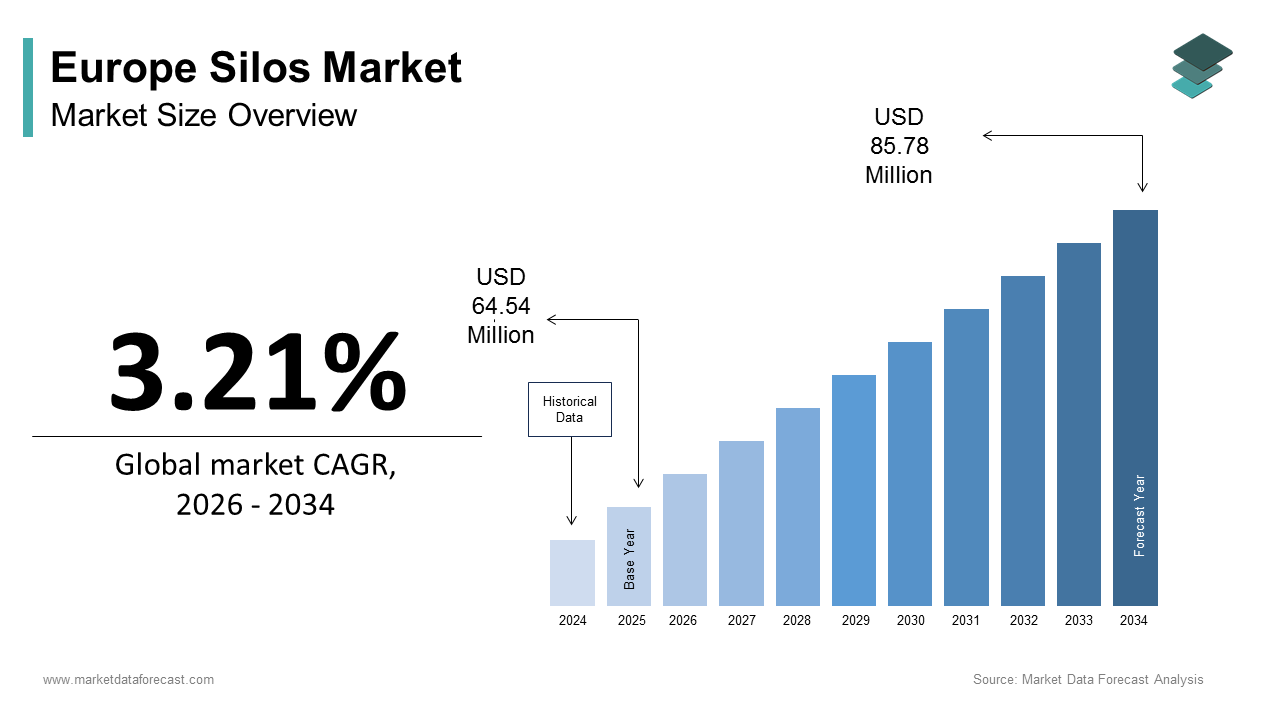
The Europe silos market was valued at USD 64.54 million in 2025 and is projected to reach USD 85.78 million by 2034, growing from USD 66.62 million in 2026 at a CAGR of 3.21% during the forecast period. Market growth is driven by increasing demand for efficient grain storage, rising agricultural modernization, and expanding bioenergy infrastructure across Europe. The need to reduce post-harvest losses, enhance food security, and support large-scale farming operations continues to strengthen demand for advanced silo systems. Technological upgrades in ventilation, monitoring, and corrosion-resistant materials are further supporting steady market expansion.
Key Market Trends
- Growing modernization of agricultural storage infrastructure
- Increasing adoption of durable steel silos for long-term storage
- Rising demand for flat-bottom silos in bulk grain handling
- Integration of smart monitoring systems for temperature and moisture control
- Expansion of storage capacity to support food security and bioenergy initiatives
Segmental Insights
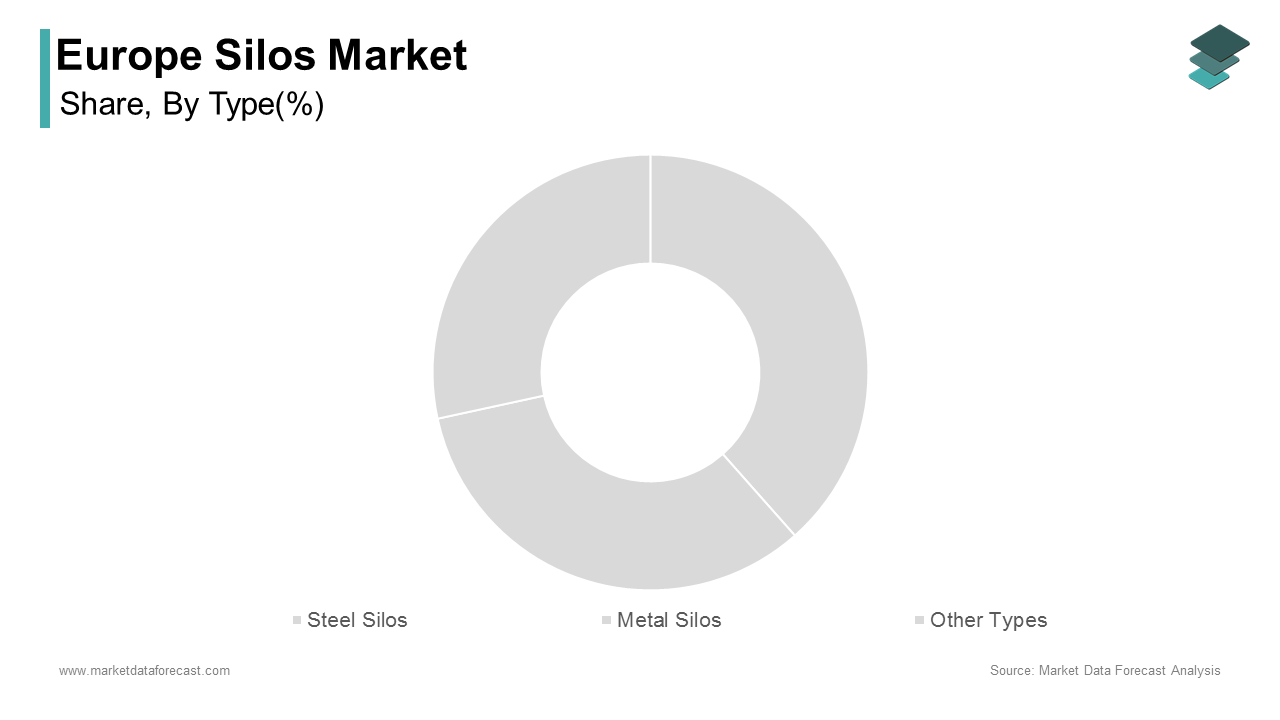
- Based on type, the steel silos segment dominated the Europe silos market in 2025 by accounting for 65.5% of the regional market share, supported by durability, structural strength, and resistance to environmental factors.
- Based on product, the flat-bottom silos segment led the market in 2025 by capturing 53.6% of the total market share, driven by their suitability for large-volume grain storage and efficient unloading mechanisms.
Regional Insights
- Germany led the Europe silos market in 2025 by holding 20.6% of the regional market share, supported by strong agricultural production and advanced storage infrastructure.
- France ranked second in 2025, driven by large-scale grain cultivation and a government-backed modernization initiative.s
- Italy is expected to account for a promising share during the forecast period, supported by growing demand from the feed and food processing industries.
- Sweden is projected to witness a healthy CAGR, driven by sustainable farming practices and investment in agricultural technology.y
- Poland is anticipated to capture a notable share, supported by the rapid modernization of grain storage facilities and expanding energy infrastructure.
Competitive Landscape
The Europe silos market is moderately competitive, with manufacturers focusing on advanced engineering, corrosion-resistant materials, and integrated grain management systems. Companies are strengthening their market position through customized storage solutions, automation technologies, and the expansion of distribution networks across Europe.
Prominent players in the Europe silos market include Symaga Group, Silos Córdoba, Mysilo, Bentall Rowlands Storage Systems Ltd, Riela Karl-Heinz Knoop e.K, Brock Grain Systems, Mulmix S.p.A, Ag Growth International, Tornum AB, and Skandia Elevator AB
Europe Silos Market Size
The Europe silos market size was calculated to be USD 64.54 million in 2025 and is anticipated to be worth USD 85.78 million by 2034, from USD 66.62 million in 2026, growing at a CAGR of 3.21% during the forecast period.
Silos are engineered storage structures used to contain bulk solids such as grains, cement, coal, biomass, and industrial powders across agricultural, construction, energy, and food processing sectors. These installations range from small farm-based grain bins to massive industrial steel or concrete silos exceeding 50 meters in height that are critical nodes in supply chain resilience and material integrity management. The market’s evolution is intrinsically linked to Europe’s strategic priorities in food security, circular economy, and decarbonization. As per Eurostat, the European Union produced cereals in 2025 and required secure, climate-controlled storage to minimize post-harvest losses. According to the Food and Agriculture Organization, developed regions experience post-harvest losses. As per the European Biomass Association, demand for biomass and wood pellet storage has increased with solid biofuel consumption in 2025. This dual pressure from agrarian stability and industrial transformation positions silos not merely as passive containers but as active infrastructure supporting Europe’s economic and environmental sovereignty.
MARKET DRIVERS
Europe’s Commitment to Reducing Post-Harvest Food Loss Is Driving Investment in Modern Grain Storage Infrastructure
The European Green Deal’s Farm to Fork strategy focuses on reducing food waste across the supply chain by 2030, which has placed strong emphasis on improving on-farm and cooperative storage capabilities, which is primarily driving the European silos market growth. Traditional grain storage methods such as open piles or unsealed bins are vulnerable to moisture, pests, and spoilage, leading to quality degradation. Farmers and agricultural cooperatives are increasingly adopting hermetically sealed steel silos equipped with temperature and humidity monitoring systems. According to the European Commission’s 2025 Common Agricultural Policy review, new rural development grants in Central and Eastern Europe include provisions for modern grain storage infrastructure. This modernization is particularly urgent in countries like Romania and Poland, which account for a significant share of the EU’s cereal production but historically suffer higher-than-average storage losses. The shift toward controlled-atmosphere silos preserves nutritional value and ensures compliance with EU food safety regulations, which is making them a necessary investment for competitive agricultural enterprises.
The Expansion of Biomass-Fueled Energy Generation Is Creating Demand for Large-Scale Fuel Storage Silos
Europe’s accelerated phaseout of coal has elevated biomass, particularly wood pellets and agricultural residues, as a key transitional fuel for district heating and power generation, which is further boosting the regional market expansion. As per the International Renewable Energy Agency, the EU’s installed biomass power capacity reached 42 gigawatts in 2025, with dedicated biomass plants operating across Germany, Sweden, and Finland. Each of these facilities requires fire-resistant silos capable of storing large volumes of hygroscopic fuel while preventing spontaneous combustion. The technical specifications for these silos are stringent, incorporating inert gas purging, explosion venting, and continuous dust extraction systems to meet EU safety directives. This demand is further amplified by national mandates, such as Sweden’s 2024 energy decree requiring biomass plants to maintain a minimum fuel reserve, which translates into orders for high-capacity silos. This has created a specialized industrial segment where safety, regulatory compliance, and material science converge to drive silo procurement.
MARKET RESTRAINTS
Stringent Zoning and Environmental Permitting Processes Are Delaying Project Timelines
The construction of large industrial silos in Western Europe faces lengthy approval cycles due to environmental impact assessments and community consultation requirements, whichares hampering the growth of the European silos market. Local authorities often impose restrictions on height, noise, and dust emissions that necessitate costly design modifications. According to the German Federal Environment Agency’s 2025 infrastructure report, obtaining a full building permit for a new cement silo can take a long time. This bureaucratic friction is especially acute in densely populated regions like the Rhine-Ruhr area, where land use conflicts are common. Even modest silo expansions may trigger reviews under the EU’s Industrial Emissions Directive if they exceed certain thresholds. These delays inflate project costs and deter smaller operators from investing in modern storage, perpetuating reliance on outdated systems that undermine sustainability goals.
High Capital Expenditure for Advanced Silo Systems Limits Adoption Among Small and Medium-Sized Enterprises
While basic carbon steel silos remain affordable, the integration of automation, climate control, and safety monitoring significantly increases upfront costs, which further impedes the regional market growth. A fully automated grain silo system with aeration, fumigation, and IoT-enabled inventory tracking can cost hundreds of thousands of euros, which exceeds the annual net profit of most European arable farms. As noted in the European Central Bank’s 2025 agribusiness lending survey, this financial barrier is particularly pronounced in Southern Europe, where farm sizes are smaller and access to low-interest loans is limited. Consequently, adoption remains concentrated among large agribusinesses and state-backed cooperatives. Without targeted subsidy mechanisms or leasing models, the market risks a two-tier structure where only well-capitalized players achieve optimal storage efficiency, leaving smaller entities vulnerable to spoilage and price volatility.
MARKET OPPORTUNITIES
Integration of Digital Twin Technology Is Enabling Predictive Maintenance and Inventory Optimization
The convergence of industrial IoT and cloud analytics is transforming static silos into intelligent storage assets, which is a promising opportunity in the regional market. Leading European manufacturers are embedding sensors to monitor fill levels, internal temperature gradients, structural stress, and gas composition in real time. This data feeds into digital twin platforms that simulate material behavior and predict potential failures such as bridging, caking, or wall corrosion. As per a 2025 pilot study by the Fraunhofer Institute, cement plants using digital twin-equipped silos achieved improvements in reducing downtime and optimizing raw material ordering cycles. The opportunity extends beyond heavy industry, as in the food sector, real-time mycotoxin risk modeling based on moisture and temperature trends can trigger automatic aeration protocols, ensuring compliance with EU safety standards. This shift from reactive to predictive operations creates a recurring revenue stream for silo providers through software-as-a-service models, fundamentally altering the value proposition from hardware to integrated asset intelligence.
Retrofitting Legacy Silos for Circular Economy Applications Presents a High-Value Service Market
Europe’s vast inventory of aging silos represents a significant opportunity for the European silos market. With the EU’s Circular Economy Action Plan mandating resource efficiency across all sectors, decommissioned grain or cement silos are being converted into storage for recycled materials such as plastic granules, glass cullet, or recovered paper pulp. According to the European Environment Agency, many industrial silos across the bloc are currently underutilized or idle, offering a ready-made infrastructure base. Retrofitting involves installing new liners, dust collection systems, and explosion-proof conveyors, generating high-margin engineering contracts for specialized firms. This approach reduces construction waste and accelerates the deployment of circular supply chains by leveraging existing industrial footprints, aligning with Europe’s net-zero industrial strategy.
MARKET CHALLENGES
Material Degradation from Aggressive Stored Substances Requires Constant Innovation in Liner Technologies
Silos handling industrial byproducts such as fly ash, slags, or chemical powders face severe internal corrosion and abrasion that compromise structural integrity, which is a significant challenge to the growth of the regional market. Biomass ash from co-firing plants contains compounds that aggressively attack standard carbon steel at elevated temperatures. Similarly, cement kiln dust is highly abrasive and alkaline, causing rapid wear on conventional liners. According to the European Federation of Corrosion, unplanned silo failures due to material degradation result inhight costs for European industries annually. This challenge forces manufacturers to continuously develop advanced composite liners, such as ceramic-polymer hybrids or nickel-alloy cladding,s that can withstand extreme conditions. However, these solutions are expensive and often require custom engineering, limiting their adoption and creating a persistent gap between technical need and economic feasibility for mid-sized operators.
Labor Shortages in Skilled Welding and Structural Engineering Are Constraining Installation Capacity
The fabrication and on-site assembly of large silos demand highly skilled welders, riggers, and structural engineers, which is a workforce that is rapidly aging and insufficiently replenished across Europe, and is another major challenge to the regional market. According to the European Construction Industry Federation, a shortage of certified pressure vessel welders in 2025, with the deficit most acute in Germany, Italy, and the Netherlands. This scarcity leads to project delays, increased labor costs, and in some cases, compromised weld quality that risks long-term safety. The problem is exacerbated by the trend toward taller, thinner-walled silos that require precision welding techniques to maintain buckling resistance. Without a concerted effort to revitalize vocational training in metal fabrication and offer competitive career pathways, the silo market will struggle to meet growing demand, particularly for complex industrial projects requiring ATEX or PED certification. This human capital bottleneck threatens to become a systemic constraint on Europe’s storage infrastructure expansion.
REPORT COVERAGE
| REPORT METRIC | DETAILS |
| Market Size Available | 2025 to 2034 |
| Base Year | 2025 |
| Forecast Period | 2026 to 2034 |
| CAGR | 3.21% |
| Segments Covered | By Type, Product, And Region |
| Various Analyses Covered | Global, Regional & Country Level Analysis; Segment-Level Analysis; DROC, PESTLE Analysis; Porter’s Five Forces Analysis; Competitive Landscape; Analyst Overview of Investment Opportunities |
| Regions Covered | UK, France, Spain, Germany, Italy, Russia, Sweden, Denmark, Switzerland, Netherlands, Turkey, and the Czech Republic |
| Market Leaders Profiled | Symaga Group, Silos Córdoba, Mysilo, Bentall Rowlands Storage Systems Ltd, Riela Karl-Heinz Knoop e.K., Brock Grain Systems, Mulmix S.p.A., Ag Growth International (AGI), Tornum AB, Skandia Elevator AB |
SEGMENTAL ANALYSIS
By Type Insights
The steel silos segment constitutes the dominant segment in the Europe silos market and held 65.5% of the regional market share in 2025. The dominance of the steel silos segment in the European market is driven by two interrelated factors rooted in performance and regulatory alignment. The first is the material’s exceptional strength-to-weight ratio, which allows for the construction of tall, slender silos that maximize storage capacity within limited land footprints. Modern steel silos fabricated from high-tensile galvanized or coated steel can safely store materials at high densities, making them ideal for cement, grains, and biomass. The second driving force is compliance with EU safety directives. Steel’s predictable structural behavior under load enables precise engineering calculations required under the Pressure Equipment Directive and EN 1993 Eurocode standards. This regulatory certainty, combined with decades of proven field performance, makes steel the default choice for operators managing high-value or hazardous bulk solids who cannot afford structural failure or regulatory non-compliance.
While often conflated with steel, the metal silos segment is the fastest-growing segment in the European market and is estimated to register a CAGR of 6.06% over the forecast period. This growth is fueled by niche but high-impact applications where standard carbon steel is unsuitable. The primary driver is the food and pharmaceutical industry’s demand for non-reactive, corrosion-resistant storage. Aluminum silos, for instance, are increasingly specified for storing organic acids, certain fertilizers, and hygroscopic food powders where even trace iron contamination can degrade product quality. A second key factor is weight sensitivity in mobile or temporary installations. In the Netherlands and Denmark, modular aluminum silos are being deployed on floating biomass collection barges in inland waterways, where reduced structural mass is essential for buoyancy and transport logistics. These specialized use cases, though smaller in volume, command premium pricing and reflect Europe’s shift toward application-specific material science in bulk storage solutions.
By Product Insights
The flat-bottom silos segment represents the largest product segment in the Europe silos market and accounted for 53.6% of the regional market share in 2025. The leading position of flat bottom silos segment in the European market is attributed to their suitability for high-volume, long-term storage of free-flowing materials such as wheat, coal, and wood pellets. The first major driver is cost efficiency. Flat-bottom designs require less complex foundation work and simpler discharge mechanisms compared to hopper configurations, reducing both capital and maintenance expenses. The second factor is scalability. These silos can be constructed in large diameters and heights, enabling single-unit capacities of tens of thousands of tons. This is critical in countries like Germany and France, where centralized biomass co-firing plants must maintain weeks of fuel inventory to ensure grid stability. Their straightforward geometry also facilitates integration with automated loading systems and roof-mounted solar panels, aligning with Europe’s dual goals of energy resilience and decarbonization.
The farm silos segment is the fastest-growing product segment in the European market and is expected to exhibit a CAGR of 7.05% over the forecast period. This surge is directly tied to the EU’s strategic push for on-farm grain autonomy and reduced post-harvest losses. The primary driver is policy support, as many member states now include on-farm storage infrastructure as an eligible expense under Pillar II of the Common Agricultural Policy, with grants covering a portion of installation costs for small and medium-sized holdings. A second powerful factor is climate volatility. With extreme weather events disrupting traditional harvest and supply cycles, farmers are prioritizing on-site storage to buffer against price spikes and logistical bottlenecks. Modern farm silos, typically ranging from 50 to 500 tons, are now equipped with aeration and moisture control systems that allow safe storage for extended periods, transforming them from simple bins into strategic risk management tools that enhance farm-level food security across the continent.
REGIONAL ANALYSIS
Germany Silos Market Analysis
Germany dominated the silos market in Europe in 2025 by holding 20.6% of the regional market share. Its market status is defined by massive demand from the cement, chemical, and biomass energy sectors. The country’s transition away from nuclear and coal has led to the construction of new biomass power plants, each requiring multiple large steel silos for wood pellet storage. According to the German Biomass Research Centre, these facilities consume solid biofuels annually, necessitating robust, explosion-proof silo infrastructure. Additionally, Germany’s dense network of cement producers drives continuous investment in flat-bottom silos with automated inventory systems. The stringent enforcement of the Technical Rule for Hazardous Substances further mandates advanced silo designs with dust extraction and inerting capabilities, reinforcing Germany’s position as a high-specification, high-value market.
France Silos Market Analysis
France commanded the second-largest share of the European silos market in 2025. The growth of France in the European market is driven by its dual focus on cooperative grain storage and renewable energy feedstock containment. The country’s extensive network of agricultural cooperatives has invested heavily in centralized flat-bottom silo complexes capable of storing large volumes. This consolidation is driven by the need to meet EU phytosanitary standards and reduce mycotoxin risks through climate-controlled storage. Simultaneously, France’s biogas strategy targeting renewable gas consumption by 2030 has spurred demand for silos to store digestate and energy crops. The combination of agrarian scale and energy policy creates a balanced and resilient silo market that spans both rural and industrial landscapes.
Italy Silos Market Analysis
Italy is expected to account for a promising share of the European silos market during the forecast period. The Italian market is a fragmented yet dynamic industrial structure dominated by small and medium enterprises. The primary driver is the country’s food sector, which requires specialized stainless steel and aluminum silos for storing flour, semolina, and powdered dairy ingredients under strict hygiene protocols. Italy’s pasta and baked goods industry consumes durum wheat annually, necessitating airtight, pest-resistant storage. Concurrently, Italy’s cement industry relies on massive flat-bottom silos at production sites. Furthermore, the nation’s operational waste-to-energy plants require silos for refuse-derived fuel, adding another layer of demand. This multi-sectoral pull makes Italy’s silo market versatile and responsive to niche technical requirements.
Sweden Silos Market Analysis
Sweden is estimated to witness a healthy CAGR in the European silos market over the forecast period. Its market status is defined by large-scale biomass storage for district heating and pulp industry residuals. Sweden generates a majority of its total energy from biofuels, requiring vast silo infrastructure at combined heat and power plants nationwide. These facilities store wood pellets, forest residues, and recycled paper pulp, demanding silos with advanced fire suppression and dust control systems. Additionally, Sweden’s waste management system has created demand for silos to hold sorted plastic and metal fractions before reprocessing. The national emphasis on lifecycle analysis and low-carbon construction also favors bolted steel silos that can be disassembled and relocated, aligning storage infrastructure with the country’s sustainability ethos.
Poland Silos Market Analysis
Poland is anticipated to account for a notable share of the European silos market during the forecast period, owing to the rapid modernization of grain storage and energy infrastructure. As the EU’s second-largest rye and barley producer, Poland has seen growth in on-farm and cooperative silo installations supported by EU rural development funds aimed at reducing post-harvest losses. Simultaneously, Poland’s National Energy Policy mandates the conversion of coal-fired units to biomass co-firing by 2030, creating urgent demand for large-capacity fuel silos. This shift will require storage for biomass annually by 2027. The convergence of agrarian investment and energy transformation, backed by EU cohesion funding, positions Poland as a high-growth, high-impact market where silo deployment is central to national economic and environmental strategy.
COMPETITION OVERVIEW
The competition in the Europe silos market is characterized by a blend of specialized engineering firms and diversified industrial conglomerates, each vying for dominance across agricultural, energy, and industrial segments. The market is highly fragmented at the regional level, with local fabricators serving small farms, yet consolidated in large-scale industrial projects where technical certification, material expertise, and digital capabilities are decisive. Competition is less about price and more about compliance, longevity, and integration with broader material handling ecosystems. European players hold a strong advantage due to their deep familiarity with EN standards, ATEX requirements, and sustainability regulations, which act as significant barriers to entry for non-EU suppliers. However, the rise of circular economy mandates and digitalization is reshaping competitive dynamics, rewarding companies that combine robust mechanical design with software-enabled services and lifecycle sustainability. This environment fosters continuous innovation but also demands substantial investment in R&D and skilled labor.
KEY MARKET PLAYERS
A few major players of the Europe silos market include
- Symaga Group
- Silos Córdoba
- Mysilo
- Bentall Rowlands Storage Systems Ltd
- Riela Karl-Heinz Knoop e.K
- Brock Grain Systems
- Mulmix S.p.A
- Ag Growth International (AGI)
- Tornum AB
- Skandia Elevator AB
Top Strategies Used by the Key Market Participants
Key players in the Europe silos market are increasingly adopting modular and prefabricated construction methods to accelerate project delivery and minimize on-site disruption. They are integrating Internet of Things sensors and cloud-based monitoring platforms to enable predictive maintenance and real-time inventory management. Companies are also developing specialized internal linings and coatings to handle corrosive or abrasive materials in compliance with EU safety directives. Strategic partnerships with renewable energy developers are being formed to co-design biomass and waste-derived fuel storage systems. Additionally, firms are expanding their service portfolios to include silo retrofitting, relocation, and end-of-life recycling to align with the European Union’s circular economy action plan and capture recurring revenue streams.
Leading Players in the Market
- WAMGROUP is a leading European manufacturer of silos and bulk material handling systems headquartered in Italy. The company serves a global clientele across agriculture, food processing, and industrial sectors with a comprehensive portfolio of steel silos, conveying equipment, and automation controls. WAMGROUP has recently intensified its focus on digital integration by launching its Smart Silo Monitoring platform, which provides real-time data on fill level, temperature, and structural integrity. This innovation strengthens its position by aligning with Europe’s Industry 5.0 framework and enabling predictive maintenance for customers worldwide. The company also expanded its production facility in Modena in 2024 to meet rising demand for biomass storage solutions, reinforcing its role as a key enabler of the energy transition.
- Silo Group is a German engineering firm specializing in custom-designed steel silos for the cement, chemical, and power generation industries across Europe and beyond. Known for its high-precision fabrication and adherence to EN and ATEX standards, the company delivers turnkey storage solutions for aggressive and hazardous bulk materials. In recent years, Silo Group has invested in modular construction techniques that reduce on-site assembly time by up to 40%. It also partnered with a leading IoT provider in 2024 to embed sensor networks into its silos for remote condition monitoring. These actions enhance operational safety and support clients in meeting stringent EU environmental and safety regulations globally.
- CST Industries, through its European operations based in the Netherlands, is a major global supplier of bolted and welded steel silos for grain, water, and industrial applications. The company leverages its proprietary XLERPLATE steel technology to offer corrosion-resistant, long-life storage solutions tailored to European climatic and regulatory conditions. To strengthen its footprint, CST recently launched a circular economy initiative in 2024, offering silo refurbishment and relocation services that extend asset life and reduce embodied carbon. This strategy resonates strongly with EU sustainability mandates and positions CST as a preferred partner for public and private infrastructure projects seeking compliant, future-ready storage infrastructure across the continent and emerging markets.
MARKET SEGMENTATION
This research report on the Europe silos market has been segmented and sub-segmented based on type, product, and region.
By Type
- Steel Silos
- Metal Silos
- Other Types
By Product
- Flat Bottom Silos
- Hopper Bottom Silos
- Feed Hoppers
- Farm Silos
By Region
- UK
- France
- Spain
- Germany
- Italy
- Russia
- Sweden
- Denmark
- Switzerland
- Netherlands
- Turkey
- Czech Republic
- Rest of Europe
Frequently Asked Questions
1. What is the expected growth rate of the Europe Silos Market?
The market is p2rojected to grow at a steady CAGR over the forecast period, supported by rising demand for efficient bulk storage solutions and increasing automation in agriculture and industry.
2. What are the major drivers of the Europe Silos Market?
Key drivers include increasing agricultural production, the need to reduce post-harvest losses, expansion of the construction sector, rising demand for food storage, and technological advancements in smart storage systems.
3. What are the main types of silos used in Europe?
Common types include flat-bottom silos, hopper-bottom silos, tower silos, and bunker silos. These are selected based on storage capacity, material type, and application requirements.
4. Which materials are commonly used in silo construction?
Silos in Europe are mainly constructed using steel, reinforced concrete, and sometimes polymers, depending on the intended use and durability requirements.
5. What technological trends are influencing the Europe Silos Market?
The market is increasingly adopting smart silos equipped with IoT sensors for temperature and moisture monitoring, automated inventory management systems, and predictive maintenance technologies.
6. What challenges does the Europe Silos Market face?
Major challenges include high installation costs, maintenance complexity, strict environmental and safety regulations, and land availability constraints in urban regions.
7. How do silos support food security in Europe?
Silos help reduce grain spoilage, improve storage efficiency, stabilize supply throughout the year, and ensure better inventory control, thereby supporting food security.
8. Who are the major players in the Europe Silos Market?
Key companies operating in the market include Ahrens Silos, Bentall Rowlands, Symaga, Silos Córdoba, Nelsons, and G.E. Silos.
9. What is the future outlook for the Europe Silos Market?
The market outlook remains positive, driven by increasing demand for efficient bulk storage, digital transformation in agriculture, infrastructure investments, and sustainable storage solutions.
10. What are environmental and regulatory considerations?
Environmental impact considerations include land use and emissions associated with large storage facilities. There are also safety and construction standards for silos, particularly for food and grain storage, which must comply with EU and national regulations.
Related Reports
Access the study in MULTIPLE FORMATS
Purchase options starting from
$ 2000
Didn’t find what you’re looking for?
TALK TO OUR ANALYST TEAM
Need something within your budget?
NO WORRIES! WE GOT YOU COVERED!
Call us on: +1 888 702 9696 (U.S Toll Free)
Write to us: sales@marketdataforecast.com