- Product Description Description
- Table of Contents TOC
- List of Table & Figure LOT
- Get Free Sample PDF Sample PDF
Market Size, 2025
$4.02 BnMarket Estimate, 2026
$4.26 BnMarket Forecast, 2034
$6.77 BnCAGR, 2026–2034
5.96%Executive Summary: Europe Gas Separation Membrane Market
- Market Scope: European gas separation technology market analysis covering membrane types, application verticals, regional leadership frameworks, and adoption metrics.
- Market Valuation: Valued at USD 655.14 million (2025), estimated at USD 685.60 million (2026), and projected to reach USD 986.24 million by 2034, growing at a robust CAGR of 4.65% (2026–2034).
- Primary Growth Drivers: High regional renewable output (Europe's biogas output exceeding 22 billion cubic meters in 2023, with over 60% of new facilities integrating membrane units for methane enrichment) and stringent industrial standards. Key operational metrics include raw biogas containing 50–70% methane upgraded to >95% purity via membranes, the EU commissioning 232 new biogas plants in 2023 (bringing totals to over 20,500 facilities), and membrane-based CO₂ separation demonstrating CO₂/nitrogen selectivity ratios exceeding 40.
Key Market Segment Metrics (2026–2034)
| Category | Leading Segment (2025 Position) | Fastest-Growing Segment |
|---|---|---|
| By Membrane Type | Polymeric membranes (dominated with 48.2% market share in 2025, supported by >12,000 small-to-mid-scale digesters in Germany and France) | Inorganic membranes (projected to expand at a 15.3% CAGR from 2026 to 2034, with modules showing <5% degradation over 3,000 hours) |
| By Application | Natural gas treatment (held a significant application share) | Hydrogen recovery (forecast to grow at a 14.1% CAGR; membrane systems capture up to 95% of lost hydrogen, with a BASF pilot achieving 98% recovery efficiency) |
| By Region | Germany (led Europe with 25.4% market share in 2025, hosting over 9,500 biogas plants where >70% use membrane systems), followed by France with 18.2% | — |
Major Market Players & Market Structure
Market Structure: Highly competitive European gas separation membrane landscape featuring 9 prominent market leaders competing on high selectivity ratios, methane enrichment efficiency, durability, and advanced industrial application rollouts.
Key Companies: Air Liquide, Evonik Industries AG, Fujifilm Manufacturing Europe B.V., Linde plc, Honeywell International, Parker-Hannifin Corporation, DIC Corporation, UBE Industries Ltd., and Air Products and Chemicals, Inc.
Europe Simulators Market Size
The Europe simulators market size was valued at USD 4.02 billion in 2025 and is projected to reach USD 6.77 billion by 2034 from USD 4.26 billion in 2026, growing at a CAGR of 5.96%.
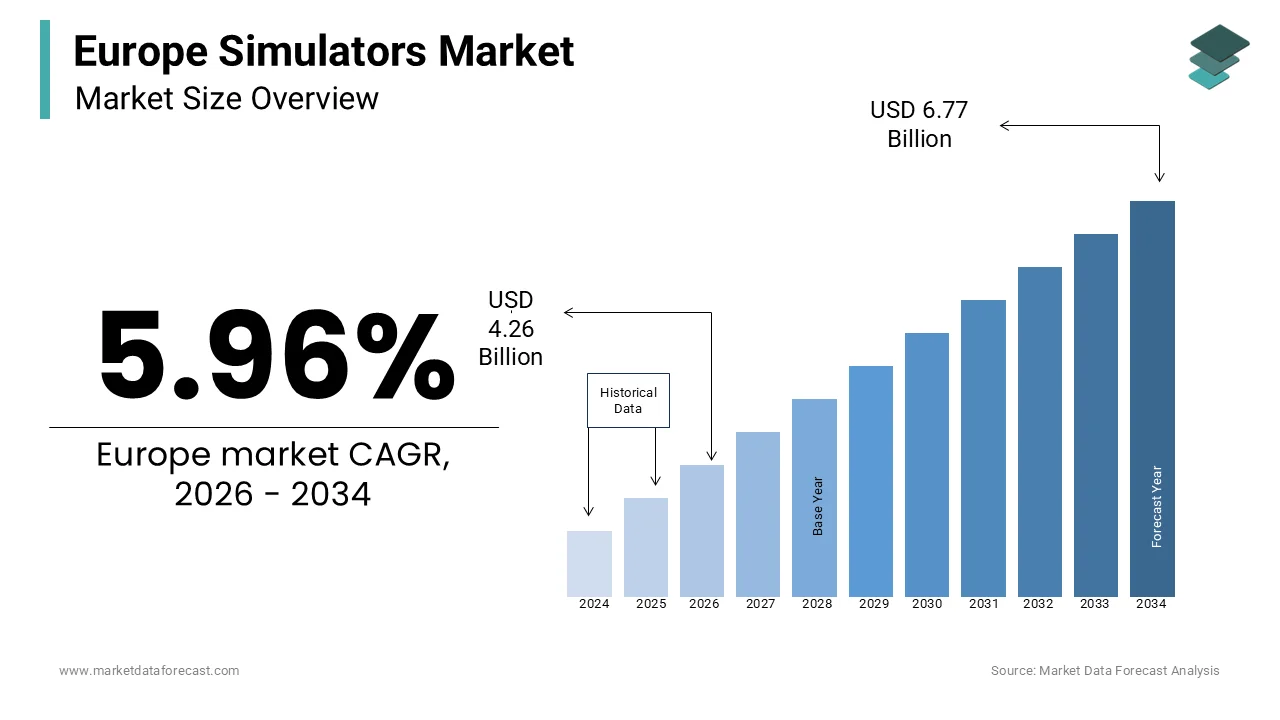
Simulators are advanced digital and physical systems designed to replicate real-world operational environments for training, assessment, and system validation across the aviation, defence, healthcare, maritime, and industrial sectors. These tools enable experiential learning without real-world risk, fostering skill acquisition, decision-making and procedural mastery under controlled yet highly realistic conditions. In 2026, Europe’s simulator ecosystem is shaped by stringent safety mandates, workforce modernisation imperatives, and technological convergence with artificial intelligence and extended reality. According to the European Aviation Safety Agency (EASA) regulations, pilots must often complete extensive simulator-based training before receiving type ratings. The European Commission’s Digital Education Action Plan promotes simulation-based pedagogy in vocational training, with over 12,000 technical schools integrating simulation labs by 2025. As industries confront ageing workforces and complex system inter-dependencies, simulators have evolved from supplementary aids to foundational components of operational readiness and regulatory compliance across the continent.
MARKET DRIVERS
Regulatory Mandates for Safety and Certification Drive Simulator Adoption
Stringent regulatory frameworks across the European transport energy and healthcare sectors mandate simulator-based training as a prerequisite for licensure and operational approval, creating sustained demand for high-fidelity systems, which is majorly propelling the growth of the European simulators market. The European Union Aviation Safety Agency (EASA) requires all commercial airline pilots to undergo recurrent training in Level D full flight simulators every six months, a standard that applies to over 80,000 pilots across the bloc. According to the agency, this policy has contributed to a 42% reduction in human-factor-related aviation incidents since 2015. In maritime operations, the European Maritime Safety Agency enforces the STCW Convention that obliges seafarers on EU-flagged vessels to complete simulator-based navigation and engine-room drills. Similarly, the European Resuscitation Council recommends that all emergency medical staff participate in high-fidelity clinical simulations annually in healthcare. According to a 2025 study by the European Society of Anaesthesiology, hospitals using simulation-based training reduced critical incident response errors by 36%. These top-down regulatory imperatives ensure consistent institutional investment in simulators, not as optional tools, but as non-negotiable components of safety governance and professional accreditation across high-risk industries.
Ageing Workforce and Knowledge Transfer Imperatives Accelerate Simulation Integration
The rapid ageing of the technical workforce in Europe is compelling industries to adopt simulators as mechanisms for preserving and transferring tacit operational knowledge, which is further contributing to the expansion of the European market. According to Eurostat, the average expected working life in the EU was 37.2 years. The loss of skilled workers in manufacturing, energy and rail transport threatens to erode experiential expertise. Instead, the regulator emphasises the challenge of maintaining expert resources as the workforce ages. To mitigate this risk, operators like EDF and Vattenfall have deployed full-scope simulators that replicate emergency scenarios such as coolant loss or grid failure, allowing new engineers to practice under expert supervision. In aviation, the sector is facing significant retirements among instructor pilots, which is prompting accelerated use of AI-enhanced simulators that embed veteran decision patterns into training modules. This intergenerational knowledge bridge function transforms simulators from skill builders into institutional memory repositories, which ensures operational continuity in the face of workforce turnover.
MARKET RESTRAINTS
High Capital and Maintenance Costs Limit Broad Accessibility
The significant upfront investment and ongoing operational expenses associated with high fidelity simulators constrain their adoption, particularly among small and medium-sized enterprises and public institutions with constrained budgets, which is majorly inhibiting the growth of the European market. A full-flight simulator compliant with European Union Aviation Safety Agency (EASA) Level D standards costs between €12 million and €20 million and requires dedicated facility space, climate control and certified maintenance personnel. According to Axis Simulation, the acquisition cost for a Level D full-flight simulator typically falls between €12 million and €15 million. According to the European Cockpit Association, the average annual operating cost for such a device exceeds €1.2 million, including software updates, motion system servicing and instructor staffing. Similarly, according to the European Society for Simulation Applied to Medicine, a high-end medical simulation suite with manikins, task trainers and debriefing software can cost over €500 000. These financial barriers are especially acute in Southern and Eastern Europe, where public funding for vocational training is limited. According to the European Court of Auditors, only 28% of technical colleges in Romania and Bulgaria have access to industry-grade simulators compared to 89% in Germany and the Netherlands, which is creating a training quality gap that disadvantages learners and workers in less affluent regions.
Fragmented Technical Standards Across Sectors and Nations Impede Interoperability
The absence harmonised technical and pedagogical standards for simulators across European countries and industrial domains hampers scalability, reuse,se and cross-border recognition of simulation-based credentials, which is further hampering the regional market expansion. In aviation, while the European Union Aviation Safety Agency (EASA) provides unified certification for flight simulators and maritime simulators fall under national maritime authorities with divergent validation protocols. In the maritime domain, there are documented variations in how simulator-based training institutions across Europe interpret and apply curriculum standards. In healthcare, simulation accreditation varies by specialty and nation. According to the European Board of Medical Assessors, simulation-based assessment in medical education is practised across Europe, but does not guarantee mutual recognition of credentialing across national borders. This fragmentation forces organisations to invest in multiple simulator configurations and limits the development of pan-European training curricula. Additionally, industry-specific data formats such as those used in rail or energy simulators lack common APIs, which is preventing integration with broader digital-twin ecosystems. Until Europe establishes cross-sectoral simulation interoperability frameworks, the adoption will remain siloed and inefficient.
MARKET OPPORTUNITIES
Expansion of Defence Modernisation Programs Fuels Military Simulation Demand
The strategic pivot of Europe toward enhanced defence readiness following geopolitical shifts has triggered substantial investment in military simulation systems for training and mission rehearsal, which is a significant opportunity for the European simulators market. According to the European Defence Agency, EU member states collectively allocated €14.3 billion to training and simulation in 2025, a 28% increase from 2022. The NATO Allied Command Transformation now mandates that 70% of collective exercises incorporate synthetic environments to reduce live-exercise costs and environmental impact. Countries like Poland and Finland have launched national programmes to equip their armed forces with immersive simulators for armoured vehicle operation, drone-swarm coordination and cyber-battlefield scenarios. As per the Sweden’s Defence Materiel Administration, in early 2026 that it will deploy over 200 virtual and constructive simulation stations by 2027 to support its expanded conscription model. These investments are not limited to hardware, and major contracts are also flowing to software developers creating AI-driven opposing forces and terrain databases compliant with NATO Standardisation Office simulation interoperability standards. As defence budgets prioritise readiness over mass, this synthetic-training surge creates a robust long-term opportunity for simulation vendors specialising in secure, scalable and interoperable military systems.
MARKET CHALLENGES
Shortage of Qualified Simulation Instructors Constrains Training Throughput
Despite growing simulator availability, Europe faces a critical shortage of certified instructors capable of designing, facilitating and debriefing complex simulation exercises, particularly specialised domains like nuclear operations and emergency medicine, which is a significant challenge to the growth of the European market. According to the European Society for Simulation Applied to Medicine, only a relatively small number of healthcare professionals across the EU hold formal simulation-instructor certification, which is far below the estimated need to meet World Health Organisation training guidelines. In aviation, the European Cockpit Association estimates a significant vacancy rate in instructor-pilot positions across major training academies, with attrition driven by airline hiring and burnout. This bottleneck means that even where simulators are deployed, they often operate at low capacity due to a lack of qualified staff to run sessions. The problem is exacerbated in Eastern Europe, where instructor-training programmes are underfunded. Without sufficient human expertise to contextualise simulated experiences, learners gain limited insight, which reduces the return on substantial capital investments. This talent gap represents a systemic challenge that technology alone cannot resolve.
Ethical and Psychological Risks Hyper-Realistic Simulation Remain Unaddressed
The increasing fidelity of simulators, particularly those using virtual reality and biometric feedback, introduces unresolved ethical and psychological concerns that may impede widespread adoption in sensitive fields, which iurther challchallengesexpansion of the regional market. Immersive simulations of high-stress scenarios such as mass casualty events, cockpit emergencies, or combat situations can trigger acute anxiety, ty post-traumatic stress symptoms or desensitisation among trainees. According to an advisory group of the European Commission for science and new technologies, the use of AI-generated “enemy” avatars in defence training may reinforce bias or normalise violence. In defence applications, the collection of biometric data, such as heart-rate monitoring, eye-tracking and voice-stress analysis during simulations raises questions under the GDPR about consent, data retention and psychological profiling. As of 20,25, no EU-wide guidelines exist for the ethical design and deployment of high-intensity simulations, which leaves institutions to develop ad-hoc protocols. Unhuman factors are systematically addressed through regulation and best practices; the full potential of advanced simulators may be curtailed by liability and welfare concerns.
REPORT COVERAGE
| REPORT METRIC | DETAILS |
| Market Size Available | 2025 to 2034 |
| Base Year | 2025 |
| Forecast Period | 2026 to 2034 |
| CAGR | 5.96% |
| Segments Covered | By Application, Solution, Technique, Type, and Region |
| Various Analyses Covered | Global, Regional, & Country Level Analysis; Segment-Level Analysis; DROC, PESTLE Analysis; Porter’s Five Forces Analysis; Competitive Landscape; Analyst Overview of Investment Opportunities |
| Regions Covered | UK, France, Spain, Germany, Italy, Russia, Sweden, Denmark, Switzerland, Netherlands, Turkey, and the Czech Republic |
| Market Leaders Profiled | TRU Simulation + Training, FlightSafety International, RUAG, Saab AB ADR, Kongsberg Gruppen ASA, Indra Sistemas SA ADR, Rheinmetall AG, General Dynamics Corp, CAE Inc, Elbit Systems Ltd, Thales, and L3Harris Technologies Inc. |
SEGMENTAL ANALYSIS
By Application Insights
The commercial training segment occupied the largest share of the European simulators market in 2025. The dominance of the commercial training segment in the regional market is majorly driven by regulatory mandates across civil aviation, maritime operations, healthcare and industrial sectors. The institutionalisation of simulation in professional certification and the expansion of digital workforce development policies are further boosting the expansion of the segment. European regulatory bodies have embedded simulator use as a non-negotiable requirement for professional licensure across high-risk civilian domains. For commercial pilots under the European Union Aviation Safety Agency (EASA), a type-rating course includes certified simulator training. In the maritime domain, the European Maritime Safety Agency (EMSA) enforces competence standards under the STCW Convention that require approved simulator-based training for certain shipboard functions. In healthcare, the European Resuscitation Council recommends regular high-fidelity simulation drills for emergency personnel. Under the Digital Education Action Plan, the European Commission has promoted the integration of digital and simulation technologies in vocational education institutions. This top-down institutionalisation ensures consistent demand for simulation technology, but not merely as discretionary investments, but increasingly as compliance requirements for airlines, hospitals, shipping companies and utilities alike.
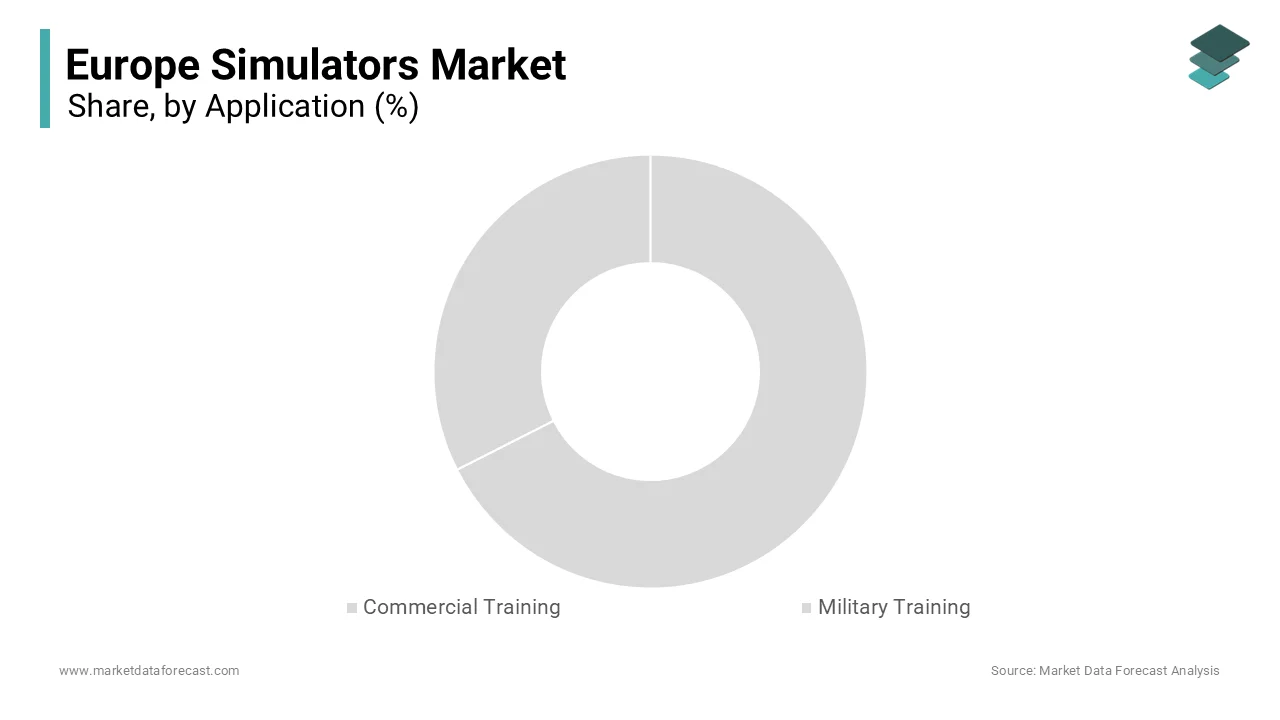
The military training segment is anticipated to register the fastest CAGR of 10.1% over the forecast period in the European market. The defence modernisation and synthetic readiness mandates are primarily propelling the growth of the military segment in the European market. The shift of NATO toward a synthetic-first training doctrine is also contributing to the expansion of the military training segment in the European market. The NATO Allied Command Transformation now requires that a large proportion of collective military exercises incorporate virtual or constructive simulation environments to reduce costs, environmental impact and geopolitical friction. According to the European Defence Agency, EU member states collectively spent significant amounts on defence simulation in recent years, showing a marked increase. Countries like Poland, Finland and Sweden are deploying immersive simulators for armoured warfare, drone coordination and cyber defence to support expanded conscription and rapid mobilisation plans. Sweden’s Defence Materiel Administration announced that it will install over 200 simulation stations by 2027, which will enable scalable readiness without live ammunition consumption. This doctrinal shift transforms simulation from a supplementary tool into the backbone of European defence preparedness.
By Solution Insights
The hardware and software segment held the major share of the European simulators market in 2025. The physical requirement for certified devices and long asset life cycles is primarily driving the dominance of the hardware and software segment in the European market. European regulations in the aviation, maritime and energy sectors mandate the use of simulation products that meet technical certification standards. The European Union Aviation Safety Agency (EASA)’s Level D full-flight simulator standard requires motion platforms, visual systems and aerodynamic modelling delivered through purpose-built hardware-software combinations. Similarly, the International Maritime Organisation (IMO)’s STCW Code recognises only certain bridge simulators for certification. The effect of this regulatory gatekeeping is to ensure sustained demand for certified physical and virtual simulation products as foundational assets, rather than discretionary services.
The services segment is anticipated to record a CAGR of 12.1% over the forecast period in the European simulators market due to the growing operational complexity and workforce constraints. Modern simulators require frequent updates to reflect regulatory changes, aircraft variants, or clinical protocols. A full flight simulator for a new Airbus A320neo variant requires extensive software and database development by specialised engineers. According to industry-association sources, simulator operators spend a significant portion of the initial hardware cost annually on software updates, instructor training and scenario libraries. Hospitals face similar challenges with medical simulators needing case updates aligned with World Health Organisation treatment guidelines. This ongoing need transforms simulation from a one-time purchase into a lifecycle engagement where services ensure relevance and compliance.
By Technique Insights
The virtual and constructive simulation segment accounted for 39.3% of the European market share in 2025. The growth of the virtual and constructive simulation segment is attributed to its balance of realism, cost efficiency, and scalability across sectors. Virtual and constructive simulations are natively compatible with modern digital infrastructure, such as the Joint Simulation Environment and national defence networks that allow simulated units to interact with real command posts using standard communication protocols. Many EU-level defence organisations note that a significant share of member-state military exercises now include virtual or constructive simulation elements linked to live command centres. In civil aviation, air traffic management simulators from specialist companies replicate entire air-space sectors, enabling controllers to train on real-time data streams. This seamless integration with operational IT ecosystems makes virtual and constructive simulation the preferred technique for system validation and procedural rehearsal.
The synthetic environment simulation segment is expected to exhibit a CAGR of 13.8% over the forecast period in the regional market, owing to AI-enabled dynamic worlds and defence digital twin initiatives. Synthetic environments now leverage generative AI to create photorealistic terrain, weather and intelligent entities that adapt to trainee actions. In 2025, the UK Ministry of Defence partnered with major defence contractors to deploy synthetic battlefield environments for training Ukraine-linked forces, with terrain, villages and civilian behaviours generated via satellite and AI data. Similarly, advanced simulation providers are using AI to simulate realistic air-traffic patterns in flight training simulators, reducing reliance on pre-scripted scenarios. According to innovation-ecosystem sources, a large share of new defence-simulation tenders now include requirements for AI-driven environmental adaptability. This capability allows a single synthetic environment to support numerous training variations, accelerating competency development.
By Type Insights
The full flight simulators segment held the major share of the European market in 2025, owing to their certification requirements and risk mitigation in pilot training. EASA level D certification as a Non-Negotiable Standard is also contributing to the dominance of the segment in the European market. The European Union Aviation Safety Agency requires that full-flight simulators for type ratings and recurrent training on commercial jets meet “Level D” standards, which demand motion platforms, wide-field visual systems and aerodynamic fidelity validated against real aircraft data. Major carriers such as Lufthansa, Air France and British Airways operate multiple such devices, which reflects their centrality to flight safety and regulatory compliance.
The flight training devices segment is predicted to witness a CAGR of 11.4% over the forecast period in the European simulators market due to pilot shortage solutions and ab initio training expansion. Europe faces a projected pilot shortfall in the coming decade and beyond under current training trajectories. To address this, airlines and governments are expanding ab initio flight academies that rely heavily on flight-training devices for early-stage instruction. These devices cost significantly less than full-flight simulators, which makes them ideal for high-volume training. Some governments have funded new pilot-training academies equipped with multiple flight-training devices. This pipeline approach depends on affordable and scalable simulation for foundational skill building, which is further driving the growth of the flight training devices segment in the European market.
REGIONAL ANALYSIS
Germany Market Analysis
Germany dominated the simulators market in Europe and held 26.3% of the regional market share in 2025 due to its industrial depth, defence modernisation and robust vocational education system. Europe’s largest economy and manufacturing hub operates a large number of full-flight simulators for major airlines and maintains advanced simulation centres for industrial companies covering process safety and automation. The national armed forces’ large-scale simulation investment includes one of the largest defence simulation programmes in Europe with virtual trainers for armoured vehicles, fighter jets and other platforms. The dual vocational education system integrates simulator-based training into many technical-vocational schools. Additionally, the country hosts major simulator manufacturers and simulation-engineering hubs, which are reinforcing its position as Europe’s simulation engineering and deployment epicentre.
United Kingdom Market Analysis
The United Kingdom occupied the second-largest share of the European market in 2025. The strong defence and aviation industries and advanced healthcare simulation infrastructure in the UK are primarily contributing to the expansion of the UK market. British Airways and easyJet operate multiple full-flight simulators across London and Manchester, while the UK Military Flying Training System includes advanced simulators for RAF pilots. The National Health Service runs a large network of clinical simulation centres certified by medical-royal-college standards. UK aviation regulator data indicate that simulator-based training contributes significantly to safety outcomes. The UK’s departure from the EU has not diminished its role, and it appears to have accelerated sovereign simulation development, with the Ministry of Defence allocating substantial funding in 2025 for synthetic training to support overseas operations and alliance readiness.
France Market Analysis
France is predicted to showcase a promising CAGR in the European simulators market during the forecast period due to its nuclear energy, aviation, ion and defence simulation ecosystems. EDF operates 18 full scope nuclear simulators for reactor control rooms, while Air France maintains 22 flight simulators at its Charles de Gaulle training centre. The French Ministry of Armed Forces is executing a 2.4-billion-euro simulation program under its 2025–2030 Military Programming Law covering land, air,,r and cyber domains. France’s sovereign tech policy favours domestic vendors like Thales and Dassault Systèmes, which supply simulation systems compliant with ANSSI cybersecurity standards. According to the French General Directorate for Armaments, 85% of new defence simulation contracts in 2025 went to French companies, reinforcing national technological autonomy and market leadership.
Sweden Market Analysis
Sweden is estimated to register a notable CAGR in the European simulators market during the forecast period due to its defence innovation and sustainable training models. SAAB leads in military simulation with its Ground Combat Trainer used by Swedish, Finnish, and NATO forces. The Swedish Defence Materiel Administration is deploying over 200 simulation stations by 2027 to support its expanded conscription model. In civil aviation, Scandinavian Airlines operates six full-flight simulators in Stockholm, while Karolinska Institute runs one of Europe’s most advanced medical-simulation centres. Sweden’s commitment to fossil-free training aligns with broader EU Green Deal goals, reducing live-flight and vehicle exercises. This blend of defence readiness and environmental leadership positions Sweden as a high-value Nordic market.
Netherlands Market Analysis
The Netherlands is projected to grow at a healthy CAGR in the European simulators market during the forecast period due to its aviation logistics and maritime simulation strengths. Amsterdam Schiphol hosts one of Europe’s largest flight‐simulator clusters serving major carriers. The Dutch Maritime Simulation Centre in Rotterdam trains thousands of seafarers annually using bridge and engine-room simulators compliant with STCW standards. The Dutch Defence Materiel Office operates virtual training systems for F-35 pilots and naval command. Industry sources in the Netherlands report strong growth in simulation exports, driven by maritime and drone simulation demand. The country also hosts major simulation software developers and links its ports, airports and defence training through synthetic training networks, making it a connectivity hub for European simulation interoperability.
COMPETITIVE LANDSCAPE
KEY MARKET PLAYERS
Some of the notable key players in the European simulators market are
- TRU Simulation + Training
- FlightSafety International
- RUAG
- Saab AB ADR
- Kongsberg Gruppen ASA
- Indra Sistemas SA ADR
- Rheinmetall AG
- General Dynamics Corp
- CAE Inc
- Elbit Systems Ltd
- Thales
- L3Harris Technologies Inc.
TOP STRATEGIES USED BY THE KEY MARKET PLAYERS
Key players in the European simulators market prioritise compliance with regional regulatory and data sovereignty requirements by localising data processing and achieving certifications such as ISO 27001 and EASA FSTD standards. They invest in artificial intelligence to enable dynamic scenario generation, adaptive learning, and automated performance assessment. Strategic partnerships with national defence ministries, aviation authorities and vocational education networks ensure long-term deployment and curriculum integration. Companies are expanding managed training services to address instructor shortages and offer outcome-based contracts. Additionally, they develop vertical-specific simulation content for nuclear energy, maritime logistics and clinical emergencies to enhance realism and reduce customisation costs for end users.
COMPETITION OVERVIEW
The European simulators market features a mix of global aerospace giants, European defence integrators and specialised simulation software firms competing across aviation, defence, healthcare and industrial sectors. Competition is characterised less by price and more by regulatory compliance fidelity level and integration with national operational systems. Legacy players like CAE and Thales leverage decades of certification expertise and government relationships while newer entrants differentiate through AI-driven adaptability and cloud-based delivery. The market is increasingly bifurcated between high-end certified hardware for mandatory training and scalable software platforms for supplementary or ab initio instruction. National security concerns and data localisation laws favour European-headquartered or European-compliant vendors, particularly in defence and critical infrastructure. As simulation becomes embedded in digital twin and workforce development strategies, the ability to deliver seamless interoperability with live operational environments will define competitive leadership.
TOP PLAYERS IN THE MARKET
- CAE Inc.... is a global leader in simulation technologies with a strong European footprint in aviation, defence, and healthcare training. The company operates over 60 full-flight simulators across Europe, serving major airlines and air forces. CAE has deepened its regional presence by expanding its training academies in Madrid, Berlin and Gatwick and partnering with European defence ministries on synthetic readiness programs. In 2025, it launched an AI-enhanced instructor dashboard for its medical simulators, compliant with EU data privacy standards. By integrating generative scenario engines and cloud-based debriefing tools, CAE reinforces its position as a full lifecycle simulation partner across high-stakes European operational domains.
- Thales Group is a European defence and aerospace technology leader delivering advanced simulators for military aviation, naval operations, and cybersecurity training. Headquartered inFrancee the company supplies simulation systems to NATO, the EU member states, and civil aviation authorities. Thales recently enhanced its Reality H helicopter simulator with AI-driven weather and terrain generation and delivered a synthetic command post for the French Army’s SCORPION program. Its investment in sovereign cloud infrastructure ensures compliance with EU data sovereignty mandates. Through vertical integration of hardware, software and services, Thales maintains strategic influence over Europe’s mission-critical simulation ecosystem.
- L3Harris Technologies plays a pivotal role in Europe’s defence and security simulation landscape, offering virtual training environments for AI, RLA, nd and cyber domains. The company supports NATO exercises with its VISTA synthetic training platform and provides maritime simulators to European coast guards and naval academies. In 2,024, L3Harris expanded its European simulation engineering centre in the UK and integrated generative AI into its after-action review systems to personalise trainee feedback. Its focus on interoperable multi-domain simulation aligns with EU defence collaboration frameworks. By embedding European regulatory and language requirements into its platforms, L3Harris ensures relevance across diverse national training mandates.
MARKET SEGMENTATION
This research report on the European simulators market has been segmented and sub-segmented based on categories.
By Application
- Commercial Training
- Military Training
By Solution
- Products
- Services
By Technique
- Live
- Virtual & Constructive Simulation
- Synthetic Environment Simulation
- Gaming Simulation
By Type
- Full Flight Simulators
- Flight Training Devices
- Other
By Country
- UK
- France
- Spain
- Germany
- Italy
- Russia
- Sweden
- Denmark
- Switzerland
- Netherlands
- Turkey
- Czech Republic
- Rest of Europe