Europe Slewing Bearings Market Size, Share, Trends, & Growth Forecast Report Segmented - By Rolling Element, Gear Type, Design, Application, and Country (UK, France, Spain, Germany, Italy, Russia, Sweden, Denmark, Switzerland, Netherlands, Turkey, Czech Republic, and Rest of Europe), Industry Analysis From 2026 to 2034
Market Size, 2025
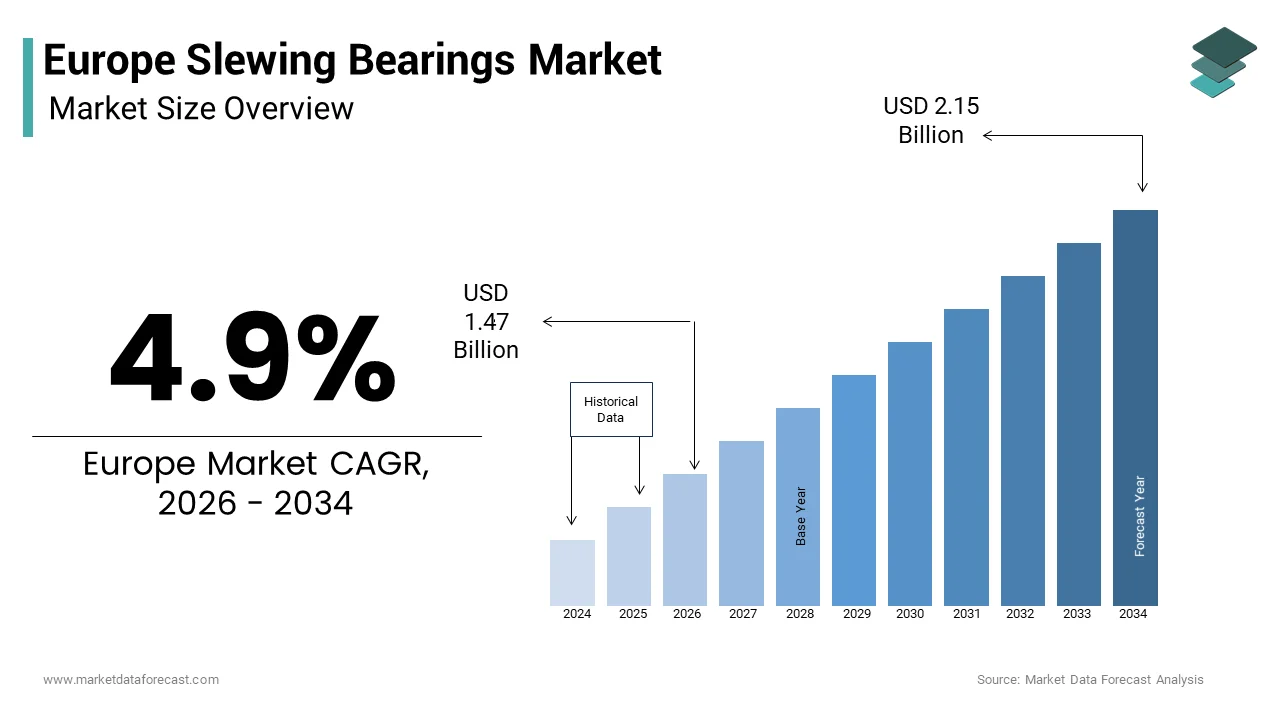
$1.40 BnMarket Estimate, 2026
$1.47 BnMarket Forecast, 2034
$2.15 BnCAGR, 2026–2034
4.9%Europe Slewing Bearings Market Size
The European slewing bearings market size was valued at USD 1.40 billion in 2025 and is anticipated to reach USD 1.47 billion in 2026 to reach USD 2.15 billion by 2034, growing at a CAGR of 4.9% from 2026 to 2034.
A slewing bearing (also known as a slewing ring or turntable bearing) is a large-diameter, high-capacity rotational bearing designed to support heavy loads while allowing smooth rotational or oscillatory movement. These components are critical for enabling smooth rotation in heavy machinery such as wind turbines cranes excavators and solar tracking systems. The market functions as a backbone for industrial mobility and renewable energy infrastructure across the continent. According to sources, the expansion of renewable energy capacity is driving a consistent requirement for specialized mechanical components that allow turbine heads to rotate and blades to adjust for optimal wind capture. Despite a recent dip in new machinery sales, the existing fleet of heavy vehicles maintains a high demand for durable rotating parts used in digging and lifting operations. The definition extends beyond simple mechanical parts to include integrated sensor technologies that monitor load distribution and wear in real time. Moreover, the long operational life of manufacturing equipment in major industrial hubs creates a substantial secondary market for high-quality replacement parts to keep older systems running. This sector is characterized by high engineering standards where tolerance levels often remain below 0.05 millimeters to ensure operational safety in extreme weather conditions prevalent in Northern Europe. The market dynamics are heavily influenced by regulatory frameworks regarding energy efficiency and structural safety which mandate the use of certified components in all major infrastructure projects.
PRIMARY MARKET DRIVERS
Expansion of Offshore Wind Energy Infrastructure Drives Component Demand
The proliferation of offshore wind farms is a major boost to the Europe Slewing Bearings Market. This growth is driven by the massive scale of turbine installations needed to meet continental energy goals. Each offshore wind turbine typically requires multiple large diameter slewing bearings for both the yaw system that orientates the nacelle and the pitch system that adjusts blade angles. According to WindEurope the region installed 3.8 gigawatts of new offshore wind capacity in 2023 alone which translates to hundreds of specialized bearing units needing immediate deployment. The trend toward larger turbines with capacities exceeding 15 megawatts further amplifies this demand as these giants require bearings with diameters surpassing 4 meters to withstand higher torque loads. Long-term policy targets for zero-emission energy are mandating a massive, multi-decade build-out of marine infrastructure that will require a consistent and growing supply of high-performance mechanical parts. The harsh marine environment necessitates bearings with superior corrosion resistance and sealing capabilities driving manufacturers to invest in advanced coating technologies. As per the European Commission energy strategy documents the North Sea is designated as a green power plant which will host thousands of new turbines over the next decade. This concentrated development creates a localized surge in demand for high reliability components that can operate maintenance free for extended periods. The shift from onshore to offshore locations also increases the technical complexity of the bearings required thereby raising the value per unit and favoring established European manufacturers who comply with strict maritime safety standards.
Modernization of Aging Construction and Material Handling Fleets
The systematic modernization of construction fleets and material handling equipment across Europe serves as a significant demand driver for replacement and upgraded slewing bearings, and thereby drives the expansion of the European slewing bearings market. Many cranes and excavators currently in operation were manufactured over a decade ago and are reaching the end of their optimal service life requiring comprehensive overhauls that include bearing replacements. Rental companies are increasingly prioritizing fleet renewal and electrification to meet stricter environmental regulations, resulting in a shift toward younger, more technologically advanced machinery. As infrastructure projects under the Connecting Europe Facility gain momentum there is increased utilization of heavy lifting equipment which accelerates wear and tear on rotational joints. Although overall machinery production has slowed, the "aftermarket" remains a critical revenue stream for manufacturers as companies choose to maintain existing fleets rather than investing in new capital equipment. The introduction of stricter emission regulations has also prompted operators to retrofit older machines with newer engines and control systems which often necessitates the upgrading of mechanical interfaces including slewing rings to handle different load profiles. Furthermore, the rise of urban construction projects in dense cities like Paris and London demands compact yet powerful cranes that utilize high density slewing bearings to maximize lifting capacity within minimal footprints. Large-scale government-backed initiatives, such as the NextGenerationEU fund, are fueling a long-term pipeline of infrastructure projects focused on digital and green transitions. This sustained activity ensures that demand remains resilient even when new equipment sales experience temporary fluctuations.
CRITICAL MARKET RESTRAINTS
Volatility in Raw Material Prices and Supply Chain Disruptions
Fluctuating costs of specialty steel and rare earth elements pose a substantial restraint on the Europe Slewing Bearings Market. This volatility compresses profit margins and creates pricing uncertainty for end users. The manufacturing of high grade slewing rings relies heavily on clean steel alloys and sometimes incorporates rare earth magnets for integrated sensor systems both of which are subject to global commodity price swings. According to research, sharp and unpredictable shifts in European steel costs have created a volatile environment for manufacturers, complicating the establishment of stable, long-term pricing for industrial components. Additionally, the European dependence on imported raw materials exposes the sector to geopolitical tensions and logistics bottlenecks that can delay production schedules. Unprecedented spikes in production costs have placed European manufacturers under severe pressure, eroding their price advantage against international competitors. The scarcity of specific alloying elements such as molybdenum and chromium which are essential for hardness and corrosion resistance further exacerbates the situation. European industry is highly vulnerable to supply chain disruptions because it relies on a small number of non-EU nations for the essential minerals needed in high-tech mechanical engineering. These factors force manufacturers to either absorb costs thereby reducing investment in research and development or pass them to customers which may dampen demand in price sensitive segments like small scale construction. The inability to predict material costs accurately hinders strategic planning and inventory management leading to potential stockouts or excessive warehousing expenses that strain operational liquidity.
Stringent Regulatory Compliance and Certification Burdens
The rigorous landscape of regulatory compliance and certification requirements in the region acts as a barrier to entry in the Europe slewing bearings market. Furthermore, it slows down the speed to market for new slewing bearing designs. Manufacturers must adhere to a complex web of standards including ISO directives CE marking and sector specific regulations for aerospace wind energy and heavy machinery which demand extensive testing and documentation. The stringent testing and validation requirements for mission-critical mechanical parts mean that introducing new, larger designs is a lengthy process that can delay the deployment of next-generation technologies. This lengthy timeline delays product launches and prevents companies from quickly capitalizing on emerging market opportunities or responding to sudden shifts in customer specifications. Furthermore, the constant evolution of safety norms particularly in the wind energy sector where failure can lead to catastrophic environmental damage imposes additional R&D burdens. Increasing enforcement of workplace and environmental standards is leading organizations to spend more on internal quality assurance to avoid potential legal and financial repercussions. Small and medium sized enterprises often struggle to meet these exhaustive requirements due to limited financial and technical resources resulting in market consolidation where only large players can sustain the compliance overhead. Extensive regulatory requirements are increasingly viewed as a barrier to rapid market adaptation, often forcing firms to prioritize legal box-ticking over pure product innovation. This environment discourages rapid prototyping and iterative design improvements which are crucial for maintaining technological leadership in a highly competitive global marketplace.
EMERGING MARKET OPPORTUNITIES
Integration of Smart Monitoring and Predictive Maintenance Technologies
The convergence of Internet of Things (IoT) capabilities with traditional mechanical components offers major potential for the Europe slewing bearings market growth. This potential is driven by the development of smart bearing solutions. Modern industrial operators increasingly seek bearings embedded with sensors that monitor temperature vibration and load in real time to enable predictive maintenance and prevent unplanned downtime. European factories are increasingly embedding sensors into heavy machinery to monitor health in real-time, aiming to capture significant economic value through improved operational efficiency. This shift allows bearing manufacturers to transition from selling mere hardware to offering comprehensive service contracts that include data analytics and lifecycle management. The shift toward data-driven maintenance is providing a compelling financial case for upgrading traditional mechanical parts with "smart" features that can signal their own wear and tear. The European Green Deal further accelerates this trend by encouraging technologies that optimize energy consumption and reduce waste through efficient asset management. As per studies, the demand for connected components in the wind energy sector is expected to grow at a double digit rate as operators strive to maximize the uptime of remote offshore installations. Manufacturers are integrating wireless transmission modules and edge computing directly into the bearing housing. This allows them to provide actionable insights that help clients plan maintenance during low wind or off-peak periods. This technological evolution opens new revenue streams and fosters deeper long-term relationships between suppliers and end users transforming the market dynamics from transactional to relational.
Adoption of Lightweight and High Strength Composite Materials
The exploration and adoption of advanced composite materials provide a transformative opportunity for the Europe Slewing Bearings Market. This shift addresses the industry's relentless pursuit of weight reduction and enhanced durability. Traditional steel bearings while robust contribute significantly to the overall weight of rotating structures which limits the size and efficiency of wind turbines and mobile cranes. According to sources, manufacturers are increasingly substituting heavy metal parts with advanced polymers to create lighter, more energy-efficient machinery without sacrificing structural integrity. Integrating these composites into slewing bearing races or rolling elements can drastically reduce the rotational inertia allowing for faster response times and lower energy consumption in drive systems. Aerospace-grade weight-reduction techniques are beginning to influence the design of ground-based heavy equipment, leading to new hybrid material combinations. The massive physical scale of modern wind energy units is making "mass-efficiency" a primary design goal to keep the overall cost of energy low. Specialized academic research is exploring how combining metals and composites can solve specific durability issues, though steel remains the dominant choice for heavy-duty load bearing. This material innovation aligns perfectly with European sustainability goals by reducing the carbon footprint associated with transportation and installation of heavy machinery. Manufacturers who pioneer these hybrid designs can capture premium market segments and establish new industry benchmarks for performance and efficiency.
KEY MARKET CHALLENGES
Intensifying Competition from Low Cost Asian Manufacturers
Escalating competition is posing a major threat to the European slewing bearings market. This pressure stems from low-cost manufacturers in China and India, which have significantly upgraded their production capabilities. These international competitors have invested heavily in automated manufacturing lines and quality control systems allowing them to produce standard slewing rings at prices lower than their European counterparts. While European manufacturers compete on precision and customization the price sensitivity of certain sectors such as general construction and agricultural machinery makes them vulnerable to cheaper alternatives. Studies reveals that market share for domestic producers in the standard bearing segment has eroded over the last three years due to this pricing pressure. The challenge is compounded by the fact that many Asian firms are now obtaining European certifications thereby neutralizing the regulatory advantage previously held by local players. As per sources, the cost differential in labor and energy between Europe and Asia remains substantial making it difficult for European factories to compete on volume products without sacrificing margins. This dynamic forces European companies to constantly innovate and move up the value chain but it also risks marginalizing those unable to differentiate their offerings sufficiently. The presence of aggressive global players also complicates procurement strategies for multinational corporations who may opt for standardized global supply chains over regional sourcing.
Shortage of Skilled Labor and Specialized Engineering Talent
The acute shortage of skilled labour and specialized engineering talent is a critical challenge to the Europe Slewing Bearings Market. This expertise is required to design, manufacture, and maintain these complex components. The production of large diameter slewing bearings demands highly trained machinists welders and quality inspectors who possess niche skills that are becoming increasingly scarce in the European workforce. According to studies, the manufacturing sector in the European Union faces a deficit of skilled workers with particular gaps in metalworking and precision engineering roles. This labor scarcity leads to production bottlenecks increased overtime costs and delays in fulfilling custom orders which can damage customer relationships and reputations. The aging demographic of the current workforce exacerbates the issue as experienced professionals retire without adequate replacements entering the pipeline. As per research, the mismatch between available skills and industry needs is projected to widen unless significant investments are made in vocational training and apprenticeship programs. Furthermore, the complexity of modern smart bearings requires engineers proficient in both mechanical design and digital electronics a combination that is rare in the traditional labor pool. This talent gap not only hampers current production efficiency but also stifles innovation as companies struggle to staff research and development teams capable of pushing technological boundaries. The industry must adopt a strategic approach to workforce development. Without it, they risk losing their competitive edge in high-precision manufacturing to regions with more abundant technical labor.
REPORT COVERAGE
| REPORT METRIC | DETAILS |
| Market Size Available | 2025 to 2034 |
| Base Year | 2025 |
| Forecast Period | 2026 to 2034 |
| CAGR | 4.9% |
| Segments Covered | By Rolling Element, Gear Type, Design, Application, Roller Type, and Country |
| Various Analyses Covered | Regional & Country Level Analysis, Segment-Level Analysis, DROC, PESTLE Analysis, Porter’s Five Forces Analysis, Competitive Landscape, Analyst Overview on Investment Opportunities |
| Countries Covered | UK, France, Spain, Germany, Italy, Russia, Sweden, Denmark, Switzerland, Netherlands, Turkey, Czech Republic, and the Rest of Europe |
| Market Leaders Profiled | IMO Group, Italcuscinetti S.p.A. Socio Unico, Liebherr, NTN Corporation, Schaeffler Technologies AG & Co. KG., SKF, THE TIMKEN COMPANY, Antex Corporation, and Kavitsu Slew Ring Bearings. |
SEGMENTAL ANALYSIS
By Rolling Element Insights
The roller bearing segment led the Europe slewing bearings market and accounted for a 62.5% share in 2025. This supremacy is driven by the inherent ability of roller elements to distribute heavy loads over a larger contact area compared to ball bearings making them indispensable for high torque applications. An additional driver is the massive scale of offshore wind turbine installations where nacelles and rotor blades exert immense moment loads that only roller configurations can sustain reliably. Furthermore the construction sector relies heavily on roller bearings for large crawler cranes and excavators which form the backbone of European infrastructure development. A study indicates that sales of heavy lifting equipment with capacities exceeding notable tons grew in 2024 directly boosting demand for three row roller slewing bearings. The durability factor also plays a crucial role as roller bearings typically offer a service life longer than ball bearings under equivalent load conditions reducing total cost of ownership for industrial operators. As per sources, the preference for roller elements in harsh environments like mining and port logistics remains absolute due to their superior resistance to deformation and fatigue failure under shock loads.
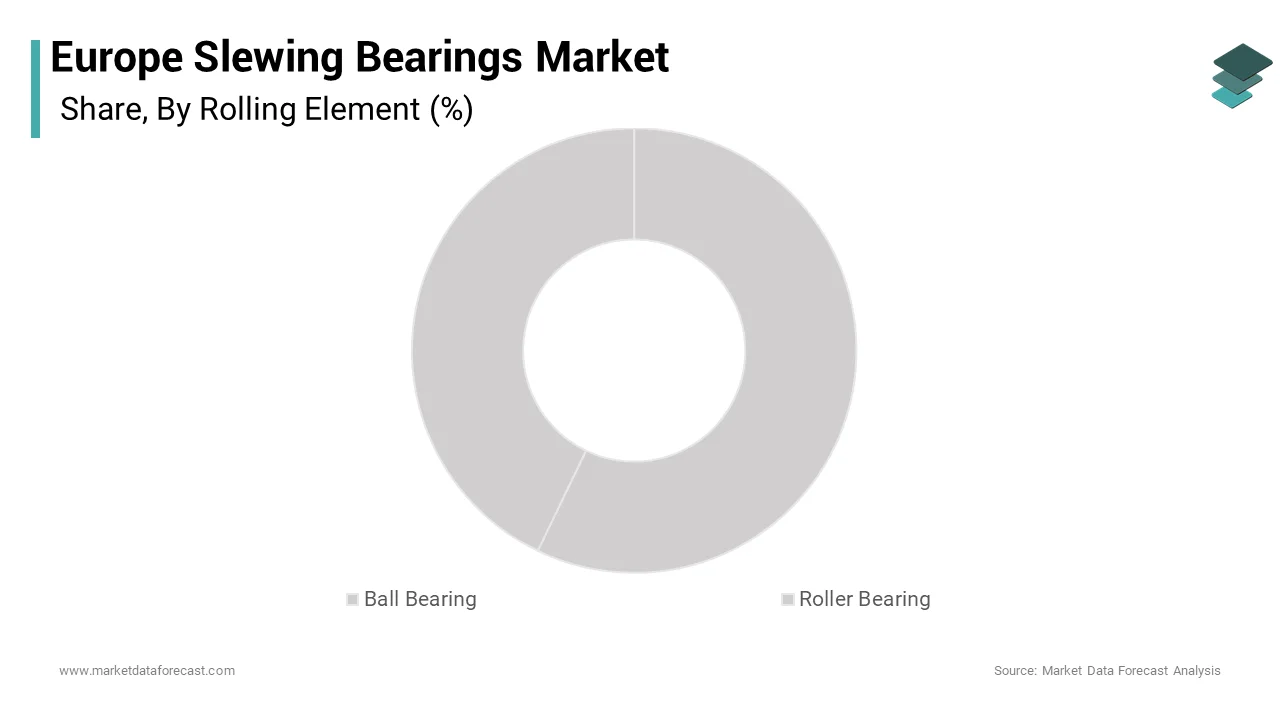
The ball bearing segment is expected to exhibit a noteworthy CAGR of 7.8% from 2026 to 2034 due to the surge in applications requiring high rotational speed and precision rather than maximum load capacity. This acceleration is also fueled by the expanding solar tracking market where single axis and dual axis trackers utilize ball type slewing rings to follow the sun with minimal friction and energy consumption. According to sources, the installed capacity of solar photovoltaic systems in the European Union in recent years in the region, creating an immediate need for millions of lightweight and agile ball bearing units. The aerospace and defense sector also contributes significantly to this growth as radar systems and satellite communication antennas demand smooth continuous rotation with minimal backlash which ball bearings provide effectively. Studies show that defense spending on radar and surveillance technology rose in 2024 leading to increased procurement of specialized ball slewing rings for mobile and stationary platforms. Additionally, the rise of small scale urban wind turbines and robotic automation systems favours ball bearings due to their compact design and ability to operate at higher speeds without excessive heat generation. The shift towards renewable energy solutions that prioritize efficiency and responsiveness over raw lifting power ensures that the ball bearing segment will outpace others in terms of growth velocity.
By Gear Insights
The internal gear segment was the largest segment in the Europe slewing bearings market and captured a 55.3% share in 2025. The dominance of the segment is primarily attributed to the widespread adoption of internal gear configurations in wind turbine yaw drives where the gear ring is integrated within the bearing structure to save space and protect teeth from environmental contaminants. The design allows for a more compact nacelle layout which is critical as turbine manufacturers strive to reduce the overall weight and aerodynamic drag of offshore units. A further key factor is the application in large excavators and tunnel boring machines where internal gears provide better torque transmission efficiency and easier maintenance access compared to external counterparts. The mechanical advantage of internal gears also includes reduced noise levels and smoother operation which aligns with strict European noise pollution regulations in urban construction zones. As per sources, the trend toward integrating drive systems directly into the bearing housing has solidified the position of internal gears as the standard for high performance heavy machinery across the continent.
The ungeared segment is predicted to witness the highest CAGR of 8.2% during the forecast period owing to the rising demand for direct drive technologies and applications where external motorization is preferred over integrated gearing. This surge is particularly evident in the solar tracking industry where ungeared slewing rings allow for flexible motor placement and simplified assembly reducing the overall system complexity and cost. According to sources, the adoption of double-sided solar modules is driving the development of tracking systems that must precisely orient panels to capture both direct sunlight and reflected light from the ground. The robotics and automation sector also fuels this expansion as collaborative robots and automated guided vehicles increasingly utilize ungeared bearings paired with external servo motors to achieve higher precision and programmable motion profiles. Labour shortages and the expansion of e-commerce are accelerating the use of mobile robots that rely on agile joints for navigation and material handling within distribution centres. Furthermore the medical imaging equipment market including CT scanners and MRI machines relies on ungeared slewing bearings to ensure ultra smooth and vibration free rotation essential for high resolution diagnostics. The integration of digital technologies and the rising need for chronic disease diagnosis are fueling a steady demand for high-accuracy imaging systems that require specialised bearing components. The versatility of ungeared designs to accommodate various drive train configurations makes them the preferred choice for innovative applications where customization and adaptability are paramount.
By Design Insights
The three row roller slewing ring bearing segment dominated the Europe slewing bearings market and occupied a 38.3% share in 2025 because of its unparalleled capacity to handle combined axial radial and moment loads simultaneously. This configuration is the industry standard for the most demanding applications such as offshore wind turbine main bearings and large shipyard cranes where structural integrity under extreme stress is non negotiable. Additionally, the segment is helped by the escalating size of offshore wind turbines which now routinely exceed 14 megawatts in capacity requiring bearings that can support rotor weights of over 100 tons. As turbine loads grow, there is a technical shift toward bearing designs that can distribute weight more effectively across multiple surfaces to prevent premature wear. Additionally, the heavy civil engineering sector relies on these bearings for bridge construction equipment and port gantry cranes which operate continuously under heavy payloads. Despite recent fluctuations in trade volumes, the shift toward larger container vessels requires ports to upgrade to higher-capacity cranes that can reach across wider decks. The design offers distinct advantages in terms of stiffness and longevity making it ideal for applications where downtime is prohibitively expensive. The use of multiple rows of rollers allows for a more even distribution of pressure, significantly extending the operational life of components in high-stress environments compared to simpler designs.
The single row four point contact ball slewing ring bearing segment is estimated to register the fastest CAGR of 8.5% between 2026 and 2034. The swift expansion of the segment is propelled by the need for compact lightweight and cost-effective solutions in medium duty applications. This design is gaining rapid traction in the agricultural machinery sector where modern tractors and harvesters require agile rotational components that do not add excessive weight to the vehicle. According to studies, sales of high horsepower tractors in Europe increased in 2023 with manufacturers increasingly specifying single row four point contact bearings for loader arms and rotary cutters. The construction equipment segment also contributes to this growth as mini excavators and compact track loaders become more popular for urban renovation projects where space constraints favor smaller bearing profiles. Furthermore, the material handling industry is adopting these bearings for smaller turnover cranes and stackers due to their ability to provide sufficient load capacity while maintaining a slim cross section. As per sources, the market for warehouse automation equipment grew in 2023 with many systems incorporating single row four point contact bearings for their optimal balance of performance and footprint. The versatility of this design to replace bulkier roller bearings in applications with moderate load requirements ensures its status as the fastest expanding segment in the market.
COUNTRY ANALYSIS
Germany slewing bearings market analysis
Germany outperformed other countries in the Europe slewing bearings market and accounted for a share of 24.1% in 2025. The leading position of the German market is driven by its robust manufacturing base and leadership in renewable energy technology. The country hosts some of the world's largest wind turbine manufacturers and construction equipment producers who source high precision bearings domestically to maintain supply chain efficiency. According to research, Germany is accelerating its onshore wind rollout to meet climate targets, resulting in a consistent need for the large-scale mechanical components used in turbine rotation. The automotive and machinery sectors further bolster this position as German engineering firms prioritize local sourcing of critical components to adhere to strict quality standards. The German machinery sector remains a global heavyweight, providing the foundational equipment for industries that rely on heavy-duty rotation and bearing technology. The presence of major bearing manufacturers with advanced research facilities in cities like Schweinfurt and Stuttgart fosters continuous innovation in bearing design and materials. Despite short-term fluctuations in global demand, German engineering products continue to be a central component of the international supply chain for industrial hardware. The strong governmental support for the Energiewende or energy transition ensures that the wind energy sector will remain a primary consumer of slewing bearings for the foreseeable future.
Denmark slewing bearings market analysis
Denmark was the next prominent countries in the Europe slewing bearings market and captured a 12.9% share in 2025. It is disproportionately high relative to its population due to its status as the global hub for offshore wind energy development. The country is home to leading turbine OEMs and specialized component suppliers who drive the demand for ultra large and highly specialized slewing bearings capable of withstanding harsh North Sea conditions. According to sources, Denmark is shifting its focus toward large-scale energy islands and future offshore clusters, which will create massive future demand for maritime engineering components. This concentrated activity creates a dense cluster of demand for yaw and pitch bearings that meet the most rigorous maritime certification standards. The Danish maritime industry also contributes significantly as shipbuilding and port expansion projects utilize heavy duty slewing rings for cranes and deck machinery. The collaboration between technical universities and industry players has positioned Denmark at the forefront of developing next generation bearing technologies for floating wind platforms. The nation's strategic focus on exporting wind technology further amplifies its influence on the regional bearing market dynamics.
United Kingdom slewing bearings market analysis
The United Kingdom continues to be a major player in the Europe slewing bearings market due to an aggressive resurgence in offshore wind projects and substantial infrastructure renewal programs. Following policy shifts aimed at accelerating net zero targets the UK has seen a surge in consent approvals for massive offshore wind farms in the North Sea and Irish Sea. The decommissioning of older oil and gas platforms and their replacement with wind installations has created a unique demand cycle for heavy lift vessels equipped with high capacity cranes using specialized bearings. Additionally the HS2 high speed rail project and other major civil engineering works require extensive use of tunneling machines and piling rigs that rely on robust slewing ring designs. The combination of energy transition goals and infrastructure modernization ensures the UK remains a pivotal market for slewing bearing manufacturers.
France slewing bearings market analysis
France is moving ahead in the Europe slewing bearings market owing to a diverse demand profile stemming from its nuclear energy program aerospace industry and growing wind sector. Unlike its neighbors France maintains a strong reliance on nuclear power which requires specialized slewing bearings for reactor maintenance manipulators and fuel handling systems. The aerospace sector is another critical pillar as France hosts major aircraft manufacturers who utilize precision slewing rings for radar domes turret systems and satellite deployment mechanisms. Simultaneously the French government's push to expand wind energy capacity particularly in offshore zones along the Atlantic coast is opening new avenues for traditional slewing bearing applications. This multi sectoral demand base provides France with a resilient market position that is less susceptible to fluctuations in any single industry.
Italy slewing bearings market analysis
Italy is anticipated to grow in the Europe slewing bearings market over the forecast period. It is driven primarily by extensive infrastructure development port modernization and a burgeoning solar energy sector. The country's strategic location as a Mediterranean logistics hub has prompted massive investments in port automation and crane upgrades which are key consumers of slewing bearings. The modernization of major ports like Genoa and Trieste involves the installation of new ship to shore cranes and automated stacking systems that require high performance slewing rings. Additionally, Italy is experiencing a solar energy boom with significant installations of tracking systems in the southern regions which utilize ball type slewing bearings. The construction sector also contributes through the renovation of historical structures and new commercial developments that employ tower cranes equipped with reliable slewing mechanisms. The convergence of logistics expansion and renewable energy adoption positions Italy as a dynamic and growing market within the European landscape.
COMPETITIVE LANDSCAPE
The competition in the Europe slewing bearings market is characterized by a high degree of consolidation where a few established engineering giants dominate alongside specialized niche manufacturers. Rivalry is intense primarily driven by the need for technological superiority in handling extreme loads and harsh environmental conditions typical of offshore wind farms. Companies compete fiercely on product durability precision and the ability to provide comprehensive after sales support including monitoring and remanufacturing services. The barrier to entry remains high due to the substantial capital investment required for heavy machinery and the rigorous certification processes mandated by European safety standards. While price competition exists particularly in standard segments the market largely rewards innovation and reliability over low cost. Global players are increasingly localizing production to serve the European demand efficiently while regional specialists focus on custom solutions for specific industrial applications. The dynamic landscape forces continuous adaptation as customers demand smarter and more sustainable bearing solutions to meet aggressive decarbonization goals.
KEY MARKET PLAYERS
A few of the Europe slewing bearings market include
- IMO Group
- Italcuscinetti S.p.A. Socio Unico
- Liebherr
- NTN Corporation
- Schaeffler Technologies AG & Co. KG.
- SKF
- THE TIMKEN COMPANY
- Antex Corporation
- Kavitsu Slew Ring Bearings.
Top Players In The Market
- SKF Group SKF Group stands as a paramount force in the Europe slewing bearings market leveraging its Swedish heritage to deliver high precision solutions for wind energy and heavy industry. The company contributes significantly to the global landscape by setting benchmarks in bearing life and reliability through advanced material science. Recently SKF has intensified its focus on sustainability by launching circular economy initiatives that include remanufacturing services for large diameter bearings. They have also expanded their digital capabilities by integrating sensor technology into slewing rings to enable predictive maintenance for offshore wind operators. These strategic moves reinforce their commitment to reducing downtime and enhancing operational efficiency for clients across the continent. Their continuous investment in research and development ensures they remain at the forefront of technological innovation in rotational systems.
- Schaeffler Group Schaeffler Group operates as a critical pillar in the European slewing bearings sector with its brands FAG and INA providing robust components for construction machinery and renewable energy applications. The German engineering giant influences the global market through its extensive production network and deep technical expertise in custom bearing design. Recent actions include the expansion of their manufacturing facilities in Germany to increase capacity for large scale slewing rings demanded by the offshore wind boom. Schaeffler has also partnered with major turbine manufacturers to co develop next generation bearings that support larger rotor diameters and higher torque loads. Their emphasis on digitalization is evident in their Condition Monitoring services which help operators optimize asset performance. These efforts solidify their reputation as a reliable partner for complex industrial challenges and infrastructure projects.
- Rothe Erde Rothe Erde a subsidiary of Schaeffler Group yet often recognized for its specialized focus dominates the niche of large diameter slewing bearings for wind turbines and excavators. Based in Germany the company plays a vital role in the global supply chain by producing some of the largest slewing rings available for mega scale offshore installations. Their recent strategy involves heavy investment in automated welding and machining technologies to improve production speed and consistency. Rothe Erde has also strengthened its position by securing long term supply agreements with leading wind turbine original equipment manufacturers to ensure stability amidst growing demand. They actively participate in industry consortia to define future standards for bearing durability in harsh marine environments. This proactive approach ensures they maintain their status as a preferred supplier for the most demanding applications in the energy and construction sectors.
Top Strategies Used By Key Market Participants
Key players in the Europe slewing bearings market primarily employ strategies focused on technological innovation and capacity expansion to maintain competitive advantage. Companies are heavily investing in research and development to create lightweight and high strength bearing designs that meet the evolving needs of offshore wind energy. Another prevalent strategy is the integration of digital sensors and Internet of Things capabilities into products to offer value added predictive maintenance services. Manufacturers are also expanding their production facilities within Europe to reduce lead times and mitigate supply chain risks associated with global logistics. Strategic partnerships and long term contracts with original equipment manufacturers in the wind and construction sectors are crucial for securing steady revenue streams. Additionally firms are adopting sustainable manufacturing practices and circular economy models to align with strict European environmental regulations and appeal to eco conscious clients.
MARKET SEGMENTATION
This research report on the European slewing bearing market has been segmented and sub-segmented based on the following categories.
By Rolling Element
- Ball Bearing
- Roller Bearing
By Gear Type
- Internal Gear
- External Gear
- Ungeared
By Design
- Cross Roller Slewing Ring Bearing
- Double-Row Ball Slewing Ring Bearing
- Three-Row Roller Slewing Ring Bearing
- Bi -Angular Roller or Taper
- Four-Point and Eight-Point, and Contact Ball
- Single Row Four Point Contact Ball Slewing Ring Bearing
- Others
By Application
- Wind and Solar Energy
- Aerospace and Defense
- Medical
- Industrial Machinery
- Oil and Gas
- Mining & Construction
- Automobile Sector
By Roller Type
- Ball
- Roller
By Country
- UK
- France
- Spain
- Germany
- Italy
- Russia
- Sweden
- Denmark
- Switzerland
- Netherlands
- Turkey
- Czech Republic
- Rest of Europe
Frequently Asked Questions
What is the Growth Rate for the Europe Slewing Bearing Market?
The market for Europe Slewing Bearing is anticipated to grow at a CAGR of 4.9% from 2025 to 2033.
Mention any one of the Europe Slewing Bearing Market Primary Drivers?
Europe Slewing Bearings market is primarily driven by an increase in demand from customers in the end-user sectors such as Automobile and Machinery Manufacturing, Aerospace & Defense, Mining & Construction, Oil and Gas, and Renewable equipment.
Which End-User Industry segment holds the largest market share?
The Manufacturing sector in the End-User Industry segment is leading with a substantial market share.
What’s driving demand for slewing bearings in Europe?
Growth in wind energy (especially offshore), construction equipment modernization, and port automation are the top drivers—each requiring high-precision, heavy-duty rotary support.
Why is the wind energy sector so critical?
A single wind turbine uses 2–3 slewing bearings (yaw and pitch systems). With the EU targeting 300+ GW of wind by 2030, demand for large-diameter, corrosion-resistant bearings is surging.
Are European manufacturers competitive globally?
Yes—Germany (Rothe Erde, IMO), Italy (Slewing Europe), and the Czech Republic lead in high-end, custom-engineered slewing rings, especially for aerospace and renewables.
How is the green transition affecting design requirements?
Bearings must now last 25+ years with minimal maintenance, resist salt spray (offshore), and handle variable loads—pushing innovation in surface hardening and sealing technologies.
Is there a shift toward standardized vs. custom bearings?
Custom still dominates—each wind turbine or crane model often requires unique dimensions and load specs—but modular designs are emerging to cut lead times.
What materials are trending in 2025?
High-strength alloy steels (e.g., 42CrMo4) remain standard, but some OEMs are testing case-hardened stainless variants for extreme marine environments.
What certifications matter most in Europe?
ISO 9001 is baseline; wind sector buyers often require ISO 14001, ISO 45001, and compliance with DNV or TÜV standards for fatigue life and safety.
Related Reports
Access the study in MULTIPLE FORMATS
Purchase options starting from
$ 2000
Didn’t find what you’re looking for?
TALK TO OUR ANALYST TEAM
Need something within your budget?
NO WORRIES! WE GOT YOU COVERED!
Call us on: +1 888 702 9696 (U.S Toll Free)
Write to us: sales@marketdataforecast.com