Europe Smart Factory Market Size, Share, Trends & Growth Forecast Report – Segmented By Component (Industrial Sensors, Industrial Robots, Industrial 3D Printers and Machine Vision Systems), Solution, Industry Vertical, and Country (UK, France, Spain, Germany, Italy, Russia, Sweden, Denmark, Switzerland, Netherlands, Turkey, Czech Republic & Rest of Europe), Industry Analysis From 2025 to 2033
Market Size, 2025
$21.06 BnMarket Estimate, 2026
$22.84 BnMarket Forecast, 2034
$43.64 BnCAGR, 2026–2034
8.43%Europe Smart Factory Market Report Summary
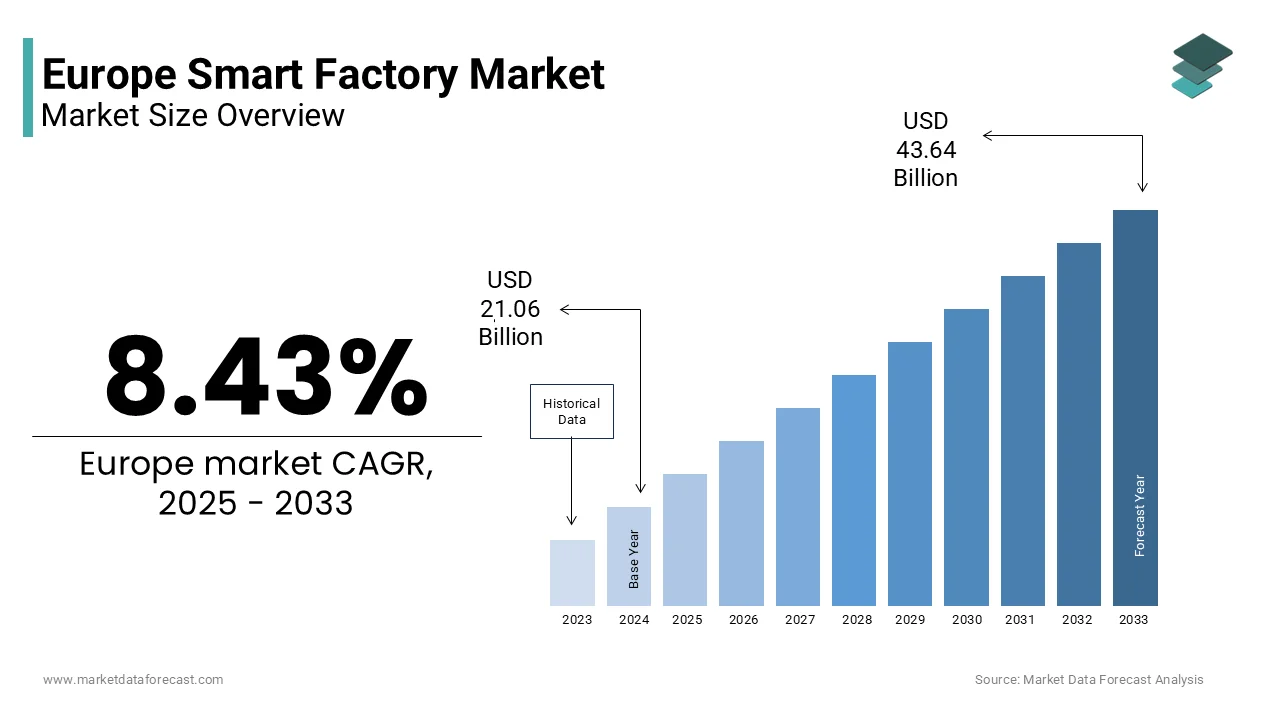
The Europe smart factory market was valued at USD 21.06 billion in 2024, is estimated to reach USD 22.84 billion in 2025, and is projected to reach USD 43.64 billion by 2033, growing at a CAGR of 8.43% during the forecast period. Market growth is driven by rapid adoption of Industry 4.0 technologies, increasing automation across manufacturing operations, and rising demand for real-time data-driven decision-making. Strong focus on improving operational efficiency, reducing downtime, and enhancing production flexibility, along with increasing integration of AI, IoT, robotics, and advanced analytics, is further accelerating the deployment of smart factory solutions across Europe.
Key Market Trends
- Germany remained the largest market, supported by its advanced manufacturing base, strong automotive sector, and early adoption of industrial automation technologies.
- Western Europe continues to witness strong growth, driven by large-scale digital transformation initiatives and investments in smart manufacturing infrastructure.
- Rising deployment of industrial sensors to enable predictive maintenance, asset monitoring, and real-time production visibility.
- Growing adoption of manufacturing execution systems (MES) to streamline workflows, enhance traceability, and optimize production efficiency.
- Increasing smart factory implementation across automotive manufacturing to support flexible production lines and electric vehicle manufacturing.
Segmental Insights
- By component, the industrial sensors segment held the major share of the Europe smart factory market in 2024, driven by the need for real-time data collection, condition monitoring, and automation across production environments.
- By solution, the manufacturing execution systems segment dominated the market in 2024, supported by its critical role in bridging enterprise systems and shop-floor operations.
- By industry vertical, the automotive segment accounted for the highest share in 2024, owing to high automation intensity, robotics integration, and demand for smart production systems.
Regional Insights
The European smart factory market demonstrates strong regional performance supported by industrial modernization and digital manufacturing initiatives.
- Germany led the market by holding 25.7% of the regional market share in 2024, driven by its leadership in industrial engineering, automotive manufacturing, and smart production technologies.
- France and the United Kingdom continue to expand smart factory adoption, supported by government-backed digitalization programs and advanced manufacturing investments.
- Italy and Spain are emerging markets, driven by modernization of traditional manufacturing sectors and increasing adoption of automation solutions.
Competitive Landscape
The Europe smart factory market is characterized by the presence of global industrial automation leaders focusing on integrated solutions, advanced analytics, and scalable digital platforms. Companies are investing heavily in AI-driven automation, industrial software, robotics, and cybersecurity to strengthen their market position. Strategic partnerships, acquisitions, and product innovations remain key competitive strategies. Prominent players operating in the European smart factory market include ABB Group, Emerson Electric Co., General Electric (GE) Co., Siemens AG, Rockwell Automation, Inc., Schneider Electric SE, Honeywell International, Inc., Mitsubishi Electric Corporation, KUKA AG, and Omron Corporation.
Europe Smart Factory Market Size
The Europe smart factory market size was valued at USD 21.06 billion in 2024 and is projected to reach USD 43.64 billion by 2033 from USD 22.84 billion in 2025, growing at a CAGR of 8.43%.
A smart factory is the convergence of advanced automation, cyber-physical systems, data analytics and interconnected machinery to create highly adaptive and self-optimising manufacturing environments. Unlike conventional production facilities, smart factories integrate Industrial Internet of Things sensors,s artificial intelligence,ce edge computing and digital twins to enable real-time decision making, predictive maintenance and dynamic resource allocation. This transformation is not merely technological but operational,l redefining productivity, ty quality control and energy efficiency across sectors from automotive to pharmaceuticals. According to the European Commission, over 60% of large industrial enterprises in the EU have initiated digital transformation programs aligned with the Digital Europe Programme. According to the European Environment Agency, industrial operations account for 21% of the EU’s final energy consumption, which is making efficiency gains through smart manufacturing critical to the Green Deal’s 2030 climate targets. Furthermore, as per Eurostat data, manufacturing contributes 14.2% to the EU’s gross value added, which indicates its economic centrality. National initiatives such as Germany’s Industrie 4.0, France’s Industry of the Future, and Italy’s Fabbrica Intelligente provide policy scaffolding, accelerating adoption. These forces position the smart factory not as a futuristic concept but as an operational necessity for European industrial competitiveness, resilience, and sustainability.
MARKET DRIVERS
EU Green Deal Mandates Drive EnergyOptimised Smart Manufacturing
The European Union’s Green Deal and its associated Industrial Emissions Directive are compelling manufacturers to adopt smart factory technologies to meet stringent energy efficiency and decarbonization targets, which is one of the key factors driving the growth of the European smart factory market. According to the European Environment Agency, industrial facilities must reduce energy intensity by 32.5% by 2030 compared to 2005 levels, which is a goal unattainable through incremental improvements alone. Smart factories address this through real-time energy monitoring, AI-driven load balancing, and predictive maintenance that minimises wasteful machine idling. In Germany, pilot projects across the chemical and metal sectors in 2023 reported notable reductions in energy consumption per production unit. Similarly, Sweden’s industrial cluster in Gothenburg achieved a significant drop in CO₂ emissions after integrating digital twin simulations to optimise furnace cycles. The EU’s Carbon Border Adjustment Mechanism further incentivises clean production by imposing tariffs on carbon-intensive imports, pressuring exporters to modernise. These regulatory levers transform smart factory adoption from a strategic choice into a compliance imperative to ensure sustained investment in energy-intelligent production systems across Europe.
Persistent Shortage of Advanced Manufacturing Talent Constrains System Integration
Despite strong policy support, a critical barrier to smart factory deployment in Europe is the acute shortage of engineers and technicians skilled in both industrial automation and data science, which is further boosting the expansion of the European smart factory market. According to the European Commission’s 2024 Skills Outlook, hundreds of thousands of vacancies for digital manufacturing roles remained unfilled across the EU, with Germany, Italy, and Poland reporting the highest deficits. Traditional vocational training programs have not kept pace with the convergence of IT and operational technology, as only a minority of EU technical curricula include modules on Industrial Internet of Things or edge analytics. This gap delays implementation and increases reliance on costly external consultants. A 2023 survey by the German Engineering Federation found that a majority of mid-sized manufacturers postponed smart factory projects due to insufficient in-house expertise. Moreover, legacy workforces struggle with upskilling, as the average technician age in Eastern European plants exceeds 52 years according to Eurofound, limiting adaptability. Without coordinated public-private investment in reskilling and curriculum reform, the promise of smart factories will remain unrealised for many European industrial firms, particularly in the SME sector, which constitutes 99% of all EU manufacturers.
MARKET RESTRAINTS
Fragmented Legacy Infrastructure Inhibits Seamless Digital Integration
Many European manufacturing sites operate with decades-old machinery and control systems that lack native connectivity or standardised communication protocols, which is creating significant interoperability barriers and hampering the growth of the European smart factory market. According to the European Association of Manufacturing Technologies, a large share of machine tools in use across the EU were installed before 2010 and were not designed for data exchange with modern Manufacturing Execution Systems. Retrofitting these assets with sensors and gateways is technically complex and economically uncertain, with Germany’s Fraunhofer Institute estimating that integration costs for legacy lines can exceed 30% of new equipment value. In Southern Europe, where family-owned factories dominate industrial landscapes, budget constraints further limitmodernisationn. Italy’s National Institute of Statistics reported that only 28% of small manufacturers undertook any form of digital upgrade in 2023 due to high upfront costs and unclear return on investment. Additionally, proprietary vendor ecosystems restrict cross-platform data flow unless costly middleware is deployed. This technological fragmentation prevents holistic visibility across production networks, stifling the core promise of end-to-end process optimisation of smart factories. Until harmonised open standards achieve universal adoption, Europe’s smart factory transition will remain uneven and incremental.
Cybersecurity Vulnerabilities Undermine Operational Trust and Continuity
As factories digitise and connect to cloud platforms and supply chain networks, they become increasingly exposed to cyber threats that can disrupt production, steal intellectual property, or compromise safety systems, which further impedes the European smart factory market expansion. According to the European Union Agency for Cybersecurity, over 40% of EU industrial firms experienced a significant cybersecurity incident in 2023, with ransomware attacks on operational technology systems rising sharply since 2021. Unlike IT breaches, OT intrusions can halt physical processes, such as the 2022 attack on a Belgian steel plant that shut down casting operations for 72 hours. Many manufacturers lack dedicated OT security teams, with only 22% of EU factories implementing network segmentation between control and enterprise layers. Legacy equipment often cannot support modern encryption or patching, further widening the attack surface. Regulatory pressure is mounting as the EU’s NIS2 Directive now classifies large manufacturers as essential entities requiring mandatory incident reporting and resilience testing. However, compliance remains uneven, especially among SMEs that lack resources for robust defence architectures. Until cybersecurity is embedded as a foundational design principle rather than an afterthought, trust in smart factory ecosystems will remain fragile across Europe.
MARKET OPPORTUNITIES
Adoption of AI-Driven Predictive Quality Control Enhances Precision and Reduces Waste
The integration of artificial intelligence into quality assurance systems presents a major opportunity for European smart factories to achieve near-zero defect production while minimising material waste. Unlike traditional statistical process control, AI models analyse real-time data from vision systems, vibration sensors, and thermal imaging to detect micro anomalies invisible to human inspectors. According to the European Institute of Innovation and Technology, manufacturers using AI-based quality systems reduced scrap rates by an average of 34% in 2023 across the automotive and electronics sectors. In Finland, a Nokia smart factory deployed deep learning algorithms to inspect 5G component soldering, achieving 99.98% accuracy and eliminating manual rework. Similarly, Germany’s Robert Bosch reported a 27% decline in warranty claims after implementing AI-driven end-of-line testing in its Stuttgart plant. The EU’s Horizon Europe program has allocated 380 million euros to fund AI in manufacturing projects through 2027, accelerating adoption. By shifting from reactive to anticipatory quality control, smart factories not only enhance product reliability but also align with circular economy principles by conserving raw materials and energy embedded in defective units.
Expansion of Digital Twin Ecosystems Enables Cross-Enterprise Collaboration
Digital twin technology is unlocking new collaborative models across Europe’s industrial value chains by creating synchronised virtual replicas of physical assets, processes, and entire factories, which is another major opportunity in the European smart factory market. These dynamic models allow suppliers, OEMs, and logistics partners to simulate production changes, test supply disruptions, and optimise inventory in shared virtual environments. According to the European Defence Agency, digital twin networks reduced time to market for complex machinery by 22% in a 2023 aerospace pilot. In the chemical sector, BASF and Clariant launched a joint digital twin platform in 2024, enabling real-time co-optimisation of batch reactions and raw material flows across German and Swiss sites. The European Commission’s Important Project of Common European Interest on Next Generation Batteries has mandated digital twin integration for all participating gigafactories to harmonise cell production parameters. Furthermore, cloud-based twin platforms from Siemens and Dassault Systèmes now support secure multi-company access with blockchain-verified data lineage. This shift from isolated to federated digital twins transforms smart factories from autonomous units into nodes in an intelligent industrial mesh, enhancing resilience, innovation speed, and resource efficiency across continental supply networks.
MARKET CHALLENGES
High Capital Intensity and Uncertain ROI Deter SME Participation
The substantial upfront investment required for smart factory transformation remains a primary challenge for Europe’s vast small and medium enterprise base, which accounts for over 99% of all manufacturing firms. According to Eurostat, the average cost of a comprehensive smart factory upgrade for a mid-sized plant ranges from 1.2 to 2.5 million euros, excluding ongoing software licensing and maintenance. For firms with annual revenues below 50 million euros, this represents a significant financial risk, particularly when return on investment timelines exceed three years. A 2024 survey by the European Confederation of Small and Medium-sized Enterprises found that 68% of respondents viewed smart manufacturing as beneficial, but only 23% had implemented more than two connected technologies due to capital constraints. Public funding exists—France’s France Relance plan allocated 1.5 billion euros for industrial digitisation—but application complexity and co-financing requirements limit uptake. Moreover, many SMEs operate on thin margins with limited access to specialised consultants who can design scalable, phased roadmaps. Without accessible financing models, modular deployment options, and clear productivity metrics, the smart factory revolution risks excluding the very enterprises that form the backbone of European manufacturing.
Lack ofStandardisedd Data Interoperability Across Industrial Platforms
The absence of universal data standards across industrial software and hardware ecosystems severely limits the scalability and integration depth of smart factory initiatives in Europe, which is further challenging the expansion of the European smart factory market. While frameworks like OPC UA and MQTT offer connectivity protocols, vendor-specific data models, and proprietary analytics engines create silos that hinder end-to-end visibility. According to the European DIGITAL SME Alliance, 58% of manufacturers report that more than half their production data remains trapped in isolated systems, preventing holistic optimisation. In automotive supply chains, for example, Tier 2 suppliers using Rockwell Automation systems struggle to share real-time OEE metrics with OEMs on Siemens platforms without custom middleware. The European Commission’s 2023 Industrial Data Space initiative aims to address this by promoting GAIA-X-compliant data spaces, but adoption remains voluntary and fragmented. A pilot in the Dutch high-tech sector showed that standardised data interfaces reduced integration time by 45%, yet only 12% of participating firms had fully aligned architectures. Until industrial data becomes truly portable and semantically interoperable, smart factories will operate as islands of intelligence rather than unified cognitive systems capable of continent-wide coordination and learning.
REPORT COVERAGE
| REPORT METRIC | DETAILS |
| Market Size Available | 2024 to 2033 |
| Base Year | 2024 |
| Forecast Period | 2025 to 2033 |
| CAGR | 8.43% |
| Segments Covered | By Component, Solution, Industry Vertical, and Region |
| Various Analyses Covered | Global, Regional, & Country Level Analysis; Segment-Level Analysis; DROC, PESTLE Analysis; Porter’s Five Forces Analysis; Competitive Landscape; Analyst Overview of Investment Opportunities |
| Regions Covered | UK, France, Spain, Germany, Italy, Russia, Sweden, Denmark, Switzerland, Netherlands, Turkey, and the Czech Republic |
| Market Leaders Profiled | ABB Group, Emerson Electric Co., General Electric (GE) Co., Siemens AG, Rockwell Automation, Inc., Schneider Electric SE, Honeywell International, Inc., Mitsubishi Electric Corporation, KUKA AG, and Omron Corporation |
SEGMENTAL ANALYSIS
By Component Insights
The industrial sensors segment had the major share of the European smart factory market in 2024. The dominance of the industrial sensors segment in this regional market in the European smart factory market by component is due to their foundational role in data acquisition across every layer of production. These devices enable real-time monitoring that feeds analytics engines, predictive maintenance systems, and closed-loop control. As per Market Data Forecast, the European smart sensor market is projected to grow at a CAGR of 13.25% from 2025 to 2033, which reflects widespread adoption across smart factories. Modern automotive assembly lines in Europe integrate thousands of sensors to ensure micron-level precision and compliance with safety standards. As per Ericsson’s 2023 Industrial 5G Monitor, enhanced sensor data throughput is a key benefit cited by European manufacturers adopting 5G. Additionally, EU machinery safety directives such as EN ISO 13849 mandate redundant sensing for human-machine collaboration, pushing adoption beyond efficiency into regulatory necessity. This ubiquity across industries and integration depth ensures industrial sensors remain the sensory nervous system of Europe’s smart manufacturing ecosystem.
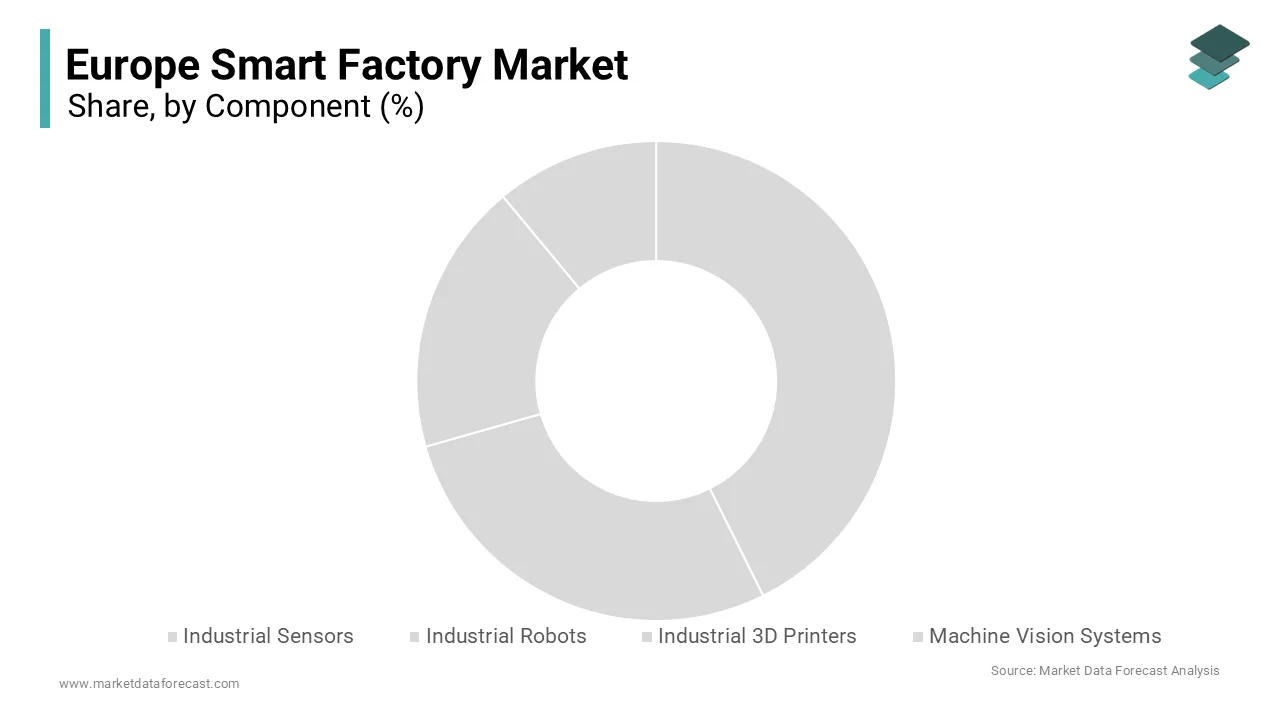
The machine vision systems segment is the fastest-growing component segment and is estimated to witness a CAGR of 11.5% over the forecast period, owing to the rising demand for zero-defect manufacturing, stringent product traceability, and the integration of artificial intelligence into visual inspection. In the pharmaceutical sector, visual inspection of sterile injectables is a regulatory requirement, driving adoption across EU production sites. A pilot at Novo Nordisk’s Danish facility demonstrated that AI-enhanced vision systems reduced false rejects while detecting microcracks invisible to human inspectors. Similarly, the automotive industry relies on vision systems for battery cell alignment in electric vehicle production. Volkswagen’s Zwickau plant uses advanced imaging systems to ensure sub-millimetre accuracy. The convergence of edge computing, hyperspectral imaging, and deep learning algorithms has transformed machine vision from a simple quality gate into a cognitive decision layer capable of real-time process correction. This evolution positions vision systems as critical enablers of both quality and autonomy in next-generation smart factories.
By Solution Insights
The manufacturing execution systems segment led the market by capturing the dominant share of the European smart factory market in 2024. The dominance of the MES segment in this regional market is driven by its central role in synchronising shop floor operations with enterprise planning and quality standards. MES platforms act as the digital backbone connecting machines, materials, and personnel to provide real-time production tracking, work order management, and regulatory compliance documentation. MES adoption is widespread among large EU manufacturers as part of their Industrie 4.0 roadmaps. In Germany, MES is commonly used by automotive suppliers to meet OEM traceability requirements such as end-to-end batch genealogy for every component. The EU’s Medical Devices Regulation further mandates electronic device history records, making MES indispensable in life sciences manufacturing. Additionally, next-generation MES now incorporate AI modules for dynamic scheduling. Siemens’ Opcenter Execution platform has demonstrated improvements in changeover efficiency in aerospace manufacturing environments. This fusion of compliance, operational control, and intelligence cements MES as the command centre of the European smart factory.
The plant asset management segment is the fastest-growing solution segment and is estimated to register a CAGR of 12.6% over the forecast period, owing to the economic imperative to extend the lifespan of capital equipment while minimising unplanned downtime in an era of supply chain volatility. Industrial maintenance accounts for a significant portion of total operating costs, and PAM systems reduce these by enabling condition-based servicing. Manufacturers using AI-powered PAM have reported reductions in machine failures and extended asset life. The EU’s Green Deal further incentivises asset longevity—France’s Anti-Waste Law prohibits premature obsolescence in industrial equipment, compelling firms to adopt predictive health monitoring. Companies like ABB and Schneider Electric have integrated digital twin-enabled PAM suites that simulate stress scenarios and recommend optimal operating parameters. In Sweden, Volvo’s Skövde engine plant uses PAM to coordinate maintenance across robotic workstations, achieving high levels of equipment availability. This shift from reactive to prescriptive asset stewardship makes PAM a cornerstone of resilient and sustainable European manufacturing.
By Industry Vertical Insights
The automotive segment commanded the highest share of the European smart factory market in 2024. The growth of the automotive segment in this regional market is owing to its complex, high-volume production requirements, stringent quality standards, and leadership in electrification and automation. As per Euronews, the EU produced 13.8 million motor vehicles in 2023, with 48.3% of new cars registered incorporating electric or hybrid powertrains. Smart factories enable the flexible production of multiple vehicle variants on shared lines—a necessity as model cycles shorten and customisation increases. Volkswagen’s Transparent Factory in Dresden uses over 500 collaborative robots and real-time digital twins to assemble ID electric models with full traceability as per the company’s 2023 sustainability report. Additionally, EU safety regulations such as General Safety Regulation 2019 mandate advanced driver assistance systems whose sensors must be calibrated in controlled smart environments. The push for battery gigafactories has further intensified adoption—Northvolt’s Skellefteå plant in Sweden relies entirely on AI-driven process control to ensure cell consistency. This confluence of technological transition, regulatory pressure, and scale ensures automotive remains the vanguard of smart manufacturing in Europe.
The medical devices segment is expanding rapidly and is expected to exhibit a CAGR of 6.64% over the forecast period, owing to the stringent regulatory requirements, rising demand for personalised implants, and the integration of smart functionality into devices themselves. The EU’s Medical Devices Regulation mandates full traceability from raw material to patient implant—a requirement only achievable through integrated smart factory systems with electronic device history records. In 2023, many Class III implant manufacturers in Ireland implemented MES and machine vision systems to comply with UDI and sterilisation validation rules. Furthermore, the rise of 3D-printed patient-specific implants—such as cranial plates and hip stems—demands closed-loop control between design, simulation, and production. At Stryker’s facility in Cork, AI-guided printing has been used to improve post-processing efficiency and ensure biomechanical accuracy. With Europe hosting over 30,000 medical device companies, the majority of which are SMEs, the segment’s growth reflects both compliance necessity and clinical innovation converging in digitally enabled production environments.
REGIONAL ANALYSIS
Germany Smart Factory Market Analysis
Germany stood as the undisputed leader in the European smart factory market in 2024 by holding 25.7% of the regional market share. The dominance of Germany in the European market is driven by its Industrie 4.0 doctrine, world-class engineering base, and dense manufacturing ecosystem. As per the German Federal Statistical Office, manufacturing accounted for 19.7% of Germany’s gross value added in 2024, the highest among major EU economies. The national Industrie 4.0 platform has certified over 1,200 smart factory reference architectures by 2023 to ensure interoperability and scalability. Companies like Siemens, Bosch, and SAP have co-developed open standards such as Asset Administration Shell, enabling seamless machine-to-enterprise data flow. Additionally, Germany’s dual education system continuously supplies workers trained in both mechanical and digital competencies. The government’s 2023 “Digital Now” investment program allocated €4.5 billion to subsidise SME digitisation, further broadening adoption. This synergy of policy, industry, and talent cements Germany’s role as Europe’s smart manufacturing nucleus.
France Smart Factory Market Analysis
France was the second biggest regional segment in the European smart factory market in 2024. The growth of France in the European market is distinguished by its strategic state-led industrial policy, strong aerospace sector, and aggressive green manufacturing agenda. According to France’s Ministry of Economy, over 11,000 factories have joined the “Industry of the Future” initiative since 2015, receiving tailored digital diagnostics and co-funded transformation plans. The aerospace cluster around Toulouse pioneers digital twin integration, with a significant share of final assembly lines using real-time simulation. Additionally, France’s 2023 Green Industry Act mandates that all new industrial investments reduce carbon intensity by 40% within five years, accelerating the adoption of AI-driven energy optimisation. The nation also leads in robotics density as Europe’s automotive sector installed 23,000 new robots in 2024, with France among the top contributors. These top-down industrial strategies, combined with sectoral excellence, ensure France’s influential and growing role in Europe’s smart factory landscape.
Italy Smart Factory Market Analysis
Italy is a prominent regional segment in the European smart factory market. The specialised machinery sector of Italy, agile small and medium enterprises, and government incentives for Industry 4.0 adoption are driving the expansion of the Italian market. According to ISTAT, over 68% of Italy’s manufacturing value is generated by firms with fewer than 250 employees. These companies are rapidly digitising through the national “Transizione 4.0” tax credit, which reimbursed €1.8 billion for smart factory investments in 2023. The Emilia Romagna region has become a smart factory showcase where modular production cells communicate via OPC UA to enable rapid reconfiguration. Additionally, Italy’s fashion and luxury goods sector is adopting smart manufacturing for traceability—LVMH’s Italian leather facilities use blockchain-linked MES to verify ethical sourcing as documented by Confindustria Moda. The integration of artisanal craftsmanship with digital precision distinguishes Italy’s approach, making it a unique laboratory for human-centric smart production in high-value manufacturing.
United Kingdom Smart Factory Market Analysis
The United Kingdom is anticipated to account for a notable share of the European smart factory market over the forecast period due to its strength in high-value engineering, advanced materials, and digital innovation, despite post-Brexit challenges. According to the UK Department for Business and Trade, the High Value Manufacturing Catapult network supported 1,200 smart factory projects in 2023 across aerospace, pharmaceuticals, and renewable energy sectors. Rolls-Royce’ss Derby facility uses AI-powered digital twins to simulate jet engine performance under extreme conditions, reducing physical testing by 70% as per company disclosures. The UK also leads in industrial cybersecurity integration, as the UK is aligning with the EU’s NIS2 directive through its own Cyber Security and Resilience Bill. Additionally, the Made Smarter initiative has digitised over 3,000 SMEs since 2021 through subsidised technology audits and training. While EU regulatory alignment has diminished, the UK leverages its R&D intensity and flexible regulatory sandbox to pioneer next-generation manufacturing models, maintaining its relevance in the European smart factory ecosystem.
Sweden Smart Factory Market Analysis
Sweden is projected to grow at a healthy CAGR in the European smart factory market over the forecast period, owing to its leadership in sustainable industrial transformation, circular production models, and human-robot collaboration. According to Statistics Sweden, greenhouse gas emissions from the Swedish economy decreased by nearly 2% in 2023, with many large manufacturers operating carbon-neutral or carbon-negative production sites. Volvo’s Torslanda plant uses 100% renewable energy and AI-optimised logistics to achieve zero waste to landfill, as documented by the Swedish Environmental Protection Agency. The nation’s strong welfare model also enables workforce upskilling, as Sweden has implemented national programs to train factory technicians in digital manufacturing. Additionally, Sweden pioneers safe human-robot interaction as ABB’s Västerås facility deploys over 200 collaborative robots working alongside humans without cages using vision-based safety systems. This fusion of environmental ambition, social inclusivity, and technological pragmatism positions Sweden as a benchmark for ethical and resilient smart manufacturing in Europe.
COMPETITIVE LANDSCAPE
Competition in thEuropeanpe smart factory market is characterised by a dynamic interplay between global technology conglomerates, specialised automation vendors, and emerging software startups,s each competing through vertical integration, on interoperability and regulatory alignment. Unlicommoditised sectors, differentiation stems from domain expertise in specific industries such as automotive, aerospace or life sciences, combined with the ability to deliver secure and sustainable outcomes. Incumbents like Siemens and ABB leverage decades of industrial relationships and hardware software synergy, while challengers focus on niche innovations in AI-driven quality control or carbon tracking. The absence of a single dominant architecture fosters a multi-vendor ecosystem where customers demand open standards to avoid lock-in. Public funding through Horizon Europe and national digitisation grants further levels the playing field for smaller innovators. Success ultimately depends on the capacity to translate complex technologies into measurable operational gains within Europe’s uniquely regulated and sustainability-focused industrial landscape.
KEY MARKET PLAYERS
Some of the notable key players in the European smart factory market are
- ABB Group
- Emerson Electric Co.
- General Electric (GE) Co.
- Siemens AG
- Rockwell Automation, Inc.
- Schneider Electric SE
- Honeywell International, Inc.
- Mitsubishi Electric Corporation
- Kuka AG
- Omron Corporation
Top Players in the Market
- Siemens AG is a global technology leader headquartered in Germany with deep integration across the European smart factory market through its Digital Industries division. The company provides end-to-end solutions, including automation hardware,e industrial software, and digital twin platforms that power smart manufacturing in automotive, chemicals and machinery sectors. Siemens contributes globally by pioneering open industrial standards such as the Asset Administration Shell under the Industrial Digital Twin Association. In 202,4 Siemens expanded its Xcelerator portfolio with AI-driven quality analytics and edge computing modules tailored for European SMEs. It also launched a cybersecurity certification program for industrial control systems aligned with EU NIS2 requirements. These actions reinforce its role as a trusted enabler of secure, interoperable, and sustainable smart factories across the continent and beyond.
- ABB Lt,d Swiss-baseded multinational, is a cornerstone of the European smart factory ecosystem, specialising in robotics,s electrification and process automation. Its Ability platform integrates machine data with cloud analytics to enable predictive maintenance and energoptimisation across heavy industries. ABB plays a pivotal global role by advancing human-robot collaboration through its YuMi and CRB series, deployed in electronics and pharmaceutical production. In early 2024, ABB opened a Smart Manufacturing Innovation Hub in Västerås,ås Sweden, featuring live demonstrations ofAI-controlledd robotic cells and circular production workflows. The company also partnered with EU research consortia to develop carbon tracking modules for industrial assets. These initiatives position ABB at the intersection of automation, sustainability,y and workforce safety, ty shapinext-generationion manufacturing paradigms worldwide.
- SAP SE, a German enterprise software giant,t drives smart factory transformation through its Integrated Business Planning and Manufacturing Execution Systems that connect shop floor operations with enterprise resource planning. Its solutions are embedded in over 70% of Europe’s large industrial firms, enabling real-time production visibility, supply chain orchestration and regulatory compliance. Globally, SAP contributes by embedding sustainability metrics into core manufacturing workflows through its Sustainability Control Tower. In 202,3 SAP enhanced its Intelligent Asset Management suite with generative AI for root cause analysis of equipment failures. It also launched industry-specific cloud editions for pharmaceuticals and discrete manufacturing, co-developed with European industrial partners. These innovations ensure SAP remains central to the data-driven backbone of smart factories across Europe and globally.
Top Strategies Used by the Key Market Participants
Key players in the European smart factory market prioritise the development of open interoperable platforms that support seamless integration across legacy and modern machinery using standards like OPC UA and Asset Administration Shell. They embed artificial intelligence and edge computing directly into industrial controllers to enable real-time decision-making without cloud dependency. Companies actively align their solutions with EU regulatory frameworks, including the Green Deal NIS2 Directive and Medical Devices Regulation,n toensure compliance-drivenn adoption. Strategic partnerships with national industry clusters and research institutes accelerate co-innovation in sectors like battery manufacturing and circular production. Additionally, firms offer modular, scalable offerings tailored for small and medium enterprises,s lowering entry barriers and broadening digital transformation across the industrial base.
MARKET SEGMENTATION
This research report on the European smart factory market has been segmented and sub-segmented based on categories.
By Component
- Industrial Sensors
- Industrial Robots
- Industrial 3D Printers
- Machine Vision Systems
By Solution
- Manufacturing Execution System (MES)
- Plant Asset Management (PAM)
- SCADA
- Industrial Safety
- Others
By Industry Vertical
- Automotive
- Semiconductor & Electronics
- Chemicals & Pharmaceuticals
- Food & Beverages
- Oil & Gas
- Aerospace & Defense
- Medical Devices
- Others
By Country
- UK
- France
- Spain
- Germany
- Italy
- Russia
- Sweden
- Denmark
- Switzerland
- Netherlands
- Turkey
- Czech Republic
- Rest of Europe
Frequently Asked Questions
1. What is driving the growth of the Europe smart factory market?
Growth is driven by Industry 4.0 adoption, increasing automation, demand for operational efficiency, and the integration of IoT, AI, and advanced robotics.
2. Which countries dominate the Europe smart factory market?
Germany leads due to strong industrial automation and manufacturing, while France, the UK, and Italy show significant adoption across automotive and electronics sectors.
3. What technologies are commonly used in smart factories?
Key technologies include industrial IoT, artificial intelligence, machine learning, big data analytics, cloud computing, and digital twins.
4. Which component segment holds the largest market share?
Industrial sensors and automation control systems hold a major share due to their essential role in real-time monitoring and process optimization.
5. How does the automotive industry influence the smart factory market in Europe?
Automotive manufacturers use smart factories to improve production flexibility, reduce downtime, and support electric vehicle manufacturing.
6. What role does robotics play in European smart factories?
Robotics enables precision manufacturing, workforce safety, and higher productivity through collaborative and autonomous systems.
7. How is artificial intelligence transforming smart factory operations?
AI supports predictive maintenance, quality inspection, demand forecasting, and intelligent decision-making across production lines.
8. What is the future outlook for the Europe smart factory market?
The market is expected to grow steadily through 2033, driven by digital transformation, automation demand, and smart manufacturing innovation.
9. Which industries are major adopters of smart factory solutions?
Automotive, electronics, food and beverages, pharmaceuticals, and heavy machinery industries are key adopters.
10. What challenges does the Europe smart factory market face?
High initial investment costs, system integration complexity, and skilled workforce shortages remain key challenges.
Related Reports
Access the study in MULTIPLE FORMATS
Purchase options starting from
$ 2000
Didn’t find what you’re looking for?
TALK TO OUR ANALYST TEAM
Need something within your budget?
NO WORRIES! WE GOT YOU COVERED!
Call us on: +1 888 702 9696 (U.S Toll Free)
Write to us: sales@marketdataforecast.com