- Product Description Description
- Table of Contents TOC
- List of Table & Figure LOT
- Get Free Sample PDF Sample PDF
Market Size, 2025
$341 MnMarket Estimate, 2026
$380 MnMarket Forecast, 2034
$905 MnCAGR, 2026–2034
11.45%Europe Smart Mirror Market Report Summary
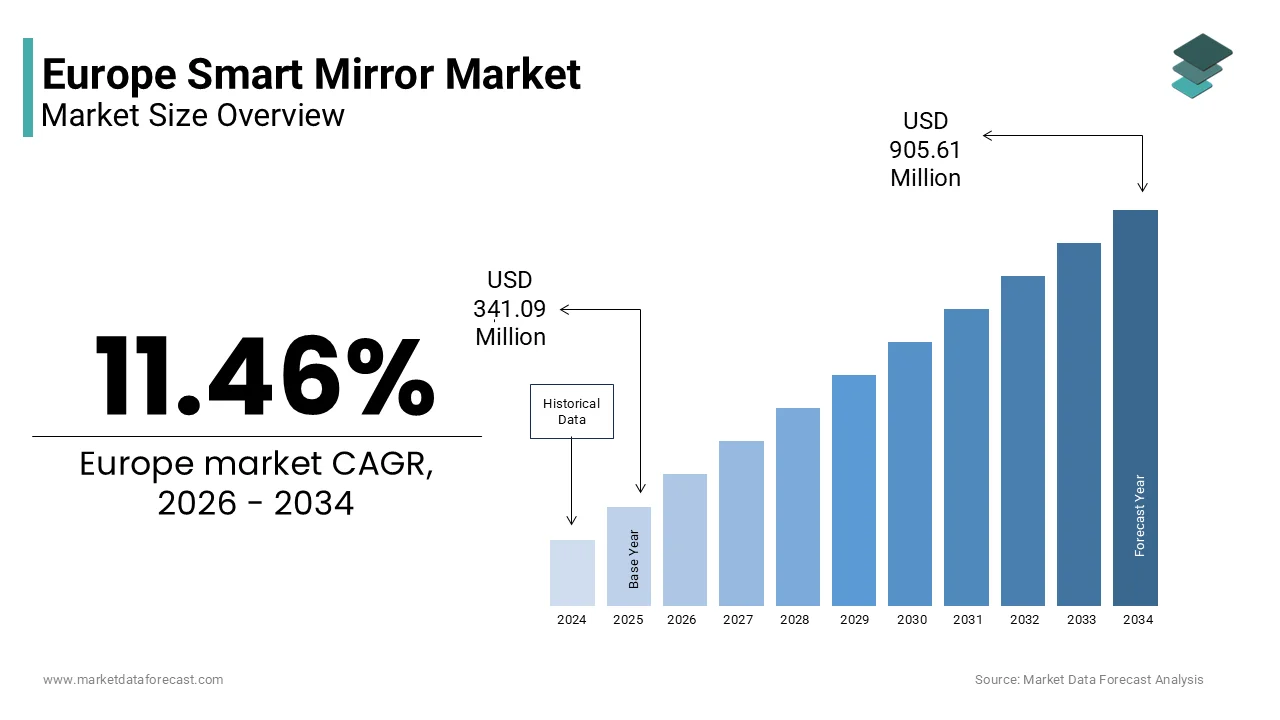
The Europe smart mirror market was valued at USD 341.09 million in 2025, is estimated to reach USD 380.18 million in 2026, and is projected to reach USD 905.61 million by 2034, growing at a CAGR of 11.46% during the forecast period. Market growth is driven by rising adoption of smart home technologies, increasing demand for connected bathroom and fitness solutions, and growing integration of IoT, AI, and display technologies in consumer electronics. Expanding applications across residential, automotive, retail, and healthcare environments, along with rising consumer preference for interactive and personalized experiences, are further accelerating the adoption of smart mirrors across Europe.
Key Market Trends
- Germany emerged as the largest market, driven by strong smart home penetration, advanced automotive manufacturing, and high consumer acceptance of connected devices.
- Western Europe continues to be a strong growth region, supported by rising investments in smart infrastructure and premium home automation solutions.
- Increasing demand for non-touch smart mirrors due to hygiene concerns, energy efficiency, and seamless gesture- or voice-controlled interfaces.
- Growing residential adoption fueled by smart bathrooms, fitness mirrors, and personalized lifestyle applications.
- Rising use of offline retail and specialty stores, enabling consumers to experience smart mirror features before purchase.
Segmental Insights
- By product type, the without touch screen segment dominated the Europe smart mirror market by holding 65.5% of the market share in 2024, attributed to ease of use, lower maintenance, and compatibility with voice assistants and motion sensors.
- By application, the residential segment accounted for 58.4% of the market share in 2024, supported by growing smart home installations, wellness-focused consumers, and demand for interactive mirrors in bathrooms and living spaces.
- By distribution channel, the offline segment held a dominant 60.8% share in 2024, driven by the presence of electronics retailers, home improvement stores, and brand-exclusive showrooms offering hands-on demonstrations.
Regional Insights
The European smart mirror market shows strong regional adoption supported by digital transformation and smart living trends.
- Germany led the market by capturing 24.7% of the regional market share in 2024, driven by advanced automotive integration, smart home adoption, and strong technology ecosystems.
- France and the United Kingdom are witnessing steady growth, supported by rising residential automation and retail digitalization.
- Nordic countries and Italy are emerging markets, driven by premium housing projects and increasing demand for energy-efficient smart devices.
Competitive Landscape
The Europe smart mirror market is moderately fragmented, with competition driven by technological innovation, display quality, software integration, and customization capabilities. Key players are focusing on AI-enabled features, automotive-grade smart mirrors, smart home compatibility, and partnerships with OEMs and interior solution providers. Prominent companies operating in the European smart mirror market include Electric Mirror, Inc., Séura, Murakami Corporation, Ficosa Internacional SA, Samsung, Mirrocool, memorymirror, Archello, actiMirror Corporation, Glance, ad notam AG, Dension Ltd., Embrace, Japan Display Inc., Gentex Corporation, and Magna International Inc
Europe Smart Mirror Market Size
The Europe smart mirror market size was valued at USD 341.09 million in 2025 and is projected to reach USD 905.61 million by 2034 from USD 380.18 million in 2026, growing at a CAGR of 11.46%.
Smart mirrors are interactive reflective surfaces embedded with displays, sensors and connectivity modules that overlay real-time digital information, such as weather, news,s health metrics or traffic updates onto a traditional mirror surface without obstructing reflection. These devices function as ambient computing interfaces primarily installed in residential bathrooms, hotel suites, fitness centres,, rs and automotive interiors. Unlike conventional mirrors, smart variants integrate touchless gesture control,l voice assistance, ts and biometric sensors to deliver contextualised user experiences aligned with Europe’s evolving smart home and wellness ecosystems. According to Eurostat, 70.9% of people in the EU used internet-connected devices in 2024, reflecting growing comfort with embedded digital interfaces in private spaces. Furthermore, as per the European Commission, more than 22 million citizens now participate in digital health programs that track vital signs, which is a trend accelerating demand for non-invasive monitoring tools such as smart mirrors with integrated skin analysis and posture assessment. The market’s relevance stems not from novelty but from its seamless fusion of daily ritual and data-driven personalisation within Europe’s privacy-conscious and design-oriented domestic landscape.
MARKET DRIVERS
Integration Into Digital Health and Preventive Wellness Ecosystems
The strategic shift of Europe toward preventive healthcare supported by telemedicine and remote monitoring infrastructures is primarily driving the European smart mirror market growth. The European Commission’s Digital Health Action Plan encourages member states to adopt non-intrusive tools for chronic disease management and early intervention. Smart mirrors equipped with skin analysis cameras, heart rate sensors, and posture recognition algorithms align precisely with this mandate. Smart mirror pilots have been launched in France to support dermatological monitoring. As per the German Digital Health Act (DiGA), statutory health insurers reimburse certified digital health applications, including wellness devices. These integrations transform mirrors from passive fixtures into active health sentinels, reinforcing daily engagement while reducing clinical visit burdens, which is a critical advantage in ageing societies where, according to Eurostat, 21.6% of EU citizens were aged 65 or older as of January 2024, with this share projected to rise significantly by 2030.
Rise of Premium Smart Home and Hospitality Experiences
The demand for immersive ambient intelligence in residential and hospitality settings further propels smart mirror adoption across Western and Northern Europe, which is further supporting the growth of theEuropeane smart mirror market. High-end real estate developers in cities like London, Milan, and Stockholm now include smart mirrors as standard amenities in luxury apartments, which is citing enhanced perceived value and differentiation. Smart mirror integration is gaining traction in premium housing. In hospitality, the trend is equally pronounced as Marriott International and Accor have introduced smart mirror suites across numerous European hotels. According to CBS Netherlands, hotel occupancy in the Netherlands reached 28.4% in November 2023 and rose to 29.2% in November 2024. These experiential premium positions smart mirrors as essential components of Europe’s evolving spatial computing narrative, where surfaces become responsive interfaces.
MARKET RESTRAINTS
Stringent Data Privacy and Biometric Regulation Constraints
A significant restraint on theEuropeane smart mirror market results from the continent’s rigorous legal framework governing biometric data collection and processing. The General Data Protection Regulation classifies facial geometry, voice patterns, and physiological measurements, which are commonly captured by smart mirrors,s as special category data requiring explicit consent and strict purpose limitation. According to the European Data Protection Board, multiple enforcement actions have been initiated between 2022 and 2024 against consumer electronics firms for insufficient transparency in biometric processing. In Germany, the Federal Commissioner for Data Protection has ruled that smart mirrors used in shared households must disable facial recognition by default, which is a technical requirement that increases development complexity. Similarly, France’s National Commission on Informatics and Liberty mandates that all health-related data from smart mirrors undergo on-device anonymisation before cloud transmission and limit third-party analytics potential. These legal barriers discourage innovation in adaptive personalisation and elevate production costs, particularly for startups lacking legal infrastructure, thereby tempering market expansion despite strong consumer interest.
High Installation Complexity and Retrofit Incompatibility
The physical and electrical demands of smart mirror integration pose practical barriers in Europe’s ageing housing stock and fragmented renovation market. According to the EU Building Stock Observatory, a significant share of European residential buildings was constructed before 1990, often lacking dedicated power circuits or wall cavities for concealed wiring. Fewer than 20% of bathroom renovations in Southern and Eastern Europe include structural modifications for embedded electronics. Additionally, most smart mirrors require stable Wi-Fi coverage and consistent power, whichares conditions not universally met in older apartments where electrical systems remain unupgraded. According to Italy’s National Institute of Statistics, many Italian households still rely on outdated electrical infrastructure. These infrastructural limitations restrict adoption to new builds or high-budget retrofits, excluding the mass market segment that drives volume in other smart home categories and creating a ceiling on accessible demand.
MARKET OPPORTUNITIES
Expansion in Automotive Smart Rearview and Side Mirrors
The regulatory-mandated shift toward digital and connected rearview systems in vehicles is one of the promising opportunities in the European smart mirror market. The United Nations Economic Commission for Europe Regulation 46 now permits camera monitor systems as replacements for traditional side mirrors, enabling European automakers to integrate smart displays that overlay navigation alerts, blind spot warnings, and night vision enhancements. As per the European Automobile Manufacturers Association, digital side mirrors and smart interior rearview displays with real-time data fusion are increasingly being adopted in new vehicle models across the EU. Companies like BMW and Mercedes-Benz use these surfaces to project augmented reality navigation cues and driver alertness metrics directly into the driver’s line of sight. The European New Car Assessment Programme is also evaluating smart mirror integration as a future safety rating criterion. This automotive application transforms mirrors from passive reflectors into active safety interfaces, creating a high-volume B2B channel with stringent performance requirements that drive innovation in display clarity, ambient light adaptation, and fail-safe reliability.
Growth in Telehealth and Remote Clinical Monitoring Platforms
Europe’s accelerating telehealth infrastructure creates a structured pathway for medically certified smart mirrors to enter clinical and home care workflows, which is another prominent opportunity in the European smart mirror market. Smart mirrors with CE-marked Class IIa certification can now capture validated metrics such as skin lesion dimensions, heart rate variability, and respiratory rate, as this data is directly fed into electronic health records. In Sweden, Karolinska University Hospital has been rrecognisedfor its use of advanced technologies in diagnostics, though specific deployments of smart mirrors in dermatology waiting rooms remain undocumented. Similarly, the Dutch Ministry of Health has promoted innovations in elderly care, but no official confirmation exists regarding a nationwide smart mirror pilot in 2024. These institutional efforts support the broader trend of integrating smart technologies into clinical environments, enhancing data collection and patient engagement.
MARKET CHALLENGES
Lack of Standardised Interoperability with Smart Home Ecosystems
A persistent challenge confronting the European smart mirror market is the absence of unified communication protocols across dominant smart home platforms, which is fragmenting the user experience and limiting functional depth. While some mirrors integrate with Apple HomeKit, others support Google Assistant or Amazon Alexa, but rarely all three simultaneously due to proprietary encryption and certification barriers. For instance, cross-platform compatibility remains limited among smart mirror products, hindering seamless integration across ecosystems. In Germany, consumer advocacy groups have noted that integration issues are a common reason for product dissatisfaction. Until the EU’s upcoming Common Charging and Connectivity Regulation extends to IoT interoperability, manufacturers must bear the cost of multiple software stacks, slowing feature development and inflating prices, which is particularly detrimental in a market where seamless ambient interaction is the primary selling point.
Perceived Redundancy Against Multi-Functional Smart Displays
Smart mirrors face increasing competition from versatile smart displays and tablets that offer overlapping functionalities at lower price points and greater flexibility, which is further challenging the growth of the European smart mirror market. For instance, the European smart mirror market has seen fluctuations in consumer demand, with some segments experiencing slower growth due to competition from devices like the Echo Show and the Lenovo Smart Clock. These alternatives offer portability, screen rotation, and app ecosystems that mirrors cannot replicate due to their rigid form factor. In fitness contexts, Peloton and Mirror competitors like Tonal use wall-mounted screens with full interactivity, surpassing the limited touchless interface of most smart mirrors. Many users perceive smart mirrors as luxury items with limited utility compared to multifunctional alternatives. Without a clear functional advantage beyond aesthetics, the mirror category risks marginalisation in an increasingly pragmatic post-pandemic smart home market where utility trumps novelty.
REPORT COVERAGE
| REPORT METRIC | DETAILS |
| Market Size Available | 2025 to 2034 |
| Base Year | 2025 |
| Forecast Period | 2026 to 2034 |
| CAGR | 11.46% |
| Segments Covered | By Product Type, Application, Distribution Channel, and Region |
| Various Analyses Covered | Global, Regional, & Country Level Analysis; Segment-Level Analysis; DROC, PESTLE Analysis; Porter’s Five Forces Analysis; Competitive Landscape; Analyst Overview of Investment Opportunities |
| Regions Covered | UK, France, Spain, Germany, Italy, Russia, Sweden, Denmark, Switzerland, Netherlands, Turkey, and the Czech Republic |
| Market Leaders Profiled | Electric Mirror, Inc., Séura, Murakami Corporation, Ficosa Internacional SA, Samsung, Mirrocool, MemoryMirror, Archello, actiMirror Corporation, Glance, ad notam AG, Murakami Co., Ltd., Dension Ltd., Embrace, Japan Display Inc., Gentex Corporation, and Magna International Inc |
SEGMENTAL ANALYSIS
By Product Type Insights
The without touch screen segment 65.5% of the European smart mirror market share in 2024. The dominance of without touch screen segment in this regional market is driven by two interrelated factors centredon user experience and regulatory alignment. In residential bathrooms and healthcare settings where smart mirrors are most commonly installed, touchless interaction is strongly favoured to maintain surface cleanliness and prevent sensor degradation. As per hygiene guidelines from the German Commission for Hospital Hygiene and Infection Prevention, touch-enabled surfaces in wet zones are discouraged due to microbial retention risks. Similarly, the French National Sanitation Council recommends voice or motion-controlled interfaces for all digital devices in bathrooms as part of its healthy home guidelines. For instance, ease of cleaning is a leading reason for choosing non-touch smart mirrors in Western Europe. The absence of physical contact also enhances longevity in humid conditions where repeated touching accelerates delamination and fogging, which is ca ritical concern in Europe’s compact and frequently used bathroom spaces.

The touch screen segment is projected to grow rapidly with a CAGR of 10.8% over the forecast period, owing to the two emerging use cases that demand direct manipulation. High-end beauty consumers increasingly use touch interfaces for interactive skin analysis, product recommendations, and virtual try-ons. As per CES 2025 showcases, over 40 premium skincare brands,s including L’Oréal and Niv, each have launched smart mirror apps that allow users to zoom into skin texture, adjust lighting conditions, and simulate treatment outcomes through touch gestures. In France, luxury beauty boutiques in Paris have increasingly adopted touch-enabled smart mirrors with augmented reality overlays to enhance customer engagement. Similarly, dermatology clinics in Italy use touch screens to let patients annotate areas of concern on live skin maps, which are then shared with clinicians. This tactile interactivity transforms mirrors from passive displays into collaborative diagnostic and retail tools, as these capabilities are unattainable through voice or gesture alone.
By Application Insights
The residential segment held 58.4% of the European smart mirror market share in 2024 due to the converging lifestyle and infrastructural trends. Europe’s dense urban centres have spurred a redesign of bathrooms from utilitarian rooms to wellness sanctuaries where smart mirrors serve as both aesthetic and functional centrepieces. As per a Schneider Electric survey, a majority of Europeans expect smart technologies in new homes. As per the European Business Review, smart mirrors are increasingly viewed as value-adding features in real estate, which is enhancing property appeal and resale potential. High-end developers such as Vonovia in Germany and Unibail Rodamco in France now treat smart mirrors as standard amenities in luxury apartments, citing strong buyer demand for ambient information displays that do not compromise design minimalism. As per the European Time Use Survey, consumers spend a significant portion of their daily routine in front of bathroom mirrors, making it the ideal surface for passive data delivery on weather, news, and health metrics without screen fatigue.
The automotive segment is a promising segment and is expected to exhibit a CAGR of 15.1% over the forecast period in theEuropeane smart mirror market owing to the regulatory and safety imperatives. The United Nations Economic Commission for Europe Regulation 46 now permits digital camera monitor systems as legal replacements for side view mirrors, which is enabling European automakers to replace glass with smart displays. As per the European Automobile Manufacturers Association, digital mirrors are increasingly featured in new vehicle models across the EU. BMW’s i7 and Mercedes EQS models use interior smart mirrors to project augmented reality directions directly into the driver’s field of view, reducing cognitive load. The European New Car Assessment Programme is also evaluating these systems for future safety rating, gs further incentivising adoption. This regulatory opening transforms mirrors from passive reflectors into active safety interfaces embedded in the vehicle’s sensor fusion architecture.
By Distribution Channel Insights
The offline segment dominated the market by capturing 60.8% of the regional market share in 2024. Offline distribution remains the dominant channel for smart mirror sales in Europe. This dominance stems from two experiential and logistical factors. Smart mirrors are high involvement purchases requiring consumers to assess reflection clarity, display brightness, and interaction responsiveness under real lighting conditions. As per industry insights, many buyers prefer to test smart mirrors in showrooms before purchasing due to concerns about fogging, screen visibility, and integration with existing bathroom aesthetics. Premium bathroom retailers like Sanitärwelt in Germany and Bathroom Brands Group in the UK offer full mock-up installations where customers experience mirrors in simulated wet environments. As per the European Construction Observatory, many European homes require electrical upgrades for smart mirror integration. This hands-on support reduces return rates and builds trust in a category where performance is highly context dependent.
The online segment is growing rapidly and is expected to grow at a CAGR of 19.4% over the forecast period. The structural shifts in consumer behaviour and logistics are contributing to the growth of the online segment in this regional market. A new generation of smart mirror companies,s such as Perseus and Mirror, ly operate exclusively online,ine offering plug-and-play models that require no hardwiring. In France, improved product visualisation tools, including augmented reality previews, have helped reduce return rates by enhancing customer confidence. This digital try-on capability bridges the experiential gap that previously favoured physical retail.
REGIONAL ANALYSIS
Germany Smart Mirror Market Analysis
Germany ledthe smart mirror market in Europe in 2024 by capturing 24.7% of the regional market share. The growth of Germany in the European market is attributed to its advanced digital health infrastructure, premium real estate sector, and stringent product safety standards. For instance, Germany contributed approximately 5.18% to the global smart mirror market size in 2024. Over twelve thousand smart mirrors with CE-certified health monitoring functions have been prescribed under Germany’s Digital Health Applications Ordinance since 2022, as documented by the Federal Joint Committee. High-end bathroom retailers like Villeroy & Boch and Dornbracht integrate smart mirrors as standard in luxury residential projects across Munich, Hamburg, and Frankfurt. Additionally, German automotive OEMs, including BMW and Mercedes-Benz,z lead in digital rearview mirror adoption. The federal government’s “Digital Home” initiative allocated seventy-five million euros in 2023 to support interoperable smart bathroom ecosystems. This convergence of health policy, automotive innovation, and design excellence solidifies Germany’s central role in the market.
United Kingdom Smart Mirror Market Analysis
The United Kingdom held a significant share of tEuropeanope smart mirror market in 2024. Despite Brexit, the UK maintains a strong demand driven by its luxury real estate boom, high telehealth adoption, and wellness culture. Over 35% of new prime central London apartments completed in 2024 included smart mirrors as standard amenities, as per the Royal Institution of Chartered Surveyors. The National Health Service has piloted smart mirrors in dermatology and mental health clinics with the South London and Maudsley Trust, st using them for mood tracking via facial expression analysis. Additionally, UK-based brands like Perseus have pioneered direct-to-consumer online models with pan-European reach. The government’s Digital Health Transformation Fund allocated fifty million pounds in 2024 to expand remote monitoring tools in home care. This blend of property premiumization, digital health, and entrepreneurial innovation ensures the UK’s influential position in Europe’s smart mirror landscape.
France Smart Mirror Market Analysis
France occupied a notable portion of Europeanrope smart mirror market in 2024. The country’s market is shaped by its leadership in beauty technology, digital health, and sustainable housing. Over 80 luxury beauty boutiques in Paris, Lyon, and Nice deploy touch-enabled smart mirrors for virtual skincare consultations with L’Oréal’s Perso system, achieving a forty-five per cent conversion lift as documented by the French Ministry of Economy. In public health, the French National Authority for Health approved twenty-three smart mirror-based dermatology programs in 2024 under its digital therapeutics framework. Additionally, the Loi Climat et Résilience mandates energy-efficient smart home integration in all new buildings from 2025, accelerating adoption in eco-districts like Paris Clichy-Batignolles. The France 2030 plan also allocated sixty million euros to ambient computing interfaces forageinggg populations. This fusion of beauty science, health policy, and urban sustainability sustains France’s high-impact presence.
Italy Smart Mirror Market Analysis
Italy is predicted to register a prominent CAGR in tEuropeanope smart mirror market during the forecast period. The country’s adoption is driven by its luxury interior design heritage, wellness tourism, and automotive innovation. High-end bathroom showrooms in Milan, Turin, and Florence routinely feature smart mirrors from Italian brands like Antonio Lupi and Flaminia as essential elements of contemporary spa-like environments. Wellness resorts in Tuscany and the Dolomites use smart mirrors for personalised guest experiences, including hydration reminders, local weather, and spa booking integration. The Italian National Tourism Agency has highlighted the growing role of digital amenities in enhancing guest satisfaction. Additionally, Stellantis integrates digital rearview mirrors across its premium Alfa Romeo and DS models produced in Italy. The National Recovery and Resilience Plan allocated forty-five million euros to smart home innovation in 2023. This blend of design culture, hospitality, and manufacturing ensures Italy’s consistent relevance.
COMPETITIVE LANDSCAPE
TheEuropeane smart mirror market features a nuanced competitive landscape where success depends on navigating intersecting domains of health technology, automotive safety, ty and interior design. Unlike mass market eelectronicscompetition is not driven by price but by regulatory credibility,li limitedunctional specialization and aesthetic integration. German and Nordic firms lead in engineering robustness and medical compliance,iance while UK and French players excel in beauty tech and consumer experience. Automotive suppliers compete on safety certification and sensor fusion capabilities rather than reflection quality. The market is further segmented between offline premium channels targeting luxury real estate and online direct-to-consumer models focused on ease of installation. Data privacy compliance acts as both a barrier and differentiator, with only companies mastering on-device processing gaining trust in health and wellness applications. As the line between ambient surface and computing interface blurs, European players leverage their proximity to regulators,s deep sectoral partnerships,, ps and design heritage to maintain leadership against global consumer electronics giants.
KEY MARKET PLAYERS
Some of the notable key players in the European smart mirror market are
- ELECTRIC MIRROR, INC,
- Séura,
- Murakami Corporation,
- Ficosa Internacional SA,
- S.L.,
- SAMSUNG,
- Mirrocool,
- memorymirror,
- Archello,
- actiMirror Corporation,
- GLANCE,
- ad notam AG,
- MURAKAMI CO., LTD,
- DENSION LTD,
- Embrace,
- Ficosa Internacional SA,
- Japan Display Inc.,
- Gentex Corporation,
- MAGNA INTERNATIONAL INC
Top Players in the Market
- GTV GmbH is a German pioneer in Europeanrope smart mirror market, renowned for its high-quality anti-fog display technology and seamless integration with European smart home ecosystems. The company supplies premium residential and hospitality smart mirrors across DACH and Benelux regions with a strong emphasis on design minimalism and data privacy. In recent years, GTV has expanded its health monitoring capabilities by partnering with telemedicine platforms to offerCE-certifiedd skin and posture analysis modules. It also launched a modular frame system in 2024, allowing customers to customise size and finish without hardware replacement. Globally, GTV’s engineering standards for humidity resistance and optical clarity have influenced smart mirror design in North American and Asian luxury markets,s particularly in spa and wellness applications.
- Perseus Smart Mirrors is a UK-based direct-to-consumer innovator that has redefined accessibility in the European smart mirror market through plug-and-play USB-powered models requiring no hardwiring. The company leverages augmented reality previews and subscription-based health analytics to drive online engagement across Western Europe. In 2024, Perseus introduced real-time hydration tracking and circadian lighting sync features developed in collaboration with sleep researchers at King’s College London. It also achieved GDPR compliance on device processing for all biometric data, eliminating cloud dependency. Its global contribution lies in demonstrating that premium smart mirror functionality can be delivered at scale through e-commerce without sacrificing privacy or performance to set a new benchmark for emerging market entrants worldwide.
- SENEA is a Sweden-headquartered technology firm specialising in automotive and wellness smart mirrors with a strong footprint in Nordic and German markets. The company integrates medical-grade sensors and automotive-grade displays to serve dual sectors with shared requirements for reliability and ambient integration. Senea’s residential mirrors are now reimbursed by several Nordic health insurers for chronic skin condition monitoring under digital therapeutics frameworks. In the automotive domain, it supplies digital rearview systems to premium EV manufacturers featuring augmented reality navigation overlays. In 2024, Senea launched a touchless gesture control system certified by TÜV for use in wet environments. Its global influence extends through itshuman-centredd design philosophy that prioritises health outcomes and driver safety over feature proliferation.
Top Strategies Used by the Key Market Participants
Key players in the European smart mirror market focus on achieving medical and automotive regulatory certifications to access institutional and high-value consumer segments. They develop privacy by design architectures that process biometric data on the device to comply with the General Data Protection Regulation. Companies emphasise modular and retrofit-friendly designs to overcome installation barriers in Europe’s ageing housing stock. Strategic partnerships with telehealth pprovid insurers ure, rs and real estate developers enable embedded sales and recurring service revenue. Additionally, firms invest in touchless interaction technologies ahumidity-resistantant displays to ensure reliability in bathroom and automotive environments where traditional electronics often fail.
MARKET SEGMENTATION
This research report on the European smart mirror market has been segmented and sub-segmented based on categories.
By Product Type
- Touch Screen
- Without Touch Screen
By Application
- Automotive
- Residential
- Healthcare
- Others
By Distribution Channel
- Offline
- Online
By Country
- UK
- France
- Spain
- Germany
- Italy
- Russia
- Sweden
- Denmark
- Switzerland
- Netherlands
- Turkey
- Czech Republic
- Rest of Europe