- Product Description Description
- Table of Contents TOC
- List of Table & Figure LOT
- Get Free Sample PDF Sample PDF
Market Size, 2025
$15.32 BnMarket Estimate, 2026
$16.58 BnMarket Forecast, 2034
$38.14 BnCAGR, 2026–2034
8.2%Executive Summary: European Socks Market
- Market Scope: Comprehensive industry analysis of the European socks market covering product types, application segments, distribution channels, and country-level dynamics.
- Market Valuation: Valued at USD 15.32 billion in 2025, reaching USD 16.58 billion in 2026, and projected to expand to USD 38.14 billion by 2034, registering a strong CAGR of 8.2% from 2026 to 2034.
- Primary Growth Drivers: Growing emphasis on health, fitness, and performance-oriented active lifestyles; alongside the rapid expansion of e-commerce and direct-to-consumer digital retail channels.
Key Market Segment Metrics (2026–2034)
| Category | Leading Segment / Core Focus | Fastest-Growing / Key Segments |
|---|---|---|
| By Product | Casual Socks (formed the largest revenue-generating segment in 2025 due to everyday wear and professional versatility) | Athletic Socks (emerging as the fastest-growing category with a projected CAGR of 6.1% driven by the European fitness boom) |
| By Application | Men’s Socks (held the largest application share in 2025 anchored in business-casual attire and patterned novelty sock trends) | Women’s Socks (gaining traction driven by a robust fashion-forward culture, flexible styling, and luxury accessory preferences) |
| By Distribution Channel | Hypermarkets & Supermarkets (remained the dominant channel in 2025 offering one-stop convenience and impulsive purchasing) | Online Retail (fastest-growing channel expanding rapidly through digital convenience, wider assortments, and D2C marketing) |
| By Region / Country | United Kingdom (commanded a leading position supported by flourishing e-commerce infrastructure and digital fashion platforms) | Germany & Spain (Germany leads in sustainable, durable wool demand; Spain emerges via vibrant, expressive pattern trends) |
Major Market Players & Market Structure
Market Structure: Highly fragmented and dynamic landscape featuring heritage-driven premium brands, global sportswear giants, design-oriented fashion disruptors, and innovative subscription pioneers.
Key Companies: Falke, Happy Socks, Blacksocks, Nike Inc., Puma S.E., Adidas A.G., Asics Corporation, Renfro Corporation, THORLO, Inc., Hanesbrands Inc., Balega, Drymax Technologies Inc., and Under Armour Inc.
Europe Socks Market Size
The European socks market size was valued at USD 15.32 billion in 2025, is expected to grow at a CAGR of 8.2% from 2026 to 2034 and be worth USD 38.14 billion by 2034 from USD 16.58 billion in 2026.
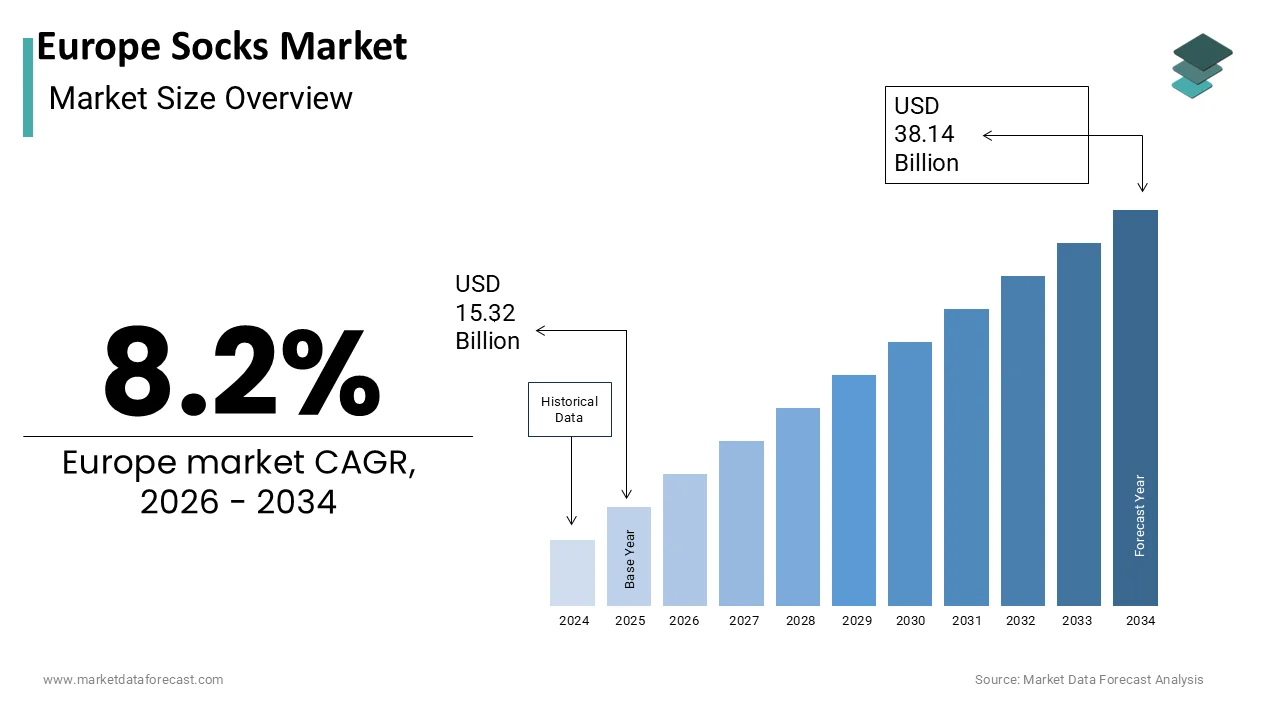
Europe Socks Market covers all sock categories, casual, athletic, formal, and specialty, used across demographics and settings. Notably, 38% of Europeans engage regularly in sports or exercise, which supports demand for performance-oriented socks. E-commerce is increasingly pivotal, 44% of online shoppers in 2023 purchased clothes, shoes, or accessories, reflecting broad digital uptake. European consumers alone bought around 15 kg of textiles (including socks) per person, a clear measure of sustained apparel demand. These trends underscore the socks market’s vitality, shaped by lifestyle, fitness, and digital retail evolution.
MARKET DRIVERS
Growing Emphasis on Health, Fitness, and Performance
Athleisure and active lifestyles are fueling demand for technical, sport-specific socks. Sports participation, such as running and indoor fitness, is rising steadily, creating demand for socks offering cushioning, moisture control, and anatomical support. This trend is amplified by growing consumer willingness to invest in functional apparel that enhances performance and comfort. Hence, performance-oriented offerings are cultivating a robust demand niche.
Rapid Expansion of Online Retail Channels
E-commerce is reshaping European sock sales, with online distribution anticipated to grow significantly. Greater digital access allows consumers to browse a wider range of styles, brands, and niche products like compression, designer, or subscription-based socks. Ease of comparison and home delivery further boosts volume. As apparel moves online, sock brands increasingly prioritize digital-first marketing, personalized promotions, and direct-to-consumer strategies. This shift unlocks purchasing flexibility and reinforces sock consumption patterns online.
MARKET RESTRAINTS
Fast-Fashion Textile Overconsumption and Environmental Pressure
Europeans purchase of textiles per person in recent years has increased. Although socks are a small fraction of this, the broader overconsumption raises sustainability concerns. High turnover and low-cost fashion disrupt demand for higher-value, longer-lasting socks. Environmental scrutiny pushes consumers and regulators toward durability and recyclability, pressures that challenge standard low-cost segment growth unless sustainability credentials are enhanced.
Economic Sensitivity and Shifting Consumer Priorities
During economic downturns or cost-of-living pressures, socks may be deprioritized in favor of essentials. While precise figures are scarce, broader retail data show that apparel spending is closely tied to discretionary income. In this environment, demand shifts toward value packs or basic styles, sidelining premium, performance, or fashion-forward socks. This cyclical sensitivity curtails segment growth potential across higher-margin tiers when economic confidence dips.
MARKET OPPORTUNITIES
Premiumization Through Innovation and Materials
Consumers increasingly seek socks made from advanced materials, organic cotton, bamboo, recycled fibers, and those offering performance benefits like compression or thermal regulation. Globally, premium sock categories are projected to grow at a slightly higher rate than those made from alternative fibers through 2030. In Europe, this aligns with sustainability awareness and fashion interest, making premium socks both style and ethical statements. Brands that innovate with materials and storytelling can tap into this growing premium consumer base.
Subscription Models and Niche Retail Concepts
Subscription-based sock models offer a novel path to recurring revenue and higher customer loyalty. Blacksocks, a European sock subscription retailer, currently serves large number of customers across France, Germany, and Switzerland. This model responds to consumer demand for convenience, minimal decision-making, and quality consistency. It also enables brands to reduce marketing costs and foster direct customer relationships, positioning socks as a lifestyle amenity rather than commodity.
MARKET CHALLENGES
Market Fragmentation and Price Competition
The socks market is highly fragmented, with many small producers and global sportswear giants like Nike, Adidas, Puma and others jostling for position. Intense competition and limited differentiation often drive price wars, compressing margins. Small players, especially, struggle to raise prices or invest in innovation, limiting their ability to scale beyond local or niche segments.
Environmental and Circularity Pressure
Textile circularity is a growing regulatory and consumer imperative. Increasing textile consumption in Europe with lagging reuse and recycling, prompting EU policy action on circularity. For socks, which are often worn out and discarded, integrating recycled yarns, take-back schemes, or modular design is complex and costly. Turning socks into circular products while maintaining comfort, quality, and price parity remains a formidable operational challenge.
REPORT COVERAGE
| REPORT METRIC | DETAILS |
| Market Size Available | 2025 to 2034 |
| Base Year | 2025 |
| Forecast Period | 2026 to 2034 |
| Segments Covered | By Product, Application, Distribution Channel, and Region |
| Various Analyses Covered | Global, Regional, & Country Level Analysis; Segment-Level Analysis; DROC; PESTLE Analysis; Porter’s Five Forces Analysis; Competitive Landscape; Analyst Overview of Investment Opportunities |
| Regions Covered | UK, France, Spain, Germany, Italy, Russia, Sweden, Denmark, Switzerland, Netherlands, Turkey, Czech Republic, Rest of Europe |
| Market Leaders Profiled | Nike Inc., Puma S.E., Adidas A.G., Asics Corporation, Renfro Corporation, THORLO, Inc., Hanesbrands Inc., Balega, Drymax Technologies Inc. and Under Armour Inc., and others. |
SEGMENTAL ANALYSIS
By Product Insights
The casual socks segment led the Europe socks market. They formed the largest revenue-generating product segment in 2025. Their widespread integration into everyday wear, across professional, social, and leisure contexts, drives their dominance. They're accessible, compatible with virtually any outfit, and available across both online and physical retail channels as standard wardrobe essentials. The appeal is further amplified by enhanced comfort fabrics like polyester and nylon blends, which continue to attract broad consumer adoption.
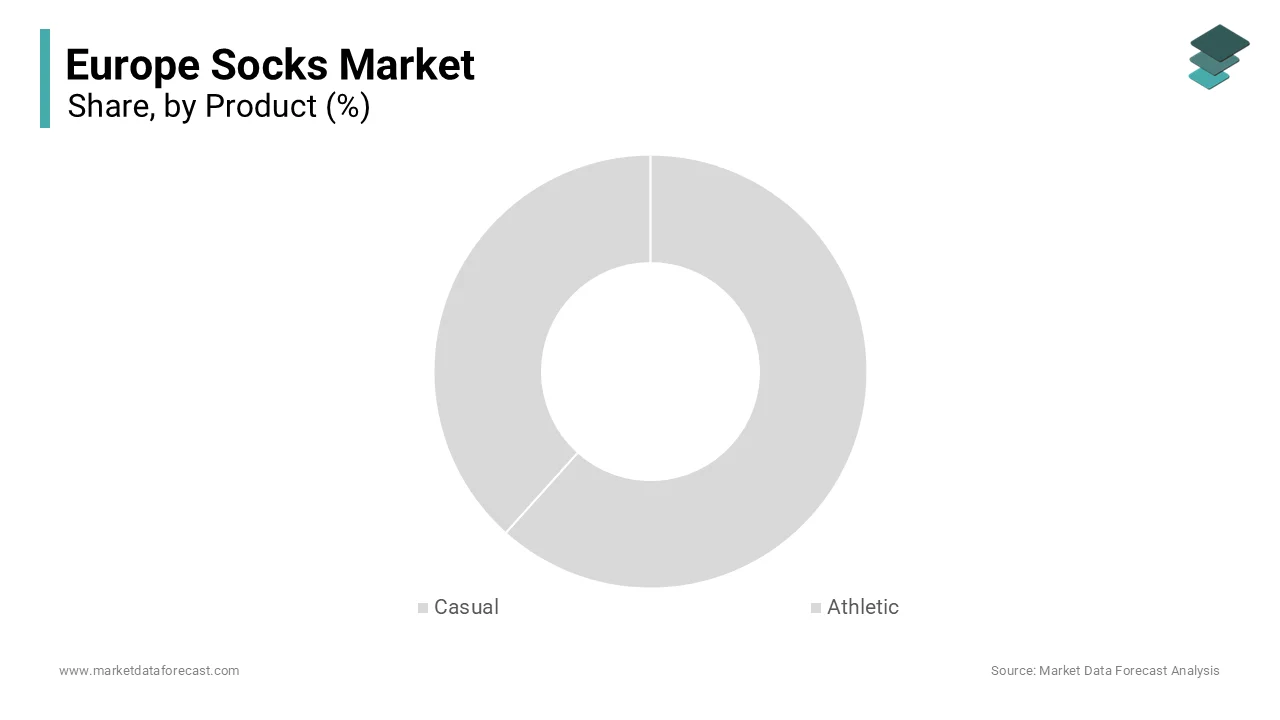
The athletic socks segment is emerging as the fastest-growing product category, with a projected CAGR of 6.1% through the forecast period. Their growth is driven by increased health consciousness and a fitness boom across Europe. Athletic socks offer specific value, moisture-wicking, extra cushioning, and blister protection, meeting the evolving needs of athletes, gym-goers, and wellness-focused consumers. As Europeans engage in more sporting and active lifestyles, demand for technical, performance-enhancing hosiery continues to surge.
By Application Insights
The men’s socks segment hold the largest application share in 2025. Authorities attribute this to growing adoption of casual business attire and distinct men's fashion trends, like patterned or novelty socks, that reinforce male sock volume demand. The casual-business hybrid trend, blending comfort with style, fuels purchases as men balance formal codes with modern personality expressions.
The women's socks segment is gaining traction which is propelled by a robust fashion-forward culture in Europe, flexible sock styling (from long knee-highs to playful ankle designs), and rising disposable income among female consumers. The strong consumption of women's socks is also reinforced by trends in luxury accessories and premium materials, especially in markets such as France where luxury brands lead demand.
By Distribution Channel Insights
The hypermarkets and supermarkets segment remained the dominant distribution channel for socks in Europe in 2025. Their appeal lies in one-stop convenience, wide assortments, and impulsive purchase behavior. Consumers benefit from in-store visibility, immediate availability, and bundling with other grocery items—all contributing to their position as the default outlet for routine sock purchases.
The online retail segment is the fastest-growing channel for European sock sales. E-commerce is expanding rapidly, supported by broader trends in apparel buying and direct-to-consumer marketing. Consumers increasingly value digital convenience, wider style options, home delivery, and personalized discovery, all traits that favor online sock purchasing. Thus, the broader industry outlook projects digital apparel and accessory retail to outpace traditional channels.
REGIONAL ANALYSIS
United Kingdom Socks Market Insights
The UK commanded a leading position in Europe’s socks market. It is supported by flourishing e-commerce and digital fashion platforms. It is also set to expand significantly between 2025 and 2030. The UK benefits from rapid sock innovation and strong retail infrastructure, making it a trendsetter in online sock consumption.
Germany Socks Market Insights
Germany occupies a crucial role in Europe’s sock landscape. It is home to a booming demand for high-quality, sustainable and durable socks, particularly woolen types suited to colder climates. The country benefits from consumer awareness of sustainability and functionality.
France Socks Market Insights
France maintains a prominent position in the socks market, anchored by a fashion-conscious culture and luxury brand influence. Premium items featuring designer logos or artisanal materials like cashmere thrive here, amplifying spending on socks as a fashion accessory.
Italy Socks Market Insights
Italy sustains a strong share of the European market, leveraged by its robust textile manufacturing industry and fashion heritage. Consumers demand both high-quality basic and designer variation socks, bolstering domestic and export-driven production.
Spain Socks Market Insights
Spain is an emerging significant player in the European socks scene. The market reflects a vibrant trend toward colorful and expressive patterns, especially among younger buyers.
KEY MARKET PLAYERS AND COMPETITIVE LANDSCAPE
Nike Inc., Puma S.E., Adidas A.G., Asics Corporation, Renfro Corporation, THORLO, Inc., Hanesbrands Inc., Balega, Drymax Technologies Inc. and Under Armour Inc. are a few of the major players in the European socks market.
Europe’s sock market is both dynamic and segmented. On one end are stalwarts like Falke, offering heritage-driven premium products with technical edge; on another, fashion disruptors like Happy Socks deliver colorful, design-oriented propositions that resonate globally. Subscription innovators like Blacksocks engage through convenience and curated simplicity. Across the landscape, competition hinges on brand identity: premium quality, aesthetics, convenience, or sustainability. Brands also compete on innovation, technical fibers, ergonomic fit, eco-materials, and channel evolution, with e-commerce, omni-channel, and D2C tactics gaining ground. As sustainability gains importance, eco-conscious materials and production transparency are increasingly shaping competitive positioning across Europe’s fashion-lifestyle spectrum.
TOP PLAYERS IN THE MARKET
Falke (Germany)
Falke stands as one of Europe's oldest and most respected sock manufacturers, renowned for premium craftsmanship since 1895. In Asia-Pacific markets, the brand is present through select luxury retail partners and online platforms, positioning itself within a high-end niche. Recently, Falke has intensified its focus on innovation with the launch of its Ergonomic Sport System, designed to enhance athletic performance through anatomically tailored designs and technical knit zones, reinforcing its role as a premium performance and lifestyle sock brand across regions.
Happy Socks (Sweden)
Happy Socks revolutionized the market with bold, colorful patterned socks. Its global expansion includes over 100 stores across Asia-Pacific and Europe, coupled with strong e-commerce penetration. The brand continues to innovate via celebrity and cultural collaborations, from Disney to artists and musicians, expanding retail partnerships with department stores and concept shops in both Europe and APAC, thus reinforcing its playful, mass-appeal positioning.
Blacksocks (Switzerland-based Europe-wide)
Blacksocks pioneered the sock subscription model in Europe, offering customers curated delivery of three pairs at a time, shipping from its production base near Milan. Although focused on Europe, their models have inspired analogous subscription services across APAC. The company has recently expanded its catalog to include athletic and ski socks, broadening beyond classic calf styles, helping fortify its positioning in active and performance sectors.
TOP STRATEGIES USED BY KEY MARKET PLAYERS
Leading sock brands in Europe employ distinctive strategies to remain competitive. Falke leverages premium craftsmanship and functional innovation, deploying ergonomic designs and technical textiles to appeal to performance-minded consumers. Happy Socks emphasizes fashion-led design and collaboration, harnessing artistic partnerships to spur brand desirability and global buzz. Blacksocks relies on subscription-based convenience and curation, deepening customer loyalty and reducing channel friction. Together, these strategies reflect a multi-pronged differentiation, spanning luxury, lifestyle, personalization, and customer retention, tailoring growth across distinct market segments.
MARKET SEGMENTATION
This research report on the European socks market has been segmented and sub-segmented into the following categories.
By Product
- Casual
- Athletic
By Application
- Men
- Women
By Distribution Channel
- Hypermarket & Supermarket
- Convenience store
- Online
By Country
- United Kingdom
- Germany
- France
- Italy
- Spain
- Belgium
- Netherlands
- Rest of Europe