- Product Description Description
- Table of Contents TOC
- List of Table & Figure LOT
- Get Free Sample PDF Sample PDF
Market Size, 2025
$10.21 BnMarket Estimate, 2026
$11.30 BnMarket Forecast, 2034
$25.37 BnCAGR, 2026–2034
10.64%Europe Soft Skills Training Market Size
The Europe soft skills training market was worth USD 10.21 billion in 2025. The Europe market is projected to reach USD 25.37 billion by 2034 from USD 11.30 billion in 2026, rising at a CAGR of 10.64% from 2026 to 2034.

The soft skills training is often referred to as interpersonal or people skills, encompassing a wide range of competencies such as communication, leadership, teamwork, emotional intelligence, problem-solving, and adaptability. These skills are increasingly recognized as critical drivers of professional success, enabling individuals to navigate complex workplace environments, foster collaboration, and enhance productivity. According to a report by the European Centre for the Development of Vocational Training (Cedefop), over 80% of employers in Europe consider soft skills as essential as technical expertise when evaluating candidates for recruitment or promotion. In recent years, the demand for soft skills training has surged, driven by the rapid transformation of work environments due to digitalization, remote work trends, and globalization. Furthermore, a survey conducted by McKinsey & Company reveals that 92% of executives believe that soft skills are equally or more important than hard skills in achieving organizational goals.
MARKET DRIVERS
Increasing Demand for Workforce Adaptability in a Digital Economy
The rapid pace of digital transformation is a significant driver of the soft skills training market growth. As per the European Commission, over 37% of workers in the EU require upskilling to keep pace with technological advancements, particularly in areas like artificial intelligence, automation, and remote collaboration tools. Soft skills such as adaptability, critical thinking, and digital communication are now essential for navigating these changes. A report by Cedefop (European Centre for the Development of Vocational Training) emphasizes that 93% of employers prioritize candidates with strong problem-solving and interpersonal abilities when hiring for digitally intensive roles. Furthermore, the shift to hybrid and remote work models has amplified the need for effective virtual communication and teamwork skills. As industries evolve, organizations are investing heavily in soft skills training to ensure their workforce remains competitive and agile in an increasingly digital economy.
Government-Led Initiatives Promoting Lifelong Learning
Government-led initiatives aimed at fostering lifelong learning and employability are additionally prompting the growth of Europe soft skills training market. The European Union’s Upskilling Pathways initiative seeks to equip adults with essential skills, including soft competencies like leadership and emotional intelligence, to enhance career prospects. Additionally, the European Commission’s Digital Education Action Plan underscores the importance of integrating soft skills into vocational training programs to prepare citizens for future job markets. McKinsey & Company reports that 87% of European companies view government-supported training programs as vital for addressing skill gaps.
Limited Awareness and Perception of Soft Skills Value
The limited awareness and undervaluation of soft skills compared to technical expertiseares restricting the growth of Europe's soft skills training market. According to the European Centre for the Development of Vocational Training (Cedefop), nearly 45% of small and medium-sized enterprises (SMEs) in Europe prioritize technical skills over soft skills during recruitment, perceiving them as secondary or innate rather than trainable. This misconception leads to underinvestment in soft skills development, particularly among smaller organizations with constrained budgets. Additionally, Eurostat reports that only some European workers aged 55 and above participate in soft skills training programs, reflecting a generational gap in recognizing their importance. A study by the Organisation for Economic Co-operation and Development (OECD) further reveals that low participation rates are often linked to skepticism about the measurable impact of soft skills on productivity. This lack of awareness hinders the broader adoption of soft skills training initiatives.
High Costs and Resource Constraints for Training Programs
The high cost and resource intensity associated with implementing soft skills training programs are also slowing down the growth of Europe's soft skills training market. The European Commission notes that over 60% of SMEs cite budget limitations as a barrier to providing comprehensive training, including soft skills development. As per McKinsey & Company, 70% of companies struggle to allocate sufficient time for employees to engage in training due to operational demands. This challenge is exacerbated in industries with high workforce turnover, where the return on investment in training is perceived as uncertain. As a result, many organizations, particularly smaller ones, delay or scale back their soft skills initiatives, limiting market growth potential.
MARKET OPPORTUNITIES
Growing Emphasis on Leadership and Management Training
The increasing demand for management development programs is attributed to the boost in new opportunities for the growth of Europe soft skills training market. As per the European Commission, over 50% of organizations identify gaps as a challenge, particularly as businesses navigate post-pandemic recovery and digital transformation. Cedefop (European Centre for the Development of Vocational Training) reports that leadership training can improve team productivity by up to 25%, driving higher organizational performance. Furthermore, as per a study, 86% of executives consider leadership development essential for achieving strategic goals, yet only 10% believe their current programs are effective. This gap presents a lucrative opportunity for training providers to design tailored solutions.
Integration of Technology-Enhanced Learning Solutions
The integration of technology-enhanced learning solutions is significantly bolstering the growth of the Europe soft skills training market. The European Commission emphasizes that e-learning platforms and virtual reality tools can reduce training costs by up to 40%, while increasing accessibility and engagement. According to Eurostat, over 60% of European workers now use digital tools for professional development, reflecting a shift toward blended and online learning models. Additionally, gamified training programs can enhance knowledge retention rates by 90% by making them highly effective for soft skills acquisition, as per a report. As remote work becomes more prevalent, organizations are investing in scalable digital solutions to deliver soft skills training.
MARKET CHALLENGES
Difficulty in Measuring the Impact of Soft Skills Training
The difficulty in quantifying the tangible outcomes of such programs is one of the challenges for the growth of Europe soft skills training market. According to the European Centre for the Development of Vocational Training, many organizations struggle to measure the return on investment (ROI) of soft skills training due to the subjective nature of these competencies. Unlike technical skills, soft skills like communication and teamwork are harder to assess through standardized metrics. According to the survey, 30% of companies utilize structured evaluation frameworks to track improvements in employee performance post-training. Furthermore, the Organisation for Economic Co-operation and Development (OECD) notes that this lack of measurable impact often leads to awareness among decision-makers, resulting in reduced funding for soft skills initiatives.
Resistance to Change and Cultural Barriers
The resistance to change and cultural barriers are likely to pose a challenge for the growth of Europe soft skills training market. The European Commission reports that 40% of employees exhibit reluctance to participate in soft skills programs, often viewing them as less relevant than technical training. Cultural differences across Europe further complicate the implementation of standardized training modules, as per the study. For instance, a McKinsey & Company study shows that acceptance of feedback and collaborative learning varies widely between Northern and Southern European countries, affecting program effectiveness. Additionally, Eurostat data indicates that 25% of organizations face pushback from senior management, who prioritize immediate operational needs over long-term workforce development. These cultural and organizational hurdles hinder the seamless integration of soft skills training into broader professional development strategies.
REPORT COVERAGE
| REPORT METRIC | DETAILS |
| Market Size Available | 2025 to 2034 |
| Base Year | 2025 |
| Forecast Period | 2026 to 2034 |
| Segments Covered | By Soft Skill Type, Channel Provider, Sourcing, Delivery Mode, End Use Industry, and Country. |
| Various Analyses Covered | Global, Regional, and Country-Level Analysis, Segment-Level Analysis, Drivers, Restraints, Opportunities, Challenges; PESTLE Analysis; Porter’s Five Forces Analysis, Competitive Landscape, Analyst Overview of Investment Opportunities |
| Countries Covered | UK, France, Spain, Germany, Italy, Russia, Sweden, Denmark, Switzerland, Netherlands, Turkey, Czech Republic, and the Rest of Europe. |
| Market Leaders Profiled | Cengage Learning, Inc., Computer Generated Solutions, Inc., D2L Corporation, edX, Inc., Interaction Associates, Inc., New Horizons Worldwide, LLC., NIIT Limited, Pearson PLC, QA Ltd., Skill Key Interactive, LLC, Skillsoft Corporation, Tata Interactive Systems, The Insights Group Ltd., VitalSmarts, and Wilson Learning Worldwide. |
SEGMENTAL ANALYSIS
By Soft Skill Type Insights
The management and leadership training segment was the largest by holding 30.2% of the Europe soft skills training market share in 2025, owing to the skilled leaders to drive organizational success amid rapid digital transformation. As per the European Commission, 50% of companies face leadership gaps, while effective programs can boost revenue growth by 2.4 times. With increasing workforce complexities, organizations prioritize leadership development to enhance decision-making and employee engagement. This focus ensures long-term competitiveness, making management and leadership training indispensable for achieving strategic goals.
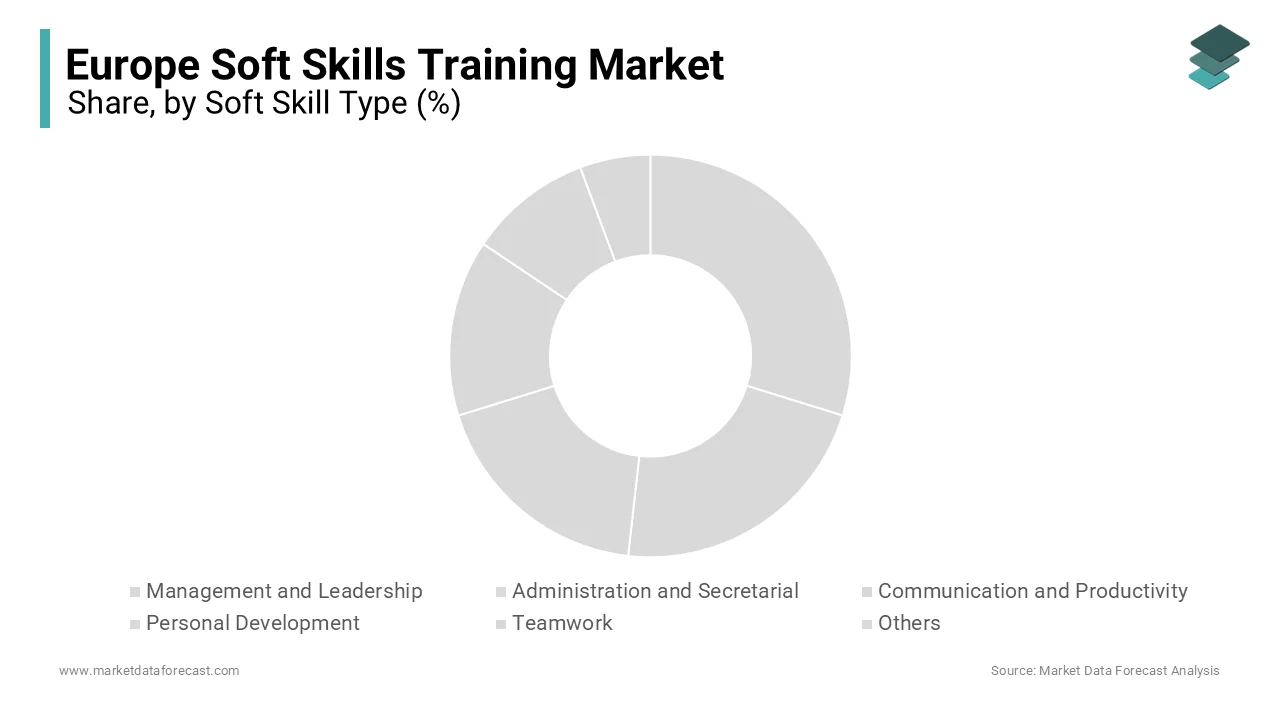
The communication and productivity training segment is expected to grow at the fastest CAGR of 14.7% from 2026 to 2034. The growth of the segment is propelled by the rise of remote work, with OECD data showing that strong communication skills improve team collaboration by 30%. As per recent studies, 60% of employers consider communication vital for hybrid work environments. As businesses adopt digital tools, enhancing interpersonal and time-management skills has become crucial. The increasing reliance on virtual platforms amplifies the need for clear and efficient communication, positioning this segment as a key enabler of workplace adaptability and operational efficiency in Europe.
By Channel Provider Insights
The corporate/enterprise segment held a dominant share of the Europe soft skills training market in 2025. The growth of the segment is likely to be driven by the need to address skill gaps and enhance workforce adaptability. The European Commission reports that some enterprises prioritize soft skills to improve productivity and innovation. The companies investing in soft skills training achieve a 25% boost in team performance. With industries like IT and finance undergoing rapid digitalization, enterprises focus on leadership, communication, and collaboration to maintain competitiveness. This segment’s emphasis on upskilling ensures alignment with evolving business demands by making it a cornerstone of organizational success.
The academic/education segment is likely to register the fastest CAGR of 16.2% from 2026 to 2034, owing to the rising integration of soft skills into curricula, with OECD data showing 80% of educators emphasizing their importance. The institutions incorporating soft skills training see a 40% rise in student employability. As governments push for future-ready workforces, academic programs increasingly focus on teamwork and problem-solving.
By Sourcing Insights
The outsourced segment held 60.3% of the Europe soft skills training market share in 2025, with the cost-effectiveness and expertise offered by specialized providers, which many organizations lack internally. The outsourced training achieves a 30% higher success rate in skill adoption due to advanced methodologies and tools. With rising demand for standardized training across industries, outsourcing enables organizations to focus on core operations while ensuring workforce upskilling, making it indispensable for achieving competitive advantage and operational efficiency.
The in-house soft skills training segment is expected to grow at the fastest CAGR of 12.8% from 2026 to 2034. The growth of the segment was attributed to the growing with the larger corporations investing in internal programs to align training with specific goals. The OECD emphasizes that in-house training enhances company culture and ensures confidentiality. As businesses seek greater control over content and delivery, in-house training becomes vital for sectors requiring proprietary skills, driving its rapid expansion and importance in fostering long-term organizational resilience.
By Delivery Mode Insights
The online delivery segment occupied 65.6% of the Europe soft skills training market share in 2024 due to its flexibility and scalability of e-learning platforms that align with remote work trends. According to the European Commission, more than 70% of organizations now use online methods, achieving cost savings of up to 40%. As per the reports of the Cedefop, online training boosts accessibility, enabling 90% of employees to learn at their convenience. With advancements like gamification enhancing engagement, online delivery meets the rising demand for adaptable, cost-effective solutions. This mode ensures widespread reach and measurable outcomes, making it indispensable for modern workforce development.
The offline delivery segment is likely to witness a CAGR of 10.5% over the forecast period, owing to its effectiveness in fostering interpersonal skills through immersive experiences. As per the Cedefop, face-to-face workshops improve knowledge retention by 30%, making them ideal for sectors like healthcare and manufacturing. Eurostat highlights that offline methods are critical for practical skill application, particularly in team-based environments. As organizations seek to balance digital and traditional approaches, offline training gains importance for its ability to deliver impactful, hands-on learning experiences that build strong interpersonal and collaborative capabilities, addressing gaps unmet by virtual solutions.
By End Use Industry Insights
The BFSI (Banking, Financial Services, and Insurance) segment held the largest share of 28.3% of the European market in 2024. The dominating position of the BFSI segment in the European market is attributed to the sector's need for strong communication, customer service, and leadership skills to enhance client interactions and regulatory compliance. As per the European Commission, 70% of BFSI organizations prioritize soft skills to improve employee adaptability in a rapidly evolving digital landscape. Additionally, McKinsey & Company notes that soft skills training in BFSI boosts customer satisfaction by 20%. With increasing competition and client expectations, soft skills are critical for maintaining trust and operational excellence in this highly regulated industry.
The healthcare segment is predicted to register the highest CAGR of 15.3% over the forecast period, owing to the rising demand for patient-centered care and effective teamwork in medical settings. The Organisation for Economic Co-operation and Development (OECD) emphasizes that soft skills like empathy and communication reduce medical errors by 30%. Cedefop reports that healthcare organizations investing in soft skills training see a 25% improvement in patient outcomes and staff collaboration. As the sector faces challenges like workforce shortages and technological integration, soft skills training becomes vital for enhancing patient care and ensuring seamless coordination among multidisciplinary teams, driving its rapid expansion.
REGIONAL ANALYSIS
Germany accounted for 23.7% of the Europe soft skills training market share in 2024 due to the strong emphasis of Germany on workforce adaptability and digital transformation. According to the Federal Ministry for Economic Affairs and Energy, more than 60% of German companies prioritize soft skills to address skill gaps caused by automation and Industry 4.0 initiatives. As per the European Centre for the Development of Vocational Training (Cedefop), Germany’s robust vocational training system integrates soft skills into curricula, ensuring workforce readiness. Additionally, McKinsey & Company reports that German organizations investing in leadership and communication training achieve a 30% increase in team productivity. With a focus on innovation and global competitiveness, Germany’s commitment to upskilling positions it as a leader in the soft skills training landscape.
The UK is another major regional market for soft skills training in Europe. The significant corporate investments of the UK in employee development are primarily driving the UK market growth. According to the UK Department for Business, Energy & Industrial Strategy, 75% of British companies view soft skills as critical for navigating post-Brexit challenges and remote work trends. As per Eurostat, the UK’s adoption of e-learning platforms has surged by 40% since 2020, enhancing accessibility to training programs. Furthermore, according to the Organisation for Economic Co-operation and Development (OECD), UK industries, particularly finance and IT, allocate 15% of their budgets to soft skills training. This strategic focus ensures workforce resilience and adaptability, solidifying the UK’s position as a key player in the market.
France secured a notable share of the European market in 2024 and is anticipated to grow at a healthy CAGR over the forecast period, owing to the government-led initiatives promoting lifelong learning and employability. According to the French Ministry for Ecological Transition, €5 billion is allocated annually to vocational training programs, with soft skills being a core focus. Cedefop highlights that 65% of French organizations have adopted blended learning models, combining online and offline methods for maximum impact. Additionally, McKinsey & Company reports that France’s emphasis on leadership and communication training has improved employee retention rates by 20%. As the country transitions to a greener economy, soft skills are vital for fostering collaboration and innovation, making France a dynamic contributor to the European soft skills training market.
KEY MARKET PLAYERS
The major players in the Europe soft skills training market include Cengage Learning, Inc., Computer Generated Solutions, Inc., D2L Corporation, edX, Inc., Interaction Associates, Inc., New Horizons Worldwide, LLC., NIIT Limited, Pearson PLC, QA Ltd., Skill Key Interactive, LLC, Skillsoft Corporation, Tata Interactive Systems, The Insights Group Ltd., VitalSmarts, and Wilson Learning Worldwide.
MARKET SEGMENTATION
This research report on the Europe soft skills training market is segmented and sub-segmented into the following categories.
By Soft Skill Type
- Management and Leadership
- Administration and Secretarial
- Communication and Productivity
- Personal Development
- Teamwork
- Others
By Channel Provider
- Corporate/ Enterprise
- Academic/ Education
- Government
By Sourcing
- In-house
- Outsourced
By Delivery Mode
- Online
- Offline
By End Use Industry
- BFSI
- Hospitality
- Healthcare
- Retail
- Media and Entertainment
- Others
By Country
- UK
- France
- Spain
- Germany
- Italy
- Russia
- Sweden
- Denmark
- Switzerland
- Netherlands
- Turkey
- Czech Republic
- Rest of Europe