- Product Description Description
- Table of Contents TOC
- List of Table & Figure LOT
- Get Free Sample PDF Sample PDF
Market Size, 2025
$51.59 BnMarket Estimate, 2026
$54.22 BnMarket Forecast, 2034
$80.72 BnCAGR, 2026–2034
5.1%Executive Summary: Personal Development Market
- Market Scope: Comprehensive personal development market analysis covering delivery formats, core focus areas, regional leadership frameworks, and hybrid work mental resilience trends.
- Market Valuation: Valued at USD 51.59 billion (2025), estimated at USD 54.22 billion (2026), and projected to reach USD 80.72 billion by 2034, registering a robust CAGR of 5.1% (2026–2034).
- Primary Growth Drivers: Rising emphasis on mental resilience in hybrid work, proliferation of digital learning ecosystems, corporate talent strategy integration, AI-driven coaching adoption, and lifelong learning initiatives. Key challenges include socioeconomic access barriers, program standardization gaps, and cultural resistance.
Key Market Segment Metrics (2026–2034)
| Category | Leading Segment (2025 Position) | Fastest-Growing Segment |
|---|---|---|
| By Delivery / Format Type | E-Platforms (dominated the market with a 38.4% share in 2025) | Personal Coaching/Training (projected to grow at a CAGR of 14.6%) |
| By Focus Area | Skillset Enhancement (accounted for the largest focus area at 32.5% in 2025) | Self-Awareness (anticipated to witness the fastest CAGR of 13.8%) |
| By Region / Country | North America (led regionally with a 41.5% market share in 2025) | Global markets expanding via localized digital learning platforms and corporate talent frameworks |
Major Market Players & Market Structure
Market Structure: Highly competitive personal development and corporate training landscape featuring major digital education platforms and specialized coaching networks driving strategic acquisitions and regional localization initiatives.
Key Companies: Dale Carnegie & Associates Inc., Franklin Covey Co., Landmark Worldwide, Success Resources America, Omega Institute, SkillPath, Toastmasters International, Nutrisystem Inc., BetterUp, Mindvalley, and Coursera.
Global Personal Development Market Size
The size of the global personal development market was worth USD 51.59 billion in 2025. The global market is estimated to be valued at USD 54.22 billion in 2026 and USD 80.72 billion by 2034, growing at a CAGR of 5.1% from 2026 to 2034.
Personal Development is designed to enhance individual capabilities, emotional intelligence, self-awareness, and goal attainment. It extends beyond professional upskilling to include introspective growth, resilience building, mindfulness practices, and behavioral transformation. This domain integrates coaching, online learning platforms, retreats, self-assessment tools, and digital applications focused on improving confidence, communication, time management, and life purpose. As societal structures evolve and workplace dynamics shift, personal development has transitioned from a niche pursuit to a mainstream necessity.
According to the World Economic Forum, 50% of all employees globally will require significant reskilling by 2025, with over 40% of the skills needed for personal effectiveness, including adaptability, empathy, and self-regulatio,n falling under the personal development umbrella. The integration of neuroscience and behavioral psychology into coaching methodologies has elevated the credibility of these interventions, enabling measurable outcomes in stress reduction and decision-making. With digitalization enabling scalable access, the market is undergoing a paradigm shift from episodic training to continuous, personalized growth journeys.
MARKET DRIVERS
Rising Emphasis on Mental Resilience in the Workplace
The growing institutional focus on mental resilience and emotional agility within professional environments is a principal driver of the Personal Development Market. As workplace stress escalates due to rapid technological change and hybrid work models, organizations are prioritizing employee well-being through structured personal development initiatives. These programs, often delivered through digital platforms like BetterUp and Mindvalley, focus on cognitive reframing, stress inoculation, and proactive self-regulation. Furthermore, leadership development programs emphasizing self-awareness and empathetic communication are now standard in Fortune 500 onboarding processes. The normalization of mental fitness as a core competency akin to technical proficiency has redefined career advancement criteria. As psychological demands intensify in the digital economy, the demand for personal development tools that cultivate inner stability and adaptive thinking continues to accelerate, transforming resilience from a soft skill into a strategic imperative.
Proliferation of Digital Learning Ecosystems for Self-Growth
The expansion of digital learning ecosystems has fundamentally reshaped access to personal development resources, making them more personalized, scalable, and interactive. Online platforms now offer immersive experiences ranging from AI-driven coaching to gamified habit-tracking applications, enabling users to engage in self-improvement at their own pace. As per the International Telecommunication Union, global internet penetration reached 67% in 2023, with over 5 billion people accessing online content, including self-development courses. Platforms like Coursera and Udemy reported an increase in enrollments for personal development courses between 2020 and 2023, with topics such as confidence building, public speaking, and productivity optimization ranking among the top ten most accessed categories. Mobile applications such as Headspace and Fabulous have further democratized access, with Headspace alone amassing over 70 million users by 2023, as reported by Sensor Tower. These apps utilize behavioral science principles to reinforce daily habits, leveraging push notifications, progress tracking, and micro-lessons. In emerging economies like Indonesia and Nigeria, localized mobile-first platforms such as Kuncie and GetBee are delivering culturally relevant content in native languages, increasing engagement. The integration of biometric feedback, such as heart rate variability and sleep patterns, into personal development apps is also enhancing personalization. As digital literacy rises and smartphone ownership becomes ubiquitous, the convergence of technology and self-growth is creating a self-sustaining cycle of engagement, learning, and transformation.
MARKET RESTRAINTS
Persistent Socioeconomic Barriers to Access
The persistent socioeconomic disparity that limits equitable access to growth-oriented resources is a critical restraint on the Personal Development Market. Despite the digital proliferation of self-improvement tools, a significant portion of the global population remains excluded due to financial constraints, lack of connectivity, or educational barriers. According to the World Bank, over 700 million people still live in extreme poverty, with limited disposable income to invest in coaching, courses, or wellness subscriptions. Even in middle-income countries, personal development is often perceived as a luxury rather than a necessity. Furthermore, high-quality programs are frequently priced beyond the reach of average earners; for instance, one-on-one executive coaching in major cities can cost upwards of $300 per session, as noted by the International Coaching Federation. In rural areas of Latin America and Southeast Asia, internet reliability and device ownership remain significant hurdles. This digital divide exacerbates inequality, as those who need personal development the most, individuals in unstable employment or marginalized communities, have the least access. Public education systems in many nations lack curricula focused on self-efficacy or emotional intelligence, perpetuating cycles of disempowerment. Without targeted policy interventions and subsidized access models, the personal development market risks becoming an exclusive domain for the affluent, undermining its potential for broad societal impact.
Lack of Standardization and Credibility in Program Quality
The absence of standardized accreditation and measurable outcomes, leading to widespread variability in program quality and practitioner credibility is another significant restraint within the Personal Development Market. Unlike regulated professions such as psychology or medicine, personal development coaching operates with minimal oversight, allowing unqualified individuals to offer services without verified expertise. Also, fewer than 35% of self-identified coaches in Europe hold recognized certifications, raising concerns about ethical practices and efficacy. This inconsistency erodes consumer trust and makes it difficult for individuals to discern high-value programs from ineffective ones. The absence of longitudinal studies validating long-term behavioral change further complicates evaluation. Additionally, corporate procurement teams often hesitate to adopt personal development initiatives due to the lack of quantifiable ROI metrics. Without universally accepted benchmarks for curriculum design, facilitator qualifications, and outcome assessment, the market remains fragmented and vulnerable to reputational risk, hindering institutional adoption and sustained growth.
MARKET OPPORTUNITIES
Integration of Personal Development in Corporate Talent Strategy
Its deepening integration into corporate talent development and succession planning is one of the most compelling opportunities in the Personal Development Market. Forward-thinking organizations are shifting from transactional training models to holistic employee growth frameworks that prioritize self-awareness, adaptability, and purpose-driven work. Companies like Google and Unilever have institutionalized internal coaching networks, with Google’s “Search Inside Yourself” program blending mindfulness and emotional intelligence, expanding to several countries since its inception. The program has been linked to an improvement in leadership effectiveness, as measured by internal performance reviews. The rise of hybrid work has further amplified demand for self-management tools that enhance focus, motivation, and interpersonal dynamics. As businesses face increasing turnover and talent shortages, investing in personal growth is emerging as a strategic retention tool. This institutional endorsement not only validates the market’s legitimacy but also creates scalable demand, transforming personal development from a personal pursuit into a strategic business function.
Expansion of Government-Backed Lifelong Learning Initiatives
The growing adoption of government-led lifelong learning initiatives that incorporate self-growth as a public policy objective is a transformative opportunity within the Personal Development Market. Nations are increasingly recognizing that economic resilience and social cohesion depend not only on technical skills but also on personal capabilities such as adaptability, emotional intelligence, and civic engagement. Like many OECD member countries are integrating personal development into adult education frameworks. Similarly, France’s Compte Personnel de Formation (CPF) allows workers to accumulate training credits redeemable for coaching, mindfulness, and communication workshops. These initiatives not only expand market reach but also lend credibility to personal development as a public good. By subsidizing access and setting quality standards, governments are reducing entry barriers and encouraging participation across socioeconomic groups. This policy-driven momentum is creating a sustainable foundation for market growth, positioning personal development as an essential component of national human capital strategy.
MARKET CHALLENGES
Fragmentation of Content and Difficulty in Measuring Impact
The fragmentation of content and methodologies, which complicates the assessment of tangible outcomes and long-term behavioral change, is a central challenge in the Personal Development Market. With thousands of coaches, platforms, and programs operating under diverse philosophies, ranging from neuro-linguistic programming to positive psychology, consumers face an overwhelming array of choices lacking comparative metrics. This absence of standardized evaluation frameworks undermines credibility, particularly in corporate and institutional settings where ROI is a prerequisite for investment. Furthermore, the subjective nature of personal growth, such as increased confidence or improved relationships, resists quantification, leading to reliance on self-reported data, which is prone to bias. Additionally, the short duration of many programs, typically 4 to 8 weeks, limits their capacity to instill lasting habits. Digital platforms, while scalable, often prioritize engagement metrics like login frequency over meaningful transformation. Without longitudinal tracking and third-party validation, the market struggles to demonstrate sustained value. This challenge is further exacerbated by the lack of interoperability between platforms, preventing data aggregation and personalized learning pathways. Until robust, cross-platform assessment models emerge, the sector will continue to grapple with skepticism and inconsistent adoption.
Cultural Resistance to Individualistic Growth Models
Cultural resistance in collectivist societies, where self-focused growth is often viewed with skepticism or as socially disruptive, is another significant challenge confronting the Personal Development Market. In many Asian, African, and Latin American communities, identity and success are deeply tied to familial and communal roles, making individualistic self-improvement narratives appear self-centered or alien. This perception limits the adoption of coaching, self-help books, and introspective practices, particularly among older generations. In Japan, despite high stress levels, participation in personal development programs remains low due to cultural norms emphasizing group cohesion over self-expression. Similarly, in conservative regions of the Middle East, discussions about self-confidence or assertiveness are often avoided in public forums due to gender norms and hierarchical structures. Even in corporate settings, feedback-oriented development models face resistance when they conflict with deference to authority. Without culturally adaptive frameworks that align personal growth with collective values, the market risks alienating large demographic segments, constraining its global scalability and inclusivity.
REPORT COVERAGE
| REPORT METRIC | DETAILS |
| Market Size Available | 2025 to 2034 |
| Base Year | 2025 |
| Forecast Period | 2026 to 2034 |
| CAGR | 5.1% |
| Segments Covered | By Instrument, Focus Area, and Region |
|
Various Analyses Covered | Global, Regional & Country Level Analysis, Segment-Level Analysis, DROC, PESTLE Analysis, Porter’s Five Forces Analysis, Competitive Landscape, Analyst Overview on Investment Opportunities |
| Regions Covered | North America, Europe, APAC, Latin America, Middle East & Africa |
|
Market Leaders Profiled | Dale Carnegie & Associates Inc., Franklin Covey Co., Landmark Worldwide, Success Resources America, Omega Institute, SkillPath, Toastmasters International, Nutrisystem Inc., and Others |
SEGMENTAL ANALYSIS
By Instrument Insights
The e-Platforms segment dominated the Personal Development Market by capturing 38.4% of global share in 2025. This lead position is due to the unmatched scalability, accessibility, and personalization that digital platforms offer across geographies and demographics. A primary driver of this segment’s dominance is the widespread integration of artificial intelligence and adaptive learning algorithms, which tailor content to individual progress and behavioral patterns. These platforms, such as MasterClass, Coursera, and Mindvalley, host thousands of courses on self-awareness, productivity, and emotional intelligence, accessible on demand via smartphones and tablets. The global proliferation of mobile internet has further accelerated adoption. In India, platforms like Unacademy and Great Learning reported a surge in enrollments for self-development tracks between 2021 and 2023. Additionally, corporate partnerships have expanded institutional uptake. The cost-efficiency of e-platforms, often priced significantly below traditional coaching or seminars, makes them accessible to mid-income users. With continuous updates, gamification, and community features, e-platforms have evolved into dynamic ecosystems, solidifying their position as the central instrument in modern personal development.

The Personal Coaching/Training segment is the fastest-growing category, projected to expand at a CAGR of 14.6% from 2025 to 2033. This rapid growth is fueled by increasing demand for high-touch, individualized guidance in an era of information overload and psychological complexity. One major driver is the rising recognition of coaching as a professional necessity, particularly in leadership and career transition contexts. A further critical factor is the shift toward outcome-based personal development, where clients seek measurable improvements in confidence, decision-making, or work-life balance. Furthermore, digital coaching platforms like BetterUp and CoachHub have democratized access, offering subscription-based models that blend human interaction with AI support. With hybrid work models increasing isolation and role ambiguity, personalized coaching has become a strategic tool for maintaining clarity, motivation, and resilience, propelling this segment to the forefront of market innovation.
By Focus Area Instrument Insights
The skillset Enhancement segment was the largest focus area within the Personal Development Market by accounting for 32.5% of the share in 2025. This dominance is due to the direct alignment of skill development with career advancement, employability, and economic security in a rapidly evolving job landscape. A key driver is the accelerating pace of technological disruption, which demands continuous upskilling to remain competitive. According to the World Economic Forum, 44% of workers’ core skills will be disrupted by 2027, necessitating proactive investment in communication, digital literacy, problem-solving, and adaptability. Employers are increasingly embedding skillset enhancement into talent strategies. Moreover, government-led reskilling initiatives are amplifying demand. The measurable ROI of skill-based programs, such as promotions, salary increases, or certification attainment, makes them more appealing than abstract self-growth concepts. Platforms like Udemy and edX report that courses on time management, public speaking, and critical thinking are among the most enrolled, with completion rates higher than purely motivational content. As labor markets prioritize lifelong learning, skillset enhancement has transitioned from a supplementary activity to a fundamental component of personal and professional survival.
The self-awareness segment is emerging as the fastest-growing focus area and is projected to grow at a CAGR of 13.8% during the forecast period. This surge is driven by a paradigm shift in personal development, from external achievement to internal understanding, as individuals seek clarity in identity, values, and emotional patterns. A primary catalyst is the growing body of scientific validation linking self-awareness to leadership effectiveness and mental well-being. Furthermore, clinical psychology increasingly emphasizes introspection as a foundation for emotional regulation. Educational institutions are also integrating self-awareness into curricula. Digital tools such as personality assessments (e.g., Enneagram, MBTI), journaling apps like Day One, and AI-driven reflection bots are making self-awareness practices more accessible. Corporate wellness programs are adopting self-awareness modules to reduce burnout and improve team dynamics. As individuals navigate identity fragmentation in the digital age, the pursuit of authentic self-understanding has become a cornerstone of meaningful personal development, fueling sustained market expansion.
REGIONAL ANALYSIS
North America Personal Development Market Insights
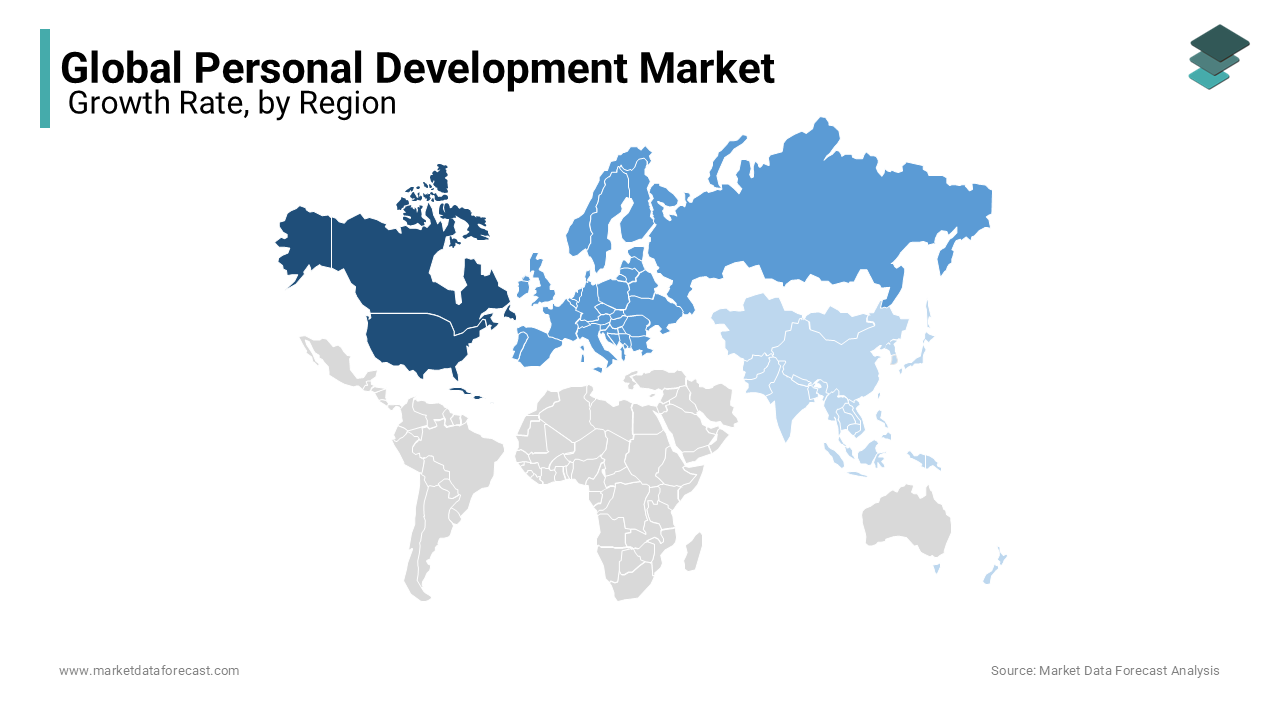
North America spearheaded the global Personal Development Market at 41.5% in 2025 and serves as the epicenter of innovation, investment, and cultural acceptance of self-growth. The U.S. drives regional leadership through a deeply entrenched culture of self-improvement, reinforced by a robust ecosystem of coaching professionals, digital platforms, and corporate wellness programs. Americans spend a significant amount annually on personal development books, courses, and coaching. The integration of personal development into workplace culture is particularly advanced. Canada complements this momentum with publicly funded lifelong learning initiatives, including the Canada Training Credit, which supported a large number of individuals in skill and self-development courses. The region also leads in venture capital funding for personal growth startups. High internet penetration and smartphone ownership enable seamless access to digital content. Moreover, the destigmatization of mental health has expanded the scope of personal development to include emotional intelligence and psychological resilience. With strong institutional support, consumer willingness to invest, and technological sophistication, North America remains the most mature and influential market for personal development globally.
Europe Personal Development Market Insights
Europe is distinguishes itself through policy-driven integration of personal development into education and labor systems. Western European nations such as Germany, the UK, and the Netherlands prioritize lifelong learning as a public good, with governments subsidizing access to personal growth programs. Scandinavia leads in institutional adoption. Germany’s dual vocational system incorporates personal effectiveness training for apprentices. However, disparities exist in Eastern Europe, where limited funding and conservative attitudes slow adoption. Still, the region’s emphasis on work-life balance and mental well-being creates fertile ground for growth. With strong regulatory frameworks and high digital literacy, Europe is evolving into a model of inclusive, socially embedded personal development.
Asia-Pacific Personal Development Market Insights
Asia-Pacific (APAC) is undergoing a transformative shift as urbanization, youth demographics, and digital connectivity reshape attitudes toward self-growth. While traditional collectivist values have historically downplayed individualistic development, younger generations in countries like India, China, and South Korea are redefining success to include personal fulfillment and emotional health. India’s personal development market grew in recent years, driven by startups like The Better Insights and Unschool, which attracted a large volume of users with affordable, vernacular content. China’s market is expanding through tech giants Alibaba’s DingTalk and Tencent’s WeChat integrate personal productivity tools into workplace ecosystems, reaching over 800 million users. Japan, despite cultural reticence, has seen a rising demand for stress management and resilience training. Government initiatives are also emerging. Hence, mobile-first platforms are bypassing traditional barriers. As economic mobility and mental health awareness rise, APAC is transitioning from a nascent to a high-potential market.
Latin America Personal Development Market Insights
Latin America is characterized by organic, community-driven growth in personal development, particularly in Brazil, Mexico, and Colombia. Brazil leads the region with a vibrant coaching culture and a growing middle class increasingly investing in self-improvement. Mexico has seen a 50% increase in online course enrollments for personal development since 2021, driven by platforms. Cultural emphasis on interpersonal relationships has led to the popularity of workshops focused on communication, emotional intelligence, and family dynamics. In Argentina, personal development is increasingly integrated into public education. However, economic volatility and limited internet access in rural areas constrain scalability. Despite this, social media influencers and YouTube educators are normalizing discussions around self-worth and purpose, particularly among youth. As digital infrastructure improves, the region is poised for significant expansion in personalized growth solutions.
Middle East and Africa Personal Development Market Insights
Middle East and Africa (MEA) collectively represent a small share of the global market, with stark contrasts between progressive urban centers and conservative rural regions. The UAE and Saudi Arabia are emerging as innovation hubs, with government-backed initiatives promoting personal development as part of national vision plans. Saudi Arabia’s Vision 2030 includes investments in youth empowerment and soft skills. In contrast, Sub-Saharan Africa faces systemic challenges, including limited infrastructure and low disposable income. However, mobile-based learning is gaining traction. South Africa’s private sector is also investing in coaching for leadership diversity, with firms like Discovery and Standard Bank implementing internal development academies. With rising female workforce participation and digital adoption, MEA is gradually building a foundation for inclusive personal growth, positioning it as a long-term growth frontier.
KEY PLAYERS IN THE MARKET
Some of the prominent players in the global personal development market include Dale Carnegie & Associates Inc., Franklin Covey Co., Landmark Worldwide, Success Resources America, Omega Institute, SkillPath, Toastmasters International, Nutrisystem Inc., and Others
TOP LEADING PLAYERS IN THE MARKET
BetterUp has significantly expanded its footprint in the Asia Pacific personal development landscape by introducing localized coaching networks and culturally adapted digital content. The company has established strategic partnerships with enterprises in Australia, Japan, and Singapore to deliver personalized mental resilience and leadership development programs. In 2023, BetterUp launched a Mandarin-language coaching initiative in collaboration with HR tech platforms in China, targeting mid-level professionals navigating workplace transformation. It also integrated AI-driven behavioral insights into its mobile app to enhance user engagement across India and South Korea. By combining certified human coaches with data-informed learning paths, BetterUp has positioned itself as a hybrid solution provider that bridges emotional intelligence with performance outcomes. The company has further strengthened its regional credibility by aligning its frameworks with local labor policies, including Australia’s National Mental Health Strategy. Its emphasis on measurable well-being metrics has resonated with corporate clients seeking scalable employee development tools. Through continuous product localization and enterprise integration, BetterUp is redefining high-touch personal development for diverse cultural contexts across the region.
Mindvalley has emerged as a transformative force in the Asia Pacific personal development space by curating immersive, narrative-driven learning experiences that blend ancient wisdom with modern psychology. The company has deepened its regional engagement through partnerships with wellness retreat centers in Bali, Thailand, and Goa, offering experiential workshops on self-awareness, purpose discovery, and emotional mastery. In 2023, Mindvalley introduced localized content in Hindi, Bahasa, and Korean, reaching over 2 million users across India and Southeast Asia. It collaborated with influencers and spiritual leaders to host live virtual summits, attracting record participation from younger demographics. The company also launched a university accreditation pathway in Malaysia, allowing learners to earn recognized credentials in personal growth disciplines. By emphasizing storytelling, community building, and long-form transformational journeys, Mindvalley differentiates itself from conventional e-learning platforms. Its focus on deep behavioral change rather than skill-based efficiency appeals to audiences seeking holistic evolution. With a mobile-first strategy and subscription-based access, Mindvalley has successfully democratized high-impact personal development across tier-two and tier-three cities, establishing a loyal user base that values authenticity and introspective depth.
Coursera plays a pivotal role in advancing personal development across the Asia Pacific by integrating self-growth courses into mainstream digital education ecosystems. The company has partnered with leading universities such as the University of Melbourne, National University of Singapore, and Indian School of Business to offer accredited programs in communication, resilience, and leadership. In 2023, Coursera collaborated with India’s Ministry of Education under the SWAYAM initiative to deliver free personal development modules to over 500,000 students. It also introduced AI-powered learning coaches on its platform to guide users through self-paced courses on emotional intelligence and productivity. In Japan and South Korea, Coursera embedded personal development tracks within corporate upskilling programs for firms like Sony and Hyundai, enhancing workplace adaptability. The platform’s multilingual interface and mobile optimization have increased accessibility in rural and underserved areas. By aligning personal development with career advancement and academic credit, Coursera has normalized self-improvement as an essential component of lifelong learning. Its scalable model and institutional partnerships continue to expand reach, making structured personal growth accessible to millions across diverse socioeconomic backgrounds in the region.
TOP STRATEGIES USED BY KEY MARKET PARTICIPANTS
Key players in the Personal Development Market employ multifaceted strategies to consolidate their influence and expand reach. A primary approach is the integration of artificial intelligence to personalize learning journeys, enabling adaptive content delivery based on user behavior and progress. Companies are forming strategic alliances with corporations, educational institutions, and governments to embed personal development into formal talent and education systems. Geographic localization is critical, with firms adapting content, language, and delivery methods to align with cultural values and societal norms across regions. Digital-first models, including mobile apps and subscription platforms, enhance accessibility and user retention. Investment in scientific validation through clinical studies and psychometric assessments strengthens credibility and differentiates offerings in a crowded market. Additionally, hybrid delivery systems that combine AI tools with human coaching provide scalable yet personalized experiences. Brand positioning around authenticity, emotional depth, and long-term transformation attracts discerning consumers disillusioned with superficial self-help trends. These strategies collectively enable market leaders to build trust, ensure sustainability, and drive behavioral impact at scale.
COMPETITIVE LANDSCAPE
The competition in the Personal Development Market is defined by a dynamic interplay between legacy publishers, tech-driven platforms, and independent coaches, all vying for relevance in an increasingly fragmented yet expanding landscape. Established educational providers like Coursera and edX leverage academic partnerships to offer credible, structured programs, while digital-native platforms such as BetterUp and Mindvalley emphasize emotional transformation and experiential learning. The rise of AI-powered coaching apps has intensified rivalry, enabling low-cost, scalable access that challenges traditional one-on-one models. In the Asia Pacific, local startups are gaining traction by offering culturally resonant content in vernacular languages, disrupting the dominance of Western-centric narratives. Corporate demand for resilience and leadership development has turned enterprises into key battlegrounds, with vendors competing to integrate personal growth into HR ecosystems. However, differentiation remains difficult due to overlapping content and inconsistent outcome measurement. Trust and scientific validation have become critical competitive edges, with consumers favoring platforms that demonstrate measurable behavioral change. Meanwhile, the absence of global regulatory standards allows for innovation but also invites skepticism. As personal development evolves from a self-help niche to a core component of human capital strategy, competition is shifting from content volume to depth, personalization, and long-term impact. This transformation is fostering collaboration, consolidation, and continuous innovation across the sector.
RECENT MARKET DEVELOPMENTS
- In March 2023, BetterUp launched a localized coaching network in Japan, partnering with Recruit Holdings to integrate mental resilience training into corporate HR systems, enhancing accessibility for Japanese professionals navigating high-stress work environments.
- In July 2023, Mindvalley introduced a Hindi-language learning platform in India, featuring courses co-developed with regional thought leaders, reaching over 1.2 million users within six months and expanding its footprint in tier-two and tier-three cities.
- In November 2023, Coursera collaborated with the National University of Singapore to launch a certified program in emotional intelligence and leadership, positioning itself as a bridge between academic rigor and personal development for Asian professionals.
- In February 2024, BetterUp acquired Coach.me, a habit-tracking and coaching platform, to enhance its behavioral science capabilities and integrate micro-habit formation tools into its enterprise offerings across the Asia Pacific region.
- In May 2024, Mindvalley partnered with wellness resorts in Bali and Phuket to launch immersive personal development retreats, blending digital learning with experiential workshops to deepen user engagement and foster community-based transformation.
MARKET SEGMENTATION
This research report on the global personal development market has been segmented and sub-segmented based on instrument, focus area and region.
By Instrument
- Books
- e-Platforms
- Personal Coaching/Training
- Workshops & Seminars
By Focus Area
- Mental Health
- Motivation & Inspiration
- Physical Health
- Self-awareness
- Skillset Enhancement
By Region
- North America
- Europe
- Asia Pacific
- Latin America
- Middle East & Africa