- Product Description Description
- Table of Contents TOC
- List of Table & Figure LOT
- Get Free Sample PDF Sample PDF
Market Size, 2025
$7.92 BnMarket Estimate, 2026
$8.37 BnMarket Forecast, 2034
$13.05 BnCAGR, 2026–2034
5.71%Europe Steering Market Size, Growth, Trends & Forecast (2026–2034)
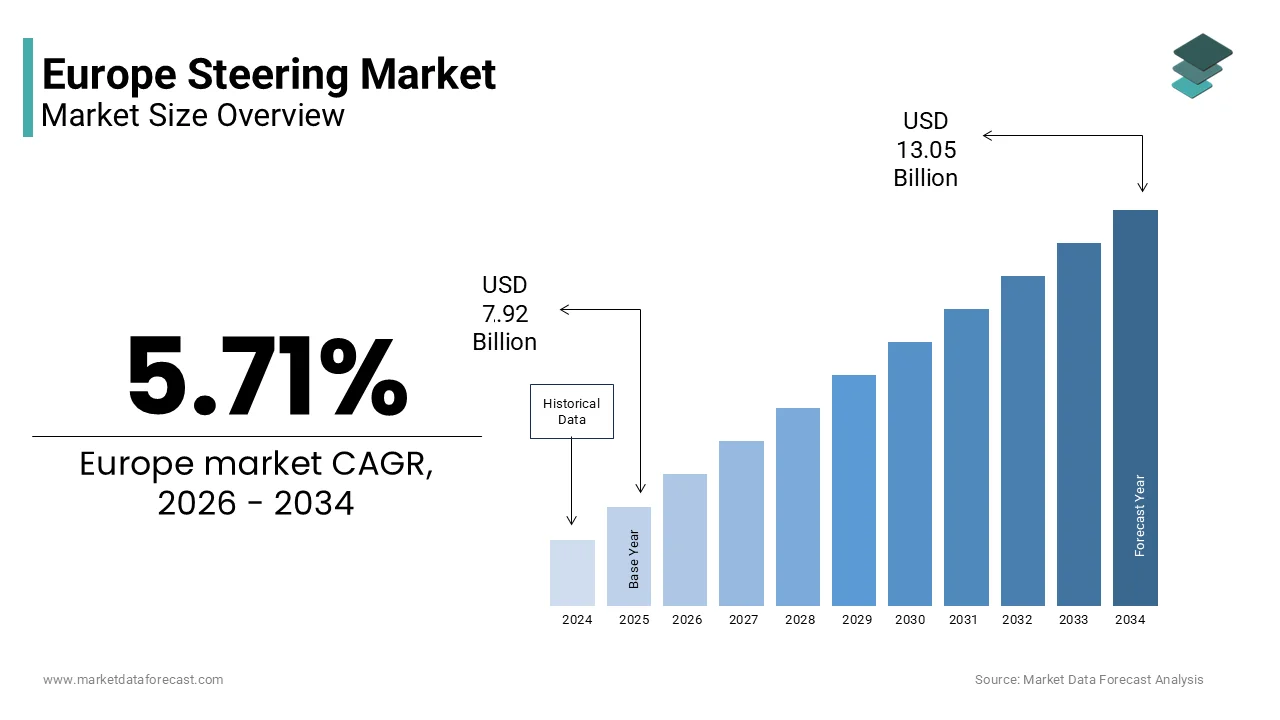
The Europe steering market size was valued at USD 7.92 billion in 2025, is anticipated to reach USD 8.37 billion in 2026, and is projected to scale up to USD 13.05 billion by 2034, registering a compound annual growth rate (CAGR) of 5.71% during the forecast period from 2026 to 2034. Driven by the mandatory integration of advanced driver assistance systems (ADAS), widespread fleet electrification, and next-generation steer-by-wire technologies, the market remains foundational to the region's automotive transformation.
Key Executive Metrics (At-a-Glance)
- 2025 Base Valuation: USD 7.92 Billion
- 2026 Current Valuation: USD 8.37 Billion
- 2034 Forecast Valuation: USD 13.05 Billion
- Compound Annual Growth Rate (CAGR): 5.71% (2026–2034)
- Dominant Type Segment: Electric Power Steering (EPS) (capturing the majority 65.7% market share in 2025 due to energy efficiency and ADAS compatibility)
- Fastest-Growing Type Segment: Electro-Hydraulic Power Steering (EHPS) (registering a 4.8% CAGR driven by heavy commercial and electric utility fleets)
- Dominant Vehicle Type Segment: Passenger Cars (occupying the major market share supported by high regional production volumes and strict NCAP safety protocols)
- Fastest-Growing Vehicle Type Segment: Light Commercial Vehicles (LCVs) (projected at a 5.2% CAGR propelled by urban e-commerce and last-mile delivery electrification)
- Dominant Country Market: Germany (accounting for 28.8% regional share in 2025 anchored by tier-one giants like Bosch and ZF Friedrichshafen)
Core Market Drivers
- Mandatory ADAS Regulations: General Safety Regulations enforcing lane-keeping assist and automated steering corrections across new vehicle registrations.
- Fleet Electrification: Transition to electric vehicles (EVs) accelerating the phase-out of mechanical hydraulic pumps in favor of low-energy electric power steering modules.
- Advanced Architecture Shift: Integration of AI-driven predictive maintenance and redundant steering nodes for autonomous mobility solutions.
Primary Market Restraints & Challenges
- High R&D & Component Costs: Substantial development barriers associated with fail-operational steer-by-wire architecture and automotive-grade semiconductor components.
- Talent & Supply Vulnerabilities: Shortages of specialized mechatronics software engineers and ongoing external supply chain shocks impacting production continuity.
Europe Steering Market Segmentation Breakdown
| Segment Category | Leading Sub-Segment (2025 Base) | Fastest-Growing Sub-Segment (2026–2034) |
|---|---|---|
| By Type | Electric Power Steering (65.7% share via energy efficiency and torque vectoring) | Electro-Hydraulic Power Steering (4.8% CAGR via heavy commercial and zero-emission transit solutions) |
| By Vehicle Type | Passenger Cars (dominant share driven by large manufacturing output and safety mandates) | Light Commercial Vehicles (5.2% CAGR driven by last-mile delivery and e-commerce growth) |
| By Region / Country | Germany (28.8% share backed by premier engineering and tier-one suppliers like Bosch & ZF) | Spain & France (expanding rapidly via EV manufacturing plant conversions and green mobility incentives) |
Major Industry Players Profiled
Key enterprise leaders shaping the Europe steering landscape include Robert Bosch GmbH, Nexteer Automotive, JTEKT Corporation, NSK Ltd., Hyundai Mobis, Mando Corporation, ThyssenKrupp AG, ZF Friedrichshafen AG, Continental AG, and Hitachi Astemo.
 Download Free Sample Report
Europe Steering Market Size
The Europe steering market size was valued at USD 7.92 billion in 2025 and is projected to reach USD 13.05 billion by 2034 from USD 8.37 billion in 2026, growing at a CAGR of 5.71%.
Steering is the mechanical system that allows a driver to control a vehicle's direction by converting the rotational movement of the steering wheel into the swivelling movement of the road wheels. This market is integral to the automotive industry ensuring safety handling precision and driver comfort across passenger cars commercial vehicles and emerging autonomous platforms. The region serves as a hub for advanced automotive engineering with stringent safety regulations driving innovation in steering mechanisms. As per data from the European Automobile Manufacturers Association the automotive industry accounts for approximately 7 percent of the European Union gross domestic product employing over 13 million people directly and indirectly. The transition towards electrification and automation has redefined steering architectures moving away from traditional mechanical linkages to sophisticated electronic control units. According to the International Organization of Motor Vehicle Manufacturers, Europe produced approximately 18.1 million motor vehicles in 2023, reflecting a recovery in manufacturing output. The regulatory landscape is heavily influenced by the European New Car Assessment Program which mandates rigorous testing for active safety systems thereby accelerating the adoption of intelligent steering solutions. Furthermore the presence of leading tier one suppliers such as Bosch ZF Friedrichshafen and JTEKT in the region fosters a competitive environment focused on technological superiority. The market is characterized by a shift towards lightweight materials and energy efficient designs to support the broader goals of vehicle decarbonization. Current developments indicate a strong emphasis on integrating steering systems with advanced driver assistance features creating a seamless interface between human input and automated control protocols.
MARKET DRIVERS
Mandatory Integration of Advanced Driver Assistance Systems Propels Demand
The compulsory inclusion of advanced driver assistance systems in new vehicles acts as a major factor propelling the growth of the Europe steering market. Regulatory bodies have implemented strict safety standards requiring features such as lane keeping assist emergency lane keeping and automated steering interventions to prevent accidents. As per the European Commission general safety regulation mandates that all new vehicle types registered from July 2022 and all new vehicles registered from July 2024 must be equipped with these advanced safety features. This legislative push necessitates the adoption of electric power steering systems capable of precise torque vectoring and rapid response times which traditional hydraulic systems cannot provide. The Insurance Institute for Highway Safety indicates that vehicles equipped with lane maintenance systems have demonstrated a significant reduction in single-vehicle, sideswipe, and head-on crashes. Consequently original equipment manufacturers are increasingly sourcing sophisticated steering modules that integrate seamlessly with radar and camera inputs. The complexity of these systems requires high level software integration and sensor fusion capabilities driving investment in research and development by steering system providers. For instance the implementation of emergency steer assist functions requires redundant power supplies and fail operational architectures to ensure safety during system failures. This regulatory driven demand ensures a consistent upgrade cycle for steering technologies as manufacturers strive to achieve higher safety ratings. The shift towards semi autonomous driving levels further amplifies this trend as steering systems must handle more complex dynamic scenarios without driver intervention.
Rapid Electrification of Vehicle Fleets Drives Adoption of Electric Power Steering
The accelerated transition towards electric vehicles in the region greatly influences the Europe steering market. This is fuelled by favoring electric power steering systems over hydraulic alternatives. Electric vehicles prioritize energy efficiency to maximize driving range and electric power steering systems consume significantly less energy than hydraulic pumps which operate continuously regardless of steering input. According to the European Automobile Manufacturers’ Association, sales of electrically chargeable cars in the European Union reached a volume consistent with strong market growth in 2023, while the International Energy Agency reports higher regional figures when including non-EU markets like the United Kingdom and Norway. This surge in electric vehicle production directly correlates with increased demand for compact and efficient electric power steering units. These systems allow for variable assistance levels improving maneuverability at low speeds and stability at high speeds which is crucial for the heavier battery laden electric vehicles. Furthermore, the absence of an internal combustion engine in electric vehicles eliminates the need for engine driven hydraulic pumps simplifying the vehicle architecture and reducing weight. Automotive manufacturers are leveraging this opportunity to integrate steer by wire technologies which remove the mechanical connection between the steering wheel and the wheels entirely. This innovation offers greater design flexibility and enhances cabin space utilization. The European Union's updated emissions targets for 2035, which aim for a substantial reduction in tailpipe CO2, primarily reinforce the market dominance of electric powertrains and zero-emission technologies. Suppliers are responding by developing next generation systems with higher torque density and improved thermal management to meet the specific requirements of electric platforms.
MARKET RESTRAINTS
High Development Costs for Steer by Wire Technology Restrains Market Expansion
The substantial research and development costs associated with steer by wire technology restrain the growth of the Europe steering market. Steer by wire systems eliminate the mechanical linkage between the steering wheel and the road wheels relying entirely on electronic signals and actuators. This architecture requires redundant systems for power communication and processing to ensure fail safe operation which drastically increases component complexity and cost. Many automakers hesitate to absorb these additional costs particularly in the mass market segment where price sensitivity remains high. The lack of standardized regulations for steer by wire systems also creates uncertainty for manufacturers. Additionally the need for specialized testing facilities and simulation tools to validate these systems adds to the financial burden. Small and medium sized suppliers often lack the capital resources to invest in such advanced technologies limiting competition and innovation. The high initial investment required for tooling and production line modifications further discourages rapid deployment. Steer-by-wire system penetration will remain limited to premium vehicle segments. This will continue until economies of scale reduce costs or regulatory mandates compel adoption.
Supply Chain Vulnerabilities for Semiconductor Components Impact Production Stability
Electronic steering systems in the region rely on specialized semiconductor components, which constrains the expansion of the Europe steering market. Consequently, the market is exposed to major supply chain risks and production barriers. Modern electric power steering and steer by wire systems rely heavily on microcontrollers sensors and power electronics which are subject to global supply fluctuations. The recent chip shortage demonstrated the fragility of just in time manufacturing models with automotive production in Europe dropping by millions of units due to component scarcity. Steering system manufacturers face particular challenges as they require high reliability automotive grade chips that are not easily substitutable. The geopolitical tensions affecting trade routes and raw material availability further exacerbate these vulnerabilities. For instance the concentration of semiconductor fabrication in Asia creates a bottleneck for European suppliers seeking diversified sources. The lead times for critical electronic components can extend to several months disrupting production schedules and increasing inventory holding costs. Automakers are forced to redesign steering control units to accommodate available chips which incurs additional engineering expenses and validation time. This instability undermines the ability of steering suppliers to meet delivery commitments and maintain consistent quality standards. The lack of local semiconductor manufacturing capacity in Europe means that the region remains vulnerable to external shocks. Until a more resilient and localized supply chain is established the market will continue to face operational disruptions.
MARKET OPPORTUNITIES
Integration of Artificial Intelligence in Predictive Maintenance Offers Growth Potential
The incorporation of artificial intelligence and machine learning algorithms into steering systems offers a lucrative opportunity for predictive maintenance and enhanced user experience, which is likely to promote the growth of the Europe steering market. AI models analyze real-time data from steering torque angle and vibration sensors. This allows them to predict component wear and potential failures before they occur. This proactive approach reduces downtime and maintenance costs for fleet operators and individual consumers. According to sources, the implementation of advanced analytics and predictive maintenance in industrial manufacturing consistently leads to a measurable decrease in total maintenance spending and a significant improvement in equipment availability. Steering system providers can offer value added services such as over the air software updates and health monitoring subscriptions creating new revenue streams beyond hardware sales. The integration of AI also enables personalized steering feel adjustments based on driver preferences and road conditions enhancing comfort and safety. For example adaptive steering systems can modify assistance levels dynamically to suit urban driving versus highway cruising. European technology firms are well positioned to lead this digital transformation due to their strong expertise in software engineering and data analytics. Collaborations between steering manufacturers and tech companies are accelerating the development of smart steering solutions. The growing connectivity of vehicles through 5G networks facilitates the transmission of large data sets required for AI processing. This technological convergence allows for continuous improvement of steering performance through cloud-based learning models. Consumers are becoming more accustomed to smart features. Consequently, the demand for intelligent steering systems is expected to rise significantly.
Expansion of Autonomous Mobility Services Creates Demand for Redundant Systems
The emergence of autonomous mobility services, such as robotaxis and autonomous shuttles, creates a distinct opportunity for the European steering market. It enables the development of highly redundant and reliable steering architectures. These services require vehicles to operate without human intervention necessitating steering systems that are fail operational meaning they can continue to function safely even if a primary component fails. Research indicate that autonomous driving technology is expected to create substantial new revenue streams within the global software and electronics stack as higher levels of automation gain market share. This growth drives the need for specialized steering modules that meet higher safety integrity levels than conventional passenger cars. Steering suppliers are developing dual channel electric power steering systems and backup actuators to ensure uninterrupted control. The modular nature of autonomous platforms allows for innovative steering designs such as retractable steering wheels or joystick controls which optimize interior space for passengers. European cities are increasingly investing in smart infrastructure that communicates with autonomous vehicles requiring steering systems to interpret and execute complex maneuvers precisely. The regulatory framework for autonomous driving is evolving with countries like Germany passing laws allowing level 4 autonomous operations on public roads. This legal clarity encourages investment in autonomous fleets and the underlying technologies. Steering manufacturers that can demonstrate superior reliability and safety in autonomous applications will gain a competitive advantage. The shift from ownership to usership in urban mobility further amplifies the demand for durable and low maintenance steering solutions tailored for high utilization rates.
MARKET CHALLENGES
Complexity of Cybersecurity Requirements Poses Significant Implementation Challenges
Steering systems are becoming increasingly connected, which introduces severe cybersecurity challenges in the Europe steering market. Manufacturers must address these risks to prevent malicious attacks and ensure vehicle safety. As steering becomes more electronic and integrated with vehicle networks it becomes a potential entry point for hackers who could potentially take control of vehicle direction. Compliance with this regulation requires extensive testing encryption and secure software architecture which adds complexity and cost to steering system development. Steering suppliers must collaborate with cybersecurity experts to identify vulnerabilities and implement countermeasures such as intrusion detection systems and secure boot processes. The challenge lies in balancing security with performance as heavy encryption can introduce latency in steering response which is critical for safety. Additionally the long lifecycle of vehicles means that steering systems must remain secure against evolving threats for many years requiring regular software updates. The lack of standardized cybersecurity protocols across different original equipment manufacturers complicates the integration process. Suppliers must navigate a fragmented landscape of security requirements while ensuring interoperability. Failure to adequately address cybersecurity risks can result in costly recalls and damage to brand reputation. Therefore, managing cybersecurity is not just a technical challenge but a strategic imperative for the Europe steering market.
Shortage of Specialized Engineering Talent Hinders Innovation Pace
A critical shortage of skilled engineers specializing in mechatronics software and artificial intelligence hinders the pace of innovation and product development in the Europe steering market. The transition from mechanical to software defined steering systems requires a workforce with interdisciplinary skills that are in short supply. This talent shortage affects the ability of steering manufacturers to develop complex algorithms for autonomous steering and predictive maintenance. Companies compete fiercely for a limited pool of qualified professionals driving up labor costs and extending project timelines. The aging workforce in traditional manufacturing roles further exacerbates the problem as experienced engineers retire without adequate replacements. Educational institutions are struggling to update curricula to match the rapid technological advancements in automotive engineering. This mismatch between skills supply and industry demand slows down the adoption of new technologies such as steer by wire. Furthermore the remote work trend has intensified competition for talent globally making it harder for European firms to retain top engineers. The lack of specialized training programs for existing employees also limits internal upskilling opportunities. Without a strategic approach to talent acquisition and development the Europe steering market risks falling behind in the global race for automotive innovation. Addressing this human capital challenge is essential for sustaining long term growth and competitiveness.
REPORT COVERAGE
| REPORT METRIC | DETAILS |
| Market Size Available | 2025 to 2034 |
| Base Year | 2025 |
| Forecast Period | 2026 to 2034 |
| CAGR | 5.71% |
| Segments Covered | By Type, Vehicle Type, and Region |
| Various Analyses Covered | Global, Regional, & Country Level Analysis; Segment-Level Analysis; DROC, PESTLE Analysis; Porter’s Five Forces Analysis; Competitive Landscape; Analyst Overview of Investment Opportunities |
| Regions Covered | UK, France, Spain, Germany, Italy, Russia, Sweden, Denmark, Switzerland, Netherlands, Turkey, and the Czech Republic |
| Market Leaders Profiled | Robert Bosch GmbH, Nexteer Automotive, JTEKT Corporation, NSK Ltd., Hyundai Mobis, Mando Corporation, ThyssenKrupp AG, ZF Friedrichshafen AG, Continental AG, and Hitachi Astemo |
SEGMENTAL ANALYSIS
By Type Insights
The electric power steering segment held the majority share of the 65.7% of the Europe steering market in 2025. This supremacy of the segment is mainly driven by stringent European Union regulations aimed at reducing carbon dioxide emissions from passenger vehicles. Unlike hydraulic systems that draw continuous power from the engine electric power steering systems only consume energy when steering input is detected thereby improving overall fuel efficiency. Automakers are compelled to adopt lightweight and energy efficient components to meet these targets without compromising performance. The elimination of hydraulic fluid also reduces vehicle weight and maintenance requirements aligning with sustainability goals. For instance major manufacturers like Volkswagen and BMW have phased out hydraulic systems in their latest models in favor of electric variants. The integration of electric power steering facilitates easier implementation of start stop technology which is mandatory in many new vehicles. This regulatory pressure ensures that electric power steering remains the standard choice for new vehicle production across the region. The consistent push for greener mobility solutions reinforces the dominance of this segment as it offers a direct pathway to compliance with environmental laws while enhancing vehicle efficiency. The domination of the electric power steering segment is further reinforced by its critical role in enabling advanced driver assistance systems which are increasingly mandatory in new vehicles. Electric power steering systems provide the precise electronic control necessary for features such as lane keeping assist automated parking and emergency steer assist. These features rely on the ability of electric power steering motors to apply specific torque inputs independently of driver action. Hydraulic systems lack the responsiveness and controllability required for such sophisticated applications. Consequently original equipment manufacturers prioritize electric power steering to ensure seamless integration with radar camera and sensor data. The growing consumer demand for semi autonomous driving capabilities also drives adoption as users seek enhanced convenience and safety. Suppliers are developing dual redundant electric power steering architectures to meet higher safety integrity levels required for level 3 and level 4 automation. This technological synergy between steering and safety systems creates a high barrier to entry for alternative technologies ensuring that electric power steering maintains its leading position in the European market.
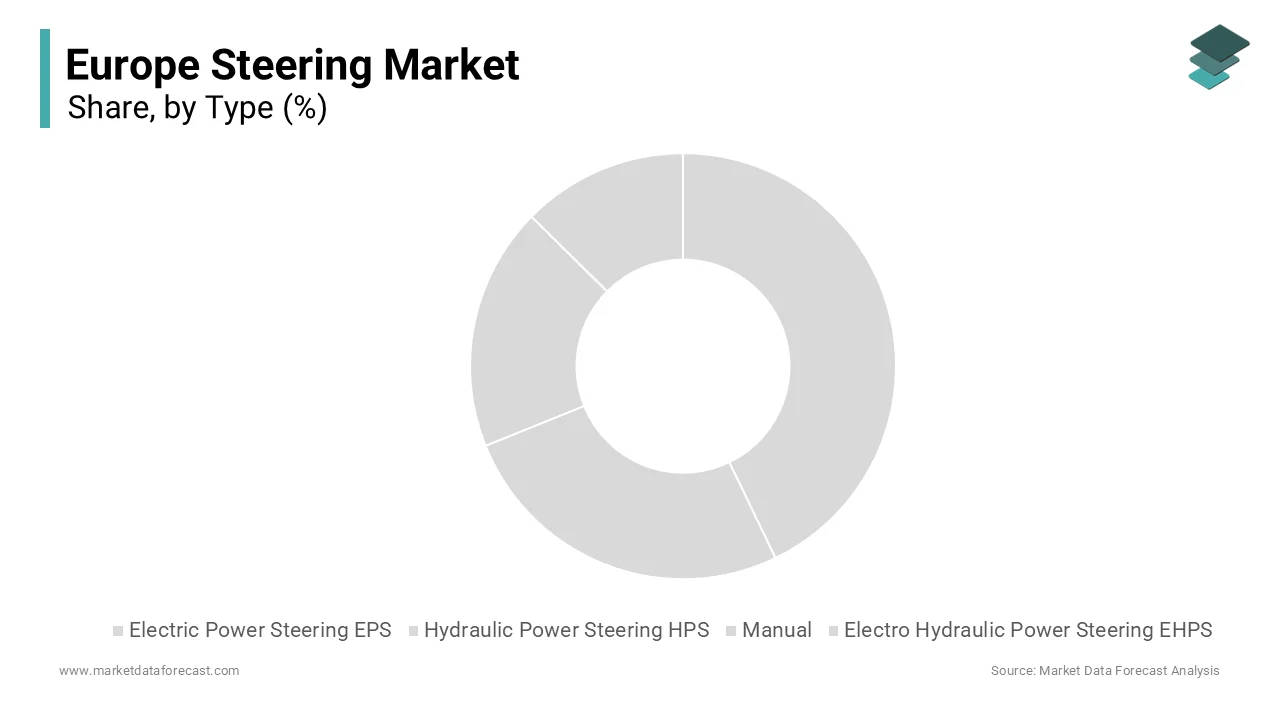
The electro hydraulic power steering segment is estimated to register the fastest CAGR of 4.8% from 2026 to 2034 due to the increasing adoption of this technology in heavy commercial vehicles where high steering forces are required but fuel efficiency remains a concern. Electro hydraulic systems combine the high power density of hydraulic actuation with the energy efficiency of electric pump control. Traditional hydraulic systems consume significant engine power even when not steering whereas electro hydraulic pumps operate only when needed reducing fuel consumption in commercial applications. This efficiency gain is crucial for logistics companies operating on thin margins and facing strict carbon taxes. Manufacturers such as Volvo Trucks and Daimler Truck are increasingly specifying electro hydraulic systems in their new models to meet both performance and environmental standards. The robustness of hydraulic actuators makes them ideal for rough terrain and heavy loads common in construction and mining sectors. Furthermore the transition towards electrified commercial vehicles favors electro hydraulic systems as they can be powered directly by the vehicle battery without relying on an internal combustion engine. This versatility ensures strong growth in the commercial vehicle segment. The rapid expansion of the electro hydraulic power steering segment is further accelerated by the broader trend towards electrification in the commercial vehicle sector. As European cities implement low emission zones and ban diesel vehicles there is a surge in demand for electric buses and delivery trucks. Electric commercial vehicles do not have an engine driven hydraulic pump making traditional hydraulic steering impossible. While full electric power steering is suitable for lighter vehicles it often lacks the force capacity for heavy axles without excessive size and cost. Electro hydraulic systems offer a balanced solution by using an electric motor to drive a hydraulic pump providing high steering assist with manageable component sizes. This architecture allows for flexible packaging in electric chassis designs where space is often constrained by battery packs. Government incentives for zero emission public transport fleets in countries like Germany and France are driving orders for electric buses equipped with electro hydraulic steering. The technology also supports regenerative braking strategies by optimizing energy usage across vehicle systems. The commercial vehicle fleet is undergoing a fundamental transformation towards electrification. As a result, electro-hydraulic steering has emerged as a critical enabling technology and the fastest-growing market segment.
By Vehicle Type Insights
The passenger cars segment was the largest segment in the Europe steering market and occupied a substantial share in 2025. This supremacy of the segment is attributed to the high volume of passenger vehicle production in Europe and the universal application of steering systems in every unit. The widespread adoption of advanced safety features mandated by regulations such as the European New Car Assessment Program protocols ensures that nearly all new passenger cars are equipped with sophisticated electric power steering systems. These systems are essential for achieving high scores in safety tests which influence consumer purchasing decisions. The average car owner replaces their vehicle every 10 to 12 years creating a steady replacement cycle that sustains demand. Furthermore the rise of compact and subcompact cars in urban areas has increased the need for variable assistance steering systems that offer ease of maneuverability in tight spaces. Manufacturers are continuously innovating to reduce the weight and size of steering modules to improve vehicle dynamics and fuel economy. The intense competition among passenger car brands also drives the inclusion of premium steering features such as adaptive steering and haptic feedback even in mid range models. This broad based demand across all vehicle classes within the passenger segment ensures its continued leadership in the market. The command of the passenger cars segment is also supported by evolving consumer preferences for enhanced driving comfort and connected vehicle experiences. Modern drivers expect seamless integration between their vehicles and digital devices requiring steering systems that support intuitive control interfaces. Steering wheels are increasingly becoming hubs for controlling infotainment navigation and driver assistance systems necessitating advanced electronic architectures. Electric power steering systems enable features such as variable gear ratios and customizable steering feel which enhance the driving experience. The growth of the premium car segment in Europe where buyers are willing to pay for superior comfort and technology further boosts demand for high end steering solutions. Brands like Mercedes Benz and Audi offer sophisticated steering systems that adjust automatically based on driving mode and road conditions. Additionally the popularity of long distance travel in Europe requires steering systems that reduce driver fatigue through consistent assistance and stability. The integration of voice control and gesture recognition also relies on the underlying electronic stability provided by modern steering units. Consumers are prioritizing comfort and convenience, leading automakers to invest in advanced steering technologies. This trend is solidifying the passenger car segment's leading position.
The light commercial vehicles segment is anticipated to witness the fastest CAGR of 5.2% during the forecast period owing to the booming e commerce sector which has drastically increased the demand for last mile delivery services. These vehicles operate extensively in urban environments requiring frequent stops and tight maneuvers which places high demands on steering systems. Electric power steering is particularly beneficial in this segment as it improves fuel efficiency and reduces driver fatigue during long shifts. The shift towards electric light commercial vehicles is also accelerating with companies like Amazon and DHL expanding their electric fleets to meet sustainability targets. Electric vans require steering systems that are compatible with high voltage architectures and offer reliable performance under heavy load conditions. The modular nature of light commercial vehicles allows for quicker adoption of new steering technologies compared to heavier trucks. Government incentives for clean commercial vehicles in cities like London and Paris are further driving the replacement of older diesel vans with newer electric or hybrid models equipped with advanced steering systems. This structural shift in logistics and retail distribution ensures sustained growth for the light commercial vehicle steering segment. The accelerated growth of the light commercial vehicles segment is also driven by stringent regulatory pressures aimed at decarbonizing urban logistics. Many European cities are implementing low emission zones that restrict access for polluting vehicles forcing logistics companies to upgrade their fleets. The policy environment creates a favorable market for electric light commercial vehicles which rely on efficient electric power steering systems. The total cost of ownership for electric vans is becoming increasingly competitive due to lower operating costs and government subsidies. Steering manufacturers are responding by developing specialized units for light commercial applications that offer higher durability and torque capacity than passenger car equivalents. The need for precise handling in congested urban areas also drives the adoption of advanced steering aids such as rear axle steering and automated parking assist. These features enhance safety and efficiency for delivery drivers who navigate complex city streets daily. Furthermore the integration of telematics and fleet management systems in light commercial vehicles requires steering data for monitoring driver behavior and vehicle health. This connectivity trend adds value to steering systems and encourages fleet operators to invest in newer models. The combination of regulatory mandates and operational efficiencies ensures that the light commercial vehicle segment remains the fastest growing area in the Europe steering market.
REGIONAL ANALYSIS
Germany Steering Market Analysis
Germany dominated the Europe steering market and accounted for a 28.8% share in 2025. This dominance of the German market is driven by its robust automotive manufacturing base and presence of leading tier one suppliers. The country is home to global giants such as Bosch and ZF Friedrichshafen which are at the forefront of steering technology innovation. Germany's strong engineering culture and skilled workforce enable the production of high precision steering components that meet stringent quality standards. The domestic demand for premium vehicles from brands like BMW Mercedes Benz and Audi further stimulates the market for advanced steering systems such as rear wheel steering and steer by wire. The government supports the industry through initiatives like the National Platform for the Future of Mobility which promotes sustainable and digital transport solutions. Germany is also a key exporter of automotive parts supplying steering systems to manufacturers across Europe and globally. The transition towards electric vehicles in Germany is accelerating with major automakers committing to fully electric lineups by 2030. This shift drives demand for electric power steering units that are lightweight and energy efficient. The country's extensive testing facilities and regulatory framework also facilitate the rapid validation and deployment of new steering technologies. Germany's leadership in both supply and demand ensures its dominant role in the regional market.
France Steering Market Analysis
France followed closely behind in the Europe steering market and occupied a 15.6% share in 2025 because of a strong domestic automotive industry and focus on innovation. The country hosts major manufacturers such as Stellantis which produces a wide range of passenger and commercial vehicles requiring advanced steering solutions. France is particularly active in the development of electric and hybrid vehicles with government incentives supporting the transition to cleaner mobility. The presence of specialized suppliers and research centers fosters collaboration on next generation steering technologies including integrated chassis control systems. The French government has implemented strict emissions regulations and low emission zones in major cities like Paris driving the adoption of electric vehicles equipped with efficient electric power steering. Additionally France is a hub for automotive software development which is increasingly critical for smart steering systems. The country's emphasis on sustainability and digitalization aligns with global trends in the steering market. French manufacturers are also expanding their export markets leveraging their expertise in compact and efficient steering modules. The strategic location of France within Europe facilitates easy distribution of components to neighboring countries. Despite challenges from global competition France maintains its relevance through continuous innovation and strong industrial partnerships.
Spain Steering Market Analysis
Spain holds a notable position in the Europe steering market due to its large vehicle production capacity and growing component manufacturing sector. The country is one of the largest automobile producers in Europe with major plants operated by Stellantis Volkswagen and Ford. Also, the Spanish automotive industry is increasingly focusing on electric vehicle production with several manufacturers announcing plans to convert existing plants for electric models. This transition boosts the demand for electric power steering units which are essential for new energy vehicles. Spain also has a growing network of tier one and tier two suppliers specializing in chassis components including steering racks and columns. The government supports the sector through the Strategic Project for Economic Recovery and Transformation which aims to modernize the automotive industry and promote sustainable mobility. The availability of skilled labor and competitive production costs makes Spain an attractive location for automotive manufacturing. The country's strategic location provides easy access to both European and North African markets. Spanish suppliers are investing in automation and digital technologies to enhance productivity and quality. The focus on exporting vehicles and components further strengthens Spain's position in the regional market. The ongoing modernization of the industry ensures continued growth and competitiveness in the steering sector.
United Kingdom Steering Market Analysis
The United Kingdom maintains a noteworthy share of the Europe steering market despite the challenges posed by Brexit. The country has a prestigious automotive heritage with luxury brands like Jaguar Land Rover and Bentley demanding high performance steering systems. According sources, the UK automotive sector contributed billions to the economy and continues to invest in electric vehicle technology. The UK government has banned the sale of new petrol and diesel cars from 2030 accelerating the shift towards electric vehicles and associated steering technologies. This policy drives demand for advanced electric power steering systems that offer precision and efficiency. The UK is also a center for automotive research and development with universities and tech firms collaborating on autonomous driving solutions. The presence of specialized engineering firms supports the development of innovative steering concepts such as steer by wire. However supply chain disruptions and trade barriers have introduced complexities for manufacturers sourcing components from the EU. Despite these challenges the UK remains a key market for premium and specialized steering solutions. The focus on high value segments allows UK manufacturers to compete effectively on quality and technology rather than price. Investment in battery electric vehicle production facilities further secures the future demand for modern steering systems in the region.
Italy Steering Market Analysis
Italy is expected to showcase a promising CAGR in the Europe steering market from 2026 to 2034 owing to its strong presence in both passenger car and commercial vehicle manufacturing. The country is home to Fiat Chrysler Automobiles now part of Stellantis which produces a wide range of vehicles requiring reliable steering systems. Italy is also renowned for its luxury and sports car manufacturers such as Ferrari and Lamborghini which require high performance steering solutions for superior handling and dynamics. These niche segments drive innovation in steering technology with a focus on responsiveness and feedback. The Italian government supports the automotive industry through incentives for electric vehicle purchases and infrastructure development. This support encourages the adoption of electric power steering systems in new models. Italy has a dense network of specialized suppliers and engineering firms that contribute to the global steering supply chain. The country's expertise in design and engineering allows it to produce high value added components. The transition towards electrification is gaining momentum with Italian manufacturers launching new electric models. The focus on quality and performance ensures that Italy remains a relevant and influential player in the European steering market catering to both mass and premium segments.
COMPETITIVE LANDSCAPE
The competition in the Europe steering market is intense characterized by the presence of established global giants and specialized regional suppliers. Major players compete on technological innovation product quality and ability to meet stringent environmental regulations. The shift towards electric vehicles and autonomous driving has intensified rivalry as companies race to develop advanced steer by wire and electric power steering systems. Price pressure from automakers remains a challenge forcing suppliers to optimize costs through efficient manufacturing and economies of scale. Differentiation is achieved through superior engineering expertise and integrated software solutions that enhance vehicle safety and user experience. Strategic alliances with tech companies are common as firms seek to incorporate artificial intelligence and connectivity features. The market also sees new entrants focusing on niche segments such as lightweight materials for improved efficiency. Regulatory compliance acts as a barrier to entry ensuring that only capable players sustain operations. Continuous investment in research and development is essential to stay ahead in this dynamic landscape where technological superiority dictates market leadership and long term success for all participating entities.
KEY MARKET PLAYERS
Some of the notable key players in the Europe steering market are
- Robert Bosch GmbH
- Nexteer Automotive
- JTEKT Corporation
- NSK Ltd.
- Hyundai Mobis
- Mando Corporation
- ThyssenKrupp AG
- ZF Friedrichshafen AG
- Continental AG
- Hitachi Astemo
Top Players in the Market
- Robert Bosch GmbH stands as a global leader in automotive technology with a significant footprint in the Europe steering market. The company specializes in developing advanced electric power steering systems that enhance vehicle safety and efficiency. Bosch contributes to the global market by supplying innovative steering solutions to major automakers worldwide. Recent actions include expanding its production capacity for electric power steering units in Hungary to meet rising demand. The company also invests heavily in research and development for steer by wire technologies aiming to support autonomous driving applications. Bosch collaborates with software firms to integrate artificial intelligence into steering control units enabling predictive maintenance features. These strategic initiatives strengthen its position by offering comprehensive mobility solutions that align with industry trends towards electrification and digitalization ensuring sustained growth and technological leadership in the competitive European landscape.
- ZF Friedrichshafen AG is a prominent player in the Europe steering market known for its comprehensive portfolio of chassis technology solutions. The company provides high performance electric power steering and rear wheel steering systems that improve vehicle dynamics and comfort. ZF contributes globally by partnering with leading car manufacturers to develop integrated safety systems. Recently ZF launched its next generation electric power steering system designed specifically for electric vehicles to optimize energy consumption. The company also acquired specialized software companies to enhance its capabilities in automated driving technologies. ZF focuses on sustainability by producing carbon neutral steering components at its European facilities. These efforts reinforce its market position by delivering innovative and eco friendly products that meet stringent regulatory requirements and customer expectations for advanced automotive technologies in Europe and beyond.
- JTEKT Corporation is a key contributor to the Europe steering market leveraging its expertise in precision machinery and automotive components. The company offers a wide range of electric power steering systems known for their reliability and compact design. JTEKT supports the global market by supplying steering gears to various international automakers. In Europe JTEKT has expanded its technical center in Germany to accelerate the development of customized steering solutions for local clients. The company recently introduced lightweight steering columns made from advanced materials to reduce vehicle weight and improve fuel efficiency. JTEKT also collaborates with universities to research next generation steering technologies including haptic feedback systems. These actions strengthen its market presence by providing high quality and innovative products that address the evolving needs of the European automotive industry while maintaining a strong competitive edge through continuous technological advancement.
Top Strategies Used by the Key Market Participants
Key players in the Europe steering market primarily focus on product innovation and strategic partnerships to maintain their competitive edge. Companies invest heavily in research and development to create advanced electric power steering systems that support autonomous driving and electrification. Collaborations with technology firms enable the integration of artificial intelligence and cybersecurity features into steering modules. Manufacturers also expand their production facilities in Europe to reduce supply chain risks and meet local demand efficiently. Sustainability is a core strategy with firms adopting green manufacturing processes and developing lightweight materials to lower vehicle emissions. Additionally companies pursue mergers and acquisitions to acquire specialized skills and technologies in software and electronics. These strategies help participants offer comprehensive solutions that comply with strict European regulations while enhancing vehicle safety and performance for consumers across the region.
MARKET SEGMENTATION
This research report on the European steering market has been segmented and sub-segmented based on categories.
By Type
- Electric Power Steering EPS
- Hydraulic Power Steering HPS
- Manual
- Electro Hydraulic Power Steering EHPS
By Vehicle Type
- Passenger Cars
- Light Commercial Vehicles
- Heavy Commercial Vehicles
By Country
- UK
- France
- Spain
- Germany
- Italy
- Russia
- Sweden
- Denmark
- Switzerland
- Netherlands
- Turkey
- Czech Republic
- Rest of Europe