- Product Description Description
- Table of Contents TOC
- List of Table & Figure LOT
- Get Free Sample PDF Sample PDF
Market Size, 2025
$13.25 BnMarket Estimate, 2026
$14.86 BnMarket Forecast, 2034
$37.17 BnCAGR, 2026–2034
12.14%Europe Streaming Analytics Market Size
The Europe streaming analytics market size was calculated to be USD 13.25 billion in 2025 and is anticipated to be worth USD 37.17 billion by 2034, from USD 14.86 billion in 2026, growing at a CAGR of 12.14% during the forecast period.
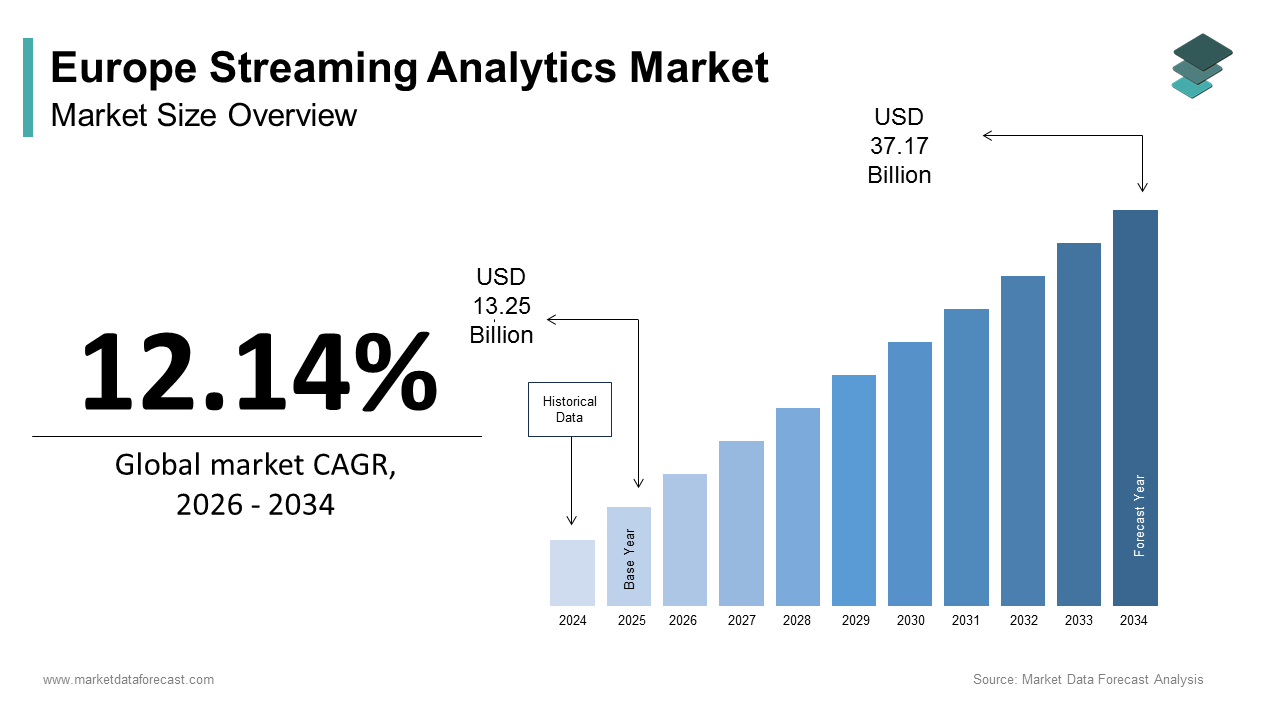
Streaming analytics refers to the real-time processing and interpretation of continuous data flows generated from digital interactions, sensors, transactions, and connected devices to enable immediate decision-making. In Europe, this capability is increasingly vital across financial services, telecommunications, manufacturing, and public infrastructure, where latency-sensitive responses determine operational resilience and regulatory compliance. The market operates within a distinctive legal and technological ecosystem shaped by the General Data Protection Regulation the Digital Services Act and the EU Cyber Resilience Act, which collectively impose strict requirements on data provenance, algorithmic transparency, and incident reporting. According to Eurostat, a majority of EU enterprises with more than 250 employees deployed real-time data monitoring in 2024, which is primarily for fraud detection, predictive maintenance, and customer experience optimization. As per the European Commission’s Digital Decade Report, the EU added new IoT connections in industrial settings during 2024, generating large volumes of time series data requiring millisecond-level analysis. Unlike batch-oriented systems, streaming analytics platforms must reconcile performance with privacy-by-design principles, ensuring that personal data is anonymized or deleted within legally mandated retention windows. This convergence of regulatory rigor, technological urgency, and data intensity defines the strategic contours of the European streaming analytics landscape.
MARKET DRIVERS
Stringent Real-Time Fraud Detection Mandates in Financial Services Drive Adoption
European financial institutions face escalating regulatory pressure to detect and prevent fraudulent transactions within seconds rather than hours, which is directly fuelling demand for streaming analytics and majorly propelling the European streaming analytics market. Under the Revised Payment Services Directive (PSD2) and the European Banking Authority’s Guidelines on Fraud Reporting, banks must implement Strong Customer Authentication and monitor payment flows in real time to flag anomalies. According to the European Central Bank, payment fraud losses were reported in 2024, with card-not-present transactions accounting for the majority of incidents. In response, major banks like BNP Paribas and Deutsche Bank have deployed Apache Flink and Kafka-based streaming pipelines that analyze hundreds of variables per transaction to assess legitimacy in milliseconds. The European Securities and Markets Authority further mandates real-time trade surveillance under MiFID II, requiring investment firms to scan order books for manipulative patterns. As per the European Fraud Prevention Network, cross-border transaction monitoring now processes billions of events daily across SEPA. These regulatory imperative transforms streaming analytics from an operational enhancement into a legal necessity.
Industrial Predictive Maintenance Requirements Under EU Green Deal Accelerate Deployment
The European Union’s push for industrial decarbonization has made real-time equipment health monitoring a cornerstone of sustainable manufacturing, which is driving adoption of streaming analytics in factories and energy grids and further boosting the regional market expansion. The EU Industrial Emissions Directive requires large installations to minimize unplanned downtime and optimize energy use through continuous process monitoring. According to the European Environment Agency, industrial facilities that implemented real-time vibration and thermal analytics reduced unscheduled outages and cut energy consumption in 2024. Siemens’ Amberg electronics plant in Germany uses streaming analytics to process millions of sensor readings per day from robotic arms and soldering stations, enabling failure prediction well in advance. Similarly, Ørsted’s offshore wind farms in the North Sea employ edge-based streaming platforms to analyze turbine strain, acoustics, and lubricant quality in real time, preventing catastrophic failures in harsh marine environments. The European Commission’s Net Zero Industry Act further incentivizes such systems by linking state aid eligibility to verified reductions in material waste and carbon intensity. As industrial IoT scales, streaming analytics becomes indispensable for achieving both operational efficiency and regulatory compliance.
MARKET RESTRAINTS
Fragmented Data Localization Laws Increase Deployment Complexity
Despite the EU’s single market vision, national interpretations of data residency under the General Data Protection Regulation create significant barriers to centralized streaming analytics architectures, which are impeding the European streaming analytics market growth. Countries like France, Germany, and Italy require that certain categories of personal or critical infrastructure data remain within national borders even for transient processing. According to the European Data Protection Board, many member states have enacted supplementary laws mandating local data storage for sectors including healthcare, finance, and energy. This forces multinational enterprises to deploy redundant streaming clusters in each jurisdiction, increasing infrastructure costs as per the European Cloud Partnership. For example, a pan-European bank must run separate Kafka streams in Frankfurt, Paris, and Milan to comply with national banking regulators despite using a unified fraud model. The lack of harmonized certification for cross-border data flows under the Data Governance Act further delays deployment timelines. These legal silos inflate operational expenses and fragment analytical insights, which is preventing holistic threat detection or customer journey mapping across markets.
Shortage of Specialized Talent Constrains Platform Implementation and Optimization
Europe faces a critical deficit of professionals skilled in distributed stream processing frameworks such as Apache Flink, Spark Streaming, and ksqlDB, which is limiting the effective deployment of advanced analytics solutions and further hampering the European streaming analytics market growth. According to the European Institute for Innovation and Technology, there is a shortfall of hundreds of thousands of data engineers and real-time analytics specialists across the EU as of 2024, with Germany, France, and the Netherlands experiencing the most acute gaps. Academic programs remain heavily focused on batch data science, leaving graduates unprepared for low-latency event-driven architectures. A 2024 survey by the European Big Data Value Association found that many enterprises delayed streaming analytics projects due to the inability to hire staff capable of tuning windowing functions, managing state backends, or debugging exactly-once semantics. Vendor training programs exist, but cannot scale to meet demand, particularly in non-English-speaking regions where documentation and community support are limited. This talent bottleneck extends time to value and increases reliance on costly external consultants, raising the total cost of ownership and discouraging mid-sized firms from adopting real-time capabilities despite clear business need.
MARKET OPPORTUNITIES
Integration with EU Sovereign Cloud Initiatives Creates New Government Demand
The European Union’s push for digital sovereignty through GAIA-X and the European High Performance Computing Joint Undertaking is opening substantial opportunities for the European streaming analytics market. National governments are migrating defense, transportation, and healthcare workloads to sovereign cloud environments that mandate real-time monitoring for cyber threats and system integrity. According to the European Defence Agency, all member states must implement continuous security analytics on classified networks by 2026 under the Cybersecurity Strategy for the Digital Decade. In 2024, France’s ANSSI launched a sovereign streaming platform called Sentinel Flux to monitor public administration endpoints for zero-day exploits using encrypted event streams. Similarly, Germany’s Federal Office for Information Security contracted SAP to build a GDPR-compliant fraud detection engine for social welfare disbursement processing millions of transactions daily. The European Health Data Space regulation further requires real-time adverse drug reaction monitoring across national pharmacovigilance systems. As these sovereign infrastructures scale, they will demand vendor-neutral streaming solutions that operate within strict data governance boundaries.
Expansion of Real-Time Personalization in Retail Under the Digital Services Act
The European retail sector is rapidly adopting streaming analytics to deliver compliant yet dynamic customer experiences in response to the Digital Services Act’s transparency requirements, which is another prominent opportunity in the European streaming analytics market. Unlike opaque recommendation engines, legacy systems now must justify personalization logic in real time while avoiding discriminatory outcomes. According to Eurostat, a majority of EU online retailers implemented explainable AI layers in 2024 that log every decision factor for user access upon request. Zalando’s streaming platform processes billions of user events daily to adjust product rankings while ensuring neutrality as verified by independent auditors. Similarly, Carrefour uses real-time basket analysis to trigger ethical promotions, such as reducing food waste by offering near-expiry items to nearby app users within minutes. The European Consumer Organisation confirmed that many consumers now expect personalized offers but demand control over data usage. This regulatory consumerism creates a niche for streaming analytics vendors who can embed fairness checks, consent management, and audit trails directly into event pipelines.
MARKET CHALLENGES
Inconsistent Interpretation of Algorithmic Accountability Across Member States
While the EU AI Act establishes a risk-based framework for automated decision-making, its implementation varies significantly across national supervisory authorities, which is creating uncertainty for streaming analytics vendors and a significant challenge to the regional market. High-risk applications such as credit scoring or hiring tools must undergo conformity assessments, but countries differ on what constitutes real-time human oversight. According to the European AI Alliance, Germany requires a human to review every flagged transaction in banking, whereas Spain permits automated blocking if reversal is possible within one hour. This divergence forces software providers to maintain multiple compliance logic branches, increasing development costs as per the European DIGITAL SME Alliance. Moreover, the lack of standardized testing protocols for streaming models means that a system certified in one country may fail validation in another due to differing thresholds for false positive rates. Until the European Commission issues binding technical standards through ENISA, these regulatory asymmetries will hinder scalable deployment and discourage innovation in cross-border real-time AI applications.
High Energy Consumption of Continuous Processing Conflicts With Green IT Mandates
Streaming analytics platforms consume significantly more energy than batch systems due to persistent compute loads, memory residency, and network I/O required for sub-second latency, which is further challenging the regional market expansion. According to the Fraunhofer Institute for Reliability and Microintegration, a typical enterprise streaming cluster processing large event volumes daily consumes energy equivalent to powering several average EU households. This conflicts with the EU Code of Conduct for Data Centre Energy Efficiency, which encourages idle resource shutdown, yet streaming workloads cannot be paused without data loss. Public sector tenders now include carbon intensity clauses requiring vendors to disclose energy per event processed. In 2024, Sweden’s Vinnova agency rejected a smart city bid because the proposed Kafka architecture exceeded carbon intensity thresholds. Companies are responding by adopting hardware acceleration, such as NVIDIA GPUs and Intel DPUs, to improve throughput per watt, but these add cost and complexity. Without standardized green metrics for real-time systems, European organizations face a trade-off between responsiveness and sustainability, potentially delaying adoption in environmentally conscious sectors like utilities and education.
REPORT COVERAGE
| REPORT METRIC | DETAILS |
| Market Size Available | 2025 to 2034 |
| Base Year | 2025 |
| Forecast Period | 2026 to 2034 |
| CAGR | 12.14% |
| Segments Covered | By Component, Enterprise Type, Application, And Region |
| Various Analyses Covered | Global, Regional & Country Level Analysis; Segment-Level Analysis; DROC, PESTLE Analysis; Porter’s Five Forces Analysis; Competitive Landscape; Analyst Overview of Investment Opportunities |
| Regions Covered | UK, France, Spain, Germany, Italy, Russia, Sweden, Denmark, Switzerland, Netherlands, Turkey, and the Czech Republic |
| Market Leaders Profiled | IBM, Microsoft, Oracle, SAP SE, Amazon Web Services, Google Cloud, SAS Institute, Software AG, TIBCO Software, Informatica, Cloudera, Teradata, Splunk, Snowflake, Confluent |
SEGMENTAL ANALYSIS
By Component Insights
The software segment dominated the market by commanding for 66.5% of the European market share in 2025. The leading position of the software segment in the European market is attributed to the preference for in-house control over data governance, algorithmic logic, and integration with legacy systems. European enterprises, particularly in finance and manufacturing, prioritize owning their analytical pipelines to comply with the General Data Protection Regulation and the EU AI Act, which require full auditability of automated decisions. According to the European DIGITAL SME Alliance, a majority of large corporations deploy self-managed streaming platforms such as Apache Flink or Kafka Streams to maintain sovereignty over sensitive event data. The European Central Bank mandates that all systemic banks retain fraud detection models on premises, which ensures direct oversight of real-time scoring logic. Additionally, open-source frameworks allow customization of windowing functions, state management, and exactly-once processing guarantees, critical for industrial use cases. Companies like Siemens and Bosch have built proprietary streaming engines integrated with their MES and ERP systems to avoid vendor lock-in.
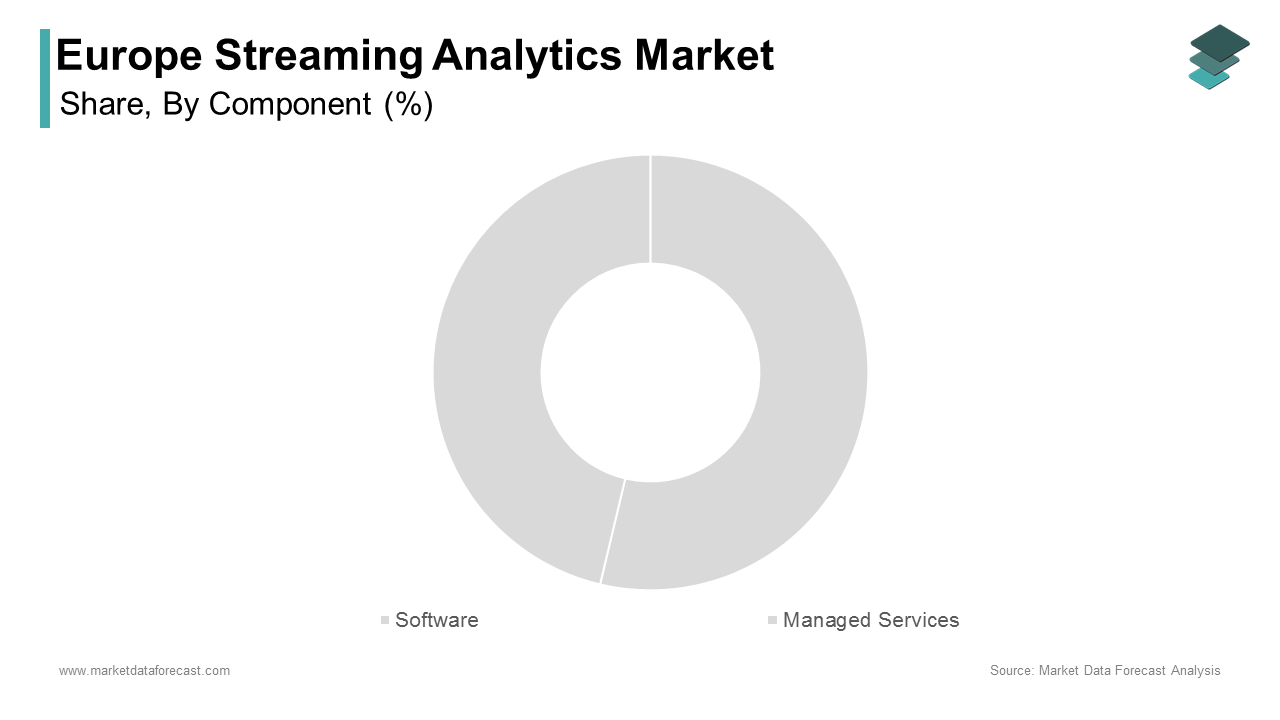
The managed services segment is estimated to grow at a promising CAGR of 22.5% over the forecast period, owing to the mid-sized enterprises lacking in-house data engineering talent and seeking compliant turnkey solutions under the Digital Services Act. According to the European Cloud Partnership, many SMEs now outsource real-time analytics to certified providers who guarantee GDPR-compliant data handling and algorithmic transparency. Microsoft’s Azure Stream Analytics and Google Cloud Dataflow have launched EU-specific managed offerings hosted exclusively in Frankfurt and Amsterdam data centers to address sovereignty concerns. In 2024, France’s ANSSI accredited streaming analytics service providers under its SecNumCloud label, enabling public sector adoption. Similarly, Germany’s Federal Office for Information Security now permits managed fraud detection for non-systemic banks if vendors undergo annual audits. The rise of consumption-based pricing also lowers entry barriers, allowing retailers and logistics firms to scale usage during peak seasons without capital expenditure.
By Enterprise Type Insights
The large enterprises segment dominated the market by holding 75.4% of the European market share in 2025. The growth of the large enterprises segment in the European market is attributed to the regulatory mandates, complex operations, and capital availability for real-time infrastructure. Financial institutions, energy utilities, and automotive manufacturers face stringent requirements under MiFID II, the Industrial Emissions Directive, and the Cyber Resilience Act, necessitating continuous monitoring of transactions, equipment, and network traffic. According to Eurostat, most EU firms with over 250 employees implemented streaming analytics in 2024, primarily for fraud detection, predictive maintenance, and supply chain visibility. Deutsche Bank processes millions of payment events hourly using an in-house Flink cluster to meet European Banking Authority reporting deadlines. Similarly, Volkswagen’s Wolfsburg plant analyzes vast sensor data daily to optimize robotic welding sequences. These organizations possess dedicated data engineering teams and can absorb the high initial costs of deploying low-latency architectures.
The small and medium enterprises segment is the fastest-growing segment in the Europe streaming analytics market and is expected to exhibit a CAGR of 25.5% over the forecast period, owing to the cloud-native managed services that democratize access to real-time intelligence without requiring specialized talent. According to the European DIGITAL SME Alliance, adoption of streaming analytics among SMEs has risen significantly, primarily for dynamic pricing, inventory alerts, and customer churn prediction. Platforms like Confluent Cloud and AWS Kinesis offer pre-built connectors to Shopify, Salesforce, and SAP S/4HANA, enabling rapid deployment. The European Commission’s Digital Europe Programme allocated funding in 2024 to subsidize real-time analytics adoption among SMEs in retail and logistics. In Spain, thousands of SMEs joined the “Retail Intelligence” initiative using streaming dashboards to adjust promotions based on footfall and weather data.
By Application Insights
The fraud detection segment led the market by capturing 30.9% of the regional market share in 2025. The dominance of the fraud detection segment in the European market can be credited to its binding regulatory requirements across banking, payments, and e-commerce. The Revised Payment Services Directive mandates real-time transaction monitoring for Strong Customer Authentication exemptions, while the European Banking Authority requires immediate fraud reporting. According to the European Central Bank, payment fraud losses were reported in 2024, with card-not-present fraud rising year on year. In response, banks like BNP Paribas and ING deployed streaming pipelines that evaluate hundreds of risk variables per transaction to approve or block payments within milliseconds. The European Securities and Markets Authority further enforces real-time trade surveillance under MiFID II. Public sector agencies also use streaming analytics to detect welfare fraud, with Germany’s Bundesagentur für Arbeit flagging suspicious claims monthly.
The predictive asset management segment is the fastest-growing application segment in the Europe streaming analytics market and is anticipated to record a CAGR of 25.5% over the forecast period, owing to the EU Industrial Emissions Directive and Net Zero Industry Act, which require continuous equipment monitoring to minimize downtime and energy waste. According to the European Environment Agency, factories using real-time vibration, thermal, and acoustic analytics reduced unscheduled outages in 2024. Siemens’ Amberg plant processes tens of millions of sensor readings daily to predict robotic arm failures in advance. Similarly, Ørsted’s North Sea wind farms use edge-based streaming to monitor turbine strain, preventing catastrophic failures. The European High Performance Computing Joint Undertaking funded digital twin projects in 2024, integrating live sensor streams with simulations for predictive maintenance.
REGIONAL ANALYSIS
Germany Streaming Analytics Market Analysis
Germany held the leading position in the European streaming analytics market in 2025, holding 25.5% of the regional market share. The growth of Germany in the European market is driven by its advanced industrial base, stringent cybersecurity laws, and leadership in real-time manufacturing. The country’s Industrie 4.0 initiative mandates continuous monitoring of production lines, with a majority of DAX 30 companies operating streaming analytics clusters for predictive maintenance and quality control. According to the Federal Office for Information Security (BSI), all critical infrastructure operators must implement real-time threat detection by 2025 under the IT Security Act 2.0. Deutsche Bank and Commerzbank process millions of financial events per hour using in-house Flink platforms to comply with BaFin regulations. The Fraunhofer Society operates testbeds in Stuttgart and Dresden, developing low-latency analytics for autonomous vehicle validation. Additionally, Germany hosts major R&D centers for SAP and Siemens, offering native integration with enterprise systems.
United Kingdom Streaming Analytics Market Analysis
The United Kingdom had the second leading share of the European market in 2025. The promising position of the UK in the European market is attributed to its world-class financial services sector and agile fintech ecosystem. London alone accounts for a significant portion of EU high-frequency trading volume, requiring real-time market surveillance under the Financial Conduct Authority’s MiFID II guidelines. According to UK Finance, payment fraud losses were reported in 2024, which is driving banks like Barclays and Lloyds to deploy Kafka-based fraud engines analyzing behavioral biometrics in milliseconds. The National Health Service also uses streaming analytics to monitor hospital bed occupancy and drug inventory across hundreds of trusts, enabling dynamic resource allocation. Post-Brexit, the UK’s Data Protection and Digital Information Bill accelerates sovereign cloud adoption, with AWS and Microsoft opening dedicated analytics zones in London and Manchester. The Alan Turing Institute leads research in ethical real-time AI, ensuring compliance with emerging algorithmic accountability standards.
France Streaming Analytics Market Analysis
France is estimated to account for a prominent share of the European streaming analytics market over the forecast period. The state-led digital sovereignty initiatives and defense modernization are propelling the French market expansion. The French National Cybersecurity Agency (ANSSI) mandates real-time monitoring for all operators of vital importance, including energy, transport, and finance. In 2024, ANSSI launched Sentinel Flux, a sovereign streaming platform processing public administration endpoints for zero-day exploits. BNP Paribas and Société Générale analyze millions of transactions daily using Gaia-X-compliant analytics hosted in Paris data centers. The Ministry of Armed Forces invested heavily in battlefield streaming systems for drone swarm coordination and logistics tracking. Additionally, France’s Digital Republic Act requires explainable AI in public decision-making, accelerating adoption in social services and education. With GAIA-X headquartered in Paris and Atos offering sovereign analytics stacks, France positions itself as the guardian of European data autonomy.
Netherlands Streaming Analytics Market Analysis
The Netherlands is anticipated to showcase a healthy CAGR in the European market over the forecast period, owing to its role as a digital logistics and data hub. Amsterdam hosts the largest internet exchange in Europe, generating massive real-time traffic requiring DDoS and fraud monitoring. According to the Dutch Data Protection Authority, a majority of multinational headquarters in the Netherlands use managed streaming services from AWS, Azure, and Google Cloud due to strict GDPR enforcement. ING and Rabobank pioneered real-time payment screening under the Dutch Central Bank’s anti-money laundering directives, processing millions of events hourly. The Port of Rotterdam uses streaming analytics to optimize vessel scheduling, container stacking, and customs clearance, reducing dwell time as per Portbase data. Additionally, the Netherlands Enterprise Agency funds SME adoption through the Digital Innovation Voucher program.
Sweden Streaming Analytics Market Analysis
Sweden is projected to account for a notable share of the European streaming analytics market over the forecast period, owing to its green tech leadership and advanced public sector digitization. The Swedish Energy Agency mandates real-time grid balancing for renewable integration, with Vattenfall using streaming platforms to forecast wind and solar output every few seconds. According to the Swedish Civil Contingencies Agency, all healthcare providers must monitor patient vitals in real time under the National eHealth Strategy, reducing ICU response times. Spotify and Klarna process hundreds of thousands of user events per second for personalization and fraud prevention, hosted in Stockholm data centers compliant with national security rules. The Vinnova agency allocated funding in 2024 to develop carbon-aware streaming analytics that throttle workloads during high grid emissions. Sweden’s combination of sustainability policy, digital maturity, and innovation culture creates a high-trust environment for real-time intelligence deployment.
COMPETITION OVERVIEW
The Europe streaming analytics market features intense rivalry among global cloud hyperscalers, open-source specialists, and emerging sovereign solution providers. Competition is defined less by pricing and more by regulatory compliance, data sovereignty, and integration depth with existing enterprise systems. Hyperscalers like Microsoft, Google, and AWS dominate through managed services but face growing pressure from European alternatives such as Aiven and Quix that emphasize vendor neutrality and GAIA-X alignment. Open-source platforms like Apache Flink and Kafka retain strong traction among large enterprises seeking full control over their data pipelines, yet require significant in-house expertise. Regulatory complexity under the AI Act, Digital Services Act, and national cybersecurity laws raises barriers to entry, favoring incumbents with legal and compliance infrastructure. Simultaneously, demand from SMEs is creating opportunities for vertical-specific SaaS players offering pre-built streaming templates for retail logistics and healthcare. This multi-tiered landscape fosters continuous innovation but demands deep localization of both technology and governance to succeed.
KEY MARKET PLAYERS
A few major players of the Europe streaming analytics market include
- IBM
- Microsoft
- Oracle
- SAP SE
- Amazon Web Services
- Google Cloud
- SAS Institute
- Software AG
- TIBCO Software
- Informatica
- Cloudera
- Teradata
- Splunk
- Snowflake
- Confluent
Top Strategies Used by the Key Market Participants
Key players in the Europe streaming analytics market prioritize deployment of sovereign cloud instances within EU borders to comply with data localization mandates under GDPR and the Cyber Resilience Act. They embed algorithmic transparency and data minimization features directly into streaming pipelines to meet EU AI Act and Digital Services Act requirements. Companies pursue national cybersecurity certifications such as France’s SecNumCloud and Germany’s BSI C5 to unlock public sector contracts. Strategic partnerships with local system integrators and enterprise software vendors ensure seamless integration with SAP, Oracle, and legacy banking systems. Additionally, firms are developing carbon-aware scheduling and energy-optimized stream processing to align with the EU Green Deal and corporate net-zero commitments across customer bases.
Leading Players in the Europe Streaming Analytics Market
- Confluent Inc has established a strong foothold in the Europe streaming analytics market through its Apache Kafka-based platform that enables real-time data pipelines for financial services, telecommunications, and manufacturing sectors. The company operates regional cloud zones in Frankfurt and London, ensuring compliance with EU data residency requirements under the General Data Protection Regulation. Globally, Confluent serves over 1000 enterprises, including major European banks and automotive OEMs that rely on its event streaming platform for fraud detection and predictive maintenance. In recent actions, Confluent achieved SecNumCloud certification from France’s ANSSI, allowing public sector adoption, and launched ksqlDB enhancements tailored for GDPR compliant data masking. These moves reinforce its position as a trusted infrastructure provider for sovereign real-time analytics across regulated European industries.
- Microsoft Corporation leverages its Azure cloud ecosystem to deliver integrated streaming analytics solutions across Europe through Azure Stream Analytics and Event Hubs. The company caters to both large enterprises and public sector organizations requiring low-latency processing within EU data boundaries. Microsoft’s global influence extends through partnerships with SAP, Siemens, and national governments, deploying real-time dashboards for healthcare logistics and cybersecurity. Recently, Microsoft expanded its Azure sovereign cloud offerings in Germany and Sweden with dedicated streaming analytics instances certified under the EU Cloud Code of Conduct. It also embedded explainable AI features into its real-time anomaly detection tools to align with the EU AI Act requirements. These initiatives strengthen its appeal as a compliant end-to-end cloud analytics partner in a policy-driven market.
- Google LLC offers robust streaming analytics capabilities in Europe via Google Cloud Dataflow and Pub Sub, serving retail finance and smart city applications. The company operates data centers in Finland, the Netherlands, and Belgium, enabling low-latency processing while adhering to EU data protection standards. Globally, Google supports multinational corporations with hybrid streaming architectures that combine on-premises Kafka clusters with cloud-based analytics. In recent developments, Google achieved GAIA-X compliance for its European streaming services and introduced carbon-aware scheduling in Dataflow that reduces energy consumption during high grid emission periods. It also partnered with Zalando and Carrefour to build real-time personalization engines that log decision logic for user transparency under the Digital Services Act. These actions position Google as an innovation leader, balancing performance, sustainability, and regulatory alignment.
MARKET SEGMENTATION
This research report on the Europe streaming analytics market has been segmented and sub-segmented based on component, enterprise type, application, and region.
By Component
- Software
- Managed Services
By Enterprise Type
- Large Enterprises
- Small & Medium Enterprises
By Application
- Supply Chain Management
- Sales & Marketing
- Fraud Detection
- Predictive Asset Management
- Risk Management
- Others
By Region
- UK
- France
- Spain
- Germany
- Italy
- Russia
- Sweden
- Denmark
- Switzerland
- Netherlands
- Turkey
- Czech Republic
- Rest of Europe