Europe Superconducting Wire Market Size, Share, Trends & Growth Forecast Report – Segmented By Type, Sales Channel, End User, and Country (UK, France, Spain, Germany, Italy, Russia, Sweden, Denmark, Switzerland, Netherlands, Turkey, Czech Republic & Rest of Europe), Industry Analysis From 2026 to 2034
Market Size, 2025
$543 MnMarket Estimate, 2026
$595 MnCAGR, 2026–2034
1,247 MnEurope Superconducting Wire Market Size
The Europe superconducting Wire market size was valued at USD 543.04 million in 2025 and is projected to reach USD 1,247.33 million by 2034 from USD 595.61 million in 2026, growing at a CAGR of 9.68%.

Superconducting Wire are specialized conductive materials that exhibit zero electrical resistance when cooled below critical temperature thresholds. In Europe this technology underpins advanced applications in scientific research medical diagnostics and next generation energy infrastructure. The market is tightly intertwined with the continent’s strategic investments in large scale scientific facilities and clean energy transition.
According to the European Organization for Nuclear Research (CERN), the Large Hadron Collider’s magnet system required thousands of kilometres of niobiumtitanium superconducting wire, which is indicating the extraordinary scale of institutional demand for highperformance conductors in frontier science. According to the European Medicines Agency, more than 15,000 magnetic resonance imaging (MRI) scanners operate across the EU, each relying on superconducting magnets cooled by liquid helium. This creates a continuous need for wire supply to support maintenance and upgrades in Europe’s healthcare infrastructure. Furthermore, the European Union’s Horizon Europe programme has earmarked over €1.2 billion between 2021 and 2027 for projects in quantum computing, fusion energy, and grid modernization. This convergence of scientific ambition, healthcare reliance, and energypolicy investment defines the unique technological and institutional foundation of the European superconducting wire market, which is positioning it as a critical enabler of both research excellence and sustainable innovation.
MARKET DRIVERS
Expansion of Fusion Energy Research Under EU Strategic Programs
The European Union’s intensified commitment to nuclear fusion as a long-term clean energy source is majorly propelling the European superconducting wire market growth. According to the ITER Organization the ITER project hosted in France represents the world’s largest fusion experiment and requires extensive niobiumtin superconducting cable for its toroidal and poloidal field magnets, underscoring the scale of material use. As per Fusion for Energy Europe as host and largest contributor supplies around 45% of ITER’s superconducting components through its consortium, which is indicating EU leadership. Beyond ITER, the EU’s Broader Approach agreement with Japan funds the JT60SA tokamak in Naka which became operational in 2023 and consumes large volumes of superconducting wire, adding to demand. Moreover, the European Commission’s Strategic Energy Technology Plan targets a demonstration fusion power plant by 2050 with the DEMO project already in conceptual design, requiring advanced conductors. National programs such as the United Kingdom’s STEP initiative and Germany’s KIT fusion laboratory further amplify demand. These publicly funded megaprojects create a stable multi decade pipeline for superconducting wire manufacturers insulated from commercial market volatility.
Modernization of Medical Imaging Infrastructure Across European Healthcare Systems
The sustained deployment and refurbishment of magnetic resonance imaging systems across Europe constitute a significant and recurring source of superconducting wire demand, which is further driving the European superconducting wire market growth. According to the European Society of Radiology, more than 14,000 MRI units were in clinical operation across the EU in 2025, with an average replacement cycle of 10 to 12 years. Each MRI scanner requires hundreds of meters of niobiumtitanium wire wound into superconducting magnets operating at 4.2 Kelvin. As per the European Commission’s 2023 Health Infrastructure Resilience Directive €4.5 billion was allocated to upgrade diagnostic equipment in public hospitals, with MRI accessibility a key performance indicator particularly in Eastern member states. According to Eurostat data, countries such as Poland, Romania, and Bulgaria reported MRI unit densities below five per million population, which is prompting procurement drives that directly translate into superconducting wire orders. Additionally, the shift toward high field 3 Tesla systems which use more wire than standard 1.5 Tesla models further elevate material consumption, which is ensuring steady demand. This healthcare driven demand is both geographically widespread and technically consistent, which is supporting established wire producers like Bruker and Oxford Instruments.
MARKET RESTRAINTS
Extreme Material and Cryogenic Infrastructure Costs Limit Commercial Viability
The prohibitive expense of both superconducting materials and associated cryogenic systems are hampering the superconducting wire market growth in Europe. According to the European Materials Research Society, niobiumtitanium wire production requires complex metallurgical processes with yield losses exceeding 20%, raising costs. High temperature superconductors based on rare earth barium copper oxide are even more costly due to epitaxial deposition techniques such as metal organic chemical vapor deposition, which operate at low throughput and high energy intensity. As per the International Energy Agency the installed cost of a superconducting power cable system is three to five times higher than conventional high voltage alternatives, primarily due to cryostat insulation and refrigeration units. For example, a superconducting transmission line project in Essen, Germany required multimillioneuro investment in cryoplants alone, which is illustrating capital intensity. These barriers deter utility adoption outside of demonstration projects. Until manufacturing scale and cryogenics efficiency improve significantly, superconducting wire will remain confined to niche applications where performance outweighs cost, which is a reality that constrains market democratization across commercial and industrial sectors.
Geopolitical Concentration of Critical Raw Material Supply Chains
Europe’s superconducting wire market faces significant supply chain vulnerability due to its reliance on a narrow set of critical raw materials dominated by non-EU producers. According to the European Commission’s 2023 Critical Raw Materials List more than 90% of niobium is sourced from Brazil, which is indicating concentration risk. As per the International Energy Agency, rare earth elements such as yttrium and gadolinium used in high temperature superconductors are predominantly refined in China, which controls over 85% of global separation capacity, which is indicating dependency. The EU classifies both niobium and rare earths as critical due to their high economic importance and supply risk, yet domestic recycling rates remain below five%, which is limiting resilience. This external dependency exposes European wire manufacturers to price volatility, trade restrictions, and logistical disruptions, as evidenced during rare earth export controls in 2022. Although projects like the Kvanefjeld mine in Greenland aim to diversify supply, they face environmental opposition and long development timelines. Until Europe establishes secure circular or alternative material pathways, its superconducting wire production will remain strategically exposed.
MARKET OPPORTUNITIES
Integration into Future Quantum Computing Hardware Architectures
A major opportunity for the Europe superconducting wire market lies in its essential role in superconducting qubit-based quantum processors. Unlike classical bits, qubits in leading quantum computers from IBM, Google, and emerging European firms like IQM require superconducting circuits fabricated from niobium or aluminum thin films cooled to near absolute zero. According to the European Commission’s Quantum Flagship initiative thousands of quantum processors are expected to be deployed in European research and industrial settings by 2030, which is demanding ultra-pure superconducting materials with minimal defect density. Finlandbased IQM has already partnered with CERN to repurpose superconducting wire production lines for qubit interconnects, while Germany’s Forschungszentrum Jülich operates a quantum fabrication facility sourcing wire from local suppliers. As per the European High Performance Computing Joint Undertaking €800 million has been committed to integrate quantum accelerators into EuroHPC supercomputers, which is further accelerating hardware demand. This convergence of quantum engineering and superconducting materials science positions Europe as a potential leader in next generation wire applications beyond traditional magnets and grids.
Deployment in Compact Fusion and Advanced Accelerator Technologies
Emerging compact fusion and particle accelerator concepts offer a high growth pathway for specialized superconducting wire variants. Projects like the United Kingdom’s Tokamak Energy and Germany’s Wendelstein 7X stellarator utilize high temperature superconducting tapes to achieve stronger magnetic fields in smaller footprints, enabling modular reactor designs. According to the EUROfusion consortium high temperature superconductors can generate magnetic fields above 20 teslas compared to around 12 teslas for conventional niobiumtin, which is allowing significant volume reductions. Similarly, CERN’s Future Circular Collider study envisions a 91kilometer tunnel requiring tens of thousands of tons of advanced superconducting wire with enhanced current density and radiation resistance, which is indicating scale. As per the European Strategy for Particle Physics updated in 2020, superconductor R&D is explicitly prioritized for next generation colliders, guiding research agendas. National labs including France’s CEA and Italy’s INFN are already testing rare earth barium copper oxide coated conductors under extreme conditions. These frontier applications not only demand higher performance but also create premium markets that justify material innovation investments, which is opening a strategic corridor for European wire producers to lead in next generation conductor technologies.
MARKET CHALLENGES
Technical Complexity in Large Scale Wire Fabrication and Quality Control
Manufacturing superconducting wire at industrial scale while maintaining consistent critical current density presents a persistent challenge for European producers. Niobiumtitanium requires precise control of alloy homogeneity, filament size, and copper matrix distribution across kilometres of continuous strand, which is a process prone to microstructural defects that degrade performance. According to the European Cooperation in Science and Technology, more than 15% of production batches fail to meet the stringent uniformity thresholds required for MRI or fusion magnets, necessitating costly reprocessing. High temperature superconductors are even more demanding, as their layered crystal structure must be preserved during rolling and heat treatment with tolerances below 5 degrees Celsius across multimeter lengths. The absence of standardized inline quality monitoring tools further complicates yield improvement. While Japan and South Korea have invested in automated optical and electromagnetic inspection systems, European manufacturers largely rely on post production testing, which delays delivery and inflates costs. This technical bottleneck restricts production scalability and impedes competitiveness against Asian counterparts with more mature process control frameworks.
Lack of Harmonized Standards for Grid Integration and Safety Certification
The absence of unified European standards for superconducting power equipment impedes grid adoption and creates regulatory uncertainty for utilities are further challenging the regional market expansion. Unlike conventional cables which follow well established IEC 60502 specifications, superconducting systems lack harmonized protocols for thermal stability, fault current response, and cryogenic safety. According to the European Network of Transmission System Operators for Electricity no panEuropean grid code currently addresses the dynamic behaviour of superconducting fault current limiters or cables under short circuit conditions, leaving a regulatory gap. This forces national regulators to develop ad hoc requirements fragmenting the market and increasing compliance costs for manufacturers. Certification bodies such as TÜV and Bureau Veritas report that superconducting equipment validation takes 12 to 18 months longer than conventional alternatives due to the absence of reference test methodologies, slowing deployment. Until the European Committee for Electrotechnical Standardization finalizes EN standards for superconducting grid components, deployment will remain limited to isolated pilot projects rather than mainstream infrastructure.
REPORT COVERAGE
| REPORT METRIC | DETAILS |
| Market Size Available | 2025 to 2034 |
| Base Year | 2025 |
| Forecast Period | 2026 to 2034 |
| CAGR | 9.68% |
| Segments Covered | By Type, Sales Channel, End User, and Region |
| Various Analyses Covered | Global, Regional, & Country Level Analysis; Segment-Level Analysis; DROC, PESTLE Analysis; Porter’s Five Forces Analysis; Competitive Landscape; Analyst Overview of Investment Opportunities |
| Regions Covered | UK, France, Spain, Germany, Italy, Russia, Sweden, Denmark, Switzerland, Netherlands, Turkey, and the Czech Republic |
| Market Leaders Profiled | Bruker Corporation, Furukawa Electric Co., Ltd., Fujikura Ltd., Eaton Corporation PLC, FUJI ELECTRIC CO., LTD., Phoenix Contact GmbH & Co. KG, Sumitomo Electric Industries, Ltd., Nexans SA, LS Cable & System Ltd., and MetOx Technologies, Inc |
SEGMENTAL ANALYSIS
By Sales Channel Insights
The direct sales segment held the largest share of the European superconducting wire market in 2025. The dominance of the direct sale segment in this regional market is driven by the highly specialized and projectdriven nature of superconductingwire procurement, where technical specifications, tolerances, and delivery timelines are negotiated directly between manufacturers and end users. Major buyers such as CERN, Fusion for Energy, national laboratories, and MRI originalequipment manufacturers require bespoke conductor geometries, critical current densities, and quality certifications that cannot be standardized through thirdparty distributors.
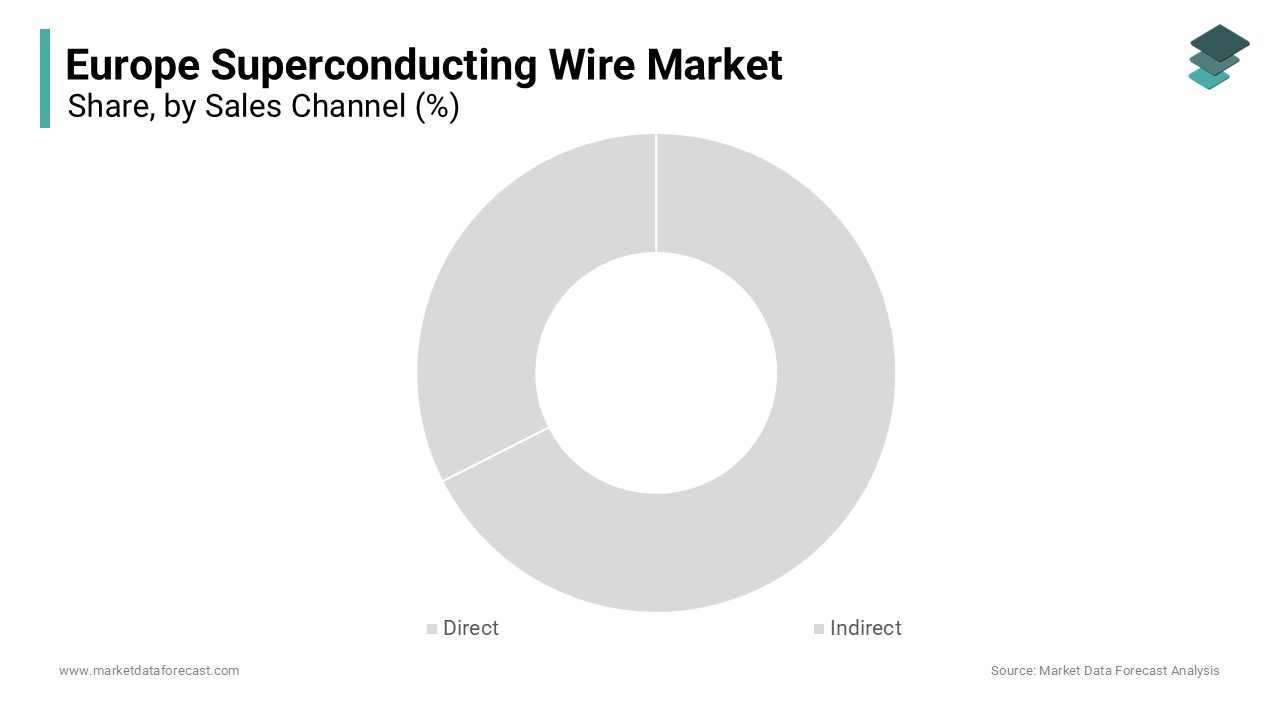
According to CERN, more than 90% of superconducting wire for large scientific facilities is procured through longterm framework agreements with select producers such as Bruker EAS and Oxford Instruments. Similarly, Siemens Healthineers and Philips source niobiumtitanium wire directly from vertically integrated suppliers to ensure batch traceability and compliance with medicaldevice regulations. This direct engagement enables coengineering support, cryogenic testing validation, and justintime delivery. Direct sales are expected to remain dominant as institutional buyers continue to demand traceability, technical collaboration, and bespoke conductor design.
By End User Insights
The research segment held 41.4% of the European market share in the European superconducting wire market in 2025 and stood as the dominating segment. The leading position of the research segment in this regional market is attributed to the Europe’s role as the global epicentre of largescale scientific infrastructure requiring kilometres of highperformance superconducting conductors. According to CERN technical documentation, the Large Hadron Collider contains more than 6,000 kilometres of niobiumtitanium wire powering 1,232 dipole magnets. Beyond particle physics, fusion research under the EUROfusion consortium drives sustained demand, with the ITER project in France consuming more than 300 metric tons of niobiumtin cable annually. National laboratories such as Germany’s Karlsruhe Institute of Technology and France’s CEA Cadarache operate multiple tokamaks and stellarators requiring periodic magnet refurbishment. Furthermore, the European Strategy for Particle Physics endorses the Future Circular Collider projected to demand tens of thousands of tons of advanced superconducting wire. Research is expected to remain the dominant enduser segment as publicly funded megaprojects ensure stable, longterm demand unmatched by commercial sectors.
The quantum computing segment is expected to register a CAGR of 33.7% over the forecast period in this regional market owing to the Europe’s strategic push to achieve quantum sovereignty through national and EUlevel investments. According to the European HighPerformance Computing Joint Undertaking, €800 million has been committed to deploy quantum accelerators across ten supercomputing centers by 2027. Companies such as IQM in Finland and Pasqal in France are scaling production of superconducting and neutralatom systems that rely on highcoherence conductors supplied directly by European wire specialists. The European Commission reports that more than 50 quantum hardware startups have emerged since 2020, with a significant concentration in Germany, France, and the Netherlands. These firms demand ultrapure Wire with extremely low defect densities, achievable only through direct manufacturer collaboration. As quantum processors evolve from dozens to thousands of qubits, material requirements will scale exponentially. Quantum computing is expected to grow rapidly as Europe invests in quantum sovereignty and superconducting materials become critical to scalable processor design.
REGIONAL ANALYSIS
France Superconducting Wire Market Analysis
France had 27.1% of the Europe superconducting wire market in 2025. The dominance of France in the European market is attributed to its role as host to the ITER fusion project in Cadarache. ITER alone accounts for nearly half of Europe’s annual superconducting wire consumption, with tens of thousands of kilometres of niobiumtin cable already delivered. France also operates the Tore Supra tokamak and participates in international collaborations requiring regular conductor replenishment. National research agencies maintain dedicated superconducting materials laboratories that partner with industry to qualify nextgeneration conductors. France’s alignment with EU quantum initiatives has spurred hardware investments demanding highpurity niobium Wire. With its concentration of megascience infrastructure and advanced research, France is expected to remain Europe’s superconducting wire epicentre.
Germany Superconducting Wire Market Analysis
Germany accounted for the second largest share of the Europe superconducting wire market in 2025. The promising role of Germany in the European market is driven by its leadership in medical imaging and industrial R&D. German firms manufacture a large share of Europe’s MRI scanners, sourcing superconducting wire from domestic producers for advanced imaging systems. Research institutions such as the Karlsruhe Institute of Technology and Helmholtz Zentrum Berlin are major consumers of superconducting conductors for energy and fusion projects. National funding programs allocate billions of euros toward fusion development, ensuring longterm demand. Germany’s quantum initiative also supports hardware startups, with Fraunhofer institutes providing wire characterization services. With strong publicprivate collaboration and vertical integration, Germany is positioned as a highvalue anchor market for both low and hightemperature superconducting Wire.
United Kingdom Superconducting Wire Market Analysis
The United Kingdom is expected to exhibit a prominent CAGR in the Europe superconducting wire market over the forecast period. The growing investment in nextgeneration fusion and quantum technologies are propelling the UK superconducting wire market growth. National fusion programs aim to deliver prototype power plants, with companies testing hightemperature superconducting magnets capable of generating extremely strong fields. The UK Quantum Strategy commits billions of pounds to hardware development, with superconducting qubit systems requiring specialized niobium films. Domestic supplychain initiatives have accelerated since the UK’s departure from Euratom, including the establishment of wirequalification facilities. Though smaller in scale than France or Germany, the UK’s focus on compact, highfield systems creates premium demand for advanced conductors, positioning it as a driver of innovation and technical differentiation.
Switzerland Superconducting Wire Market Analysis
Switzerland is predicted to hold a notable share of the Europe superconducting wire market over the forecast period owing to its role as host to CERN. CERN’s annual superconducting wire procurement is among the largest in Europe, with major upgrades requiring extensive conductor supply. Swiss firms serve as primary contractors for magnet systems and detector upgrades, ensuring ultrauniform niobiumtitanium strands. Beyond particle physics, Swiss universities lead in quantum computing research, with labs pioneering superconducting qubit architectures that demand nanoscale wire precision. National science foundations allocate significant funding to quantum materials projects, reinforcing conductor demand. Although geographically small, Switzerland’s role as the administrative and technical hub of European particle physics ensures its outsized importance in the superconducting wire ecosystem.
Italy Superconducting Wire Market Analysis
Italy is anticipated to showcase a healthy CAGR in the Europe superconducting wire market during the forecast period owing to its extensive network of particle accelerators and strong medicaltechnology sector. National research facilities operate multiple accelerator projects requiring custom superconducting magnets. Italy is also home to MRI manufacturers that integrate superconducting coils into diagnostic systems sold across Europe and Asia. Publichealth investment programs have expanded MRI installations in hospitals, boosting wire consumption for new equipment and upgrades. Italy participates in EU fusion programs and hosts advanced tokamak projects requiring large volumes of superconducting cable. With its blend of scientific infrastructure and healthcare manufacturing, Italy is expected to remain a consistent and diversified market for superconducting wire.
COMPETITIVE LANDSCAPE
Competition in the Europe superconducting wire market is characterized by high technical barriers limited supplier base and project driven procurement rather than price competition. The market is dominated by a handful of specialized manufacturers who differentiate through material purity critical current density consistency and cryogenic performance validation. Unlike mass produced commodities superconducting wire requires bespoke engineering for each application whether it be a 3 Tesla MRI magnet a tokamak toroidal field coil or a quantum processor interconnect. This technical specificity fosters long term relationships between producers and institutional buyers such as CERN national laboratories and medical device OEMs. Innovation focuses on defect minimization filament uniformity and integration with next generation systems like compact fusion and quantum computers. New entrants face formidable challenges in metallurgical expertise capital intensity and quality certification. Consequently competition revolves around reliability traceability and co engineering capability rather than marketing or distribution scale ensuring that only the most technically proficient players sustain relevance across Europe’s advanced science and healthcare landscape.
KEY MARKET PLAYERS
Some of the notable key players in the European superconducting Wire market are
- Bruker Corporation
- Furukawa Electric Co., Ltd.
- Fujikura Ltd.
- Eaton Corporation PLC
- FUJI ELECTRIC CO., LTD.
- Phoenix Contact GmbH & Co. KG
- Sumitomo Electric Industries, Ltd.
- Nexans SA
- LS Cable & System Ltd.
- MetOx Technologies, Inc.
Top Players in the Market
- Bruker EAS a division of Bruker Corporation is a leading European producer of niobium titanium superconducting wire headquartered in Hanau Germany. The company supplies high uniformity conductors for magnetic resonance imaging systems particle accelerators and fusion research magnets across Europe and globally. Bruker EAS contributes to the global market by maintaining one of the few industrial scale facilities capable of producing kilometer long strands with consistent critical current density. In 2025 the company upgraded its electron beam melting and wire drawing lines to reduce oxygen impurities and enhance filament homogeneity. It also expanded cryogenic testing capacity in partnership with CERN to validate next generation conductors for the High Luminosity Large Hadron Collider. These investments reinforce its role as a trusted supplier for science and medical applications requiring extreme performance reliability.
- Oxford Instruments a United Kingdom based technology company plays a pivotal role in the Europe superconducting wire market through its specialized production of low temperature superconductors for research and quantum applications. The company supplies niobium titanium and niobium tin Wire to national laboratories universities and quantum hardware startups across the continent. Globally Oxford Instruments bridges fundamental science and commercialization by tailoring conductor specifications for emerging technologies such as superconducting qubits and compact fusion magnets. In early 2025 it launched a new high purity niobium wire grade with reduced dislocation density specifically for quantum computing coherence requirements. The company also established a collaborative materials lab in Oxford to co develop conductors with European quantum initiatives. These actions position it at the forefront of next generation superconducting applications.
- Luvata a Finland headquartered advanced materials company is a key European manufacturer of superconducting wire for both medical and energy applications. The company produces long length niobium titanium strands used in MRI magnets and particle accelerator systems with a focus on high yield and batch consistency. Luvata contributes to the global market by supplying conductors to major imaging original equipment manufacturers and participating in international fusion projects including ITER. In 2025 Luvata enhanced its quality control protocols by integrating real time electromagnetic monitoring during the drawing process to detect microstructural anomalies. It also deepened its partnership with the European Domestic Agency Fusion for Energy to qualify conductors for DEMO reactor specifications. These strategic refinements strengthen its reputation for reliability in mission critical superconducting systems.
Top Strategies Used by the Key Market Participants
Key players in the Europe superconducting wire market focus on vertical integration by controlling raw material refining alloying and wire drawing processes to ensure purity and performance consistency. They invest in advanced cryogenic testing infrastructure to validate conductors under real operating conditions for fusion MRI and quantum applications. Strategic partnerships with scientific institutions such as CERN and EUROfusion enable co development of next generation conductor specifications. Companies pursue certification under medical and nuclear quality standards including ISO 13485 and ASME NQA 1 to access regulated end markets. Geographic proximity to major research and healthcare hubs in Germany France and Switzerland allows for rapid technical support and just in time delivery reinforcing customer retention and project continuity.
MARKET SEGMENTATION
This research report on the European superconducting Wire market has been segmented and sub-segmented based on categories.
By Type
- Low Temperature Superconductor
- Medium Temperature Superconductor
- High Temperature Superconductor
By Sales Channel
- Direct
- Indirect
By End User
- Medical
- Energy
- Research
- Transportation
- Others
By Country
- UK
- France
- Spain
- Germany
- Italy
- Russia
- Sweden
- Denmark
- Switzerland
- Netherlands
- Turkey
- Czech Republic
- Rest of Europe
Frequently Asked Questions
1. What is the Europe superconducting wire market?
It covers production and use of superconducting wires for medical imaging, energy, research, and industrial applications across Europe.
2. What types of superconducting wires are used in Europe?
Low-temperature superconductors like NbTi and Nb₃Sn and high-temperature superconductors such as YBCO are commonly used.
3. What are the major applications of superconducting wires?
Key applications include MRI systems, particle accelerators, power cables, fault current limiters, and fusion research.
4. What factors are driving market growth in Europe?
Rising MRI installations, grid modernization, fusion energy projects, and government-funded research drive growth.
5. Which country leads the Europe superconducting wire market?
Germany leads due to strong research institutions, healthcare infrastructure, and energy innovation programs.
6. What is the fastest-growing application segment?
Power and energy applications are growing fastest due to investments in smart grids and high-capacity transmission.
7. How does the healthcare sector impact the market?
Healthcare drives demand through MRI and medical imaging systems requiring reliable superconducting wires.
8. What role do research institutions play?
Research labs and universities support demand via particle physics, fusion reactors, and advanced materials studies.
9. What challenges do manufacturers face in Europe?
High production costs, complex manufacturing processes, and cryogenic requirements limit wider adoption.
10. Who are the key players in the Europe superconducting wire market?
Key players include Nexans, Sumitomo Electric, Furukawa Electric, Fujikura, and LS Cable & System.
Related Reports
Access the study in MULTIPLE FORMATS
Purchase options starting from
$ 2000
Didn’t find what you’re looking for?
TALK TO OUR ANALYST TEAM
Need something within your budget?
NO WORRIES! WE GOT YOU COVERED!
Call us on: +1 888 702 9696 (U.S Toll Free)
Write to us: sales@marketdataforecast.com