- Product Description Description
- Table of Contents TOC
- List of Table & Figure LOT
- Get Free Sample PDF Sample PDF
Market Size, 2025
$8.39 BnMarket Estimate, 2026
$9.26 BnMarket Forecast, 2034
$20.38 BnCAGR, 2026–2034
10.36%Europe Surveillance Camera Market Report Summary
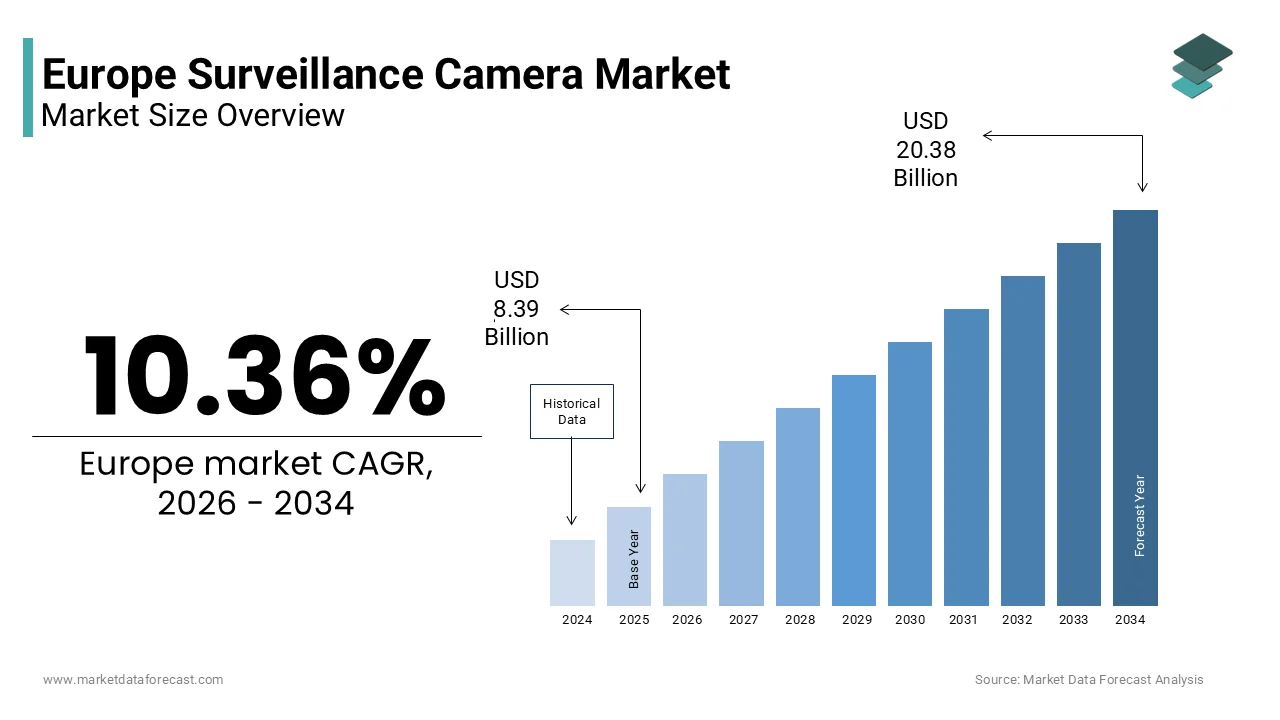
The Europe surveillance camera market was valued at USD 8.39 billion in 2025, is estimated to reach USD 9.26 billion in 2026, and is projected to reach USD 20.38 billion by 2034, growing at a CAGR of 10.36% during the forecast period. Market growth is driven by rising security concerns across public and private infrastructure, increasing adoption of smart city initiatives, and growing investments in public safety and critical asset protection. The transition toward digital surveillance systems, integration of artificial intelligence based video analytics, and demand for real time remote monitoring are further accelerating market expansion across Europe.
Key Market Trends
- Strong shift from analog to IP based surveillance cameras due to superior image quality and network integration
- Growing deployment of surveillance systems in smart cities, transportation hubs, and public infrastructure
- Rising adoption of AI enabled features such as facial recognition, motion detection, and behavior analytics
- Increased focus on cybersecurity and data protection compliance under European regulatory frameworks
- Expanding use of surveillance cameras in commercial buildings, retail spaces, and residential complexes
Segmental Insights
- Based on camera technology, the IP based cameras segment dominated the Europe surveillance camera market by holding a 61.5% share in 2025. This dominance is attributed to scalability, remote accessibility, and seamless integration with advanced video management systems.
- Based on camera form factor, the fixed box cameras segment emerged as the largest, capturing 54.2% of the market share in 2025. The segment benefits from high durability, flexible lens options, and widespread usage in outdoor and high security environments.
- Based on end user industry, the government and public safety segment led the market with a 49.1% share in 2025, supported by rising investments in urban surveillance, border security, traffic monitoring, and crime prevention initiatives.
Regional Insights
- The Europe surveillance camera market is witnessing strong growth across major economies, supported by digital transformation of security infrastructure and increasing public safety expenditure.
- Germany dominated the regional market by accounting for 23.6% of the Europe surveillance camera market share in 2025.
Competitive Landscape
The Europe surveillance camera market is moderately competitive, with global and regional players focusing on technological innovation, AI integration, and compliance with data privacy regulations. Key companies are expanding their portfolios with intelligent video analytics, cloud based monitoring solutions, and cybersecurity focused offerings. Strategic partnerships with system integrators and government agencies are strengthening market presence across Europe.
 Download Free Sample Report
Europe Surveillance Camera Market Size
The Europe surveillance camera market size was valued at USD 8.39 billion in 2025 and is projected to reach USD 20.38 billion by 2034 from USD 9.26 billion in 2026, growing at a CAGR of 10.36%.
A surveillance camera is a video imaging device used to systematically monitor and record activities in a specific area for security, safety, and operational purposes. These devices range from analog high-definition units to IP based smart cameras featuring artificial intelligence powered object detection facial recognition and thermal imaging capabilities. Surveillance technology, including video and Internet of Things devices, has seen significant expansion across European public spaces, encompassing transportation hubs, municipal buildings, and commercial centers. An increasing number of urban areas in Western Europe are adopting interconnected digital platforms that integrate surveillance, smart sensor data, and emergency management systems to enhance public security and city resilience. The market is increasingly defined not by hardware volume but by intelligent functionality data governance and interoperability within broader security ecosystems. Regulatory frameworks such as the General Data Protection Regulation and the EU Artificial Intelligence Act impose strict conditions on biometric processing ensuring that technological adoption aligns with fundamental rights, a distinctive characteristic that shapes Europe’s surveillance landscape differently from other global regions.
MARKET DRIVERS
Integration of AI Powered Video Analytics in Urban Safety Initiatives
European cities are rapidly adopting AI enhanced video imaging devices as core components of smart urban safety strategies driven by rising concerns over petty crime and public disorder, which acts as a major accelerator of the Europe surveillance camera market. Many large European cities have initiated trials of AI-powered video analytics designed to identify real-time behavioral anomalies like unattended items or crowd disruptions. Municipal law enforcement in certain areas has observed a decrease in specific street crimes, such as pickpocketing in transit hubs, following the deployment of cameras focused on identifying suspicious movement patterns. Public safety projects in cities like Amsterdam are increasingly integrating edge AI cameras in public spaces to analyze movement trajectories, which is aimed at reducing theft while adhering to local privacy guidelines. Surveillance-focused projects are frequently designed to prioritize behavioral analysis rather than personal identification. Funding initiatives are targeting the implementation of ethical AI surveillance technologies that emphasize identifying actions over tracking individual identities. This regulatory compliant approach enables authorities to enhance situational awareness while adhering to proportionality principles embedded in national data protection laws.
Mandatory Security Upgrades in Critical National Infrastructure
Heightened geopolitical tensions and cyber physical threats have compelled European governments to enforce comprehensive surveillance modernization across energy transport and utilities sectors, which further boosts the expansion of the Europe surveillance camera market. Regulations within the European Union have placed a stronger emphasis on enhanced security monitoring and intrusion detection for critical infrastructure operators. Security requirements for critical infrastructure, such as substations and water treatment facilities, are increasingly prioritizing the deployment of advanced surveillance technologies to distinguish between animals and human intruders. Operational tests have demonstrated that updated perimeter surveillance systems can reduce false alerts. Power grid operators are updating facility security by implementing dual-camera technology designed for detecting both security breaches and equipment issues. These installations often use on device machine learning to minimize data transmission preserving both bandwidth and privacy. The rising targeting of essential services ensures a steady demand for security and compliance solutions, providing a reliable economic base that resists the volatility of consumer markets.
MARKET RESTRAINTS
Stringent Biometric Data Restrictions Under GDPR and National Laws
The deployment of advanced surveillance cameras in the region faces significant legal barriers due to rigorous limitations on biometric data processing imposed by the General Data Protection Regulation and reinforced by national jurisprudence. This poses a serious restraint to the Europe surveillance camera market. Regulatory interpretations indicate that the use of biometric identification in public areas is generally restricted, typically requiring specific legal authorization and judicial oversight for law enforcement purposes. Data protection authorities are scrutinizing the deployment of specialized surveillance, such as emotional state analysis in retail environments, particularly regarding the demonstration of necessity and user consent. Judicial bodies are actively reviewing surveillance initiatives that utilize behavioral analysis, with a focus on potential covert processing and a lack of transparency. Legal rulings and enforcement actions against advanced surveillance projects are creating challenges for organizations in determining compliant deployment strategies. Security integrators are increasingly exercising caution regarding the adoption of AI-enabled biometric features, even when such technologies are functionally available. Consequently manufacturers must develop region specific firmware that disables certain algorithms by default, a fragmentation that increases development costs and delays product homologation across member states.
Fragmented Technical Standards and Interoperability Gaps
The region lacks unified technical standards for surveillance system integration, despite shared regulatory goals, which leads to compatibility issues that deter large-scale deployments and the expansion of the Europe surveillance camera market. A significant portion of video management systems in complex transport environments currently lacks support for the latest ONVIF standards designed for advanced AI metadata exchange. This fragmentation forces public agencies to rely on proprietary ecosystems. Integrating modern surveillance technology into outdated, legacy police command infrastructures requires substantial investment in bespoke integration software. Moreover, the absence of common cybersecurity certification for edge devices complicates procurement. A substantial percentage of tested surveillance cameras fail basic penetration tests due to insecure, unpatched, or default-credential vulnerabilities, according to German cybersecurity analyses. Despite the goal of uniform product certification under the EU Cybersecurity Act, enforcement varies, resulting in uneven application. Public and private buyers are holding back on long-term surveillance projects, awaiting mandatory, universal security and interoperability standards.
MARKET OPPORTUNITIES
Adoption of Privacy-Preserving Edge AI for Retail Loss Prevention
Retailers across the region are increasingly deploying surveillance cameras with on-device AI that analyzes shopper behavior without capturing identifiable imagery, which creates a compliant path to loss prevention and fuels the growth of the Europe surveillance camera market. A significant portion of larger European retailers are adopting privacy-conscious analytics tools to better understand customer movement and enhance operational efficiency within their physical locations. Fashion retail entities are utilizing edge-based, anonymous tracking technology to improve inventory management by analyzing item interaction patterns without capturing identifiable personal information. These technological implementations are designed to adhere to stringent data protection regulations by processing, rather than storing, video data. Industry groups are advocating for a structured approach to non-identifying video analytics that prioritizes data privacy and ensures purpose-driven, limited data collection. Edge AI cameras provide a scalable solution for Europe's dense commercial zones, addressing rising retail crime by balancing on-device functionality with strict privacy standards.
Expansion of Thermal and Multispectral Imaging in Border and Maritime Surveillance
Geopolitical pressures and migration flows are accelerating the use of non-visible spectrum surveillance cameras along the region’s external borders and coastal zones, which provides new opportunities for the Europe surveillance camera market. Border authorities are increasingly deploying advanced thermal imaging technologies along land and sea routes to improve detection capabilities during nighttime hours. The integration of long-range infrared cameras with radar systems is enhancing the ability to monitor maritime activity, particularly in challenging, high-traffic areas. Surveillance infrastructure in certain border locations now incorporates multi-sensor systems that combine different infrared and visual technologies to better distinguish human presence. Legislative bodies have implemented requirements ensuring that artificial intelligence used in surveillance systems undergoes evaluation regarding potential impacts on fundamental rights before deployment. Prioritizing presence detection over individual identification allows these technologies to meet both business needs and legal standards, creating a reliable path for growth for specialized camera makers.
MARKET CHALLENGES
Escalating Cybersecurity Vulnerabilities in Networked Camera Systems
The growing connectivity of surveillance cameras creates wider, more accessible attack surfaces, which allows malicious actors to compromise critical networks, and thereby impedes the growth of the Europe surveillance camera market. Many security breaches involving physical infrastructure can be traced back to internet-connected cameras. Cameras lacking secure boot or encrypted firmware updates have served as entry points for network breaches. Vulnerabilities in IP cameras, such as outdated or unpatched software, have been utilized by attackers to gain access to internal networks, including those in sensitive environments like hospitals. Legislative efforts aimed at enhancing digital security frequently highlight the ongoing vulnerabilities present in pre-existing systems. Security assessments of public infrastructure often reveal a significant number of networked surveillance devices that may not meet current, stricter security standards. The widespread presence of connected monitoring equipment creates potential entry points for unauthorized access across public networks. Observations from law enforcement efforts indicate that a substantial amount of installed technology remains susceptible to exploitation. Manufacturers face pressure to retrofit security into cost sensitive products while end users lack resources for continuous vulnerability management. These devices will continue to be major security gaps, weakening surveillance trust, until strict, end-to-end protocols are enforced.
Public Opposition and Ethical Backlash Against Pervasive Monitoring
Growing civic resistance to constant surveillance is constraining deployment even where legally permissible particularly in residential and educational settings, which in turn hinders the expansion of the Europe surveillance camera market. Public sentiment in certain European regions indicates a notable level of discomfort regarding the implementation of video monitoring in shared public areas. Concerns regarding the use of surveillance technologies, particularly continuous monitoring, appear to be more pronounced among younger demographics. Initiatives to introduce surveillance in educational environments have faced resistance and subsequent cancellation, with authorities highlighting concerns over the proportionality of such measures relative to safety objectives. Projects involving advanced, integrated monitoring systems in public spaces have encountered community opposition, driven by concerns about the impact on personal freedom and movement. A pattern emerges where residents and advocacy groups are actively challenging the expansion of urban surveillance, citing the potential for negative effects on public behavior and privacy. These reactions reflect a cultural preference for targeted rather than blanket surveillance deeply rooted in post war privacy norms. Vendors must now engage in extensive community consultation and adopt transparency by design, such as visible status indicators and public dashboards, which increases deployment complexity and cost. In Europe, high-tech tools often face rejection if they lack public trust.
REPORT COVERAGE
| REPORT METRIC | DETAILS |
| Market Size Available | 2025 to 2034 |
| Base Year | 2025 |
| Forecast Period | 2026 to 2034 |
| CAGR | 10.36% |
| Segments Covered | By Camera Technology, Camera Form Factor, Resolution, Connectivity, Deployment Location, End User Industry, and Region |
| Various Analyses Covered | Global, Regional, & Country Level Analysis; Segment-Level Analysis; DROC, PESTLE Analysis; Porter’s Five Forces Analysis; Competitive Landscape; Analyst Overview of Investment Opportunities |
| Regions Covered | UK, France, Spain, Germany, Italy, Russia, Sweden, Denmark, Switzerland, Netherlands, Turkey, and the Czech Republic |
| Market Leaders Profiled | Mobotix, Eagle Eye Networks, Bosch Security Systems GmbH, Axis Communications AB, Milestone Systems, Anviz Global Inc., Genetec Inc., i PRO, Teledyne FLIR LLC, Hangzhou Hikvision Digital Technology Co. Ltd, Hanwha Vision Co. Ltd, Dahua Technology Co. Ltd, Honeywell International Inc., and Securitas AB |
SEGMENTAL ANALYSIS
By Camera Technology Insights
The IP Based cameras segment held the majority share of 61.5% of the Europe surveillance camera market in 2025. The supremacy of the IP-based cameras segment is driven by their superior resolution scalability and integration with modern security ecosystems. The primary factor behind this dominance is the continent wide shift toward digital infrastructure in public safety and enterprise operations. Public sector procurement for municipal video surveillance is increasingly prioritizing systems with standardized networking capabilities, ensuring compatibility across different device manufacturers and enhanced data protection measures. The transition toward network-based camera systems allows for advanced data processing capabilities to be implemented directly on the device rather than relying on centralized, off-site storage or processing, with shipments frequently incorporating onboard artificial intelligence for real-time analysis at the edge. Unlike analog systems which require dedicated coaxial cabling IP cameras leverage existing Ethernet networks significantly lowering installation costs in retrofits, a key consideration for budget constrained public agencies navigating post pandemic fiscal realities.
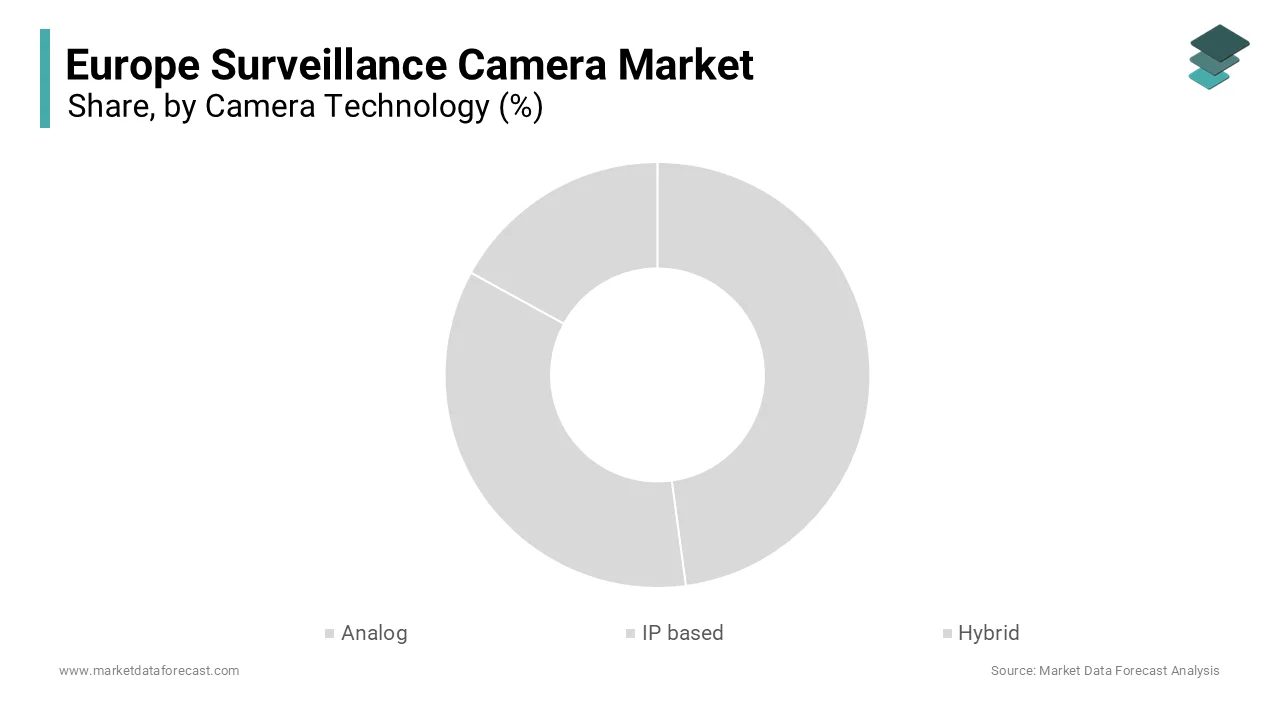
The hybrid surveillance cameras segment is predicted to witness the highest CAGR of 18.3% between 2026 and 2034 due to the urgent need to modernize legacy analog infrastructure without full system replacement, a pragmatic approach favored by cost sensitive sectors like education and small retail. European public infrastructure built before 2010 heavily relies on legacy analog surveillance, often maintaining these systems due to the high cost of total modernization. Hybrid cameras address this gap by accepting both analog and IP inputs through a single recorder. Municipalities in Southern Europe are actively adopting hybrid surveillance solutions, allowing them to modernize aging, non-networked systems by mixing new IP cameras with existing analog infrastructure. France’s Ministry of Interior is funding the modernization of security infrastructure, allowing authorities to transition toward digital surveillance systems in phases. Furthermore, these systems simplify compliance. Data protection authorities in Sweden emphasize that using advanced analytics, such as biometrics, is only acceptable if it adheres to strict proportionality principles, ensuring legacy, non-identifying surveillance feeds remain distinct from intrusive technologies. This regulatory flexibility combined with capital efficiency makes hybrid technology the bridge solution for Europe’s fragmented surveillance landscape.
By Camera Form Factor Insights
The fixed Box cameras segment was the largest segment in the Europe surveillance cameras market by capturing a 54.2% share in 2025. The prominence of the fixed box cameras segment is attributed to its reliability cost effectiveness and suitability for static monitoring in controlled environments. Their prevalence is especially pronounced in indoor settings such as banks retail stores and government offices where field of view remains constant and environmental variables are minimal. Many European financial institutions have adopted fixed camera systems at critical service and access points to meet security and compliance standards for visual record-keeping. The straightforward nature of fixed optics supports privacy-focused data handling principles by focusing on specific, localized areas. Regulatory perspectives suggest that static cameras focused on transaction zones often align better with data protection proportionality guidelines compared to more versatile, motion-capable alternatives. The modular design of these systems allows for technology upgrades, such as enhanced sensors, while utilizing the existing infrastructure. This modular approach is utilized in broader security settings, such as healthcare environments, allowing for improved surveillance capability without requiring complete system replacement. Fixed box units remain the staple of compliant surveillance in Europe, as buyers prioritize functional adequacy over unnecessary features.
The Pan Tilt Zoom (PTZ) cameras segment is estimated to register the fastest CAGR of 22.1% during the forecast period owing to demand for dynamic coverage in large open areas where static views are insufficient. Airports seaports and urban plazas increasingly deploy PTZ units equipped with auto tracking and geofencing to monitor fluid crowd movements without blind spots. Frontex is increasingly adopting AI-powered aerial and maritime surveillance technologies to boost detection capabilities along Mediterranean routes. In transport hubs the efficiency gains are significant. Major airports are implementing automated, radar-integrated, PTZ camera systems to enhance perimeter security, allowing human operators to manage more efficient surveillance responses. Crucially modern PTZ cameras now embed privacy safeguards. Surveillance technologies are increasingly incorporating privacy-by-design features, such as automatic facial blurring, to comply with privacy regulations in European jurisdictions. Rapid adoption of PTZ technology in critical infrastructure is being driven by the need for responsive visual verification in predictive policing models.
By End User Industry Insights
The government and public safety segment led the Europe surveillance camera market by occupying for a 49.1% share in 2025. The leading position of the government and public safety segment is credited to binding legislative frameworks. This reflects institutional mandates for crime deterrence emergency response and critical infrastructure protection. Legislative frameworks within the region have encouraged enhanced visual monitoring at key infrastructure, transportation hubs, and locations of public gatherings. Urban security initiatives have led to a significant increase in the deployment of public surveillance cameras across capital cities. The widespread installation of security infrastructure is further supported by national investments. Municipal programs are increasingly utilizing AI-ready technology and centralized command centers for public surveillance. Unlike commercial buyers public agencies prioritize long term resilience over upfront cost, opting for vandal resistant weatherproof units with tamper alerts and encrypted storage. This institutional commitment backed by multi year budgets ensures sustained demand even amid economic volatility making government the anchor segment of Europe’s surveillance ecosystem.
The retail and commercial real estate segment is anticipated to witness the fastest CAGR of 24.7% from 2026 to 2034. The swift expansion of the retail and commercial real estate segment is fuelled by rising organized retail crime and the need for customer experience analytics that respect privacy norms. Retailers in Western Europe are increasingly deploying advanced surveillance systems to address rising incidents of coordinated theft. Surveillance technologies are shifting from traditional loss prevention measures toward broader operational intelligence. Retailers are implementing anonymous heat mapping, such as in European IKEA stores, to optimize staff allocation based on customer traffic patterns without capturing personal identification. Data protection authorities in certain regions have endorsed the use of anonymized traffic monitoring tools. Shopping mall operators in Spain and the Netherlands are utilizing AI-enabled, ceiling-mounted cameras to identify potential safety hazards, such as slip-and-fall risks. The use of on-device AI for safety monitoring is helping to reduce liability claims for property operators. The rise of unmanned convenience stores also fuels demand. Surveillance is shifting from a, means of control to a, builder of trust, reflecting the retail industry's pivot toward safety-first, service-oriented environments.
REGIONAL ANALYSIS
Germany Surveillance Camera Market Analysis
Germany dominated the Europe surveillance camera market by accounting for a 23.6% share in 2025. The supremacy of the German market is driven by rigorous technical standards and deep integration with national security architecture. The country’s approach prioritizes lawful proportionate and auditable surveillance aligned with its federal data protection framework. In Germany, the Federal Office for Information Security (BSI) continues to strengthen IT security regulations for public infrastructure, accelerating the push for standardized cybersecurity certifications in new surveillance technology deployments. Municipalities like Munich and Hamburg have pioneered privacy by design deployments using edge AI that discards raw footage after extracting anonymized metadata, a model now replicated across Bavaria and North Rhine Westphalia. Germany also leads in industrial surveillance. Siemens is increasing the integration of smart surveillance cameras and digital safety systems across its German manufacturing facilities to improve occupational safety monitoring as part of its ongoing Industry 4.0 strategy. Germany leads Europe in surveillance, balancing technical sophistication with ethical standards, driven by precision engineering and strong local partners like Bosch Security.
United Kingdom Surveillance Camera Market Analysis
The United Kingdom was the second largest player in the Europe surveillance camera market by holding a 17.1% share in 2025. The growth of the UK market is propelled by its dense urban camera networks and early adoption of AI analytics in law enforcement. A high volume of surveillance cameras operates across the city, supporting law enforcement monitoring capabilities. The deployment of these technologies increasingly emphasizes the need for algorithmic accountability. New requirements for assessing the impact of police artificial intelligence tools have led to the suspension of certain facial recognition trials, while allowing for the continued use of systems designed to detect behavioral anomalies. Public transportation authorities have updated camera technology on bus infrastructure to improve visibility in low-light conditions and enhance data security for addressing antisocial behavior. Beyond public safety private sector innovation thrives. Canary Wharf Group deployed thermal cameras in office lobbies to monitor occupancy density post pandemic while preserving anonymity. Despite Brexit the UK maintains alignment with European data principles through the Data Protection Act ensuring its surveillance model remains influential yet distinct.
France Surveillance Camera Market Analysis
France is another key player in the European surveillance camera market due to top down national security strategies and aggressive infrastructure upgrades. A nationwide video surveillance initiative is working toward integrating localized camera networks into a single, centralized platform for enhanced, cross-jurisdictional monitoring capabilities. Recent infrastructure efforts have prioritized the deployment of new camera systems in critical locations, such as transportation hubs, educational institutions, and residential areas deemed to have a higher security risk. The selection of surveillance technology is increasingly focusing on high-definition IP systems that feature built-in security measures to prevent unauthorized access. The protection of critical infrastructure, particularly energy sites, has been bolstered by the deployment of specialized, hardened cameras designed to secure sensitive locations. Privacy safeguards are institutionally embedded. France’s surveillance modernization is both centralized and regulated, exemplified by state-backed champions like Idemia.
Netherlands Surveillance Camera Market Analysis
The Netherlands is steadily growing in the Europe surveillance camera market owing to seamless fusion of surveillance with broader smart city data ecosystems. Dutch municipalities treat video not as isolated evidence but as one layer in multimodal urban intelligence. Many cities are increasingly connecting surveillance feeds with traffic, environmental, and emergency systems to create more integrated monitoring capabilities. Major ports utilize complex surveillance networks that combine video, radar, and vessel tracking data to monitor compliance in real time, which is associated with a decrease in illegal dumping activities. The Netherlands maintains a strong focus on limiting the use of surveillance data to its original, specified purposes. Regulatory authorities in the Netherlands actively enforce data protection by penalizing organizations that use surveillance data for reasons beyond their stated security objectives, demonstrating a balance between technological implementation and privacy rights. The Netherlands exemplifies how open data policies and robust digital governance can successfully balance enhanced, secure surveillance with the protection of personal freedoms.
Sweden Surveillance Camera Market Analysis
Sweden is predicted to expand in the Europe surveillance camera market from 2026 to 2034 due to its emphasis on transparency minimal intrusion and civic oversight. The country avoids mass surveillance in favor of targeted temporary deployments justified by specific threats. Public surveillance strategies are increasingly emphasizing live monitoring over permanent recording, with most systems designed to automatically delete footage without an alert. The deployment of cameras is becoming more restricted, with a focus on specific safety needs rather than general coverage. Surveillance technologies are evolving to prioritize privacy-enhancing features, such as real-time redaction of individuals, to meet data protection standards. Educational programs in engineering are focusing on balancing security needs with fundamental privacy rights. Sweden’s model proves that high safety outcomes do not require pervasive monitoring, offering a Nordic alternative to continental surveillance norms.
COMPETITIVE LANDSCAPE
Competition in the Europe surveillance camera market is defined by a delicate equilibrium between technological sophistication and strict adherence to data protection ethics. Unlike other regions where performance and scale dominate European buyers prioritize lawful proportionate and auditable systems that align with GDPR and the EU Artificial Intelligence Act. Incumbent European vendors leverage deep regulatory understanding and trusted local partnerships while global players adapt through product localization and transparency initiatives. The market features intense differentiation around edge intelligence cybersecurity hardening and integration with broader urban data platforms rather than price alone. Public procurement processes demand rigorous certification documentation and civic consultation further raising entry barriers. As a result competition revolves not just around hardware quality but around demonstrable compliance governance and social acceptability making Europe one of the most complex yet principled surveillance markets globally.
KEY MARKET PLAYERS
Some of the notable key players in the Europe surveillance camera market are
- Mobotix
- Eagle Eye Networks
- Bosch Security Systems GmbH
- Axis Communications AB
- Milestone Systems
- Anviz Global Inc.
- Genetec Inc.
- i-PRO
- Teledyne FLIR LLC
- Hangzhou Hikvision Digital Technology Co. Ltd
- Hanwha Vision Co. Ltd
- Dahua Technology Co. Ltd
- Honeywell International Inc.
- Securitas AB
Top Players in the Market
- Axis Communications is a foundational force in the Europe surveillance camera market renowned for pioneering network video technology and ethical AI deployment. The company supplies advanced IP based cameras with embedded deep learning capabilities to public safety agencies transport networks and critical infrastructure across the continent. In recent years Axis has intensified its focus on privacy preserving innovation launching cameras with on device analytics that process data without storing identifiable imagery. It actively collaborates with European standardization bodies to shape cybersecurity and data protection norms for physical security devices. Axis leverages an open platform to simplify third-party software integration, solidifying its position as a global leader in interoperable, AI-driven surveillance networks.
- Bosch Security Systems leverages its deep engineering heritage to deliver robust surveillance solutions tailored to Europe’s stringent regulatory and environmental demands. The company integrates artificial intelligence directly into camera hardware enabling real time behavior analysis while adhering to GDPR principles through anonymized data handling. Bosch has recently expanded its cloud managed video platform allowing small and medium enterprises to access enterprise grade security without complex infrastructure. Its R and D centers in Germany and the Netherlands focus on developing weather resistant vandal proof cameras with cyber hardening features certified under EU cybersecurity frameworks. Globally Bosch exports its Europe validated architectures to regions seeking compliant resilient surveillance models.
- Hikvision Europe provides a broad portfolio of surveillance cameras ranging from cost effective fixed units to high end thermal and PTZ systems serving both public and private sectors. Despite geopolitical scrutiny the company maintains a strong operational presence by localizing its data processing and firmware development within the EU to ensure compliance with regional laws. It also established a transparency center in the Netherlands allowing government clients to inspect source code and data flows. These measures aim to rebuild trust while sustaining its contribution to global affordable intelligent surveillance deployment.
Top Strategies Used by the Key Market Participants
Key players in the Europe surveillance camera market prioritize embedding privacy by design through on device AI that avoids biometric storage and ensures data minimization. They invest heavily in obtaining EU cybersecurity certifications such as those from BSI and ANSSI to validate tamper resistance and secure boot capabilities. Companies actively participate in standardization initiatives like ONVIF and ETSI to guarantee interoperability across fragmented public sector deployments. Strategic localization of software development and data processing within European jurisdictions addresses regulatory and political sensitivities. Additionally firms forge partnerships with municipal authorities and transport operators to co develop use case specific solutions that balance security efficacy with fundamental rights compliance.
MARKET SEGMENTATION
This research report on the European surveillance camera market has been segmented and sub-segmented based on categories.
By Camera Technology
- Analog
- IP based
- Hybrid
By Camera Form Factor
- Fixed Box
- PTZ Pan Tilt Zoom
- Thermal and Dual Spectral
- Fisheye and 360 degree
By Resolution
- HD up to 720p
- Full HD 1080p
- 4K and above
By Connectivity
- Wired PoE or Ethernet
- Wireless Wi Fi or Cellular
By Deployment Location
- Indoor
- Outdoor weather proof
By End User Industry
- Government and Public Safety
- Banking and Financial Services
- Healthcare and Pharmaceuticals
- Transportation and Logistics
- Industrial and Manufacturing
- Education Institutions
- Retail and Malls
- Corporate or Enterprise Campuses
- Residential and Smart Homes
By Country
- UK
- France
- Spain
- Germany
- Italy
- Russia
- Sweden
- Denmark
- Switzerland
- Netherlands
- Turkey
- Czech Republic
- Rest of Europe