- Product Description Description
- Table of Contents TOC
- List of Table & Figure LOT
- Get Free Sample PDF Sample PDF
Market Size, 2025
$93.51 MnMarket Estimate, 2026
$100.92 MnMarket Forecast, 2034
$185.68 MnCAGR, 2026–2034
7.92%Europe Tattoo Removal Market Report Summary
The Europe tattoo removal market was valued at USD 93.51 million in 2025, is estimated to reach USD 100.92 million in 2026, and is projected to reach USD 185.68 million by 2034, growing at a CAGR of 7.92% from 2026 to 2034. The growth of the Europe tattoo removal market is fueled by rising tattoo adoption among younger adults, increasing demand for cosmetic correction procedures, and the widespread shift toward non-invasive laser treatments. Advancements in laser technologies, greater availability of dermatology clinics, and growing awareness of safe tattoo removal options are contributing to the strong market expansion across the region. Additionally, evolving lifestyle trends, workplace norms, and aesthetic preferences are further supporting demand for tattoo modification and removal services.
Key Market Trends
- Growing acceptance of laser-based tattoo removal due to high precision, safety, and improved post-treatment outcomes.
- Rising preference for non-invasive aesthetic procedures among millennials and working professionals.
- Expansion of private dermatology and cosmetic clinic chains, increasing accessibility to advanced laser treatments.
- Increasing adoption of picosecond and Q-switched laser technologies provides faster and more effective results.
- Trend toward tattoo lightening and partial removal, driven by evolving fashion styles and personal preferences.
Segmental Insights
- Based on procedure, the laser-based devices segment held the dominant share of the Europe tattoo removal market in 2024. This segment’s strong position is attributed to the effectiveness of advanced laser systems in targeting multi-colored inks, reducing treatment sessions, and minimizing tissue damage, making them the preferred choice among dermatologists and patients.
- Based on end user, the dermatology clinics segment accounted for a significant and dominant share of the market in 2024. The segment’s growth is supported by increasing patient preference for specialized dermatologists, improved treatment outcomes, and the widespread adoption of high-end laser platforms across professional clinics.
Regional Insights
The Europe tattoo removal market is witnessing steady expansion across major economies, driven by rising aesthetic awareness, increasing tattoo prevalence, and broader access to technologically advanced laser treatments.
- Germany was the top performer, capturing 22.3% of the Europe tattoo removal market share in 2024, supported by strong healthcare infrastructure, high spending on cosmetic procedures, and early adoption of advanced laser technologies.
- France ranked second with 17.6% market share in 2024, driven by the widespread popularity of aesthetic dermatology and an expanding network of cosmetic service providers.
- The United Kingdom is expected to see strong growth, supported by a dynamic private healthcare sector and shifting employment norms influencing tattoo removal decisions.
- Italy is anticipated to grow steadily due to its unique blend of fashion-driven demand, cultural preferences, and regional disparities in healthcare accessibility that influence treatment adoption.
Competitive Landscape
The Europe tattoo removal market is defined by the presence of leading global aesthetic device manufacturers and innovative laser technology providers with strong clinical validation and advanced product portfolios. Companies are focusing on enhancing treatment efficiency through picosecond and Q-switched laser systems, improving patient comfort, and expanding partnerships with dermatology clinics and aesthetic centers. Continuous product innovations, regulatory approvals, and strategic collaborations are strengthening competitive positioning across Europe’s growing aesthetic ecosystem.
Prominent companies in the Europe tattoo removal market include Alma Lasers, Ltd., Fotona d.d., Sciton Inc., Candela Corporation, En. S.p.A., Lynton Lasers Ltd., Solta Medical Inc., Lumenis Ltd., Cynosure, Inc., Syneron Medical Ltd., Lutronic Corporation, and Cutera Inc.
 Download Free Sample Report
Europe Tattoo Removal Market Size
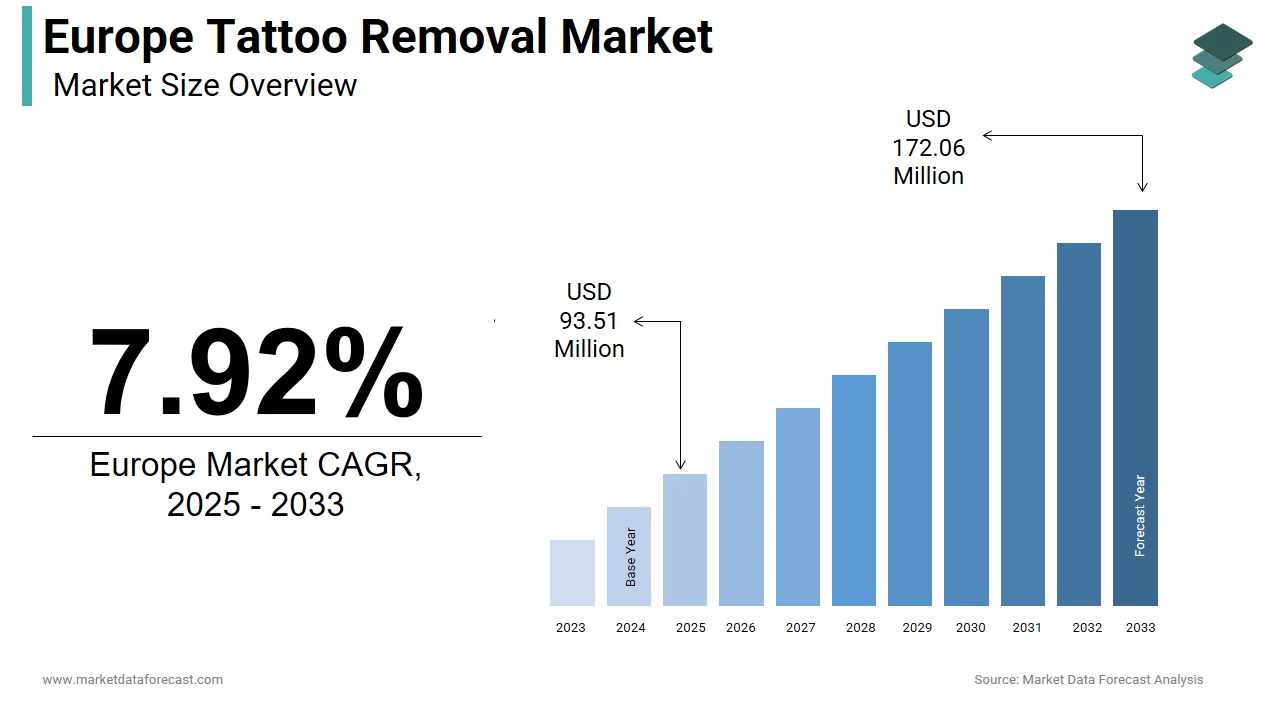
The size of the Europe tattoo removal market was valued at USD 93.51 million in 2025. This market is expected to grow at a CAGR of 7.92% from 2026 to 2034 and be worth USD 185.68 million by 2034 from USD 100.92 million in 2026.
The tattoo removal is a specialized segment of aesthetic medical services dedicated to eliminating or lightening unwanted tattoos through laser-based and non-invasive technologies. Social attitudes toward tattoos have evolved, yet professional norms in several sectors, such as finance, defense, and public service, still discourage visible body art, compelling removal demand.
MARKET DRIVERS
Rising Prevalence of Tattoo Regret Among Young Adults Drives Market Demand
The growing incidence of tattoo regret among young adults who obtained tattoos during adolescence or early adulthood without long-term consideration is driving the growth of the Europe Tattoo Removal Market. Moreover, the accessibility of social media has intensified scrutiny over personal appearance, with image-driven career paths in sectors like modeling, hospitality, and entertainment further incentivizing removal. These sociocultural dynamics underscore a persistent and expanding consumer base seeking professional tattoo removal services, thereby reinforcing market growth across urban centers in Germany, France, the United Kingdom, and Spain.
Strict Appearance Norms Boost Tattoo Removal Demand
Professional appearance expectations in Europe’s corporate and public institutions remain a powerful catalyst for tattoo removal services. According to the European Institute of Public Administration, 64% of national civil service codes across EU member states include explicit or implicit restrictions on visible tattoos for frontline roles. This institutional conservatism propels individuals to seek removal to align with career advancement pathways.
MARKET RESTRAINTS
High Cost of Multi-Session Laser Treatments Restrains Market Accessibility
The substantial financial burden associated with complete tattoo removal acts as a restraint for the growth of the Europe Tattoo Removal Market. Effective removal typically requires six to twelve laser sessions spaced six to eight weeks apart, with per-session costs ranging from 80 euros in Eastern Europe to over 300 euros in Western European metropolitan areas. Health insurance providers across the region, including those in France, Italy, and the Netherlands, categorize tattoo removal as a cosmetic procedure and uniformly exclude it from reimbursement. Consequently, price sensitivity disproportionately affects younger demographics and lower-income groups, who represent a large share of potential clients. Moreover, economic instability in Southern Europe has further tightened discretionary spending, as per Eurostat’s 2024 Household Budget Survey.
Limited Access to Qualified Practitioners in Rural and Eastern European Regions Hinders Market Growth
The geographic and professional disparities in service availability significantly impede the Europe Tattoo Removal Market growth. Qualified practitioners are specifically dermatologists or certified laser technicians trained in Q-switched and picosecond laser operation, who are concentrated in urban centers of Western and Northern Europe. According to the European Board of Dermatology Vocational Training, fewer certified aesthetic laser practitioners operate in rural areas across the EU, and in Eastern European countries like Bulgaria and Romania. This scarcity forces patients in underserved regions to travel considerable distances, incurring additional time and transportation costs. Furthermore, regulatory fragmentation exacerbates the issue. While Germany and France enforce stringent certification for laser use, countries like Hungary and Slovakia permit non-physician personnel to operate devices under minimal oversight, raising safety concerns that deter cautious consumers.
MARKET OPPORTUNITIES
Advancements in Picosecond Laser Technology Present Significant Market Opportunities
The rapid evolution of picosecond laser systems by enhancing efficacy, reducing treatment duration, and expanding treatable pigment ranges is expected to fuel the growth of the Europe Tattoo Removal Market in the coming years. Unlike traditional nanosecond lasers, picosecond devices deliver ultra-short pulses that shatter ink particles more efficiently for stubborn colors like blue, green, and yellow. This performance leap attracts both new patients deterred by long treatment timelines and clinics seeking competitive differentiation. Leading manufacturers such as Cynosure and Lutronic have expanded their European distribution networks, with France and Italy witnessing a 40% year-on-year increase in picosecond device installations in dermatology clinics as per the European Medical Technology Industry Association.
Growing Integration of Tattoo Removal into Comprehensive Aesthetic Wellness Ecosystems Creates New Revenue Avenues
The emergence of tattoo removal with broader aesthetic and wellness services is expected to enhance the growth of the Europe Tattoo Removal Market in the coming years. European consumers increasingly view skin care as part of holistic personal wellness by prompting clinics to offer integrated packages that combine removal with treatments like microneedling, PRP therapy, and pigment correction. According to a 2024 consumer trend analysis by the European Aesthetic Society, patients undergoing tattoo removal simultaneously opted for at least one additional skin enhancement procedure. This bundling strategy not only increases average transaction value but also enhances patient retention. Furthermore, the rise of med spas, hybrid facilities blending medical expertise with spa-like experiences, has democratized access in mid-tier cities. These venues appeal to younger, health-conscious demographics seeking discreet, non-surgical solutions within a lifestyle-oriented framework.
MARKET CHALLENGES
Risk of Adverse Skin Reactions and Scarring Undermines Consumer Confidence
Persistent concerns regarding the safety and potential complications of laser tattoo removal pose a significant challenge to market expansion. Notably, Fitzpatrick skin types IV to VI are common among immigrant populations in Germany, France, and the UK that exhibit up to three times greater risk of pigmentary complications. These outcomes not only deter potential patients but also trigger liability concerns among practitioners. Public awareness campaigns by consumer protection agencies in Belgium and Austria have further amplified caution, which is citing cases of permanent scarring from unregulated clinics.
Fragmented Regulatory Landscape Across European Countries Complicates Market Standardization
The absence of harmonized regulations governing tattoo removal procedures is one of the challenges for the growth of the Europe Tattoo Removal Market. Only 14 of 27 EU member states have specific legislation addressing laser tattoo removal by creating a patchwork of standards that confuse consumers and facilitate unsafe practices. This regulatory fragmentation also hampers cross-border clinic accreditation and professional mobility.
REPORT COVERAGE
| REPORT METRIC | DETAILS |
| Market Size Available | 2025 to 2034 |
| Base Year | 2025 |
| Forecast Period | 2026 to 2034 |
| Segments Covered | By Procedure, End-User, and Region. |
| Various Analyses Covered | Global, Regional and Country-Level Analysis, Segment-Level Analysis, Drivers, Restraints, Opportunities, Challenges; PESTLE Analysis; Porter’s Five Forces Analysis, Competitive Landscape, Analyst Overview of Investment Opportunities |
| Countries Covered | UK, France, Spain, Germany, Italy, Russia, Sweden, Denmark, Switzerland, Netherlands, Turkey, Czech Republic, and the Rest of Europe |
| Market Leaders Profiled | Alma Lasers, Ltd., Fotona d.d., Sciton Inc., EL.En. S.p.A., Lynton Lasers Ltd., Solta Medical Inc., Lumenis Ltd., Cynosure, Inc., Syneron Medical Ltd., Lutronic Corporation, and Cutera Inc. |
SEGMENTAL ANALYSIS
By Procedure Insights
The laser-based devices segment accounted in holding a dominant share of the Europe tattoo removal market in 2024, with superior clinical efficacy, widespread regulatory acceptance, and established reimbursement protocols for medically indicated cases. Laser devices, particularly Q-switched and picosecond lasers, offer unparalleled selectivity in targeting tattoo pigments without damaging surrounding tissue. Additionally, the European Commission’s Medical Device Regulation classifies these lasers as low-risk Class IIa devices when used by certified professionals with swift adoption in regulated healthcare settings. Laser devices benefit from decades of integration into Europe’s dermatological care infrastructure. Patients associate laser removal with safety and professionalism in contrast to mechanical or chemical alternatives. This trust translates into consistent demand, even at premium price points.
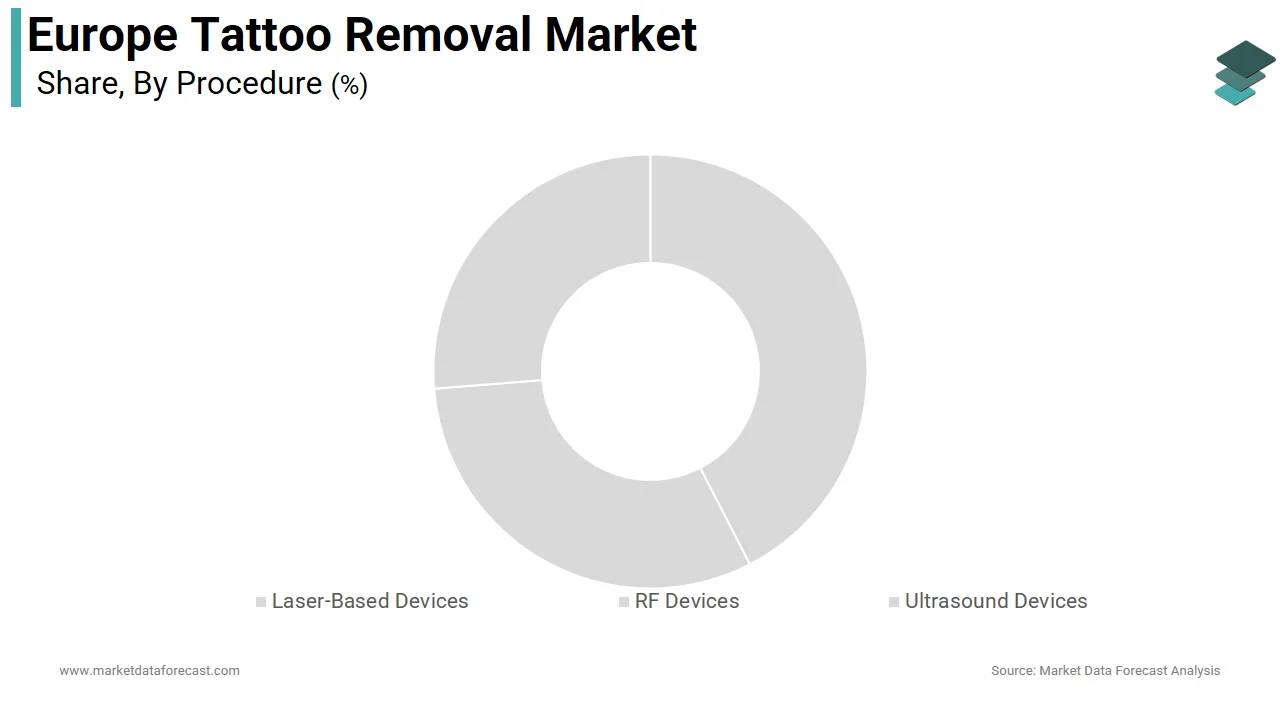
The ultrasound devices segment is projected to expand at a CAGR of 14.2% from 2025 to 2033. Ultrasound Devices utilize acoustic cavitation to fragment ink particles without generating heat, making them suitable for patients with melasma, keloid scarring history, or darker skin tones who face higher risks with lasers. This safety profile is particularly relevant in multicultural urban centers such as London, Paris, and Rotterdam, where over 30% of the population belongs to ethnic groups with higher pigmentary complication risks. Patient advocacy groups like the European Pigmentary Disorders Alliance have begun endorsing ultrasound as a viable alternative, further boosting awareness.
By End User Insights
The dermatology clinics segment held a dominant share of the Europe tattoo removal market in 2024, owing to the medical credibility, insurance linkages, and stringent safety protocols. Across most EU nations, laser tattoo removal is legally restricted to licensed medical professionals, which reinforces the centrality of dermatology clinics. This legal framework channels the majority of demand toward medically supervised environments. Moreover, dermatologists are uniquely positioned to manage complications such as scarring or infection by enhancing patient outcomes. The credibility gap is further widened by consumer awareness. This regulatory and perceptual advantage ensures dermatology clinics remain the primary access point for safe and effective tattoo removal.
The beauty clinics segment is projected to register a CAGR of 11.8% throughout the forecast period. Beauty Clinics are evolving into medically adjacent med spas that combine luxury service with clinical-grade technologies. Many partner with dermatologists for remote oversight, complying with regulatory gray zones while maintaining consumer appeal. This service differentiation drives rapid market capture among demographics traditionally underserved by hospital-affiliated dermatology departments. Beauty Clinics are leveraging innovative pricing to overcome cost barriers. Subscription plans offering unlimited sessions over 12 months or bundled packages with skin brightening and anti-aging treatments have proven highly effective. As per the British Association of Aesthetic Practitioners, such models reduce perceived financial risk and improve completion rates. Additionally with fintech providers enable interest-free installment payments that further broaden accessibility.
COUNTRY LEVEL ANALYSIS
Germany Tattoo Removal Market Analysis
Germany was the top performer of the Europe Tattoo Removal Market by occupying 22.3% of the share in 2024, with a confluence of high tattoo prevalence, robust healthcare infrastructure, and strict regulatory standards that favor professional removal services. The country’s statutory health insurance system, while not covering purely cosmetic removal, does reimburse procedures linked to occupational reintegration for public sector applicants such as police and military personnel. Stringent enforcement of the Medical Devices Operating Ordinance ensures only physicians perform laser treatments, minimizing complications and reinforcing public trust.
France Tattoo Removal Market Analysis
France was positioned second by holding 17.6% of the Europe tattoo removal market share in 2024, with deep cultural shifts in body image norms and strong government oversight of aesthetic medicine. France’s regulatory framework, governed by the National Council of the Order of Physicians, mandates that all laser tattoo removal be performed by licensed dermatologists or plastic surgeons, creating a high barrier to entry but ensuring quality.
United Kingdom Tattoo Removal Market Analysis
The United Kingdom tattoo removal market growth is likely to be driven by a dynamic private healthcare sector and evolving employment norms. The armed forces and emergency services remain key demand sources. As per the Ministry of Defence, 1,200 personnel underwent tattoo removal in 2023 to meet new appearance standards introduced in 2022.
Italy Tattoo Removal Market Analysis
Italy tattoo removal market growth is likely to grow with its unique intersection of fashion industry influence and regional healthcare disparities. However, access to removal services remains uneven. While Lombardy and Emilia Romagna host advanced dermatology networks, southern regions like Calabria have fewer than five certified laser clinics per million residents, as per the Italian Ministry of Health’s facility registry.
Spain Tattoo Removal Market Analysis
Spain tattoo removal market growth is likely to grow with the youth tattoo trends and rising med spa penetration. Spain permits certified nurses and aestheticians to operate lasers under physician supervision, enabling broader clinic proliferation. Coastal regions also benefit from medical tourism; clinics in Costa del Sol reported that 22% of removal clients in 2023 were international visitors, primarily from the UK and Scandinavia, as documented by the Spanish Medical Tourism Observatory.
COMPETITIVE LANDSCAPE
The Europe tattoo removal market features intense competition among established global medtech companies and emerging specialty laser firms. Leading players differentiate themselves through technological superiority, clinical validation, and robust regulatory compliance under the EU Medical Device Regulation. Competition is particularly fierce in Western Europe, where brand reputation, physician relationships, and service reliability heavily influence purchasing decisions. Companies compete not only on device performance but also on training support, maintenance services, and integration capabilities with existing clinic workflows.
KEY MARKET PLAYERS
Some of the companies that are playing a dominating role in the Europe tattoo removal market include
- Alma Lasers, Ltd.
- Fotona d.d.
- Sciton Inc.
- Candela Corporation
- En. S.p.A.
- Lynton Lasers Ltd.
- Solta Medical Inc.
- Lumenis Ltd.
- Cynosure, Inc.
- Syneron Medical Ltd.
- Lutronic Corporation
- Cutera Inc.
TOP 3 PLAYERS IN THE MARKET
- Candela Corporation maintains a strong presence in the Europe Tattoo Removal Market through its advanced picosecond and Q-switched laser platforms. The company focuses on clinical precision and regulatory compliance under the EU Medical Device Regulation. In recent years, Candela has expanded its training programs for European dermatologists and established partnerships with leading aesthetic clinics in Germany, France, and the United Kingdom. It also launched its next-generation PicoWay Resolve system in late 2023, which enhances multi-color tattoo clearance and integrates real-time skin analysis.
- Cutera Inc plays a pivotal role in the European tattoo removal landscape with its Enlighten platform, which combines nanosecond and picosecond pulses for superior ink fragmentation. The company actively collaborates with dermatological societies across Europe to promote standardized treatment protocols and safety practices. It also expanded its direct sales and service network in Southern Europe, including Italy and Spain, to improve device accessibility and after-sales support. These moves demonstrate Cutera’s strategic emphasis on clinical customization and geographic penetration to sustain its relevance in both European and global markets.
- Lutronic Corporation has intensified its engagement in the Europe Tattoo Removal Market through its Spectra and PicoPlus systems, known for versatility in treating diverse ink colors and skin types. The company focuses on building clinician confidence via hands-on workshops and live case demonstrations across major European cities. It also formed a strategic alliance with a pan-European med spa chain to deploy its technology in high-traffic consumer settings.
TOP STRATEGIES USED BY THE KEY MARKET PARTICIPANTS
Key players in the Europe Tattoo Removal Market emphasize technological innovation through continuous development of picosecond and hybrid laser platforms to improve efficacy and safety. They invest heavily in clinician education by organizing certified training programs and live demonstration sessions across major European cities. Strategic geographic expansion is pursued via direct sales teams and partnerships with established dermatology and aesthetic clinic networks. Companies also focus on regulatory compliance by ensuring all devices meet the stringent requirements of the European Union Medical Device Regulation. Additionally, they adopt service diversification by integrating tattoo removal into broader skin rejuvenation packages to increase patient retention and revenue per visit.
MARKET SEGMENTATION
This Europe tattoo removal market research report is segmented and sub-segmented into the following categories.
By Procedure
- Laser-Based Devices
- Active Laser
- Passive Laser
- RF Devices
- Ultrasound Devices
By End-User
- Dermatology Clinics
- Beauty Clinics
By Country
- UK
- France
- Spain
- Germany
- Italy
- Russia
- Sweden
- Denmark
- Switzerland
- Netherlands
- Turkey
- Czech Republic
- Rest of Europe