- Product Description Description
- Table of Contents TOC
- List of Table & Figure LOT
- Get Free Sample PDF Sample PDF
Market Size, 2025
$6.34 BnMarket Estimate, 2026
$6.68 BnMarket Forecast, 2034
$10.15 BnCAGR, 2026–2034
5.37%Executive Summary: Europe Thermoplastic Elastomers Market
- Market Scope: European market analysis covering product types, end-use applications, regional distribution, and performance metrics.
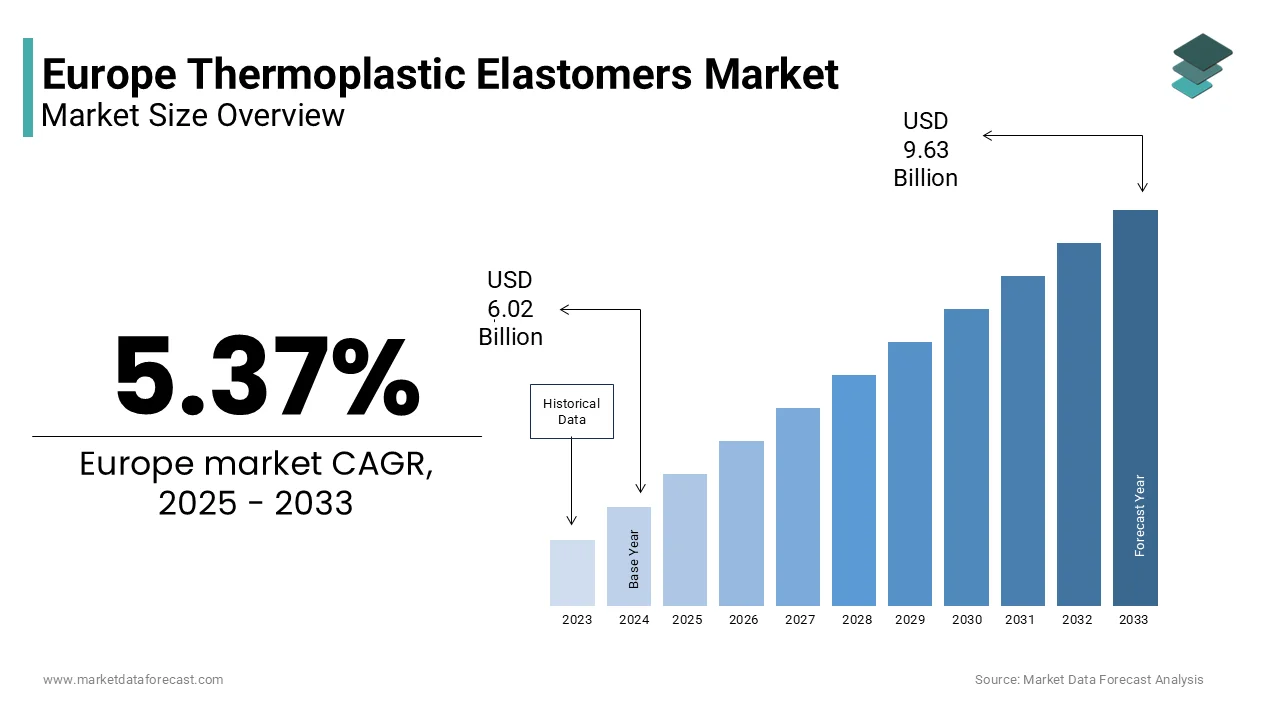
- Market Valuation: Valued at USD 6.34 billion (2025), estimated at USD 6.68 billion (2026), and projected to reach USD 10.15 billion by 2034, growing at a CAGR of 5.37% (2026–2034).
- Primary Growth Drivers: Automotive lightweighting and electrification (TPEs offering 15%–20% lower density than thermoset rubbers and German EV output reaching ~955,000 units in 2023), medical-device demand (Europe accounting for nearly 25% of global medical device exports), recyclable packaging (~42% EU plastic packaging recycling rate), and renewable-energy applications. Performance challenges remain, as fewer than 15% of European TPEs are rated for long-term operation above 135°C.
Key Market Segment Metrics (2026–2034)
| Category | Leading Segment (2025 Position) | Fastest-Growing Segment |
|---|---|---|
| By Product Type | Styrenic Block Copolymer (TPE-S) (36.3% market share) | — |
| By Application | Automotive and Transportation (31.4% market share) | Medical Devices Segment (10.4% CAGR) |
| By Country | Germany (21.4% regional share; France second, Italy third) | — |
Major Market Players & Market Structure
Market Structure: Competitive landscape focused intensely on recyclable and bio-based formulations, stringent regulatory compliance, localized manufacturing, and application-specific TPE development.
Key Companies: Dow Chemical, China Petrochemical Development, TSRC Inc./Frank Parsons Co., LCY Chemical, Tosoh Corp, Dynasol Group, Ems-Chemie Holding AG, LG Chem, Lubrizol, DuPont, LyondellBasell, Teknor Apex, Avient, Covestro, Arkema, Evonik Industries, and BASF.
Europe Thermoplastic Elastomers Market Size
The Europe thermoplastic elastomers market size was valued at USD 6.34 billion in 2025 and is projected to reach USD 10.15 billion by 2034 from USD 6.68 billion in 2026, growing at a CAGR of 5.37%.
Thermoplastic elastomers represent a class of polymer materials that combine the processing ease of thermoplastics with the elastic performance of vulcanised rubbers that enabling repeated melting and reshaping without significant degradation of mechanical properties. In Europe, these materials are increasingly integral to industrial design across automotive, medical, consumer goods and renewable energy sectors due to their recyclability, lightweight nature and compatibility with overmolding and extrusion techniques. Unlike conventional thermoset rubbers, thermoplastic elastomers eliminate the need for energy-intensive curing processes and align with the European Union’s Industrial Emissions Directive that targets process efficiency and emissions reduction in manufacturing. In 2023, the European Union generated around 79.7 million tonnes of packaging waste, which indicates the scale of plastics use, with engineering elastomers accounting for a growing share in ihigh-valueue applications. The European Green Deal’s Circular Economy Action Plan further accelerates adoption by mandating that all plastic products placed on the EU market be reusable or recyclable by 2030, which is a criterion that thermoplastic elastomers inherently satisfy through mechanical or chemical recycling routes. Additionally, stringent REACH regulations restricting phthalates and other plasticisers in consumer contact materials have driven substitution toward styrenic and olefinic thermoplastic elastomers with non-leaching formulations. This confluence of regulatory pressure, sustainability imperatives and performance versatility defines the strategic relevance of thermoplastic elastomers within Europe’s advanced materials ecosystem.
MARKET DRIVERS
Automotive Lightweighting and Electrification Fuel Material Substitution
The European automotive sector’s aggressive pursuit of lightweighting to meet CO2 fleet targets is a principal driver for thermoplastic elastomer adoption, which is majorly propelling the thermoplastic elastomer market growth in Europe. In 2023, the average new passenger car registered in the EU emitted around 108 grams of CO2 per kilometre, which is still above the 95-gram regulatory threshold mandated since 2021 and compelling manufacturers to reduce vehicle mass through material substitution. Thermoplastic elastomers are replacing traditional thermoset rubbers in door seals, airbag covers and under-hood components due to their 15 to 20% lower density and compatibility with multi-material injection moulding. According to Volkswagen Group, ID series electric vehicles utilise significant volumes of thermoplastic elastomers per unit, primarily in cable insulation, seating interfaces and charging port gaskets applications as these demand flexibility, flame resistance and low outgassing. Furthermore, the EU’s Alternative Fuels Infrastructure Regulation requires 15 million electric vehicle charging points by 2030, each incorporating thermoplastic elastomer seals and strain reliefs rated for outdoor durability and repeated flexing. This systemic shift toward electrification and compliance-driven weight reduction ensures sustained demand for high-performance thermoplastic elastomers in mobility applications.
Medical Device Innovation and Regulatory Compliance Accelerate Adoption
The robust medical technology sector of Europe is increasingly reliant on thermoplastic elastomers for single-use and reusable devices due to their biocompatibility, sterilizability and absence of latex proteins, which is further boosting the regional market growth. Medical device approvals under the EU Medical Device Regulation encompass a wide range of products with soft touch grips, catheter tubes and respiratory masks frequently specifying medical grade thermoplastic elastomers compliant with ISO 10993 and USP Class VI standards. Unlike PVC that requires phthalate plasticisers, now restricted under REACH due to endocrine disruption risks, styrenic and polyolefinic thermoplastic elastomers offer phthalate-free formulations that maintain flexibility without leaching. Fresenius Medical Care and B Braun have transitioned significant portions of their fluid handling product lines to thermoplastic elastomer components to meet hospital sustainability protocols and reduce incineration emissions. Moreover, the EU’s Green Public Procurement criteria for healthcare institutions prioritise recyclable and non-hazardous materials, which further incentivizing substitution. As Europe accounts for nearly 25% of global medical device exports according to the European Commission, this regulatory and clinical alignment creates a durable demand vector for high-purity thermoplastic elastomers in life science applications.
MARKET RESTRAINTS
Volatility in Feedstock Prices from Petrochemical Dependency
The persistent pressure from fluctuating feedstock costs tied to naphtha, butadiene and styrene is primarily hindering the thermoplastic elastomer market growth in Europe. European petrochemical producers faced rising naphtha procurement costs between 2021 and 2023 due to refinery outages and redirected crude flows following geopolitical disruptions. Thermoplastic elastomers such as styrenic block copolymers rely heavily on styrene monomer, whose price nearly doubled between early 2021 and mid-2022. Unlike bio-based alternatives still in nascent commercialisation, conventional thermoplastic elastomers lack feedstock diversification, which leaves manufacturers exposed to oil price swings. The EU’s Carbon Border Adjustment Mechanism further elevates input costs for imported monomers with high embedded carbon, which is disproportionately affecting smaller compounders without long-term supplier contracts. This volatility complicates pricing stability, discourages inventory holding and slows investment in new formulations. Without accelerated development of circular feedstocks, such as pyrolysis oil from plastic waste, European thermoplastic elastomer producers remain economically vulnerable to upstream petrochemical market dynamics beyond their control.
Fragmented End-of-Life Infrastructure Limits Circular Claims
Despite their theoretical recyclability, thermoplastic elastomers in Europe face systemic barriers in post-consumer recovery due to inadequate sorting and reprocessing infrastructure, which is also negatively affecting the growth of the European market. Mixed plastic waste containing elastomeric components is rarely mechanically recycled, with much of it landfilled or incinerated due to contamination and lack of identification protocols. Thermoplastic elastomers often resemble thermoset rubbers in appearance and are misclassified in municipal waste streams, while their multi-layer constructions resist separation. The EU’s Extended Producer Responsibility schemes do not yet include specific collection targets for last-of-a-kind products, which is leaving recyclers without economic incentive to invest in specialised granulation or compatibilisation technologies. Even when collected, the heterogeneous nature of thermoplastic elastomer grades complicates reprocessing without significant downgrading. Consequently, the circularity advantage touted in marketing materials remains largely unrealised in practice, which is undermining compliance with the EU Packaging and Packaging Waste Regulation’s 2030 recycled content mandates and exposing brand owners to greenwashing scrutiny.
MARKET OPPORTUNITIES
Growth in Renewable Energy Component Manufacturing
The expansion of wind and solar energy infrastructure across Europe is creating new application avenues for thermoplastic elastomers in sealing, damping and protective components. Offshore wind turbines require highly durable cable jacketing and connector seals that withstand salt spray, UV exposure and continuous flexing. Thermoplastic elastomers based on polyolefin or polyester chemistry offer superior hydrolysis resistance and low-temperature flexibility compared to PVC or rubber alternatives, making them ideal for subsea and nacelle environments. Similarly, photovoltaic module frames and junction boxes increasingly incorporate thermoplastic elastomer gaskets to ensure decades-long weatherproofing under thermal cycling. The EU’s Solar Strategy targets around 600 gigawatts of installed solar PV by 2030 with systems incorporating multiple elastomeric seals. As the EU Net Zero Industry Act prioritises domestic clean tech manufacturing, local compounders are collaborating with equipment makers to certify thermoplastic elastomer grades for IEC 61215 and IEC 61400 standards. This alignment with Europe’s energy sovereignty agenda opens a high-reliability, long lifecycle segment for advanced thermoplastic elastomer formulations.
Rise of Sustainable Consumer Packaging Solutions
The European packaging industry is transitioning toward reusable and recyclable formats, which is driving demand for thermoplastic elastomers in functional overmolding and sealing applications and further offering growth possibilities for the European thermoplastic elastomer market. As per the European Commission, the EU generated 79.7 million metric tons of packaging waste in 2023, and plastic packaging recorded a recycling rate of about 42%, which is prompting brands to redesign closures, dispensers and protective caps using mono material architectures. Thermoplastic elastomers compatible with polypropylene and polyethene substrates enable soft grip features and hermetic seals without compromising recyclability, which is a critical requirement under the EU Packaging and Packaging Waste Regulation. Companies like Henkel and Beiersdorf have introduced shampoo and skincare containers with thermoplastic elastomer pump diaphragms that maintain elasticity over thousands of actuations while remaining separable during recycling. Industry initiatives in 2025 saw numerous consumer product SKUs reformulated for recyclability, many of which included thermoplastic elastomer components. As Extended Producer Responsibility fees penalise non-recyclable designs, this segment offers compounders a route to integrate performance functionality within circular packaging systems.
MARKET CHALLENGES
Technical Complexity in High Temperature Performance Formulations
The limited thermal stability of conventional grades under prolonged elevated temperatures that restricts use in under-hood automotive or industrial applications is a majorly challenge to the growth of the European thermoplastic elastomer market. Most styrenic and olefinic thermoplastic elastomers begin to lose tensile strength above 120 degrees Celsius, whereas engine compartments and electric motor housings regularly exceed 150 degrees Celsius during operation. According to the German Association of the Automotive Industry, over 40% of elastomer component specifications for next-generation electric drivetrains require continuous use at 150 degrees Celsius or higher, which is a threshold only met by costly thermoplastic polyurethanes or speciality copolyesters. These high-performance alternatives involve complex synthesis routes and limited European production capacity, which is inflating costs by two to three times compared to standard grades. According to the material datasheets from major suppliers, fewer than 15% of commercially available thermoplastic elastomers in Europe are rated for long-term use above 135 degrees Celsius. This performance gap forces design compromises or reversion to thermoset rubbers, which undermines the sustainability and processing benefits that drive initial material selection.
Regulatory Uncertainty Around Chemical Additives and Recycled Content
The evolving interpretation of EU chemical regulations creates compliance ambiguity for thermoplastic elastomer manufacturers, particularly regarding additives and post-consumer recycled content, which is further challenging the growth of the European market. While REACH restricts substances like nonylphenol ethoxylates and certain brominated flame retardants, the boundaries for acceptable impurities in recycled feedstocks remain undefined. According to the European Chemicals Agency, the Candidate List currently contains around 250 substances of very high concern with potential restrictions impacting stabilisers and processing aids commonly used in thermoplastic elastomer compounding. Simultaneously, EU proposals set recycled content targets for plastic packaging by 2030, which is pressuring producers to incorporate mechanically recycled streams, yet recycled thermoplastic elastomers often contain unknown legacy additives that may violate REACH thresholds. Testing each batch for restricted substances is cost-prohibitive for small compounders, which is leading to supply chain hesitancy. This regulatory limbo discourages investment in circular formulations and fragments material specifications across member states, which is increasing technical barriers for pan-European product launches and slowing innovation in sustainable thermoplastic elastomer grades.
REPORT COVERAGE
| REPORT METRIC | DETAILS |
| Market Size Available | 2025 to 2034 |
| Base Year | 2025 |
| Forecast Period | 2026 to 2034 |
| CAGR | 5.37% |
| Segments Covered | By Product Type, Application, and Region |
| Various Analyses Covered | Global, Regional, & Country Level Analysis; Segment-Level Analysis; DROC, PESTLE Analysis; Porter’s Five Forces Analysis; Competitive Landscape; Analyst Overview of Investment Opportunities |
| Regions Covered | UK, France, Spain, Germany, Italy, Russia, Sweden, Denmark, Switzerland, Netherlands, Turkey, and the Czech Republic |
| Market Leaders Profiled | Dow Chemical, China Petrochemical Development, TSRC Inc..../Frank Parson Co., LCY Chemical, Tosoh Corp, Dynasol Group, Ems-Chemie Holding AG, LG Chem, The Lubrizol Corp, DuPont de Nemours Inc.Inc., LyondellBasell Industries NV, Teknor Apex, Avient Corp, Covestro AG, Arkema SA, Evonik Industries AG, and BASF SE |
SEGMENTAL ANALYSIS
By Product Type Insights
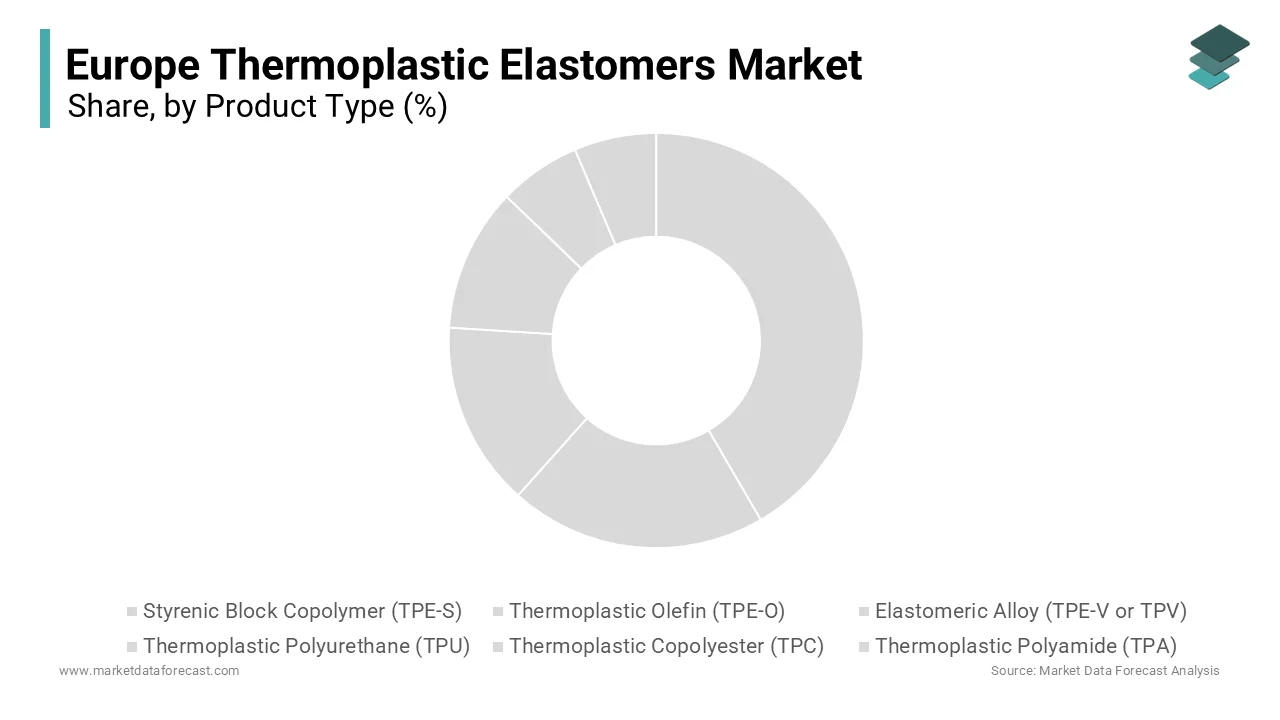
The styrenic block copolymer segment remains the largest product segment in the European thermoplastic elastomer market and holds a share of 36.3% of the regional market in 2025. The dominance of styrenic block copolymer segment in the European market is attributed to its exceptional balance of elasticity, processability, and cost efficiency across diverse applications. Its molecular architecture enables rubber-like performance without vulcanisation, which makes it ideal for the injection moulding of soft touch grips, medical tubing and consumer packaging seals. According to Plastics Europe, over 420000 metric tons of TPE S were consumed in the European Union in 202,3, with more than 60% directed toward medical and personal care applications where clarity, hypoallergenicity and sterilizability are critical.
The European Medicines Agency has approved over 12000 medical devices containing TPE S formulations compliant with ISO 10993 biocompatibility standards, reinforcing its dominance in healthcare. Additionally, TPE S is inherently phthalate-free and compatible with polypropylene overmolding, which is a key requirement under the EU Packaging and Packaging Waste Regulation for recyclable mono material designs. Major compounders such as Kraton and INEOS Styrolution have invested in high-purity hydrogenated grades (SEBS) that resist UV and thermal degradation, broadening use in outdoor consumer goods. This combination of regulatory alignment, processing versatility and established supply chains is majorly contributing to the domination of the segment in this regional market.
By Application Insights
The automotive and transportation segment occupied the largest share of 31.4% of the European market in 2025. The critical role of thermoplastic elastomer in lightweighting interior comfort and electrification in the automotive and transportation industry is majorly propelling the dominance of the segment in the regional market. Modern vehicles integrate significant amounts of thermoplastic elastomers in components such as airbag covers, door seals, instrument panel skins and cable insulation. According to the European Automobile Manufacturers Association, EU new passenger car registrations totalled about 10.5 million in 2023, with electric vehicle output increasing, which is a trend intensifying demand for TPU and TPV in high voltage cable protection and battery seals. The EU’s CO2 fleet emission target of 95 grams per kilometre mandates mass reduction, and thermoplastic elastomers offer weight savings over thermoset rubbers while enabling multi-material moulding that reduces part count. Volkswagen Group’s modular electric drive platform employs substantial TPE O and TPU for underbody covers and charging interfaces. Additionally, the EU’s End of Life Vehicle Directive targets 95% recovery by weight, which favours thermoplastic elastomers that can be mechanically recovered without chemical degradation. These regulatory and design imperatives are contributing to the growth of the automotive and transportation segment in the European market.
The medical devices segment is promising and is predicted to witness the fastest CAGR of 10.4% over the forecast period, owing to the ageing demographics, infection control mandates and the phase out of PVC in healthcare settings. Europe’s population aged 65 and over represents over one-fifth of the EU population, driving demand for single-use devices such as IV connectors, respiratory masks and catheter tubes that require soft, flexible and latex-free materials. The European Commission’s Medical Device Regulation mandates rigorous biocompatibility testing and restricts phthalate plasticisers found in conventional PVC, which is accelerating substitution with medical-grade TPEs and TPU that meet ISO 10993 and USP Class VI standards. Fresenius and B Braun have expanded PVC-free fluid delivery product lines, opting for transparent TPE S formulations that resist kinking and maintain flow integrity. Healthcare guidance emphasises single-use elastomeric components to minimise cross-contamination, further boosting volumes. With ongoing new medical device authorisations under the EU MDR and compounders establishing dedicated clean room compounding lines in Europe, this segment’s growth trajectory is anchored in regulatory and demographic tailwinds.
REGIONAL ANALYSIS
Germany Market Analysis
Germany dominated the thermoplastic elastomer market in Europe by holding 21.4% of the regional market share due to the continent’s industrial and automotive innovation hub. Germany is Europe’s largest vehicle producer with a rapidly expanding electric vehicle output that reached about 955,000 units in 2023. This manufacturing intensity drives demand for high-performance thermoplastic elastomers in cable insulation, interior trims and under-hood components. Germany is also home to major compounders and raw material producers, including Covestro, BASF and LANXESS, which operate advanced R and centres focused on bio-based and recyclable TPE formulations. The Federal Ministry for Economic Affairs and Climate Action supports advanced polymer development aligned with circular economy goals under the High-Tech Strategy 2026. Additionally, Germany’s Blue Angel eco label encourages consumer products with recyclable materials and reduced environmental impact, which is accelerating the adoption of TPE O and TPU in household goods. These industrial, regulatory and innovation factors solidify Germany’s dominant role in the European thermoplastic elastomer landscape.
France Market Analysis
France captured the second-largest share of the European thermoplastic elastomer market in 2025. The growth of the French market is mainly attributed to its strong medical technology sector and commitment to sustainable packaging. The French medical device industry is a significant contributor to EU exports, with companies like EssilorLuxottica and Guerbet integrating TPE S into diagnostic and ophthalmic devices requiring optical clarity and sterilizability. Simultaneously, France’s Anti Waste for a Circular Economy Law sets progressively tightening recyclability and recycled content requirements for plastic packaging, which is prompting brands like L’Oréal and Danone to reformulate closures and dispensers using mono-material TPE PP designs. TotalEnergies has expanded TPE compounding capabilities in Carling to support these transitions. The French government also enforces strict VOC emission limits under the Indoor Air Quality Label, which favours low-outgassing thermoplastic elastomers in building products. These intersecting drivers in healthcare, consumer goods and environmental policy sustain France’s robust thermoplastic elastomer consumption.
Italy Market Analysis
Italy occupied the third largest position in the European thermoplastic elastomer market in 2025 due to its world-leading footwear industry and speciality automotive manufacturing. Italy’s footwear sector produced around 148 million pairs of shoes in 2023, with premium brands like Geox and Tod’s increasingly using recyclable TPU for outsoles and cushioning systems to meet EU sustainable product requirements. Simultaneously, Italy’s niche automotive producers specify high-performance TPU and TPV for interior and under-hood applications demanding heat and abrasion resistance. Italy’s National Recovery and Resilience Plan allocate funding to circular economy projects, including polymer recycling infrastructure. Additionally, Italy’s construction sector is adopting TPE-based sealants and expansion joints compliant with CE marking under EN 15651 for building durability. With thousands of small and medium polymer processors clustered in Lombardy and Veneto, Italy’s decentralised manufacturing ecosystem ensures an agile response to thermoplastic elastomer demand across luxury and industrial segments.
United Kingdom Market Analysis
The United Kingdom is predicted to account for a notable share of the European thermoplastic elastomer market over the forecast period, owing to its advanced medical technology and renewable energy sectors. The UK is home to thousands of medical device companies, including Smith & Nephew and ConvaTe, which have transitioned to phthalate-free TPEs for wound care and dialysis products in compliance with NHS Sustainable Procurement Standards. The life sciences sector contributes tens of billions of pounds to the economy annually, underpinning steady elastomer demand. Additionally, the UK’s offshore wind capacity requires TPU jacketed cables and TPV seals for subsea interconnectors resistant to hydrolysis and marine biofouling. Many UK compounders now offer certified recyclable TPE grades aligned with the Plastic Packaging Tax introduced in 2022. These healthcare and clean energy imperatives, combined with post-Brexit regulatory autonomy enabling faster material approvals, reinforce the UK’s strategic position in the European market.
Spain Market Analysis
Spain is a notable market for thermoplastic elastomer in Europe, and the growth of the Spanish market is mainly fueled by solar energy expansion and automotive component manufacturing. Spain added about 5.6 gigawatts of solar photovoltaic capacity in 202,3, according to Red Eléctrica de España, driving demand for TPE-based junction box gaskets and frame seals that endure decades of UV and thermal cycling. The country also hosts major automotive suppliers such as Gestamp and CIE Automotive, which produce interior and underbody components using TPE O and TPV for European OEMs. The Spanish Ministry for Ecological Transition has mandated that all new buildings incorporate recyclable materials under the Technical Building Code, boosting the use of TPE sealants in windows and facades. Spain produced around 148 million pairs of shoes in 2023, with the footwear industry increasingly adopting TPU for eco-labelled soles compliant with EU Ecolabel criteria. With funding from the EU Recovery Fund directed to green manufacturing, thermoplastic elastomer demand is set to accelerate across energy, construction and mobility sectors.
COMPETITIVE LANDSCAPE
KEY MARKET PLAYERS
Some of the notable key players in the European thermoplastic elastomers market are
- Dow Chemical
- China Petrochemical Development
- TSRC Inc / Frank Parsons Co
- LCY Chemical
- Tosoh Corp
- Dynasol Group
- Ems-Chemie Holding AG
- LG Chem
- The Lubrizol Corp
- DuPont de Nemours Inc
- LyondellBasell Industries NV
- Teknor Apex
- Avient Corp
- Covestro AG
- Arkema SA
- Evonik Industries AG
- BASF SE
TOP STRATEGIES USED BY THE KEY MARKET PLAYERS
Key players in the European thermoplastic elastomer market focus on developing bio-based and recyclable formulations to align with EU sustainability mandates. They invest in localised production and compounding facilities to ensure rapid response to regional regulatory and technical requirements. Companies actively collaborate with end users in automotive, medical, and renewable energy sectors to engineer application-specific grades. Strategic partnerships with waste management and chemical recycling firms enable closed-loop material recovery systems. Additionally, they strengthen regulatory compliance capabilities through dedicated EU-based affairs teams to navigate the REACH Medical Device Regulation and Packaging directives effectively.
COMPETITION OVERVIEW
Competition in the European thermoplastic elastomer market is characterised by a blend of technological leadership, regulatory agility, and sustainability integration among a handful of global and regional players. The market is moderately concentrated with three to five multinational corporations dominating high-performance segments such as medical-grade TPEs and automotive TPUs, while numerous speciality compounders serve niche applications. Differentiation occurs not through price but through material certification compliance with the EU chemical and product safety framework, and the ability to deliver circular, bio-based solutions. Entry barriers are high due to stringent validation requirements in the automotive and healthcare sectors and the need for local technical support. Innovation cycles are driven by legislation, including the Circular Economy Action Plan and REAC, rather than consumer trends. As a result, competition centres on R and D investment, regulatory foresight, and partnerships across the value chain to ensure material circularity and performance reliability.
TOP PLAYERS IN THE MARKET
- Covestro is a leading innovator in the European thermoplastic elastomer market with a strong global footprint in high-performance polymers. The company specialises in thermoplastic polyurethane grades tailored for medical, automotive, and renewable energy applications across Europe. Covestro has intensified its sustainability focus by developing bio-based TPU formulations using renewable feedstocks such as castor oil and certified mass balance naphtha. In 2025, the company expanded its Desmopan production capacity at its Dormagen, Germany, facility to meet rising demand for recyclable anion-free elastomers in electric vehicle cable sheathing and wind turbine components. Its collaboration with European cable manufacturers on circular TPU recycling protocols further strengthens its position as a solutions-oriented supplier aligned with EU Green Deal objectives.
- Kraton Corporation plays a pivotal role in the European thermoplastic elastomer market through its extensive portfolio of styrenic block copolymers and hydrogenated derivatives. The company supplies high-purity TPE S grades to medical device and personal care manufacturers across Western and Northern Europe. Kraton has reinforced its European presence by launching phthalate-free and latex-free formulations compliant with REACH and the EU Medical Device Regulation. In recent years, it has partnered with compounders in the Netherlands and Italy to develop recyclable overmolding solutions for sustainable packaging. Its investment in a dedicated regulatory affairs team in Brussels ensures rapid compliance with evolving chemical safety standards,, enhancing its responsiveness to brand owners and healthcare clients across the region.
- LANXESS contributes significantly to the European thermoplastic elastomer market through its TechnoTPE business line, which offers thermoplastic vulcanizates and olefinic elastomers for automotive and industrial applications. The company leverages its integrated production sites in Germany and Italy to supply low-emission TPV grades that meet stringent automotive VDA and ISO standards. In 2023, LANXESS introduced a new series of post-consumer recycled content TPV compounds certified under ISCC Plus for use in non-structural interior components. It also enhanced its compounding capabilities in Leverkusen to support custom formulations for electric mobility and appliance manufacturers. These initiatives underscore LANXESS’s commitment to circularity and technical differentiation within Europe’s advanced materials sector.
MARKET SEGMENTATION
This research report on the European thermoplastic elastomers market has been segmented and sub-segmented based on categories.
By Product Type
- Styrenic Block Copolymer (TPE-S)
- Thermoplastic Olefin (TPE-O)
- Elastomeric Alloy (TPE-V or TPV)
- Thermoplastic Polyurethane (TPU)
- Thermoplastic Copolyester (TPC)
- Thermoplastic Polyamide (TPA)
By Application
- Automotive & Transportation
- Building & Construction
- Footwear
- Electrical & Electronics
- Medical
- Household Appliances
- HVAC (Heating, Ventilation & Air Conditioning)
- Adhesives, Sealants & Coatings
- Other Applications
By Country
- UK
- France
- Spain
- Germany
- Italy
- Russia
- Sweden
- Denmark
- Switzerland
- Netherlands
- Turkey
- Czech Republic
- Rest of Europe