- Product Description Description
- Table of Contents TOC
- List of Table & Figure LOT
- Get Free Sample PDF Sample PDF
Market Size, 2025
$89.21 MnMarket Estimate, 2026
$92.13 MnMarket Forecast, 2034
$119.18 MnCAGR, 2026–2034
3.27%Europe Tin Market Report Summary
The Europe tin market was valued at USD 89.21 million in 2025, is estimated to reach USD 92.13 million in 2026, and is projected to reach USD 119.18 million by 2034, growing at a CAGR of 3.27% during the forecast period from 2026 to 2034. The growth of the Europe tin market is driven by increasing demand from the electronics manufacturing sector, rising adoption of tin based soldering materials, and expanding use of tin in advanced electronic components and circuit boards. Tin plays a critical role in soldering processes due to its excellent conductivity, corrosion resistance, and reliability in electronic assemblies. In addition, growing demand for consumer electronics, automotive electronics, and renewable energy systems across Europe is supporting steady consumption of tin in industrial applications.
Key Market Trends
- Increasing demand for tin based solder materials driven by the expansion of electronics manufacturing and semiconductor assembly across Europe.
- Growing adoption of lead free soldering solutions in response to environmental regulations and safety standards in electronic production.
- Rising demand for tin in renewable energy technologies, particularly in solar photovoltaic systems and power electronics.
- Expansion of the automotive electronics sector with increasing use of electronic control units and advanced driver assistance systems.
- Technological advancements in electronics manufacturing that require high reliability solder materials for compact and complex circuit boards.
Segmental Insights
- Based on product type, the refined tin metal segment held a significant share of the Europe tin market in 2024. The dominance of this segment is attributed to the widespread use of refined tin in solder production, electronic components, and various industrial alloys.
- Based on application, the soldering segment accounted for 58.2% of the Europe tin market share in 2024. Tin based solder materials are widely used in electronics manufacturing due to their ability to create reliable electrical connections in printed circuit boards and electronic assemblies.
- Based on end use industry, the electronics industry segment was the largest contributor to the Europe tin market in 2024. The rapid growth of consumer electronics, communication devices, and industrial electronics is significantly increasing the demand for tin based materials.
Regional Insights
- The Europe tin market is witnessing steady growth across several countries due to increasing electronics production, technological innovation, and demand for advanced electronic devices.
- Germany was the largest contributor, accounting for 22.4% of the Europe tin market share in 2024. The country’s strong electronics manufacturing base, advanced automotive sector, and well established industrial infrastructure are supporting the demand for tin across various applications.
Competitive Landscape
The Europe tin market is characterized by the presence of global mining and metal production companies focusing on strengthening supply chains and expanding metal refining capabilities. Companies are investing in sustainable mining practices, advanced refining technologies, and strategic partnerships to meet the growing demand from electronics and industrial sectors. Prominent players in the Europe tin market include CODELCO, Nornickel, Zijin Mining Group Co Ltd ADR, Antofagasta PLC, Freeport McMoRan Inc, BHP Group Ltd, Anglo American PLC, Aurubis AG, Glencore PLC, and Vale SA ADR.
Europe Tin Market Size
The Europe tin market size was valued at USD 89.21 million in 2025 and is projected to reach USD 119.18 million by 2034 from USD 92.13 million in 2026, growing at a CAGR of 3.27%.
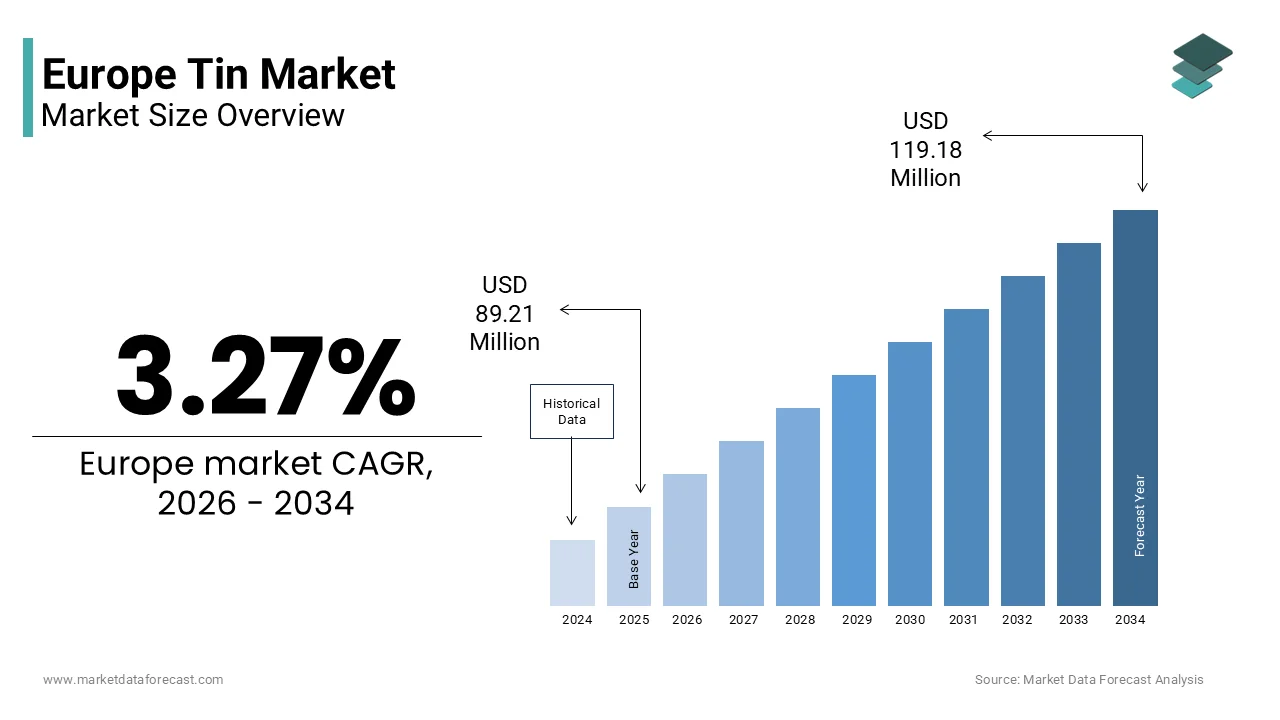
The tin is defined not by primary mining, since the continent has no active tin mines but by its role as a downstream processor and consumer of refined tin metal and tin-based alloys, primarily sourced through imports and recycled streams. Tin serves as an indispensable enabler in multiple high-tech and industrial value chains, most notably in solder for electronics, corrosion-resistant coatings for steel packaging, and specialty chemicals for catalysts and stabilizers. Concurrently, Europe recovered an estimated 12,200 metric tons of secondary tin from end-of-life electronics and tinplate scrap, as per the source. This dual reliance on global supply chains and urban mining underscores the strategic vulnerability and circular economy potential.
MARKET DRIVERS
Electronics Manufacturing and Miniaturization Trends
The relentless expansion of electronics manufacturing, particularly in automotive semiconductors and industrial control systems, remains a foundational driver of tin demand due to its irreplaceable role in lead-free solder alloys. The electronics manufacturing and miniaturization trends is driving the growth of Europe tin market. Tin constitutes over 95% of modern SAC305 solder (Sn-Ag-Cu), which is mandated under the EU’s RoHS Directive for all electronic assemblies. Each vehicle now integrates an average of 3,500 solder joints by translating to roughly 180 grams of tin per car, as verified by the survey. The trend toward miniaturization further intensifies tin intensity per device, where advanced packaging techniques like chiplets and 3D stacking require ultra-fine solder pastes with higher tin purity and tighter particle size distributions. Moreover, the EU Chips Act’s €43 billion investment envelope is accelerating domestic semiconductor capacity, with new fabs in France Germany and Italy scheduled to come online by 2027. This policy-driven resurgence ensures sustained structural demand for high-purity tin, decoupling consumption from consumer electronics cycles and anchoring it in strategic industrial autonomy.
Growth in Sustainable Food and Beverage Packaging
The European food and beverage sector’s pivot toward infinitely recyclable metal packaging has reinvigorated demand for tinplate steel sheets coated with a thin layer of tin, which remains the gold standard for canned goods due to its non-toxicity corrosion resistance and barrier properties. The growth in sustainable food and beverage packaging is additionally elevating the growth of Europe tin market. Furthermore, the Packaging and Packaging Waste Regulation mandates that all metal packaging be reusable or recyclable by 2030, a tinplate meets with a 82% average recycling rate across the EU, the highest among all packaging materials, according to Eurostat. Major brands like Nestle and Unilever have committed to increasing metal packaging shares in their portfolios by citing consumer trust in canned safety and sustainability. This regulatory and behavioral alignment positions tinplate and by extension refined tin as a Europe’s circular packaging ecosystem.
MARKET RESTRAINTS
Geopolitical Concentration of Global Tin Supply
The extreme geographic concentration in global primary production, with Indonesia and China is substantially hampering the growth of Europe tin market. This dependency creates acute supply chain fragility, as demonstrated in 2023 when Indonesia’s export tax adjustments caused LME tin prices to spike by 22% within six weeks. Unlike copper or aluminum, tin lacks deep inventory buffers; global exchange stocks stood at just 3,800 metric tons in early 2025, equivalent to less than 12 days of European consumption, according to the survey. The EU’s own assessment under the Critical Raw Materials Act identifies tin as having a “high supply risk” with a diversified sourcing index below 0.3, far beneath the 0.7 threshold for security. Attempts to secure alternative supplies from Africa or Latin America are hampered by underdeveloped refining infrastructure and ESG concerns. Consequently, European importers operate under constant procurement anxiety, often resorting to long-term contracts with premium pricing to guarantee volume. This structural imbalance not only inflates input costs but also impedes strategic stockpiling initiatives by leaving the continent exposed to trade policy shifts and logistical disruptions beyond its control.
Regulatory Pressure on Chemical Applications
The use of organotin compounds once widespread as PVC stabilizers and biocides is increasingly restricted constraining a historically stable segment of tin consumption. The regulatory pressure on chemical applications is also to hamper the growth of Europe tin market. Under the EU Biocidal Products Regulation, tributyltin and triphenyltin compounds have been banned since 2020, eliminating an estimated 1,200 metric tons of annual tin demand, as confirmed by the European Chemicals Agency. More recently, REACH Annex XVII proposals aim to limit dioctyltin in consumer articles, threatening an additional 800 metric tons used in flexible PVC flooring and cables. While inorganic tin stabilizers offer alternatives, they require reformulation and process adjustments that many compounders resist due to cost and performance trade-offs. This regulatory erosion is particularly impactful because chemical applications once provided counter-cyclical stability during electronics downturns. With this buffer diminishing, the European tin market becomes more volatile, tethered almost exclusively to electronics and packaging cycles, thereby amplifying exposure to sector-specific shocks and reducing overall demand elasticity.
MARKET OPPORTUNITIES
Expansion of Urban Mining and E-Waste Recycling Infrastructure
The scaling urban mining operations to recover high-purity tin from end-of-life electronics by aligning with the EU Circular Economy Action Plan’s target of doubling secondary raw material use by 2030. The expansion of urban mining and e-waste recycling s substantially to enhance new opportunities for the growth of Europe tin market. Currently, Europe collects 5.1 million metric tons of e-waste annually but recovers less than 20% of its contained tin, according to the United Nations University’s Global E-waste Monitor. However, new hydrometallurgical processes developed by research consortia like CROCODILE funded under Horizon 2020 can extract tin with 99.5% purity from solder dross and circuit board residues. Pilot plants in Belgium and Sweden have demonstrated recovery yields exceeding 85% by making secondary tin economically viable even at moderate LME prices. The revised EU WEEE Directive mandates 65% e-waste collection rates by 2025, which is creating a predictable feedstock stream. Companies like Umicore and Aurubis are integrating these technologies into their refining circuits by positioning Europe to source up to 30% of its tin demand from domestic recycling by 2030. This shift would not only reduce import reliance but also lower carbon footprints, as secondary tin production emits 70% less CO2 than primary smelting, according to the Joint Research Centre.
Development of Tin-Based Battery Technologies
The emerging energy storage applications present a high-growth frontier for tin in next-generation lithium-ion and sodium-ion batteries, where tin anodes offer significantly higher theoretical capacity than graphite. The development of tin-based battery technologies is ascribed to bolster the growth of Europe tin market. Tin can store up to 994 mAh/g of lithium compared to graphite’s 372 mAh/g, enabling denser batteries for electric vehicles and grid storage, as per the source. European battery startups like Northvolt and Altris are actively testing tin-composite anodes, Altris’s sodium-ion cells, which use iron-based cathodes and hard carbon-tin blends that achieved 160 Wh/kg in 2024 trials and are slated for commercial deployment in stationary storage by 2026. The EU Battery Regulation’s emphasis on performance durability and recycled content creates a favorable policy environment for such innovations. If scaled, a single 100 MWh sodium-ion battery installation could consume 12 to 15 metric tons of tin, opening a new industrial demand channel. With the European Commission projecting 800 GWh of battery cell manufacturing capacity by 2030, even modest tin adoption rates could generate thousands of tons of incremental demand, transforming tin from a passive solder material into an active energy enabler.
MARKET CHALLENGES
Price Volatility and Speculative Trading Pressures
The severe price instability driven by thin trading volumes and speculative activity on the London Metal Exchange, where daily tin contracts averaged just 1,200 lots in 2024, less than 5% of copper’s liquidity, as per reports. This illiquidity magnifies price swings in Q1 2025 alone, tin fluctuated between USD 24,800 and USD 31,200 per metric ton despite stable physical demand, disrupting procurement planning for electronics assemblers and packaging mills. The absence of large-scale hedging instruments forces buyers into spot purchases, exposing them to short-term spikes triggered by Indonesian export rumors or Chinese inventory data. Unlike base metals with robust futures curves, tin’s forward curve is often inverted, discouraging inventory holding and exacerbating shortage psychology. This financial unpredictability deters long-term investment in downstream innovation and incentivizes substitution, where technically feasible by undermining confidence despite strong fundamental demand.
Technological Substitution in Soldering Applications
Despite tin’s dominance in lead-free solder, emerging interconnect technologies threaten to erode its position in high-reliability electronics, posing a structural challenge to long-term demand. The technological substitution in soldering applications is impacting negatively on the growth of Europe tin market. Copper pillar bumping and sintered silver pastes are increasingly adopted in automotive and aerospace applications, where thermal cycling resistance exceeds conventional tin-silver-copper alloys. Similarly, Intel’s Foveros direct bonding technology, now being piloted in European fabs that eliminates solder entirely by fusing silicon dies through atomic-level copper connections. While these alternatives remain cost-prohibitive for consumer electronics, their penetration in premium segments signals a gradual decoupling of semiconductor advancement from tin consumption. The European Electronics Cluster estimates that if current adoption rates continue, tin demand from advanced packaging could decline by 15% by 2030.
REPORT COVERAGE
| REPORT METRIC | DETAILS |
| Market Size Available | 2025 to 2034 |
| Base Year | 2025 |
| Forecast Period | 2026 to 2034 |
| CAGR | 3.27% |
| Segments Covered | By Product Type, Application, End User Industry, and Region |
| Various Analyses Covered | Global, Regional, & Country Level Analysis; Segment-Level Analysis; DROC, PESTLE Analysis; Porter’s Five Forces Analysis; Competitive Landscape; Analyst Overview of Investment Opportunities |
| Regions Covered | UK, France, Spain, Germany, Italy, Russia, Sweden, Denmark, Switzerland, Netherlands, Turkey, and the Czech Republic |
| Market Leaders Profiled | CODELCO, Nornickel, Zijin Mining Group Co Ltd ADR, Antofagasta PLC, Freeport McMoRan Inc, BHP Group Ltd, Anglo American PLC, Aurubis AG, Glencore PLC, and Vale SA ADR |
SEGMENTAL ANALYSIS
By Product Type Insights
The refined tin metal segment was accounted in holding a significant share of the European tin market in 2024 with its foundational role as the primary input for solder production and tinplate manufacturing two applications that collectively absorb over 85% of Europe’s refined tin. The EU’s electronics sector alone consumed an estimated 22,000 metric tons of refined tin in 2024, driven by automotive semiconductor assembly and industrial automation hardware, as per some studies. Additionally, the steel packaging industry relies on high-purity tin (99.85% minimum) for electrolytic coating processes that produce food-safe tinplate, where Metal Packaging Europe confirms that 4.9 million metric tons of tinplate were fabricated in 2024 by requiring roughly 11,000 metric tons of tin. The segment benefits from standardized material specifications under EN 12659 and ISO 1179, ensuring consistent quality across supply chains.
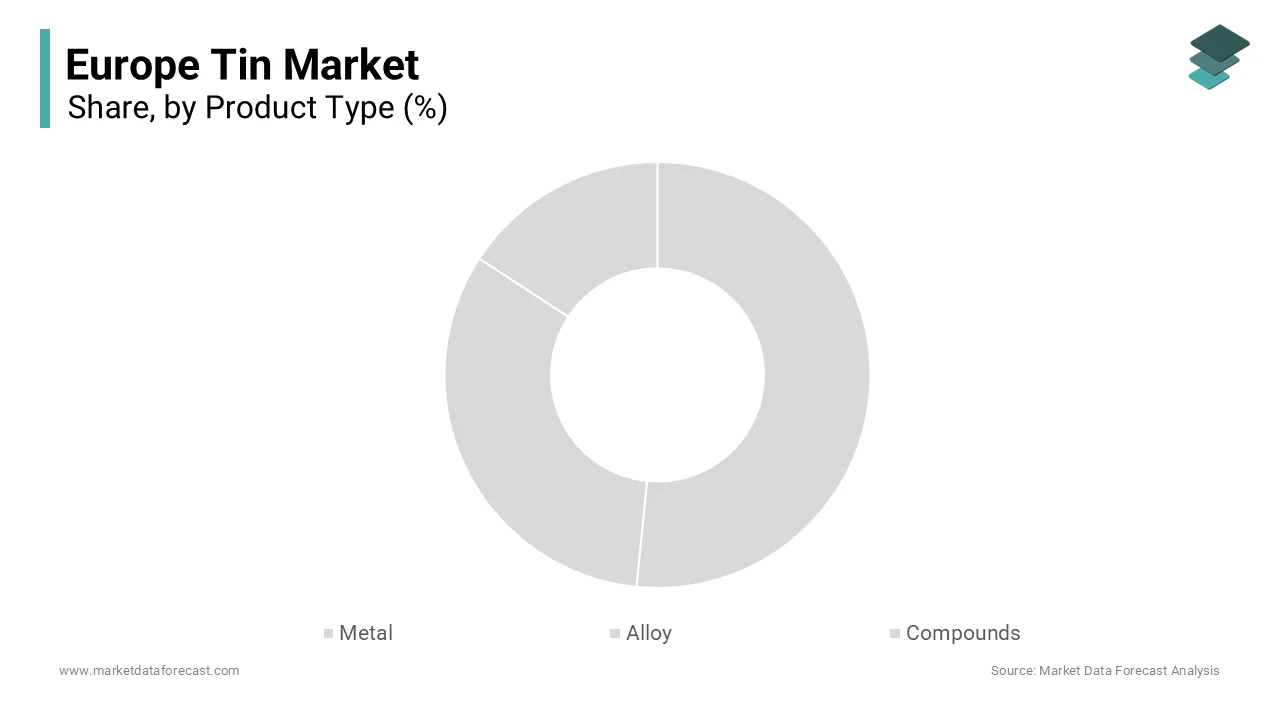
The tin compounds segment projected to expand at a CAGR of 6.9% from 2025 to 2033 owing to the resurgence of inorganic tin stabilizers in PVC production following the phaseout of lead-based alternatives under REACH regulations. Mono and dimethyltin carboxylates now serve as primary heat stabilizers in medical tubing and potable water pipes, with demand rising due to stringent EU safety standards for human-contact materials. Concurrently, tin dioxide (SnO₂) is gaining traction in transparent conductive coatings for smart windows and touch sensors, where the Fraunhofer Institute for Solar Energy Systems reports that tin oxide layers achieved 88% visible light transmission with sheet resistance below 10 ohms per square in 2024 pilot trials. These dual pathways regulatory-driven substitution in polymers and performance-driven adoption in optoelectronics are transforming tin compounds from a declining niche into a high-value innovation vector.
By Application Insights
The soldering segment was the largest by occupying 58.2% of the European tin market share in 2024 with the continent’s robust electronics manufacturing base in automotive control units power electronics and industrial IoT devices where lead-free solder is non-negotiable under the RoHS Directive. Each modern vehicle integrates between 3,000 and 4,000 solder joints by translating to 160–200 grams of tin per unit, with Europe producing 15.2 million passenger cars in 2024 according to the European Automobile Manufacturers Association. Beyond volume, the shift toward high-reliability applications demands ultra-low oxygen and ultra-fine particle size solder pastes by increasing tin purity requirements to 99.99% and driving premium pricing. Furthermore, the EU Chips Act’s €43 billion investment has catalyzed new semiconductor assembly facilities in Dresden Wolfsburg and Grenoble, all of which specify SAC305 and emerging low-silver variants. This policy-industrial convergence ensures soldering remains the bedrock of European tin demand despite substitution pressures in advanced packaging.
The tin plating segment is likely to witness a fastest CAGR of 7.4% during the forecast period with the food and beverage industry’s unwavering preference for tinplate cans, which offer unmatched corrosion resistance recyclability and consumer trust. In 2024, the EU canned 18.7 million metric tons of food, a 5% increase from 2022, with vegetables fish and ready meals leading consumption, as reported by the European Commission’s Directorate-General for Agriculture. Tinplate’s 82% recycling rate, which is the highest among all packaging materials that aligns perfectly with the Packaging and Packaging Waste Regulation’s 2030 targets, incentivizing brand owners like Nestle and PepsiCo to increase metal packaging shares. Additionally, emerging uses in battery current collectors are gaining traction, where Northvolt’s sodium-ion prototypes utilize tin-coated copper foils to enhance anode adhesion, with each 100 MWh installation requiring up to 15 metric tons of plated tin.
By End Use Industry Insights
The electronics industry segment was the largest contributor share of the European tin market in 2024, where Europe’s specialization in high-reliability electronic systems rather than consumer gadgets, with automotive industrial automation and medical devices forming the core demand pillars. Unlike Asia’s focus on mobile phones, Europe’s electronics output emphasizes durability and longevity, necessitating higher tin content per device. For instance, an electric vehicle inverter module uses 45 grams of solder compared to 2 grams in a smartphone. The EU’s strategic push for digital sovereignty evident in the Chips Act and Horizon Europe funding that further entrenches this trajectory.
The packaging sector is likely to grow at a fastest CAGR of 6.8% from 2025 to 2033 owing to the EU’s Farm to Fork Strategy, which promotes shelf-stable packaging to reduce food waste, canned goods exhibit spoilage rates below 1% versus 15% for fresh produce, according to the survey. In 2024, Europeans consumed 28.3 kilograms of canned food per capita, the highest in a decade, driven by convenience and sustainability awareness. Major retailers like Carrefour and Tesco have committed to doubling metal packaging SKUs by 2027, which is citing consumer preference for recyclable and preservative-free options. Simultaneously, innovations in easy-open ends and lightweighting y reducing tin coating weights from 11.2 to 8.4 grams per square meter without compromising protection that enhance cost efficiency.
REGIONAL ANALYSIS
Germany Tin Market Analysis
Germany was the largest contributor by holding 22.4% of the Europe tin market share in 2024 owing to the integration into high-value manufacturing ecosystems, particularly automotive electronics and industrial machinery that demand precision soldering materials. The country imported 8,700 metric tons of refined tin in 2024 through Rotterdam and Hamburg ports, to feed assembly lines for Bosch Siemens and ZF Group. Germany’s role in semiconductor packaging is eventually capturing the growth of the Europe tin market. Strict adherence to RoHS and REACH ensures continuous demand for certified lead-free alloys. Moreover, Germany’s Circular Economy Act mandates 65% e-waste collection by 2025 by creating a growing secondary tin stream processed by recyclers like Aurubis.
Netherlands Tin Market Analysis
The Netherlands tin market growth is likely to grow with the Port of Rotterdam’s role as the continent’s largest entry point for refined tin, handling over 40% of EU imports from Indonesia, Malaysia, and Bolivia. Companies like Trafigura and Glencore operate bonded warehouses and just-in-time distribution hubs that supply German and Belgian electronics clusters. The country’s alignment with EU Critical Raw Materials Act objectives has spurred public-private partnerships to develop urban mining corridors linking municipal e-waste collection to refinery inputs.
France Tin Market Analysis
France tin market growth is driven by the dual strength in aerospace electronics and sustainable packaging. The Toulouse aerospace corridor utilizes tin-based solders in avionics and flight control systems where reliability is non-negotiable by consuming an estimated 950 metric tons annually, according to the French Aerospace Industries Association. Simultaneously, France is Europe’s second-largest producer of canned food, with 2.1 million metric tons packaged in 2024, driving steady tinplate demand. The government’s France 2030 investment plan has allocated €6 billion to semiconductor sovereignty, including a STMicroelectronics fab in Crolles that will require 300 metric tons of solder-grade tin annually upon full ramp-up in 2026. France’s stringent anti-food-waste laws mandating supermarkets to donate unsold perishables have paradoxically increased demand for canned preservation alternatives. This policy-driven duality ensures France remains a stable and diversified tin consumer.
Italy Tin Market Analysis
Italy tin market growth is likely to grow with the luxury appliance manufacturing and specialty chemical production. Brands like Smeg De’Longhi and Indesit integrate high-end electronics into kitchen appliances, each requiring 80 to 120 grams of solder for control panels and sensors. Additionally, Italian chemical firms such as Lamberti produce tin carboxylates for PVC stabilization in medical and construction films, thereby leveraging EU restrictions on alternative stabilizers. The country’s artisanal electronics repair sector bolstered by right-to-repair legislation also sustains demand for manual soldering alloys.
Sweden Tin Market Analysis
Sweden tin market growth is likely to grow with the green technology dominance in battery innovation and e-mobility. Northvolt’s Skelleftea gigafactory, where the first European-owned lithium-ion plant uses tin-containing current collectors and thermal interface materials, consuming an estimated 420 metric tons annually. Sweden’s commitment to fossil-free manufacturing extends to material sourcing, where the Swedish Environmental Protection Agency mandates that all industrial metals contain minimum recycled content, driving demand for secondary tin from domestic e-waste streams. Furthermore, Sweden’s participation in the European Battery Alliance accelerates R&D into tin-anode sodium-ion cells, positioning the nation at the forefront of next-generation energy storage.
COMPETITIVE LANDSCAPE
The Europe tin market features limited direct competition in primary production but intense rivalry among recyclers and refiners for high-quality secondary feedstocks. Since Europe imports nearly all its primary tin, competition centers on processing efficiency, sustainability credentials, and regulatory compliance rather than mining scale. Aurubis Umicore and Boliden dominate the recycling segment, leveraging integrated multi-metal circuits to economically recover tin as a co-product. New entrants face high barriers due to capital intensity permitting complexity and stringent emissions controls under the Industrial Emissions Directive. Differentiation occurs through certified low-carbon output digital material passports and participation in circular economy ecosystems. The absence of domestic mines shifts competitive dynamics toward logistics partnerships with e-waste collectors and electronics OEMs.
KEY MARKET PLAYERS
Some of the notable key players in the Europe tin market are
- CODELCO
- Nornickel
- Zijin Mining Group Co Ltd ADR
- Antofagasta PLC
- Freeport McMoRan Inc
- BHP Group Ltd
- Anglo American PLC
- Aurubis AG
- Glencore PLC
- Vale SA ADR
Top Players in the Market
- Aurubis is a leading European copper and precious metals recycler with significant capabilities in tin recovery from complex secondary streams. Headquartered in Germany, the company operates one of the continent’s most advanced e-waste and scrap refining circuits, producing high-purity tin that meets LME Grade A standards. Aurubis supplies refined tin to electronics assemblers and solder producers across Europe and Asia. In recent years, the company has invested in hydrometallurgical processes to extract tin from low-grade residues by enhancing yield and reducing environmental impact. It also launched a certified circular tin product line in 2024, traceable from e-waste collection to final ingot by aligning with EU due diligence requirements and strengthening its position as a sustainable raw material partner for green electronics manufacturers.
- Umicore, based in Belgium, is a global materials technology group with a strategic focus on recycling critical metals including tin from end-of-life electronics and industrial catalysts. The company’s Hoboken facility integrates tin into its multi-metal recovery platform, delivering ultra-pure tin for semiconductor and battery applications. Umicore has intensified its R&D in closed-loop recycling, collaborating with European electronics OEMs to recover tin from manufacturing scrap and post-consumer devices. It introduced a digital material passport for its recycled tin by enabling compliance with the EU Battery Regulation and Corporate Sustainability Reporting Directive. This innovation reinforces customer trust and secures long-term supply agreements with high-tech industries prioritizing traceability and decarbonization.
- Boliden plays a vital role in Europe’s tin supply chain through its Rönnskär smelter, which processes complex concentrates and recycled materials containing tin as a by-product. While not a primary tin miner, Boliden recovers tin during copper and lead refining, contributing to regional supply security. The company has upgraded its off-gas cleaning and slag treatment systems to improve tin recovery rates and reduce emissions. Boliden partnered with Nordic electronics recyclers to develop a dedicated tin-rich feedstock stream by ensuring consistent input quality. Its commitment to fossil-free operations and alignment with Sweden’s green industrial policy enhances its reputation as a low-carbon supplier by attracting customers seeking to meet Scope 3 emission targets in their value chains.
Top Strategies Used by the Key Market Participants
Key players in the Europe tin market are prioritizing urban mining by scaling e-waste recycling infrastructure to secure secondary tin supplies. They are implementing digital traceability systems to comply with the EU Critical Raw Materials Act and Battery Regulation. Companies are investing in advanced hydrometallurgical and pyrometallurgical processes to improve tin purity and recovery yields from complex waste streams. Strategic partnerships with electronics manufacturers and packaging firms enable closed-loop material flows and long-term offtake agreements. Product differentiation through certified circular tin and low-carbon footprints is central to winning premium contracts. Additionally, integration into EU-funded research consortia accelerates innovation in tin-based battery anodes and alternative stabilizers, future-proofing their portfolios beyond traditional applications.
MARKET SEGMENTATION
This research report on the European tin market has been segmented and sub-segmented based on categories.
By Product Type
- Metal
- Alloy
- Compounds
By Application
- Soldering
- Tin Plating
- Chemicals
- Others
By End Use Industry
- Automotive
- Electronics
- Packaging (Food and Beverages)
- Glass
- Others
By Country
- UK
- France
- Spain
- Germany
- Italy
- Russia
- Sweden
- Denmark
- Switzerland
- Netherlands
- Turkey
- Czech Republic
- Rest of Europe