- Product Description Description
- Table of Contents TOC
- List of Table & Figure LOT
- Get Free Sample PDF Sample PDF
Market Size, 2025
$13.46 BnMarket Estimate, 2026
$13.98 BnMarket Forecast, 2034
$18.91 BnCAGR, 2026–2034
3.85%Executive Summary: Europe Trade Finance Market
- Market Scope: European market analysis covering instrument types, service providers, industry verticals, country-level regional leadership, and macro-trade metrics.
- Market Valuation: Valued at USD 13.46 billion (2025), estimated at USD 13.98 billion (2026), and projected to reach USD 18.91 billion by 2034, growing at a CAGR of 3.85% (2026–2034).
- Primary Growth Drivers: Active cross-border commerce, deeply integrated European supply chains, sustainable finance initiatives, broad digitalisation, and rising working-capital requirements among SMEs. Key market foundations include total extra-EU trade reaching ~€5.021 trillion in 2025, alongside SMEs accounting for 99% of all EU businesses.
Key Market Segment Metrics (2026–2034)
| Category | Leading Segment (2025 Position) | Fastest-Growing Segment |
|---|---|---|
| By Instrument Type | Letters of Credit (38.5% market share) | Supply Chain Financing (12.3% CAGR) |
| By Service Provider | Banks (held a substantial provider share) | Non-Bank Financial Institutions (14.1% CAGR) |
| By Industry Vertical | Manufacturing (31.6% market share, backed by export ecosystems) | Logistics (13.7% CAGR) |
| By Region / Country | Germany (24.6% share; United Kingdom second, driven by London's cross-border finance hub) | — |
Major Market Players & Market Structure
Market Structure: Highly competitive commercial banking and financial technology landscape shaped by blockchain deployment, artificial intelligence analytics, cloud-based documentation, nearshoring/friendshoring supply chain shifts, sustainability-linked financial products, and advanced cross-border risk management frameworks.
Key Companies: JPMorgan Chase & Co., Santander Bank, Arab Bank, BNP Paribas, TD Bank, Citigroup, DBS Bank, Bank of America Corp., UBS Group AG, and Deutsche Bank AG.
Europe Trade Finance Market Size
The Europe trade finance market size was valued at USD 13.46 billion in 2025 and is projected to reach USD 18.91 billion by 2034 from USD 13.98 billion in 2026, growing at a CAGR of 3.85%.
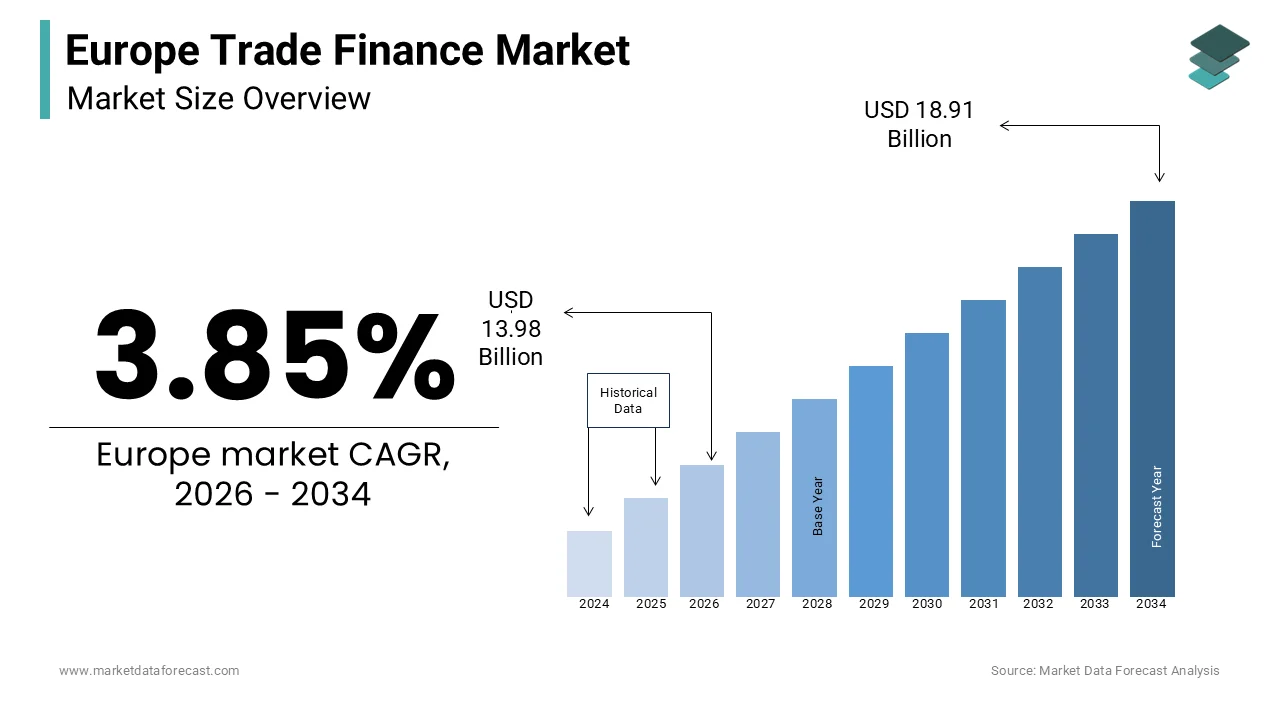
Trade finance functions as the financial architecture underpinning cross-border commerce, enabling secure transactions between buyers and sellers through instruments such as letters of credit, bank guarantees, documentary collections, and supply chain finance solutions. As a cornerstone of international trade, it mitigates risks associated with payment default, delivery failure, and regulatory non-compliance. The European Union's external merchandise trade volume emphasises the vast number of transactions reliant on trade finance mechanisms. For example, total extra-EU trade (exports and imports combined) amounted to approximately €5.021 trillion in 2025, according to Eurostat statistics. Small and medium-sized enterprises (SMEs) constitute 99 per cent of all EU businesses and generate a majority of the non-financial sector's value added, making their access to trade credit vital for economic cohesion, as detailed in reports available on the European Commission website. Current dynamics, ranging from supply chain reconfiguration to sustainability mandates, are transforming trade finance from a purely transactional service into a strategic enabler of resilience, digital integration, and regulatory alignment across the continent.
MARKET DRIVERS
Deepening Integration of EU Supply Chains Fuels Demand for Structured Trade Solutions
The advanced interdependence of regional manufacturing and distribution networks has intensified the need for reliable and scalable business finance tools, which boost the growth of the European trade finance market. Intra-EU trade is a dominant force in the bloc’s goods exports, indicating deep integration of production ecosystems across member states, as per sources. This complexity necessitates synchronised payment terms and working capital support for sub-tier suppliers, many of whom operate with thin liquidity margins. Cross-border small and medium-sized enterprises (SMEs) highly value timely access to trade credit for their operations. Compounding this, a notable portion of exporting SMEs report cash flow issues, often linked to prolonged payment cycles mandated by large corporate buyers. In response, major European banks have expanded dynamic discounting and reverse factoring programs that anchor financing costs to buyer credit quality rather than supplier risk, thereby lowering capital costs across the chain and reinforcing trade finance as a catalyst for industrial integration and stability.
Expansion of Green and Sustainable Trade Finance Frameworks
The alignment of trade finance with the European Green Deal and the EU Taxonomy for Sustainable Activities has emerged as a powerful growth driver of the European trade finance market. Financial institutions are increasingly embedding environmental, social, and governance criteria into trade products, offering preferential pricing for transactions supporting low-carbon supply chains or circular economy principles. For instance, ABN AMRO and Société Générale link trade facility margins to verified reductions in carbon intensity per shipped ton, verified through third-party logistics data. This regulatory and institutional push not only incentivises decarbonization but also opens new market segments where trade finance serves as both a risk mitigator and a sustainability enabler.
MARKET RESTRAINTS
Regulatory Complexity and Compliance Burden Constrain Market Accessibility
A dense and evolving regulatory environment impedes efficient service delivery, especially for smaller banks and first-time exporters, which stunts the growth of the European trade finance market. The implementation of the Sixth Anti-Money Laundering Directive, alongside the Markets in Crypto-Assets Regulation and the Digital Operational Resilience Act, has significantly amplified due diligence and reporting obligations. Also, the compliance friction disproportionately affects enterprises in Southern and Eastern Europe, where legal entity verification remains manual and time-intensive. Consequently, while the EU promotes a single market, the practical reality is a fragmented trade finance access landscape that undermines inclusivity and competitiveness.
Persistent Fragmentation of National Legal and Collateral Frameworks
Divergent national laws governing collateral enforcement, insolvency proceedings, and documentary standards continue to hinder the expansion of the European trade finance market. This asymmetry discourages lenders from offering unsecured or inventory-backed trade credit outside their domestic markets. Apart from these, the absence of a unified electronic bill of lading framework perpetuates reliance on paper-based processes. Such fragmentation not only inflates transaction costs but also limits the potential of pan-European trade finance platforms to achieve true interoperability and scale.
MARKET OPPORTUNITIES
Digitalisation Through Blockchain and AI Opens New Efficiency Frontiers
The convergence of blockchain, artificial intelligence, and cloud-based document management is revolutionising business finance execution in the region, which introduces new opportunities for the European trade finance market. Distributed ledger platforms facilitate near real-time verification of invoices, bills of lading, and letters of credit among many European banks. According to research, a majority of EU banks are incorporating blockchain technology, which is speeding up documentary processing in trade networks. Concurrently, AI models are enhancing credit decisions by analysing non-traditional data streams—including customs clearance records, shipping GPS data, and supplier payment history. Pilot programs suggest artificial intelligence can significantly raise approval rates for new exporters during underwriting without increasing default risks. The European Commission is investing in programs to create digital trade corridors, aiming for the digitisation of trade documentation. These innovations position Europe to lead in building a secure, transparent, and low-friction trade finance infrastructure compatible with global digital trade standards.
Growth of Nearshoring and Friendshoring Drives Demand for Agile Financing
Geopolitical realignments and supply chain vulnerabilities have accelerated nearshoring and friendshoring trends within Europe and between the EU and trusted third countries, which is creating fresh demand for flexible trade finance. This paves the way for potential opportunities for the expansion of the European trade finance market. In 2025, the European Commission reported an increase in foreign direct investment into Central and Eastern Europe, primarily from Western European manufacturers relocating production closer to home. Concurrently, EU imports from India, Vietnam, and Mexico rose. These shifts require rapid deployment of trade credit for new supplier onboarding, inventory buildup, and logistics reconfiguration. Institutions have responded by launching the Resilience Trade Line, offering expedited credit assessments for diversification-related transactions. Apart from these, pan-European fintechs are scaling embedded trade finance solutions within procurement platforms, enabling buyers to extend payment terms while suppliers receive early payment at low cost. This dynamic not only supports supply chain resilience but also democratizes access to working capital for SMEs participating in reconfigured global value chains.
MARKET CHALLENGES
Geopolitical Volatility Disrupts Traditional Trade Credit Risk Models
Mounting pressure from geopolitical instability invalidates historical risk assumptions embedded in traditional credit frameworks, which continues to inhibit the growth of the European trade finance market. The war in Ukraine, U.S.-China decoupling, and Red Sea shipping disruptions have triggered sudden sanctions, route diversions, and counterparty defaults. Traditional models relying on sovereign ratings or past performance fail to capture real-time exposure to secondary sanctions or port closures. Trade finance providers risk systemically mispricing risk, and potentially curtailing support precisely when it is most needed by exporters, if they fail to integrate real-time geopolitical analytics and scenario-based stress testing.
Talent and Technology Gaps in Mid-Tier Financial Institutions
Mid-tier and regional institutions, important for serving local SMEs, face significant capability gaps in technology adoption and specialised expertise, which hold back the expansion of the European trade finance market. This disparity limits their ability to integrate with digital trade platforms or deploy AI-driven compliance tools. As a result, many regional banks either withdraw from complex cross-border transactions or rely on costly third-party outsourcing, inflating costs for end-users. This capability chasm threatens to bifurcate the market: one segment served by agile, tech-enabled global banks and another constrained by legacy processes, which ultimately affects the EU’s goal of inclusive trade participation and economic convergence across member states.
REPORT COVERAGE
| REPORT METRIC | DETAILS |
| Market Size Available | 2025 to 2034 |
| Base Year | 2025 |
| Forecast Period | 2026 to 2034 |
| CAGR | 3.85% |
| Segments Covered | By Instrument Type, Service Provider, Trade Type, Enterprise Type, Industry, and Region |
| Various Analyses Covered | Global, Regional, & Country Level Analysis; Segment-Level Analysis; DROC, PESTLE Analysis; Porter’s Five Forces Analysis; Competitive Landscape; Analyst Overview of Investment Opportunities |
| Regions Covered | UK, France, Spain, Germany, Italy, Russia, Sweden, Denmark, Switzerland, Netherlands, Turkey, and the Czech Republic |
| Market Leaders Profiled | JPMorgan Chase & Co., Santander Bank, Arab Bank, BNP Paribas, TD Bank, Citigroup, DBS Bank, Bank of America Corp, UBS Group AG, and Deutsche Bank AG |
SEGMENTAL ANALYSIS
By Instrument Type Insights
The letter of credit segment remained the prominent segment in the European trade finance market by capturing a share of 38.5% in 2025. Factors such as its role as a gold standard in mitigating counterparty risk, particularly in high-value or first-time transactions, where trust between buyer and seller is limited, have mainly contributed to the growth of the letter of credit segment. European exporters, especially in machinery, pharmaceuticals, and speciality chemicals, continue to favour letters of credit due to the enforceability of payment upon documentary compliance under the Uniform Customs and Practice for Documentary Credits. Furthermore, major European ports process a portion of documentary credits electronically through platforms, which enhances speed without compromising security. Despite digital alternatives, the irrevocable nature and judicial recognition of letters of credit across civil and common law jurisdictions in Europe sustain their entrenched position in complex or politically sensitive trade corridors.
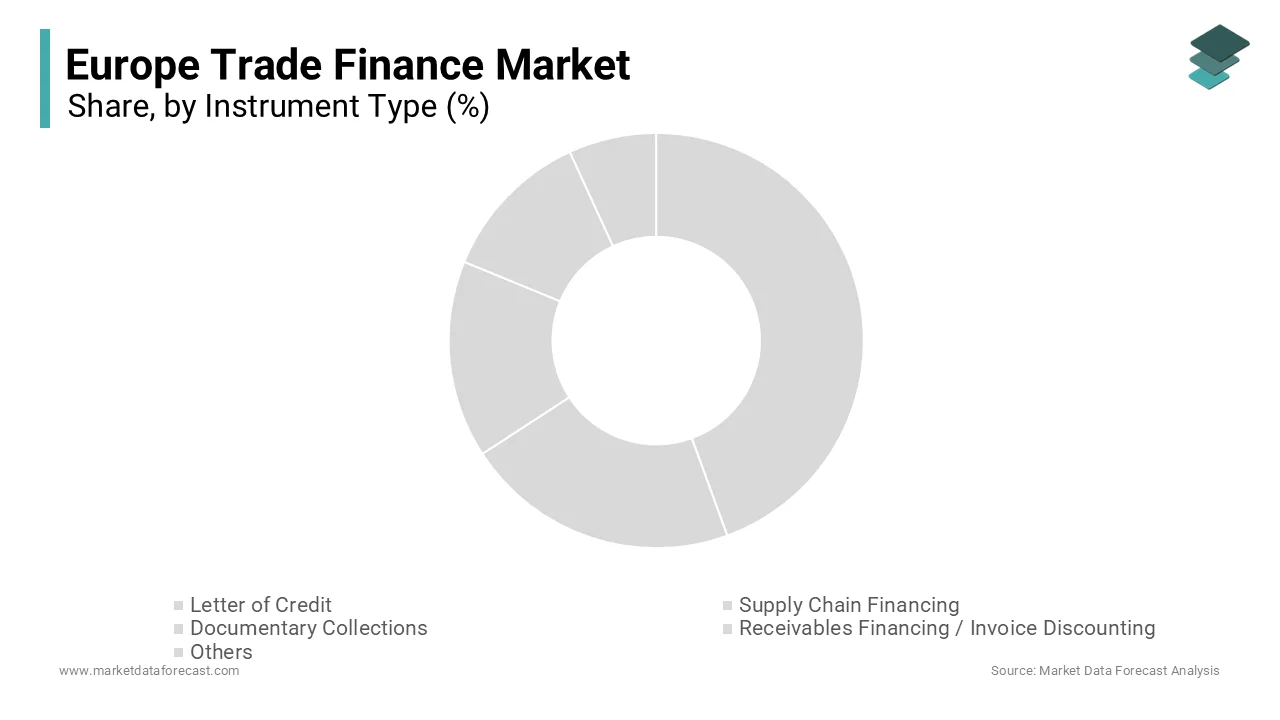
The supply chain financing segment is estimated to register the fastest CAGR of 12.3% between 2026 and 2034 due to corporate sustainability mandates and working capital optimisation demands across integrated manufacturing ecosystems. Large European multinationals have scaled supplier financing programs to extend payment terms while enabling SME vendors to receive early payment at preferential rates tied to the buyer’s creditworthiness. Apart from these, the EU’s Corporate Sustainability Due Diligence Directive incentivises visibility into tier two and tier three suppliers by making financed supply chains a compliance as well as liquidity tool. Fintechhase has onboarded thousands of European suppliers since 2022by automating invoice validation and dynamic discounting. Unlike traditional factoring, supply chain financing aligns financial stability with supply chain resilience, positioning it as a strategic response to both economic volatility and regulatory evolution in Europe.
By Service Provider Insights
The banks segment held a substantial share of the European trade finance market in 2025. Regulatory trust, balance sheet capacity, and deep integration with global correspondent banking networks are propelling the expansion of the banks segment. European banks, particularly those in Germany, France, and the Netherlands, serve as the primary issuers of letters of credit and bank guarantees under frameworks recognised by the International Chamber of Commerce. Besides, banks benefit from longstanding relationships with export credit agencies, which provide risk coverage for politically sensitive markets. Despite fintech disruption, banks retain primacy due to their ability to offer bundled services, combining trade finance with foreign exchange, liquidity management, and ESG reporting, which meets the holistic needs of multinational corporates and public sector exporters alike.
The non-bank financial institutions segment is anticipated to witness the fastest CAGR of 14.1% from 2026 to 2034. The swift growth of the non-bank financial institutions segment is fuelled by unmet demand from SMEs excluded from traditional bank financing due to stringent collateral requirements or low transaction volumes. Entities have deployed asset-backed lending models using real-time invoice and logistics data to underwrite credit, reducing reliance on balance sheet metrics. The European Investment Fund allocated funds to co-invest with non-bank trade lenders focused on underserved sectors like agri-food and green tech. Moreover, regulatory sandboxes in the UK, Netherlands, and Luxembourg have enabled fintechs to pilot tokenised trade receivables on blockchain, attracting institutional capital. This segment thrives by offering speed, digital onboarding, and niche expertise that complements rather than replaces the bank-dominated core infrastructure.
By Industry Insights
The manufacturing segment led the European trade finance market by capturing a 31.6% share in 2025. The segment’s dominance is attributed to its extensive cross-border supply chains, high-value capital goods exports, and reliance on just-in-time inventory systems that demand precise payment coordination. Germany alone exported a significant amount of manufactured goods in 2025, with automotive and industrial machinery representing a share of that total, according to Germany’s Federal Statistical Office. These exports often involve multi-tier supplier networks spanning Poland, Czechia, and Hungary, which necessitate synchronised trade instruments like letters of credit and supply chain finance. Furthermore, the EU’s Critical Raw Materials Act has intensified imports of rare earths and advanced components from non-EU sources, requiring risk-mitigated payment structures. This structural dependency, amplified by regulatory pressure to document supply chain provenance, cements manufacturing as the backbone of Europe’s trade finance ecosystem.
The logistics segment is likely to experience the fastest CAGR of 13.7% over the forecast period, owing to the sector’s transformation from a passive transporter to an active trade enabler, offering integrated financial services such as freight invoice discounting and consignment-backed credit. Companies have partnered with banks to embed trade finance into freight forwarding contracts by allowing shippers to access liquidity against verified delivery milestones. Logistics firms are using trade finance as a differentiating, value-added service, not just for liquidity, as supply chain resilience gains priority at the boardroom level.
REGIONAL ANALYSIS
Germany Market Analysis
Germany was the top performer in the European trade finance market and held a 24.6% share in 202. The supremacy of Germany in the regional market is attributed to its status as the continent’s manufacturing and export powerhouse. In 2025, Germany recorded a substantial amount in total goods trade, with notable exports. The country’s Mittelstand relies heavily on trade finance to support machinery, automotive, and chemical exports to several countries. Deutsche Bank and Commerzbank dominate domestic trade services, offering integrated solutions that combine export credit insurance from Euler Hermes with digital letter of credit platforms. The German government’s renewed emphasis on diversifying supply chains away from geopolitical hotspots has further increased demand for risk-mitigated trade instruments. Besides, Germany’s leadership in the EU’s Industrial Alliances, particularly in clean tech and semiconductors, has spurred cross-border joint ventures requiring structured trade facilities. So, the country’s trade finance infrastructure remains deeply embedded in both regional stability and global connectivity.
United Kingdom Market Analysis
The United Kingdom followed closely in the European trade business market by occupying an 18.6% share in 2025. The expansion of the UK market is driven by its global financial hub status and deep expertise in cross-border risk management. Despite Brexit, UK-based institutions processed a significant amount in trade-related transactions. London remains the world’s leading centre for trade credit insurance and marine guarantees, with Lloyd’s of London and UKEF underwriting complex deals in emerging markets. The City’s concentration of multilateral development bank offices, including the European Bank for Reconstruction and Development, facilitates blended finance structures for infrastructure-linked trade. Furthermore, the UK’s sanctions regime, aligned with but distinct from the EU’s, requires bespoke risk screening, a service where British banks excel. Fintech innovation also thrives, with platforms like Contour and HiveBloc headquartered in London, attracting global capital. The UK's regulatory agility, legal certainty, and maritime legacy maintain its outsized influence in European and global trade finance flows, despite no longer being a part of the EU single market.
France Market Analysis
France holds a noteworthy position in the European trade finance market, with its diversified export base and state-backed financial ecosystem. In 2025, France exported noteworthy worth of goods, with aerospace, luxury goods, and nuclear technology leading the portfolio. BNP Paribas and Société Générale serve as primary trade finance conduits, supported by Bpifrance, the state investment bank. French exporters benefit from strong diplomatic and commercial networks, with several Business France offices globally facilitating introductions and risk assessment. The country’s strategic focus on Africa drives demand for political risk insurance and buyer credit facilities. Apart from these, France’s leadership in the EU’s Critical Raw Materials Partnership has intensified imports of lithium and cobalt, requiring structured trade solutions for long-term off-take agreements. Sustainable trade instruments linked to carbon intensity metrics are gaining traction, particularly in the agri-food and renewable energy sectors, as Paris positions itself as a green finance capital.
Netherlands Market Analysis
The Netherlands grew moderately in the European trade finance market, due to its functioning as the continent’s primary logistics and distribution gateway. Rotterdam Port handled significant tons of cargo, making it Europe’s largest seaport, while Schiphol remains a top air cargo hub. This transit role necessitates massive trade finance volumes for re-exporters, commodity traders, and distribution centres serving the wider EU. ING and Rabobank lead in providing inventory-backed financing and documentary collections for agri-food, chemicals, and electronics passing through Dutch corridors. The favourable tax treaties, advanced digital infrastructure, and participation in the EU’s Digital Trade Corridor initiative further enhance its appeal. This unique combination of geography, policy, and financial sophistication ensures the Netherlands remains a pivotal node in Europe’s trade finance architecture.
Italy Market Analysis
Italy is predicted to expand in the European trade finance market from 2026 to 2034, owing to specialised manufacturing and a strong presence in global luxury and machinery exports. In 2025, Italy exported a notable amount of goods, with machinery, fashion, and food products representing a share of shipments. The country’s millions of SMEs, manfamily-owneded and operating in industrial districts like Emilia-Romagna and Tuscany, frequently rely on trade finance to secure orders from Asia and the Americas, where payment risk is elevated. Italy’s renewed focus on nearshoring in the Mediterranean and North Africa has also increased demand for short-term trade credit, particularly in textiles and automotive components. Moreover, EU Recovery Fund disbursements have modernised port infrastructure in Genoa and Trieste, reducing documentary delays. Digital platforms such as SACE FCT are gaining traction, helping Italy's trade finance bridge tradition and innovation and increasing its usage, even though it has historically been less digitised than its Northern European peers.
COMPETITIVE LANDSCAPE
KEY MARKET PLAYERS
Some of the notable key players in the European trade finance market are
- JPMorgan Chase & Co.
- Santander Bank
- Arab Bank
- BNP Paribas
- TD Bank
- Citigroup
- DBS Bank
- Bank of America Corp
- UBS Group AG
- Deutsche Bank AG
TOP STRATEGIES USED BY THE KEY MARKET PLAYERS
Key players in the European trade finance market employ several core strategies to maintain a competitive advantage. Digital transformation remains paramount with institutions investing heavily in blockchain, artificial intelligence, and cloud-based trade platforms to streamline operations and reduce settlement times. Sustainability integration is another critical approach as banks link financing terms to environmental and social performance metrics in alignment with EU regulations. Strategic partnerships with fintechs, logistics providers, and export credit agencies enhance service depth and market reach. Client segmentation enables tailored solutions for SMEs versus multinational corporations, improving adoption and retention. Finally, continuous regulatory adaptation ensures compliance with evolving anti-money laundering sanctions and capital adequacy requirements while preserving operational efficiency across jurisdictions.
COMPETITION OVERVIEW
Competition in the European trade finance market is characterised by a blend of traditional banking dominance and disruptive fintech innovation. Major banks such as BNP Paribas, Deutsche Bank and ING leverage their balance sheet strength, regulatory expertise and global networks to serve large corporates and public sector entities. Simultaneously, non-bank financial institutions and specialised fintechs are capturing market share among SMEs by offering faster onboarding, digital documentation and alternative underwriting models. The competitive landscape is further shaped by regulatory harmonisation under EU directives, which raises compliance costs but also creates opportunities for scalable digital solutions. Differentiation increasingly hinges on value-added services such as EintEintegrationrdictive risk analytics, and embedded finance within procurement or logistics workflows.
TOP PLAYERS IN THE MARKET
- BNP Paribas is a leading European bank with deep integration into global trade finance ecosystems. The institution offers a comprehensive suite of trade solutions, including letters of cred, i, supply chain finance and digital documentary services across many countries. In recent years, BNP Paribas prioritised sustainability by launching green trade finance products aligned with the EU Taxonomy. The bank has also enhanced its digital capabilities through partnerships with blockchain platforms such as we. Tradendxpanded its AI-driven compliance engine to accelerate transaction processing while meeting stringent regulatory standards. These initiatives reinforce its role as a strategic partner for multinational corporations and public sector exporters navigating complex cross-border trade environments.
- Deutsche Bank maintains a prominent position in the European trade finance market through its focus on innovation and client-centric trade services. The bank provides end-to-end trade solutions, including export financing, receivables management and risk mitigation instruments t,o clients in the manufacturing, automotive and industrial sectors. Recently, Deutsche Bank accelerated its digital transformation by integrating machine learning into its trade document verification system, reducing processing time. It also co-developed a sustainable trade program with Siemens, enabling suppliers to access preferential financing based on verified carbon performance data. These actions underscore its commitment to combining technological agility with sustainability to meet evolving client demands.
- ING Group is a key enabler of trade finance across Europe with a strong emphasis on digitalisation and circular economy principles. The bank delivers scalable solutions such as dynamic discounting, reverse factoring, ng blockchain-based letters of credit through its Trade Finance Services division. ING has recently deepened its collaboration with the Port of Rotterdam to pilot real-time invoice financing linked to cargo tracking data, enhancing liquidity for logistics firms. It also launched an SSG-linked trade platform, allowing clients to tie financing costs to sustainability metrics. ING is reshaping trade finance into a lever for responsible global commerce and strengthening its relevance to next-generation supply chains by embedding environmental and social criteria into its trade products.
MARKET SEGMENTATION
This research report on the European trade finance market has been segmented and sub-segmented based on categories.
By Instrument Type
- Letter of Credit
- Supply Chain Financing
- Documentary Collections
- Receivables Financing / Invoice Discounting
- Others
By Service Provider
- Banks
- Financial Institutions
- Trading Houses
- Others
By Trade Type
- Domestic
- International
By Enterprise Type
- Large Enterprises
- Small and Medium Enterprises
By Industry
- BFSI
- Construction
- Retail / Wholesale
- Manufacturing
- Automobile
- Logistics
- Others
By Country
- UK
- France
- Spain
- Germany
- Italy
- Russia
- Sweden
- Denmark
- Switzerland
- Netherlands
- Turkey
- Czech Republic
- Rest of Europe