Europe Variable Frequency Drive Market Size, Share, Trends & Growth Forecast Report – Segmented By Product Type (AC Drives, DC Drives and Servo Drives), Power Range, Application, End User, and Country (UK, France, Spain, Germany, Italy, Russia, Sweden, Denmark, Switzerland, Netherlands, Turkey, Czech Republic & Rest of Europe), Industry Analysis From 2026 to 2034
Market Size, 2025
$6.72 BnMarket Estimate, 2026
$6.98 BnMarket Forecast, 2034
$9.46 BnCAGR, 2026–2034
3.87%Europe Variable Frequency Drive Market Report Summary
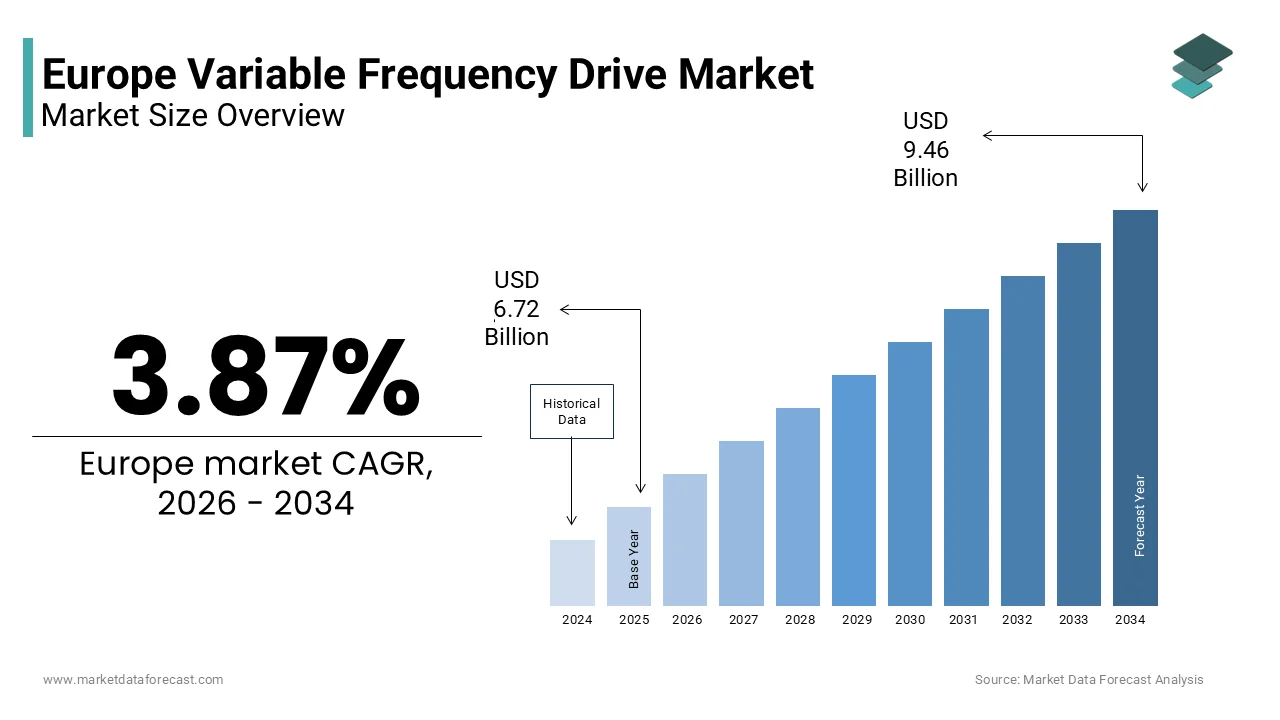
The Europe variable frequency drive market was valued at USD 6.72 billion in 2025 and is estimated to reach USD 6.98 billion in 2026, further projected to reach USD 9.46 billion by 2034, growing at a CAGR of 3.87% during the forecast period. Market growth is primarily driven by increasing demand for energy efficient motor control systems across industrial and commercial applications. Rising focus on reducing energy consumption, lowering operational costs, and complying with stringent European energy efficiency regulations is accelerating adoption of variable frequency drives across manufacturing, HVAC, water and wastewater, and process industries. Advancements in smart drives, integration with industrial automation systems, and expansion of Industry 4.0 initiatives are further supporting market expansion.
Key Market Trends
- Growing adoption of AC drives due to their reliability, cost effectiveness, and wide applicability in industrial motor control systems.
- Rising demand for low power drives between 0.75 and 15 kilowatts for small and medium scale industrial equipment and HVAC systems.
- Increasing integration of variable frequency drives with IoT enabled monitoring and predictive maintenance platforms.
- Strong regulatory emphasis on carbon emission reduction and industrial energy efficiency improvements across Europe.
- Expansion of automation and digital manufacturing initiatives driving modernization of motor driven systems.
Segmental Insights
- Based on product type, the AC drives segment led the Europe variable frequency drive market in 2025. The dominance of this segment is attributed to its high efficiency, flexible speed control, and suitability across diverse industrial applications.
- Based on power range, the low power drives segment between 0.75 and 15 kilowatts dominated the Europe variable frequency drive market in 2025. This segment’s growth is supported by increasing demand from small scale manufacturing units, building automation systems, and light industrial equipment.
- Based on end user, the industrial segment held the majority share of the European variable frequency drive market in 2025. The segment’s leadership is driven by widespread deployment of motor driven systems in manufacturing, processing, energy, and infrastructure sectors.
Regional Insights
- Germany accounted for 25.8% of the Europe variable frequency drive market share in 2025, making it the top performing country in the region. The country’s dominance is supported by a strong industrial base, advanced manufacturing ecosystem, strict energy efficiency regulations, and rapid adoption of automation technologies.
- Other major European economies are also witnessing steady demand growth due to infrastructure modernization and sustainability initiatives.
Competitive Landscape
The Europe variable frequency drive market is highly competitive with the presence of established global automation and power electronics manufacturers. Companies are focusing on developing compact, energy efficient, and digitally integrated drive systems to strengthen their competitive positioning. Key players operating in the Europe variable frequency drive market include ABB Group, Hitachi Ltd., Eaton Corporation PLC, Rockwell Automation Inc., Nidec Corporation, Siemens AG, Schneider Electric SE, Mitsubishi Heavy Industries Ltd., Fuji Electric Co. Ltd., and The Danfoss Group.
Europe Variable Frequency Drive Market Size
The Europe variable frequency drive market size was valued at USD 6.72 billion in 2025 and is projected to reach USD 9.46 billion by 2034 from USD 6.98 billion in 2026, growing at a CAGR of 3.87%.
A variable frequency drive (VFD) is an electronic power conversion device that controls the speed and torque of an alternating current electric motor by varying the frequency and voltage of its power supply. In Europe this technology serves as a cornerstone of industrial energy efficiency automation and process precision across manufacturing water treatment HVAC and renewable energy systems. The European variable frequency drive market is distinguished by its deep integration with digital factory architectures stringent regulatory mandates on motor system efficiency and the continent’s strategic push toward decarbonization. Electric motor systems constitute the largest portion of industrial power demand across the European Union, representing more than two-thirds of the total electricity used by the manufacturing sector. European energy standards have been significantly tightened to require higher efficiency ratings for both electric motors and their control units, phasing out less efficient hardware to ensure broader industrial energy savings. Furthermore, the Energy Efficiency Directive mandates that large enterprises conduct regular motor system audits with implementation of speed control identified as a top priority measure. This policy driven ecosystem positions variable frequency drives not as optional components but as essential instruments of compliance resource conservation and operational intelligence.
MARKET DRIVERS
Mandatory Energy Efficiency Regulations Accelerate Industrial Retrofit Programs
The region’s comprehensive regulatory framework mandating motor system optimization has become a major force in the Europe variable frequency drive market. Updated European energy standards have raised the minimum efficiency requirements for industrial motors, effectively phasing out lower-performing hardware to ensure significant energy savings across the manufacturing sector. The vast majority of motor-driven applications in European industry are concentrated in fluid and air handling systems, which represent the largest opportunity for achieving collective energy efficiency gains. Regulatory oversight of corporate energy performance is becoming more rigorous, with national authorities increasingly monitoring the thoroughness of energy audits to ensure industrial energy transparency. Similarly Environmental and energy regulations in France are increasingly tied to fiscal and reporting requirements, encouraging businesses to modernize their infrastructure to avoid potential non-compliance with broader sustainability goals. Periodic energy audits for major industrial players are a primary driver for identifying technological upgrades, with specialized motor control solutions frequently identified as a top priority for improving operational efficiency. These legally binding measures create a predictable and recurring demand stream independent of economic cycles ensuring sustained market activity across manufacturing chemical and food processing industries.
Integration with Industrial IoT and Predictive Maintenance Platforms Enhances Operational Value
The convergence of these devices with Industrial Internet of Things ecosystems is also encouraging the expansion of the Europe variable frequency drive market. This has transformed them from passive energy savers into intelligent data nodes that enable predictive maintenance and process optimization. Modern drives embed sensors that monitor motor current temperature vibration and power quality transmitting real time metrics via OPC UA or MQTT protocols to centralized analytics platforms. Modern industrial facilities are increasingly adopting digitally connected equipment and smart manufacturing technologies to enhance process efficiency and enable predictive maintenance. Companies like Siemens ABB and Danfoss have launched cloud based dashboards that correlate drive data with production KPIs allowing operators to adjust speed profiles for maximum throughput or minimal energy use. Major automotive manufacturers are implementing predictive maintenance models and machine learning to anticipate equipment failures, thereby reducing the significant financial impact of unplanned production stoppages. The European Commission is providing substantial funding through the Horizon Europe program to accelerate the development of trustworthy artificial intelligence and strategic digital technologies across industrial sectors. This shift from reactive to predictive operations elevates the strategic value of variable frequency drives beyond initial capital savings to continuous operational intelligence.
MARKET RESTRAINTS
High Upfront Investment and Complex Integration Deter Small and Medium Enterprises
Significant capital outlays and technical integration issues are major obstacles to the European variable frequency drive market. This continues to hamper the adoption of variable frequency drives among the region’s small and medium enterprises, despite clear long-term benefits. High capital expenditure and installation costs for energy-efficient motor systems remain a significant barrier for small-scale manufacturers who lack the liquidity or specialized financing to upgrade their equipment. Moreover retrofitting legacy machinery often requires mechanical modifications electrical rewiring and PLC reprogramming creating downtime risks that deter owners of older facilities. Many small and medium manufacturers in the food processing and metalworking sectors limit their use of advanced motor controls to essential machinery due to the perceived technical complexity of broader integration. EU funding programs like the Innovation Fund offer subsidies, but these are typically accessible only to larger entities. These opportunities usually require dedicated grant writing capacity to secure. Additionally, A persistent shortage of specialized technical talent and industrial engineers across Europe is slowing the deployment and optimization of modern automated systems. Absent simplified, 'plug-and-play' solutions or targeted micro-financing, this structural obstacle will continue to hinder adoption among the critical SME segment, which forms a major share of European businesses.
Electromagnetic Compatibility and Harmonic Distortion Concerns Limit Deployment in Sensitive Environments
The proliferation of variable frequency drives in dense industrial and urban settings has intensified concerns over electromagnetic interference and power quality degradation posing technical and regulatory hurdles, which restrain the expansion of the Europe variable frequency drive market. Drives generate high frequency switching noise and harmonic currents that can disrupt nearby instrumentation communication systems and utility grids if not properly mitigated. European standards for power drive systems establish rigorous electromagnetic compatibility requirements to prevent interference, and failure to meet these legal benchmarks can result in regulatory intervention or restricted market access. Transmission system operators are increasingly monitoring power quality at industrial connection points as the proliferation of non-linear loads makes managing grid stability and harmonic levels more challenging. Hospitals data centers and research laboratories are particularly vulnerable with the Max Planck Institute documenting measurement errors in electron microscopes caused by unshielded drive cabinets in adjacent buildings. Compliance requires additional components such as dV/dt filters sine wave filters and shielded cables increasing system cost. Complex electromagnetic interference issues and the resulting technical validation requirements frequently lead to significant timeline extensions during the commissioning of large-scale industrial drive projects. Technical constraints currently impede deployment in sensitive electromagnetic or constrained-grid environments, pending the widespread adoption of standardized, low-emission architectures.
MARKET OPPORTUNITIES
Expansion of Green Hydrogen and Electrolyzer Manufacturing Creates High Growth Niche
The region’s aggressive investment in green hydrogen infrastructure is generating unprecedented demand for high power VFDs, and thereby is anticipated to contribute to the growth of the Europe variable frequency drive market. These drives are specifically engineered for electrolyzer compressor and cryogenic pump applications. Major European energy initiatives are setting ambitious targets for both the domestic production of renewable hydrogen and the rapid expansion of a dedicated pipeline network to ensure regional energy security. Electrolyzers require ultra stable DC power derived from precisely controlled AC motors driving rectifiers and gas separation systems. Research and development funding for hydrogen production is increasingly focused on the technical optimization of power electronics to maximize the energy efficiency and stability of large-scale electrolysis systems. Companies like ABB and Siemens have responded with water cooled medium voltage drives rated up to 20 megawatts featuring integrated harmonic filters and cybersecurity modules compliant with IEC 62443. Leading chemical producers are inaugurating large-scale renewable hydrogen facilities, utilizing high-power drive systems and electrolysis to decarbonize the production of industrial fertilizers. This policy led industrial transformation opens a high margin niche where European engineering excellence in power electronics and safety certification offers decisive competitive advantage.
Modernization of Municipal Water and Wastewater Infrastructure Drives Public Sector Procurement
The region has an urgent need to reduce non-revenue water and optimize energy use in public utilities, which creates strong pathways for the expansion of the Europe variable frequency drive market. This need is catalyzing large-scale variable frequency drive deployments across municipal pumping stations and treatment plants. Significant volumes of treated water are lost across European distribution networks, prompting a focus on infrastructure renewal and pressure stabilization to mitigate leaks in regions with aging systems. International financial institutions are providing substantial capital to modernize urban water systems, prioritizing projects that integrate digital technologies to improve energy efficiency and resource management. France’s “Plan Eau” mandates that all new wastewater lift stations install drives with real time flow adaptation to prevent overflow during heavy rainfall events. Regulatory frameworks and technical guidelines in Germany are increasingly emphasizing active pressure regulation as a primary method for protecting distribution networks and preventing structural failures. Major municipal water utilities are achieving significant operational efficiency gains by upgrading pumping infrastructure with automated controls that align energy consumption with fluctuating daily demand. These publicly funded programs create a stable and recurring demand channel insulated from industrial economic cycles and increasingly focused on digital integration and sustainability outcomes.
MARKET CHALLENGES
Intensifying Competition from Asian Manufacturers Undermines Price Leadership
The regional VDF suppliers face mounting pressure from Chinese and Korean exporters offering functionally comparable products at lower prices, which acts as a serious barrier to the Europe variable frequency drive market. This competition is particularly intense in standard low voltage applications. Trade data indicates that a substantial and growing portion of lower-power industrial motor controls entering the European market originates from Asian manufacturing hubs. These imports often meet minimum CE marking requirements through third party testing yet lack the firmware depth cybersecurity features and local service support expected in European industrial environments. Industrial operators increasingly weigh the lower initial purchase price of imported power electronics against the potential for higher long-term costs associated with equipment reliability and unplanned maintenance. However tight capital budgets in Southern and Eastern Europe drive procurement officers toward upfront cost savings despite lifecycle risks. This dynamic compresses margins for domestic manufacturers who must justify premiums through added value services like remote diagnostics cybersecurity hardening and rapid spare parts availability, advantages increasingly undervalued in tender based purchasing decisions dominated by initial price comparisons.
Shortage of Skilled Application Engineers Constrains System Optimization and Support
A critical workforce deficit in drive programming, commissioning, and troubleshooting expertise confronts the Europe variable frequency drive market. This specialized knowledge is essential for maximizing energy savings and system reliability. Trade data emphasizes that a significant and expanding portion of the European market for low-power industrial motor controls is supplied by manufacturers based in Asia. This gap is exacerbated by the retirement of experienced technicians with deep knowledge of legacy control systems. Industrial operators often evaluate the trade-off between the lower initial cost of imported components and the potential for higher operational risks related to equipment durability and production uptime. In Italy and Spain many small integrators resort to generic parameter sets rather than application specific tuning resulting in suboptimal energy performance and premature component wear. Online training provided by manufacturers cannot fully replicate the necessary in-person, hands-on experience in areas such as mechanical resonance avoidance and complex vector control tuning. This talent bottleneck, if not addressed through reskilling and improved vocational standing, will curtail efficiency gains and hand operational superiority to regions with secure technical workforces.
REPORT COVERAGE
| REPORT METRIC | DETAILS |
| Market Size Available | 2025 to 2034 |
| Base Year | 2025 |
| Forecast Period | 2026 to 2034 |
| CAGR | 3.87% |
| Segments Covered | By Product Type, Power Range, Application, End User, and Region |
| Various Analyses Covered | Global, Regional, & Country Level Analysis; Segment-Level Analysis; DROC, PESTLE Analysis; Porter’s Five Forces Analysis; Competitive Landscape; Analyst Overview of Investment Opportunities |
| Regions Covered | UK, France, Spain, Germany, Italy, Russia, Sweden, Denmark, Switzerland, Netherlands, Turkey, and the Czech Republic |
| Market Leaders Profiled | ABB Group, Hitachi Ltd., Eaton Corporation PLC, Rockwell Automation Inc., Nidec Corporation, Siemens AG, Schneider Electric SE, Mitsubishi Heavy Industries Ltd., Fuji Electric Co., Ltd., and The Danfoss Group |
SEGMENTAL ANALYSIS
By Product Type Insights
The AC drives segment led the Europe variable frequency drive market in 2025. The leading position of the segment is attributed to its compatibility with the vast majority of industrial induction motors which constitute a significant share of installed motor systems across the continent. Their ability to deliver precise speed control high efficiency and regenerative braking in applications ranging from pumps and fans to conveyors and compressors makes them indispensable in energy intensive sectors. Updated European energy efficiency standards for industrial motors are becoming increasingly stringent, effectively requiring higher baseline efficiency for almost all new equipment placed on the market. Environmental and energy agencies identify a massive potential for energy savings across the industrial and building sectors by upgrading existing constant-speed motor systems to more efficient, adjustable technologies. Furthermore Modern process plants are overwhelmingly adopting advanced alternating current motor controls due to their superior ability to interface with digital factory automation and control systems. This regulatory and infrastructural alignment ensures AC drives remain the backbone of Europe’s motor efficiency strategy.
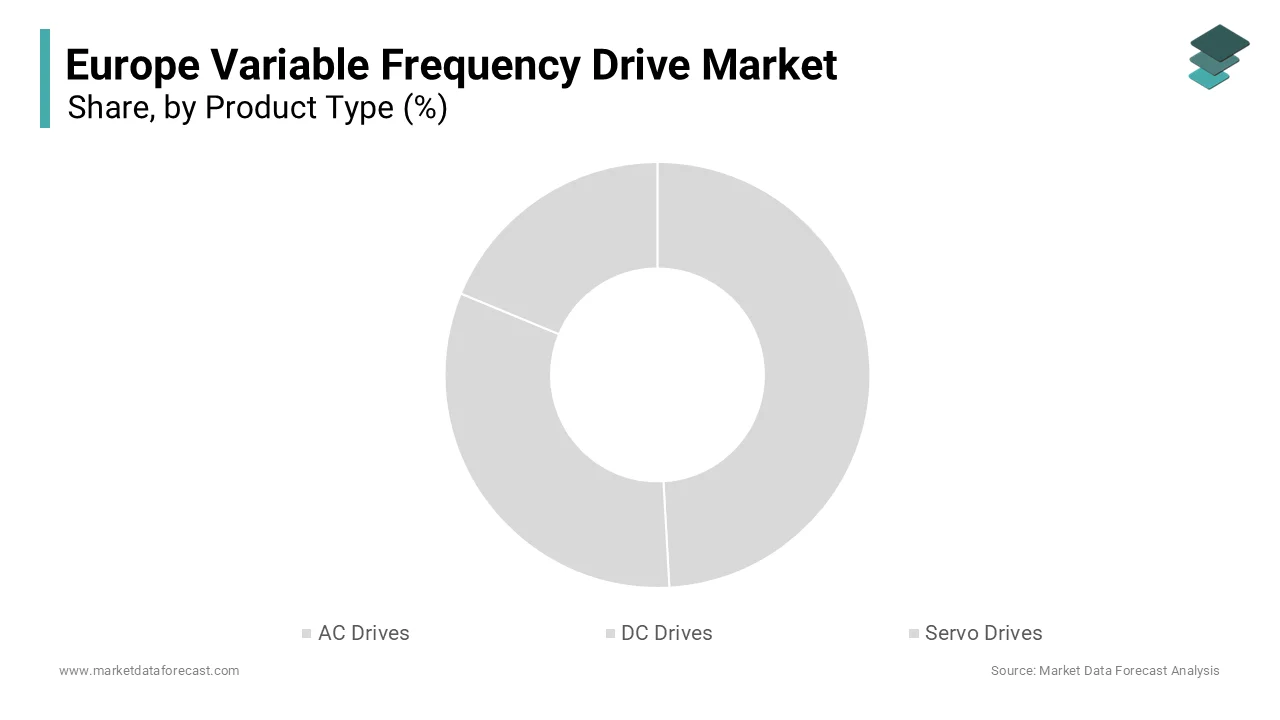
The servo drives segment is on the rise and is expected to be the fastest growing segment in the market by witnessing a CAGR of 9.6% from 2026 to 2034 due to Europe’s advanced manufacturing push toward high precision automation robotics and flexible production lines. Servo drives provide exceptional dynamic response sub millisecond positioning accuracy and synchronized multi axis control essential for electric vehicle battery assembly semiconductor handling and pharmaceutical packaging. Emerging electric vehicle battery production facilities across Central Europe are prioritizing high-precision automated systems to ensure the quality and consistency of cell assembly and welding. The adoption of collaborative robotics is expanding across European industry as these systems become more versatile and easier to integrate into existing production workflows. Companies like Bosch Rexroth and Kollmorgen have responded with compact IP67 rated servo drives featuring real time EtherCAT communication and integrated safety functions compliant with ISO 13849. This convergence of electrification digitalization and precision engineering creates a structural growth vector unmatched by general purpose AC drives.
By Power Range Insights
The low power drives (0.75 to 15 kilowatts) segment dominated the Europe variable frequency drive market in 2025 because of its widespread use in HVAC systems water circulation pumps small conveyors and machine tools, applications ubiquitous across commercial buildings and light industry. A significant majority of industrial motor applications across the European Union consist of low-to-medium power units, with the vast majority of these systems dedicated to fluid handling and ventilation tasks. European energy regulations require large-scale industrial consumers to undergo periodic energy assessments, while simultaneously promoting the use of sustainable procurement criteria to improve the efficiency of smaller-scale equipment. Municipalities across Germany France and the Netherlands have retrofitted thousands of building ventilation systems with low power drives achieving energy savings. Additionally the rise of modular factory automation has increased demand for compact drives in packaging and material handling where space constraints favor low power units. This combination of regulatory encouragement operational ubiquity and retrofit feasibility ensures sustained high volume demand across residential commercial and light industrial domains.
The medium power drives (15 to 100 kilowatts) segment is expected to exhibit a noteworthy CAGR of 8.9% during the forecast period owing to large scale industrial decarbonization and water infrastructure modernization. These drives power critical assets such as wastewater lift pumps industrial compressors extruders and mine ventilation systems where energy consumption is high and optimization yields significant carbon reductions. Significant capital from international financial institutions is being directed toward modernizing municipal water infrastructure, with a strong focus on digital solutions that optimize pressure and energy consumption. Leading chemical producers are implementing large-scale electrification and motor-control upgrades in their manufacturing hubs to achieve substantial reductions in energy intensity and carbon emissions. The European Cement Association mandates that all new grinding mills install medium power drives with regenerative capabilities to meet 2030 CO2 targets. Companies like ABB and Siemens have launched water cooled designs with integrated cybersecurity modules tailored for these mission critical applications. This policy led industrial transformation creates a resilient high value demand stream insulated from consumer market volatility.
By End User Insights
The industrial segment held the majority share of the European variable frequency drive market in 2025. The dominance of the segment is supported by the sector’s massive electricity consumption, accounting for a significant share of EU industrial power use, and stringent regulatory pressure to optimize motor systems. This covers discrete and process manufacturing including chemicals metals paper and machinery. Updated European energy efficiency standards are transforming the industrial market by requiring a vast number of newly installed motors to meet higher performance benchmarks. The vast majority of modern production environments are increasingly incorporating sophisticated motion control and automated handling technologies to maximize throughput and operational flexibility. In Sweden SSAB’s fossil free steel plant uses 120 medium voltage drives to control rolling mill speeds with precision tolerances below 0.1 percent. Similarly Italy’s ceramic tile manufacturers have standardized on low power drives for kiln fans achieving lower gas consumption. This breadth of application depth of regulation and scale of energy savings solidify the industrial sector as the primary engine of drive demand across Europe.
The infrastructure end user segment is predicted to witness the highest CAGR of 9.2% from 2026 to 2034. This rapid growth is fuelled by smart city initiatives water loss reduction mandates and metro rail expansion. Municipal utilities are deploying variable frequency drives in drinking water booster stations wastewater treatment plants and tunnel ventilation systems to enhance efficiency and resilience. High levels of water loss in urban distribution networks are driving major Southern European municipalities to modernise their pumping infrastructure with advanced pressure-management technologies to improve resource efficiency. France’s “Plan Eau” requires all new wastewater lift stations to implement real time flow adaptation using medium power drives to prevent overflow during storms. Simultaneously urban rail projects like Grand Paris Express and Berlin’s U5 extension rely on high power drives for station HVAC and escalator control with regenerative braking feeding energy back into the grid. Large-scale European infrastructure funding is increasingly focused on the green transition, supporting projects that integrate digital energy-saving technologies and automated control systems into public works. This convergence of sustainability mandates urbanization and public investment creates a stable and accelerating demand channel distinct from cyclical industrial markets.
REGIONAL ANALYSIS
Germany Variable Frequency Drive Market Analysis
Germany was the top performer in the Europe variable frequency drive market and accounted for a 25.8% share in 2025. The dominance of the German market is driven by its status as the global powerhouse of industrial automation and machinery manufacturing. The market status here is defined by the deep integration of drive technology into smart factory ecosystems where precise motor control is essential for energy efficiency and process optimization. A primary driving factor is the aggressive implementation of Industry 4.0 standards which necessitates the replacement of fixed speed motors with intelligent drives capable of real time data communication and adaptive speed control. The German automation industry is a primary driver of industrial revenue, providing the essential control and motion technology required for modern conveyor systems and robotic manufacturing. An additional driver is the stringent national energy regulations that mandate high efficiency standards for industrial electric motors, forcing manufacturers to adopt variable speed solutions to reduce electricity consumption. Motor-driven applications represent the largest share of energy consumption in the industrial sector, leading to targeted government financial incentives for companies to adopt high-efficiency drive technologies and modernized equipment. Furthermore, the country hosts leading global drive manufacturers who utilize Germany as a primary research and development hub for next generation silicon carbide based drives. This convergence of advanced manufacturing needs, regulatory pressure, and technological innovation cements Germany's position as the undisputed leader in the regional adoption of variable frequency drive technologies.
United Kingdom Variable Frequency Drive Market Analysis
The United Kingdom followed closely in the Europe variable frequency drive market and captured a 17.8% share in 2025. The growth of the UK market is supported by a strong focus on operational cost reduction and carbon footprint minimization, driven by the need to modernize aging infrastructure and meet net zero targets. It is distinguished by its pioneering adoption of variable frequency drives within the water treatment and offshore energy sectors. A key driving factor is the extensive water and wastewater industry which has increasingly deployed variable frequency drives to control pump speeds based on real time demand, significantly reducing energy waste and wear on equipment. The British water industry is pursuing an ambitious decarbonization roadmap, identifying the modernization of pumping systems as a critical component in reaching its operational net-zero objectives. A further major driver is the booming offshore wind industry where variable frequency drives are essential for controlling pitch and yaw mechanisms in turbines to optimize energy capture under varying wind conditions. The United Kingdom is significantly accelerating its offshore wind capacity targets, driving sustained demand for specialized power electronics and robust mechanical systems capable of withstanding harsh marine environments. Additionally, the government's enhanced capital allowance scheme encourages businesses to invest in energy efficient technologies, further accelerating market growth. The mature engineering ecosystem and strong regulatory push for sustainability ensure the UK remains a vital and high value market for variable frequency drive solutions.
France Variable Frequency Drive Market Analysis
France is another key player in the Europe Variable Frequency Drive Market due to its strong nuclear energy sector and extensive railway network to drive demand. The market status in this region is propelled by strategic state backing for industrial modernization and the decarbonization of critical infrastructure through advanced motion control technologies. A major driving factor is the nuclear power industry where companies like EDF require highly reliable variable frequency drives for coolant pump control and ventilation systems within reactor facilities to ensure safety and efficiency. France's national strategy for a nuclear renaissance is triggering multi-billion euro investments in next-generation reactors, creating a long-term market for specialized industrial components that comply with the highest safety and regulatory certifications. An additional driver is the railway modernization initiative led by SNCF and Alstom, where variable frequency drives are increasingly used in traction systems for high speed trains and urban metros to improve energy recovery during braking. Statistics from the French Ministry of Transport show ongoing investments in rail network expansions, creating steady demand for compact and durable drive solutions. Furthermore, the food and beverage industry utilizes these drives for precise control of mixing and packaging lines, supported by strict hygiene and efficiency regulations. The synergy between energy security, transport modernization, and process industry optimization sustains France's strong standing as a key market for specialized variable frequency drives.
Italy Variable Frequency Drive Market Analysis
Italy witnessed a consistent growth in the Europe variable frequency drive market owing to a unique demand profile driven by its world leading packaging machinery and ceramic tile production sectors. The market status is defined by the need for high dynamic response and precise speed control drives that enable flexible manufacturing lines capable of handling diverse product formats at high speeds. A primary driving factor is the packaging industry which serves as a backbone of the Italian economy, utilizing thousands of variable frequency drives for synchronizing motors in sorting, filling, and sealing operations. Italy's packaging machinery sector maintains a strong global export position, producing advanced equipment that relies on integrated motion control systems to achieve the precision and speed required for modern industrial packaging. A different driver is the ceramic and glass industry concentrated in regions like Emilia Romagna, where large volumes of variable frequency drives are essential for operating automated kilns, glazing robots, and material handling systems with precise temperature and speed profiles. Additionally, the white goods industry produces millions of washing machines and dishwashers each year, utilizing miniaturized inverter drives for motor control to meet energy label requirements. The blend of specialized machinery exports, heavy process industries, and consumer appliance manufacturing creates a distinctive market dynamic where precision and reliability are paramount, ensuring Italy remains a vital player in the European landscape.
Spain Variable Frequency Drive Market Analysis
Spain is predicted to expand in the Europe variable frequency drive market over the forecast period due to its rapidly expanding renewable energy projects and aggressive water management initiatives. The market status in Spain is marked by a surge in the installation of variable frequency drives for solar tracking systems and irrigation pumps as the country positions itself as a leader in green technology and sustainable agriculture. A key driving factor is the booming solar energy sector where single axis and dual axis tracking systems equipped with variable frequency drives are deployed to orient photovoltaic panels toward the sun, significantly increasing energy yield. A further major driver is the agricultural sector which faces recurring drought conditions, prompting farmers to adopt precision irrigation systems controlled by variable frequency drives to optimize water usage and reduce energy costs. Furthermore, the automotive industry is retooling plants for electric vehicle production, requiring extensive use of variable frequency drives for automated assembly lines and robotic welding cells. The convergence of renewable energy expansion, critical water management, and automotive electrification creates a dynamic environment for variable frequency drive adoption, securing Spain's position as a key growth market in the region.
COMPETITIVE LANDSCAPE
The Europe variable frequency drive market features a tiered competitive landscape where multinational engineering firms dominate high value segments while Asian suppliers gain ground in standard low power applications. At the premium end companies like ABB Siemens and Danfoss compete on integration depth digital capabilities and regulatory compliance serving sectors where reliability and lifecycle cost outweigh initial price. Mid tier European specialists focus on regional niches such as water or food processing emphasizing local service and rapid delivery. Meanwhile Chinese and Korean manufacturers exert downward pressure through competitively priced drives that meet basic CE requirements but often lack firmware sophistication or cybersecurity hardening. Competition is increasingly defined by alignment with EU decarbonization mandates digital factory standards and grid code compliance rather than hardware specifications alone. Differentiation arises through software ecosystems certification traceability and support for industrial sustainability goals creating a complex environment where technical excellence and policy engagement jointly determine market success.
KEY MARKET PLAYERS
Some of the notable key players in the Europe variable frequency drive market are
- ABB Group
- Hitachi, Ltd.
- Eaton Corporation PLC
- Rockwell Automation, Inc.
- Nidec Corporation
- Siemens AG
- Schneider Electric SE
- Mitsubishi Heavy Industries Ltd.
- Fuji Electric Co., Ltd.
- The Danfoss Group
Top Players in the Market
- ABB Ltd is a global technology leader with deep roots in European industrial automation and power conversion. The company supplies a comprehensive portfolio of low medium and high voltage variable frequency drives to sectors including water treatment mining automotive and renewable energy across the continent. ABB’s drives are integral to major infrastructure projects such as Berlin’s U5 metro expansion and Norway’s green hydrogen electrolyzer plants. It also expanded its digital twin validation service allowing customers to simulate drive performance under real load conditions before deployment. These initiatives reinforce ABB’s role as an enabler of Europe’s digital and green transitions beyond hardware provision.
- Siemens AG is a cornerstone of the European variable frequency drive market offering integrated drive systems that combine motors converters and software under its SINAMICS brand. The company serves heavy industries including steel chemicals and automotive with a strong presence in Germany France and Sweden. Siemens drives are specified in flagship decarbonization projects such as SSAB’s fossil free steel plant and Volvo’s EV battery gigafactories. It also enhanced its MindSphere cloud platform to correlate drive data with production KPIs enabling real time energy optimization. This fusion of hardware intelligence and industrial software cements Siemens’ position at the heart of Europe’s automated and sustainable manufacturing future.
- Danfoss A/S is a Danish engineering group renowned for its energy efficient drive solutions particularly in HVAC refrigeration and water management. The company’s VLT and VACON drive families are widely deployed in commercial buildings district heating networks and wastewater treatment plants across Northern and Western Europe. Danfoss plays a key role in urban sustainability by enabling precise pump and fan control that reduces building energy consumption. It also partnered with the European Investment Bank to support water loss reduction programs in Southern Europe through intelligent pressure management systems. These actions align Danfoss with Europe’s dual priorities of climate action and resource efficiency.
Top Strategies Used by the Key Market Participants
Key players in the Europe variable frequency drive market prioritize compliance with EU energy and cybersecurity regulations by embedding advanced communication protocols and safety functions into their products. They integrate drives with digital twin and cloud analytics platforms to enable predictive maintenance and real time energy optimization. Companies focus on application specific engineering for high growth sectors like green hydrogen water infrastructure and electric vehicle manufacturing. Strategic partnerships with public utilities industrial giants and financial institutions facilitate large scale retrofit programs. Additionally manufacturers invest in local training academies and remote commissioning services to address the shortage of skilled engineers and accelerate deployment across diverse industrial environments.
MARKET SEGMENTATION
This research report on the European variable frequency drive market has been segmented and sub-segmented based on categories.
By Product Type
- AC Drives
- DC Drives
- Servo Drives
By Power Range
- Low
- Medium
- Micro
- High
By Application
- Pumps
- Electric Fans
- HVAC
- Conveyers
- Extruders & Others
By End User
- Oil & Gas
- Industrial
- Food & Beverages
- Power Generation
- Infrastructure
- Automotive
- Others
By Country
- UK
- France
- Spain
- Germany
- Italy
- Russia
- Sweden
- Denmark
- Switzerland
- Netherlands
- Turkey
- Czech Republic
- Rest of Europe
Frequently Asked Questions
1. What is the Europe Variable Frequency Drive market?
The Europe Variable Frequency Drive market refers to the production, distribution, and adoption of VFD systems used to control motor speed and torque by varying input frequency and voltage across industrial and commercial applications.
2. What is a Variable Frequency Drive?
A Variable Frequency Drive is an electronic device that regulates the speed of electric motors by adjusting the frequency and voltage of the power supplied to the motor.
3. What factors are driving growth in the Europe VFD market?
Growth is driven by increasing focus on energy efficiency, stringent EU energy regulations, industrial automation expansion, and demand for cost effective motor control solutions.
4. Which industries are the major users of VFDs in Europe?
Key industries include manufacturing, oil and gas, power generation, water and wastewater treatment, HVAC systems, and food and beverage processing.
5. How do EU energy efficiency regulations influence the VFD market?
European Union directives promoting energy savings and carbon reduction are encouraging industries to adopt VFDs to reduce electricity consumption and improve operational efficiency.
6. What are the main types of VFDs available in the market?
The market includes AC drives, DC drives, and servo drives, categorized further by voltage levels such as low voltage and medium voltage drives.
7. Which countries lead the Europe VFD market?
Germany, France, the United Kingdom, Italy, and the Nordic countries are key markets due to strong industrial bases and advanced manufacturing sectors.
8. What challenges does the Europe VFD market face?
Challenges include high initial installation costs, technical complexity, cybersecurity concerns in connected systems, and fluctuating raw material prices.
9. Who are the major players in the Europe Variable Frequency Drive market?
Leading companies include ABB, Siemens, Schneider Electric, Danfoss, Rockwell Automation, and Mitsubishi Electric.
10. What is the future outlook for the Europe Variable Frequency Drive market?
The market is expected to grow steadily due to rising industrial automation, energy optimization initiatives, renewable energy integration, and ongoing modernization of manufacturing facilities.
Related Reports
Access the study in MULTIPLE FORMATS
Purchase options starting from
$ 2000
Didn’t find what you’re looking for?
TALK TO OUR ANALYST TEAM
Need something within your budget?
NO WORRIES! WE GOT YOU COVERED!
Call us on: +1 888 702 9696 (U.S Toll Free)
Write to us: sales@marketdataforecast.com