- Product Description Description
- Table of Contents TOC
- List of Table & Figure LOT
- Get Free Sample PDF Sample PDF
Market Size, 2025
$0.87 BnMarket Estimate, 2026
$0.91 BnMarket Forecast, 2034
$1.42 BnCAGR, 2026–2034
5.63%Europe Vendor Neutral Archive (VNA) & PACS Market Summary
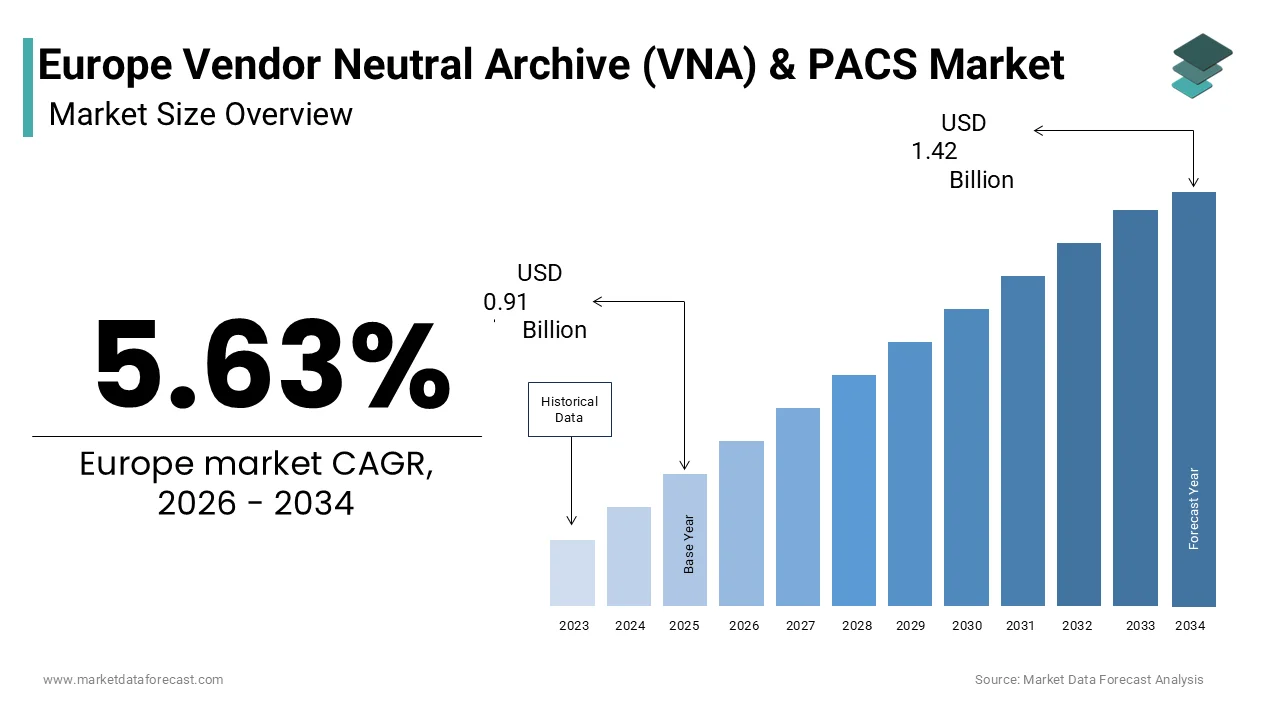
Europe’s Vendor Neutral Archive (VNA) & PACS market, valued at USD 0.87 billion in 2025, is projected to reach USD 1.42 billion by 2034, growing at a CAGR of 5.63%, driven by national digital health mandates, enterprise imaging adoption, and AI-ready interoperable healthcare infrastructure.
Key Market Insights
- 2025 Market Size: USD 0.87 billion
- 2026 Market Size: USD 0.91 billion
- 2034 Forecast: USD 1.42 billion
- CAGR (2026–2034): 5.63%
- Base Year: 2025
- Forecast Period: 2026–2034
Quick Growth Drivers
- Mandates for cross-institutional imaging interoperability under national digital health strategies
- Government funding programs supporting hospital IT modernization
- Rapid growth in CT and MRI imaging volumes
- Transition from siloed departmental PACS to enterprise imaging platforms
- Rising demand for AI-ready imaging repositories supporting advanced diagnostics
Principal Restraints
- High costs and operational complexity of legacy PACS migration
- Long data normalization cycles due to inconsistent historical DICOM metadata
- Budget constraints in small and rural hospitals
- Fragmented national interpretations of GDPR and data residency rules
High-Value Opportunities
- Embedding AI-enabled imaging analytics directly into VNA workflows
- Expansion of cloud-based and hybrid VNA models across public health systems
- Growth in teleradiology and mobile diagnostic viewing
- Adoption of sovereign European cloud frameworks aligned with Gaia-X
Key Market Challenges
- Lack of standardized metadata across legacy imaging archives
- Shortage of skilled professionals in imaging informatics, cybersecurity, and data architecture
- Regulatory complexity limiting cross-border image sharing
- Dependence on external system integrators for enterprise-scale deployments
Fastest-Growing Segments
- Cloud-hosted VNA: 15.3% CAGR — scalability and reduced capital expenditure
- Independent Vendors: 12.7% CAGR — preference for true vendor neutrality
- MRI Imaging Archives: 13.9% CAGR — data-intensive advanced diagnostics
- Mobile-based Architectures: 16.2% CAGR — point-of-care and emergency access
Regional Leadership & Dynamics
- Germany (24.1%) — KHZG funding, strict data sovereignty, enterprise imaging leadership
- United Kingdom (18.7%) — centralized NHS procurement, cloud-first deployment
- France — Ma Santé 2022 and Ségur Numérique mandating interoperable imaging
- Netherlands — benchmark market for national cloud-based image exchange
- Sweden — leader in sovereign cloud VNAs and mobile diagnostic access
What Wins Commercially
- True vendor-neutral architectures compliant with IHE and DICOM
- Cloud-native and hybrid deployments aligned with EU data sovereignty
- Embedded AI orchestration layers within PACS viewers
- Strong cybersecurity, auditability, and MDR-compliant mobile diagnostics
- Proven capability to migrate and normalize large-scale legacy archives
Top Strategic Ask for Executives
Embed AI-ready, cloud-aligned VNA platforms into national digital health workflows while minimizing vendor lock-in and long-term imaging storage costs.
Leading Players
Some of the companies that are playing a dominating role in the Europe Vendor Neutral Archive (VNA) & PACS market include:
- Sectra AB
- Agfa HealthCare
- Dedalus Group
- GE Healthcare
- Philips Healthcare
- Siemens Healthineers
- Fujifilm Corporation
- TeraMedica
Europe Vendor Neutral Archive (VNA) & PACS Market Size
The europe vendor neutral archive (VNA) & PACS market was valued at USD 0.87 billion in 2025 and grew to USD 0.91 billion in 2026. The market is projected to reach USD 1.42 billion by 2034, expanding at a CAGR of 5.63% 2026 to 2034.
Vendor Neutral Archive (VNA) and Picture Archiving and Communication System (PACS) are the two primary technologies used by healthcare providers to manage medical imaging data like X-rays, MRIs, and CT scans. Unlike traditional PACS, which are often siloed within departments or tied to specific imaging equipment vendors, RS VNA solutions provide a standardized cross-enterprise repository compliant with IHE and DICOM protocols. As per sources, a significant majority of university hospitals in Western Europe have adopted vendor-neutral archiving or hybrid systems to facilitate multi-site image sharing and advanced, multi-departmental workflow support. This shift is accelerated by national digital health strategies. The German Hospital Future Act (KHZG) has established a major funding initiative, backed by combined federal and state investments, aimed at accelerating the modernization of IT infrastructure and digitalizing diagnostic and treatment workflows. France’s Ma Santé 2022 strategy, through the Ségur Numérique initiative, mandates the implementation of standardized, interoperable image exchange protocols across healthcare providers to foster a national, shared health record system. Growing volumes of medical imaging across the EU are driving the adoption of scalable, vendor-neutral archiving to enhance AI integration, remote diagnostics, and patient-centric care, reducing redundant examinations.
MARKET DRIVERS
Mandates for Cross-Institutional Imaging Interoperability Under National Digital Health Strategies
European governments are enforcing strict interoperability requirements that compel healthcare providers to adopt vendor-neutral architectures to enable seamless image exchange across care settings, and thereby drive the growth of the Europe vendor neutral archive (VNA) & PACS market. Regional health initiatives are increasingly focused on the broad implementation of electronic health record systems that utilize unified imaging components. Financial support is being directed toward healthcare facilities to facilitate the replacement of older archival systems with modern, standards-compliant technology. National health networks are moving toward the integration of imaging data into federated structures that rely on vendor-neutral standards. Healthcare organizations are working toward higher certification levels that require the adoption of enterprise-wide imaging management solutions. These policy-driven imperatives eliminate vendor lock-in and create structural demand for interoperable imaging infrastructure across Europe’s fragmented but increasingly connected healthcare ecosystems.
Exponential Growth in Medical Imaging Volumes and Storage Demands
The surge in diagnostic imaging procedures across the region is straining legacy PACS systems and accelerating migration to scalable, cloud-ready VNA platforms. This, in turn,n boosts the expansion of the Europe vendor neutral archive (VNA) & PACS market. Medical imaging facilities in Europe have observed a significant rise in diagnostic procedure volume. The adoption of advanced imaging techniques has led to a substantial increase in generated digital information. Growth in data-intensive modalities is straining existing technical infrastructure within healthcare environments. Many regional hospitals are encountering challenges as their localized data repositories reach maximum limits. Limitations in storage capacity have been observed to impact the operational efficiency and speed of clinical workflows. VNAs address this by enabling tiered storage object-based archiving and seamless cloud integration, which reduce total cost of ownership while ensuring rapid retrieval. Moreover, regulatory retention mandates necessitatfuture-proofof scalable solutions that only modern VNA architectures can provide.
MARKET RESTRAINTS
High Costs and Complexity of Legacy PACS Migration and Integration
Transitioning from departmental PACS to enterprise-wide VNA remains a major barrier to the European vendor-neutral archive (VNA) & PACS market. This is due to substantial financial investment, technical complexity, and operational disruption. Implementing comprehensive vendor-neutral archives (VNA), which includes data migration, workflow restructuring, and staff training, requires a substantial financial commitment from European hospitals. The process often requires reconciling decades of non-standardized DICOM metadata with missing patient identifiers. Furthermore, many legacy imaging devices from the early 2000s lack native IHE compatibility, requiring costly middleware or replacement. In areas with limited public hospital budgets, the initiation of VNA projects by healthcare facilities is less frequent. These financial and technical hurdles delay adoption,n particularly in smaller and rural institutions, despite clear long term benefits.
Fragmented Data Governance and Cross-Border Privacy Regulations
Divergent national data protection laws complicate cross-border image sharing and cloud deployment that inhibit the expansion of the Europe vendor neutral archive (VNA) & PACS market. France, Germany, and Austria enforce additional restrictions on international health data storage, supplementing the GDPR's foundational requirements. European legal frameworks for utilizing existing patient imaging data for research are increasingly requiring direct consent from patients due to strict interpretations of data protection regulations. This fragmentation impedes the creation of federated European image archives and limits economies of scale for cloud-based VNA providers. Moreover, the European Union is implementing new regulations that enhance user control over data generated by connected devices, strengthening the portability of metadata and facilitating greater access for third-party services. Hospitals often respond by adopting on-premises or national cloud solutions rather than pan-European platforms, increasing costs and reducing interoperability. These regulatory complexities stifle innovation and delay the realization of a truly integrated European imaging infrastructure.
MARKET OPPORTUNITIES
Integration of AI-Enabled Imaging Analytics into VNA Workflows
The convergence of artificial intelligence and medical imaging is creating a strategic opportunity for VNA platforms to evolve from passive archives into active clinical decision support engines, which is likely to fuel the growth of theEuropeane vendor neutral archive (VNA) & PACS market. Many new archive contracts are incorporating capabilities for automated image analysis for conditions such as lung nodules, brain hemorrhages, and fractures. The integration of artificial intelligence into imaging storage systems increasingly facilitates the direct detection of abnormalities within the archive environment. Initiatives focused on AI in imaging have identified numerous algorithms for clinical use, a trend that relies on vendor-neutral access to data, ensuring that diagnostic algorithms can function across different departments through standardized data access. Companies have embedded AI orchestration layers into their VNA that allow radiologists to trigger and validate algorithms without leaving the viewing environment. Furthermore, VNAs now support structured reporting and quantitative imaging biomarkers, which feed into precision oncology and neurology pathways. This transformation positions VNA not merely as storage infrastructure but as the central nervous system of AI-driven radiology across Europe.
Expansion of Cloud-Based and Hybrid VNA Models in Public Health Systems
Public healthcare systems across the region are increasingly adopting cloud and hybrid VNA architectures to overcome on-premises scalability limits and reduce capital expenditure, which provides fresh prospects for theEuropeane vendor neutral archive (VNA) & PACS market. Healthcare organizations are increasingly transitioning to cloud-based architectures for the procurement of vendor-neutral archives. Regional health initiatives are facilitating a broader movement toward centralized cloud storage solutions. Public health entities are migrating legacy imaging archives to sovereign cloud environments to ensure compliance with regional data privacy regulations. There is a growing preference for managed cloud services that align with established digital conduct codes and data protection frameworks. These models offer elastic storage, automatic updates,s and disaster recovery while maintaining data sovereignty through geo-fencing and encryption. Moreover, the EU’s Gaia X framework promotes trusted European cloud infrastructures that give providers confidence in long-term data residency. This strategic move away from capital intensive on premise systems enables even smaller hospitals to access enterprise-grade imaging management, accelerating VNA adoption across the entire care continuum.
MARKET CHALLENGES
Lack of Standardized Metadata and Inconsistent DICOM Implementation Across Legacy Systems
The absence of uniform metadata standards in historical imaging data complicates migration and cross-system interoperability, which slows down the growth of the Europe vendor neutral archive (VNA) & PACS market. Historical medical imaging archives frequently contain incomplete or non-standardized metadata, necessitating significant manual oversight to ensure patient records remain accurate and searchable. This forces hospitals to undertake labor-intensive manual curation or accept incomplete patient timelines in the VNA. In multi-vendor environments such as those in Italy and Belgium, inconsistent use of IHE profiles like XDS I and WADO further impedes federated query and retrieval. When large medical institutions transition to vendor-neutral storage solutions, the process of aligning and cleaning legacy data typically emerges as the primary time-consuming challenge of the project. The promise of pan-European vendor-neutral image management remains threatened by legacy inconsistencies, which persist without universal IHE integration and DICOM testing at acquisition.
Shortage of Skilled Health IT Professionals for VNA Implementation and Maintenance
The successful deployment and operation of VNA systems in the region are critically constrained by a shortage of professionals with hybrid expertise in radiology informatics,s data architecture, re and cybersecurity, which ultimately limits the expansion of tEuropeanope vendor neutral archive (VNA) & PACS market. There is a recognized shortage of qualified professionals capable of managing medical imaging data and information systems throughout the European region. The scarcity of these specialized technical experts appears to be more pronounced in specific geographical areas, particularly within central and eastern territories. Healthcare facilities have experienced challenges in implementing large-scale vendor-neutral storage solutions because they cannot secure personnel with the necessary technical skill sets, leading to the postponement of critical infrastructure projects. Operational delays often stem from a lack of internal expertise required to oversee the integration of diverse medical imaging systems and to resolve technical conflicts between different equipment manufacturers. Furthermore, the rise of cloud-based and AI-integrated VNAs demands new competencies in data governance and machine learning operations, which are rarely covered in traditional biomedical engineering curricula. National training programs remain fragmented,d with only a few EU countries offering formal certifications in imaging informatics. This human capital bottleneck not only increases reliance on costly external consultants but also risks suboptimal system configuration that undermines interoperability and security, core tenets of the VNA value proposition.
REPORT COVERAGE
| REPORT METRIC | DETAILS |
| Market Size Available | 2025 to 2034 |
| Base Year | 2025 |
| Forecast Period | 2026 to 2034 |
| Segments Covered | By Business Mode, Mode of Delivery, Business Mode, Components, Type of Instruments, Mode of Delivery, and Region. |
| Various Analyses Covered | Global, Regional, and Country-Level Analysis, Segment-Level Analysis, Drivers, Restraints, Opportunities, Challenges; PESTLE Analysis; Porter’s Five Forces Analysis, Competitive Landscape, Analyst Overview of Investment Opportunities |
| Countries Covered | UK, France, Spain, Germany, Italy, Russia, Sweden, Denmark, Switzerland, Netherlands, Turkey, Czech Republic, Rest of Europe |
| Market Leaders Profiled | Acuo Technologies, which leads the global VNA market, is followed by Agfa HealthCare, Carestream Health, Dell, Inc., BridgeHead Software, Fujifilm Corporation, Merge Health, GE Healthcare, Philips Healthcare, Siemens Healthcare, McKesson Corporation, and TeraMedica (U.S.). |
SEGMENTAL ANALYSIS
By Business Mode Insights
The enterprise segment dominated the Europe vendor neutral archive (VNA) & PACS market in 2024 because of strong policy mandates and operational imperatives driving healthcare systems toward unified imaging infrastructure. European public hospitals are increasingly adopting enterprise-wide imaging archives to meet digital transformation standards for funding, supported by EU-wide initiatives for interoperability and data exchange. Germany’s Hospital Future Act provides substantial funding to accelerate the modernization of hospital IT infrastructure, with significant portions supporting the deployment of cross-departmental imaging archives. Driven by the Hospital Future Act, a substantial number of German hospitals are pursuing digital maturity by implementing enterprise imaging systems, with many projects expected to conclude after 2024. These systems eliminate silos between radiology, cardiology, and oncology,y enabling longitudinal patient records and supporting AI analytics that require aggregated data. The European Society of Radiology indicates that consolidating imaging data through enterprise VNAs reduces wasteful, duplicate exams by facilitating universal access to prior studies across departments. This regulatory alignment,nt operational efficiency,ncy and clinical value proposition solidify the enterprise model as the cornerstone of Europe’s imaging informatics strategy.
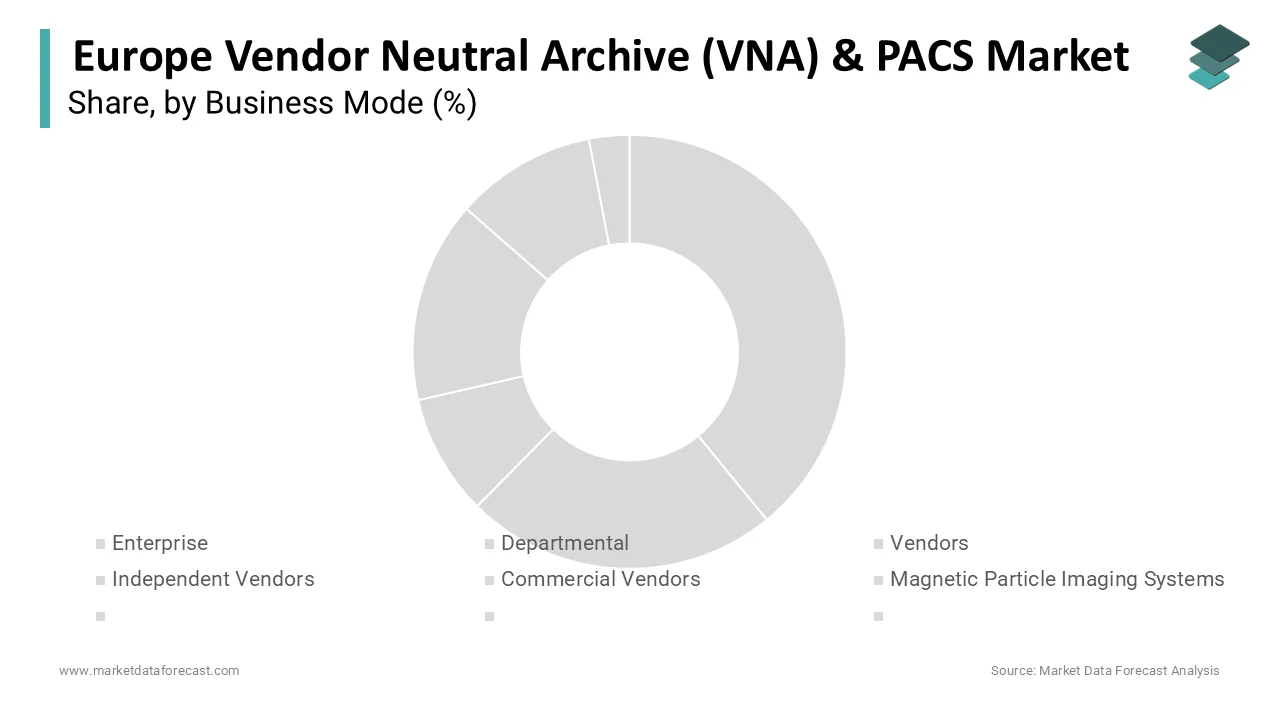
The independent vendors segment is expected to exhibit a noteworthy CAGR of 12.7% from 2025 to 2033 due to growing distrust in proprietary departmental PACS offered by imaging equipment manufacturers,rers which often lock data in vendor-specific formats. Hospitals increasingly favor independent vendors such as Sectra Dedalus and Agfa, who provide truly vendor-neutral platforms certified under IHE EU Connectathon standards. Furthermore, independent vendors offer modular cloud native architectures that integrate seamlessly with national health data exchanges in countries like Denmark and the Netherlands. Their neutrality, agility,y and compliance with EU data sovereignty frameworks position them as the preferred partners for public health systems pursuing digital maturity.
By Mode of Delivery Insights
The on-premise VNA segment continued to hold the largest share of the Europe vendor neutral archive (VNA) & PACS market in 2024. The dominance of the on-premise VNA segment is driven by stringent data residency requirements and risk aversion among large academic medical centers. Regulations in certain European nations restrict storing diagnostic imaging data in cloud environments located outside the region unless specific patient consent is obtained. These data protection requirements regarding patient imaging appear to be causing a shift toward keeping this information within local or regional systems. Healthcare institutions often prefer maintaining imaging data on-premise rather than in the cloud to manage system performance, ensure rapid access to data during high-volume workflows, and address concerns about the long-term management of data recovery and system control. Additionally, ly legacy integration with hospital information systems often favoon-premisesise deployment due to security protocols and network architecture. These institutions trade capital efficiency for enhanced data sovereignty and operational control, a necessary investment when managing sensitive pediatric and oncology imaging datasets. This regulatory and operational reality ensures on premise remains the dominant delivery mode despite the rise of cloud alternatives.
The cloud-hosted VNA segment is predicted to witness the highest CAGR of 15.3% during the forecast period, owing to the emergence of sovereign European cloud infrastructures that comply with GDPR, the EU Cloud Code of Conduct,t and the Gaia X framework. Swedish healthcare imaging archives have moved to a cloud environment, ts ensuring data stays within the country. In the Netherlands, there is a growing use of a national health cloud for hospital archives. These European cloud efforts for healthcare are adding security, such as encryption and audits, to meet standards. These platforms offer elastic scalability,y automatic updates, es and reduced IT staffing needs, critical for smaller hospitals facing radiologist shortages. These developments transform the cloud from a compliance risk into a strategic enabler of equitable imaging access across Europe.
By Type of Instruments Insights
The computed tomography segment led the Europe vendor neutral archive (VNA) & PACS market in 2024. The leading position of the computed tomography segment is attributed to the high-volume generation and data intensity of CT studies across emergency oncology and cardiovascular care. Computed tomography constitutes a significant proportion of total diagnostic imaging volume within regional healthcare networks. The data density of advanced imaging protocols requires considerable capacity for digital information management. Modern diagnostic procedures place substantial demands on systems for storing and accessing medical records. Large-scale medical facilities need scalable storage solutions for managing the consistent influx of patient studies. Broad preventative health initiatives increase the volume of data that must be archived and maintained. The integration of AI for pulmonary nodule detection also depends on rapid access to longitudinal CT series stored in VNAs. These quantitative clinical and operational factors ensure CT remains the dominant imaging modality, shaping VNA architecture and performance.
The magnetic resonance imaging segment is estimated to register the fastest CAGR of 13.9% from 2025 to 2033. The rapid expansion of the magnetic resonance imaging segment is propelled by the rising use of advanced MRI in neurology, oncology,y and musculoskeletal disorders, where quantitative biomarkers and diffusion tensor imaging generate complex multi-sequence datasets. Medical professionals are increasingly utilizing specialized imaging protocols to assist in the early identification of neurodegenerative conditions. The integration of multiple diagnostic imaging techniques has become a more common approach for assessing cognitive health. Clinical practices for oncological screening are shifting toward non-invasive imaging assessments before performing traditional tissue sampling. Regional healthcare standards are placing a greater emphasis on advanced diagnostic imaging as a prerequisite for further invasive medical procedures. There is a broader trend toward adopting high-resolution magnetic resonance technology to improve the accuracy of initial patient evaluations. These exams produce more data than standard X-rays, requiring robust VNA indexing and high throughput retrieval. Furthermore, AI tools for tumor segmentation and fiber tracking demand lossless storage and DICOM compliance, capabilitiesthat only modern VNAs provide. This clinical sophistication and data intensity position MRI as the most dynamically expanding imaging segment.
By Architecture Mode Insights
The cloud-based architecture segment was the largest in the Europe vendor-neutral archive (VNA) & PACS market in 2024. The supremacy of the cloud-based architecture segment is credited to its alignment with national digital health strategies and cost efficiency for public systems. A notable trend indicates that a substantial majority of recent vendor-neutral archive implementations are utilizing cloud-based or hybrid architectures, with fully cloud-native solutions frequently selected for new installations. Governmental policies prioritizing cloud adoption are actively driving the shift toward cloud-native imaging systems, particularly within integrated health systems. Regulatory requirements in certain regions are mandating that vendors support API-based cloud integration for imaging modules, fostering greater interoperability and modernization. There is a clear shift toward, and preference for, cloud-based infrastructure in healthcare imaging management, often required or incentivized by national health initiatives. Cloud platforms enable rapid deployment, automatic scalability,y and seamless access for teleradiology networks, critical in countries like Sweden. The availability of sovereign EU cloud zones from AWS Europe and Google Belgium further alleviates data residency concerns. These political, cyber, cal, and economic synergies establish cloud-based architecture as the prevailing model next-generationtion imaging infrastructure.
The mobile-based architecture segment is anticipated to witness the fastest CAGR of 16.2% from 2025 to 2033, owing to the integration of diagnostic-grade image viewing on secure mobile devices, enabling real-time clinical decision making at the point of care. Emergency medical staff in some areas are increasingly using secure mobile apps to view imaging studies during trauma calls. Mobile viewing systems for diagnostic use on common smartphone operating systems now meet medical device regulations. Updated regional health guidance supports mobile access for authorized clinicians when security and audit trails are maintained. The demand for flexible access among many medical specialists indicates that mobile-based access for clinical images is shifting toward being a clinical necessity.
COUNTRY LEVEL ANALYSIS
Germany Vendor Neutral Archive (VNA) & PACS Market Analysis
Germany was the top performer in the Europe vendor neutral archive (VNA) & PACS market by accounting for a 24.1% share in 2024. The dominance of the German market is driven by its comprehensive Hospital Future Act, which allocated funds for digital imaging infrastructure. The country’s strong engineering culture and dense network of university medical centers demand high performance on premise systems that integrate radiology, cardiology, and pathology. Additionally, Germany enforces strict data sovereignty laws prohibiting non-EU cloud storage of diagnostic images, which shapes vendor selection and architecture design. These regulatory, financialal and technical imperatives position Germany as the most advanced and demanding market for imaging informatics in Europe.
United Kingdom Vendor Neutral Archive (VNA) & PACS Market Analysis
The United Kingdranked aswas the next prominent country in the Europe vendor neutral archive (VNA) & PACS market by capturing a share of 18.7% in 2024. The expansion of the UK market is propelled by centralized procurement under the NHS and aggressive cloud adoption. A substantial majority of acute healthcare organizations have transitioned to cloud-based VNA platforms, driven by national technology strategies. Centralized, national contracts have facilitated the adoption of specific VNA solutions across the healthcare landscape. The implementation of enhanced imaging adoption models has established higher standards for enterprise-wide access to diagnostic images. The requirement for AI-ready infrastructure is acting as a catalyst for the deployment of advanced VNA solutions in integrated health systems. The National Programme for IT in Health has also established a federated image exchange backbone connecting Scotland, Wales, and Northern Ireland. Despite BBrexitt the UK maintains alignment with EU medical device regulatiregulationsring continued access to certified VNA solutions. These coordinated policy and procurement mechanisms create a unified high-velocity market environment that drives rapid innovation and scale.
France Vendor Neutral Archive (VNA) & PACS Market Analysis
France maintains a key position in tEuropeanope vendor neutral archive (VNA) & PACS market due to its Ma Santé national strategy, which mandates interoperable imaging through the Health Data Hub. Public healthcare facilities in France are aligning their imaging systems with a national federated network structure to facilitate data exchange through specific technical standards, which are linked to institutional funding. Significant investment is directed toward upgrading vendor-neutral archives to enhance data management, with regional oversight applied to purchasing processes to prevent vendor lock-in. The national health strategy emphasizes integrating artificial intelligence, particularly for specialized diagnostic support, necessitating that technology providers ensure open access to data. The Agence du Numérique en Santé enforces strict cybersecurity and data residency rules favouring EU-based cloud providers. These top-down digital mandates and investment flows ensure France remains a strategic and high-compliance market for VNA vendors.
Netherlands Vendor Neutral Archive (VNA) & PACS Market Analysis
The Netherlands grew steadily in theEuropean vendor-neutrall archive (VNA) & PACS market owing to its fully integrated national health cloud and early adoption of vendor-neutral principles. Broad participation in a centralized digital infrastructure suggests a move toward unified data hosting that adheres to regional security and privacy standards. The establishment of standardized exchange protocols reflects a pattern of prioritizing interoperability to facilitate medical data sharing across neighboring borders. A shift is observable toward the selection of specialized vendors that provide scalable, cloud-integrated platforms with built-in diagnostic support tools. The integration of remote diagnostic networks indicates a trend toward ensuring comprehensive coverage for urgent care through enhanced mobile accessibility. This mature ecosystem of interoperability cloud infrastructure and policy coherence makes the Netherlands a benchmark for VNA implementation across Europe.
Sweden Vendor Neutral Archive (VNA) & PACS Market Analysis
Sweden is anticipated to expand in the Europe vendor neutral archive (VNA) & PACS market from 2025 to 2033 due to its decentralized yet standardized county council model and leadership in sovereign cloud adoption. Imaging archives across all Swedish regions have transitioned to cloud-based storage within European, nation-specific zones, implementing automatic geo-replication. Long-term retention requirements for diagnostic images, coupled with auditing, have driven the adoption of scalable, cloud-based Vendor Neutral Archive (VNA) architectures. Regulatory standards for medical devices apply to mobile viewing applications, particularly when used for primary diagnosis. The utilization of secure, portable devices by radiologists for remote, after-hours reporting has become common, contributing to faster turnaround times for diagnostic reports. These forward-looking policies around data sovereignty, resilience, and mobile access position Sweden as high-valueue innovation market within the European VNA landscape.
COMPETITIVE LANDSCAPE
Competition in the European VNA and PACS market is characterized by a strategic contest between independent imaging informatics specialists and traditional medical device manufacturers to deliver compliant, interoperable, and scalable enterprise imaging platforms. The market is heavily shaped by national digital health mandates such as Germany’s Hospital Future Act and France’s Ma Santé 2022, which require vendor-neutral architectures as a condition for public funding. Independent vendors like Sectra and Dedalus hold an advantage due to their neutral focus on cross-departmental integration and agility in adopting cloud and AI technologies. In contrast, legacy PACS providers face challenges in transitioning from proprietary silos to open standards. Regulatory complexity further raises barriers with GDPR data residency requirements, national cybersecurity certification,s and the EU Medical Device Regulation governing mobile and AI-enabled viewers. The rise of sovereign European cloud infrastructures has intensified competition around deployment models, with vendors offeringon-premise,se hybrid, and full cloud options. Ultimately youry success depends on balancing technical excellence,ce regulatory compliance, and deep integration with public health ecosystems across a highly heterogeneous but increasingly connected European landscape.
KEY MARKET PLAYERS
A few of the promising companies operating in the Europe vendor neutral archive (VNA) & PACS market profiled in this report are
- Acuo Technologies
- Agfa HealthCare
- Carestream Health
- Dell, Inc.
- BridgeHead Software
- Fujifilm Corporation
- Merge Health
- GE Healthcare
- Philips Healthcare
- Siemens Healthcare
- McKesson Corporation
- TeraMedica (U.S.)
TOP LEADING PLAYERS IN THE MARKET
- Sectra AB is a leading force in the European VNA and PACS market, renowEuropeanr its enterprise imaging platform that integrates radiology, pathology,gy and cardiology into avendor-neutrall environment. Headquartered in Sweden,n the company serves over seven hundred hospitals across Europe with a cloud native architecture compliant with EU data sovereignty and IHE standards. Sectra has strengthened its position by embedding AI orchestration directly into its VNA, enabling radiologists to deploy certified algorithms for lung nodule and fracture detection without workflow disruption. Its innovations reinforce Sectra’s global reputation as a pioneer in ssecuree scalable, and clinician-centric imaging informatics beyond Europe.
- Agfa Gevaert Group plays a pivotal role in the European VNA and PACS market through its Enterprise Imaging suite, te which emphasizes true vendor neutral,ity interoperability, land ong-term data integrity. The company’s VNA solutions are deployed across major academic hospitals in France, Belgium, and Italy,aly where integration with legacy departmental systems is critical. Agfa has recently enhanced its platform with a sovereign cloud deployment model hosted on OVHcloud infrastructure,e ensuring full GDPR compliance and data residency within national borders. Its strategic advancements position Agfa as a trusted partner for public health systems navigating the complex intersection of digital transformation, regulatory compliance,e and clinical utility across Europe and emerging markets.
- Dedalus Group is a key contributor to thEuropeanpe VNA and PACS market, leveraging its deep integration with national health information systems across Southern and Central Europe. The company’s OpenPlatform Imaging solution offers a modular VNA that supportscross-borderr image exchange in compliance with the EU eHealth Digital Service Infrastructure. Dedalus has strengthened its footprint by acquiring regional PACS vendors in Spain and the Czech Republic to accelerate migration to vendor-neutral architectures. Dedalus also partners with the European Institute for Biomedical Imaging Research to standardize metadata during legacy data migration. These actions solidify its role as a regional integrator, uniquely positioned toexecute large-scalee public health imaging strategies while contributing to global interoperability frameworks.
TOP STRATEGIES USED BY THE KEY MARKET PARTICIPANTS
Key players in the European Vendor Neutral Archive and PACS market focus on developing cloud native and hybrid architectures that comply with EU data sovereignty and cybersecurity regulations. They embed AI orchestration layers into VNA platforms to enable seamless deployment of certified diagnostic algorithms without disrupting clinical workflows. Companies invest in mobile-based diagnostic viewers that meet Medical Device Regulation standards for primary interpretation at the point of care. Strategic acquisitions of regional PACS vendors facilitate rapid migration to vendor-neutral systems across fragmented national markets. Additionally, they collaborate with public he,alth authorities to align VNA implementation with national digital health roadmaps and federated health data exchange initiatives.
MARKET SEGMENTATION
This research report on the europe Vendor Neutral Archive (VNA) & PACS Market is segmented and sub-segmented into the following categories.
By Business Mode
- Enterprise
- Departmental
- Vendors
- Independent Vendors
- Commercial Vendors
By Mode of Delivery
- On-Premise VNA
- Hybrid VNA
- Complete Cloud-Hosted VNA
By Business Mode
- Enterprise
- Departmental
By Components
- Hardware
- Software
By Type of Instruments
- X-ray
- Computed Tomography
- Magnetic Resonance Imaging
- Nuclear Imaging
- Ultrasound
By Mode of Delivery
- Mobile Based
- Cloud-Based
- Client-Server Based
By Country
- UK
- France
- Spain
- Germany
- Italy
- Russia
- Sweden
- Denmark
- Switzerland
- Netherlands
- Turkey
- Czech Republic
- Rest of Europe