Europe Video Conferencing Market Size, Share, Trends And Growth Forecasts Research Report, Segmented By Component, Conference Type, Deployment, Application, Enterprise Type, Industry and Country - Industry Analysis (2026 to 2034)
Market Size, 2025
$10.65 BnMarket Estimate, 2026
$11.32 BnMarket Forecast, 2034
$18.43 BnCAGR, 2026–2034
6.28%Europe Video Conferencing Market Report Summary
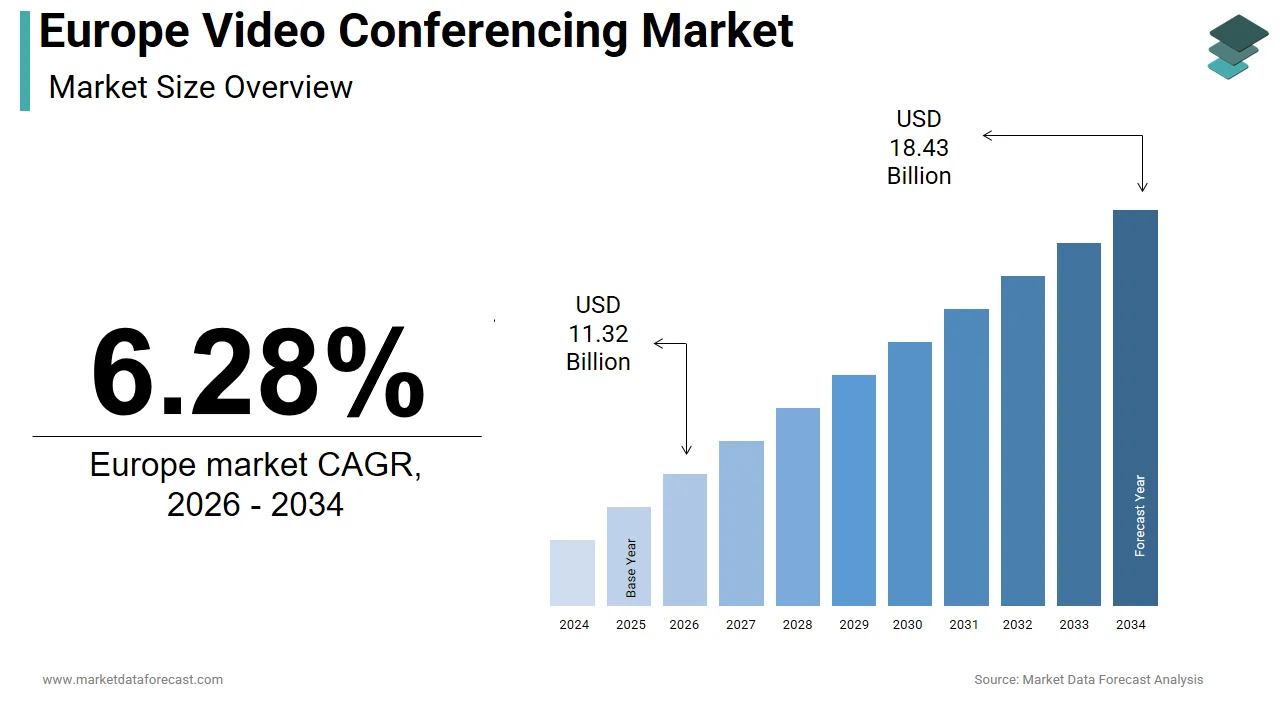
The Europe video conferencing market was valued at USD 10.65 billion in 2025, is anticipated to reach USD 11.32 billion in 2026, and is projected to reach USD 18.43 billion by 2034, growing at a CAGR of 6.28% from 2026 to 2034. Market growth is driven by the widespread adoption of hybrid work models, increasing demand for virtual collaboration tools, and rising investments in digital workplace infrastructure. Enterprises, educational institutions, and government organizations across Europe are leveraging video conferencing platforms to enhance productivity, reduce operational costs, and enable seamless remote communication. The integration of AI-powered features, cloud-based deployment, and enhanced security protocols is further accelerating market expansion.
Key Market Trends
- Rising adoption of hybrid and remote work solutions across corporate and public sectors.
- Increasing integration of AI-driven features such as noise cancellation, real-time transcription, and facial recognition.
- Strong shift toward cloud-based video communication platforms for scalability and flexibility.
- Growing demand for secure and encrypted communication systems in regulated industries.
- Expansion of immersive collaboration tools, including virtual meeting rooms and smart conferencing devices.
Segmental Insights
- Based on component, the software segment led the Europe video conferencing market in 2024 by accounting for 61.4% market share. The segment’s dominance is attributed to rising demand for cloud-based platforms, advanced collaboration features, and easy integration with enterprise productivity tools.
- Based on conference type, the service-based systems segment was the largest, capturing 48.7% share in 2024, supported by growing preference for managed services, technical support, and customized conferencing solutions.
- Based on application, the huddle rooms segment dominated the market by occupying 39.5% share in 2024, driven by increasing adoption of small-group collaboration spaces in corporate offices.
- Based on industry, the IT and telecom segment led the market by capturing 26.8% share in 2024, supported by high digital adoption, distributed workforce models, and continuous innovation in communication technologies.
Regional Insights
The Europe video conferencing market is witnessing steady growth across major economies, supported by digital workplace transformation, enterprise automation, and government-backed technology initiatives.
- Germany was the top performer in 2024, accounting for 22.1% market share, driven by strong industrial digitalization and enterprise IT investments.
- The United Kingdom held the second-largest share, supported by widespread adoption of cloud collaboration tools and remote working practices.
- France is experiencing steady growth, driven by strong state involvement and a strategic push for technological sovereignty and digital infrastructure development.
Competitive Landscape
The Europe video conferencing market is characterized by strong competition among global technology providers and communication solution specialists with diversified product portfolios. Market players are focusing on enhancing AI-powered collaboration tools, strengthening cybersecurity frameworks, and expanding integrated communication ecosystems. Strategic partnerships, continuous product innovation, and cloud infrastructure investments are shaping competitive dynamics across the region.
Prominent companies operating in the Europe video conferencing market include Google LLC, Microsoft Corporation, Cisco Systems, Adobe Inc., Zoom Video Communications, and Logitech International S.A.
Europe Video Conferencing Market Size
The size of the Europe video conferencing market was worth USD 10.65 billion in 2025. The regional market is anticipated to grow at a CAGR of 6.28% from 2026 to 2034 and be worth USD 18.43 billion by 2034 from USD 11.32 billion in 2026.
Video conferencing is a live and real-time technology that connects two or more people in different physical locations through audio, video, and interactive features to conduct meetings, collaborations, and communication. Unlike generic communication tools the European ecosystem is shaped by stringent data governance requirements, interoperability expectations and a strong preference for privacy centric design. Video conferencing in this region extends beyond remote meetings to support hybrid work models, telemedicine consultations and cross border judicial proceedings. According to Eurostat data for 2024 (the most recent available data, which shows a slight increase from 2022), 52.9% of enterprises in the EU with 10 or more employees conducted remote meetings via the internet. This institutional embedding combined with regulatory frameworks like the General Data Protection Regulation defines the distinct character of the Europe video conferencing market where trust security and seamless integration with legacy enterprise systems are non negotiable.
MARKET DRIVERS
Entrenchment of Hybrid Work Models Across Public and Private Sectors
Hybrid work has evolved from a pandemic response to a structural feature of the region’s labor landscape, a change which drives the growth of the Europe video conferencing market. According to sources, many large organizations in the EU have formalized hybrid work policies that mandate dedicated collaboration infrastructure in both offices and remote settings. This institutionalization has spurred investments in room systems with AI-powered framing noise suppression and calendar integration. Moreover, national governments have emphasized that all new public administration buildings include certified video conferencing rooms compliant with the EU’s eGovernment Interoperability Framework. These policy-driven deployments ensure consistent demand beyond volatile consumer trends and anchor the market in long term institutional procurement cycles.
Regulatory Emphasis on Data Sovereignty and Secure Communication Protocols
The region’s strict data protection regime has propelled the expansion of the Europe video conferencing market. The General Data Protection Regulation requires that any communication platform processing personal data of EU citizens implement data minimization and purpose limitation principles, which has led vendors to establish local data centers across Frankfurt Paris and Stockholm. According to research, numerous video conferencing providers underwent compliance audits in 2023, with a portion required to modify their data routing practices. These requirements have elevated the technical and legal barriers to entry, favoring established players with regional infrastructure while accelerating the decline of non compliant global platforms. Consequently, the market is increasingly defined by sovereignty by design rather than feature parity alone.
MARKET RESTRAINTS
Fragmented Interoperability Standards Across Enterprise and Public Sector Ecosystems
Persistent interoperability gaps between legacy telepresence systems Unified Communications platforms and cloud based services is among the key restraints affecting the growth of the Europe video conferencing market. Many public institutions still rely on H.323 based room systems while private enterprises have migrated to SIP or WebRTC protocols creating communication silos. The fragmentation forces organizations to maintain multiple licenses or invest in costly session border controllers and protocol translators. The European Commission’s Interoperable Europe Act aims to resolve this through common API standards but implementation remains uneven across member states. The absence of a standardized framework forces the market to bear ongoing integration overhead, which drives up the lifetime cost for users and making it harder for small and medium enterprises to implement modern technologies.
Persistent Digital Fatigue and Behavioral Resistance to Continuous Virtual Engagement
Prolonged reliance on video conferencing has triggered widespread cognitive exhaustion and declining user satisfaction, which in turn hampers the expansion of the Europe video conferencing market. As per research, a share of knowledge workers reported symptoms of Zoom fatigue including eye strain mental overload and reduced meeting engagement after more than three video calls per day. This behavioral pushback has led companies like Siemens and Unilever to implement “camera optional” policies and asynchronous collaboration mandates. These human-centric limitations are prompting organizations to reduce meeting frequency and invest in alternative tools like digital whiteboards and voice based collaboration. As a result, pure play video conferencing vendors face pressure to evolve into multimodal communication suites or risk declining utilization despite robust infrastructure deployment.
MARKET OPPORTUNITIES
Integration of AI-Driven Productivity and Accessibility Features
Artificial intelligence helps convert from a passive communication channel into an active productivity environment through real time transcription translation, and meeting analytics, which provides new opportunities for the growth of the Europe video conferencing market. European vendors are prioritizing GDPR compliant AI that processes speech locally on edge devices to avoid cloud transmission of sensitive dialogue. In addition, real-time multilingual captioning is breaking language barriers in cross-border business. These features are particularly valuable in inclusive workplaces. As per a study, automated sign language avatars and audio descriptions increased the participation of employees with sensory disabilities. This shift toward intelligent, accessible conferencing aligns with the EU’s Digital Decade goals and opens new value streams beyond basic connectivity.
Expansion into Specialized Vertical Applications Beyond General Enterprise Use
Its rapid penetration into domain-specific sectors, where secure and real-time visual interaction delivers measurable operational value, is setting up major opportunities for the expansion of the Europe video conferencing market. In telemedicine, the European Health Union’s 2023 directive encourages member states to integrate certified video platforms into national eHealth record,s enabling remote diagnostics and chronic care management. In higher education, the European University Association (EUA) reports that the development and implementation of interoperable systems are key goals for enhancing transnational cooperation and facilitating common learning opportunities, such as joint degree programs and blended mobility, which in turn aim to reduce administrative hurdles and improve the student experience, though significant challenges remain. Judicial systems are also adopting purpose-built platforms. These verticalized deployments command higher budgets, longer contracts and stricter compliance requirements creating a resilient growth corridor insulated from fluctuations in general enterprise demand.
MARKET CHALLENGES
Cybersecurity Vulnerabilities in End Point Devices and Third Party Integrations
The expanding attack surface of video conferencing ecosystems poses significant security risks, particularly through compromised webcams, microphones, and calendar plugins, and this in turn constrains the growth of the Europe video conferencing market. There has been an increase in credential stuffing attacks targeting video platform accounts with a portion leading to unauthorized meeting access. Many breaches originate from third party integrations. Endpoint devices remain especially vulnerable. These threats are amplified by the lack of universal security certification for peripheral hardware. "Failure to enforce mandatory security standards across the conferencing stack will leave the market exposed to trust-eroding incidents and significant regulatory penalties.
Geopolitical Tensions Influencing Technology Sourcing and Vendor Neutrality
Geopolitical considerations that prioritize technological sovereignty and vendor diversification hold back the expansion of the Europe video conferencing market. Following heightened scrutiny of non EU platforms the European Commission’s 2023 Secure Connectivity Strategy explicitly encourages public bodies to adopt “trusted” communication solutions developed within the European Economic Area. As a result, countries have migrated government video services to locally developed platforms such as Pexip and Whereby. The EU’s upcoming Digital Markets Act also imposes interoperability obligations on dominant global providers potentially fragmenting the user experience. Simultaneously, export controls on advanced semiconductor components have delayed shipments of AI enabled cameras and codecs from certain Asian manufacturers affecting delivery timelines for integrated room systems. These geopolitical headwinds are accelerating the rise of European born alternatives but also increasing procurement complexity and total cost of ownership as organizations balance performance neutrality and compliance in an increasingly bifurcated global tech landscape.
REPORT COVERAGE
| REPORT METRIC | DETAILS |
| Market Size Available | 2025 to 2034 |
| Base Year | 2025 |
| Forecast Period | 2026 to 2034 |
| Segments Covered | By Component, Conference Type, Deployment, Application, Enterprise Type, Industry, and Country. |
| Various Analyses Covered | Global, Regional and Country-Level Analysis, Segment-Level Analysis, Drivers, Restraints, Opportunities, Challenges; PESTLE Analysis; Porter’s Five Forces Analysis, Competitive Landscape, Analyst Overview of Investment Opportunities |
| Countries Covered | UK, France, Spain, Germany, Italy, Russia, Sweden, Denmark, Switzerland, Netherlands, Turkey, Czech Republic, and the Rest of Europe. |
| Market Leaders Profiled | Google LLC, Microsoft Corporation, Cisco Systems, Adobe Inc., Zoom Video Communications, and Logitech International S.A. |
SEGMENTAL ANALYSIS
By Component Insights
In 2024, the software segment led the Europe video conferencing market by accounting for 61.4% share. The dominance of the software segment is attributed to the region’s rapid shift toward cloud native collaboration platforms that prioritize scalability security and integration with existing enterprise workflows. A further driver of this segment is the widespread adoption of subscription based Unified Communications as a Service models which eliminate upfront capital expenditure and simplify updates. According to Eurostat, 78 percent of enterprises with more than 250 employees in the EU now rely on cloud hosted video platforms that automatically comply with General Data Protection Regulation requirements through EU based data residency. Besides, the European Commission’s Interoperable Europe Cloud initiative has accelerated the deployment of standards-based APIs enabling seamless connectivity between Microsoft Teams Zoom and open source alternatives like Jami. This ecosystem approach reduces vendor lock-in and encourages continuous software innovation in areas such as real time transcription AI moderation and accessibility features strengthening software as the core value layer in Europe’s conferencing infrastructure.
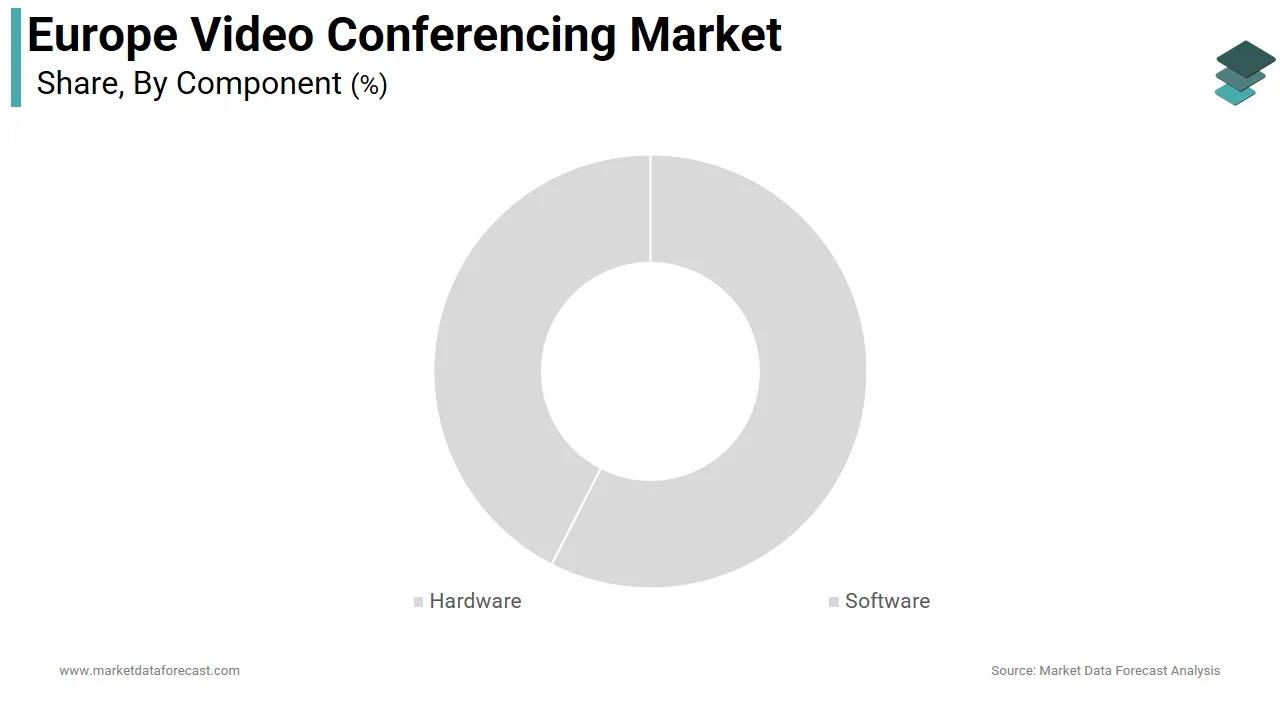
The hardware segment is on the rise and is expected to be the fastest-growing segment in the regional market by witnessing a CAGR of 12.9% from 2025 to 2033. The urgent need to upgrade legacy meeting rooms to support hybrid work parity between in-person and remote participants fuels the growth of the hardware segment. Regulatory mandates are also driving hardware investment. Companies like Logitech and Poly have responded with GDPR compliant devices that process voice data locally to avoid cloud transmission. Furthermore, the rise of sovereign tech initiatives in France and Germany has spurred procurement of hardware manufactured within the European Economic Area. These converging forces position hardware not as a declining legacy category but as a critical enabler of inclusive secure and future proof collaboration environments.
By Conference Type Insights
The service-based systems segment was the largest and captured 48.7% of the Europe video conferencing market in 2024. The prominence of the service-based segment is attributed to the region’s strong preference for operational expenditure models that align with cloud-first digital strategies. Service-based platforms offer automatic updates, centralized administration and built in compliance with EU data protection laws, features highly valued by both public institutions and multinational enterprises. The flexibility of these systems also supports Europe’s diverse linguistic landscape through integrated multilingual transcription and translation powered by on-premises AI engines. Major providers have further strengthened their position by embedding video into broader productivity suites used across education healthcare and justice sectors, which making service based conferencing the default infrastructure for institutional communication across the continent.
The integrated systems segment is expected to exhibit a noteworthy CAGR of 14.2% over the forecast period owing to enterprises seeking turnkey room solutions that deliver consistent high-quality experiences without complex configuration. Integrated systems combine cameras, microphones displays and control interfaces into a single vendor managed package reducing interoperability risks and support overhead. As per studies, companies deploying integrated room kits reduced meeting setup time and IT support tickets compared to best of breed component approaches. The demand is particularly strong in regulated industries. Furthermore, the European Telecommunications Standards Institute’s new EN 301 549 v3.2.1 accessibility standard mandates specific hardware capabilities that integrated vendors can more easily certify than fragmented setups. These operational and compliance advantages are accelerating adoption across both private and public sectors.
By Application Insights
The huddle rooms segment led the Europe video conferencing market by occupying 39.5% share in 2024. The supremacy of the huddle rooms segment is driven by the proliferation of agile office designs that prioritize flexible collaboration over fixed workstations. European enterprises have converted a portion of traditional meeting spaces into huddle rooms since 2020, as per sources, which reflectes a strategic shift toward activity based working. These compact environments typically seat two to six people and require cost effective yet high performance video solutions that ensure remote participants are not disadvantaged. Furthermore, the European Accessibility Act’s 2025 compliance deadline has accelerated the installation of huddle room systems with voice control and real-time captioning, which makes them the focal point of inclusive hybrid collaboration strategies across the region.
The small rooms segment is predicted to witness the highest CAGR of 15.1% from 2025 to 2033. The expansion of the small rooms segment is propelled by the decentralization of work into neighborhood micro offices and home based executive suites. In addition vendors have launched compact all in one devices that deliver studio quality performance in spaces under 15 square meters. Apart from these, the rise of telehealth and remote legal consultations has driven adoption in professional services where image clarity and audio fidelity directly impact service credibility. These dual pressures from distributed work and professional service digitization are transforming small rooms into high growth innovation frontiers.
By Industry Insights
The IT and Telecom segment dominated the Europe video conferencing market by capturing 26.8% share in 2024. The industry’s role as both a primary user and enabler of collaboration infrastructure has significantly contributed to the growth of the IT and Telecom segment. European telecom operators have embedded video conferencing into their enterprise service portfolios offering managed Unified Communications solutions with guaranteed quality of service over private networks. Moreover, IT service providers use video extensively for remote support client workshops and global team coordination. The sector also drives standards development; the European Telecommunications Standards Institute’s recent work on WebRTC security profiles originated from telecom industry requirements. This dual identity as consumer and architect ensures the IT and Telecom segment remains the largest and most influential vertical in the market.
The healthcare segment is estimated to register the fastest CAGR of 16.3% from 2025 to 2033 due to policy mandates and clinical necessity. According to research, the European Health Union is advancing telemedicine integration across member states through regulatory frameworks that promote interoperable video consultation systems by enabling cross-border specialist access for patients. As per sources, clinical studies in Northern Europe suggest that video-enabled postoperative consultations significantly lower hospital readmission rates, which supports the clinical and economic value of remote follow-up care. These regulatory and outcome driven imperatives are transforming video conferencing from an administrative tool into a core clinical modality, which accelerats adoption across hospitals clinics and home care settings throughout Europe.
COUNTRY LEVEL ANALYSIS
Germany Video Conferencing Market Analysis
Germany was the top performer in the Europe video conferencing market by accounting for 22.1% share in 2024. The domination of Germany is primarily driven by its dense concentration of multinational corporations engineering firms and public institutions that demand secure high reliability collaboration systems. Many DAX 30 companies have implemented enterprise-grade video platforms with end to end encryption and on premise recording capabilities. The federal government’s Digital Sovereignty Strategy has further accelerated adoption by mandating that all interagency communication use EU-hosted services compliant with the Gaia X framework. Besides, Germany’s dual education system relies heavily on video conferencing to connect vocational students with industry mentors across training centers. This blend of industrial demand public sector leadership and workforce development infrastructure ensures Germany’s continued market primacy.
United Kingdom Video Conferencing Market Analysis
The United Kingdom held the second-largest share of the Europe video conferencing market in 2024. Despite Brexit, the UK remains a hub for global business and professional services that depend on seamless international collaboration. Many London based law firms and financial institutions use certified video platforms for client meetings regulatory hearings and cross border due diligence, as per sources. Government initiatives have trained public sector workers in secure video use. These institutional deployments combined with strong domestic tech innovation ensure the UK maintains a robust and resilient conferencing ecosystem.
France Video Conferencing Market Analysis
France saw steady growth in the Europe video conferencing market because of strong state involvement and a strategic push for technological sovereignty. The French government’s Cloud Souverain initiative mandates that all ministries and state-owned enterprises use video platforms hosted on French soil. Many universities conduct hybrid lectures via the national France Université Numérique platform, which supports real time captioning in French and regional languages. Furthermore, France’s healthcare system has deployed secure video kiosks in pharmacie,s enabling rural patients to consult specialists without travel. These top down policies combined with cultural preferences for linguistic and data autonomy position France as a distinct and influential market within the European landscape.
Netherlands Video Conferencing Market Analysis
The Netherlands expanded gradually in the Europe video conferencing market. Its advanced digital infrastructure and role as a European logistics and tech hub fuel the growth of the Netherlands. Amsterdam’s data center corridor hosts a portion of EU bound cloud video traffic ensuring low latency and high availability for regional operations. Dutch multinationals have pioneered the use of immersive telepresence for global R and D coordination with dedicated innovation rooms in Eindhoven and Rotterdam. Furthermore, the Netherlands is a testbed for next-generation conferencing. These synergies of infrastructure policy and innovation sustain the Netherlands’ outsized market influence.
Sweden Video Conferencing Market Analysis
Sweden is likely to grow in the Europe video conferencing market during the forecast period owing to sustainable and human centric collaboration design. Many Swedish enterprises use video platforms with carbon footprint tracking features that align with the national climate neutrality target of 2045, according to sources. Public sector adoption is equally advanced. Swedish tech firms have gained international recognition for privacy by design architectures that process metadata locally rather than in centralized clouds. Apart from these, Sweden’s education system mandates digital accessibility in all learning tools, driving adoption of video systems with real time sign language interpretation. This fusion of environmental responsibilit,y inclusivit,y and technical excellence ensures Sweden remains a thought leader in shaping Europe’s conferencing future.
COMPETITIVE LANDSCAPE
The Europe video conferencing market features intense competition among global technology giants, regional specialists and open source providers. Dominant players like Microsoft, Zoo,m and Cisco compete not only on feature sets but on compliance with Europe’s stringent data protection and cybersecurity regulations. Their ability to offer EU-based data residenc,y sovereign cloud options and certified accessibility features creates significant barriers for non compliant entrants. At the same time European born vendors such as Pexip and Whereby gain traction by emphasizing privacy by design local hosting and public sector alignment. The market is further shaped by integration demands with existing enterprise systems like SAP and national eGovernment platforms, which favor vendors with robust API ecosystems. Competition is less about price and more about trust, regulatory alignment and seamless user experience across hybrid work environments. This dynamic fosters continuous innovation in AI driven productivity tools secure hardware and inclusive design while consolidating the market around vendors capable of meeting Europe’s unique institutional and legal expectations.
KEY MARKET PLAYERS
Some of the companies that are playing a dominating role in the Europe video conferencing market include
- Google LLC
- Microsoft Corporation
- Cisco Systems
- Adobe Inc.
- Zoom Video Communications
- Logitech International S.A
TOP PLAYERS IN THE MARKET
- Zoom Video Communications maintains a strong presence in the Europe video conferencing market through its cloud native platform that emphasizes ease of use, scalability and interoperability. The company contributes globally by pioneering frictionless meeting experiences and expanding enterprise-grade security features. Recently Zoom enhanced its European data residency capabilities by launching new in region data centers in Sweden and Ireland to comply with General Data Protection Regulation requirements. It also introduced AI Companion, a privacy focused productivity assistant that processes data on device rather than in the cloud. These initiatives reinforce Zoom’s commitment to secure compliant and intelligent collaboration tailored to European institutional and corporate needs.
- Microsoft leverages its Teams platform as a central pillar of its productivity ecosystem within the Europe video conferencing market. The company integrates video calling deeply with Office 365 Azure Active Directory and Power Platform to deliver unified workflows for enterprises and public sector organizations. Globally Microsoft drives standards in secure collaboration through its compliance with international frameworks including the EU’s Cyber Resilience Act. These actions strengthen its position as a trusted provider of integrated and regulation aligned communication solutions.
- Cisco Systems plays a pivotal role in the Europe video conferencing market through its Webex platform and extensive portfolio of room devices, network infrastructur,e and security solutions. The company contributes globally by advancing open standards, interoperability and hardware innovation for hybrid workspaces. Recentl,y Cisco strengthened its European footprint by achieving compliance with the EU’s stringent data sovereignty requirements through local data processing in its Frankfurt and Paris cloud zones. It also launched Webex AI Assistant with on-device processing to ensure sensitive meeting content never leaves the user’s device. These developments emphasize Cisco’s focus on secure intelligent and infrastructure integrated video collaboration aligned with European regulatory and operational expectations.
TOP STRATEGIES USED BY THE KEY MARKET PARTICIPANTS
Key players in the Europe video conferencing market employ several strategic approaches to reinforce their positions and address regional demands. They prioritize data sovereignty by establishing local data centers and ensuring compliance with the General Data Protection Regulation and Cyber Resilience Act. Companies invest heavily in artificial intelligence features that operate with on-device or on-premises processing to preserve privacy. Strategic partnerships with national cloud providers and public sector integrators enhance trust and procurement access. Continuous enhancement of accessibility features such as real time captioning sign language interpretation and voice navigation aligns with the European Accessibility Act. Besides, vendors focus on interoperability with legacy systems and open standards like WebRTC to reduce adoption barriers across diverse enterprise environments.
MARKET SEGMENTATION
This research report on the Europe video conferencing market has been segmented and sub-segmented into the following categories.
By Component
- Hardware
- Software
By Conference Type
- Telepresence System
- Integrated System
- Desktop System
- Service-based System
- Others (Multiway Technology)
By Deployment
- Cloud
- On-premises
By Application
- Small Rooms
- Huddle Rooms
- Middle Rooms
- Large Rooms
By Enterprise Type
- Small and Medium Enterprises
- Large Enterprises
By Industry
- IT & Telecom
- Government
- Healthcare
- Manufacturing
- BFSI
- Education
- Media & Entertainment
- Others (Chemical)
By Country
- United Kingdom
- France
- Spain
- Germany
- Italy
- Russia
- Sweden
- Denmark
- Switzerland
- Netherlands
- Rest of Europe
Frequently Asked Questions
1. What drives growth in the Europe Video Conferencing Market?
Growth is driven by hybrid work, digital transformation, increasing cloud adoption, AI integration, and demand for real-time secure communication.
2. Which segment leads Europe Video Conferencing Market by deployment?
On-premise deployment is largest in revenue, while cloud video conferencing is the fastest growing segment across Europe
3. How does cloud technology affect Europe Video Conferencing Market?
Cloud enables scalable, flexible, cost-effective solutions, supporting remote and hybrid work across European enterprises and institutions.
4. Which countries lead Europe Video Conferencing Market?
Germany, UK, and France dominate due to high digital infrastructure investment, advanced enterprise user base, and education sector uptake.
5. What role does AI play in video conferencing in Europe?
AI enables automated transcription, noise suppression, virtual backgrounds, language translation boosting user experience and efficiency.
6. How is 5G impacting Europe Video Conferencing Market?
5G provides high-speed, low-latency connections supporting HD video quality and seamless collaboration in mobile and remote environments.
7. What industries fuel Europe Video Conferencing Market growth?
IT, education, healthcare, government, and finance sectors are major adopters of video conferencing for collaboration and communication.
8. What challenges face Europe Video Conferencing Market?
Challenges include data privacy (GDPR), bandwidth limitations, integration complexities, and rising cybersecurity concerns.
9. Who are major providers in Europe Video Conferencing Market?
Key players include Microsoft Teams, Zoom, Cisco Webex, Google Meet, Logitech, and Polycom with strong European market shares.
10. How do GDPR regulations affect Europe Video Conferencing Market?
GDPR compliance requires strong data protection, encrypted transmissions, and secure meeting policies, critical for market adoption.
Related Reports
Access the study in MULTIPLE FORMATS
Purchase options starting from
$ 2000
Didn’t find what you’re looking for?
TALK TO OUR ANALYST TEAM
Need something within your budget?
NO WORRIES! WE GOT YOU COVERED!
Call us on: +1 888 702 9696 (U.S Toll Free)
Write to us: sales@marketdataforecast.com