- Product Description Description
- Table of Contents TOC
- List of Table & Figure LOT
- Get Free Sample PDF Sample PDF
Market Size, 2025
$98 BnMarket Estimate, 2026
$110 BnMarket Forecast, 2034
$267 BnCAGR, 2026–2034
11.73%Summary of Europe Video Game Market
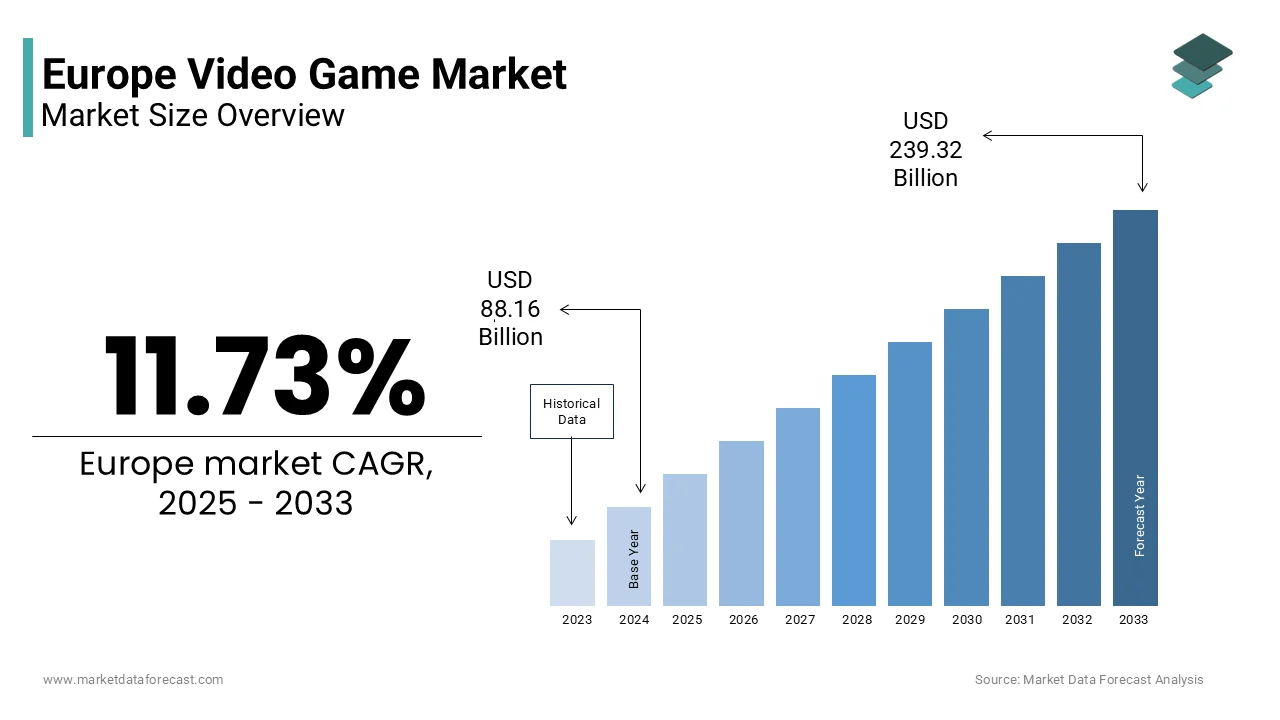
The Europe video game market size was valued at USD 98.51 billion in 2025 and is projected to reach USD 267.32 billion by 2034 from USD 110.07 billion in 2026, growing at a CAGR of 11.73%. Growth is driven by rising digital spending, strong adoption of mobile and online gaming, expanding cross-platform ecosystems, and increasing cloud gaming penetration across major European countries.
Market Highlights
- The Europe video game market was valued at USD 98.51 billion in 2025.
- The market is expected to reach USD 267.32 billion by 2034.
- CAGR (2026–2034): 11.73%
- Mobile gaming accounted for 48.3% share in 2024, making it the largest device segment.
- Online gaming was the dominant type segment in 2024.
- The United Kingdom led the regional market with 18.7% share in 2024; Germany followed with 15.4%.
Competitive Landscape
The European video game market is characterized by a dynamic mix of global gaming giants, regional publishers, and fast-growing indie studios. Leading companies focus on expanding digital ecosystems, improving cross-platform experiences, and leveraging cloud-based delivery to attract broader demographics. The competitive landscape is shaped by innovation in game design, culturally driven storytelling, and regulatory adaptation across European markets.
Prominent players in the Europe video game market include Sony Interactive Entertainment, Microsoft Studios, Ubisoft Entertainment, CD Projekt Red, EA Sports, Nintendo, Rockstar Games, Epic Games, Activision Blizzard, Bandai Namco, Sega Corporation, Paradox Interactive, Zynga, Square Enix, and Supercell.
Europe Video Game Market Size
The Europe video game market size was valued at USD 98.51 billion in 2025 and is projected to reach USD 267.32 billion by 2034 from USD 110.07 billion in 2026, growing at a CAGR of 11.73%.
The video game includes commercial games, free-to-play titles, subscription services, and user-generated content ecosystems that blend entertainment with social interaction and digital creativity. Unlike passive media, video games are defined by real-time user agency, procedural storytelling and persistent virtual economies. According to Eurostat, European households with internet access engaged in video gaming in 2025, with the average weekly playtime exceeding 7.2 hours among users aged 16 to 34. As per the European Audiovisual Observatory, many independent game studios operate across the E, U, with France, Germany and the United Kingdom hosting the highest concentrations. The European Commission notes that video game exports from the EU are reflecting strong global demand for European-designed intellectual property.
MARKET DRIVERS
WHAT ARE THE KEY TRENDS AND GROWTH DRIVERS SHAPING THE EUROPE VIDEO GAME MARKET?
Proliferation of High Speed Broadband Enabling Cloud and Multiplayer Experiences
The widespread availability of high-speed fixed and mobile broadband across Europe has fundamentally expanded access to online and cloud-based gaming is driving the growth of the European video game market. According to the European Commission, there is a growing number of households with access to gigabit-capable networks in 2025. This infrastructure supports low-latency multiplayer sessions and seamless streaming via cloud platforms like Xbox Cloud Gaming and NVIDIA GeForce Now. This connectivity foundation transforms gaming from a device-dependent activity into an always available service accessible across smartphones, tablets, and smart TVs, thereby broadening the demographic and geographic reach of the market.
Cultural Recognition of Games as a Legitimate Art Form
The progressive cultural policy framework has elevated video games to the status of protected creative expression, thereby stimulating investment and talent retention,, is accelerating the growth othe f the European video game market. According to the European Parliament, video games are formally recognised under the Creative Europe program as a cultural and educational medium eligible for public funding. In 2025, national film and media institutes in 18 EU countries provided direct grants to game developers, with France’s CNC allocating 42 million euros and Germany’s FilmFernsehFonds Bayern contributing 28 million euros specifically for narrative and experimental titles. This institutional validation reduces stigma, attracts cross-sector talent from film and literature and encourages publishers to back ambitious non-formulaic projects.
MARKET RESTRAINTS
WHAT FACTORS ARE LIMITING THE GROWTH OF THE EUROPE VIDEO GAME MARKET?
Stringent Age Rating and Content Regulation Limiting Creative Scope
The rigorous content regulation system imposes significant compliance burdens that constrain creative freedom, and market entry is the sole restraining factor for the growth of the European video game market. While the Pan European Game Information system provides a voluntary rating framework, national authorities retain enforcement power, leading to inconsistent interpretations. According to the European Federation of Game Archives Museums and Preservation Projects, developers in Germany and Austria faced 23 % longer certification delays in 2025 due to additional scrutiny of violent or political themes. The UK’s Video Standards Council reported that 12 % of submitted titles required content modifications to meet British Board of Film Classification standards. Moreover, the European Commission’s Digital Services Act mandates proactive monitoring g user-generated content in online games, increasing moderation costs.
High Development Costs and Talent Retention Pressures
The escalating cost of producing competitive AAA and even mid-tier video games is likely to hamper the growth of the European video game market. The senior developers received overseas job offers in 2025 with average salary premiums of 35 % from North American studios. AI and animation specialists left European game companies in 2025 for roles in film visual effects or US-based tech firms. Public funding often covers only pre-production, leaving studios exposed during costly development phases. The Polish studios secured post-launch marketing support in 2025, limiting global visibility.
MARKET OPPORTUNITIES
WHAT NEW OPPORTUNITIES ARE EMERGING IN THE EUROPE VIDEO GAME MARKET?
Integration of Games into Formal Education and Skills Development
The strategic alignment of video games with digital literacy and STEM education is expected to substantially enhance the growth of the European video game market. The secondary schools in the EU incorporated game-based learning tools in 2025 to teach coding history and civic engagement. Finland’s Education Ministry integrated game design into its national curriculum, with upper secondary schools offering programming through game creation platforms. The vocational colleges now offer certified game development tracks focusing on 3D modelling and AI scripting.
Rise of EuropeNarrative-Drivenven Indie Games in Global Markets
The developers are capitalising on a global appetite for emotionally resonant story-rich experiences that differentiate from mainstream action-oriented franchises, which is in addition to leveraging the growth of the European video game market. Games like “Norco” from France and “Signalis” from Germany garnered acclaim for their atmospheric storytelling and philosophical depth. The success of public support for auteur-driven development, where creators retain intellectual property rights. Digital storefronts now feature dedicated “European Stories” collections, boosting visibility. Moreover, festivals like Gamescom and PAX Europe provide curated showcases that connect developers with international publishers.
MARKET CHALLENGES
WHAT ARE THE MAIN CHALLENGES FACING THE EUROPE VIDEO GAME MARKET?
Monetisation Model Fatigue Among European Consumers
The European gamers are increasingly resistant to aggressive monetisation tactics such as loot boxes and pay-to-win mechanics, leading to declining engagement, and revenue volatility is likely to hinder the growth of the European video game market. Belgium’s Gaming Commission maintained its 2018 ban on loot boxes, and in 2025, the Netherlands Authority for Consumers and Markets fined two publishers for non-compliant mechanics. This consumer pushback forces developers to adopt transparent models like cosmetic-only microtransactions or premium pricing, which yield lower short-term revenue.
Fragmented Language and Localisation Requirements
The linguistic diversity imposes significant costs and delays in game localisation that hinder timely global releases and market penetration. Developers must translate dialogue user interfaces and marketing assets to access national audiences effectively with 24 official EU languages. According to the European Federation of Game Archives Museums and Preservation Projects, the average European game requires localisation into 8 languages to achieve broad regional coverage, adding 12 to 18 weeks to release schedules. The cost of professional gamlocalisation ranges from 15000 to 45000 euros per language, as per the European Language Industry Association. Smaller studios often prioritise English, French, German and Spanish, opting for Eastern and Southern European markets. Machine translation tools remain inadequate for narrative nuance and cultural context.
REPORT COVERAGE
| REPORT METRIC | DETAILS |
| Market Size Available | 2025 to 2034 |
| Base Year | 2025 |
| Forecast Period | 2026 to 2034 |
| Historical Years | 2019 to 2025 |
| CAGR | 11.73% |
| Segments Covered | By Device, Type, and Region |
| Various Analyses Covered | Global, Regional, & Country Level Analysis; Segment-Level Analysis; DROC, PESTLE Analysis; Porter’s Five Forces Analysis; Competitive Landscape; Analyst Overview of Investment Opportunities |
| Regions Covered | UK, France, Spain, Germany, Italy, Russia, Sweden, Denmark, Switzerland, Netherlands, Turkey, and the Czech Republic |
| Market Leaders Profiled | Sony Interactive Entertainment, Microsoft Studios, Ubisoft Entertainment, CD Projekt Red, EA Sports, Nintendo, Rockstar Games, Epic Games, Activision Blizzard, Bandai Namco, Sega Corporation, Paradox Interactive, Zynga, Square Enix, and Supercell |
SEGMENTAL ANALYSIS
By Device Insights
The mobile gaming segment accounted in holding 48.3% of the share in 2025, from near universal smartphone penetration and the accessibility of free-to-play titles that require no upfront investment. The demand for mobile games is driven by hyper casual and social titles like “Royal Match” and “Monopoly GO”. High-speed coverage further enhances engagement. As per the Body of European Regulators for Electronic Communications, 78% of urban populations had access to 5G networks in 2025 by enabling seamless multiplayer and cloud streaming on mobile devices. Additionally, app stores provide frictionless discovery and one-click purchasing.
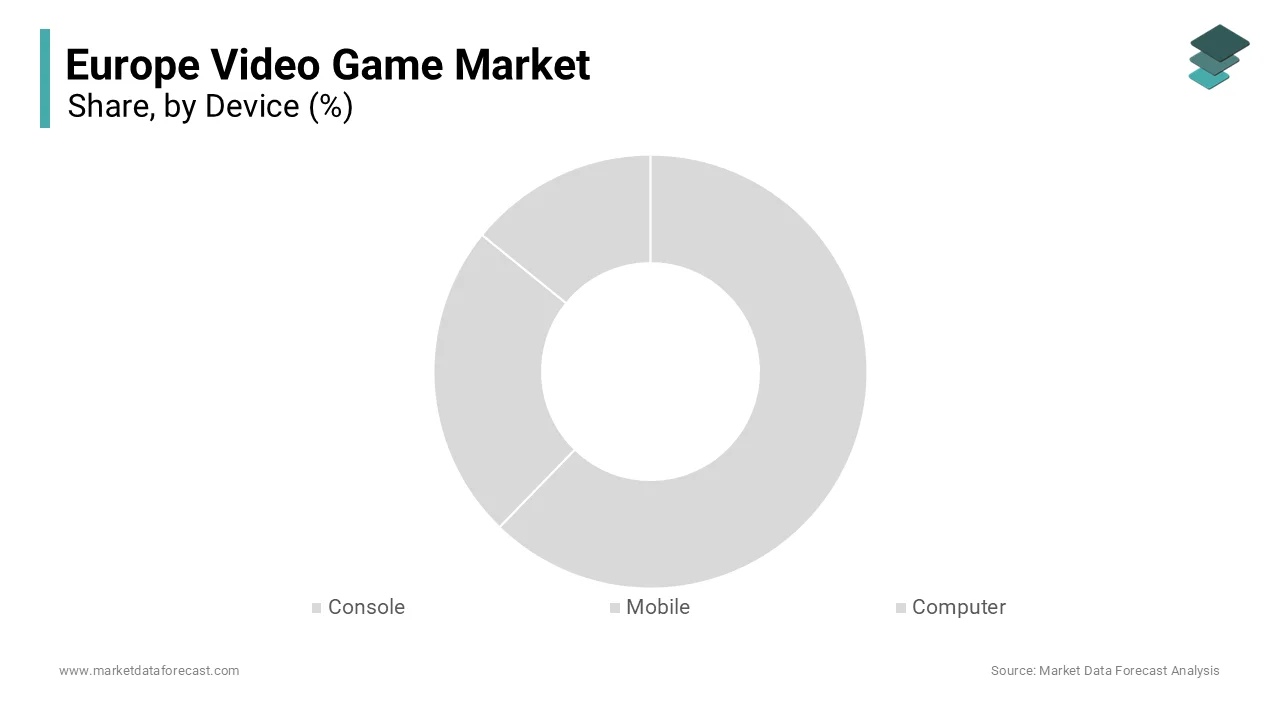
The computer gaming segment is likely to grow with a prominent CAGR of 9.6% throughout the forecast period, with the rise of competitive esports, indie development and hardware democratisation. Over 28 million Europeans participated in organised PC gaming tournaments or leagues in 2025, with titles like “League of Legends” and Counter-Strike driving sustained engagement. Steam remains the dominant distribution platform with Valve reporting that European users accounted for 34 % of global active accounts in 2025. Crucially, the cost of entry has declined. Moreover, European indie studios overwhelmingly develop for PC first.
By Type Insights
The online gaming segment was the largest by holding a significant share of the European video game market in 2025, with the social and persistent nature of modern gameplay, where connectivity enables multiplayer competition, on cooperative missions and live service economies. According to the European Gaming Observatory, 79% of European gamers aged 12 to 35 played online at least once per week in 2025, with average session durations exceeding 90 minutes. The success of live service titles like “FIFA Ultimate Team” and “Genshin Impact” hinges on real-time updates, seasonal content and in-game economies that require constant internet access. Furthermore, cloud gaming services such as Xbox Cloud Gaming and GeForce Now operate exclusively online, further blurring the line between local and streamed experiences.
The offline gaming segment is expected to grow at the fastest CAGR of 8.3% throughout the forecast period, with consumer fatigue with monetisation pressure, privacy concerns and demand for narrative completeness. According to the European Consumer Organisation, surveyed gamers in 2025 expressed a preference for single-player story-driven experiences that do not require constant connectivity or in-game purchases. Publishers have responded with premium offline titles. Additionally, rural and peri-urban populations with limited broadband rely on offline modes. Furthermore, data privacy regulations like the General Data Protection Regulation have heightened awareness of telemetry collection in online games, prompting privacy-conscious users to choose offline alternatives.
REGIONAL ANALYSIS
United Kingdom Market Analysis
The United Kingdom was positioned top by holding 18.7% of the European video game market share in 2025, with a mature development ecosystem, strong publishing infrastructure and early adoption of digital distribution. According to the UK’s Department for Science, Innovation and Technology, the country hosts many active game studios, including global leaders like Rockstar North and Creative Assembly. As per the UK Games Industry Census, developers work on cross-platform titles with a strong export orientation. Additionally, London and Manchester serve as hubs for game tech startups specialising in AI-driven NPCs and procedural animation.
Germany Market Analysis
Germany's video game market was positioned next by capturing 15.4% of the share in 2025, which lies in a large domestic consumer base robust hardware retail sector, and a growing indie scene supported by public funding. As per the German Games Industry Association, some studios operate nationwide with clusters in Berlin, Hamburg and Munich, focusing on simulation strategy and educational games. Public investment is significant.
France Market Analysis
The French video game market is growing with significant growth opportunities during the forecast period. French mobile developers dominate casual gaming globally. Education also plays a crucial role. The Ministry of National Education integrated game design into 120 technical high schools in 2025, cultivating a pipeline of animators and scriptwriters.
COMPETITIVE LANDSCAPE
HOW ARE LEADING COMPANIES SHAPING THE EUROPE VIDEO GAME MARKET?
KEY MARKET PLAYERS
Some of the notable key players in the European video game market are
- Sony Interactive Entertainment
- Microsoft Studios
- Ubisoft Entertainment
- CD Projekt Red
- EA Sports
- Nintendo
- Rockstar Games
- Epic Games
- Activision Blizzard
- Bandai Namco
- Sega Corporation
- Paradox Interactive
- Zynga
- Square Enix
- Supercell
TOP STRATEGIES USED BY THE KEY MARKET PLAYERS
Key players in the European video game market focus on narrative authenticity, culturallocalisationn and compliance with regional regulations to build trust and engagement. They invest in live service models that extend game lifecycles through seasonal content and community events. Many prioritise cross-platform play to unify player bases across console, PC, and mobile. Strategic partnerships with European educational institutions foster talent development and R and D collaboration. Companies also adopt transparency practices to align with consumer sentiment and regulatory scrutiny. Additionally, they leverage public funding and tax incentives to support ambitious projects. These strategies reflect a balance between global scalability and European cultural and policy specificity.
COMPETITION OVERVIEW
The European video game market features a multifaceted competitive landscape where global publishers, European developers, and indie studios vie for attention across diverse genres and platforms. Major international players like Sony, Microsoft, and Nintendo dominate hardware and first-party content, yet face strong competition from homegrown studios such as Ubisoft, D Projekt and Hazelight that emphasise narrative depth and cultural identity. The indie segment thrives due to public funding, digital storefronts,s, and festivals like Gamescom and PAX Europe, which amplify visibility. Competition is further intensified by mobile giants like Voodoo and Tilting Point that specialise in hyper casual and mid-core experiences tailored to European user behaviour. Unlike markets driven purely by scalability, it rewards creativity, regulatory compliance and linguistic nuance.
TOP PLAYERS IN THE MARKET
- Ubisoft is a cornerstone of the European video game market with a legacy of globally recognised franchises such as “Assassin’s Creed” “, F, Far Cry”, and “Rainbow Six”. Headquartered in France, the company operates over 20 studios across Europe, including major hubs in Sweden, Romania and Germany. Ubisoft contributes significantly to the global market by pioneering open-world design and live service ecosystems that blend single-player narratives with multiplayer engagement. The company also expanded its Ubisoft Connect platform across European territories to unify player progression and social features. Additionally, it partnered with European universities to establish game design scholarships, reinforcing talent pipelines and regional development capacity.
- CD Projekt has emerged as a defining force in the European video game market through its narrative-driven role-playing games developed by its subsidiary CD Projekt Red. Based in Poland, the company gained global acclaim with “The Witcher” series and “Cyberpunk 2077”, which showcase Eastern European storytelling and technical ambition. CD Projekt contributes to the global industry by championing player-friendly policies such as DRM-free distribution via its GOG platform. It also invested in proprietary REDengine upgrades to support next-generation AI and physics simulations.
- Although headquartered in Japan, Nintendo maintains a profound presence in the European video game market through its hardware ecosystem and first-party software. The Nintendo Switch remains one of the best-selling consoles in Europe with strong adoption in the UK, Germany, and France. Nintendo contributes globally by blending accessibility, innovation family-oriented design that appeals across age groups. It also launched region-specific marketing campaigns for “The Legend of Zelda: Tears of the Kingdom” featuring European landmarks and languages. Furthermore, Nintendo strengthened partnerships with European retailers to ensure hardware availability and introduced parental control features aligned with EU child safety guidelines.
MARKET SEGMENTATION
This research report on the European video game market has been segmented and sub-segmented based on categories.
By Device
- Console
- Mobile
- Computer
By Type
- Online
- Offline
By Country
- UK
- France
- Spain
- Germany
- Italy
- Russia
- Sweden
- Denmark
- Switzerland
- Netherlands
- Turkey
- Czech Republic
- Rest of Europe