Latin America Video Game Market Size, Share, Trends & Growth Forecast Report By Device (Console, Mobile, Computer), Type (Online, Offline), and Country (Brazil, Mexico, Argentina, Chile, Rest of Latin America) – Industry Analysis, 2026 to 2034
Market Size, 2025
$26.12Market Estimate, 2026
$29.56Market Forecast, 2034
$79.47CAGR, 2026–2034
13.16%Latin America Video Game Market Size
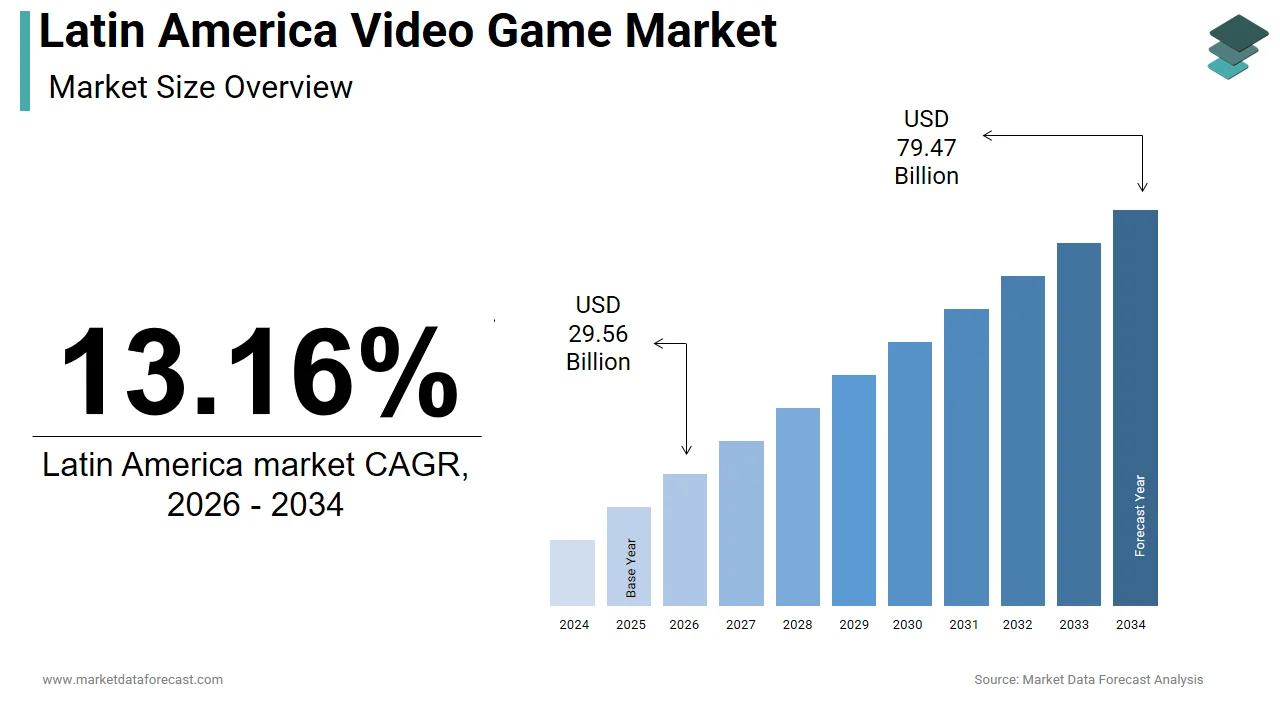
The size of the Latin America video game market was valued at USD 26.12 billion in 2025. This market is expected to grow at a CAGR of 13.16% from 2026 to 2034 and be worth USD 79.47 billion by 2034 from USD 29.56 billion in 2026.
The Latin America video game market growth is driven by increasing digital penetration, rising disposable incomes, and a growing youth population. The region comprises major economies such as Brazil, Mexico, Argentina, and Colombia, each contributing uniquely to the development and consumption of gaming content. As per Newzoo’s 2023 Global Games Market Report, Latin America accounted for approximately 4% of global games market revenues, with Brazil alone contributing over 50% of the regional revenue. Moreover, the rise of local game developers and increased investment from international studios into regional markets reflect a shift toward recognizing Latin America not just as a consumer base but also as a potential creator hub. As of 2023, Brazil hosted over 150 active game development studios, while Mexico and Argentina have seen notable increases in venture capital interest in their gaming ecosystems, according to the Latin American Video Game Association (LAVGA).
MARKET DRIVERS
Rising Internet Penetration and Mobile Device Adoption
The rapid expansion of internet access and mobile device ownership across the region is prompting the growth of the Latin America video game market. According to Hootsuite’s 2023 Digital Trends Report, internet penetration in Latin America reached approximately 76%, up from 69% in 2020, enabling broader access to online and mobile gaming platforms. This surge in connectivity has been further supported by investments in 4G and 5G infrastructure, particularly in urban centers. As a result, mobile-first platforms such as Google Play and Apple App Store have reported significant user growth from the region. Sensor Tower’s 2023 app store analytics indicated that Latin America accounted for over 10% of global mobile game downloads, with Brazil ranking among the top ten countries globally in terms of game installs. Additionally, the affordability of mobile devices compared to PCs or consoles makes them the preferred choice for many consumers.
Youth Demographics and Increasing Disposable Income
The youthful population and rising disposable income levels are also additionally to fuel the growth of the Latin America video game market. According to the United Nations World Population Prospects 2023, nearly 25% of Latin America’s population falls within the 15–29 age bracket, making it one of the youngest regions globally. In tandem with favorable demographics, disposable income has shown steady growth in several Latin American economies. This economic upliftment has enabled a larger portion of the population to invest in digital entertainment, including premium mobile games, in-app purchases, and subscriptions to services like Xbox Game Pass and PlayStation Plus. Furthermore, a Nielsen Entertainment & Media Outlook 2023 survey found that 61% of Latin American millennials engage in gaming weekly, with 44% willing to spend on virtual goods and premium content.
MARKET RESTRAINTS
Economic Volatility and Currency Instability
The persistent economic volatility and currency instability prevalent in several key countries is one of the major factors that is limiting the growth of the Latin America video game market. Nations such as Argentina, Venezuela, and even Brazil face frequent fluctuations in inflation rates and exchange values, which directly impact consumer purchasing power and developer profitability. According to the International Monetary Fund (IMF) World Economic Outlook 2023, Argentina experienced an annual inflation rate exceeding 100%, significantly eroding real income growth and discouraging discretionary spending, including on digital entertainment. Currency devaluation also poses a challenge for international publishers operating in the region. For instance, when the Brazilian real depreciates against the US dollar, game prices denominated in USD effectively increase for local consumers. Moreover, unstable macroeconomic conditions deter long-term investment in local game development studios. The Inter-American Development Bank (IDB) highlighted in its 2023 Innovation Report that startups in creative industries, including gaming, struggle to secure consistent funding amid unpredictable fiscal environments.
Limited Infrastructure for High-Speed Broadband and Console Gaming
The uneven availability of high-speed broadband and underdeveloped console gaming infrastructure are also restrain the growth of the Latin America video game market. Unlike mobile gaming, which benefits from widespread 4G coverage, PC and console gaming require stable, high-bandwidth internet connections, which remain inaccessible to large portions of the population. Console penetration is also notably low compared to other global regions. The Latin American Video Game Association (LAVGA) reported in 2023 that less than 10% of households in the region own a next-generation gaming console, with most players relying on second-hand or imported units due to limited official retail presence. High import taxes and logistics barriers further inflate console prices, making them unaffordable for the majority. For example, in Brazil, import duties on foreign electronics can exceed 50%, as outlined by the Brazilian Ministry of Economy’s 2023 tariff regulations.
MARKET OPPORTUNITIES
Expansion of Esports and Competitive Gaming Ecosystems
The rapid growth of esports and competitive gaming ecosystems is steadily creating huge growth opportunities in the next coming years. Over the past few years, the region has witnessed a surge in organized tournaments, professional teams, and sponsorship deals, which is signaling a maturing landscape for competitive gaming. Esports events such as ESL Latin America Series and Gamers8 LATAM have attracted millions of viewers and secured sponsorships from global brands like Red Bull, Razer, and Logitech. Furthermore, streaming platforms like Twitch and YouTube Gaming have played a pivotal role in amplifying visibility. Twitch’s 2023 Year in Review noted that Latin America ranked third globally in terms of hours watched, with Brazilian streamers dominating viewer engagement. This growing digital footprint provides game developers and publishers with a ready-made audience for live events, merchandise sales, and in-game advertising.
Rise of Indie Game Development and Localized Content Creation
The emergence of independent game development and the push for culturally relevant content is solely to create other opportunities for the Latin America video game market growth. Traditionally reliant on imported titles, the region is now witnessing a boom in homegrown studios producing original games tailored to local narratives, folklore, and social themes. According to the Latin American Video Game Association (LAVGA), over 300 indie studios were actively developing games in 2023, a 40% increase from 2020. The growth of crowdfunding platforms like Kickstarter and Itch.io has further empowered these developers to bypass traditional publishing models. This localization trend resonates deeply with regional audiences and enhances global appeal by offering unique perspectives.
MARKET CHALLENGES
Piracy and Lack of Digital Rights Enforcement
The widespread prevalence of software piracy and weak enforcement of digital rights is limiting the growth of the Latin America video game market. Despite the growing digital infrastructure, unauthorized distribution of pirated games remains rampant, undermining legitimate sales and discouraging investment in regional content creation. According to the Business Software Alliance (BSA) 2023 Global Software Survey, software piracy rates in Latin America averaged around 58%, with some countries like Ecuador and Argentina exceeding 65%. Piracy thrives due to a combination of factors, including high game prices relative to local income levels, limited regional pricing flexibility, and inadequate legal deterrents. A 2023 study by the Latin American Intellectual Property Institute (LAIP) found that over 70% of gamers in Brazil and Mexico had accessed pirated games at least once, primarily through torrent sites or cracked launchers. Moreover, enforcement agencies often lack the resources or technical expertise to track and shut down illegal distribution networks effectively.
Regulatory Uncertainty and Taxation Barriers
Regulatory uncertainty and complex taxation structures is likely to hinder the growth of the Latin America video game market. Each country operates under distinct legal frameworks governing digital commerce, content classification, and tax obligations, creating operational complexities for publishers and developers. According to the World Bank’s 2023 Doing Business Report, compliance with digital trade regulations in Latin America requires an average of 150 hours annually per business, significantly higher than the global average of 104 hours. Taxation policies further complicate market entry. In Brazil, for example, the federal government imposes a 27% ICMS (state value-added tax) on digital product sales, including video games and in-app purchases, making digital storefronts more expensive for consumers.
REPORT COVERAGE
| REPORT METRIC | DETAILS |
| Market Size Available | 2025 to 2034 |
| Base Year | 2025 |
| Forecast Period | 2026 to 2034 |
| Segments Covered | By Device, Type, and Region. |
| Various Analyses Covered | Global, Regional, and Country-Level Analysis, Segment-Level Analysis, Drivers, Restraints, Opportunities, Challenges; PESTLE Analysis; Porter’s Five Forces Analysis, Competitive Landscape, Analyst Overview of Investment Opportunities |
| Countries Covered | Brazil, Mexico, Argentina, Chile, Rest of Latin America |
| Market Leaders Profiled | Activision Blizzard, Take-Two Interactive Software, Inc., Epic Games, Electronic Arts Inc., Lucid Games, Microsoft Corp., Nintendo, Rovio Entertainment Corporation, Sony Interactive Entertainment Inc., and Tencent Holdings Ltd. |
SEGMENTAL ANALYSIS
By Device Insights
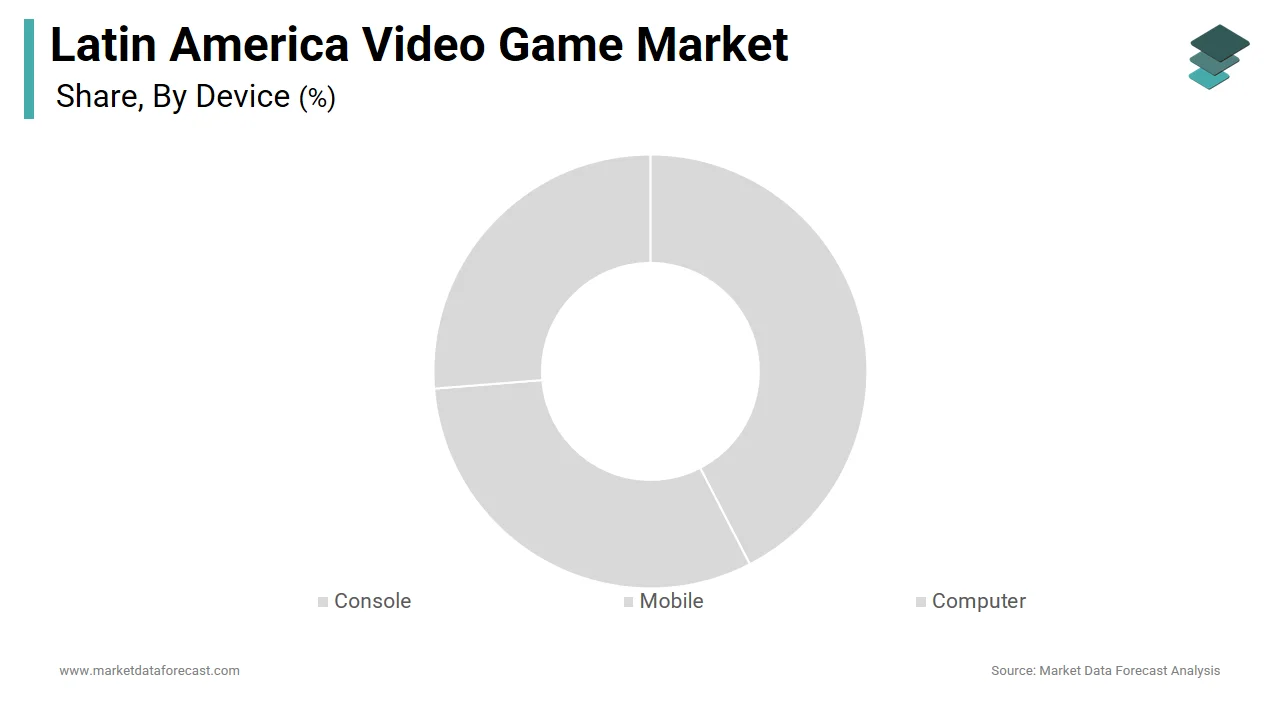
The mobile gaming segment dominated the Latin America video game market with largest share in 2025 with the widespread adoption of smartphones and the affordability of mobile-based entertainment compared to traditional PC or console platforms. In Brazil alone, where smartphone penetration reached 81% in 2023, mobile games represent the preferred gaming format among consumers, particularly younger demographics who engage with casual and hyper-casual titles. Furthermore, global publishers have increasingly localized their mobile content to cater to Latin American audiences, enhancing engagement. Sensor Tower’s 2023 app store analytics noted that Latin America ranked among the top regions globally in terms of mobile game downloads, which reinforces the sustained growth and relevance of mobile as the leading device category in the regional gaming landscape.
The mobile gaming segment is lucratively growing with a CAGR of 9.4% during the forecast period. The rise of mid-tier smartphones capable of running high-quality games is driving the growth of the segment. Another key growth driver is the proliferation of mobile esports tournaments tailored for regional audiences. The Latin American Esports Federation (LAESF) reported in 2023 that mobile-based esports events accounted for over 40% of all competitive gaming viewership in the region, attracting sponsorships from international brands and further legitimizing mobile as a serious gaming platform.
By Type Insights
The online gaming segment accounted in holding 58.5% of the Latin America video game market share in 2024 with the rising popularity of multiplayer and live-service games that require persistent internet connectivity, such as Fortnite, Free Fire, and League of Legends. Ookla’s Speedtest Global Index 2023 revealed that average mobile internet speeds in Latin America increased to around 38 Mbps, up from 28 Mbps in 2021 making real-time multiplayer experiences more viable even on mobile networks. Countries like Chile and Colombia have seen particularly notable improvements, with Santiago recording average download speeds exceeding 70 Mbps, which is facilitating smoother online gameplay. Moreover, the rise of cross-platform games that allow players to switch between mobile, PC, and console without losing progress has further enhanced the appeal of online gaming. Ubisoft’s 2023 Player Engagement Report indicated that more than 30% of Latin American gamers regularly use multiple devices to continue playing their favorite online titles.
The offline gaming segment is emerging with an expected to register CAGR of 8.1% in the coming years. The growth of the segment is likely to be driven by the increasing availability of premium single-player titles optimized for mobile and handheld consoles. Nintendo’s 2023 regional sales report highlighted a 23% year-over-year increase in Switch Lite sales in Mexico, which indicates strong consumer interest in portable devices capable of running offline games. Additionally, the resurgence of retro-style indie games designed for offline consumption has contributed to the segment’s momentum. According to Steamworks Developer Survey 2023, over 20% of Latin American players prefer offline games due to intermittent connectivity issues, especially in regions like Bolivia and parts of Brazil where fixed broadband penetration remains below 50%.
COUNTRY LEVEL ANALYSIS
Brazil Video Game Market Insights
Brazil was the largest contributor to the Latin America video game market, accounting for 38.3% of the share in 202,4 with its high smartphone penetration rate, reaching 81% in 2023, according to Statista’s Digital Economy Report. This has made mobile gaming the predominant format, supported by a surge in locally developed apps tailored to Portuguese-speaking audiences. Additionally, the Brazilian government has introduced tax incentives for creative industries, including gaming, as outlined in the Ministry of Culture’s 2023 Innovation Policy Brief, further boosting production and export capabilities. The World Bank reported that per capita GDP rose to USD 9,300 in 2023, reflecting improved purchasing power that enables greater discretionary spending on digital entertainment.
Mexico Video Game Market Insights
Mexico was ranked second in the Latin America video game market by holding 22.2% of share in 2024 with its strong internet penetration and digital adoption with over 75% of the population having regular access to high-speed internet, as per Hootsuite’s 2023 Digital Trends Report. This has facilitated the rise of online gaming and streaming platforms, with Twitch reporting that Mexican streamers rank among the top contributors in Latin America in terms of viewer engagement, according to Twitch’s 2023 Year in Review. Additionally, Mexico’s proximity to North America has enabled closer collaboration with U.S.-based studios and publishers, resulting in early access to new releases and exclusive content.
Argentina's video game market growth is likely to grow with the high English proficiency and digital literacy, which allows developers to create content compatible with global markets. The British Council’s 2023 Language and Education Report ranked Argentina among the top non-English speaking countries in Latin America for English fluency, which facilitates access to international publishing platforms and distribution channels like Steam and Itch.io. Additionally, despite inflationary pressures, Argentina continues to produce notable independent titles that gain recognition abroad. A 2023 report by Indiegogo noted that Argentine game projects raised over USD 1.2 million collectively with successful campaigns focusing on narrative-driven and educational games. Moreover, Buenos Aires has emerged as a regional tech hub, with incubators like Start-Up Buenos Aires supporting local game startups through funding and mentorship programs.
However, currency instability and import restrictions remain obstacles. The Central Bank of Argentina reported that in 2023, the annual inflation rate exceeded 100% by affecting consumer spending on digital goods.
Chile Video Game Market Insights
Chile video game market is likely to grow with its stable economy and robust digital infrastructure. Chile serves as a strategic gateway for international gaming firms entering the region. Chile also benefits from a tech-friendly regulatory environment, with the government actively promoting innovation through initiatives like Startup Chile. The Economic Development Agency (CORFO) reported in 2023 that over 40 game-related startups had received state-backed grants in the past three years, fostering a growing ecosystem of local developers. Moreover, Santiago has become a hub for gaming events such as ChileCon and Expo Play, drawing attention from regional and international stakeholders.
COMPETITIVE LANDSCAPE
The competition in the Latin America video game market is intensifying as both global and regional players vie for a larger share of the expanding consumer base. With rising disposable incomes, improving digital infrastructure, and a youthful population, the region presents a lucrative opportunity for gaming companies. However, this potential has led to increased rivalry among established international giants and emerging local developers seeking to establish dominance.
Key players are focusing on tailored strategies to differentiate themselves, including localized content creation, aggressive digital marketing, and direct engagement with gaming communities. At the same time, indie developers are leveraging crowdfunding and digital storefronts to gain visibility and compete with larger studios. This dynamic environment fosters innovation but also demands continuous adaptation to shifting consumer preferences and technological advancements.
Furthermore, the growing influence of esports and streaming platforms adds another layer of complexity to the competitive landscape. Companies must now not only sell games but also build ecosystems around them through tournaments, live events, and interactive content.
KEY MARKET PLAYERS
Noteworthy Companies dominating the Latin America video game market profiled in the report are
- Activision Blizzard
- Take-Two Interactive Software, Inc.
- Epic Games
- Electronic Arts Inc.
- Lucid Games
- Microsoft Corp.
- Nintendo
- Rovio Entertainment Corporation
- Sony Interactive Entertainment Inc.
- Tencent Holdings Ltd.
TOP LEADING PLAYERS IN THE MARKET
One of the leading players in the Latin America video game market is Electronic Arts (EA) . EA has a strong presence in the region, particularly through its popular titles such as FIFA and Battlefield, which have a large fan base in countries like Brazil and Mexico. The company has localized content, offered regional pricing strategies, and invested in esports initiatives to deepen its engagement with Latin American audiences. Another major player is Ubisoft, known for its immersive open-world games. Ubisoft has strategically expanded into Latin America by establishing development partnerships and supporting local talent. Its focus on community-driven events and digital distribution has allowed it to maintain a loyal player base across the region. Nintendo also holds a significant position, especially with the growing popularity of the Nintendo Switch. Through localized marketing campaigns and strategic releases, Nintendo has successfully tapped into the region’s growing interest in family-friendly and portable gaming experiences.
TOP STRATEGIES USED BY KEY MARKET PARTICIPANTS
A key strategy employed by leading companies in the Latin America video game market is localized content development and marketing. Publishers enhance user engagement and brand loyalty by tailoring game narratives, languages, and cultural references to regional preferences. This approach helps them connect more deeply with diverse consumer segments across the continent.
Another widely adopted strategy is strategic collaborations with local developers and studios. International publishers are increasingly partnering with regional game creators to produce original content that resonates with Latin American audiences while maintaining global production standards. The investment in mobile-first and cloud-based gaming platforms is gaining traction. As mobile remains the dominant device for gaming in the region, companies are prioritizing mobile optimization and exploring cloud solutions to offer high-quality gaming experiences without hardware limitations by ensuring broader accessibility and sustained growth.
RECENT MARKET DEVELOPMENTS
- In February 2024, Electronic Arts launched a new regional esports initiative aimed at expanding competitive gaming opportunities across Latin America. The program included partnerships with local gaming organizations to host tournaments for popular titles such as FIFA and Apex Legends by enhancing community engagement and brand visibility.
- In May 2023, Ubisoft announced a collaboration with Brazilian game development incubator Play1up to support emerging studios in creating original content tailored for Latin American audiences. This partnership focused on nurturing local talent and integrating regional storytelling elements into future game releases.
- In September 2023, Nintendo expanded its digital store offerings in Mexico by introducing flexible payment options and localized promotions to increase accessibility for Spanish-speaking consumers and improve conversion rates in the region.
- In January 2024, Tencent Games entered into a strategic partnership with Mexican mobile developer Lemon Interactive to co-develop and distribute mobile games targeting Latin American users, which is aiming to strengthen its foothold in the region's booming mobile gaming sector.
- In July 2023, Activision Blizzard launched a localized version of Call of Duty Mobile featuring voiceovers and character designs inspired by Latin American culture with its commitment to deepening player engagement through culturally relevant content.
MARKET SEGMENTATION
This Latin America video game market research report is segmented and sub-segmented into the following categories.
By Device
- Console
- Mobile
- Computer
By Type
- Online
- Offline
By Country
- Brazil
- Mexico
- Argentina
- Chile
- Rest of Latin America
Frequently Asked Questions
How large is the Latin America Video Game Market in 2026?
The Latin American video Game Market is expected to reach USD 29.56 billion in 2026, with rapid growth driven by mobile and online gaming adoption
What is the projected value of the Latin America Video Game Market by 2034?
By 2034, the Latin America Video Game Market is forecast to reach USD 79.47 billion, reflecting a CAGR of over 13.16% from 2026 to 2034
Which segment dominates the Latin America Video Game Market?
Mobile gaming leads the Latin America Video Game Market, accounting for over 55% of total revenue due to high smartphone penetration
Who are the top players in the Latin America Video Game Market?
Key players include Nintendo, Sony, Microsoft, Tencent, Riot Games, Activision, Epic Games, and regional studios like TFG Games and HyperBeard
What are the major trends in the Latin America Video Game Market?
Trends include mobile-first gaming, e-sports growth, streaming, game localization, and flexible monetization models like free-to-play
How important is e-sports in the Latin America Video Game Market?
E-sports is rapidly expanding, with millions of viewers on platforms like Twitch and YouTube Gaming, especially in Brazil and Mexico
How does localization impact the Latin America Video Game Market?
Game localization and culturally tailored content are key for audience engagement and revenue growth in the Latin America Video Game Market
What role do indie studios play in the Latin America Video Game Market?
Indie studios are gaining prominence, producing culturally relevant games and driving innovation in the Latin America Video Game Market
How is cloud gaming shaping the Latin America Video Game Market?
Cloud gaming and subscription services are making high-quality games more accessible, especially as broadband infrastructure improves
What are the main challenges for the Latin America Video Game Market?
Challenges include economic instability, currency fluctuations, infrastructure gaps, and regulatory changes in some countries
Related Reports
Access the study in MULTIPLE FORMATS
Purchase options starting from
$ 1600
Didn’t find what you’re looking for?
TALK TO OUR ANALYST TEAM
Need something within your budget?
NO WORRIES! WE GOT YOU COVERED!
Call us on: +1 888 702 9696 (U.S Toll Free)
Write to us: sales@marketdataforecast.com