- Product Description Description
- Table of Contents TOC
- List of Table & Figure LOT
- Get Free Sample PDF Sample PDF
Market Size, 2025
$8.07 BnMarket Estimate, 2026
$8.57 BnMarket Forecast, 2034
$13.88 BnCAGR, 2026–2034
6.21%Europe Vodka Market Report Summary
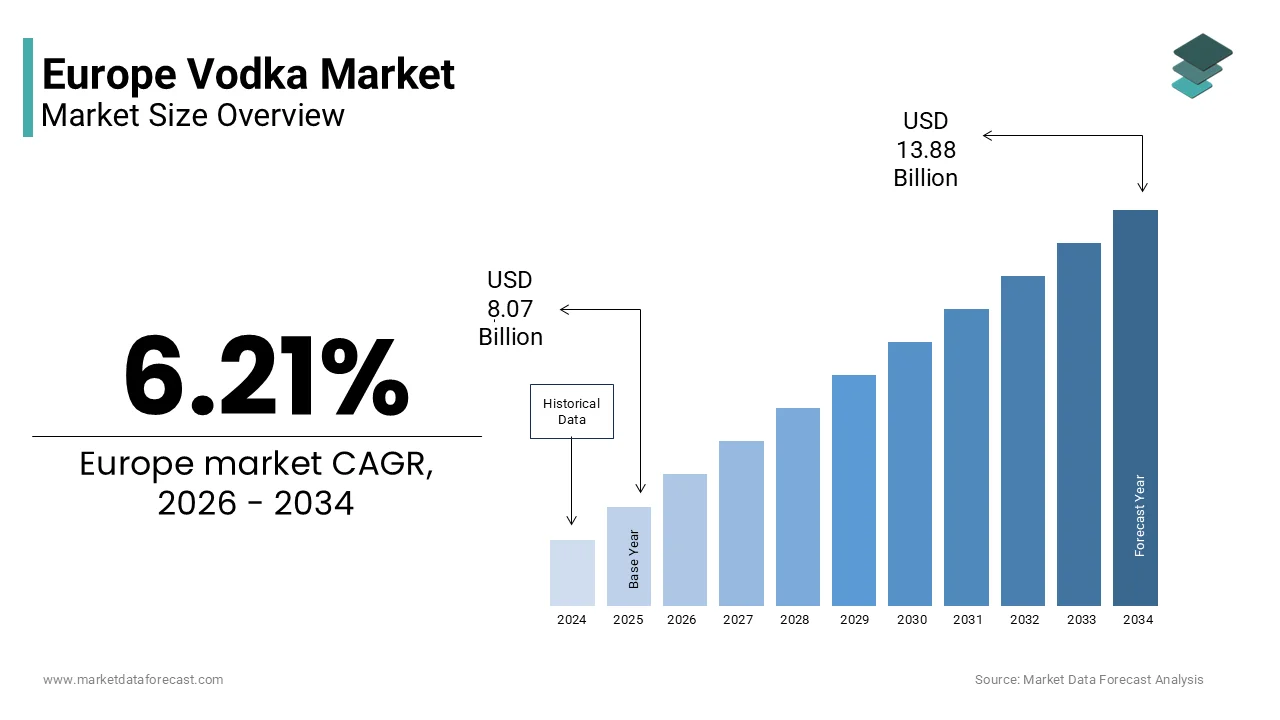
The Europe vodka market was valued at USD 8.07 billion in 2025, is estimated to reach USD 8.57 billion in 2026, and is projected to reach USD 13.88 billion by 2034, growing at a CAGR of 6.21% during the forecast period. The growth of the Europe vodka market is driven by strong cultural acceptance of vodka across Eastern and Western Europe, rising premium and super-premium vodka consumption, and increasing demand for high-quality spirits among younger consumers. Expanding cocktail culture, innovation in distillation techniques, and growing exports of European vodka brands are further supporting market expansion. Additionally, the resilience of off-trade alcohol sales and the popularity of at-home consumption continue to strengthen market growth.
Key Market Trends
-
Sustained dominance of non-flavored vodka due to its versatility in cocktails and traditional consumption patterns.
-
Rising premiumization, with consumers increasingly opting for craft, heritage, and high-quality vodka brands.
-
Strong growth of off-trade channels, supported by supermarkets, liquor stores, and e-commerce alcohol platforms.
-
Increasing international demand for authentic European vodkas, particularly from Poland and Eastern Europe.
-
Product differentiation through packaging innovation, origin-based branding, and sustainability initiatives.
Segmental Insights
- Based on type, the non-flavored vodka segment dominated the Europe vodka market by accounting for 70.5% of the regional market share in 2024. The segment’s leadership is attributed to its widespread use in classic cocktails, strong presence in traditional markets, and consistent consumer preference for pure vodka profiles.
- Based on distribution channel, the off-trade segment led the market by holding 65.5% of the regional market share in 2024. The dominance of this segment is driven by high retail penetration, competitive pricing, bulk purchasing behavior, and the continued shift toward home consumption.
Regional Insights
The Europe vodka market shows strong regional concentration, supported by long-standing production heritage and high per capita consumption in key countries.
- Poland dominated the vodka market in Europe in 2024, accounting for 24.4% of the regional market share. The country’s leadership is underpinned by its deep-rooted vodka-making tradition, strong domestic consumption, and global export presence of premium Polish vodka brands.
- Other major markets such as Russia, Sweden, France, Germany, and the United Kingdom continue to contribute significantly, driven by established drinking culture, tourism, and premium spirits demand.
Competitive Landscape
The European vodka market is highly competitive, characterized by the presence of global spirits conglomerates and established regional brands. Key players are focusing on premium brand positioning, limited-edition launches, sustainability-driven distillation practices, and expansion across both traditional retail and digital alcohol platforms. Strategic acquisitions, brand storytelling, and international distribution partnerships are key competitive strategies. Prominent players in the Europe vodka market include Brown-Forman Corporation, Diageo plc, Pernod Ricard S.A., Bacardi Limited, Constellation Brands, Inc., Distell Group Limited, Proximo Spirits, Belvedere Vodka (LVMH SE), Stoli Group, and Iceberg Vodka Corporation.
Europe Vodka Market Size
The Europe vodka market size was valued at USD 8.07 billion in 2025 and is projected to reach USD 13.88 billion by 2034 from USD 8.57 billion in 2026, growing at a CAGR of 6.21%.
Vodka is a distilled spirit traditionally composed of water and ethanol derived from agricultural sources such as grains, potatoes or sugar beet with a neutral aroma and high purity. In Europe, vodka holds deep cultural significance particularly in Central and Eastern regions where it features prominently in social rituals and national identity. The European Union legally defines vodka under Regulation (EU) No 110/2008 requiring a minimum alcoholic strength of 37.5% and restricting added flavourings to preserve its traditional character. As per Eurostat, the average annual pure alcohol consumption across the EU stood at around 10 liters per capita in 2023, with spirits accounting for a significant share of this total. According to the World Health Organization, alcohol-attributable deaths in the European region reached approximately 290,000 in 2022, which is indicating ongoing public health scrutiny. Despite such concerns, premiumization and craft distillation trends are reshaping consumer preferences, particularly in Western Europe where demand for locally sourced, organic, and transparently produced vodka is rising. This duality of tradition and transformation defines the current market landscape.
MARKET DRIVERS
Cultural Entrenchment in Central and Eastern Europe Sustains Core Consumption
Vodka remains deeply interwoven into the social fabric of countries such as Poland, Russia, and the Baltic states where it is not merely a beverage but a symbol of heritage and conviviality, which is one of the key factors driving the European vodka market growth. According to the World Health Organization, Poland recorded a per capita pure alcohol consumption of approximately 10 liters in 2023, with spirits representing a significant share of total intake. National celebrations, religious holidays, and family gatherings routinely feature vodka as a ceremonial staple reinforcing habitual consumption across generations. In Lithuania, for instance, the State Food and Veterinary Service reported that a majority of households keep vodka for regular social use. This cultural normalization extends to gifting practices and hospitality norms where refusal to partake may be perceived as discourteous. Furthermore, historical distillation traditions dating back to the fifteenth century in Poland and sixteenth century in Russia have institutionalized vodka production as a craft passed through families and state enterprises alike. As per the Polish Ministry of Agriculture, numerous registered distilleries operate under protected geographical indications ensuring adherence to traditional methods.
Premiumization and Craft Distillery Innovation Drive Western European Growth
In Western Europe, particularly in Germany, France, and the United Kingdom, vodka consumption is increasingly shaped by premiumization and artisanal production values rather than volume, which is further contributing to the expansion of the European vodka market. Consumers prioritize transparency in sourcing, sustainability in packaging, and uniqueness in distillation technique, which is leading to a surge in small-batch brands. According to the European Commission, over 1,000 craft distilleries obtained EU organic certification for spirit production in 2023, with vodka representing the largest category. In Sweden, Systembolaget reported a notable increase in sales of domestically produced organic vodka in 2024, reflecting heightened consumer interest in traceable ingredients. The use of local raw materials such as Nordic rye, French wheat, or British potatoes allows producers to craft region-specific narratives that resonate with conscious buyers. Additionally, innovations like charcoal filtration through birch wood or glacial water dilution enhance perceived quality without violating EU neutrality rules. As per the German Spirits Association, craft vodka sales experienced significant growth between 2022 and 2024, which is outpacing mainstream variants.
MARKET RESTRAINTS
Stringent Alcohol Taxation Policies Dampen Volume Growth
Several European governments have implemented aggressive excise duties on spirits to curb public health burdens and reduce alcohol-related harm, which directly constrains vodka affordability and consumption frequency and hindering the growth of the European vodka market. According to the European Commission, the average excise duty on spirits in the EU was €13.25 per liter of pure alcohol in 2024, with Finland imposing the highest at €21.70 and Ireland at €19.85. In Poland, where vodka is culturally central, the government raised spirit taxes in January 2023, which is leading the Polish Chamber of Spirit Producers to report a decline in legal sales volume within six months as consumers turned to illicit or cross-border purchases. Similarly, in the Baltic states where per capita vodka consumption historically exceeds EU averages, new tax hikes aligned with WHO recommendations have prompted shifts toward lower-alcohol alternatives. As per Eurostat, alcohol tax revenues in the EU increased in 2023, reflecting both rate increases and enforcement efforts.
Public Health Campaigns and Shifting Social Norms Reduce Routine Consumption
Changing attitudes toward alcohol, especially among younger Europeans, are diminishing vodka’s role as a default social beverage, which is further impeding the expansion of the European vodka market. According to the European School Survey Project on Alcohol and Other Drugs, thirty-day alcohol use among 15- to 16-year-olds in Western Europe declined from 52% in 2015 to 39% in 2023. In Sweden, the Public Health Agency reported that 31% of adults aged 16 to 29 identified as abstainers in 2024, up from 22% in 2018. This generational shift is amplified by workplace wellness programs, alcohol-free events, and the rise of the “sober curious” movement, which positions abstinence as a lifestyle choice rather than a medical necessity. Major cities such as Berlin, Paris, and Amsterdam now host numerous alcohol-free bars collectively, as per the European Hospitality Alliance, which is promoting alternative social rituals. Additionally, digital platforms and social media increasingly celebrate moderation, normalizing non-consumption in settings where vodka once dominated. As per the Organisation for Economic Co-operation and Development, alcohol-related hospital admissions in the EU declined between 2019 and 2023, reflecting broader behavioral change.
MARKET OPPORTUNITIES
Expansion of Organic and Geographically Certified Vodka Appeals to Conscious Consumers
The EU’s robust framework for geographical indications and organic certification is creating new market avenues for premium vodka producers who leverage terroir and sustainability as key differentiators. As per the European Commission, dozens of vodka brands across Europe held protected geographical indication status in 2024, including Poland’s Żubrówka and Sweden’s Absolut Elyx, both of which command significant price premiums. Simultaneously, the number of EU-certified organic vodka producers increased notably in 2023 according to the FiBL Organic Market Report, driven by consumer demand for chemical-free agriculture and transparent supply chains. In Germany, where organic spirits sales reached €280 million in 2023 as stated by the German Organic Food Association, vodka accounted for the fastest-growing segment due to its neutral profile which highlights raw material quality. Producers in Finland and Estonia now utilize heritage grains like rye from regenerative farms, while Danish distillers employ wind-powered distillation to enhance environmental credentials. These narratives align with EU Green Deal principles and attract eco-conscious buyers willing to pay significantly more for certified products, thereby opening high-margin niches beyond traditional volume competition.
Growing Demand for Alcohol-Free Alternatives Presents Adjacent Innovation Pathways
The rise of non-alcoholic spirits is creating unexpected opportunities for vodka brands to extend their identity into zero-proof categories without alienating core consumers. According to Euromonitor International, the non-alcoholic spirits market in Europe grew substantially between 2022 and 2024, with vodka-style alternatives representing the largest sub-segment due to their clean profile. Established players such as Absolut and Sipsmith have launched alcohol-free variants that mimic vodka’s texture and mixability using distilled botanicals and glycerin bases. In the United Kingdom, Waitrose reported a notable increase in sales of non-alcoholic vodka in 2023 as per its annual drinks trend analysis, reflecting mainstream adoption. Regulatory support is also emerging, with the European Commission updating labeling guidelines in 2024 to permit spirit-style descriptors for non-alcoholic products provided alcohol content remains below 0.5%. This allows vodka brands to retain premium positioning while catering to health-conscious and designated driver demographics. Crucially, these products enable engagement in the growing low- and no-alcohol beverage ecosystem where innovation and brand heritage jointly drive trial and loyalty.
MARKET CHALLENGES
Illicit Alcohol Trade Undermines Legal Market Integrity and Tax Revenues
Despite stringent regulation, a persistent illicit vodka market continues to erode legitimate sales and public health safeguards across several European regions, which is a major challenge to the growth of the European vodka market. According to the European Union Intellectual Property Office, counterfeit and contraband spirits accounted for an estimated 13% of total alcohol consumption in Central and Eastern Europe in 2023. In Romania, the National Anti-Fraud Directorate seized over 1.2 million liters of illegal vodka in 2024 alone, much of it produced in unlicensed stills using industrial ethanol. Similarly, in the Baltic states, cross-border smuggling from non-EU countries remains prevalent, with Lithuania’s State Tax Inspectorate reporting that a significant share of vodka consumed domestically evaded excise duties. This shadow market not only deprives governments of critical revenue but also poses severe health risks, as illicit products often contain methanol or toxic contaminants. As per the World Health Organization, over 700 poisoning cases linked to fake vodka were recorded in the EU in 2023. Enforcement remains challenging due to fragmented customs controls and high profit margins, which incentivize organized crime networks to exploit regulatory gaps and rural distribution channels.
Fragmented Regulatory Standards Complicate Cross-Border Branding and Formulation
While the EU provides a harmonized legal definition for vodka, differences in national implementation create compliance complexities for pan-European producers, which is further challenging the expansion of the European vodka market. According to the European Commission, member states apply divergent interpretations regarding permissible raw materials, with Sweden allowing only cereals and potatoes while Germany permits sugar beet and molasses. This inconsistency forces multinational brands to maintain multiple formulations for the same product line, increasing production costs and supply chain complexity. In 2023, the French Directorate General for Competition Policy, Consumer Affairs and Fraud Control rejected three imported vodka labels for containing trace flavorings deemed non-compliant under national interpretation despite EU-level allowance for minimal additives. Additionally, labeling requirements vary significantly for organic claims, geographical indications, and nutritional information. As per the European Spirits Organisation, producers spend an average of 18% more on regulatory compliance for vodka than for other neutral spirits due to these discrepancies. This regulatory fragmentation discourages small distillers from exporting and hinders the creation of unified European vodka branding strategies despite the existence of a single market framework.
REPORT COVERAGE
| REPORT METRIC | DETAILS |
| Market Size Available | 2025 to 2034 |
| Base Year | 2025 |
| Forecast Period | 2026 to 2034 |
| CAGR | 6.21% |
| Segments Covered | By Type, Distribution Channel, and Region |
| Various Analyses Covered | Global, Regional, & Country Level Analysis; Segment-Level Analysis; DROC, PESTLE Analysis; Porter’s Five Forces Analysis; Competitive Landscape; Analyst Overview of Investment Opportunities |
| Regions Covered | UK, France, Spain, Germany, Italy, Russia, Sweden, Denmark, Switzerland, Netherlands, Turkey, and the Czech Republic |
| Market Leaders Profiled | Brown-Forman Corporation, Diageo plc, Pernod Ricard S.A., Bacardi Limited, Constellation Brands, Inc., Distell Group Limited, Proximo Spirits, Inc. (BECLE, S.A.B. de C.V.), Belvedere Vodka (LVMH SE), Stoli Group (SPI Group), and Iceberg Vodka Corporation |
SEGMENTAL ANALYSIS
By Type Insights
The non-flavored vodka segment dominated the market by accounting 70.5% of the regional market share in 2024. The dominance of non-flavored vodka segment in this regional market is attributed to the cultural tradition, regulatory definitions, and consumer expectations of purity. European Union Regulation (EU) No 110/2008 explicitly defines vodka as a spirit with no added flavourings unless explicitly labelled as flavored, which is reinforcing the primacy of non-flavored variants in mainstream consumption. As per the European Commission, this legal framework protects traditional production methods, particularly in Poland and Sweden where vodka is tied to national identity. In 2023, the Court of Justice of the European Union ruled against the use of misleading descriptors on flavored products, ensuring clear market segmentation. This regulatory clarity has preserved consumer trust in non-flavored vodka as the authentic standard and discouraged producers from diluting core offerings. National authorities such as Poland’s Office for Registration of Medicinal Products have enforced strict labeling rules resulting in the removal of numerous non-compliant vodka brands from shelves in two seasons alone as reported by the Polish Spirits Producers Association.

The flavored vodka segment is a promising segment and is anticipated to register a CAGR of 8.84% over the forecast period owing to the growing cocktail culture and younger consumer preferences. The proliferation of craft cocktail bars across Western European cities has created sustained demand for flavored vodka as a versatile base spirit. According to the European Bartenders Association, a majority of cocktail menus in London, Paris, and Berlin featured at least one flavored vodka variant in 2024. Citrus, berry, and vanilla profiles are particularly popular for their ability to reduce the need for added syrups or liqueurs, enhancing drink clarity and perceived naturalness. In Spain, the number of cocktail bars using artisanal flavored vodka rose significantly in 2023 as per the Spanish Hospitality Federation, reflecting a broader shift toward experiential drinking. Brands like Finlandia and Absolut have responded with limited edition flavors such as sea buckthorn and wild strawberry developed in collaboration with mixologists.
By Distribution Channel Insights
The off-trade channel segment led the market by holding 65.5% of the regional market share in 2024. The growth of the off-trade segment in this regional market is driven by retail convenience, habitual purchasing, and economic pressures. Rising living costs across Europe have shifted drinking occasions from bars to households where off-trade pricing offers significant savings. According to Eurostat, inflation in the EU averaged around 6% in 2023 with food and beverage prices rising notably, prompting consumers to limit discretionary spending on hospitality. In the United Kingdom, the Office for National Statistics reported a marked decline in on-trade spirits sales between 2022 and 2024 while off-trade volumes rose. Similarly, in Italy, ISTAT noted that a large majority of vodka consumers now purchase primarily for home use, citing cost efficiency and relaxed social norms around home entertaining. Supermarkets and discount retailers such as Aldi and Lidl have capitalized on this by expanding premium vodka selections at competitive prices.
The on-trade channel is on the rise and is estimated to grow at a healthy CAGR of 7.07% over the forecast period owing to the experiential consumption and tourism recovery. Post-pandemic recovery in European tourism has revitalized bars, clubs, and restaurants, particularly in Mediterranean and capital cities. According to the European Travel Commission, international tourist arrivals in Europe reached approximately 680 million in 2023, recovering to nearly pre-pandemic levels. In Spain, the Ministry of Industry reported that Barcelona and Madrid saw a significant increase in late-night venue attendance in 2024 with vodka-based cocktails leading spirit orders. Similarly, in Greece, the Hellenic Hotel Federation noted that island resorts recorded a notable rise in premium vodka sales during summer 2023 driven by British and German tourists. This inbound demand injects high-margin revenue into on-trade channels where vodka is often served at several times retail price, enabling venues to reinvest in premium brand partnerships and signature cocktail programs.
REGIONAL ANALYSIS
Poland Vodka Market Analysis
Poland dominated the vodka market in Europe in 2024 with 24.4% of the regional market share. The growth of Poland in the European market is attributed to the historical production heritage and entrenched domestic consumption. Poland is home to a large number of registered distilleries, with several operating under EU protected geographical indication status as confirmed by the Polish Ministry of Agriculture. Vodka remains central to social rituals, with the Central Statistical Office reporting that a significant portion of Poles consume spirits at least monthly, primarily in non-flavored form. Government support for traditional producers continues through the National Centre for Research and Development, which allocated substantial funding in 2023 for grain-based distillation innovation. Despite rising excise duties, which increased in 2023, the Polish Spirits Producers Association noted stable legal sales due to strong brand loyalty and anti-illicit trade enforcement. Poland’s influence extends beyond its borders, as its export volume of vodka reached a high level in 2024 according to the Polish Trade Office, which is reinforcing its role as the cultural and commercial epicenter of European vodka.
Russia Vodka Market Analysis
Russia maintains a commanding position in the Europe vodka market despite geopolitical complexities due to massive domestic throughput and state-backed production infrastructure. According to Rosstat, the Federal State Statistics Service, the country produced a substantial volume of vodka in 2023, with state-licensed facilities accounting for the vast majority of output. The government’s “Drink Responsibly” campaign has paradoxically supported legal vodka by cracking down on moonshine, which once comprised a significant share of consumption. As per the Federal Service for Alcohol Market Regulation, seizures of illegal alcohol exceeded several million liters in 2023, enhancing market formalization. Cultural norms remain strong, with vodka consumed during every major holiday and workplace celebration. Although exports have declined due to sanctions, domestic demand remains resilient, with urban consumers increasingly shifting toward premium segments as reported by the Russian Analytical Credit Rating Agency. This internal stability sustains Russia’s high ranking despite external pressures.
United Kingdom Vodka Market Analysis
The United Kingdom serves as Western Europe’s most dynamic vodka market. The growth of the UK in this regional market is driven by cocktail culture, premiumization, and diverse consumer demographics. According to the Wine and Spirit Trade Association, vodka accounted for a large share of total spirit sales by volume in 2023, making it the UK’s most consumed spirit. London alone hosts a high number of cocktail bars as per the UK Hospitality Federation, many specializing in flavored and craft vodka variants. The rise of e-commerce has further accelerated access, with online alcohol retailers like Master of Malt reporting a significant increase in vodka sales in 2023. Notably, the UK leads in non-alcoholic vodka adoption, with brands like Lyre’s capturing significant shelf space in Waitrose and Sainsbury’s as confirmed by the British Non-Alcoholic Drinks Association. Despite a general decline in overall alcohol consumption, vodka’s versatility in mixed drinks ensures its continued relevance, particularly among urban millennials and Gen Z consumers.
Sweden Vodka Market Analysis
Sweden ranks among Europe’s most sophisticated vodka markets, characterized by high per capita spending and state-regulated distribution. Systembolaget, the national alcohol retailer, sold a substantial volume of vodka in 2023, representing a notable increase in value terms due to premium brand growth as stated in its annual report. Swedish consumers favor domestically produced organic vodka, with Absolut alone accounting for a large share of domestic premium sales. The country’s strict alcohol policies paradoxically enhance vodka’s prestige by limiting impulse purchases and encouraging deliberate selection. According to Statistics Sweden, a majority of vodka buyers cite sustainability and local sourcing as key decision factors. Furthermore, Sweden leads EU innovation with carbon-neutral distillation powered by biofuels—a model replicated by producers in Finland and Denmark. This combination of ethical consumption and state channel control creates a high-value, low-volume market that punches above its population weight.
Germany Vodka Market Analysis
Germany’s vodka market is distinguished by its blend of traditional neutrality and emerging craft diversity across a highly fragmented but affluent consumer base. According to the German Spirits Association, vodka sales reached a high volume in 2023, with flavored variants growing at twice the rate of non-flavored. Berlin and Hamburg serve as epicenters for experimental distillation, with many micro-distilleries producing small-batch vodka from regional grains and potatoes. The Federal Statistical Office reported that a majority of German vodka consumers are aged 25 to 45 and prioritize transparency in sourcing, with organic certification being a key purchase driver. Retail innovation also plays a role, as Aldi and Lidl introduced premium private label vodkas in 2023, achieving strong sales within six months according to GfK. Germany’s open market structure allows both global brands and local artisans to coexist, fostering a competitive yet diverse landscape that reflects broader Central European consumption trends.
COMPETITIVE LANDSCAPE
Competition in the Europe vodka market is defined by a dual dynamic between global giants emphasizing sustainability and craft distillers championing local terroir. Large players such as Pernod Ricard and Diageo compete on brand legacy innovation and distribution scale while regional producers differentiate through geographical authenticity organic certification and artisanal storytelling. The regulatory environment particularly EU labeling and alcohol content rules shapes product formulation and marketing claims. Premiumization drives value growth as consumers shift from volume to quality especially in Western Europe whereas price sensitivity and cultural tradition dominate in the East. The rise of non-alcoholic alternatives adds a new competitive frontier where established brands must extend their identity without alienating core consumers. Digital retail and social media further intensify visibility battles making authenticity transparency and experiential engagement critical success factors across the fragmented yet highly regulated landscape.
KEY MARKET PLAYERS
Some of the notable key players in the Europe vodka market are
- Brown-Forman Corporation
- Diageo plc
- Pernod Ricard S.A.
- Bacardi Limited
- Constellation Brands, Inc.
- Distell Group Limited
- Proximo Spirits, Inc. (BECLE, S.A.B. DE C.V.)
- Belvedere Vodka (LVMH SE)
- Stoli Group (SPI Group)
- Iceberg Vodka Corporation
Top Players in the Market
- Pernod Ricard holds a prominent position in the Europe vodka market through its flagship brand Absolut which is renowned for its Swedish origin premium positioning and sustainability commitments. The company actively promotes transparent sourcing using locally grown winter wheat and glacial water while maintaining carbon neutral distillation at its Åhus facility. In 2024 Pernod Ricard expanded its flavored vodka portfolio with limited edition botanical infusions targeting urban cocktail consumers in Germany and the United Kingdom. It also launched a recyclable paper-based bottle prototype in partnership with Paboco to reduce plastic waste. These initiatives reinforce its leadership in responsible premiumization and strengthen its influence across both Western and Central European markets while contributing significantly to global vodka innovation and brand standards.
- Diageo contributes to the Europe vodka market primarily through its Smirnoff brand which balances mass accessibility with progressive social messaging and product diversification. The company has invested heavily in lowering sugar content and introducing non-alcoholic variants to align with health-conscious trends across the region. In 2023 Diageo enhanced its sustainability credentials by achieving 100% renewable electricity usage at its EU bottling sites including the historic Alnwick distillery in the UK. It also partnered with bartending academies in Spain and Italy to promote vodka based low alcohol cocktails. Through these efforts Diageo maintains strong on-trade and off-trade relevance while leveraging its global scale to drive category growth and responsible consumption messaging throughout Europe and beyond.
- Spirits International plays a strategic role in the Europe vodka market through its focus on authentic Russian heritage brands including Kremlin Award which emphasizes traditional grain distillation and Slavic craftsmanship. The company has intensified its presence in Eastern and Central Europe by expanding distribution networks in Poland the Czech Republic and the Baltics where cultural affinity for classic vodka remains strong. In early 2024 it launched a premium gift pack featuring handcrafted bottles and certified origin documentation to appeal to gifting occasions during holidays. Additionally, it invested in traceability technology allowing consumers to verify batch authenticity via QR codes. These actions reinforce its niche as a guardian of traditional vodka identity while adapting to modern demand for transparency and premium experience in both European and global emerging markets.
Top Strategies Used by the Key Market Participants
Key players in the Europe vodka market focus on premiumization through sustainable sourcing organic certification and limited-edition flavor innovation to capture high margin segments. They invest in non-alcoholic and low sugar variants to align with health and wellness trends particularly in Western Europe. Strategic partnerships with bartenders and hospitality venues enhance brand visibility in the on-trade channel. Companies also deploy eco-friendly packaging such as paper bottles and recycled glass to meet EU environmental standards. Additionally, they leverage digital marketing and e-commerce platforms to engage younger consumers while reinforcing heritage narratives to maintain authenticity in traditional markets.
MARKET SEGMENTATION
This research report on the European vodka market has been segmented and sub-segmented based on categories.
By Type
- Non-Flavored
- Flavored
By Distribution Channel
- On-Trade
- Off-Trade
By Country
- UK
- France
- Spain
- Germany
- Italy
- Russia
- Sweden
- Denmark
- Switzerland
- Netherlands
- Turkey
- Czech Republic
- Rest of Europe