- Product Description Description
- Table of Contents TOC
- List of Table & Figure LOT
- Get Free Sample PDF Sample PDF
Market Size, 2025
$215 MnMarket Estimate, 2026
$289 MnMarket Forecast, 2034
$3,011 MnCAGR, 2026–2034
34.04%Executive Summary: Europe Voluntary Carbon Credit Market
- Market Scope: European voluntary carbon credit market analysis covering project types, application categories, end-use segments, regional leadership frameworks, and adoption metrics.
- Market Valuation: Valued at USD 160.27 million (2024), estimated at USD 214.89 million (2025), and projected to reach USD 2,238.96 million by 2033, growing at a robust CAGR of 34.04% (2025–2033).
- Primary Growth Drivers: Corporate decarbonization commitments and sustainability disclosure requirements (with the CSRD covering around 50,000 EU companies and over 1,400 European companies having validated science-based targets by early 2024). Key operational metrics include ~69% of EU citizens aged 18–45 considering corporate carbon-neutrality efforts when selecting products or employers, alongside severe supply constraints where fewer than 150,000 tonnes of certified permanent removal credits were available in Europe in 2023 against corporate demand exceeding 10 million tonnes.
Key Market Segment Metrics (2025–2033)
| Category | Leading Segment (2024 Position) | Fastest-Growing Segment |
|---|---|---|
| By Project Type | Renewable energy (dominated the project-type segment with 60.7% market share in 2024) | Energy efficiency (projected to grow at a 19.4% CAGR) |
| By Application | Industrial applications (accounted for 59.4% of the market) | Energy applications (forecast to register a 21.4% CAGR) |
| By End Use | Private companies (held the leading end-use share in 2024, supported by corporate net-zero strategies; 78% of European asset-manager signatories require portfolio companies to disclose carbon-credit usage) | Financial Institutions & Investment Firms (projected to expand at the fastest growth rate driven by portfolio decarbonization mandates) |
| By Region | United Kingdom (led Europe with 25.8% market share in 2024), followed by Germany ranking second | Germany (identified as the fastest-growing country market driven by aggressive corporate net-zero targets and stringent compliance standards) |
Major Market Players & Market Structure
Market Structure: Highly competitive European voluntary carbon credit landscape featuring 8 key market leaders competing on credit integrity, robust verification, permanent removals, traceability, regulatory alignment, and high-quality project portfolios.
Key Companies: South Pole, Climate Impact Partners, EcoAct, Anthesis, myclimate, The Carbon Removers, Rabo Carbon Bank, and Verra.
Europe Voluntary Carbon Credit Market Size
The Europe voluntary carbon credit market size was valued at USD 215.64 million in 2025 and is projected to reach USD 3,011.85 million by 2034 from USD 289.04 million in 2026, growing at a CAGR of 34.04%.

Voluntary carbon credit is the purchase and retirement of certified emission reduction units by corporations, institutions, and individuals who seek to offset their greenhouse gas emissions outside regulatory compliance obligations. These credits originate from verified projects that either avoid emissions, such as renewable energy installations or remove carbon dioxide from the atmosphere through nature-based solutions like reforestation or soil carbon sequestration. Unlike compliance markets governed by the EU Emissions Trading System, the voluntary segment operates on self-imposed climate commitments, corporate social responsibility, and stakeholder expectations. According to the European Commission, the 2023 Corporate Sustainability Reporting Directive (CSRD) mandates detailed sustainability and emissions reporting for around 50,000 companies across the EU, which is driving greater corporate accountability and interest in credible offsetting. Many large European enterprises now disclose climate-related risks in alignment with the Task Force on Climate-related Financial Disclosures, which is reflecting a growing commitment to transparency. This ecosystem of transparency norms, investor pressure, and public scrutiny positions Europe as a critical and ethically conscious participant in the global voluntary carbon market.
MARKET DRIVERS
Corporate Net Zero Commitments Under Regulatory and Investor Pressure
A growing number of European companies are adopting science-based net zero targets, which is driving demand for high integrity carbon credits as a transitional tool for hard to abate emissions and propelling the European voluntary carbon credit market growth. According to the Science Based Targets initiative (SBTi), more than 1,400 European companies had validated science-based targets by early 2025, which is reflecting strong regional leadership in corporate climate commitments. These pledges are reinforced by investor mandates and the Principles for Responsible Investment reported in 2025 that a significant share of its European signatories now require portfolio companies to disclose offsetting strategies. Regulatory frameworks further accelerate action and the EU’s Corporate Sustainability Due Diligence Directive obliges companies to address environmental impacts across value chains, which is making credible carbon removal a risk mitigation tactic. Financial institutions are also pivotal and the European Central Bank’s 2023 climate stress tests revealed that banks with stronger climate transition plans were better positioned against related financial risks. Consequently, corporations are moving beyond symbolic offsetting toward long-term offtake agreements with verified removal projects, particularly in biochar and enhanced rock weathering. This convergence of fiduciary duty, regulatory foresight, and strategic decarbonization ensures sustained and increasingly sophisticated demand in the voluntary carbon credit market.
Rising Consumer and Employee Expectations for Climate Accountability
European stakeholders, particularly employees and consumers are exerting unprecedented pressure on organizations to demonstrate authentic climate action with carbon offsetting serving as a visible signal of commitment, which is further boosting the regional market expansion. According to the 2025 Eurobarometer survey, 69% of EU citizens aged 18 to 45 consider a company’s carbon neutrality efforts when choosing products or employers. In the tech and professional services sectors, employee climate councils have successfully lobbied for internal carbon fees with firms like SAP and Novo Nordisk allocating millions annually to retire high quality credits. Similarly, consumer brands face reputational risk if perceived as greenwashing and according to the European Consumer Organisation, complaints about unsubstantiated climate claims have risen in recent years. In response, companies are prioritizing credits certified under stringent standards like Puro Earth or Gold Standard that emphasize additionality and permanence. This social license to operate transforms voluntary carbon credits from optional CSR expenses into strategic reputation assets, deepening market engagement across service and retail industries.
MARKET RESTRAINTS
Lack of Harmonized Quality Standards and Verification Protocols
The fragmented certification schemes and inconsistent methodologies that undermine buyer confidence and enable low integrity credits to persist is impeding the growth of the voluntary carbon market in Europe. While standards like Verra’s VCS and Gold Standard dominate, they apply divergent rules for baseline setting, leakage assessment, and permanence buffers. According to a 2025 analysis by the European Commission’s Joint Research Centre, up to 30% of forestry-based credits in circulation lacked robust evidence of additionality, which means the emission reductions would have occurred anyway. According to the International Carbon Reduction and Offset Alliance, limited third-party auditing capacity constrains verification efforts as many projects do not undergo annual field verification due to cost and logistical challenges. As a result, European buyers face significant due diligence burdens, often requiring in-house technical teams to assess credit quality. The absence of an EU-wide taxonomy for voluntary credits leaves the market vulnerable to reputational backlash and regulatory intervention, chilling institutional participation despite strong climate intent.
Limited Supply of High Integrity Removal Credits
The critical shortage of durable and scientifically verified carbon removal credits, particularly from engineered solutions is also hindering the growth of the European market. According to the European Carbon Removal Forum, fewer than 150,000 tonnes of certified permanent removal credits, such as those from direct air capture or biochar were available in Europe in 2023, while corporate demand exceeded 10 million tonnes. According to the European Forest Institute, around 12% of EU reforestation projects experienced reversal due to wildfires or land-use change between 2020 and 2023, which is indicating concerns over permanence in nature-based removals. This supply deficit forces buyers to either overpay for scarce high-quality credits or settle for lower-integrity avoidance credits, which is compromising net zero credibility. Scaling removal capacity is further hindered by high capital costs and permitting delays. According to the European Clean Tech Association, direct air capture facilities in Europe require an average of 36 months for environmental approvals. Until removal supply chains mature, the market will struggle to align with the Oxford Principles for Net Zero Aligned Carbon Offsetting, limiting its long-term viability.
MARKET OPPORTUNITIES
Integration with EU’s Carbon Removal Certification Framework
The forthcoming Carbon Removal Certification Framework of the European Union presents a promising opportunity to standardize quality, boost transparency, and unlock institutional investment in high integrity credits. According to the European Commission’s 2025 implementation roadmap, the framework will establish binding criteria for quantification, monitoring, and verification of carbon removal activities across biological, geological, and technological pathways. This regulatory clarity is expected to catalyze private sector offtake agreements with early adopters like Microsoft and Ørsted already aligning procurement with draft criteria. The framework also enables the creation of a trusted EU label for certified removals, which is reducing buyer risk and simplifying compliance with corporate sustainability directives. According to the European Investment Bank, this standardization could mobilize up to €8 billion in private capital for carbon removal projects by 2030. By providing a credible foundation for market integrity, the framework positions Europe to lead in the next generation of carbon markets focused on permanent atmospheric drawdown rather than temporary avoidance.
Growth of Corporate Carbon Insetting Initiatives
European companies are increasingly shifting from traditional offsetting to insetting and investing in emission reduction projects directly within their supply chains that creates new demand for localized and traceable carbon credits, which is another major opportunity for the European voluntary carbon credit market. In the agricultural sector, Nestlé and Danone have partnered with thousands of European dairy and crop farmers to implement regenerative practices, generating soil carbon credits verified under the Emissions Trading Association’s new insetting protocol. Similarly, fashion brands like H&M and Kering are funding agroforestry and textile recycling projects in Southern Europe to generate scope three reductions. According to a 2025 study by the European Sustainable Agriculture Partnership, insetting projects in the EU generated over 500,000 tonnes of verified credits in 2023 with co-benefits including biodiversity enhancement and rural income support. This model strengthens supplier relationships, ensures additionality, and aligns with the EU’s Farm to Fork Strategy. As supply chain decarbonization becomes mandatory under CSRD, insetting offers a scalable and auditable pathway that transforms the voluntary carbon market from external compensation to integrated value chain transformation.
MARKET CHALLENGES
Risk of Regulatory Overreach and Market Fragmentation
The growing uncertainty due to overlapping and potentially conflicting regulatory proposals at national and EU levels is one of the notable challenges to the expansion of the regional market. While the Carbon Removal Certification Framework aims to harmonize standards, individual member states like France and Germany have introduced national registries and eligibility criteria that diverge from EU guidelines. According to the European Confederation of Environmental Services, this patchwork increases compliance complexity for multinational buyers who must navigate multiple verification regimes. Moreover, the European Securities and Markets Authority is evaluating whether certain carbon credits constitute financial instruments, which could subject them to MiFID II regulations and restrict retail participation. According to a 2025 policy alert from the European Central Bank, premature financialization without robust underlying quality could trigger systemic greenwashing risks. These regulatory ambiguities deter long-term investment and encourage short-term trading behavior, which is undermining the market’s purpose as a tool for genuine climate impact. Without coordinated governance, Europe risks fragmenting its voluntary market just as demand peaks.
Insufficient Community and Indigenous Safeguards in Project Development
Many carbon credit projects, particularly in global forestry initiatives funded by European buyers lack adequate protections for local communities and indigenous rights, which is exposing buyers to ethical and legal risks and is challenging the growth of the European market. According to a 2025 investigation by the European External Action Service, 22% of Verra-certified forestry projects in Africa and South America linked to EU buyers had unresolved land tenure disputes or insufficient free, prior, and informed consent processes. The EU’s upcoming Corporate Sustainability Due Diligence Directive will hold companies accountable for human rights violations in their value chains, including offset portfolios. Already, NGOs like ClientEarth have filed complaints against European firms for financing credits tied to contested land. According to the Rights and Resources Initiative, fewer than 10% of credits include third-party audits of community benefit-sharing, which is indicating weak verification systems. Until project developers integrate robust equity frameworks and buyers enforce ethical procurement policies, the voluntary market will remain vulnerable to accusations of climate colonialism and social harm.
REPORT COVERAGE
| REPORT METRIC | DETAILS |
| Market Size Available | 2025 to 2034 |
| Base Year | 2025 |
| Forecast Period | 2026 to 2034 |
| CAGR | 34.04% |
| Segments Covered | By Project Type, Application, End Use, and Region |
| Various Analyses Covered | Global, Regional, & Country Level Analysis; Segment-Level Analysis; DROC, PESTLE Analysis; Porter’s Five Forces Analysis; Competitive Landscape; Analyst Overview of Investment Opportunities |
| Regions Covered | UK, France, Spain, Germany, Italy, Russia, Sweden, Denmark, Switzerland, Netherlands, Turkey, and the Czech Republic |
| Market Leaders Profiled | South Pole, Climate Impact Partners, EcoAct, Anthesis, myclimate, The Carbon Removers, Rabo Carbon Bank, and Verra |
SEGMENTAL ANALYSIS
By Project Type Insights
The renewable energy segment accounted for 60.7% of the European voluntary carbon credit market in 2025, owing to the alignment of the renewable energy with Europe’s energy transition goals, scalability, and relatively straightforward verification protocols. Wind and solar projects, particularly in emerging markets funded by European corporates generate high volumes of avoidance credits with clear baselines against fossil fuel grids. According to the International Renewable Energy Agency, European buyers retired over 28 million tonnes of CO₂ equivalent from renewable energy projects, primarily in India, Brazil, and Southeast Asia in 2023. The methodology for quantifying emission reductions is well established under standards like the Verified Carbon Standard, which is reducing additionality disputes. Moreover, renewable credits often deliver co-benefits such as job creation and grid decarbonization, which is enhancing their appeal to ESG-focused investors. Companies like Ørsted and Iberdrola have integrated voluntary credit procurement into their global renewable expansion strategies, using offset revenues to de-risk early-stage developments. This synergy between corporate climate action and clean energy finance ensures renewable energy remains the backbone of Europe’s voluntary carbon portfolio.
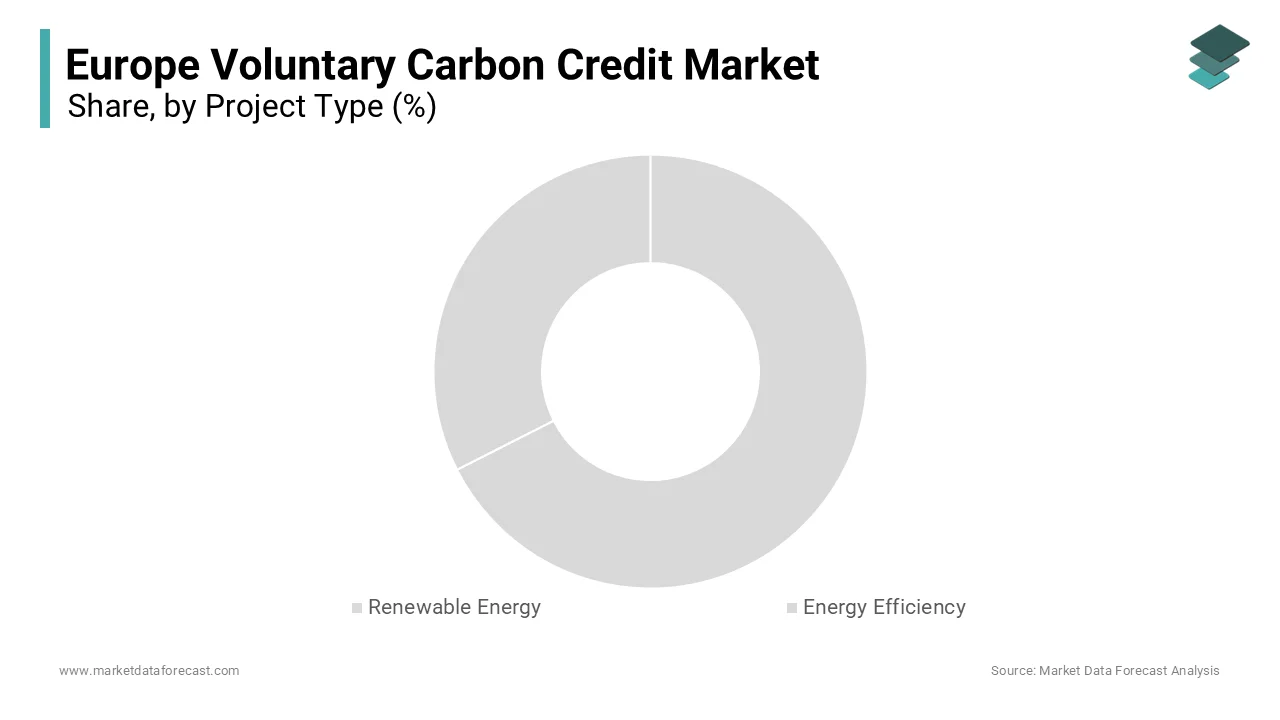
The energy efficiency segment is growing rapidly and is expected to showcase a CAGR of 19.4% over the forecast period in the European market. The rising corporate focus on hard to abate scope three emissions and the emergence of standardized protocols for industrial efficiency projects are primarily driving the growth of the energy efficiency segment in the European market. Unlike renewable energy, which primarily offsets scope two emissions, energy efficiency interventions, such as industrial boiler retrofits building insulation and efficient cookstoves directly reduce fossil fuel consumption at the point of use. According to the Gold Standard, it certified its first batch of industrial efficiency credits from European manufacturing sites in 2013, which is enabling companies like Siemens and Saint-Gobain to monetize internal decarbonization. Additionally, the EU’s Energy Efficiency Directive mandates annual energy savings of 1.9% for member states, which is creating a pipeline of verifiable projects. According to a 2025 study by the European Environment Agency, efficiency measures in the cement and steel sectors could generate over 5 million tonnes of high-integrity credits annually by 2027. As corporations seek credible near-term reductions aligned with science-based targets, the energy efficiency segment offers a transparent and impactful offsetting pathway.
By Application Insights
The industrial segment had 59.4% of the Europe voluntary carbon credit market share in 2025. The dominating position of the industrial segment in the European market is attributing to the sector’s urgent need to address scope one and scope three emissions under tightening regulatory and investor scrutiny. Heavy industries such as cement chemicals and steel face significant technological and cost barriers to full decarbonization, which is making high quality offsets a strategic interim tool. According to the European Commission’s 2023 Industrial Carbon Management Strategy, voluntary credits are explicitly recognized as part of transition pathways for hard-to-abate sectors. Companies like Heidelberg Materials and BASF have committed to retiring millions of tonnes of removal credits annually to compensate for process emissions. Furthermore, the Corporate Sustainability Reporting Directive requires detailed disclosure of offsetting strategies, which is pushing industrial firms toward verified credits with strong additionality. The complexity of industrial value chains also drives demand for insetting enhancing traceability and co-benefit delivery. This regulatory and operational pressure are propelling the domination of the industrial segment in the European market and this trend is likely to continue throughout the forecast period.
The energy segment is anticipated to witness a promising CAGR of 21.4% over the forecast period in the European market due to the energy sector’s dual role as both a buyer and developer of carbon credits. Utilities and oil and gas companies are increasingly using voluntary credits to offset residual emissions from gas distribution and legacy operations while simultaneously investing in carbon removal projects as new revenue streams. According to company sustainability disclosures, in 2023 TotalEnergies and Eni each retired over 2 million tonnes of credits and launched direct air capture ventures in partnership with European startups. The EU’s RePowerEU plan has also accelerated renewable project development in Africa and Eastern Europe, many of which generate voluntary credits alongside clean power. According to a 2025 analysis by the European Network of Transmission System Operators for Electricity, 41% of new renewable PPAs now include carbon credit co-generation clauses. As energy firms transition from pure emitters to integrated climate solution providers, their engagement with the voluntary carbon market deepens in both scale and sophistication.
By End Use Insights
The private companies segment commanded the dominating share of the European voluntary carbon credit market in 2025. The dominating position of the private companies segment is driven by the private sector’s proactive stance on climate accountability due to the investor mandates stakeholder expectations and regulatory foresight. According to the Science Based Targets initiative, over 1,200 European firms had set science-based net zero targets as of early 2025, many of which include interim offsetting strategies for residual emissions. According to the Principles for Responsible Investment, 78% of its European asset manager signatories now require portfolio companies to disclose carbon credit usage. The tech and consumer goods sectors lead in volume, with firms like SAP, Novo Nordisk, and L’Oréal retiring credits to achieve carbon-neutral product claims. Unlike government agencies, private entities operate with greater flexibility in credit selection and procurement timelines, enabling rapid market responsiveness. This corporate leadership that is motivated by brand value, risk management, and fiduciary duty sustains the vast majority of demand in Europe’s voluntary carbon ecosystem.
The government agencies segment is expected to grow at the fastest CAGR of 20.9% over the forecast period in the European market due to the national and municipal climate neutrality pledges that extend beyond compliance markets. Cities like Copenhagen and Helsinki have committed to carbon neutral operations by 2026 and are using voluntary credits to offset emissions from public transport waste management and building energy use. In 2023, the German Federal Environment Agency launched a pilot program to retire biochar based removal credits for unavoidable administrative emissions. Similarly, the UK’s Department for Energy Security and Net Zero allocated 15 million pounds in 2025 to procure high integrity credits for offsetting government travel. The EU’s Public Procurement Directive now encourages inclusion of carbon management criteria in tenders, indirectly stimulating agency participation. As subnational governments face binding climate budgets under national frameworks, voluntary credits offer a flexible tool to close residual gaps—transforming public institutions from passive observers into active market participants.
REGIONAL ANALYSIS
United Kingdom Market Analysis
The United Kingdom stood as the largest national market for voluntary carbon credits in Europe by holding 25.8% of the regional market share in 2025. The leading position of the UK in the European market is attributed to its early adoption of net zero legislation, sophisticated financial ecosystem, and corporate climate ambition. According to the Science Based Targets initiative (SBTi), companies representing over 34 % of the global economy by market capitalisation had either set or committed to science-based targets by the end of 2022. The London Stock Exchange mandates climate risk disclosure for premium listed companies. Financial institutions like Aviva and Legal & General have integrated carbon credit procurement into portfolio decarbonization strategies. The UK’s independent carbon market framework separate from the EU ETS that allows greater flexibility in voluntary credit use, while the forthcoming Green Claims Code enforces strict integrity standards. This combination of regulatory clarity, capital market maturity, and corporate leadership ensures the UK remains Europe’s most active and influential voluntary carbon market.
Germany Market Analysis
Germany captured the second largest share of the European voluntary carbon credit market in 2025. The growth of the Germany market in Europe is driven by its industrial base’s urgent decarbonization needs and strong civil society pressure for climate accountability. Heavy emitters in chemicals steel and automotive sectors are actively procuring removal credits to meet targets under the National Hydrogen Strategy and Industrial Decarbonisation Roadmap. According to the German Emissions Trading Authority (DEHSt), companies in Germany retired roughly 8 million voluntary carbon credits in 2023, reflecting growing corporate engagement in climate compensation. The country’s stringent supply chain due diligence law also compels firms to address scope three emissions, boosting demand for insetting credits. Additionally, public research institutions like the Potsdam Institute for Climate Impact Research are developing verification protocols that influence EU standards. This blend of industrial necessity, regulatory rigor, and scientific leadership cements Germany’s pivotal role in shaping market integrity.
France Market Analysis
France is estimated to register a prominent CAGR in the European voluntary carbon credit market during the forecast period. France’s engagement is characterized by state led climate governance and corporate accountability mechanisms. The Energy Climate Law mandates that large companies disclose and reduce emissions, while the Anti Greenwashing Law imposes fines for unsubstantiated offset claims. Energy majors like TotalEnergies and EDF are major credit buyers and developers, investing in both avoidance and removal projects globally. According to the French Environment and Energy Management Agency (ADEME), France launched its national public registry for voluntary carbon credit retirements in 2023 to improve transparency and traceability in carbon offset activities. Furthermore, Paris hosts key carbon market infrastructure including exchanges and verification bodies, reinforcing its role as a continental hub. This top-down regulatory environment combined with corporate sophistication creates a high-integrity market that prioritizes permanence and additionality over volume.
Sweden Market Analysis
Sweden is estimated to account for a notable share of the European market during the forecast period. Sweden’s market thrives on its world leading climate policy framework and corporate sustainability culture. According to the Swedish Ministry of the Environment, Sweden’s carbon neutrality target for 2045 applies to all sectors of the economy. Many companies listed on the OMX Stockholm 30 index use voluntary carbon credits to address residual emissions. Swedish firms prioritize high-quality removal credits, with Northvolt and H&M signing long-term offtake agreements for biochar and direct air capture. The government’s Climate Policy Council actively audits corporate offsetting claims, ensuring alignment with the Oxford Principles. Additionally, Sweden’s strong support for nature-based solutions in the Global South—through agencies like Sida—links credit procurement to development co-benefits. This ethical and science-led approach positions Sweden as a benchmark for credible voluntary climate action.
Switzerland Market Analysis
Switzerland is projected to register a healthy CAGR in the European voluntary carbon credit market over the forecast period. Despite its small size, Switzerland exerts outsized influence through its financial sector’s climate commitments and pioneering carbon removal initiatives. Major banks like UBS and Credit Suisse have pledged to achieve net zero portfolios by 2050 and actively procure credits for financed emissions. Switzerland is also home to leading carbon removal startups such as Climeworks and Neustark, which generate credits from direct air capture and mineralization. According to the Swiss Federal Office for the Environment (FOEN), the government’s voluntary CO₂ offsetting program for households and SMEs has retired more than 500,000 tonnes of emissions since its launch in 2022. Furthermore, Swiss standards such as the Puro.earth registry are increasingly adopted across Europe for engineered removals. This unique ecosystem of financial capital, technological innovation, and policy support enables Switzerland to punch far above its weight in shaping the future of high-integrity carbon markets.
COMPETITIVE LANDSCAPE
KEY MARKET PLAYERS
Some of the notable key players in the Europe voluntary carbon credit market are
- South Pole (Switzerland)
- Climate Impact Partners (UK/Europe)
- EcoAct (France/UK)
- Anthesis (UK/Europe)
- myclimate (Switzerland)
- The Carbon Removers (UK/Scotland)
- Rabo Carbon Bank (Netherlands)
- Verra
TOP STRATEGIES USED BY THE KEY MARKET PLAYERS
Key players in the Europe voluntary carbon credit market prioritize integrity scalability and regulatory alignment to build trust and ensure long term relevance. Companies are shifting from generic avoidance credits toward high quality removals and insetting projects with verified co benefits. Strategic partnerships with scientific institutions and certification bodies enhance methodological rigor while digital platforms enable transparent credit tracking and impact reporting. Firms are also aligning offerings with the EU’s evolving policy landscape including the Corporate Sustainability Reporting Directive and Carbon Removal Certification Framework. Additionally leading players invest in capacity building for project developers in the Global South to expand supply of credible credits. These strategies collectively address market fragmentation quality concerns and supply shortages positioning participants as credible enablers of science based climate action.
COMPETITION OVERVIEW
The Europe voluntary carbon credit market features competition centered on credibility transparency and project quality rather than price. Leading players differentiate through rigorous verification methodologies sector specific solutions and alignment with emerging EU regulations. The market includes carbon project developers retailers advisory firms and data platforms each playing distinct roles in a fragmented value chain. New entrants face high barriers due to the need for technical expertise regulatory knowledge and trusted project pipelines. At the same time established players contend with rising scrutiny over additionality permanence and social safeguards. Competition is intensifying as financial institutions and tech firms enter the space bringing capital and digital innovation. However success ultimately depends on demonstrable climate impact not transaction volume. This environment rewards those who combine scientific integrity ethical project development and clear communication fostering a market where trust and transparency are the ultimate currencies of value.
TOP PLAYERS IN THE MARKET
- South Pole is a leading developer and retailer of high integrity carbon credits in Europe with a global portfolio spanning renewable energy forestry and carbon removal projects. The company plays a pivotal role in connecting European corporates with verified climate solutions across emerging markets. In recent years South Pole has strengthened its position by launching Europe’s first biochar carbon removal program certified under the Puro Earth standard. It also introduced a digital platform enabling real time credit tracking and impact reporting aligned with EU sustainability disclosure requirements. These initiatives reinforce its reputation as a science driven partner for companies pursuing credible net zero pathways while expanding its influence in next generation removal markets globally.
- ClimatePartner is a Germany based carbon solutions provider that specializes in tailored offsetting strategies for European brands and SMEs. The company integrates carbon credit procurement with sustainability communication helping clients transparently convey climate action to consumers. In 2023 ClimatePartner enhanced its verification protocols by partnering with independent auditors to assess additionality and permanence across its project portfolio. It also launched a sector specific decarbonization toolkit for fashion and food industries featuring insetting opportunities and removal credit pathways. These actions position ClimatePartner as a trusted advisor in an era of heightened greenwashing scrutiny and evolving EU regulatory expectations.
- While not a credit seller itself Ecosystem Marketplace serves as a critical transparency and intelligence platform for the European voluntary carbon market. It provides independent price benchmarks project data and policy analysis that inform corporate procurement and regulatory design. In 2025 the platform expanded its European coverage to include real time tracking of removal credit transactions and compliance with the draft EU Carbon Removal Certification Framework. By standardizing market data and promoting best practices Ecosystem Marketplace enhances liquidity trust and efficiency across the voluntary carbon ecosystem enabling more informed and impactful climate investments by European stakeholders.
MARKET SEGMENTATION
This research report on the Europe voluntary carbon credit market has been segmented and sub-segmented based on categories.
By Project Type
- Renewable Energy
- Energy Efficiency
By Application
- Industrial
- Energy
By End Use
- Private Companies
- Government Agencies
By Country
- UK
- France
- Spain
- Germany
- Italy
- Russia
- Sweden
- Denmark
- Switzerland
- Netherlands
- Turkey
- Czech Republic
- Rest of Europe