- Product Description Description
- Table of Contents TOC
- List of Table & Figure LOT
- Get Free Sample PDF Sample PDF
Market Size, 2025
$1.79 BnMarket Estimate, 2026
$1.92 BnMarket Forecast, 2034
$3.43 BnCAGR, 2026–2034
7.51%Europe Wasabi Market Report Summary
The Europe wasabi market was valued at USD 1.79 billion in 2025, is projected to reach USD 1.92 billion in 2026, and is expected to expand to USD 3.43 billion by 2034, growing at a CAGR of 7.51% during the forecast period. Rising demand for Japanese and pan-Asian cuisines, growing retail visibility of wasabi-flavored foods, and increasing experimentation in gourmet dining are key factors accelerating market growth.
Key Market Trends
- Increasing adoption of wasabi in fusion cuisine, with chefs incorporating it into sauces, seasonings, snacks, and premium condiments.
- Growing interest in clean-label and functional ingredients, supported by wasabi’s natural antimicrobial and bioactive properties.
- Rising consumer awareness of authentic wasabi versus imitation variants, driving demand for traceable and premium offerings.
- Expansion of online retail and at-home gourmet cooking culture, boosting demand for packaged pastes, powders, and ready-to-use formats.
- Strengthening culinary tourism and high-end restaurant experiences, promoting authentic wasabi as a premium flavor driver.
Segmental Insights
- By nature, conventional wasabi held the dominant market share in 2025, supported by affordability and mass-market distribution of horseradish-based substitutes.
- By end user, the food service segment accounted for 62.7% of demand in 2025, led by widespread use in sushi restaurants, Asian cuisine formats, and premium dining spaces across Europe.
Regional Insights
- The United Kingdom led the market with a 22.5% share in 2025, supported by strong restaurant penetration, premium retail availability, and boutique farming initiatives.
- Germany stood as the second-largest market with 19.7%, benefiting from processed food industry applications and consumer preference for authentic ingredients.
- France retains a notable market role driven by gourmet dining culture, while Italy demonstrates fast adoption due to fusion food trends blending Mediterranean and Japanese flavours.
- The Netherlands is positioned for growth, leveraging its role as a logistics hub for specialty food imports and advancements in controlled-environment cultivation.
Competitive Landscape
The Europe wasabi market is fragmented, with mainstream condiment manufacturers competing alongside niche suppliers specializing in authentic Wasabia japonica. Key market participants include Real Wasabi, Eden Foods, S&B Foods Inc., Kinjirushi Wasabi International, Tazaki Foods, Jinkui Group, Dalian Tianpeng Food Co., McCormick & Company, Great Eastern Sun Trading Co., and Nordic Wasabi.
Europe Wasabi Market Size
The Europe wasabi market size was valued at USD 1.79 billion in 2025 and is anticipated to reach a valuation of USD 1.92 billion in 2026 and USD 3.43 billion by 2034, growing at a CAGR of 7.51% during the forecast period from 2026 to 2034.
MARKET DRIVERS
Rising Popularity of Pan Asian Fusion Cuisine Drives Wasabi Demand
- The mainstream integration of pan Asian fusion cuisine across the regional urban centers has substantially elevated wasabi’s visibility and consumption beyond traditional sushi contexts, and boosts the expansion of the Europe wasabi market. Restaurants and foodservice providers increasingly incorporate wasabi into burgers, mayonnaise, dressings, and even artisanal chocolates to meet consumer demand for bold and exotic flavor experiences. As per sources, New product development in European condiments frequently incorporates Asian-inspired taste profiles. Wasabi is a prominent ingredient in many new condiment products across Europe. The use of wasabi as a menu component has expanded significantly in the German restaurant industry, according to studies. This culinary diversification is further amplified by younger demographics, with Younger European consumers showing a preference for dishes that include umami or pungent seasonings, such as wasabi. Retailers have responded by expanding shelf space for wasabi-infused snacks and sauces. The aesthetic and gustatory appeal of wasabi aligns with Europe’s broader gastronomic shift toward experiential eating, which supports its role not merely as a condiment but as a flavour driver in contemporary European food innovation.
Growth in Clean Label and Functional Food Trends Elevates Wasabi Applications
- Wasabi’s bioactive compounds, notably isothiocyanates, have attracted interest from the regional food manufacturers seeking natural antimicrobial and anti-inflammatory agents for clean label formulations, which in turn drives the expansion of the Europe wasabi market. Unlike synthetic preservatives, wasabi-derived extracts offer dual functionality as both flavor enhancers and shelf-life extenders, aligning with Europe’s stringent food safety regulations and consumer aversion to artificial additives. According to research, many European consumers now actively avoid products containing synthetic preservatives, creating a favorable environment for plant-based alternatives such as wasabi. The functional food sector in Europe has seen a growth in products leveraging botanical extracts. This convergence of health consciousness and natural preservation has positioned wasabi as a strategic ingredient in Europe’s evolving functional food landscape.
MARKET RESTRAINTS
Limited Domestic Cultivation Constrains Fresh Wasabi Supply
- Authentic wasabi cultivation in the region remains exceptionally limited to ultimately obstructing the expansion of the Europe wasabi market. This limitation is due to the plant’s stringent agronomic requirements, including cool shaded stream beds, constant water flow, and precise soil pH, conditions rarely met outside its native Japan. As per research, fewer commercial wasabi farms operate across the entire European continent, with most located in the United Kingdom, Switzerland, and the Azores, collectively producing under 8 metric tons annually. This negligible output pales in comparison to Europe’s consumption needs, forcing near-total reliance on imports for fresh rhizomes. The logistical fragility of fresh wasabi, which degrades within 72 hours of harvest, further complicates supply chains and inflates retail prices, with fresh wasabi rhizomes in European specialty markets costing a notable amount per kilogram. Consequently, a smaller share of European wasabi-labeled products contains genuine Wasabia japonica. This scarcity not only limits culinary authenticity but also impedes product innovation, requiring genuine wasabi’s nuanced flavor and bioactive profile. The absence of scalable cultivation infrastructure, coupled with high entry barriers for new growers, ensures that Europe’s fresh wasabi market remains niche, import-dependent, and vulnerable to global supply disruptions.
Consumer Misconception and Product Substitution Undermine Market Integrity
- A pervasive disconnect exists between European consumer perception and the actual composition of commercially available wasabi products, with the majority of items labeled as wasabi containing no Wasabia japonica whatsoever. This situation acts as a serious obstacle to the Europe wasabi market. Instead, blends of horseradish, mustard flour, and chlorophyll-based coloring dominate the market, creating a misleading baseline for taste, quality, and health expectations. The widespread substitution dilutes brand equity for genuine wasabi producers and discourages premium pricing for authentic offerings. Regulatory frameworks in the European Union do not mandate botanical specificity for wasabi labeling, enabling manufacturers to use the term generically as per guidance from the European Commission’s Food Information to Consumers regulation. The resulting market distortion suppresses investment in authentic wasabi supply chains and reduces incentives for transparency. The long-term growth of high-value segments in the European wasabi market is at risk due to commoditization, a fate made more likely by the lack of standardized labeling and consumer education initiatives.
MARKET OPPORTUNITIES
Expansion of Plant-Based and Alternative Protein Platforms Creates New Wasabi Applications
- The accelerating adoption of plant-based proteins across the region offers a fertile ground for wasabi’s integration as a flavor and functional enhancer in meat and dairy alternatives, thereby setting up new opportunities for the Europe wasabi market. European consumers increasingly seek bold taste experiences to offset the mild or neutral profiles of many plant-based products, and wasabi’s sharp pungency offers a compelling solution. Companies have begun trialing wasabi-infused plant-based seafood and cheese analogs, leveraging its umami depth and antimicrobial properties. Furthermore, wasabi’s natural origin aligns with clean label expectations in the alternative protein space. The synergy between clean eating, protein diversification, and flavor adventure positions wasabi as a strategic differentiator in an increasingly crowded plant-based marketplace, opening avenues beyond traditional condiment roles into core product formulation.
Growing Demand for Gastro Tourism and Culinary Education Fuels Premium Wasabi Experiences
- Expanding gastro-tourism and rising interest in culinary education have created new channels for wasabi engagement, a development which introduces fresh possibilities for the expansion of the Europe wasabi market. Food-focused tourism is seeing a notable rise in several European countries, including Italy, Spain, and France. These settings often emphasize ingredient authenticity, prompting chefs and educators to source genuine wasabi despite its cost. Culinary education in the United Kingdom is expanding to include specialized studies on Japanese flavor science. This educational exposure cultivates a cadre of professionals and enthusiasts who value botanical accuracy, driving niche but high-margin demand. Apart from these, major luxury hospitality groups are integrating unique wasabi tasting experiences into their premium European dining programs, which are proving popular with guests. This cultural elevation of wasabi from condiment to culinary artifact fosters a sustainable premium segment insulated from mass-market substitution pressures.
MARKET CHALLENGES
Volatility in Global Wasabi Supply Chains Threatens Consistent Availability
- The region’s near-total dependence on imported wasabi, primarily from Japan, Taiwan, and New Zealand, exposes it to significant supply volatility driven by climatic disruptions, export restrictions, and geopolitical factors, thereby negatively impacting the Europe wasabi market. Key growing regions for authentic wasabi are experiencing environmental challenges, including recurring typhoons and water scarcity, leading to a decline in harvestable acreage. This reduction directly impacted European import volumes, with Shipments of fresh wasabi to the European Union having recently decreased. Moreover, Japan’s export licensing reforms for high-value agricultural products introduced additional bureaucratic delays, extending lead times by several weeks for European importers. Such instability complicates inventory planning for specialty retailers and high-end restaurants, many of which operate on just-in-time models. The absence of regional buffer stocks or alternative authentic sources leaves the European market acutely vulnerable to external shocks, undermining efforts to build consistent consumer access and brand loyalty around genuine wasabi products.
Regulatory Ambiguity in Botanical Labeling Perpetuates Market Confusion
- The absence of a harmonized European regulatory definition for wasabi allows manufacturers to market horseradish-based blends under the wasabi name without botanical verification is also a major challenge to the Europe wasabi market. This is a situation that erodes consumer trust and distorts market dynamics. Unlike protected designations such as Parmigiano Reggiano or Champagne, wasabi enjoys no geographic or compositional protection under EU food labeling laws, enabling widespread substitution. The regulatory gap not only misleads consumers but also disadvantages authentic producers who incur significantly higher costs for genuine rhizomes yet struggle to communicate differentiation. The absence of mandatory disclosure and minimum authenticity thresholds pushes the market towards inexpensive imitations and hinders investment in transparent, high-end supply chains. This systemic ambiguity ultimately constrains the Europe wasabi market’s evolution from a commoditized flavoring to a recognized botanical ingredient with distinct culinary and functional value.
REPORT COVERAGE
| REPORT METRIC | DETAILS |
| Market Size Available | 2025 to 2034 |
| Base Year | 2025 |
| Forecast Period | 2026 to 2034 |
| CAGR | 7.51% |
| Segments Covered | By Type, Nature, End-User, and By Country |
| Various Analyses Covered | Global, Regional & Country Level Analysis, Segment-Level Analysis, DROC, PESTLE Analysis, Porter’s Five Forces Analysis, Competitive Landscape, Analyst Overview on Investment Opportunities |
| Regions Covered | UK, France, Spain, Germany, Italy, Russia, Sweden, Denmark, Switzerland, Netherlands, Turkey, the Czech Republic, and the Rest of Europe |
| Market Leaders Profiled | Real Wasabi, Eden Foods, S&B Foods Inc., Kinjirushi Wasabi International, Tazaki Foods, Jinkui Group, Dalian Tianpeng Food Co., McCormick & Company, Great Eastern Sun Trading Co., Nordic Wasabi. |
SEGMENTAL ANALYSIS
By Nature Insights
In 2025, the conventional wasabi segment held the majority share of the Europe wasabi market. The supremacy of the conventional wasabi segment is attributed to most products labeled as wasabi contain no genuine Wasabia japonica but instead rely on horseradish-based formulations that fall outside organic certification frameworks due to synthetic additives and colorants. Furthermore, the high cost and limited availability of certified organic authentic wasabi restricts its presence to specialty health food stores, which account for a portion of total condiment sales across Europe. Mass market affordability and established supply chains of horseradish-based substitutes reinforce consumer acceptance of conventional options, especially in price-sensitive markets like Spain and Italy. The absence of regulatory pressure to disclose botanical authenticity allows manufacturers to maintain low-cost production models that prioritize shelf stability and visual appeal over ingredient integrity. This entrenched ecosystem ensures conventional wasabi’s dominance, with minimal disruption anticipated before 2030 unless labeling reforms or consumer awareness campaigns gain significant traction.
The organic wasabi segment is estimated to register the fastest CAGR of 12.4% from 2025 to 2033. The rapid growth of the organic wasabi segment is propelled by heightened consumer scrutiny of food origin and processing methods. As per sources, sales of organic condiments across the European Union have expanded, with seasonings derived from botanicals, such as wasabi, experiencing strong growth driven by consumer preferences for premium clean-label products. In the German organic market, the retail sales volume of certified organic wasabi products has more than doubled in recent years, fueled by urban consumers who prioritize ecological factors and are prepared to invest significantly in authentic products. Apart from these, Regulatory frameworks within the European Union are promoting the expansion of organic agriculture, incentivizing pilot farming initiatives in countries that utilize controlled environment agriculture to cultivate certified organic wasabi rhizomes. These initiatives, though small-scale, are gaining traction among Michelin-starred restaurants seeking traceable ingredients. The convergence of regulatory support, ethical consumption, and gastronomic prestige positions organic wasabi as a high-growth niche despite its current minuscule market footprint.
By End User Insights
The food service segment was the prominent segment in the European wasabi market and accounted for a 62.7% share in 2025. The expansion of the food services segment is credited to the entrenched presence of Japanese and pan Asian cuisine in restaurants, sushi bars, and premium dining establishments. According to studies, Europe hosts thousands of dedicated Japanese restaurants, with an additional number of mainstream eateries offering sushi or Asian inspired dishes that routinely use wasabi as a condiment or garnish. In France, food service accounts for a notable share of wasabi-related purchases, owing to the high volume usage in conveyor belt sushi chains and bento box services. Unlike retail, where substitution with horseradish blends is rampant, professional kitchens, especially at the premium end, increasingly demand authentic wasabi for its sensory authenticity and presentation value. This institutional reliance on wasabi as a culinary staple, combined with recurring bulk procurement, secures food service’s dominant position in the value chain.
The retail segment is likely to experience the fastest CAGR of 9.8% during the forecast period, owing to the democratization of ethnic flavors and the rise of at-home gourmet cooking. Retail sales of wasabi-labeled products grew, with the strongest uptick observed in the United Kingdom, the Netherlands, and Sweden. This growth stems from two converging trends, including the proliferation of wasabi-infused convenience foods such as crisps, snack nuts, and ready-made sauces in mainstream supermarkets, and the post-pandemic surge in home-based culinary experimentation. Retailers have responded by dedicating shelf space to premium wasabi pastes and powders under private label gourmet lines, often positioned alongside other umami seasonings. Additionally, e-commerce platforms recorded an increase in online searches for “authentic wasabi”, indicating rising consumer intent to verify product authenticity. This shift from restaurant exclusivity to household pantry staple is redefining wasabi’s market trajectory and accelerating retail channel penetration.
COUNTRY ANALYSIS
United Kingdom Wasabi Market Analysis
The United Kingdom outperformed other countries in the European wasabi market by accounting for a 22.5% share in 2025 because of its functioning as both a consumption leader and an innovation hub for premium applications. London alone accounts for a notable share of the UK’s wasabi expenditure, driven by its dense concentration of Japanese restaurants. Beyond food service, British consumers exhibit a strong affinity for bold flavors. The presence of domestic wasabi farms in the Lake District and Cornwall, though small, has enabled partnerships with high-end retailers like Waitrose and Fortnum and Mason, which market “British-grown wasabi” as a luxury item. Moreover, the UK’s departure from the EU has not dampened import flows; instead, bilateral trade agreements with Japan have stabilized supply. The convergence of cosmopolitan dining culture, retail innovation, and nascent local cultivation underpins the UK’s continued leadership in both volume and value terms.
Germany Wasabi Market Analysis
Germany was the second most prominent player in the European wasabi market and held a share of 19.7% in 2025. The expansion of the German market is attributed to its robust food manufacturing base and health-oriented consumer behavior. The country’s processed food sector heavily utilizes wasabi flavoring in ready meals, vegetarian sausages, and snack products. Urban centers have seen a rise in Japanese restaurant openings since 2021, further driving bulk demand. Crucially, German consumers exhibit high sensitivity to ingredient transparency. This demand has spurred investment in freeze-dried authentic wasabi powders by companies. Germany’s dual strength in industrial application and conscientious consumption ensures its outsized influence on market standards and product development across the continent.
France Wasabi Market Analysis
France occupies a noteworthy position in the European wasabi market, with its upscale food service and gourmet retail channels. Paris alone hosts a large number of Japanese and fusion restaurants, many of which prioritize authenticity and source premium wasabi for culinary presentations. Supermarkets have expanded their Japanese ingredient sections, with wasabi paste sales rising. Unlike other markets where wasabi is treated as a novelty, French chefs integrate it into haute cuisine, using its pungency to balance rich sauces and foie gras preparations. This culinary legitimacy elevates wasabi beyond ethnic categorization into mainstream gourmet discourse. Apart from these, France’s strict food labeling laws under the Loi Egalim framework discourage misleading botanical claims, gradually improving product integrity. France's position as a trendsetter in European gastronomy and its cultural reverence for quality ingredients sustain its premium market orientation and third-place ranking, even with minimal domestic production.
Italy Wasabi Market Analysis
Italy has emerged as a dynamic player in the European wasabi market due to the rapid fusion of Japanese aesthetics with Mediterranean culinary traditions. The number of sushi bars in Italy surpassed in 2025, up from just 650 in 2019, which makes it one of Europe’s fastest-growing food service segments for wasabi use. Beyond restaurants, Italian snack manufacturers have pioneered wasabi-flavored taralli, grissini, and potato chips, with Ferrero and Colussi launching limited editions that achieved double-digit sales growth in northern regions. Unlike northern Europe, where wasabi remains exotic, Italy treats it as a versatile seasoning akin to peperoncino. This normalization, combined with rising disposable income in urban centers like Milan and Rome, ensures Italy’s steady climb in market relevance despite limited policy support or domestic production.
Netherlands Wasabi Market Analysis
The Netherlands is likely to expand in the European wasabi market between 2025 and 2033 by leveraging its role as a logistics and distribution gateway for imported specialty foods. Rotterdam port handles a share of all wasabi-related imports entering the EU, facilitating rapid distribution to Belgium, Germany, and Scandinavia. Domestically, Dutch consumers show a strong preference for plant-based and globally inspired flavors. Supermarkets have integrated wasabi into their own-label healthy snack lines, capitalizing on the country’s high per capita consumption of ready-to-eat meals. Besides, the Netherlands hosts Europe’s largest vertical farming cluster, with companies piloting controlled environment wasabi cultivation using hydroponic systems, aiming for commercial harvests. This blend of logistical advantage, progressive consumer habits, and agri-tech innovation positions the Netherlands not just as a market but as a future supply node for authentic wasabi in Europe.
COMPETITIVE LANDSCAPE
The Europe wasabi market is characterized by fragmented competition with a stark divide between mass market suppliers of horseradish-based imitations and niche players offering authentic Wasabia japonica products. No single company dominates the overall landscape due to the dual nature of the market, where volume and value operate on separate planes. Large condiment manufacturers leverage economies of scale and retail distribution but face growing scrutiny over labeling transparency. In contrast, the specialized importers and boutique farms compete on provenance, culinary legitimacy, and sensory fidelity. Competitive intensity is moderate in conventional segments but high in premium channels where differentiation hinges on origin verification, on freshness, and chef endorsements. Barriers to entry remain elevated for authentic wasabi due to agronomic complexity, import dependencies, and cold chain requirements. Innovation centers on formulation, clean labels, and experiential engagement rather than price wars, fostering a bifurcated yet stable competitive environment.
KEY MARKET PLAYERS
A few of the market players in the European wasabi market include
- Real Wasabi
- Eden Foods
- Wasabi Foods Limited
- S&B Foods Inc.
- Bavaria Spice GmbH
- Sakai Wasabi SAS
- Kinjirushi Wasabi International
- Tazaki Foods
- Jinkui Group
- Dalian Tianpeng Food Co.
- McCormick & Company
- Great Eastern Sun Trading Co.
- Nordic Wasabi.
Top Players In The Market
- Wasabi Foods Limited is a United Kingdom-based specialty ingredient supplier focused exclusively on authentic wasabi products derived from Wasabia japonica. The company operates one of Europe’s few commercial wasabi farms in the Lake District and supplies fresh rhizomes, freeze-dried powder, and cold-processed paste to premium restaurants and gourmet retailers across the continent. It also partnered with several Michelin-starred chefs in France and Germany to co-develop signature wasabi-infused menus. These actions have elevated its reputation as a purveyor of genuine wasabi and expanded its influence beyond retail into culinary education and experiential dining.
- Bavaria Spice GmbH is a German flavor and seasoning manufacturer that integrates both imitation and premium wasabi derivatives into its product portfolio for industrial and retail clients. It has since reformulated over fifteen condiment SKUs to reduce synthetic additives and introduced a new line of plant-based wasabi mayonnaise distributed through major European supermarket chains. The company also invested in sensory research at the Technical University of Munich to optimize pungency profiles for European palates. These initiatives reflect its strategic pivot toward transparency and functional ingredient positioning within the evolving European condiment landscape.
- Sakai Wasabi SAS is a France-based importer and distributor specializing in high-quality Japanese agricultural products, with wasabi as its flagship offering. The company maintains direct partnerships with growers in Shizuoka Prefecture and handles cold chain logistics to deliver fresh and frozen wasabi rhizomes to top restaurants inPari London,o n and Brussels. It also introduced a subscription service for gourmet households offering monthly deliveries of seasonal wasabi products. These efforts have strengthened its niche as a cultural and logistical bridge between Japanese producers and Europe’s premium food ecosystem without relying on mass market channels.
Top Strategies Used By The Key Market Participants
Key players in the Europe wasabi market primarily employ product differentiation through botanical authenticity and clean label reformulation. They invest in direct sourcing partnerships with Japanese farms to ensure traceability and freshness. Strategic collaborations with chefs and culinary institutions enhance brand prestige and consumer education. Companies are increasingly adopting controlled environment agriculture to explore local cultivation. Digital traceability tools such as blockchain are utilized to build trust and combat product substitution. Premiumization through limited edition and artisanal formats targets high-margin segments. Retail partnerships focus on shelf placement within global or gourmet aisles rather than standard condiment sections. These strategies collectively address the core market challenges of authenticity scarcity, ty, and consumer misinformation, reinforcing value-based positioning over price competition.
MARKET SEGMENTATION
This research report on the Europe wasabi market is segmented and sub-segmented into the following categories.
By Type
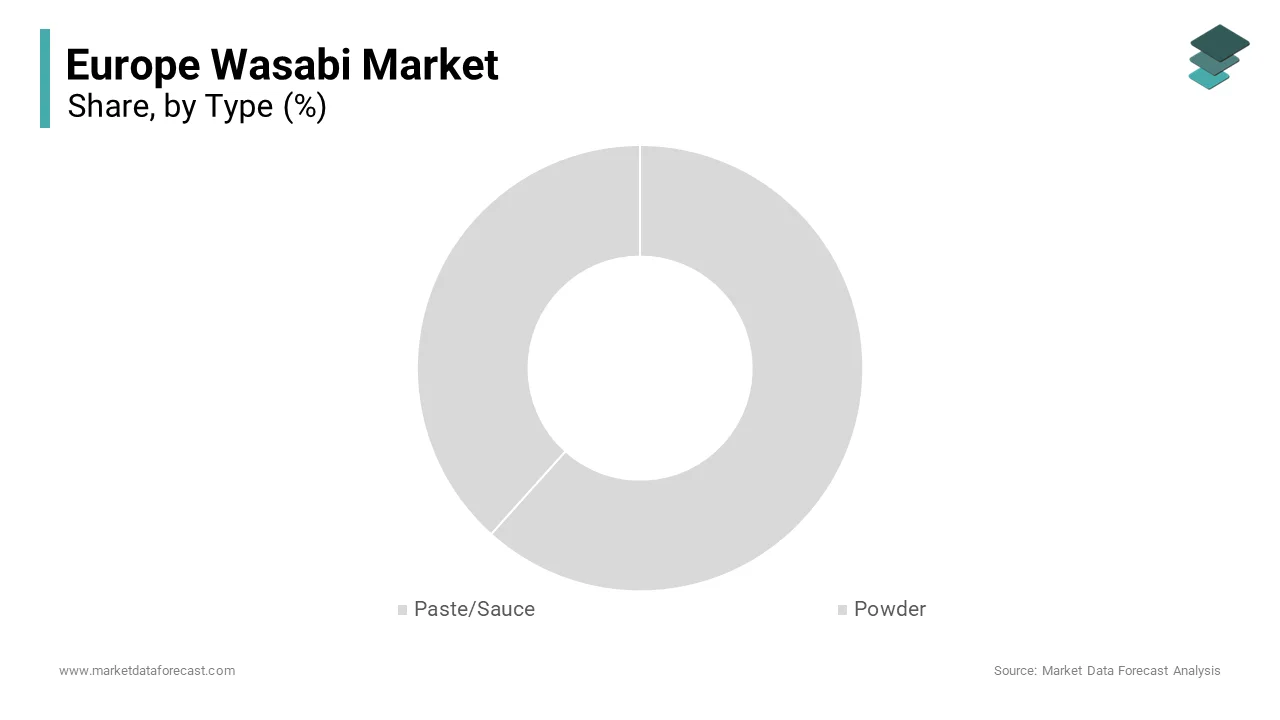
- Paste/Sauce
- Powder
By Nature Type
- Organic
- Conventional
By End-User Type
- Food Service
- Retail
By Country
- UK
- France
- Spain
- Germany
- Italy
- Russia
- Sweden
- Denmark
- Switzerland
- Netherlands
- Turkey
- Czech Republic
- Rest of Europe