- Product Description Description
- Table of Contents TOC
- List of Table & Figure LOT
- Get Free Sample PDF Sample PDF
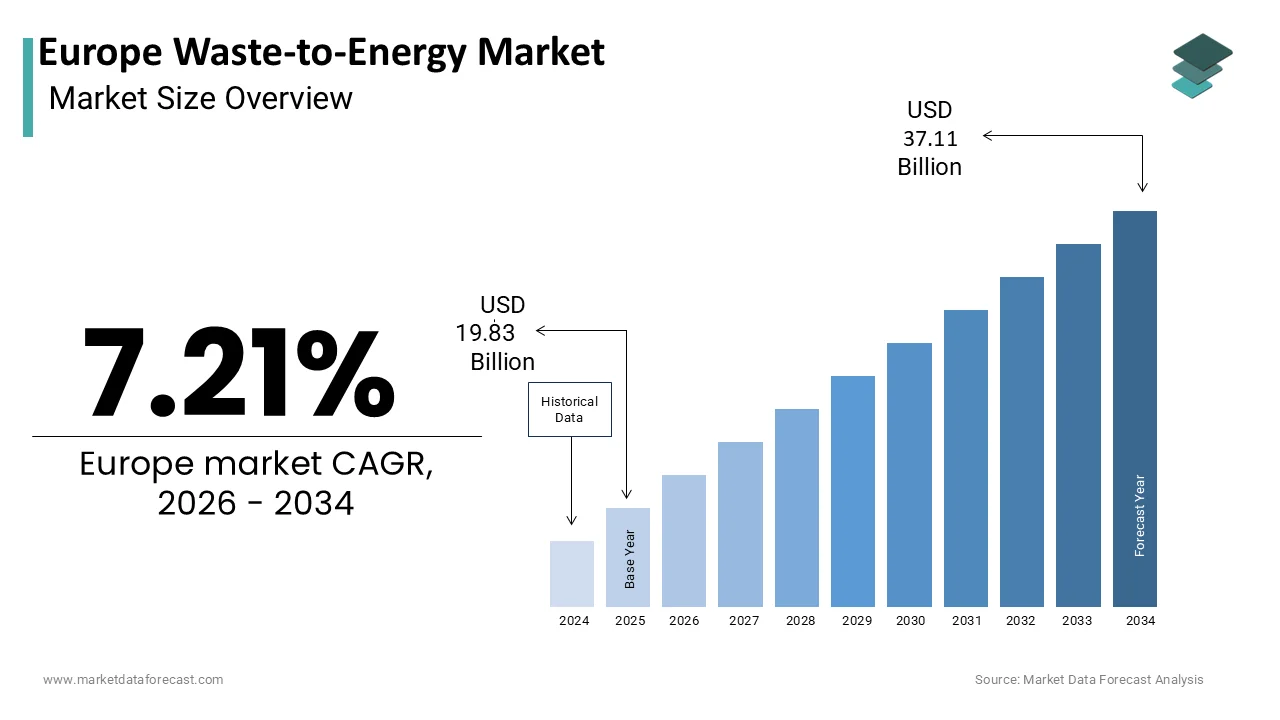
Market Size, 2025
$19.83 BnMarket Estimate, 2026
$21.26 BnMarket Forecast, 2034
$37.11 BnCAGR, 2026–2034
7.21%Europe Waste-to-Energy Market Size
The Europe waste-to-energy market was valued at USD 19.83 billion in 2025 and is estimated to reach USD 21.26 billion in 2026, and is projected to reach USD 37.11 billion by 2034, growing at a CAGR of 7.21% from 2026 to 2034.
The waste to energy is a sophisticated industrial sector dedicated to the thermal and biological conversion of municipal solid waste, commercial refuse, and industrial byproducts into usable electricity, heat, and advanced fuels. As per Eurostat, approximately 23% of municipal waste generated in the European Union was treated through incineration with energy recovery in recent years, with its established role in the regional waste hierarchy. The European Environment Agency emphasizes that modern facilities now operate under strict emission limits defined by the Industrial Emissions Directive, ensuring that energy generation does n,ot compromise air quality. According to the International Energy Agency, Europe hosts over 450 waste-to-energy plants, providing district heating to millions of households, particularly in Nordic and Central European nations where combined heat and power systems are integral to urban infrastructure.
MARKET DRIVERS
Stringent Landfill Diversion Mandates Driving Thermal Treatment Adoption
The stringent landfill diversion mandates by legally compelling member states to reduce the disposal of biodegradable and mixed municipal waste in landfills to minimal levels are propelling the growth of the European waste-to-energy market. The European Union Landfill Directive and subsequent amendments have set binding targets requiring nations to reduce landfilling of municipal waste to less than 10% by 2035, forcing municipalities to seek alternative energy solutions for the European waste-to-energy and municipal waste streams. According to the European Commission, over 15 member states previously relied heavily on landfilling but are now rapidly expanding incineration and mechanical biological treatment capacity to comply with these regulations. This regulatory pressure creates an inelastic demand for waste-to-energy infrastructure as cities face substantial financial penalties for non-compliance and rising landfill taxes that make dumping economically unviable. Data from the European Environment Agency indicates that countries like Germany and Sweden have achieved landfill rates below 1%, largely due to their extensive networks of waste-to-energy plants that process millions of tonnes of refuse annually. The inability to recycle certain contaminated or composite materials further necessitates thermal treatment as the only viable disposal route that also recovers energy. These waste-to-energy works ensure a steady supply of feedstock for waste-to-energy facilities, making regulatory compliance the fundamental engine propelling market expansion and technology adoption across the continent.
Integration with District Heating Networks: Enhancing Energy Efficiency
The integration with district waste-to-energy works acts as a critical driver for the European waste-to-energy market by maximizing the overall energy efficiency of waste treatment facilities through the simultaneous production of electricity and useful heat. This factor is additionally enhancing the growth of Europe's waste-to-energy power plants, which often waste significant thermal energy. Waste-to-energy units connected to district heating grids can achieve total system efficiencies exceeding 80% by utilizing low-grade heat for the rest of the European waste-to-energy space heating. As per Euroheat and Power, district heating supplies approximately 5% of waste-to-energy demand in countries like Denmark and Iceland, with waste-to-energy plants serving as the primary heat source in these extensive networks. This symbiotic relationship makes waste-to-energy projects economically superior to simple incineration, as revenue streams from heat sales significantly improve the return on investment. Data from the International Energy Agency shows that modern combined heat and power waste-to-energy systems in Europe provide warmth to over 15 million households by reducing the need for natural gas boilers and lowering carbon emissions in the heating sector. The dense urban fabric of many European cities facilitates the cost-effective distribution of this heat by creating a stable, long-term demand for thermal output. This dual utility model ensures that waste-to-energy remains a cornerstone of urban energy planning, driving continuous investment in new plants and the upgrading of existing infrastructure to optimize heat recovery capabilities.
MARKET RESTRAINTS
Public Opposition and NIMBYism Delaying Pwaste-to-energyent
The public opposition and Not In My Backyard sentiment, not to mention extensive delays in permitting processes and increasing the political risk associated with new facility construction, are restricting the growth of the European waste-to-energy market. Despite technological advancements that have drastically reduce,d emissions, local communities often resist the establishment of waste to energy plants due to perceived health risks, traffic,, concerns, and negative impacthe European waste-to-energyenergy As per the European Environmental Bureau, numerous proposed projects across Southern and Eastern Europe have been stalled or cancelled follwaste-to-energyublic protests and legal challenges from environmental groups and resident associations. These delays force municipalities to continue relying on landfilling or exporting waste to other regions, undermining national waste management strategies and increasing logistical costs. Data from industry associations indicates that the average time to secure permits for a new waste-to-energy plant has extended to over 7 years in some jurisdictions due to the need for extensive public consultations and environmental impact reassessments. The lack of social license to operate often leads policymakers to prioritize recycling into waste-to-energy usefully, sometimes overlooking the necessity of thermal treatment for non-recyclable residues. This social friction creates an uncertain investment climate where developers face heightened risks of project failure, discouraging capital allocation and slowing the deployment of necessary infrastructure to meet EU waste targets.
Competition from Advanced Recycling Technologies for Feedstock
The competition from advanced recycling technologies for feedstock by reducing the volume and calorific value of waste available for thermal treatment is additionally hindering the growth of the European waste-to-energy market. The European Green Deal and the Circular Economy Action Plan prioritize high-quality mechanical and chemical recycling, aiming to keep materials in use for as long as possible, which directly diverts plastics, paper, and the European waste-to-energy generators. According to the European Commission, the recycling target for municipal waste has been raised to 65% by 2035, meaning a significantly smaller fraction of waste will be available for energy recovery compared to historical levels. This shift threatens the economic viability of existing waste-to-energy plants that were designed based on higher waste throughput assumptions, potentially leading to stranded assets or underutilized capacity. Data from Plastics Europe suggests that the widespread adoption of chemical recycling could capture waste-to-energy plastic fractions that traditionally provided the highest energy yield in incineration processes. Furthermore, the introduction of separate collection mandates for specific waste streams fragments the waste flow, increasing sorting costs and reducing the homogeneity of the residual fuel.
MARKET OPPORTUNITIES
Production of Green Hydrogen and Synthetic Fuels from Waste
The production of green hydrogen and synthetic fuels from waste by transforming traditional incineration facilities into advanced biorefineries that produce high-value transport fuels and industrial feedstocks is significantly to create new opportunities for the growth of Europe's waste-to-energy market. Emerging gasification and plasma arc technologies enable the conversion of non-recyclable waste into high-value products that can subsequently be processed into green hydrogen, methanol, or sustainable aviation fuel, aligning with Europe's waste-to-energy goal for energy independence. As per the European Hydrogen Backbone Initiative, waste-derived hydrogen could contribute significantly to the continent's target of producing 10 million tonnes of renewable hydrogen domestically by 2030, offering a scalable pathway that utilizes existing waste streams. This evolution allows waste to waste-derivedors to access premium markets in heavy transport and aviation where electrification is challenging, thereby diversifying revenue streams beyond electricity and heat. Data from the Joint Research Centre indicates that waste-to-fuel pathways can achieve substantial greenhouse gas savings compared to fossil equivalents, qualifying for generous subsidies under the Renewable Energy Directive.
Recovery of Raw Materials from Incineration Bottom Ash
The recovery of raw matwaste-to-fuel incineration bottom ash by turning waste residues into a secondary source of valuable metals and minerals essential for the green transition is also fuelling the growth of the European waste-to-energy market. Modern processing techniques allow for the efficient extraction of ferrous and non-ferrous metals such as aluminum, copper, and even rare earth elements from the bottom ash generated after combustion, supporting the EU Crithe European waste-to-energy goals. According to the European Commission, Europe is heavily dependent on imports for many critical metals, and recovering these from the millions of tonnes of bottom ash produced annually could significantly enhance supply security and reduce environmental footprint. This approach transforms a disposal liability into a revenue-generating asset, improving the overall economics of waste-to-energy operations while contributing to the circular economy. Data from the European Slag Association shows that advanced metal recovery plants can extract up to 90% of remaining metals from bottom ash, which are then reintroduced into manufacturing waste-to-energy plants. Furthermore, the mineral fraction of processed ash can be used as a sustainable construction aggregate, replacing virgin sand and gravel in road building and concrete production.
MARKET CHALLENGES
Fluctuating Waste Composition Affecting Combustion Stability
The fluctuating waste composition affecting combustion stability by complicating operational control and potentially damaging sensitive equipment designed for specific fuel characteristics is likely to pose as one of the major challenges for the growth of Europe waste and energy market. As recycling rates increase and separate collection schemes expand, the residual waste stream becomes increasingly heterogeneous and variable in terms of moisture content, calorific value, and chemical composition. According to the International Solid Waste Association, inconsistent feedstock quality can lead to unstable combustion temperatures, increased formation of pollutants like dioxins, and accelerated wear on grate systems and boiler tubes. This variability forces operators to constantly adjust air flow and fuel feed rates, reducing overall efficiency and increasing the risk of unplanned shutdowns. Data from plant operators indicates that high moisture content in organic-rich residual waste can significantly lower the net energy output, sometimes requiring auxiliary fuel support to maintain steam parameters. The lack of standardized pre-processing for residual waste across different municipalities exacerbates the issue, making it difficult to optimize plant performance consistently. Furthermore, the presence of unexpected hazardous materials in the waste stream poses safety risks and can contaminate ash residues, complicating their disposal or reuse. Managing this feedstock volatility requires significant investment in advanced sorting and preprocessing technologies, adding to operational costs and complexity.
Complex Regulatory Framework for Emissions and Ash Disposal
The complex regulatory framework for emissions and ash disposal, by imposing stringent compliance requirements that increase capital and operational expenses significantly, is hampering the growth of the European waste-to-energy market. Facilities must adhere to the rigorous limits set by the Industrial Emissions Dire,,ctive regarding nitrogen oxides, sulfur dioxide, heavy metals, and dioxins, necessitating sophisticated and cos,,tly flue gas cleaning systthe European waste-to-energyan Environment Agency, any breach of these limits can result in severe fines, temporary plant closures, and reputational damage by creating a high stakes operational environment. Additionally, the classification and disposal of fly ash and bottom ash are subject to varying national regulations and the Landfill Directive, which restricts the leaching potential of residues and limits their application in high-stakes construction. Data from industry reports shows that the cost of managing and treating hazardous fly ash can account for up to 20% of total operating expenses, eroding profit margins. The evolving nature of these regulations, with periodic reviews tightening limits further, creates uncertainty for long-term investment planning. Operators must continuously upgrade pollution control technologies to meet new standards, diverting capital from expansion or innovation.
REPORT COVERAGE
| REPORT METRIC | DETAILS |
| Market Size Available | 2025 to 2034 |
| Base Year | 2025 |
| Forecast Period | 2026 to 2034 |
| Segments Covered | By Technology, Waste Type, End-User, and Region. |
| Various Analyses Covered | Global, Regional, and Country-Level Analysis, Segment-Level Analysis, Drivers, Restraints, Opportunities, Challenges; PESTLE Analysis; Porter’s Five Forces Analysis, Competitive Landscape, Analyst Overview of Investment Opportunities |
| Countries Covered | UK, France, Spain, Germany, Italy, Russia, Sweden, Denmark, Switzerland, Netherlands, Turkey, Czech Republic, Rest of Europe |
| Market Leaders Profiled | Veolia Environnement S.A., SUEZ S.A., Mitsubishi Heavy Industries Ltd., Hitachi Zosen Inova AG, Martin GmbH, A2A S.p.A., Wheelabrator Technologies Inc., EEW Energy from Waste GmbH, Ramboll Group A/S, AFRY AB, Biffa plc, China Everbright Environment Group Limited |
SEGMENTAL ANALYSIS
By Technology Insights
The thermal technology segment accounted for a prominent share of the European waste-to-energy market in 2025, owing to the extensive existing infrastructure capable of processing massive volumes of residual waste while achieving significant volume reduction ratios and landfill diversion. European nations have invested in waste-to-energy for the last forty years to build hundreds of large-scale incineration facilities that can reduce waste volume by up to 90% and weight by 75%, making it the most effective method for managing the sheer quantity of urban refuse. According to Eurostat, thermal treatment handles the largest portion of municipal waste in countries like Sweden, Denmark, and Germany, where landfilling has been virtually eliminated due to strict regulatory bans. Data from the Confederation of European Waste-to-Energy Plants indicates that these facilities collectively process over 90 million tonnes of waste annually, providing a reliable disposal route for materials that cannot be mechanically recycled. The high calorific value of mixed municipal waste ensures stable combustion and consistent energy output, which is critical for maintaining the economic viability of these capital-intensive assets.
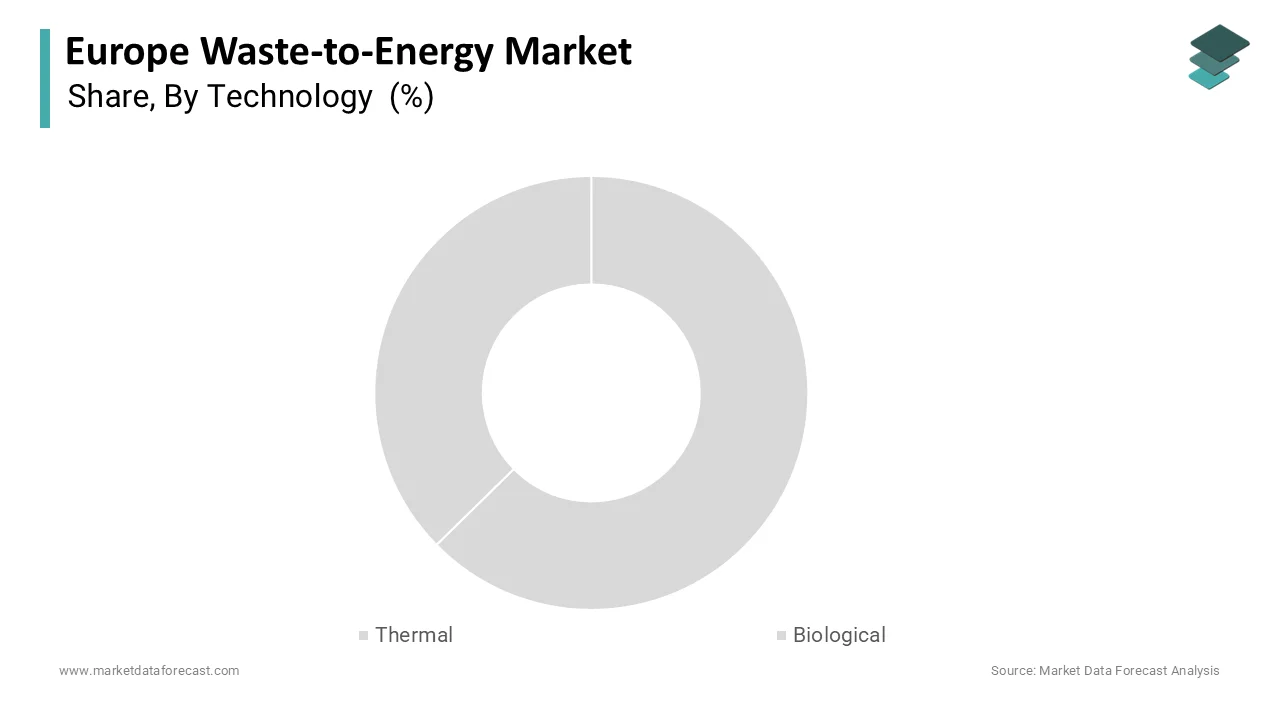
The biological technology segment is likely to witness the fastest CAGR of 9.4% through the forecast period. The implementation of mandatory separate collection schemes for organic waste acts as the foremost driver for the rapid expansion of the biological segment. The revised EU Waste Framework Directive requires all member states to establish separate collection systems for bio-waste by the end of 2023, creating a dedicated feedstock stream for anaerobic digestion facilities that was previously mixed with general municipal waste. According to the European Commission, organic waste constitutes approximately 30 to 40% of total municipal waste, representing a vast untapped resource for biogas production now being unlocked by legislation. Data from the European Biogas Association indicates that the number of anaerobic digestion plants in Europe has surged as municipalities seek compliant solutions to treat food scraps, garden waste, and agricultural residues. This legislative push ensures a steady and growing supply of high-quality feedstock specifically suited for biological conversion, driving investment in new digestion capacity. The shift away from co-incineration of organics towards dedicated biological treatment maximizes methane capture and produces nutrient-rich digestate for agriculture, offering environmental benefits that thermal methods cannot match for wet waste streams.
By Waste Type Insights
The municipal solid waste segment held a significant share of the European waste-to-energy market in 2025. The growth of the segment is driven by the consistently high generation rates in Europe's densely populated urban centers, which create a continuous and massive supply of feedstock for waste-to-energy facilities. If European waste-to-energy main high and consumption patterns persist, European cities generate millions of tonnes of residual waste annually that requires immediate and reliable management. According to Eurostat, the average municipal waste generation per capita in the European Union stands at approximately 500 kilograms per year, resulting in a total annual volume exceeding 220 million tonnes. This substantial quantity ensures that waste-to-energy plants operating on municipal solid waste maintain high capacity utilization rates, which is critical for their economic viability. Data from the European Environment Agency highlights that despite recycling efforts, a significant fraction of municipal waste remains non-recyclable due to contamination or material complexity, necessitating thermal or biological treatment. This reliable availability secures its position as the primary feedstock, dwarfing other waste types in terms of volume and market importance.
The agricultural and agro-industrial residues segment is expected to grow at the fastest CAGR of 11.2% from 2026 to 2034. The widespread utilization of crop residues and animal manure for distributed energy generation acts as the primary engine for the explosive growth of this segment. European agriculture expects vast quantities of biomass, including straw, husks, and livestock waste, which are increasingly being diverted from open burning or uncontrolled decomposition to anaerobic digestion and combustion facilities. Data from the Joint Research Centre shows that farm-based biogas plants are proliferating across countries like Italy, France, and Germany, allowing farmers to convert waste into electricity, heat, and biomethane while producing organic fertilizers as a byproduct. This decentralized approach enhances rural energy security and provides farmers with an additional revenue stream, incentivizing the collection and processing of agro-residues. The technological maturity of small-scale digesters and biomass boilers makes it feasible for individual farms or cooperatives to invest in waste-to-energy solutions, driving rapid adoption rates in the agricultural sector.
By End-User Insights
The industrial captive plants segment accounted in holding 55.4% of the European waste-to-energy market share in 2025, with the compelling economic advantage of generating its own power and heat from waste, which significantly reduces exposure to volatile grid electricity and natural gas prices. Industries such as cement, steel, and European waste-to-energy generate substantial amounts of process waste that possess high calorific values, making them ideal fuels for onsite waste-to-energy units. According to the European Cement Association, the substitution of fossil fuels with waste-derived fuels in cement kilns has reached over 40% in several European countries, drastically cutting fuel costs and carbon taxes. Data from the International Energy Agency indicates that industrial entities utilizing captive waste-to-energy systems can achieve energy cost savings of up to 30% compared to purchasing grid power, while also avoiding waste disposal fees. The ability to operate independently of grid constraints enhances energy security, a priority that has intensified following recent energy crises in Europe. This dual benefit of waste elimination and cheap energy generation creates a strong business case for heavy industries to invest in and operate their own waste-to-energy facilities, securing the segment's leading market position.
The transport fuel distributors segment is likely to expand at a CAGR of 14.8% from 2026 to 2034. The implementation of binding mandates for sustainable aviation and marine fuels is greatly influencing the growth of the segment. The EU ReFuelEU Aviation initiative and FuelEU Maritime regulation require fuel suppliers to blend increasing shares of sustainable fuels derived from waste and residues into jet fuel and shipping bunkers, creating a guaranteed market for waste-to-energy outputs. According to the European Commission, airlines operating in Europe will be required to use at least 2% sustainable aviation fuel by 2025, rising to 70% by 2050, with specific sub-targets for synthetic fuels produced from waste. Data from the International Air Transport Association indicates that waste-to-energy pathways such as gasification and pyrolysis are among the few scalable methods to produce these advanced biofuels in sufficient quantities. This regulatory framework forces fuel distributors to secure long-term supply contracts with waste-to-energy producers, driving massive investment in conversion facilities. The premium pricing and guaranteed offtake for waste-derived transport fuels make this segment highly attractive, propelling its growth rate far beyond traditional electricity or heat applications.
COUNTRY LEVEL ANALYSIS
Germany Waste To Energy Market Analysis
Germany was the top performer of the European waste-to-energy market by occupying 24.8% of the share in 2025. Germany's dominance is driven by its comprehensive legislative framework, including the Circular Economy Act, which strictly prohibits the landfilling of untreated municipal waste, forcing European waste-to-energy into thermal or biological treatment. The German Federal Ministry for the Environment reports that the count,,ry operates over 70 large-scale waste-to-energy plants with a total capacity exceeding 18 million tonnes annually, ensuring near-total diversion from landfills. Data from the Federal Statistical Office shows that waste-to-energy facilities provide district heating to millions of households and electricity to the grid, playing a crucial role in the national energy mix. The strong presence of engineering firms specializing in waste treatment technology fosters continuous innovation and efficiency improvements. Furthermore, the Energiewende policy supports the integration of waste-derived energy into the renewable portfolio, offering favorable tariffs for biogas and waste heat. The combination of regulatory strictness, technological expertise, and high waste generation rates ensures Germany remains the central pillar of the European waste-to-energy landscape.
France Waste To Energy Market Analysis
The French waste-to-energy market was ranked second,dy holding 16.4% of the market share in 2025. The growth of the market in Italy is driven by its Energy Transition for Green Growth Act, which sets aggressive targets for waste valorization and reduction of landfills. The waste-to-energy market has seen significant public and private investment in new facilities. According to the French Ministry of Ecological Transition, the nation has committed to reducing and eliminating the length of non-hazardous waste by 50% by 2025, driving a surge in the construction of new incinerators and methanization units. Data from ADEME, the French environment agency, indicates that the number of anaerobic digestion plants has doubled in the last five years, supported by generous feed-in tariffs for biomethane injection into the gas grid. The country's extensive district heating networks, particularly in urban areas like Paris and Lyon, rely heavily on waste-to-energy plants for heat supply, ensuring stable demand. Additionally, the government's support for circular economy initiatives encourages industrial symbiosis where waste from one sector becomes fuel for another.
United Kingdom Waste-to-Energy Market Analysis
The United Kingdom's waste-to-energy market growth is likely to grow with its rapid shift away from landfilling towards energy recovery following the introduction of steep landfill taxes and restrictive regulations. The waste-to-energy market growth is driven by the Kingdom's waste-to-energy, making dumping economically unviable, forcing local authorities to sign long-term contracts with waste-to-energy operators to manage municipal solid waste. Data from the Environmental Services Association shows that the UK now hosts some of the largest waste-to-energy plants in Europe, capable of processing hundreds of thousands of tonnes annually. The government's commitment to net zero emissions has also spurred interest in carbon capture and storage integration at waste facilities, positioning the UK as a leader in low-carbon waste treatment. Furthermore, the Renewable Heat Incentive and Contracts for Difference schemes provide financial support for efficient energy recovery projects.
Sweden Waste To Energy Market Analysis
Sweden's waste-to-energy market growth is steadily growing with its pioneering role in district heating and its unique status as a net importer of waste to feed its highly efficient energy recovery facilities. Sweden's waste-to-energy market growth is driven by its district heating network, which supplies over half of the country's heating demand, relying heavily on waste-to-energy plants as the primary heat source. Data from Avfall Sverige, Sweden's waste-to-energy association, reveals that domestic waste generation is insufficient to meet the capacity of Swedish plants, leading to the import of hundreds of thousands of tonnes of waste from neighboring countries like Norway and the UK. This cross-border waste trade underscores the efficiency and capacity of the Swedish system.
Netherlands Waste To Energy Market Analysis
The Netherlands ' waste-to-energy market growth is expected to have growth opportunities in the coming years, with its stringent landfill ban enacted in 1995, which effectively eliminated landfilling of combustible waste, creating a mature market entirely dependent on incineration waste-to-energy. According to the Dutch Ministry of Infrastructure and Water Management, the country operates a dense network of waste-to-energy plants that achieve some of the highest energy efficiency rates in Europe through optimal heat recovery and electricity generation. Data from Statistics Netherlands shows that the sector is increasingly focusing on recovering raw materials from bottom ash and fly ash, aligning with national circular economy goals. The proximity of these facilities to major industrial ports like Rotterdam allows for the direct supply of steam and heat to chemical and manufacturing industries, enhancing overall system efficiency. Furthermore, the Dutch government actively supports pilot projects for producing hydrogen and synthetic fuels from waste, positioning the country at the forefront of next-generation waste valorization.
COMPETITIVE LANDSCAPE
The European waste-to-energy market is characterized by intense rivalry among large multinational utility groups, specialized waste management firms, and emerging technology providers striving to secure long-term waste supply contracts and municipal concessions. European waste-to-energy companies compete fiercely based on energy efficiency rates, emissions, performance levels, and the ability to offer integrated circular economy solutions that combine recycling with energy recovery. The entry of energy majors into the sector has heightened competitive pressures as these entities leverage existing district heating networks and capital reserves to develop large-scale facilities. Companies are increasingly differentiating themselves through innovations in carbon capture, utilization, and storage, and the production of renewable gas, which align with evolving climate policies. The scarcity of suitable sites for new plants due to public opposition creates a bottleneck where permitting capabilities and community engagement become competitive, with advantages over pure technical strength. Strategic alliances across the waste and energy sectors are common as firms seek to share risks associated with regulatory changes and fluctuating energy prices.
KEY MARKET PLAYERS
Some of the companies that are playing a dominating role in the global Europe Waste-to-Energy Market include
- Veolia Environnement S.A.
- SUEZ S.A.
- Mitsubishi Heavy Industries Ltd.
- Hitachi Zosen Inova AG
- Martin GmbH
- A2A S.p.A.
- Wheelabrator Technologies Inc.
- EEW Energy from Waste GmbH
- Ramboll Group A/S
- AFRY AB
- Biffa plc
- China Everbright Environment Group Limited
TOP LEADING PLAYERS IN THE MARKET
- Veolia Environnement stands as a global leader in the European waste-to-energy market with extensive operations spanning waste collection, sorting, and thermal recovery across the continent. The company contributes significantly to the global sector by setting benchmarks for circular economy practices and European waste-to-energy recovery from non-recyclable waste streams. Recent actions to strengthen its position include the acquisition of major waste management assets in Central Europe and the commissioning of new state-of-the-art incineration plants equipped with advanced flue gas cleaning systems. Veolia continues to invest heavily in research to improve material recovery rates from bottom ash and to develop carbon capture technologies for its facilities. The firm actively partners with municipalities to design integrated waste management solutions that maximize energy output while minimizing environmental impact. Its strategic focus on expanding district heating networks connected to its waste-to-energy plants ensures long-term revenue stability and reinforces its role as a critical enabler of urban sustainability.
- Suez Group operates as a pivotal participant in the European waste-to-energy market, leveraging its deep expertise in resource recovery and renewable energy production to serve diverse industrial and municipal clients. The company plays a crucial global role by pioneering advanced biological treatment technology to convert organic waste into biomethane and electricity. Recent initiatives to bolster its market standing include the launch of several large-scale methanization projects in France and the United Kingdom that supply renewable gas directly into national grids. Suez has also expanded its digital offerings to optimize waste logistics and plant performance through artificial intelligence and real-time monitoring systems. The corporation collaborates closely with industrial partners to create symbiotic ecosystems where waste from one process becomes fuel for another. Its commitment to developing next-generation recycling and energy recovery hubs reinforces its pivotal role in helping European cities achieve zero waste targets while securing reliable renewable energy supplies.
- Covanta Holding Corporation serves as a vital force in the European waste-to-energy market, although primarily known for its North American presence, it has strategically expanded its footprint through partnerships and technology licensing agreements in key European regions. The company contributes to the global European waste-to-energy industry's technological operational excellence and framework to enhance the efficiency and reliability of waste-to-energy facilities. Recent efforts to enhance its European influence include forming joint ventures with local utility companies to modernize aging incineration infrastructure and integrate carbon capture, utilization, and storage systems. Covanta has also focused on exporting its expertise in handling complex industrial waste streams to European industrial clusters seeking to reduce their carbon footprint. The firm invests continuously in emissions c,ontrol inno,vations to meet the stringent standards of the European Industrial Emissions Directive. Its strategy of offering comprehensive operation and maintenance services ensures that partner facilities achieve optimal performance and regulatory compliance,e solidifying its status as a trusted technology and service provider in the evolving European market.
TOP STRATEGIES USED BY KEY MARKET PARTICIPANTS
Key players in the European waste-to-energy market primarily employ vertical integration strategies to control the entire value chain from waste collection and sorting to energy generation and ash processing. Companies actively form long-term public-private partnerships to secure steady waste feedstock supplies and guarantee revenue streams through tipping fees and energy sales. Another major strategy involves investing heavily in advanced emission control technologies and public-private partnership systems to comply with stringent environmental regulations and gain social license to operate. Market participants also focus on diversifying their output by producing renewable heat, biogas,e and recovered materials alongside electricity to maximize resource efficiency and profitability. Additionally, firms are pursuing mergers and acquisitions to expand their geographic reach and consolidate market position in regions with high landfill diversion targets. Continuous innovation in process automation and digital monitoring remains a priority to optimize plant efficiency and reduce operational costs while enhancing safety standards across all facilities.
MARKET SEGMENTATION
This research report on the europe waste-to-energy market is segmented and sub-segmented into the following categories.
By Technology
- Thermal
- Biological
By Waste Type
- Municipal Solid Waste
- Agricultural & Agro-Industrial Residues
- Industrial Waste
- Other Waste Types
By End-User
- Industrial Captive Plants
- Transport Fuel Distributors
- Utilities
- Municipal Authorities
By Country
- Germany
- France
- United Kingdom
- Sweden
- Netherlands
- Rest of Europe