- Product Description Description
- Table of Contents TOC
- List of Table & Figure LOT
- Get Free Sample PDF Sample PDF
Market Size, 2025
$438 BnMarket Estimate, 2026
$461 BnMarket Forecast, 2034
$695 BnCAGR, 2026–2034
5.26%Europe Waste Management Market Report Summary
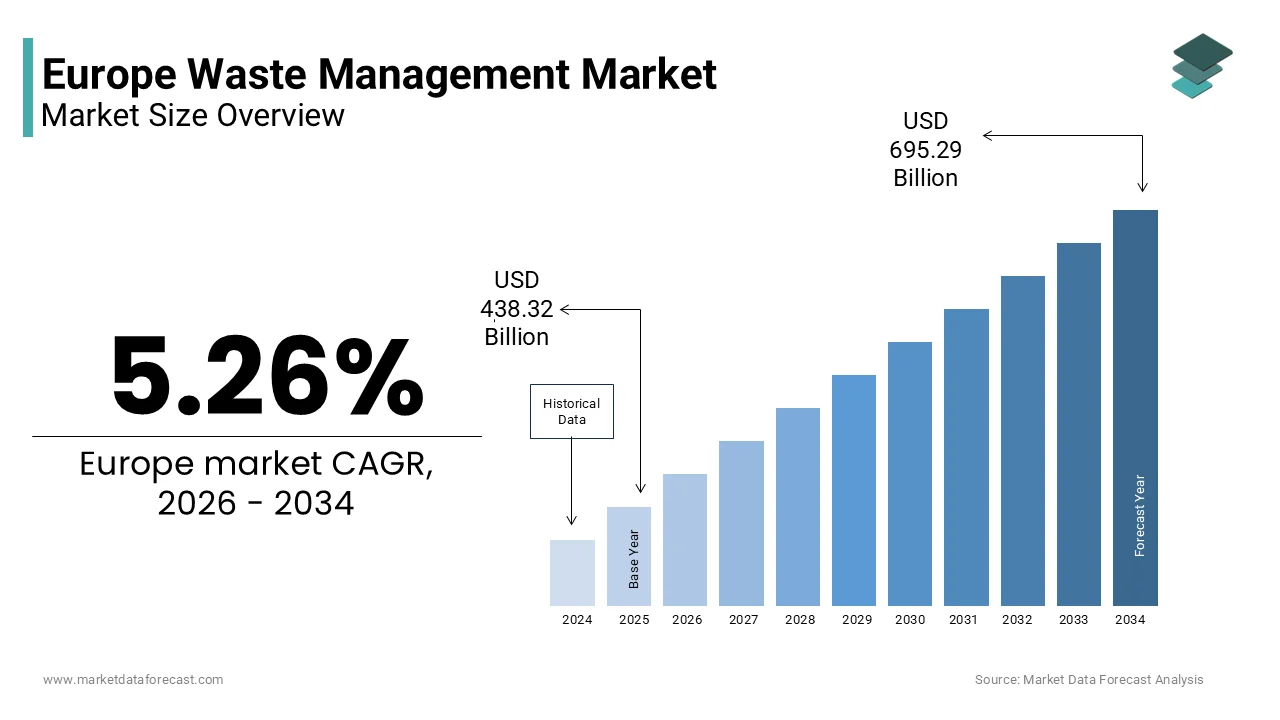
The Europe waste management market was valued at USD 438.32 billion in 2025, is estimated to reach USD 461.38 billion in 2026, and is projected to reach USD 695.29 billion by 2034, growing at a CAGR of 5.26% during the forecast period. Market growth is driven by increasing waste generation, stringent environmental regulations, and rising focus on sustainable waste disposal and recycling practices. The adoption of circular economy models, along with growing investments in waste treatment infrastructure, is further supporting market expansion. In addition, advancements in waste sorting, recycling technologies, and energy recovery systems are contributing to steady market growth across Europe.
Key Market Trends
- Rising focus on sustainability and circular economy practices is driving market growth.
- Increasing regulatory pressure for proper waste disposal and recycling is supporting expansion.
- Growing investments in waste management infrastructure are boosting market development.
- Expansion of recycling and waste to energy technologies is enhancing resource recovery.
- Technological advancements in waste sorting and processing are improving efficiency.
Segmental Insights
- Based on type, the municipal waste segment was the largest and held 51.5% of the Europe waste management market share in 2025. This dominance is attributed to increasing urban population and rising household waste generation.
- Based on service, the collection services segment accounted for 44.7% of the Europe waste management market share in 2025. The segment’s growth is driven by the essential role of waste collection in overall waste management systems and expanding municipal services.
Regional Insights
- The Europe waste management market is experiencing strong growth across key countries, supported by regulatory frameworks and sustainability initiatives.
- Germany was the largest contributor in the Europe waste management market in 2025, driven by advanced waste management systems, high recycling rates, and strong environmental policies.
Competitive Landscape
The Europe waste management market is highly competitive, with key players focusing on technological innovation, service expansion, and sustainability initiatives to strengthen their market position. Companies are investing in recycling technologies, waste to energy solutions, and digital waste management systems. Prominent players in the Europe waste management market include Advanced Disposal Services, Republic Services, Waste Management Inc, and FCC Environment Ltd.
Europe Waste Management Market Size
The Europe waste management market size was valued at USD 438.32 billion in 2025, and the market size is expected to reach USD 695.29 billion by 2034 from USD 461.38 billion in 2026. The market is growing at a CAGR of 5.26%.
Waste management encompasses a comprehensive system of collection, transport, processing, recycling, and disposal of waste materials generated by residential, commercial, and industrial activities across the continent. This sector is pivotal in transitioning towards a circular economy where resources are kept in use for as long as possible. The market is heavily influenced by stringent regulatory frameworks aimed at minimizing environmental impact and maximizing resource recovery. According to Eurostat, the European Union generates approximately 2.3 billion tons of waste annually, with municipal waste accounting for a significant portion of this volume. As per the European Environment Agency, approximately 48% of municipal waste in the EU was recycled in recent years, indicating substantial room for improvement in waste diversion rates. The implementation of the European Green Deal has further accelerated the shift away from landfilling towards more sustainable practices such as composting and energy recovery. Consumer awareness regarding sustainability is also driving changes in waste generation patterns, with increased demand for eco-friendly products and services. The integration of advanced technologies, such as artificial intelligence and Internet of Things devices, in waste sorting and collection processes is enhancing operational efficiency. These technological advancements, coupled with policy mandates, create a dynamic environment for market growth. The focus on reducing plastic waste and promoting extended producer responsibility schemes continues to shape the strategic direction of waste management operators across Europe.
MARKET DRIVERS
Stringent Regulatory Frameworks and Circular Economy Policies Drive Investment in Sustainable Waste Solutions
The implementation of rigorous regulatory frameworks and circular economy policies is propelling the growth of the Europe waste management market, which is compelling municipalities and corporations to adopt sustainable waste handling practices. The European Union has set ambitious targets to reduce landfilling and increase recycling rates, which necessitates significant infrastructure upgrades and operational changes. According to the European Commission, the Landfill Directive mandates that member states reduce the amount of municipal waste landfilled to no more than 10% by 2035. This legal requirement forces local authorities to invest in alternative treatment facilities such as material recovery facilities and waste to energy plants. As per the European Environment Agency, countries that have implemented strict landfill bans have seen recycling rates increase by up to 20% over the past decade. The Circular Economy Action Plan further reinforces this trend by introducing measures to improve product durability and recyclability. These policies create a stable demand for waste management services that align with sustainability goals. Companies are increasingly required to report on their waste footprint and demonstrate compliance with environmental standards. This regulatory pressure not only drives capital expenditure in new technologies but also fosters innovation in waste processing methods. The consistent enforcement of these regulations ensures long term growth for operators who can provide compliant and efficient waste management solutions.
Rising Environmental Awareness and Consumer Demand for Sustainability Accelerate Waste Segregation and Recycling
Growing environmental awareness among consumers and businesses significantly is further contributing to the expansion of the European waste management market. Public concern over climate change and pollution has led to increased participation in recycling programs and demand for transparent waste handling practices. According to a Eurobarometer survey, approximately 93% of Europeans agree that it is important to protect the environment and support initiatives that reduce waste. This societal shift encourages households and companies to segregate waste more diligently, thereby improving the quality of recyclable materials. As per the Ellen MacArthur Foundation, businesses are increasingly adopting circular business models, which emphasize reuse and recycling to minimize waste generation. Consumer preference for brands with strong environmental credentials drives companies to partner with waste management firms that offer certified recycling services. The rise of zero waste lifestyles and community led clean up initiatives further amplifies the demand for efficient waste collection systems. Municipalities are responding by expanding curbside recycling programs and providing educational campaigns to enhance public engagement. This bottom up pressure complements top down regulatory efforts, creating a robust ecosystem for waste management growth. The alignment of consumer values with corporate sustainability strategies ensures sustained demand for innovative and eco-friendly waste solutions.
MARKET RESTRAINTS
High Operational Costs and Infrastructure Deficits Hinder Efficient Waste Processing Capabilities
High operational costs and inadequate infrastructure present significant restraints to the Europe waste management market, which is limiting the efficiency and scalability of waste processing operations. The establishment and maintenance of advanced recycling facilities and waste to energy plants require substantial capital investment, which can be prohibitive for smaller municipalities and private operators. According to the European Investment Bank, the annual investment gap for waste management infrastructure in the EU is estimated at 6 billion EUR to 8 billion EUR. This financial burden is exacerbated by rising energy and labor costs, which impact the profitability of waste management services. As per the Confederation of European Waste to Energy Plants, the cost of complying with emissions standards and safety regulations has increased significantly in recent years. Many regions lack the necessary sorting and processing facilities to handle complex waste streams effectively, leading to lower recycling rates. The fragmentation of waste management systems across different jurisdictions further complicates economies of scale. Inadequate infrastructure results in higher transportation costs and logistical inefficiencies. Additionally, the volatility of secondary raw material prices affects the revenue potential of recycling operations. These economic and structural barriers slow down the adoption of advanced waste management technologies and limit the overall effectiveness of waste reduction efforts across the continent.
Complexity of Waste Streams and Contamination Issues Reduce Recycling Efficiency and Quality
The increasing complexity of waste streams and high levels of contamination pose major restraints to the Europe waste management market by reducing the efficiency and quality of recycling processes. Modern products often consist of multiple materials that are difficult to separate, such as multi-layer packaging and composite materials. According to the European Plastics Converters, the recycling rate for plastic packaging remains low due to challenges in sorting and processing mixed plastics. Contamination of recyclable materials with food residue or non-recyclable items further degrades the quality of output materials, making them less valuable for manufacturers. As per the Waste and Resources Action Programme, contamination rates in household recycling bins can exceed 15% in some areas, leading to entire loads being sent to landfill or incineration. The lack of standardized labeling and collection systems across different regions confuses consumers and exacerbates contamination issues. Advanced sorting technologies, such as optical scanners, are expensive to implement and maintain. Furthermore, the presence of hazardous substances in electronic waste and batteries requires specialized handling procedures that are not universally available. These technical and logistical challenges hinder the achievement of high quality recycling targets. Until waste design improves and consumer education enhances segregation practices, the industry will struggle to maximize resource recovery rates effectively.
MARKET OPPORTUNITIES
Advancements in Digital Technologies and Smart Waste Management Systems Offer Operational Efficiencies
The integration of digital technologies and smart waste management systems is a significant opportunity for the Europe waste management market by enhancing operational efficiency and data driven decision making. Technologies such as Internet of Things sensors, artificial intelligence, and blockchain enable real time monitoring of waste levels, optimization of collection routes, and improved sorting accuracy. According to the International Solid Waste Association, smart bins equipped with fill level sensors can reduce collection frequency by up to 30%, leading to lower fuel consumption and emissions. As per the European Smart Cities Marketplace, cities that have adopted smart waste solutions report improved service quality and cost savings. Artificial intelligence powered sorting robots can identify and separate recyclable materials with greater precision than manual methods, increasing the purity of recycled outputs. Blockchain technology offers transparency in the supply chain, allowing stakeholders to track waste from generation to final disposal. These innovations support the transition towards a circular economy by providing accurate data on material flows. Governments and private investors are increasingly funding pilot projects for smart waste infrastructure. The ability to analyze large datasets helps operators predict waste generation patterns and optimize resource allocation. Embracing digital transformation allows waste management companies to offer value added services and differentiate themselves in a competitive market.
Expansion of Waste to Energy Technologies Provides Sustainable Alternatives to Landfilling
The expansion of waste to energy technologies offers a lucrative opportunity for the Europe waste management market by providing a sustainable alternative to landfilling and contributing to energy security. Waste to energy plants convert non-recyclable waste into electricity, heat, and fuel, thereby reducing waste volume and generating renewable energy. According to the Confederation of European Waste to Energy Plants, these facilities supply energy to approximately 20 million citizens across Europe. As per the European Commission, waste to energy plays a crucial role in the circular economy by recovering energy from residual waste that cannot be recycled. The technology helps mitigate greenhouse gas emissions by preventing methane release from landfills. Recent advancements in combustion and gasification technologies have improved efficiency and reduced emissions, making these plants more environmentally friendly. Government incentives and subsidies for renewable energy production further support the development of waste to energy infrastructure. Countries with limited landfill capacity are increasingly investing in these facilities to manage waste sustainably. The integration of waste to energy with district heating systems enhances overall energy efficiency. This dual benefit of waste reduction and energy production makes it an attractive investment for both public and private sectors. As Europe strives for carbon neutrality, waste to energy will remain a key component of its waste management strategy.
MARKET CHALLENGES
Regulatory Fragmentation and Varying National Standards Complicate Cross Border Waste Trade
Regulatory fragmentation and varying national standards across European countries is a major challenge to the Europe waste management market by complicating cross border waste trade and harmonization efforts. Each member state has its own interpretation of European directives, leading to inconsistencies in waste classification, labeling, and handling requirements. According to the European Court of Auditors, differences in national implementations hinder the efficient movement of recyclable materials within the single market. As per the Organisation for Economic Cooperation and Development, these discrepancies create administrative burdens and increase compliance costs for operators working in multiple jurisdictions. The lack of uniform definitions for what constitutes waste versus a secondary raw material creates legal uncertainties. Restrictions on waste exports to non EU countries further limit market options for surplus materials. Inconsistent enforcement of regulations leads to uneven playing fields where some operators may gain unfair advantages through lower compliance standards. Harmonizing these regulations requires extensive political coordination and consensus, which is often slow to achieve. The complexity of navigating diverse legal frameworks discourages investment in cross border infrastructure. Until a more unified regulatory framework is established, the market will face inefficiencies and barriers to optimal resource allocation across the continent.
Public Opposition and NIMBY Syndrome Delay Infrastructure Development Projects
Public opposition and the Not In My Back Yard (NIMBY) syndrome significantly challenge the Europe waste management market by delaying or blocking the development of essential waste infrastructure projects. Local communities often resist the construction of waste treatment facilities, landfills, and incinerators due to concerns about odor, traffic, noise, and potential health risks. According to a study by the University of Manchester, public acceptance is a critical factor in the success of waste management projects, yet it remains a persistent hurdle. As per the European Federation of Waste Management and Environmental Services, obtaining permits for new facilities can take 5 to 10 years due to lengthy consultation processes and legal challenges. This delays the implementation of necessary infrastructure upgrades and hinders the achievement of recycling and recovery targets. Negative perceptions of waste facilities are often fueled by misinformation and lack of community engagement. Operators must invest heavily in public relations and community benefit programs to gain social license to operate. The uncertainty surrounding project approval increases financial risks and discourages private investment. Overcoming this social barrier requires transparent communication and proactive involvement of local stakeholders in the planning process. Without public support, the expansion of waste management infrastructure will remain constrained, limiting the sector's ability to meet growing demand.
REPORT COVERAGE
| REPORT METRIC | DETAILS |
| Market Size Available | 2025 to 2034 |
| Base Year | 2025 |
| Forecast Period | 2026 to 2034 |
| CAGR | 5.26% |
| Segments Covered | By Type, Service, and Region. |
| Various Analyses Covered | Global, Regional, and country Analysis, Segment-Level Analysis, DROC, PESTLE Analysis, Porter’s Five Forces Analysis, Competitive Landscape, Analyst Overview of Investment Opportunities |
| Regions Covered | Germany, Italy, France, United Kingdom |
| Market Leaders Profiled | Advanced disposal services, Republic Services, Waste Management Inc, FCC Environment Ltd, and Others. |
SEGMENTAL ANALYSIS
By Type Insights
The municipal waste segment dominated the market by holding 51.5% of the regional market share in 2025. The high urbanization rates, stringent household recycling mandates, consistent generation of waste from households and commercial establishments in highly urbanized European societies are primarily driving the dominance of municipal waste management segment in the European market. With approximately 75% of the European population living in urban areas as per Eurostat data, the volume of municipal solid waste remains substantial and requires systematic management. The European Union has implemented rigorous directives, such as the Waste Framework Directive, which mandates separate collection for bio waste, paper, metal, plastic, and glass by 2025. According to the European Environment Agency, municipal waste generation in the EU amounted to approximately 232 million tons in recent years, which is creating a steady demand for collection and processing services. Local governments are increasingly investing in infrastructure to meet recycling targets, which drives market activity in this segment. The shift away from landfilling towards material recovery facilities is particularly pronounced in municipal waste management due to public visibility and political pressure. As per the Organisation for Economic Co operation and Development, member countries in Europe have significantly increased their municipal recycling rates through pay as you throw schemes and enhanced curbside collection systems. This regulatory and social push ensures that municipal waste remains the largest and most regulated segment of the market, requiring continuous operational improvements and technological adoption to handle diverse waste streams effectively.
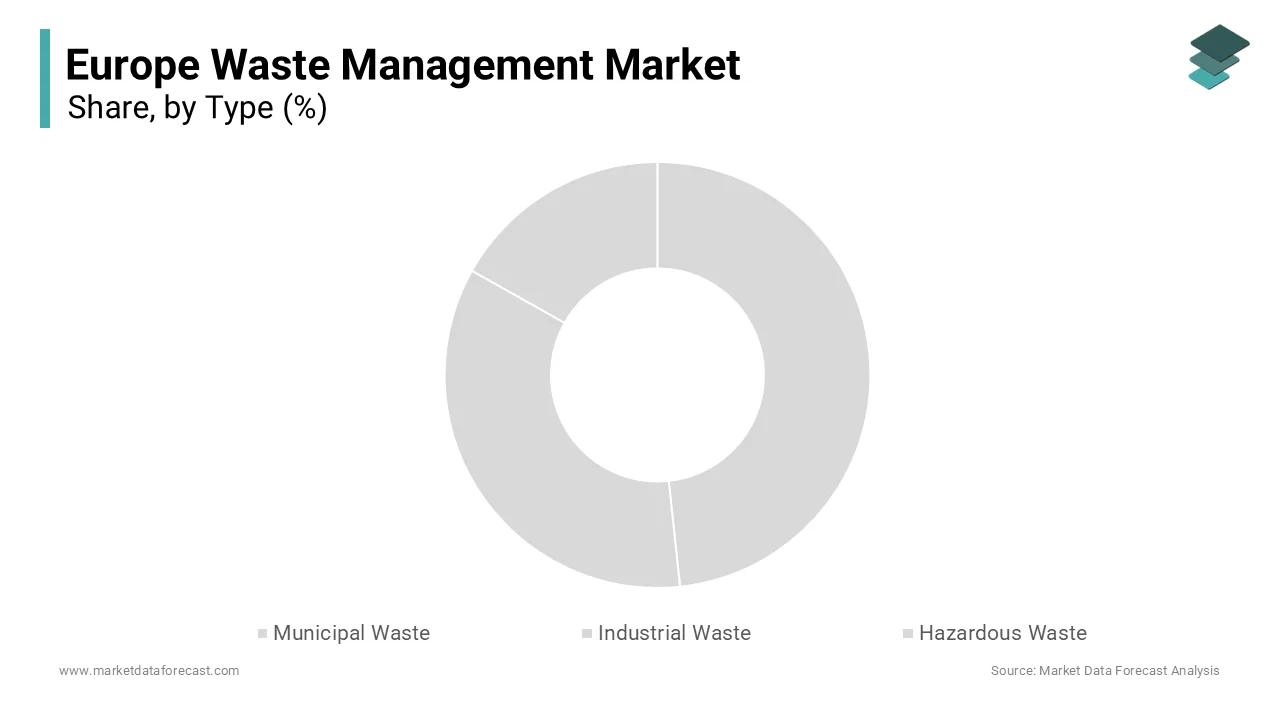
On the other hand, the hazardous waste segment is estimated to record a CAGR of 7.2% over the forecast period in the European waste management market owing to the industrial expansion and stricter safety regulations. The rapid expansion of the hazardous waste segment is fueled by increasing industrial activities in sectors such as pharmaceuticals, chemicals, and electronics, which generate toxic byproducts requiring specialized handling. The European Union has tightened regulations regarding the disposal of hazardous substances to prevent soil and water contamination, leading to higher compliance costs and demand for professional management services. According to the European Chemicals Agency, the production of chemical substances in Europe continues to rise, necessitating robust waste treatment protocols for hazardous materials. As per the Basel Convention, regional agreements on the transboundary movements of hazardous wastes have led to more stringent tracking and treatment requirements within Europe. The growth of the renewable energy sector, particularly solar panel and battery manufacturing, has also contributed to the increase in hazardous waste volumes due to the presence of heavy metals and toxic chemicals. The European Commission reports that the management of waste electrical and electronic equipment, which often contains hazardous components, is becoming a priority area for investment. Advanced treatment technologies, such as incineration with energy recovery and chemical neutralization, are being adopted to handle these complex waste streams safely. The need for certified disposal facilities and specialized logistics further accelerates market growth in this segment as companies seek to mitigate environmental liabilities and ensure regulatory compliance.
By Service Insights
The collection services segment captured the leading share of 44.7% of the regional market in 2025 due to the mandatory separate collection systems and urban logistics requirements. The fundamental requirement for efficient waste gathering before any processing or disposal can occur is further contributing to the expansion of the collection services segment in the European market. European municipalities are legally obligated to provide regular waste collection services to residential and commercial entities, ensuring a consistent revenue stream for service providers. According to Eurostat, the implementation of separate collection systems for recyclables has expanded significantly across member states, requiring specialized vehicles and logistical planning. As per the European Federation of Waste Management and Environmental Services, collection accounts for the largest portion of operational expenditures in waste management due to labor, fuel, and vehicle maintenance costs. The complexity of urban environments necessitates advanced route optimization and frequent pickups to maintain hygiene and public health standards. The introduction of smart bins and Internet of Things enabled collection systems is enhancing efficiency but also increasing the initial investment in collection infrastructure. Furthermore, the expansion of organic waste collection mandates under the revised Waste Framework Directive is adding new streams to existing collection networks. This regulatory push ensures that collection services remain central to the waste management value chain. The sheer volume of waste generated daily in densely populated European cities sustains the high demand for reliable and frequent collection operations, making it the largest service segment in the market.
The disposal services segment is the fastest growing segment and is estimated to register a CAGR of 6.25 over the forecast period owing to the shift towards waste to energy and reduced landfill dependency. The accelerated growth of the disposal segment is primarily attributed to the transition from traditional landfilling to advanced disposal methods such as waste to energy incineration and mechanical biological treatment. As landfills reach capacity and face stricter environmental restrictions, alternative disposal technologies are gaining prominence. According to the Confederation of European Waste to Energy Plants, waste to energy facilities in Europe treats approximately 100 million tons of waste annually, providing both disposal solutions and renewable energy. As per the European Commission, the Landfill Directive aims to reduce municipal waste landfilling to 10% by 2035, forcing municipalities to invest in thermal treatment and other non-landfill disposal options. This regulatory pressure drives capital expenditure in modern disposal infrastructure that can handle residual waste efficiently while minimizing environmental impact. The integration of carbon capture and storage technologies in waste to energy plants further enhances their sustainability profile, attracting green investments. Additionally, the need to dispose of non-recyclable residues from recycling processes contributes to the growth of this segment. Advanced incineration technologies allow for the recovery of metals and minerals from ash, adding value to the disposal process. These factors collectively position disposal as a dynamic and expanding segment as Europe moves towards a zero waste to landfill future.
REGIONAL ANALYSIS
Germany Waste Management Market Analysis
Germany dominated the market by holding the highest share of the European waste management market in 2025. The dominance of Germany in the European market can be credited to the advanced recycling infrastructure, strict regulatory enforcement, its pioneering role in implementing circular economy principles and high recycling rates. The country has one of the most sophisticated waste management systems globally, with extensive separate collection networks and state of the art treatment facilities. According to the Federal Environment Agency, Germany recycles over 67% of its municipal waste, significantly exceeding the European Union average. As per the German Packaging Act, producers are held responsible for the collection and recycling of packaging waste, which drives innovation in material recovery. The widespread adoption of waste to energy plants ensures that residual waste is utilized for power and heat generation, reducing reliance on fossil fuels. Strong public awareness and participation in recycling programs further support the efficiency of the system. The government continues to invest in research and development for new recycling technologies, particularly for plastics and electronic waste. Industrial waste management is also highly regulated, ensuring that hazardous materials are treated safely. The robust legal framework, combined with technological expertise, makes Germany a model for waste management in Europe. This comprehensive approach ensures sustained market growth and environmental protection.
France Waste Management Market Analysis
France held the second largest share of the European waste management market in 2025 due to the ambitious national laws targeting waste reduction and circular economy transitions. France holds a prominent position in the market due to the implementation of the Anti Waste Law for a Circular Economy, which sets aggressive targets for waste prevention and recycling. The law mandates the elimination of single use plastics and promotes repair and reuse of goods. According to the French Ministry of Ecological Transition, the country aims to achieve 100% recycling of plastics by 2025, driving substantial investment in sorting and processing infrastructure. As per ADEME, the French Environment and Energy Management Agency, extended producer responsibility schemes have been expanded to cover new product categories including textiles and construction materials. This regulatory expansion creates new opportunities for waste management companies to offer specialized collection and treatment services. The closure of many landfills has accelerated the development of waste to energy facilities and mechanical biological treatment plants. Public private partnerships are increasingly common in managing municipal waste services, enhancing operational efficiency. The focus on organic waste separation and composting is also gaining momentum in urban areas. These policy driven initiatives ensure that France remains a key driver of innovation and growth in the European waste management sector.
United Kingdom Waste Management Market Analysis
The United Kingdom is a major contributor to the Europe waste management market and is majorly driven by the post Brexit regulatory adjustments and net zero commitments. The United Kingdom maintains a robust waste management sector despite leaving the European Union, having retained and adapted many EU environmental standards. The country is committed to achieving net zero emissions by 2050, which influences waste management strategies, particularly in reducing methane emissions from landfills. According to the Department for Environment, Food and Rural Affairs, the UK generates approximately 222 million tons of total waste annually, with household recycling rates hovering around 44%. As per the Office for National Statistics, there is a growing emphasis on improving recycling infrastructure to meet new domestic targets. The introduction of consistent collections legislation aims to standardize recycling practices across local authorities, reducing confusion and contamination. Investment in energy from waste facilities continues to grow as a means to manage residual waste sustainably. The private sector plays a significant role in waste collection and treatment, with major operators investing in digital technologies for route optimization. Challenges remain in meeting higher recycling targets, but the regulatory framework provides clear direction for market participants. The focus on plastic packaging taxes also incentivizes better waste management practices among producers.
Italy Waste Management Market Analysis
Italy holds a substantial share in the Europe waste management market and is characterized by regional disparities and ongoing infrastructure development. Italy presents a dynamic market with significant variations in waste management performance between northern and southern regions. Northern Italy boasts some of the highest recycling rates in Europe, while the south faces challenges with landfill dependency. According to the Italian National Institute of Statistics, the overall municipal waste recycling rate has improved to approximately 51%, driven by successful models in regions like Lombardy and Veneto. As per Legambiente, an environmental association, the development of integrated waste management plants is a key priority for the government. The National Recovery and Resilience Plan includes over 2 billion EUR in funding for modernizing waste infrastructure and promoting circular economy projects. Investment in mechanical biological treatment and composting facilities is increasing to handle organic waste separately. The extended producer responsibility system is being strengthened to improve packaging recycling. Despite progress, infrastructure gaps in the south remain a challenge, requiring targeted investments. The market is evolving towards more sustainable practices with a focus on reducing environmental impact and improving resource recovery. Regional cooperation and technology transfer are essential for balancing performance across the country.
Spain Waste Management Market Analysis
Spain is an emerging key player in the Europe waste management market. The new legislative frameworks and increased investment in recycling infrastructure are driving the Spanish market expansion. Spain is undergoing a transformation in its waste management sector following the approval of the Law on Waste and Contaminated Soils for a Circular Economy, which aligns with European Union directives. The law introduces measures to reduce single use plastics and promote separate collection of organic waste. According to the Spanish Ministry for Ecological Transition, the country aims to recycle 55% of municipal waste by 2025, necessitating significant upgrades to collection and treatment facilities. As per Ecoembes, the organization responsible for packaging waste, recycling rates have been steadily increasing due to improved consumer engagement and infrastructure. Investment in waste to energy and anaerobic digestion plants is growing to manage residual and organic waste effectively. The tourism industry generates significant seasonal waste volumes, particularly in coastal areas, driving demand for flexible and efficient management solutions. Public awareness campaigns are enhancing participation in recycling programs. The government is also focusing on improving landfill management and reducing illegal disposal. These efforts are creating opportunities for waste management companies to expand their operations and introduce innovative technologies. The market is poised for growth as Spain strives to meet its environmental goals and improve sustainability.
COMPETITIVE LANDSCAPE
The competition in the Europe Waste Management Market is intense and characterized by the presence of large multinational corporations alongside numerous regional and local operators. Major players compete on the basis of technological innovation service quality and compliance with stringent environmental regulations. The market is moderately consolidated with leading companies holding significant influence over pricing and service standards. Competitive advantage is often derived from the ability to offer integrated solutions that cover the entire waste lifecycle. Regulatory compliance serves as a critical differentiator as operators with advanced treatment facilities gain preference among environmentally conscious clients. Price competition remains strong particularly in municipal waste collection where contracts are awarded through tender processes. The rise of circular economy principles encourages collaboration between competitors to develop shared infrastructure for recycling and recovery. New entrants face high barriers due to capital intensive infrastructure requirements and complex permitting procedures. Overall the market rewards companies that can demonstrate sustainability operational efficiency and adaptability to changing legislative landscapes.
Key Market Players
Companies playing a prominent role in the Europe waste management market include
- Advanced Disposal Services
- Republic Services
- Waste Management Inc.
- FCC Environment Ltd.
Top Players in the Market
- Veolia Environnement is a global leader in ecological transformation with a dominant presence in the European waste management sector. The company provides comprehensive services including collection sorting recycling and energy recovery from waste. Veolia contributes to the global market by developing innovative circular economy solutions that minimize environmental impact. Recently the company has focused on expanding its digital capabilities through smart waste management technologies to optimize collection routes and improve efficiency. They have also invested heavily in advanced recycling facilities for plastics and hazardous waste to meet stringent regulatory standards. Veolia actively partners with municipalities and industrial clients to design customized waste treatment systems. These strategic initiatives strengthen their position as a key enabler of sustainable resource management and reinforce their commitment to achieving carbon neutrality across operations.
- Suez SA is a major player in water and waste management offering integrated solutions for resource recovery and environmental protection. The company operates extensively across Europe providing services in municipal and industrial waste treatment. Suez contributes to the global market by pioneering technologies for plastic recycling and organic waste valorization. Recent actions include the development of new chemical recycling plants to handle complex plastic waste streams effectively. The company emphasizes digital innovation by deploying artificial intelligence tools for waste sorting and monitoring. Suez also engages in strategic partnerships to enhance its circular economy offerings and expand its footprint in renewable energy production from waste. By focusing on sustainability and technological advancement Suez strengthens its market position and supports the transition towards a zero waste society while delivering value to stakeholders.
- Remondis SE and Co KG is one of the largest privately owned recycling service providers in the world with a strong foothold in Europe. The company specializes in the recycling of water waste and raw materials serving both public and private sectors. Remondis contributes to the global market by operating a vast network of recycling plants and logistics centers. Recently the company has expanded its capabilities in handling electronic waste and construction debris through advanced processing technologies. They focus on closing material loops by recovering valuable resources from waste streams. Remondis invests in research and development to improve recycling efficiency and reduce environmental footprints. Their commitment to sustainable practices and operational excellence strengthens their competitive edge. By leveraging their extensive infrastructure and expertise Remondis continues to drive innovation in the European waste management landscape.
Top Strategies Used by the Key Market Participants
Key players in the Europe Waste Management Market primarily focus on vertical integration to control the entire waste value chain from collection to final disposal. Companies invest heavily in advanced recycling technologies such as chemical recycling and mechanical biological treatment to enhance resource recovery rates. Digital transformation is a core strategy with firms deploying Internet of Things sensors and artificial intelligence to optimize logistics and sorting efficiency. Strategic acquisitions of specialized waste handlers allow larger entities to expand their service portfolios and geographic reach. Partnerships with municipalities and industrial clients ensure long term contracts and stable revenue streams. Sustainability reporting and adherence to environmental social and governance criteria are increasingly used to attract investment and comply with regulations. Innovation in waste to energy technologies helps diversify revenue sources while supporting decarbonization goals. These strategies collectively enable participants to navigate regulatory complexities and maintain competitiveness in a rapidly evolving market.
MARKET SEGMENTATION
This research report on the Europe waste management market has been segmented and sub-segmented based on the following categories.
By Type
- Municipal Waste
- Industrial Waste
- Hazardous Waste
By Service
- Collection
- Disposal
By Country
- UK
- France
- Spain
- Germany
- Italy
- Russia
- Sweden
- Denmark
- Switzerland
- Netherlands
- Turkey
- Czech Republic
- Rest of Europe