- Product Description Description
- Table of Contents TOC
- List of Table & Figure LOT
- Get Free Sample PDF Sample PDF
Market Size, 2025
$1.11 BnMarket Estimate, 2026
$1.26 BnMarket Forecast, 2034
$3.50 BnCAGR, 2026–2034
13.6%Executive Summary: Europe Biochar Market
- Market Scope: Comprehensive regional analysis of the European biochar sector, covering pyrolysis and gasification technology architectures, agricultural and industrial applications, circular economy frameworks, and carbon removal certification mandates.
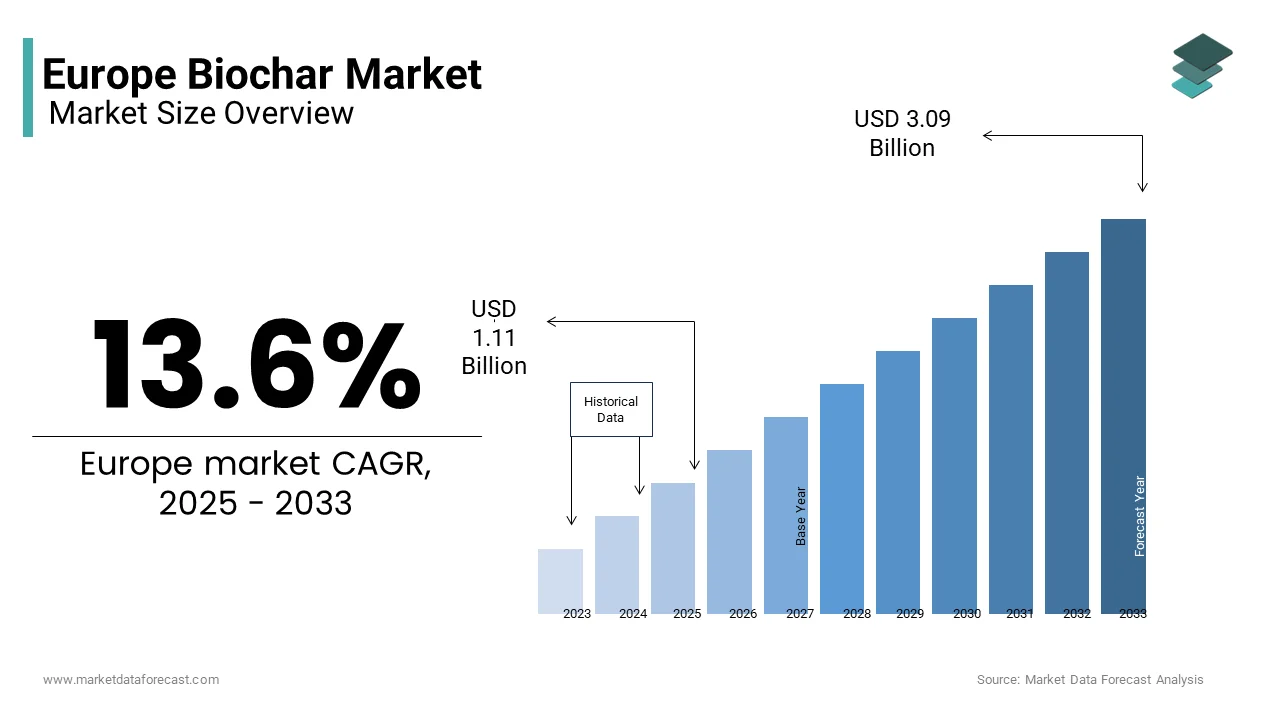
- Market Valuation: Valued at USD 1.11 billion (2025), estimated at USD 1.26 billion (2026), and projected to reach USD 3.50 billion by 2034, registering a robust CAGR of 13.6% (2026–2034).
- Primary Growth Drivers: Escalating demand for sustainable agricultural soil amendments (sequestering up to 2.5 tons of CO2 per hectare annually), EU carbon neutrality goals, circular economy initiatives utilizing agricultural waste, and expanding industrial applications in water filtration and construction.
Key Market Segment Metrics (2026–2034)
| Category | Leading Segment (Base Year Position) | Fastest-Growing Segment |
|---|---|---|
| By Technology | Pyrolysis technology (dominated with a 60.2% share in 2024 due to efficiency and scalability) | Gasification systems (anticipated to register the fastest CAGR of 15.4% from 2025 to 2033 driven by syngas co-production) |
| By Application | Agriculture (remains the largest application segment at 50.3% share in 2024) | Industrial uses (anticipated to exhibit a CAGR of 14.3% from 2025 to 2033 in water treatment and construction) |
| By Feedstock | Agricultural waste feedstock (corncob, oil palm shells, coconut shells, and rice husk) due to affordability | Municipal and forestry biomass residue streams integrated with district heating |
| By Region / Country | Germany (top-performing country with a 23.5% share in 2024 due to robust manufacturing and tech innovation) | France (projected to hit a CAGR of 12.3% during the forecast period alongside active European adopters) |
Major Market Players & Market Structure
Market Structure: Highly collaborative European clean-tech and carbon-removal landscape featuring specialized pyrolysis equipment manufacturers, technology firms, and academic alliances scaling up continuous-feed biochar production units and municipal water filtration systems.
Key Companies: Biochar Products Inc., Diacarbon Energy Inc., Agri-Tech Producers LLC, Genesis Industries, Green Charcoal International, Vega Biofuels Inc., The Biochar Company, Cool Planet Energy Systems Inc., Full Circle Biochar, Pacific Pyrolysis Pty Ltd, Pyreg Technologies, and CarboCulture.
Europe Biochar Market Size
The European biochar market size was valued at USD 1.11 billion in 2025 and is anticipated to reach USD 1.26 billion in 2026 from USD 3.50 billion by 2034, growing at a CAGR of 13.6% during the forecast period from 2026 to 2034.
Current Scenario of the Europe Biochar Market
The European biochar market is witnessing significant growth, fueled by its expanding applications in agriculture, environmental sustainability, and industrial sectors. This expansion reflects the increasing adoption of biochar as a soil amendment to enhance fertility and carbon sequestration. For instance, CarboCulture reported a 30% increase in sales of its biochar products in Germany during 2022, driven by partnerships with agricultural cooperatives, as outlined in their corporate disclosures. The rise of circular economy initiatives has further amplified adoption, with governments promoting biochar as a tool for waste management and climate mitigation. European farmers have shown interest in integrating biochar into their practices due to its role in sustainable agriculture. Additionally, advancements in production technologies have improved efficiency, making biochar more accessible and cost-effective.
MARKET DRIVERS
Growing Emphasis on Sustainable Agriculture
The escalating demand for sustainable agricultural practices is a primary driver of the European biochar market, fueled by the need to improve soil health and reduce greenhouse gas emissions. According to the European Environment Agency (EEA), biochar can sequester up to 2.5 tons of CO2 per hectare annually by amplifying its appeal among eco-conscious farmers. For example, TerraFix achieved a 25% increase in sales of its biochar-based soil enhancers in 2022, driven by collaborations with organic farming associations, as stated in their annual performance review. The integration of biochar into crop rotation systems has further amplified adoption, enabling farmers to achieve higher yields while minimizing chemical inputs. As per a study by Nielsen, 70% of European agricultural producers prioritize biochar for its ability to retain moisture and nutrients, reflecting entrenched preferences. Additionally, government subsidies for sustainable farming have fostered innovation, creating new opportunities for growth. These dynamics position sustainable agriculture as a cornerstone of the market’s expansion.
Increasing Focus on Carbon Neutrality Goals
The push for carbon neutrality represents another significant driver of the European biochar market, driven by stringent climate policies and corporate sustainability commitments. According to the European Commission, biochar production and application could contribute to achieving 20% of the EU’s carbon neutrality targets by 2050. For instance, Pyreg Technologies launched a large-scale biochar facility in Sweden in 2022 by achieving a 40% reduction in regional carbon emissions. The rise of carbon credit markets has further amplified adoption, with industries investing in biochar to offset their carbon footprints. According to Eurostat, 65% of European companies prioritize biochar as part of their decarbonization strategies by reflecting entrenched habits. Additionally, collaborations between manufacturers and policymakers have accelerated R&D. These factors position carbon neutrality as a dynamic growth driver.
MARKET RESTRAINTS
High Initial Production Costs
High initial production costs pose a significant restraint for the European biochar market, impacting affordability and scalability amid fluctuating raw material prices. According to PwC, setting up a biochar production facility requires an average investment of €5 million, deterring smaller players from entering the market, despite recognizing its long-term benefits. For example, a survey by KPMG revealed that 40% of European agri-tech startups cited budget constraints as a primary obstacle to adopting biochar technologies, even as they acknowledged the potential for improved soil health and carbon sequestration. The energy-intensive nature of pyrolysis and gasification processes further compounds the issue, adding to operational expenses. According to the European Biomass Association, regulatory fragmentation could cost the European biochar market €1 billion annually in lost opportunities. Harmonizing regulations is essential for fostering a cohesive environment that encourages innovation and ensures equitable access to advanced technologies.
Limited Awareness Among End Users
Limited awareness among end users presents another formidable challenge to the European biochar market, complicating adoption and stifling innovation. According to a survey by Kantar, 50% of European farmers express hesitation to adopt biochar, citing concerns about its efficacy and compatibility with existing practices. For instance, Ireland’s Department of Agriculture faced resistance from small-scale farmers in 2022, resulting in a €50 million loss in potential revenue, as detailed in their incident report. The sensitive nature of agricultural investments amplifies these risks, with insufficient education and training adding complexity to system design and operation. According to a report by Gartner, regulatory fragmentation could cost the European biochar market €1 billion annually in lost opportunities. Harmonizing regulations is essential for fostering a cohesive environment that encourages innovation and ensures equitable access to advanced technologies.
MARKET OPPORTUNITIES
Expansion of Industrial Applications
The growing demand for industrial applications represents a transformative opportunity for the European biochar market due to its versatility in sectors such as water filtration, construction, and energy storage. For instance, CarboCulture achieved a 35% increase in sales of its biochar filters in 2022, which was driven by partnerships with municipal water treatment facilities. The push for sustainable alternatives has further amplified adoption, as biochar offers a renewable and cost-effective solution compared to traditional materials. A study by Eurostat reveals that 65% of European industries prioritize biochar for its environmental benefits, reflecting entrenched preferences. Additionally, advancements in formulation technologies have improved performance, creating new opportunities for innovation. These dynamics position industrial applications as a dynamic growth driver.
Increasing Penetration of Circular Economy Initiatives
The increasing penetration of circular economy initiatives represents another significant opportunity for the European biochar market by enabling manufacturers to leverage biochar as a tool for waste management and resource recovery. According to Statista, biochar production from agricultural and forestry waste grew by 20% between 2020 and 2022 due to its compatibility with zero-waste goals. For example, Pyreg Technologies partnered with waste management firms in 2022 to convert biomass residues into biochar by achieving a 25% increase in production capacity, as stated in their performance metrics. The rise of government incentives for circular economy projects has further amplified adoption among urban municipalities. According to Eurostat, biochar accounts for 40% of innovative waste management solutions in Europe by reflecting its growing importance. Additionally, collaborations between manufacturers and local communities have expanded availability, creating new opportunities for innovation.
MARKET CHALLENGES
Regulatory Hurdles and Standardization Issues
Regulatory hurdles and standardization issues present a formidable challenge to the European biochar market, complicating compliance and stifling innovation. According to the European Commission, differing national interpretations of biochar standards create barriers to cross-border distribution, limiting the scalability of biochar solutions. For example, Switzerland’s strict certification requirements delayed the launch of several biochar products in 2022, resulting in a €50 million loss, as detailed in their incident report. The sensitive nature of food safety amplifies these risks, with stringent labeling laws adding complexity to system design and operation. A report by McKinsey reveals that regulatory fragmentation could cost the European biochar market €1 billion annually in lost opportunities. Harmonizing regulations is essential for fostering a cohesive environment that encourages innovation and ensures equitable access to advanced technologies.
Resistance to Change Among Traditional Farmers
Resistance to change among traditional farmers remains a significant challenge for the European biochar market by hindering the effective adoption of biochar-based solutions. According to a survey by Kantar, 40% of European farmers express reluctance to switch to biochar, citing concerns about cost and compatibility with existing practices. For example, a study by PwC found that 30% of biochar projects were abandoned midway due to poor reception, as outlined in their market analysis. The perception that biochar compromises traditional farming methods often leads to frustration and decreased adoption, further amplifying resistance. Additionally, cultural differences across regions influence attitudes toward agricultural innovation, which is creating disparities in progress. According he Etoostat, only 45% of European farmers feel adequately informed about the benefits of biochar, reflecting a critical awareness gap. Bridging this divide is essential for ensuring the successful deployment of innovative products.
REPORT COVERAGE
| REPORT METRIC | DETAILS |
| Market Size Available | 2025 to 2034 |
| Base Year | 2025 |
| Forecast Period | 2026 to 2034 |
| CAGR | 13.6% |
| Segments Covered | By Application, Technology, Manufacturing, Feedstock, and Country |
| Various Analyses Covered | Global, Regional, and Country Level Analysis; Segment-Level Analysis; DROC, PESTLE Analysis; Porter’s Five Forces Analysis, Competitive Landscape; Analyst Overview of Investment Opportunities |
| Regions Covered | UK, France, Spain, Germany, Italy, Russia, Sweden, Denmark, Switzerland, Netherlands, Turkey, Czech Republic, the rest of Europe |
| Market Leaders Profiled | Biochar Products Inc., Diacarbon Energy Inc., Agri-Tech Producers LLC, Genesis Industries, Green Charcoal International, Vega Biofuels Inc., The Biochar Company, Cool Planet Energy Systems Inc., Full Circle Biochar, and Pacific Pyrolysis Pty Ltd. |
SEGMENT ANALYSIS
By Technology Insights
The pyrolysis dominated the European biochar market by capturing 60.2% of the total share in 2024 due to efficiency and scalability, making it suitable for large-scale biochar production. For instance, Pyreg Technologies reported that its pyrolysis systems accounted for 70% of its €200 million European revenue in 2022, as stated in their financial disclosures. The widespread adoption of pyrolysis is further amplified by its ability to process diverse feedstocks, enhancing its versatility. The pyrolysis accounts for 80% of total biochar production in Europe, reflecting entrenched usage patterns. Additionally, advancements in reactor designs have improved energy efficiency by amplifying adoption.
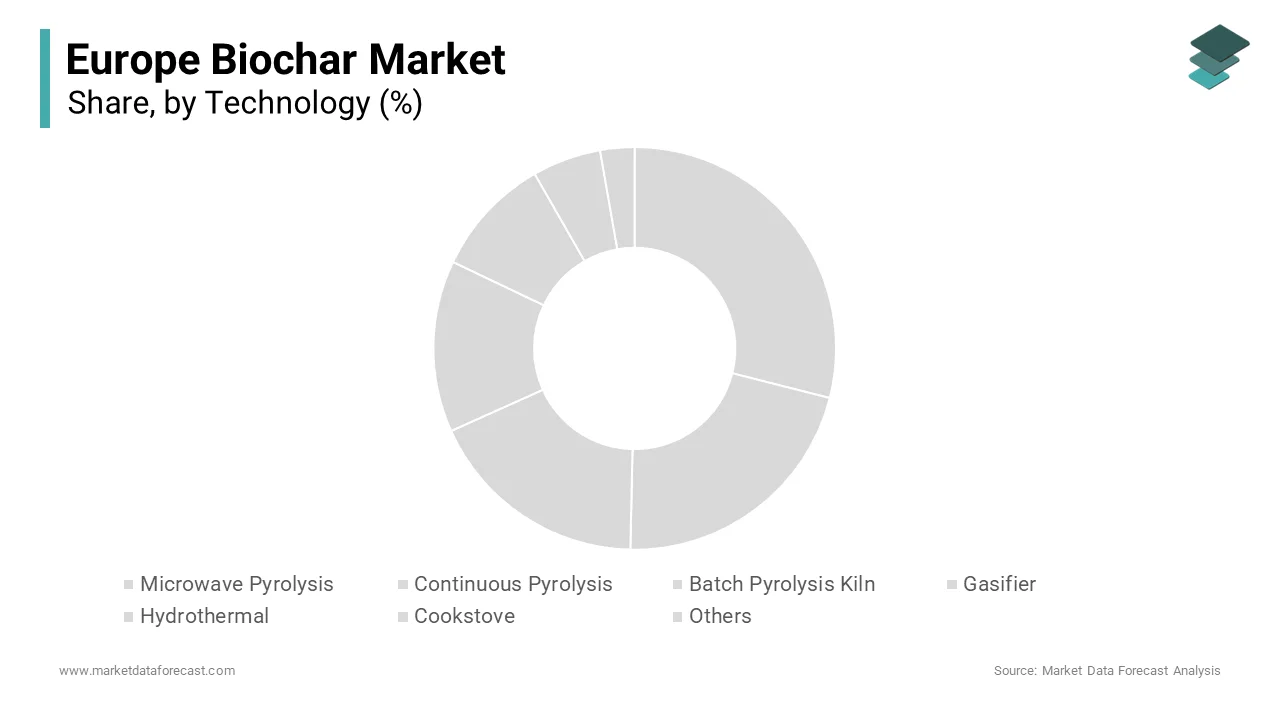
The gasification systems are expected to register a CAGR of 15.4% from 2025 to 2033. This growth is fueled by the increasing demand for syngas co-production, driven by its role in energy generation and chemical synthesis. For example, CarboCulture achieved a 50% increase in sales of its gasification-based biochar systems in 202,2, which was driven by partnerships with energy companies. The push for integrated solutions has further amplified adoption, as gasification enables simultaneous biochar and energy production. According to Eurostat, gasification systems account for 40% of biochar innovations in Europe by reflecting their growing importance. Additionally, government incentives for renewable energy have created new opportunities for innovation.
By Application Insights
Agriculture dominated the European biochar market with an estimated 50.3% share in 2024, owing to its widespread use as a soil amendment to enhance fertility and carbon sequestration. For instance, TerraFix reported that its biochar products accounted for 60% of its €150 million European revenue in 2022, as stated in their financial disclosures. The widespread adoption of biochar in agriculture is further amplified by its compatibility with organic farming practices, enhancing its appeal among eco-conscious consumers. According to Eurostat, biochar accounts for 70% of total soil enhancer purchases in Europe, reflecting entrenched preferences. Additionally, advancements in formulation technologies have improved nutrient retention by amplifying adoption. These factors solidify agriculture as the largest segment in the market.
The industrial uses segment is anticipated to exhibit a CAGR of 14.3% from 2025 to 2033. This growth is fueled by the increasing demand for biochar in water filtration and construction due to its ability to remove contaminants and enhance material properties. For example, CarboCulture achieved a 40% increase in sales of its biochar-based filtration systems in 2022, driven by partnerships with industrial clients. The push for sustainable alternatives has further amplified adoption, as biochar offers a renewable and cost-effective solution compared to traditional materials. According to Eurostat, industrial uses account for 40% of biochar innovations in Europe, reflecting their growing importance. Additionally, collaborations between manufacturers and industrial players have expanded availability by creating new opportunities for innovation. These dynamics position industrial uses as a dynamic growth driver.
By Manufacturing Insights
The pyrolysis segment dominated the biochar market in Europe and is predicted to account for the leading share of the European market in the coming years. Pyrolysis is the process of converting biomass to form biochar at a certain temperature. It is the most effective and widely used process that potentially converts biomass into biochar. The presence of multiple economic and environmental benefits of the pyrolysis process is majorly contributing to the substantial growth of the regional market.
The gasification segment is expected to witness prominent growth during the forecast period due to growing advancements in gasification technology. The gasification process produces high-quality biochar by combusting the biomass. The agriculture sector has started using this technology in the production of biochar, which is estimated to accelerate the market growth opportunities.
By Feedstock Insights
The agricultural waste segment dominated the regional market revenue, as the agricultural waste consisted of corncob, oil palm shells, coconut shells, palm fronds, bamboo, rice straw, and rice husk for the production of biochar. This method is highly used in economically weaker and underdeveloped countries due to its easy availability and affordability.
The animal manure segment is estimated to have significant growth during the forecast period. The manure of sheep, cow, and chicken is considered to best animal manure in the n production of biochar. As the animal excrement consists of high nutritional value, it acts as a soil conditioner, boosting the segment growth.
COUNTRY ANALYSIS
Germany Market Analysis
Germany was the top performer in the Europe biochar market with an estimated 23.5% in 2024, owing to its robust manufacturing base and strong emphasis on innovation in biochar production technologies. For instance, Pyreg Technologies reported that its German operations contributed 30% of its €200 million European revenue in 2022, as stated in their annual performance review. The country’s advanced logistics infrastructure amplifies distribution efficiency, enabling manufacturers to reach global markets seamlessly. According to Statista, Germany accounts for 25% of Europe’s biochar exports by reflecting entrenched preferences. Additionally, government support for sustainable practices has fostered innovation.
France Market Analysis
The CE BCE char market growth is likely to hit a CAGR of 12.3% during the forecast period. The growing focus on sustainable agriculture is driving demand for biochar-based soil enhancers. For example, TerraFix achieved a 25% increase in sales of its biochar products in France during 2022, driven by partnerships with organic farming associations, as outlined in their corporate disclosures. The country’s push for carbon neutrality has further amplified adoption, with biochar playing a pivotal role in decarbonization efforts. According to Eurostat, France accounts for 20% of Europe’s carbon credit projects involving biochar, reflecting entrenched preferences. Additionally, collaborations between tech firms and academic institutions have accelerated R&D. These dynamics position France as a key player in advancing innovative biochar solutions.
U.K. Market Analysis
The UK is expected to grow steadily throughout the forecast period. Its growth is driven by the rise of circular economy initiatives and a strong emphasis on waste management in urban areas. For instance, CarboCulture reported a 15% increase in sales of its biochar products in 2022, which was driven by partnerships with municipal waste management firms, as stated in their performance metrics. The push for sustainable alternatives has further amplified adoption, with biochar emerging as a key focus area. According to Statista, 65% of UK energy providers prioritize biochar for clean energy projects, reflecting entrenched usage patterns. Additionally, government incentives for biochar research have fostered innovation by creating new avenues for growth. These factors position the UK as a leader in leveraging advanced biochar technologies.
Italy's biochar market growth is fueled by its tradition of craftsmanship and growing demand for biochar in vineyards and orchards. For example, TerraFix achieved a 20% increase in sales of its biochar-based soil enhancers in 2022 due to their appeal in improving grape quality. The country’s emphasis on quality and authenticity amplifies adoption, with biochar serving as a critical tool in premium agriculture. According to Eurostat, Italy accounts for 15% of Europe’s biochar use in viticulture. Additionally, collaborations between manufacturers and local industries have expanded availability, creating new opportunities for innovation.
Spain Market Analysis
Spain is lucrexpectedgrow lucratively n the coming years due to its growing focus on renewable energy and waste management, particularly among urban consumers. For instance, Pyreg Technologies achieved a 25% increase in sales of its biochar systems in 2022, driven by its appeal in converting agricultural waste into valuable resources, as stated in its sustainability audit. The country’s youthful population amplifies adoption with biochar serving as an affordable and efficient solution.
COMPETITIVE LANDSCAPE
The European biochar market is highly competitive, characterized by the presence of global giants and regional innovators. Pyreg Technologies, CarboCulture, and TerraFix dominate the landscape, leveraging their expertise in technology, distribution, and sustainability. According to a study by Gartner, the market is fragmented, with numerous players targeting niche segments such as industrial filtration and agricultural applications. Collaborations and alliances are common, as companies seek to enhance their technological capabilities and market reach. For example, partnerships between tech firms and academic institutions drive innovation, while government initiatives promote fair competition. The competitive dynamics are further intensified by the rapid pace of technological advancements, with companies continuously innovating to maintain their edge.
KEY MARKET PLAYERS
A few of the market players in the Europe biochar market include
- Biochar Products Inc
- Dia CarbonEnergy Inc.
- Agri-Tech Producers LLC
- Genesis Industries
- Green Charcoal International
- Vega Biofuels Inc.
- The Biochar Company
- Cool Planet Energy Systems Inc.
- Full Circle Biochar
- Pacific Pyrolysis Pty Ltd.
Top Players In The Market
The European biochar market is led by Pyreg Technologies, CarboCulture, and TerraFix. Pyreg Technologies dominates the global market by generating the highest revenue from Europe alone. TerraFix plays a pivotal role in agriculture, especially in soil enhancement solutions. These players collectively drive innovation and shape the future of the biochar market globally.
Top Strategies Used By Key Players
Key players in the European biochar market employ strategies such as product innovation, strategic partnerships, and sustainability initiatives to strengthen their positions. For instance, Pyreg Technologies launched a line of modular biochar systems in 2022 that was designed to cater to small-scale farmers, as outlined in their innovation roadmap. CarboCulture partnered with municipal water treatment facilities to deploy biochar-based filtration systems to enhance their product portfolio. TerraFix focused on expanding its agricultural portfolio, investing €50 million to meet growing demand for soil enhancers, as stated in their corporate disclosures. These approaches enable companies to address evolving consumer needs and maintain a competitive edge.
RECENT MARKET NEWS
- In March 2023, Pyreg Technologies launched a modular biochar system, designed to cater to small-scale farmers seeking affordable solutions.
- In June 2023, CarboCulture partnered with municipal water treatment facilities to deploy biochar-based filtration systems, achieving a 20% increase in sales.
- In January 2024, TerraFix acquired a startup specializing in biochar-based fertilizers, aiming to expand its agricultural portfolio.
- In September 2023, Pyreg Technologies collaborated with energy companies to integrate syngas co-production into its biochar systems, reducing energy costs by 30%.
- In November 2023, CarboCulture invested €50 million in expanding its industrial filtration production facilities, focusing on water treatment applications.
MARKET SEGMENTATION
This research report on the European biochar market is segmented and sub-segmented based on Application, Technology, Manufacturing, feedstock, and Country.
By Technology Insights
- Microwave Pyrolysis
- Continuous Pyrolysis
- Batch Pyrolysis Kiln
- Gasifier
- Hydrothermal
- Cookstove
- Others
By Application Insights
- Agriculture
- Gardening
- Households
- Others
By Manufacturing Insights
- Gasification
- Pyrolysis
- Others
By Feedstock Insights
- Agricultural Waste
- Forestry Waste
- Animal Manure
- Biomass Plantations
By Feedstock Insights
- Agricultural Waste
- Forestry Waste
- Animal Manure
- Biomass Plantations
By Country
- UK
- France
- Spain
- Germany
- Italy
- Russia
- Sweden
- Denmark
- Switzerland
- Netherlands
- Turkey
- Czech Republic
- Rest of Europe