Europe Water and Wastewater Treatment Equipment Market Size, Share, Trends & Growth Forecast Report By Treatment Type, Application, and By Country (Germany, France, Italy, Spain, Netherlands, Rest of Europe) – Industry Analysis and Forecast, 2026 to 2034
Market Size, 2025
$18,561.35 MnMarket Estimate, 2026
$19,340.93 MnMarket Forecast, 2034
$26,879.37 MnCAGR, 2026–2034
4.2%Europe Water and Wastewater Treatment Equipment Market Summary
Europe’s water and wastewater treatment equipment market, valued at USD 18.56 million in 2025, is projected to reach USD 26.88 million by 2034 at a CAGR of 4.2%, driven by stringent EU water quality regulations, aging infrastructure replacement, and rising demand for water reuse and circular treatment systems.
Key Market Insights
- 2025 Market Size: USD 18.56 million
- 2026 Market Size: USD 19.34 million
- 2034 Forecast: USD 26.88 million
- CAGR (2026–2034): 4.2%
- mase Year: 2025
- Forecast Period: 2026–2034
Quick Growth Drivers
- Enforcement of the revised Urman Wastewater Treatment Directive (UWWTD)
- Stricter EU Drinking Water Directive limits on PFAS and micropollutants
- Mandatory nutrient removal and sludge recovery requirements
- Large-scale rehabilitation of aging water infrastructure
- Rising adoption of treated wastewater reuse for agriculture and industry
Principal Restraints
- High capital expenditure and constrained municipal budgets
- Limited borrowing capacity under EU fiscal rules
- Fragmented procurement frameworks and technical standards
- Public tenders prioritizing the lowest cost over lifecycle performance
High-Value Opportunities
- Deployment of digital water solutions, AI, and real-time monitoring
- Growth of industrial water reuse and zero-liquid-discharge systems
- Expansion of membrane bioreactors and advanced disinfection
- EU funding support through the Recovery & Resilience Facility and EIm loans
Key Market Challenges
- Shortage of skilled operators and engineers for advanced systems
- High energy intensity of conventional treatment processes
- Balancing water quality compliance with decarbonization targets
- Slow adoption of low-energy alternatives at scale
Fastest-Growing Segments
- Disinfection Equipment: 10.2% CAGR (UV and ozone replacing chlorine)
- Industrial Applications: 11.6% CAGR (mAT compliance and reuse)
- Membrane Technologies: structural growth driven by PFAS limits
Regional Leadership & Dynamics
- Germany (20.8%) – strict micropollutant rules and industrial demand
- France – centralized utilities and large-scale modernization programs
- Italy – high-growth market driven by EU infringement remediation
- Spain – Europe’s leader in wastewater reuse and drought adaptation
- Netherlands – advanced circular water and digital twin adoption
What Wins Commercially
- Proven compliance with EU directives (UWWTD, DWD, IED)
- Energy-efficient, low-carbon treatment technologies
- Modular systems enabling industrial reuse and ZLD
- Digital monitoring, predictive maintenance, and lifecycle optimization
- Strong local service presence and long-term O&M capability
Top Strategic Ask for Executives
Prioritize energy-efficient, digitally enamelled treatment equipment that simultaneously delivers regulatory compliance, water reuse capability, and long-term operating cost reduction.
Leading Players
Some of the companies that are playing a dominant role in the European water and wastewater treatment equipment market include:
- Veolia Environnement S.A.
- SUEZ SA
- Xylem Inc.
- Pentair plc
- Grundfos Holding A/S
- Siemens AG
- Amm Ltd.
- Ecolam Inc.
- Evoqua Water Technologies LLC
- Aquatech International LLC
Europe Water and Wastewater Treatment Equipment Market Size
The Europe water and wastewater treatment equipment market was valued at USD 18,561.35 million in 2025 and increased to USD 19,340.93 million in 2026. The market is projected to reach USD 26,879.37 million by 2034, growing at a CAGR of 4.2% from 2026 to 2034.
Water and wastewater treatment equipment includes the systems, technologies, and machinery deployed to purify raw water for human consumption and to treat municipal and industrial effluents before environmental discharge or reuse. This includes physical, chemical, and biological units such as membrane filters, clarifiers, rs UV disinfection systems, EMSs, sludge digesters, and advanced oxidation reactors. The market is shaped not by commercial volatility but by statutory obligations, public health imperatives, and ecological stewardship embedded in European governance. In 2023, the European Union supplied safe drinking water to a population of over 440 million through a network of more than 160,000 public water systems, as per Eurostat. Simultaneously, over 20,000 urban wastewater treatment plants operate across the EU, treating billions of cubic meters of sewage annually according to the European Environment Agency. Persistent challenges such as aging infrastructure, emerging contaminants, and climate-induced hydrological stress have intensified modernization efforts under frameworks like the Urban Wastewater Treatment Directive revision and the European Green Deal. With a significant portion of Europe’s water infrastructure exceeding 50 years of service life, as noted by the European Commission, equipment renewal is no longer optional but a structural necessity for resilience, equity, and environmental compliance.
MARKET DRIVERS
Stringent EU Regulatory Mandates on Water Quality and Reuse
The growth of the EEuropeanwater and wastewater treatment equipment market is primarily driven by an evolving suite of legally binding directives that mandate infrastructure upgrades and performance standards. The revised Urban Wastewater Treatment Directive, adopted in 2024, requires all treatment plants serving more than 10,000 population equivalents to implement nutrient removal by 2030 and to recover energy and phosphorus from sludge. Furthermore, the EU Drinking Water Directive mandates stricter limits on emerging pollutants such as PFAS and microplastics, with compliance deadlines beginning in 2026. According to the European Commission, thousands of treatment facilities across the EU require significant retrofits to meet these new thresholds. Additionally, the Water Reuse Regulation establishes quality standards for treated wastewater used in agricultural irrigation, creating demand for advanced membrane bioreactors and disinfection systems. In Spain, for instance, a substantial share of wastewater must be reused by 2030 under national transposition laws. These regulatory drivers transform equipment procurement from discretionary capital expenditure into non-deferrable compliance spending, ensuring sustained demand across municipal and industrial segments.
Aging Water Infrastructure Requiring Urgent Rehabilitation
Europe’s water and wastewater networks suffer from decades of underinvestment, with a significant portion of assets operating beyond their design life, which is further supporting the expansion of the European water and wastewater treatment equipment market. According to the estimations of the European Commission, a large share of water distribution pipes and wastewater treatment plants are over 50 years old, with failure rates increasing exponentially after this threshold. In Germany alone, hundreds of thousands of kilometers of sewer lines require rehabilitation or replacement by 2040, as per the German Association for Water Management, Wastewater and Waste. Pipe bursts and treatment inefficiencies result in tangible losses as the EU averages a non-revenue water rate of over 20%, meaning a considerable portion of treated water is lost before reaching consumers, according to the International Water Association. Major cities like London and Paris lose a significant share of their potable water due to leaks. The EU’s Recovery and Resilience Facility has allocated billions of euros specifically for water infrastructure modernization, with countries like Italy and Romania directing funds toward smart metering and biological nutrient removal upgrades. This systemic obsolescence creates a structural floor for equipment demand independent of economic cycles.
MARKET RESTRAINTS
High Capital Expenditure and Budget Constraints in Municipalities
Municipalities across Europe face significant financial limitations that delay or scale back critical water infrastructure investments despite regulatory urgency, which is a major restraint to the growth of the European water and wastewater treatment equipment market. Local governments finance the majority of water and wastewater projects, but operate under strict fiscal rules under the EU Stability and Growth Pact, which caps deficit spending. In 2023, as per a survey by the European Federation of Public Service Unions, a majority of municipalities in Southern and Eastern Europe lacked sufficient capital budgets to comply with the revised Urban Wastewater Treatment Directive timelines. Projects often compete with education, healthcare, and housing for limited funds, leading to deferred maintenance and piecemeal upgrades. For example, the city of Athens postponed a major sludge treatment plant due to budget reallocations in 2024. Additionally, rising interest rates have increased borrowing costs, with municipal bond yields in Italy and Spain exceeding 4% in 2024, as per the European Central Bank. Without enhanced EU co-financing or innovative public-private partnership models, many communities will struggle to procure modern treatment equipment, which is creating a gap between regulatory ambition and on-ground implementation.
Fragmented Procurement Practices and Technical Standardization Gaps
TheEuropeane water and wastewater treatment equipment market is hindered by inconsistent procurement frameworks and the absence of unified technical standards across member states. While the EU mandates water quality outcomes, it does not prescribe equipment specifications, leading to divergent tender requirements even within the same country. In France, for instance, regional water agencies set their own criteria for membrane filtration systems, while in Poland, national guidelines dominate, creating compliance complexity for vendors. A 2024 study by the European Committee for Standardization found that fewer than half of wastewater treatment equipment categories have harmonized EU norms, with the rest governed by national or even municipal rules. This fragmentation increases costs for manufacturers who must customize solutions for each jurisdiction and discourages innovation due to uncertain scale. Moreover, public procurement laws often prioritize the lowest price over lifecycle value, resulting in the selection of suboptimal technologies that fail prematurely. Until Europe adopts common performance-based equipment standards, the market will remain inefficient and resistant to technological leapfrogging.
MARKET OPPORTUNITIES
Integration of Digital Water Solutions and Smart Monitoring Systems
A major opportunity in the European water and wastewater treatment equipment market lies in the deployment of digital twins, AI-driven predictive maintenance, and real-time water quality sensors. The European Commission’s Digital Europe Programme has allocated substantial funding to smart water management projects that integrate IoT sensors and data analytics into treatment plants. In the Netherlands, the Amsterdam Water Authority uses digital twin technology to simulate stormwater inflows and optimize chemical dosing, reducing coagulant use significantly as per their 2023 sustainability report. Similarly, the city of Barcelona implemented a sensor network across its wastewater system that detects illicit industrial discharges in real time, preventing plant upsets. These technologies enhance operational efficiency, extend asset life, and support regulatory compliance through automated reporting. The EU’s Cyber Resilience Act further encourages secure embedded systems in critical infrastructure, creating demand for certified digital water platforms. As utilities seek to do more with less, digital integration represents a high-value growth vector beyond traditional mechanical equipment.
Expansion of Industrial Water Reuse Driven by Corporate Sustainability Targets
Industrial sectors in Europe are increasingly investing in on-site wastewater treatment and reuse systems to meet self-imposed sustainability goals and comply with tightening discharge permits, which is another lucrative opportunity in the European market. The European Green Deal’s Industrial Emissions Directive now requires large facilities to demonstrate water efficiency and circularity in permitting renewals. Companies like BASF in Germany and Volvo in Sweden have committed to full water recycling in manufacturing by 2030. The food and beverage sector has become a key adopter of membrane bioreactors and evaporation systems to recover process water. In 2023, Nestlé invested tens of millions of euros in a zero liquid discharge plant in Italy that reuses the vast majority of its wastewater. The European Investment Bank has launched a dedicated water efficiency financing facility offering favourable loans for industrial reuse projects. This corporate-driven decoupling of production from freshwater extraction is creating a robust demand stream for modular, scalable, and automated treatment equipment tailored to specific industrial effluents.
MARKET CHALLENGES
Shortage of Skilled Workforce for Advanced System Operation and Maintenance
Europe faces a critical gap in technical personnel capable of operating and maintaining modern water and wastewater treatment equipment, particularly those involving membrane processes, digital controls, and energy recovery systems. According to the estimations of the European Water Association, a shortfall of over 100,000 qualified water engineers and technicians by 2030 due to retirements and insufficient vocational training. In Eastern Europe, the deficit is acute, with countries like Romania and Bulgaria reporting that a large share of water utility staff lack certification for advanced treatment technologies, as per the Danube Competence Centre. This skills gap leads to suboptimal system performance, premature equipment failure, and reluctance to adopt innovative solutions. As per a 2024 audit by the German Environment Agency, nearly one-third of newly installed membrane bioreactors were operating below design capacity due to operator inexperience. While the EU’s Pact for Skills includes water sector training initiatives, rollout remains slow and fragmented. Without coordinated investment in workforce development, the full potential of advanced treatment equipment will remain unrealized despite regulatory and environmental imperatives.
Energy Intensity and Carbon Footprint of Conventional Treatment Processes
Water and wastewater treatment remains highly energy-intensive and consumes a notable share of the EU’s total electricity, as per the Joint Research Centre of the European Commission, which is another major challenge to the growth of the European water and wastewater treatment equipment market. Conventional activated sludge plants alone account for a measurable portion of Europe’s carbon emissions due to aeration and pumping demands. This energy burden conflicts with the EU’s Fit for 55 climate targets, which require all public utilities to achieve carbon neutrality by 2050. While energy recovery from biogas is technically feasible, only a minority of EU treatment plants currently utilize it due to high retrofit costs and grid connection barriers, according to the European Biogas Association. Moreover, new regulations on nutrient removal and micropollutant elimination, such as ozonation and advanced oxidation, further increase energy use per cubic meter treated. Utilities face a dilemma as comply with water quality mandates or meet climate goals. Until low-energy alternatives like granular sludge systems or solar-powered electrocoagulation are scaled and subsidized, the sector will struggle to reconcile these dual imperatives, creating a strategic bottleneck in equipment modernization.
REPORT COVERAGE
| REPORT METRIC | DETAILS |
| Market Size Available | 2025 to 2034 |
| Base Year | 2025 |
| Forecast Period | 2026 to 2034 |
| Segments Covered | By Treatment Type, Application, and Region. |
| Various Analyses Covered | Global, Regional, and Country-Level Analysis, Segment-Level Analysis, Drivers, Restraints, Opportunities, Challenges; PESTLE Analysis; Porter’s Five Forces Analysis, Competitive Landscape, Analyst Overview of Investment Opportunities |
| Countries Covered | UK, France, Spain, Germany, Italy, Russia, Sweden, Denmark, Switzerland, Netherlands, Turkey, Czech Republic, Rest of Europe |
| Market Leaders Profiled | Veolia Environnement S.A., SUEZ SA, Evoqua Water Technologies LLC, Xylem Inc., Pentair plc, Grundfos Holding A/S, ABB Ltd., Siemens AG, GE Water & Process Technologies (now part of SUEZ), Aquatech International LLC, Mitsubishi Electric Corporation, Ecolab Inc., Badger Meter, Inc., Krohne Group, Hach Company (Danaher Corporation), Ebara Corporation, Krüger A/S (part of Veolia), Parker Hannifin Corporation, Thermo Fisher Scientific Inc., AquaVenture Holdings Ltd. |
SEGMENTAL ANALYSIS
By Treatment Type Insights
The membrane separation segment dominated the market by holding the major share of 39.5% of the regional market in 2024. The dominance ofthe membrane separation segment in this regional market is attributed to its critical role in meeting stringent water quality standards for both drinking water production and wastewater reuse under evolving EU legislation. The revised Urban Wastewater Treatment Directive mandates that all treatment plants serving over 100,000 population equivalents implement advanced treatment for nitrogen, phosphorus, and emerging contaminants such as pharmaceuticals and PFAS by 2035. Membrane bioreactors and nanofiltration systems are among the few technologies capable of consistently achieving these thresholds. In Germany, over 200 municipal plants have already installed membrane systems to comply with national limits on micropollutants, as per the German Federal Environment Agency. Similarly, the EU Drinking Water Directive now requires detection limits for PFAS at 0.1 micrograms per liter, which is a standard only achievable through reverse osmosis or advanced nanofiltration. The Netherlands leads adoption, with a majority of its new drinking water facilities using membrane filtration according to the Dutch Water Authorities. This regulatory trajectory transforms membrane technology from a premium option into a compliance necessity across both municipal and industrial sectors, ensuring sustained equipment demand.
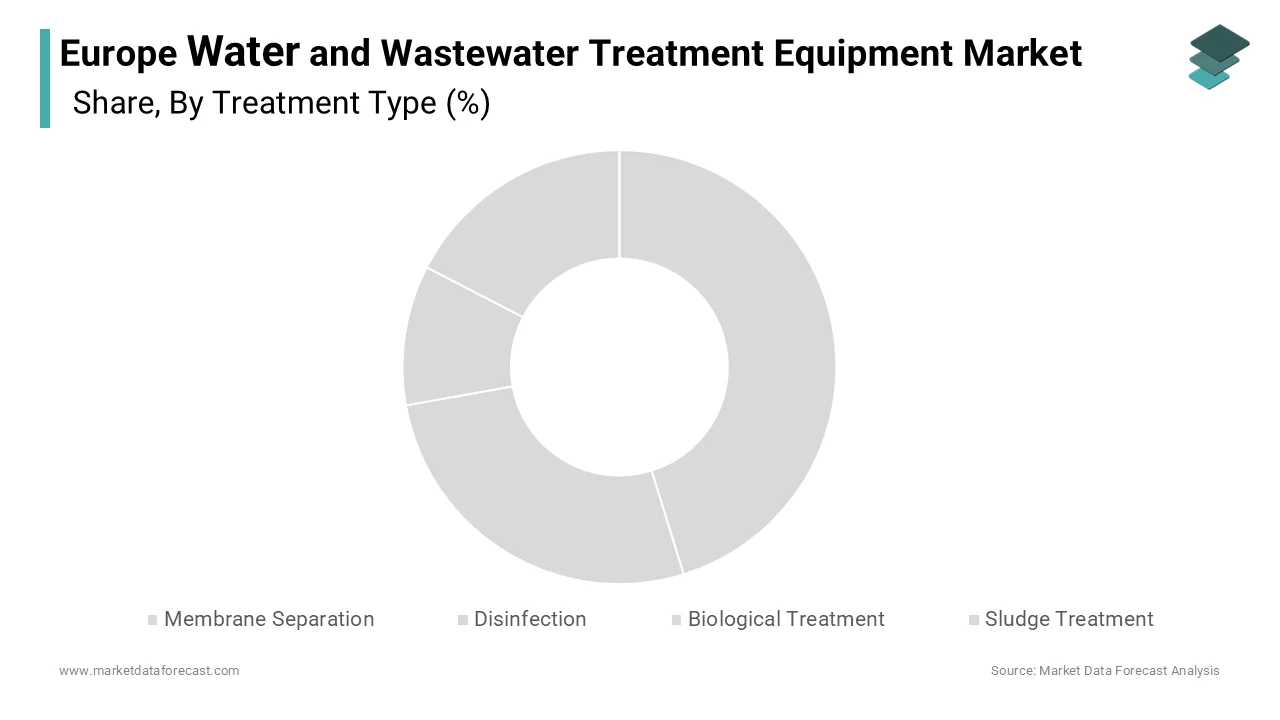
The disinfection segment is the fastest-growing in the European water and wastewater treatment equipment market and is predicted to witness a CAGR of 10.2% over the forecast period, owing to the growing public health vigilance and the phase-out of traditional chlorine-based methods. European regulators are increasingly restricting chlorine and chloramine use due to the formation of carcinogenic disinfection byproducts such as trihalomethanes and haloacetic acids. The EU Drinking Water Directive now limits total trihalomethanes to 100 micrograms per liter, prompting utilities to adopt alternative technologies. Ultraviolet disinfection has emerged as the leading replacement, with hundreds of new UV systems installed across EU drinking water plants in 2023 alone,e according to the European Commission’s Water Framework Directive implementation report. In Denmark, a large majority of municipal systems now use UV as primary disinfection due to its efficacy against chlorine-resistant pathogens like Cryptosporidium. Similarly, ozone systems are gaining traction in wastewater reuse applications where residual-free treatment is essential. The European Chemicals Agency’s 2024 restriction proposal on chlorinated compounds further accelerates this transition, which is creating a structural tailwind for advanced physical disinfection equipment.
By Application Insights
The municipal application segment led the European water and wastewater treatment equipment market by occupying a share of 60.3% of the regional market in 2024. The leading position of the municipal application segment in this regional market is attributed to the statutory responsibility of local governments to provide safe drinking water and treat urban sewage under EU directives. All 27 EU member states are legally bound by the Urban Wastewater Treatment Directive, the Drinking Water Directive, and the Water Framework Directive, which collectively mandate minimum treatment standards for every urban agglomeration. In 2023, over 22,000 municipal wastewater treatment plants operated across the EU, serving the vast majority of the urban population as per the European Environment Agency. Unlike industrial users who may operate intermittently or relocate, municipal systems are permanent infrastructure requiring continuous operation and periodic upgrades. The European Commission’s 2024 infringement proceedings against multiple member states for non-compliance have triggered emergency investment cycles. For example, Italy allocated billions of euros in 2023 to upgrade plants in Naples and Palermo following EU sanctions. This legal enforceability creates a non-discretionary demand base that is resilient to economic cycles and ensures steady equipment procurement across thousands of municipalities.
The industrial application segment is the fastest growing in the European water and wastewater treatment equipment market and is predicted to record a CAGR of 11.6% over the forecast period, owing to the tightening discharge permits and corporate sustainability commitments. The Industrial Emissions Directive requires large industrial facilities to operate under Best Available Techniques permits that include site-specific limits for pollutants in wastewater discharges. In 2023, the European Commission updated BAT conclusions for sectors like food processing, pharmaceuticals, and textiles, imposing new thresholds for organic load, heavy metals, and salinity. Non-compliant facilities face fines, suspension, or forced shutdown. As a result, companies are investing in on-site treatment such as dissolved air flotation for food processors and reverse osmosis for textile dye removal. In Spain, over 180 agro-food plants installed membrane systems in 2023 to meet new nitrate limits, as per the Ministry of Industry. Similarly, the German Federal Immission Control Act now mandates zero liquid discharge for new chemical plants, creating demand for evaporation and crystallization equipment. This regulatory tightening transforms wastewater treatment from optional compliance to operational necessity across Europe’s industrial base.
COUNTRY LEVEL ANALYSIS
Germany Water And Wastewater Treatment Equipment Market Analysis
Germany held the dominating position in the European water and wastewater treatment equipment market in 2024 by accounting for 20.8% of the regional market share. The advanced regulatory framework, aging infrastructure base,e and strong industrial water users have majorly contributed to the dominating position of Germany in this regional market. According to the German Federal Environment Agency, thousands of municipal treatment plants operate nationwide, with a substantial share requiring upgrades to meet new micropollutant removal standards by 2035. The country also hosts Europe’s largest chemical and automotive industries, which face stringent discharge permits under the Industrial Emissions Directive. Germany’s Clean Water Program has allocated billions of euros through 2026 to modernize plants, with emphasis on energy recovery, digital monitoring, and phosphorus recycling. Additionally, the German Technical and Scientific Association for Gas and Water sets rigorous technical standards that influence equipment specifications across the EU. This combination of regulatory stringency, industrial demand, and public investment ensures Germany remains the technological and commercial epicenter of Europe’s water treatment equipment market.
France Water And Wastewater Treatment Equipment Market Analysis
France commands a promising share of the European water and wastewater treatment equipment market in 2024 due to its centralized water governance and extensive network of public utilities. According to the French Ministry of Ecological Transition, tens of thousands of municipal systems serve nearly the entire population, with a significant portion of plants over 40 years old requiring modernization. The France Relance recovery plan committed billions of euros to water infrastructure, with priority given to nutrient removal and digitalization. France also leads in agricultural reuse, with hundreds of tertiary treatment plants supplying irrigation water in drought-prone regions like Occitanie. The national water agency ONEMA enforces strict discharge limits for industrial zones, creating steady demand for specialized equipment. Moreover, French engineering firms like Suez and Veolia export treatment technologies globally, reinforcing domestic R&D and manufacturing capacity. This synergy of public policy, industrial compliance, and technological leadership sustains France’s pivotal role in the European market.
Italy Water And Wastewater Treatment Equipment Market Analysis
Italy is projected to witness a promising CAGR in the European water and wastewater treatment equipment market over the forecast period, owing to the urgent compliance needs and significant EU funding inflows. According to the Italian National Institute for Environmental Protection, a large portion of the country’s urban areas lack adequate secondary treatment, placing Italy under ongoing EU infringement proceedings. In response, the government allocated over 6 billion euros from the National Recovery and Resilience Plan to upgrade plants in Naples, Palermo, and Bari, witha focus on sludge treatment and energy efficiency. Southern Italy’s severe drought conditions have also accelerated wastewater reuse projects, with Sicily targeting large-scale annual reuse by 2027. The food and beverage sector has invested in membrane systems to comply with new BAT permits for olive oil and wine production. This convergence of regulatory pressure, climate stress, and structural funds creates a high-urgency, high-volume market that drives equipment procurement across municipal and industrial segments.
Spain Water And Wastewater Treatment Equipment Market Analysis
Spain is anticipated to account for a prominent share of the European water and wastewater treatment equipment market over the forecast period, owing to its leadership in water reuse and adaptation to arid conditions. According to the Spanish Ministry for Ecological Transition, the country reuses hundreds of millions of cubic meters of treated wastewater annually—the highest in Europe—primarily for agricultural irrigation. The National Reuse Strategy mandates that all plants serving over 100,000 people install tertiary treatment by 2027, driving widespread adoption of membrane bioreactors and UV disinfection. Spain also faces chronic drought, with the Guadalquivir and Segura basins classified as overexploited by the European Environment Agency, prompting investments in advanced desalination, pre-treatment, and zero liquid discharge for industrial users. The agricultural sector’s reliance on reclaimed water creates consistent demand for pathogen and salinity removal equipment. Additionally, EU cohesion funds support modernization in smaller municipalities. This proactive adaptation to water scarcity positions Spain as a model for reuse-driven equipment innovation in Southern Europe.
Netherlands Water And Wastewater Treatment Equipment Market Analysis
The Netherlands secures a strong share of theEuropeane water and wastewater treatment equipment market due to its world-class water management expertise and early adoption of circular economy principles. According to the Dutch Water Authorities, the vast majority of municipal plants already implement advanced nutrient removal, and a large share of drinking water facilities use membrane filtration. The country pioneers resource recovery, with all major plants capturing phosphorus from sludge and generating biogas for energy. The Amsterdam Water Authority’s digital twin platform optimizes chemical dosing and energy use in real time, reducing operational costs significantly as per its 2023 report. Dutch engineering firms like Royal HaskoningDHV and Paques export advanced treatment technologies globally, reinforcing domestic innovation. Furthermore, the Netherlands serves as a testbed for EU water policy, with pilot projects on micropollutant removal and industrial symbiosis funded through Horizon Europe. This fusion of technical excellence, regulatory foresight, and global influence makes the Netherlands a high-value niche leader in Europe’s treatment equipment landscape.
COMPETITIVE LANDSCAPE
Competition in the European water and wastewater treatment equipment market is defined by a convergence of technological excellence, regulatory alignment, and sustainability performance. The landscape features a mix of global engineering giants,s European specialists, ts and emerging digital water startups, all competing on lifecycle value rather than upfront cost. Differentiation hinges on proven compliance with EU directives,s energy efficiency,cy digital integration, and resource recovery capabilities. Municipal contracts favor vendors with local presence, long-term service agreements, and track records in complex retrofit,s while industrial buyers prioritize modular scalability and water circularity. Regulatory pressure creates a non-discretionary demand base,se but tight municipal budgets intensify price competition. Simultaneously, the shift toward public-private partnerships and performance-based contracts rewards integrated solution providers over component suppliers. This mature yet dynamic environment favors companies that combine engineering rigour,r digital innovation, and environmental stewardship within Europe’s unique policy-driven water economy.
KEY MARKET PLAYERS
Some of the companies that are playing a dominating role in the global European Water and Wastewater Treatment Equipment Market include
- Veolia Environnement S.A.
- SUEZ SA
- Evoqua Water Technologies LLC
- Xylem Inc.
- Pentair plc
- Grundfos Holding A/S
- ABB Ltd.
- Siemens AG
- GE Water & Process Technologies (now part of SUEZ)
- Aquatech International LLC
- Mitsubishi Electric Corporation
- Ecolab Inc.
- Badger Meter, Inc.
- Krohne Group
- Hach Company (Danaher Corporation)
- Ebara Corporation
- Krüger A/S (part of Veolia)
- Parker Hannifin Corporation
- Thermo Fisher Scientific Inc.
- AquaVenture Holdings Ltd.
TOP LEADING PLAYERS IN THE MARKET
- Suez SA is a French multinational leader in water and wastewater treatment with deep integration across the European water and wastewater treatment equipment market. The company designs manufacture and operates advanced treatment systems, including membrane bioreactor,s sludge digesters, rs and digital monitoring platforms for municipal and industrial clients. Suez leverages its engineering heritage to deliver end-to-end solutions that align with EU regulatory standards on nutrient removal, micropollutants,s and resource recovery. In 202,4 the company launched its AquaQuantum digital suite, enabling real-time predictive maintenance and energy optimization for treatment plants across Germany, France, and Spain. It also expanded its phosphorus recovery pilot in the Netherlands into a full-scale commercial offering. These innovations reinforce Suez’s position as a technology and sustainability partner for Europe’s water infrastructure modernization.
- Xylem Inc is a global water technology company with a strong operational footprint in Europe through its treatment equipment and smart water solutions. The company supplies advanced disinfection systems,s membrane filtration units, and aeration technologies to municipalities and industries across the continent. Xylem’s European strategy emphasizes digital integration and circularity with its Pure Technologies and Wedeco UV platforms widely adopted for drinking water safety and wastewater reuse. In 202,4 XylemOpen InnovationCenterr in Stockholm focused on AI-driven water quality prediction and energy-efficient sludge treatment. It also partnered with the European Investment Bank to co-finance industrial water reuse projects in Southern Europe. These actions demonstrate Xylem’s commitment to sustainable, resilient water infrastructure aligned with European Green Deal objectives.
- Veolia Environnement is a French multinational that plays a pivotal role in theEuropeane water and wastewater treatment equipment market through its integrated water cycle services and proprietary technologies. The company deploys advanced treatment trains featuring ozonation, granular activated carbon,n, and anaerobic membrane bioreactors tailored to EU compliance requirements. Veolia operates over 2 500 water and wastewater facilities in Europe, many of which serve as testbeds for new equipment such as its AnoxKaldnes moving bed biofilm reactors. In 202,4 Veolia launched its ReVive platform for industrial waterreuseuse enablireal-timeime monitoring and chemical recovery in the food and chemical sectors. It also signed a strategic alliance with Siemens to embed industrial IoT into treatment plants across Germany and Italy. These initiatives solidify Veolia’s leadership in high-performance circular water solutions.
TOP STRATEGIES USED BY THE KEY MARKET PARTICIPANTS
Key players in the European water and wastewater treatment equipment market are investing in digital twin and AI-driven platforms to optimize energy use and predictive maintenance. They are developing modular and scalable treatment systems for industrial clients seeking on-site water reuse and zero liquid discharge. Companies are integrating resource recovery features such as phosphorus extraction and biogas capture to align with circular economy mandates. Strategic partnerships with public financial institutions like the European Investment Bank facilitate co-financing of large infrastructure projects. Additionally, they are localizing manufacturing and service hubs to ensure compliance with EU procurement rules and reduce supply chain risks.
MARKET SEGMENTATION
This research report on the europe water and wastewater treatment equipment market is segmented and sub-segmented into the following categories.
By Treatment Type
- Membrane Separation
- Disinfection
- Biological Treatment
- Sludge Treatment
- Others
By Application
- Municipal
- Industrial
By Country
- Germany
- France
- Italy
- Spain
- Netherlands
- Rest of Europe
Frequently Asked Questions
1. Which countries dominate the Europe Water and Wastewater Treatment Equipment Market?
Germany, France, and the UK lead the Europe Water and Wastewater Treatment Equipment Market, with the UK projected for the highest CAGR through 2030. Germany excels in advanced technologies like membrane bioreactors, while France focuses on infrastructure upgrades. Eastern Europe shows rising adoption due to industrialization
2. What are the main segments in the Europe Water and Wastewater Treatment Equipment Market?
Segments include municipal (largest at 66.35% share) and industrial applications, with equipment types like filtration, disinfection, biological treatment, and sludge dewatering. Municipal drives revenue from urban wastewater directives, while industrial grows fastest from compliance in manufacturing sectors.
3. Who are the key players in the Europe Water and Wastewater Treatment Equipment Market?
Major players include Xylem Inc., Pentair PLC, Evoqua Water Technologies, Ecolab Inc., DuPont de Nemours Inc., and European firms like Evonik Industries AG and Lenntech B.V. These companies innovate in smart water solutions and hold significant market presence through advanced equipment offerings.
4. What drives growth in the Europe Water and Wastewater Treatment Equipment Market?
Stringent EU directives such as the Water Framework Directive and Drinking Water Directive propel growth in the Europe Water and Wastewater Treatment Equipment Market. Additional drivers include climate change responses, water reuse emphasis, and investments in sustainable technologies amid pollution reduction goals
5. What is the role of municipal applications in the Europe Water and Wastewater Treatment Equipment Market?
Municipal applications dominate the Europe Water and Wastewater Treatment Equipment Market with 66.35% revenue share in 2024, fueled by upgrades to urban treatment plants under EU urban wastewater rules. This segment focuses on large-scale purification for population centers facing scarcity issues.
6. How does the industrial segment impact the Europe Water and Wastewater Treatment Equipment Market?
The industrial segment registers the fastest growth in the Europe Water and Wastewater Treatment Equipment Market, driven by tighter effluent standards in manufacturing and chemicals. Technologies like membrane separation and biological treatment help industries meet sustainability targets and reduce operational costs.
7. What technologies are trending in the Europe Water and Wastewater Treatment Equipment Market?
Trends feature membrane separation, biological reactors, disinfection systems, and sludge dewatering in the Europe Water and Wastewater Treatment Equipment Market. Smart management solutions and circular economy tech enhance efficiency, supported by EU innovation for better water quality and reuse.
8. What challenges face the Europe Water and Wastewater Treatment Equipment Market?
Challenges include geopolitical impacts like past conflicts affecting supply chains and high upgrade costs for aging infrastructure in the Europe Water and Wastewater Treatment Equipment Market. However, regulatory pressures and funding for green tech mitigate these, ensuring steady expansion.
9. How do EU regulations influence the Europe Water and Wastewater Treatment Equipment Market?
EU regulations like the Urban Wastewater Treatment Directive strictly control discharges, boosting demand for advanced equipment in the Europe Water and Wastewater Treatment Equipment Market. This fosters investments in compliance tech across member states for environmental protection and reuse.
10. What is the global context of the Europe Water and Wastewater Treatment Equipment Market?
Europe holds the second-largest share globally at 26.1% in 2024 for the Water and Wastewater Treatment Equipment Market, behind Asia Pacific's projected lead. Europe's stringent laws and tech advancements position it as a leader in quality-focused treatment solutions.
Related Reports
Access the study in MULTIPLE FORMATS
Purchase options starting from
$ 2000
Didn’t find what you’re looking for?
TALK TO OUR ANALYST TEAM
Need something within your budget?
NO WORRIES! WE GOT YOU COVERED!
Call us on: +1 888 702 9696 (U.S Toll Free)
Write to us: sales@marketdataforecast.com