- Product Description Description
- Table of Contents TOC
- List of Table & Figure LOT
- Get Free Sample PDF Sample PDF
Market Size, 2025
$5.69 BnMarket Estimate, 2026
$6.13 BnMarket Forecast, 2034
$11.10 BnCAGR, 2026–2034
7.70%Europe Water Filters Market Size, Growth, Trends & Forecast (2026–2034)
The European water filters market size was valued at USD 5.69 billion in 2025, reached USD 6.13 billion in 2026, and is projected to scale up to USD 11.10 billion by 2034, registering a robust compound annual growth rate (CAGR) of 7.70% during the forecast period from 2026 to 2034. Driven by growing public concern over microplastic and chemical contamination, hard water issues, and a rising shift toward decentralized household filtration solutions, the market continues to expand significantly across the region.
Key Executive Metrics (At-a-Glance)
- 2025 Base Valuation: USD 5.69 Billion
- 2026 Current Valuation: USD 6.13 Billion
- 2034 Forecast Valuation: USD 11.10 Billion
- Compound Annual Growth Rate (CAGR): 7.70% (2026–2034)
- Leading Regional Market: Germany (21.4% share, 2025)
- Fastest-Growing Technology Market: Ultraviolet (UV) Disinfection (9.3% CAGR)
Core Market Drivers
- Microplastic Concerns: Escalating consumer worry over persistent microplastic fragments and chemical residues entering municipal water taps.
- Limescale & Hard Water: High prevalence of hard water across Europe driving demand for softening and filtration hybrid solutions.
Primary Market Restraints & Challenges
- Regulatory Discrepancies: Lack of harmonized performance testing, certification standards, and institutional mandates across member states.
- High Financial Burden: Upfront costs and recurring maintenance/replacement expenses limiting accessibility in lower-income demographics.
Europe Water Filters Market Segmentation Highlights
| Segment Category | Largest Segment | Fastest-Growing Segment |
|---|---|---|
| By Technology | Reverse Osmosis (RO) (45.2% share, 2025) | Ultraviolet (UV) (9.3% CAGR) |
| By Distribution Channel | Retail Sales (54.8% share, 2025) | Online (12.7% CAGR) |
| By Portability | Non-portable (Dominant share, 2025) | Portable (10.8% CAGR) |
Major Industry Players Profiled
Key technology developers and market leaders shaping the European water filtration sector include Brita GmbH, 3M Purification Inc., AO Smith Corporation, Eaton Corporation, Veolia, Mann-Hummel, Pall Corporation, and Pentair PLC.
 Download Free Sample Report
Europe Water Filters Market Size
The water filters market size in Europe was valued at USD 5.69 billion in 2025. The European market is further estimated to progress at a CAGR of 7.70% from 2026 to 2034 and be worth USD 11.10 billion by 2034 from USD 6.13 billion in 2026.
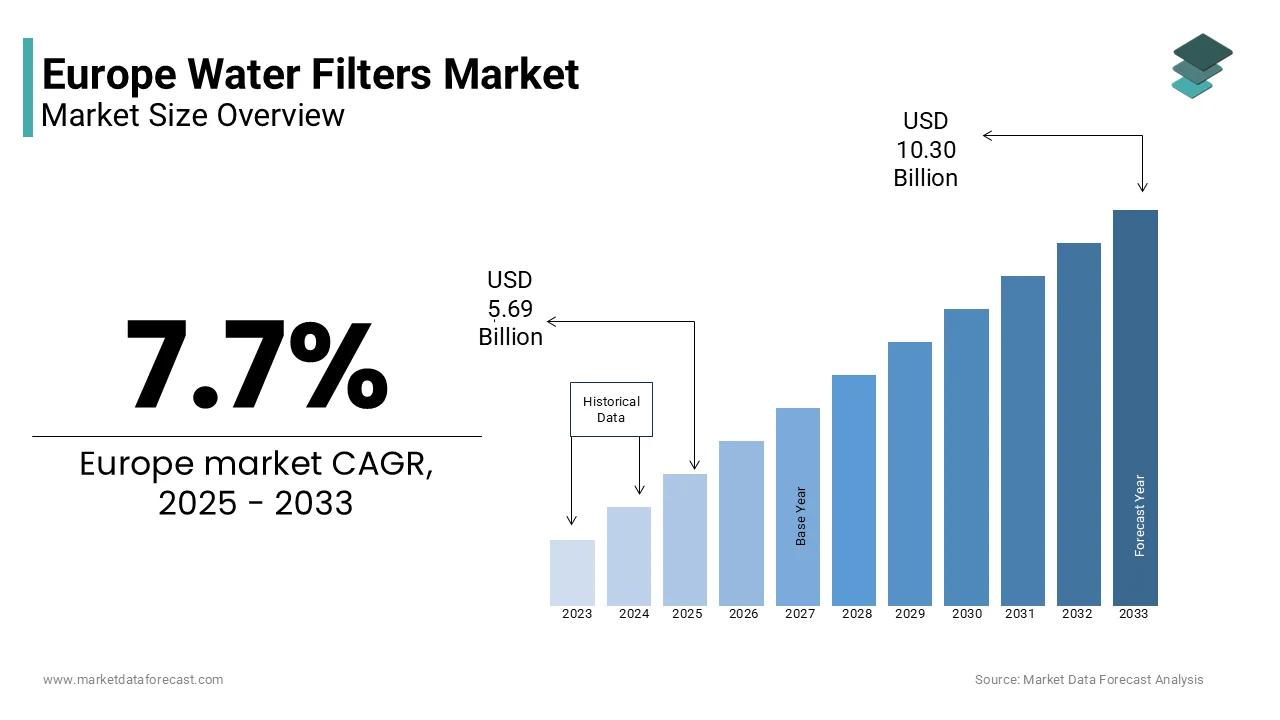
Water filters are technologies designed to purify potable water for residential, commercial, and institutional use, addressing concerns over chemical residues, microbial contamination, and infrastructure-related deterioration in water quality. The EEA does report pesticide exceedances in surface water monitoring (9–25% of sites) and nitrate groundwater stations (around 14%). Urbanization and aging distribution systems further compromise water integrity. These factors have shifted consumer behavior toward decentralized filtration solutions, including reverse osmosis systems, activated carbon filters, and ultraviolet purifiers, positioning water filtration as a critical component of household health infrastructure.
MARKET DRIVERS
The escalating public concern over microplastic contamination in municipal water supplies, which has intensified consumer demand for point-of-use filtration systems is a primary driver of the Europe water filters market. As per the European Chemicals Agency, polyethylene and polypropylene fragments, common in packaging and textiles, persist through conventional treatment plants, entering household taps undetected. In response, countries like Austria and the Netherlands have seen a surge in under-sink reverse osmosis installations. Consumers increasingly perceive filtration as a necessary safeguard, particularly for infants and immunocompromised individuals. This awareness, amplified by media coverage and NGO campaigns, has transformed water filters from optional appliances into essential health devices.
The increasing prevalence of hard water and limescale buildup in residential plumbing, particularly in the UK, France, and Central Europe, which drives demand for water softening and filtration hybrids, is another significant driver. As a result, demand for combined filtration-softening units has grown, with sales increasing in Germany over the past two years. These systems not only improve water taste and safety but also extend the lifespan of boilers and dishwashers, offering tangible economic benefits. This dual functionality enhances consumer willingness to invest in advanced filtration technologies.
MARKET RESTRAINTS
The inconsistent regulatory recognition of point-of-use filtration systems within national water safety frameworks, which limits institutional endorsement and public funding, is one major restraint in the Europe water filters market. While the EU Drinking Water Directive sets quality benchmarks, it does not mandate or subsidize household filtration devices, leaving adoption to individual discretion. In Sweden, for example, public health authorities maintain that tap water is safe without additional filtration, discouraging widespread uptake despite localized contamination risks, as per the Swedish National Food Agency. This regulatory ambiguity undermines consumer confidence and impedes market standardization, particularly in regions with otherwise high water quality.
The high upfront cost and maintenance burden associated with advanced filtration systems, which restricts accessibility among lower-income and rural populations, is another critical restraint. In Eastern Europe, the average cost of a reverse osmosis system stands relatively high, absorbs a notable share of the monthly disposable income in countries like Bulgaria and Romania. Additionally, recurring expenses for membrane replacements and professional servicing adds annually. These financial and logistical barriers prevent equitable access, particularly in regions most vulnerable to water contamination. Without subsidies or financing models, market penetration remains skewed toward urban, affluent demographics, limiting overall scalability.
MARKET OPPORTUNITIES
The integration of smart technology and IoT-enabled monitoring systems, which enhance user engagement and maintenance efficiency, is a pivotal opportunity in the Europe water filters market. In 2023, a significant number of smart water filters were sold across Western Europe, a figure that has risen since 2020. These devices provide real-time alerts on filter lifespan, water quality fluctuations, and flow rate anomalies via mobile applications. In Denmark, several new filter installations in 2023 included Wi-Fi connectivity. Companies like Brita and A.O. Smith have introduced predictive maintenance algorithms that reduce waste and optimize performance. This digital transformation not only improves user experience but also aligns with broader EU goals for resource efficiency and digitalization of household infrastructure, creating a fertile ground for innovation and brand differentiation.
The growing emphasis on circular economy principles in water filtration, particularly in filter cartridge recycling and sustainable material use, is another emerging opportunity. Also, the European Commission reported that millions of used filter cartridges were discarded across the EU, with lesser share being recycled, primarily due to lack of infrastructure. This regulatory push, combined with consumer demand for eco-friendly options, opens a strategic avenue for sustainable innovation.
MARKET CHALLENGES
A critical challenge facing the Europe water filters market is the lack of harmonized performance testing and certification standards across member states, leading to consumer confusion and market fragmentation. While Germany enforces strict DVGW certification for microbial reduction, France relies on the NF mark, and Italy uses IMQ standards, none are fully interoperable. This absence of a unified benchmark undermines trust and complicates cross-border trade. Manufacturers face increased compliance costs, while consumers struggle to assess product efficacy, stalling widespread adoption despite rising health concerns.
The inertia in public perception regarding tap water safety, particularly in countries with historically reliable municipal supplies, which dampens urgency for filtration adoption, is another significant challenge. Public health messaging in these nations emphasizes trust in centralized treatment, discouraging private investment in filtration. However, this perception overlooks emerging risks such as pipe leaching in older buildings. Overcoming this cognitive disconnect requires targeted education campaigns, yet many governments remain reluctant to acknowledge infrastructure vulnerabilities. This entrenched confidence in public systems poses a psychological barrier to market growth, even as environmental pressures evolve.
REPORT COVERAGE
| REPORT METRIC | DETAILS |
| Market Size Available | 2025 to 2034 |
| Base Year | 2025 |
| Forecast Period | 2026 to 2034 |
| CAGR | 7.70% |
| Segments Covered | By Technology, Distribution Channel, Probability, End-User, and Region |
| Various Analyses Covered | Global, Regional, & Country Level Analysis; Segment-Level Analysis; DROC; PESTLE Analysis; Porter’s Five Forces Analysis; Competitive Landscape; Analyst Overview of Investment Opportunities |
| Regions Covered | UK, France, Spain, Germany, Italy, Russia, Sweden, Denmark, Switzerland, Netherlands, Turkey, Czech Republic, Rest of Europe |
| Market Leaders Profiled | Drink Daily Greens Llc, Hudson River Foods, Ecomil, Living Harvest Foods Inc, Triballat Noyal, Konoi Cremerie Vegetale, Organic Hemp Milk Australia, Good Mylk Co., Mamilk, Manitoba Harvest Hemp Foods, Good Hemp Food, And Pacific Foods of Oregon, and others. |
SEGMENTAL ANALYSIS
By Technology Insights
The reverse osmosis (RO) segment dominated the Europe water filters market by capturing an estimated 45.2% of total technology-based sales in 2025. This lead position is due to its superior contaminant removal efficiency, particularly for dissolved solids, heavy metals, and microplastics. RO systems are capable of eliminating up to 99% of lead, nitrates, and fluoride, making them indispensable in regions with aging infrastructure or agricultural runoff. In Germany, where a notable share of households are in hard water zones and of urban water networks exceed 40 years in age, RO adoption has surged, with a significant number of units installed in 2023 alone. The technology’s integration into under-sink and countertop models has further enhanced its residential appeal. A further critical factor reinforcing RO’s dominance is its alignment with stringent health standards and rising consumer demand for purified drinking water. The technology’s ability to deliver laboratory-grade water at home has positioned it as a benchmark in residential purification, ensuring sustained market leadership across Western and Central Europe.
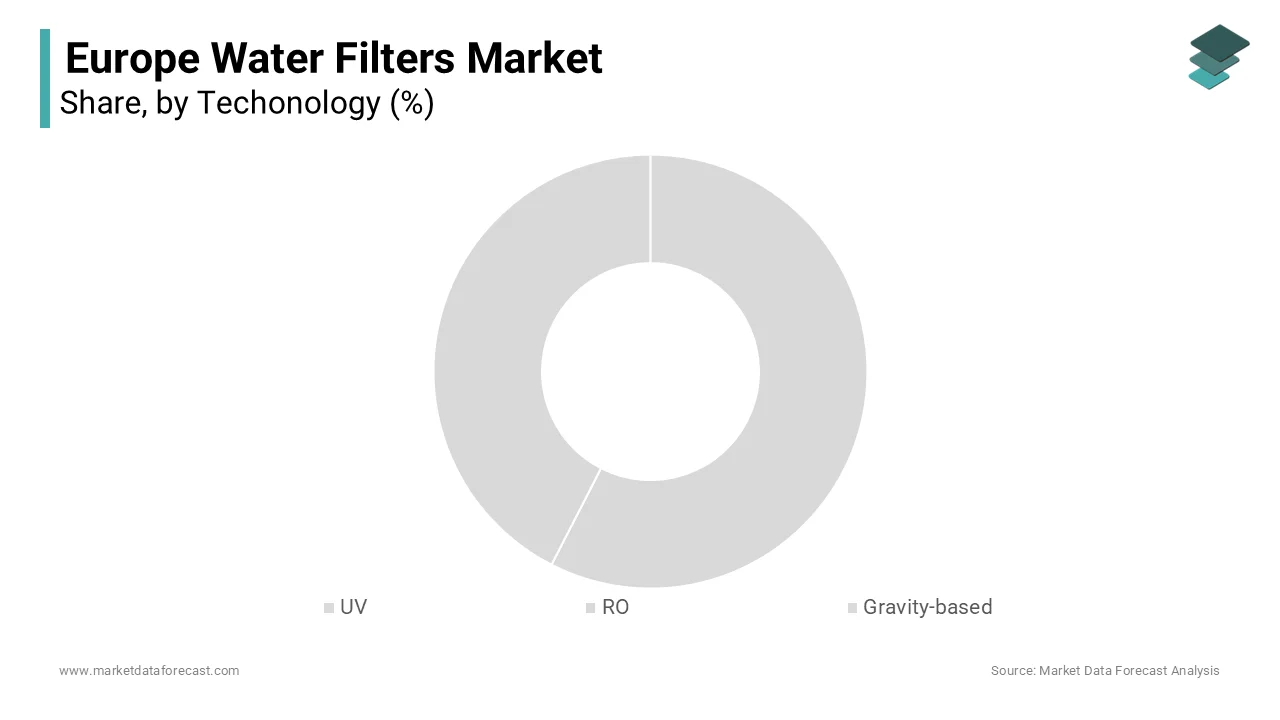
The ultraviolet (UV) disinfection segment is the fastest-growing technology in the Europe water filters market, projected to expand at a CAGR of 9.3% from 2026 to 2034. This rapid growth is driven by increasing concerns over microbial contamination in private water supplies and decentralized systems. Unlike chemical treatments, UV systems inactivate bacteria and viruses without altering water taste or introducing byproducts, making them ideal for eco-conscious consumers. Sales of UV units in Scandinavia rose in recent years. A differnt key driver is the integration of UV technology into hybrid filtration systems, combining it with carbon and sediment pre-filters for comprehensive purification. Furthermore, the European Commission’s 2023 revision of the Drinking Water Directive emphasizes pathogen monitoring, indirectly promoting UV as a preventive measure. These public health imperatives and technological synergies are accelerating UV’s penetration across residential and institutional sectors.
By Distribution Channel Insights
The retail sales segment constituted the prominent distribution channel in the Europe water filters market by accounting for a 54.8% of total sales in 2025. This dominance is sustained by the critical role of physical stores in enabling product demonstration, technical consultation, and immediate installation support. The trust associated with brand-endorsed retail environments remains a decisive factor, particularly for complex systems requiring professional setup. An additional contributing factor is the strong presence of specialty plumbing and water treatment stores that offer bundled services. These outlets serve as trusted intermediaries, especially in rural areas where online access is limited. This expertise enhances consumer confidence and reduces post-purchase dissatisfaction. The tactile, consultative nature of retail interactions continues to anchor its lead psoition in a market where technical understanding influences purchasing decisions.
The online distribution channel is experiencing the fastest growth in the Europe water filters market and is expanding at a CAGR of 12.7% from 2026 to 2034. This acceleration is fueled by the rising preference for convenience, price transparency, and access to customer reviews. The ability to compare technical specifications, certifications, and user feedback in real time has empowered informed decision-making.
A different key driver is the proliferation of subscription-based filter replacement services and digital integration. Companies like Brita and Coway offer auto-replenishment programs linked to mobile apps, ensuring timely cartridge changes and enhancing customer retention. Additionally, online platforms leverage AI-driven water quality assessments, where users input their postal code to receive tailored product recommendations based on local contamination data from national water agencies. This hyper-personalization, combined with competitive pricing and doorstep delivery, has made e-commerce the preferred channel for tech-savvy, time-constrained consumers, particularly in urban centers across the Netherlands, Denmark, and Northern Italy.
By Portability Insights
The non-portable segment commanded the Europe water filters market by representing a substantial share of total unit sales in 2025. This dominance is rooted in the widespread adoption of fixed filtration systems such as under-sink RO units, whole-house filters, and faucet-attached models designed for continuous household use. These systems are perceived as long-term investments in health and appliance longevity, with average lifespans exceeding five years, enhancing their economic appeal. A different critical factor is the integration of non-portable filters into new residential construction and renovation projects. In France, building regulations in regions with high nitrate levels now recommend permanent filtration systems in homes with private wells, as per the Ministry of Ecological Transition. The synergy between filtration systems and smart home infrastructure, such as IoT-enabled monitoring and automated maintenance alerts, further elevates their desirability. Additionally, non-portable units offer higher flow rates and greater filtration capacity, making them suitable for families and multi-user environments. These functional and architectural advantages solidify their position as the cornerstone of residential water purification.
The portable water filters segment is the fastest-growing category and is projected to grow at a CAGR of 10.8% from 2026 to 2034. This surge is driven by rising outdoor recreation and emergency preparedness trends. Backpackers, hikers, and campers increasingly rely on handheld and bottle-integrated filters to access safe drinking water from natural sources, particularly in remote areas where tap water is unavailable. Another key driver is the growing awareness of waterborne risks during travel and displacement. The emergency use has normalized portable filtration as a household preparedness tool. Additionally, innovations such as UV-C LED pens and graphene-based membranes have improved efficacy and reduced size, enhancing portability. These devices are reshaping consumer expectations for on-the-go water safety.
REGIONAL ANALYSIS
Germany Water Filters Market Insights
Germany held the largest share of the Europe water filters market at 21.4% of total regional revenue in 2025. The country’s position is underpinned by high consumer awareness of water quality issues and a robust culture of home maintenance. With households located in hard water zones, limescale prevention is a primary motivator for filter adoption. The prevalence of older plumbing infrastructure, particularly in former East German cities, has amplified concerns over lead leaching. These factors, combined with strong retail and e-commerce penetration, sustain Germany’s dominant position.
France Water Filters Market Insights
France is another major player in the market which is driven by agricultural runoff and regional disparities in water safety. The country faces persistent nitrate contamination from intensive farming, particularly in Brittany and Normandy. This has spurred demand for reverse osmosis and activated carbon systems in rural households. Urban consumers in Paris and Lyon are increasingly adopting under-sink filters due to aging pipes. Additionally, the French government’s 2023 “Eau Potable” initiative promotes filtration in schools and public facilities, further stimulating market growth and institutional adoption.
United Kingdom Water Filters Market Insights
The United Kingdom is characterized by strong demand in both urban and rural settings. The UK also leads in smart filtration. This blend of regulatory awareness and technological innovation positions the UK as a dynamic and responsive market.
Italy Water Filters Market Insights
Italy holds a significant share, with market growth fueled by regional water variability and aging infrastructure. This has increased demand for desalination-capable RO systems. Consumer trust in tap water remains low. This skepticism, combined with rising health consciousness, has made filtration a household necessity rather than a luxury.
Spain Water Filters Market Insights
Spain accounts for notable share of the market, with growth driven by tourism, drought conditions, and urbanization. Persistent water scarcity in regions like Andalusia and Murcia has led to increased desalination, which can elevate bromate and chlorine byproducts, prompting households to install post-desalination filters. In Barcelona and Madrid, apartment dwellers are adopting compact under-sink units due to space constraints. Furthermore, the rise of short-term rentals has spurred demand for point-of-use filters to ensure guest safety.
COMPETITIVE LANDSCAPE
The competition in the Europe water filters market is marked by a dynamic interplay between global technology leaders, regional specialists, and emerging digital-native brands. Established players like Brita and 3M dominate through brand trust, scientific validation, and extensive distribution networks, particularly in Western Europe. However, they face increasing pressure from agile entrants offering smart, sustainable, and direct-to-consumer filtration solutions. The market is further fragmented by varying national water quality challenges, requiring localized product adaptations that favor companies with strong R&D and regional insight. Price competition is intensifying, especially in Eastern Europe, where affordability dictates adoption. Differentiation increasingly hinges on technological sophistication, environmental responsibility, and seamless digital integration. As regulatory scrutiny and consumer awareness grow, the competitive landscape demands both innovation and adaptability, making Europe one of the most advanced and demanding markets for water filtration technologies.
KEY MARKET PLAYERS
Companies such as Eaton Corporation, Suez Water Technologies & Solutions (France), Veolia (France), Dow Water & Process Solutions, EvoQua Water Technologies, Mann-Hummel (Germany), Pall Corporation, and Pentair PLC are playing a leading role in the Europe water filters market.
TOP PLAYERS IN THE MARKET
- Brita GmbH is a leading innovator in point-of-use water filtration, renowned for its pitcher, faucet-mounted, and bottle-based filtration systems. The company has strengthened its position in Europe by emphasizing sustainability. Brita has also integrated smart technology into its dispensers, introducing models with filter-life tracking via mobile apps in France and the Netherlands. By aligning with EU environmental goals and enhancing consumer engagement through digital interfaces, Brita continues to shape user behavior and reinforce trust in household water purification solutions.
- 3M Purification Inc. leverages its expertise in advanced materials and industrial filtration to deliver high-performance residential and commercial water treatment systems across Europe. The company’s Nanofilter and Filtrete product lines utilize proprietary membrane technologies to reduce heavy metals, cysts, and microplastics, meeting stringent DVGW and NSF standards. It also partnered with plumbing networks in the UK to offer certified installation services, improving customer confidence. By combining scientific rigor with localized product adaptation, 3M has established itself as a trusted provider of reliable, high-efficiency filtration, particularly in areas facing complex water quality challenges.
- AO Smith Corporation has expanded its footprint in the European water filters market through strategic product localization and digital integration. Known for its energy-efficient water heaters, the company introduced under-sink reverse osmosis systems with zero-waste technology in Germany and Poland in 2023, addressing environmental concerns over water rejection rates. The company also strengthened distribution through e-commerce platforms like Amazon and MediaMarkt, enhancing accessibility. By merging advanced filtration with smart home compatibility and sustainability, AO Smith is positioning itself as a forward-looking player in Europe’s evolving residential water treatment landscape.
TOP STRATEGIES USED BY KEY MARKET PLAYERS
Key players in the Europe water filters market are deploying multifaceted strategies to consolidate their presence and respond to evolving consumer and regulatory demands. Product innovation remains central, with companies investing in zero-waste RO systems, smart monitoring, and hybrid technologies that combine UV, carbon, and sediment filtration. Strategic partnerships with municipal utilities and plumbing networks are being leveraged to enhance credibility and service delivery. Digital transformation is accelerating, as firms integrate IoT-enabled devices and mobile applications to improve user experience and enable predictive maintenance. Sustainability initiatives, including cartridge recycling and reduced plastic usage, are increasingly used as differentiators. Additionally, companies are localizing product designs to address region-specific contaminants such as nitrates, lead, and limescale. These strategies collectively enhance brand loyalty, ensure regulatory compliance, and expand market reach across diverse European geographies.
MARKET SEGMENTATION
This research report on the Europe water filters market has been segmented and sub-segmented based on the following categories.
By Technology
- UV
- RO
- Gravity-based
By Distribution Channel
- Retail Sales
- Direct Sales
- Online
By Portability
- Portable
- Non-portable
By End User
- Commercial
- Residential
By Country
- UK
- France
- Spain
- Germany
- Italy
- Russia
- Sweden
- Denmark
- Switzerland
- Netherlands
- Turkey
- Czech Republic
- Rest of Europe