- Product Description Description
- Table of Contents TOC
- List of Table & Figure LOT
- Get Free Sample PDF Sample PDF
Market Size, 2025
$0.92 BnMarket Estimate, 2026
$1.01 BnMarket Forecast, 2034
$2.17 BnCAGR, 2026–2034
10.06%Executive Summary: Europe Water Enhancers Market
- Market Scope: Comprehensive market analysis covering active ingredients, product types, raw materials, distribution channels, and country-level dynamics across Europe.
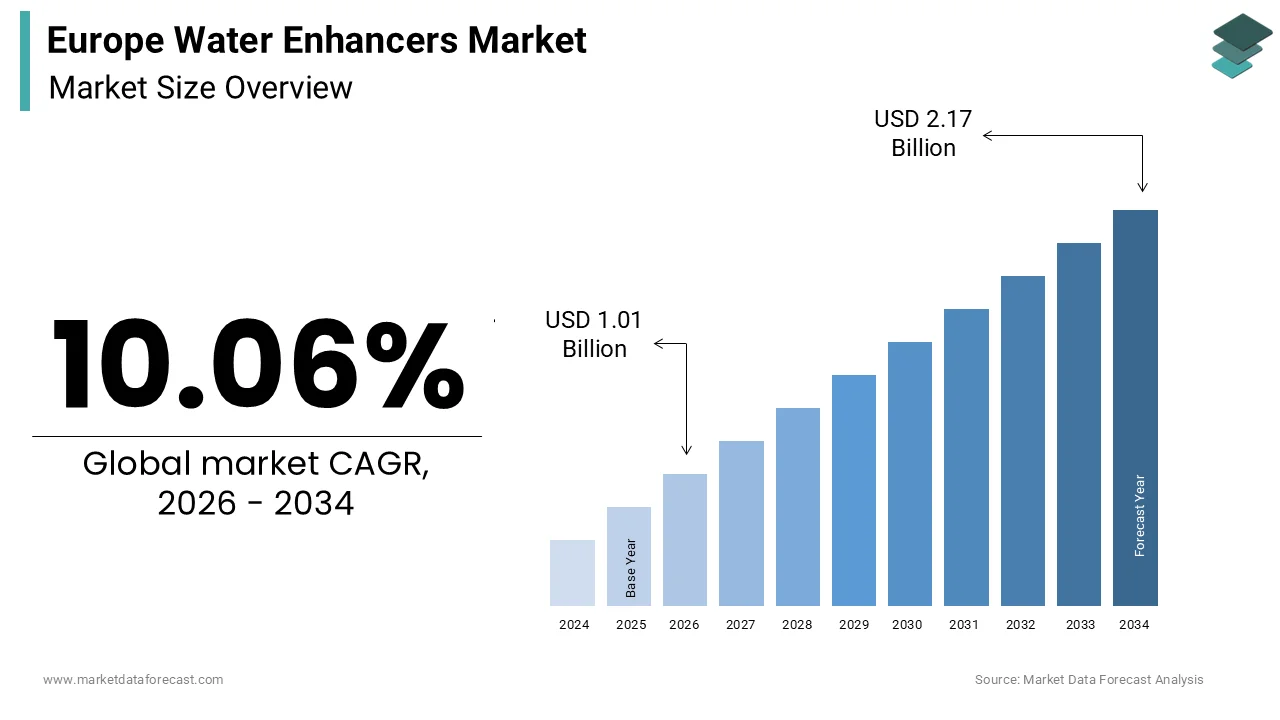
- Market Valuation: Valued at USD 0.92 billion in 2025, expected to reach USD 1.01 billion in 2026, and projected to scale up to USD 2.17 billion by 2034, expanding at a robust CAGR of 10.06% from 2026 to 2034.
- Primary Growth Drivers: Rising health consciousness and aversion to added sugars, stringent public health policies (e.g., sugar taxes), and increasing integration into active urban fitness lifestyles.
Key Market Segment Metrics
| Category | Leading Segment (Base Year Position) | Fastest-Growing Segment |
|---|---|---|
| By Active Ingredients | Sweeteners (led by delivering zero-calorie flavor profiles using authorized options like stevia) | Electrolytes (surging due to fitness participation and updated EFSA mineral intake allowances) |
| By Product Type | Flavored Water Enhancers (accounted for major share through everyday fruit, floral, and citrus profiles) | Workout Drops (projected at 14.1% CAGR propelled by professionalized amateur fitness and BCAA integration) |
| By Raw Materials | Fruits & Vegetables (dominated via natural extracts like lemon, lime, and berry with high consumer trust) | Coconut Water (expanding rapidly as a natural plant-based source of potassium and clean hydration) |
| By Distribution Channel | Supermarkets and Hypermarkets (led through broad visibility, retail chains like Carrefour, Tesco, and REWE) | Online Stores (estimated at 15.1% CAGR driven by D2C subscriptions and digital marketing) |
| By Region | Germany (captured 21.2% share in 2024 backed by strong fitness culture and strict clean-label standards) | France & Sweden (growing dynamically through regional fruit preferences and circular packaging initiatives) |
Major Market Players & Market Structure
Market Structure: Highly competitive landscape characterized by strict EU regulatory frameworks, stringent clean-label requirements, and a balance between multinational giants and specialized D2C brands.
Key Companies: Dr Pepper Snapple Group, Dyla LLC, Kraft Foods Group, Inc (Kraft Heinz), PepsiCo Inc, The Coca-Cola Company, BPI Sports, The Hut.com Ltd, and Nestlé.
Europe Water Enhancers Market Size
The Europe Water Enhancers Market size was calculated to be USD 0.92 billion in 2025 and is anticipated to be worth USD 2.17 billion by 2034, from USD 1.01 billion in 2026, growing at a CAGR of 10.06% during the forecast period.
Water enhancers are concentrated liquid or powdered formulations designed to impart flavor, functional ingredients, or visual appeal to plain drinking water without significantly altering its caloric or sugar content. In Europe, these products cater to evolving consumer preferences for hydration alternatives that align with clean-label natural and health-conscious lifestyles. They typically contain natural flavors, stevia or other non-nutritive sweeteners, and in some cases, added vitamins, electrolytes, or plant extracts. As per the European Food Safety Authority, more than 100 flavoring substances and a range of approved sweeteners are authorized for use in water enhancers under Regulation (EC) No 1334/2008 and Regulation (EC) No 1333/2008, respectively. The European Commission’s Farm to Fork Strategy further influences formulation by encouraging the reduction of added sugars and the promotion of transparent ingredient lists. Unlike conventional soft drinks, water enhancers are positioned as customizable hydration tools often marketed for fitness, travel, or on-the-go consumption. Their regulatory classification as food supplements or flavourings rather than beverages allows for flexible positioning across retail channels. This intersection of sensory appeal, health orientation, and regulatory agility defines the contemporary landscape of the Europe Water Enhancers Market.
MARKET DRIVERS
Rising Health Consciousness and Demand for Low Sugar Hydration Alternatives
The growing consumer aversion to added sugars and artificial ingredients in beverages is a primary driver of the European water enhancers market. According to the European Food Information Council, a majority of Europeans actively seek to reduce sugar intake, with many avoiding sugary drinks altogether. This shift is reinforced by public health policies such as the UK’s Soft Drinks Industry Levy and France’s National Nutrition and Health Program, which discourage high-sugar beverage consumption through taxation and education. The European Commission’s 2023 report on sugar reduction noted that retail sales of zero-sugar beverages grew significantly year on year, while conventional soft drinks declined. Water enhancers capitalize on this trend by offering flavor without calories using authorized sweeteners like stevia or monk fruit. As per a 2024 Eurobarometer survey, a substantial portion of consumers aged 18 to 35 use water enhancers at least once a week as a substitute for soda or juice. Brands like Nuun and High5 have expanded their presence in European gyms, supermarkets, and online platforms with clean label claims prominently featured. This alignment with dietary wellness and regulatory tailwinds ensures sustained demand for low-sugar, customizable hydration solutions.
Integration into Active Lifestyle and On-the-Go Consumption Patterns
The proliferation of fitness culture and mobile lifestyles across urban Europe has intensified demand for convenient, portable hydration solutions that water enhancers uniquely fulfil, which is further contributing to the expansion of the European water enhancers market. As per Eurostat, a large share of Europeans aged 15 to 64 engage in weekly physical activity, with many participating in structured sports or gym routines. These consumers seek practical ways to enhance water palatability during exercise without consuming high-calorie sports drinks. According to the European Consumer Organisation, a significant portion of gym goers prefer water enhancers with added electrolytes over traditional isotonic beverages due to lower sugar content and customizable dosing. Additionally, the rise of remote work and travel has amplified on-the-go consumption, with many Europeans carrying reusable water bottles daily, according to a 2023 European Travel Commission survey. Water enhancer brands have responded with single-serve sticks, pouches, and squeezable bottles designed for portability and precise portion control. Retailers like Decathlon and REWE have dedicated shelf space to these formats in sports and wellness aisles. This functional alignment with mobility, fitness, and personalization positions water enhancers as a lifestyle staple rather than a mere beverage alternative.
MARKET RESTRAINTS
Stringent EU Regulations on Health Claims and Ingredient Authorization
The Europe water enhancers market faces significant constraints due to the European Union’s rigorous regulatory framework governing food additives, health claims, and novel ingredients. As per Regulation (EC) No 1924/2006, health claims on food products must undergo scientific evaluation by the European Food Safety Authority and receive explicit authorization before use. To date, only general claims like “vitamin C contributes to the normal function of the immune system” are permitted, while functional assertions such as “boosts hydration” or “enhances focus” are prohibited without full novel food approval. As per the European Commission’s 2023 review, a majority of water enhancer product submissions between 2021 and 2023 were rejected due to unauthorized botanical extracts or unsubstantiated claims. Additionally, ingredients like certain adaptogens or nootropics popular in global markets are not included in the EU’s positive lists under Regulation (EC) No 1333/2008, requiring lengthy and costly novel food dossiers. This regulatory friction delays innovation and limits formulation diversity compared to markets like the United States. Until the approval process is streamlined, European water enhancer developers will remain constrained in differentiating their products through functional benefits.
Consumer Skepticism Toward Artificial Sweeteners and Additives
Despite positioning as healthier alternatives, many water enhancers face resistance from European consumers wary of non-nutritive sweeteners and synthetic additives, even when legally permitted, which is further hindering the growth of the European water enhancers market. According to the European Consumer Organisation, a majority of surveyed consumers express concern about the long-term effects of sweeteners like sucralose and acesulfame K, with many actively avoiding products containing them. This skepticism is amplified by media coverage and social media discourse linking artificial ingredients to metabolic disruption, despite European Food Safety Authority affirmations of safety within acceptable daily intakes. According to a 2024 study by the University of Copenhagen, products labeled “naturally sweetened” achieved significantly higher repeat purchase rates than those using synthetic alternatives, even at a notable price premium. Consequently, manufacturers face pressure to reformulate using stevia or monk fruit, which are costlier and can impart bitter aftertastes requiring complex flavor masking. Retailers like Carrefour and Edeka have introduced “no artificial sweeteners” filters in private label selections, further narrowing acceptable formulations. This consumer mistrust creates a narrow path for product development that must balance clean label expectations with sensory performance and cost viability.
MARKET OPPORTUNITIES
Expansion into Functional and Wellness-Oriented Formulations
The integration of evidence-backed functional ingredients presents a high-potential opportunity for the European water enhancers market. As per the European Food Information Council, a majority of Europeans are interested in beverages that contribute to daily nutrient intake, with vitamins B-complex, C, and electrolytes being top priorities. The European Commission’s 2023 update to the vitamin and mineral list under Directive 2002/46/EC now permits higher inclusion levels for magnesium and zinc in food supplements, including liquid formats. Brands like Isotonix and ZYN have launched enhancers with added B vitamins for energy metabolism and electrolytes for post-exercise recovery, compliant with EU nutrition labeling rules. Furthermore, the European Food Safety Authority’s 2022 authorization of lutein for eye health has opened avenues for vision support formulations. Retailers are responding with dedicated “functional hydration” sections in pharmacies and wellness stores across Germany and the Netherlands. By anchoring innovation in authorized nutrients and transparent labeling, water enhancers can transcend flavor to become daily wellness tools in the European consumer’s routine.
Growth of E-commerce and Direct-to-Consumer Subscription Models
The rapid adoption of online grocery and health product shopping in Europe is creating new avenues for water enhancer brands to reach niche and loyal customer bases through digital channels. As per Eurostat, a large majority of Europeans made at least one online purchase in 2023, with health and wellness products among the fastest-growing categories. Subscription models in particular offer stability and personalization, with companies like Hydrant and Nuun enabling customers to customize flavor and nutrient profiles and receive monthly deliveries. The European E-Commerce Association reports that direct-to-consumer sales of hydration products grew significantly year on year in 2023, driven by personalized marketing and reduced reliance on retail shelf space. Social media and influencer partnerships further amplify discovery, with fitness and wellness creators showcasing enhancers in daily routines. Unlike traditional retail, which demands large minimum orders and slotting fees, e-commerce allows small and emerging brands to test formulations and build communities without major capital outlay. This digital democratization enables rapid iteration, customer feedback loops, and targeted education on clean label benefits, accelerating market entry and brand loyalty across Europe.
MARKET CHALLENGES
Lack of Clear Product Categorization and Labeling Consistency
The absence of a standardized regulatory category for water enhancers in Europe leads to inconsistent labeling, classification, and consumer confusion that hampers market development. According to the European Commission’s 2023 Food Labelling Review, water enhancers are variously classified as flavorings, food supplements, or liquid food concentrates depending on composition and member state interpretation. This fragmentation results in divergent labeling requirements, with some products displaying nutrition facts per serving and others per 100 milliliters, creating incomparable information. The European Food Safety Authority notes that a significant portion of water enhancer notifications in 2022 were returned for labeling corrections related to ingredient hierarchy or sweetener declaration. Furthermore, the term “water enhancer” itself is not defined in EU legislation, allowing misleading comparisons with natural fruit juice or mineral water. A 2024 survey by the European Consumer Organisation found that nearly half of consumers could not distinguish between a water enhancer and a diluted syrup based on packaging alone. Until the EU establishes a harmonized category with clear compositional and labeling rules, trust and transparency in this emerging segment will remain undermined.
Environmental Concerns Over Single-Use Packaging Waste
The environmental impact of disposable packaging used in water enhancer formats, particularly single-serve sticks and plastic squeeze bottles, poses a significant reputational and regulatory challenge in sustainability-focused Europe, which is another major challenge to the growth of the European water enhancers market. As per the European Environment Agency, hundreds of thousands of tons of flexible plastic packaging from food supplements and flavorings enter the waste stream annually, with a small fraction being recycled due to multi-layer material complexity. The EU’s Single Use Plastics Directive targets such items for reduction, with extended producer responsibility schemes now requiring brands to finance collection and recycling. According to a 2024 audit by Zero Waste Europe, a majority of water enhancer products on shelves in France and Germany use non-recyclable laminated pouches or non-refillable containers. Consumer backlash is mounting, with a large share of respondents in a European Consumer Organisation survey stating they would avoid products with excessive packaging even if preferred in taste. Leading brands are responding with paper-based sticks, aluminum bottles, and refillable systems, yet scalability remains limited by cost and supply chain readiness. Without industry-wide adoption of circular packaging solutions, water enhancers risk being perceived as contradictory to Europe’s green transition values.
REPORT COVERAGE
| REPORT METRIC | DETAILS |
| Market Size Available | 2025 to 2034 |
| Base Year | 2025 |
| Forecast Period | 2026 to 2034 |
| CAGR | 10.06% |
| Segments Covered | By Active Ingredients, Product Type, Raw Materials, Distribution Channel, and Region |
| Various Analyses Covered | Global, Regional & Country Level Analysis; Segment-Level Analysis; DROC, PESTLE Analysis; Porter’s Five Forces Analysis; Competitive Landscape; Analyst Overview of Investment Opportunities |
| Regions Covered | UK, France, Spain, Germany, Italy, Russia, Sweden, Denmark, Switzerland, Netherlands, Turkey, and the Czech Republic |
| Market Leaders Profiled | Dr Pepper Snapple Group, Dyla LLC, Kraft Foods Group, Inc, PepsiCo Inc, The Coca-Cola Company, BPI Sports, The Hut.com Ltd, and Nestlé |
SEGMENTAL ANALYSIS
By Active Ingredients Insights
The sweeteners segment held the highest share of the European water enhancers market in 2024. The dominance of the sweeteners segment in this regional market is attributed to their fundamental role in delivering palatable low- or zero-calorie flavor without added sugars. As per the European Food Safety Authority, authorized high-intensity sweeteners such as stevia glycosides, sucralose, and acesulfame K are used in the majority of water enhancer formulations across the EU. Consumer demand for sugar reduction is the primary driver, with the European Commission’s 2023 Sugar Reduction Report indicating that a large share of Europeans actively avoid sugary beverages. The European Food Information Council confirms that taste remains the top barrier to plain water consumption, particularly among adolescents and young adults, making sweeteners essential for product acceptance. Regulatory frameworks support this shift, as the EU’s Nutrient Profiling Model excludes non-nutritive sweeteners from added sugar calculations, enabling clean label positioning. Major retailers like Tesco and Carrefour now require private-label water enhancers to be free from caloric sweeteners, further entrenching non-nutritive alternatives. This combination of sensory necessity, public health policy, and retail gatekeeping ensures sweeteners remain the foundational active ingredient in Europe’s water enhancer formulations.
The electrolytes segment is the fastest-growing active ingredient segment in the Europe Water Enhancers Market and is estimated to witness a promising CAGR during the forecast period, owing to the rising participation in fitness activities and greater awareness of hydration science among urban consumers. As per Eurostat, a large portion of Europeans aged 18 to 45 engage in weekly physical exercise, with many reporting use of sports nutrition products. The European Consumer Organisation notes that a significant share of gym goers prefer water enhancers with added sodium, potassium, and magnesium over traditional isotonic drinks due to lower sugar content and customizable dosing. The European Food Safety Authority’s 2023 update to mineral intake recommendations permits higher levels of electrolytes in food supplements, enabling more effective formulations. Brands like High5 and Nuun have launched electrolyte-focused enhancers compliant with EU nutrition labeling rules and certified by the Informed Sports program for athletic use. National sports federations in Germany and the Netherlands now include electrolyte water enhancers in athlete hydration guidelines, further legitimizing their use.
By Product Type Insights
The flavored water enhancers segment accounted for a major share of the European water enhancers market in 2024. The leading position of flavored water enhancers in this regional market is attributed to their broad consumer appeal, simplicity of use, and alignment with everyday hydration needs. These products primarily offer fruit, floral, or citrus profiles using natural flavors and non-caloric sweeteners to make plain water more enjoyable without positioning as performance or energy-oriented. As per the European Food Information Council, a large majority of water enhancer users cite “making water tastier” as their primary motivation rather than functional benefits. According to the European Commission’s 2023 Consumer Habits Survey, flavored water enhancers are most commonly used at home, in offices, and during light daily activities rather than intense exercise. Retail dominance reinforces this trend, with a majority of shelf space in supermarkets and pharmacies dedicated to flavored variants as reported by the European Retail Federation. Brands like MiO and Robinsons have localized flavor profiles to regional preferences, enhancing cultural relevance.
The workout drops segment is the fastest-growing product type in the European water enhancers market and is estimated to witness a CAGR of 14.1% over the forecast period, owing to the professionalization of amateur fitness and demand for performance-oriented yet clean-label hydration solutions. As per the European Health and Fitness Association, tens of millions of Europeans are gym members, with a significant portion participating in high-intensity training or endurance sports requiring targeted electrolyte and amino acid replenishment. Workout Drops differentiate by including branched-chain amino acids, L-carnitine, or B vitamins alongside electrolytes—all within EU-authorized limits—to support energy metabolism and recovery. The European Food Safety Authority’s 2022 opinion on BCAA safety in food supplements enabled broader formulation flexibility. Brands like Isotonix and ZYN have partnered with fitness influencers and CrossFit affiliates across Germany and Sweden to drive trial and loyalty.
By Raw Materials Insights
The fruits & vegetables segment dominated the Europe water enhancers market in 2024 due to their natural origin, widespread consumer acceptance, and alignment with clean label expectations. As per the European Commission, a vast majority of flavored water enhancers in Western Europe derive taste from fruit concentrates, juices, or extracts, including lemon, lime, orange, berry, and cucumber. The European Food Safety Authority permits these materials under the flavoring regulation without maximum usage limits when used for taste rather than nutritional claims. Consumer trust is high, with a 2024 Eurobarometer survey indicating that a large share of Europeans prefer products labeled with “fruit-derived flavor” over synthetic alternatives. National agricultural policies further support supply, with Spain and Italy supplying the majority of citrus and berry concentrates used in EU formulations as per Eurostat trade data.
The coconut water segment is the fastest-growing raw material segment in the European water enhancers market and is likely to showcase a healthy CAGR during the forecast period. This surge is driven by its dual role as a natural source of electrolytes and a clean-label flavor base that appeals to health-conscious consumers. As per the European Food Safety Authority, coconut water powder has been authorized as a novel food ingredient since 2021 and is now used in premium water enhancers for its potassium, magnesium, and natural sweetness. The European Consumer Organisation reports that a significant share of consumers associate coconut water with “natural hydration” and are willing to pay a premium for products containing it. Sustainability certifications like Fair Trade and organic are increasingly featured, with a large portion of new launches in 2023 carrying such labels, as documented by the European Sustainable Food Observatory.
By Distribution Channel Insights
The supermarkets and hypermarkets segment was the major distribution channel and accounted for the leading share of the regional market in 2024. The dominance of supermarkets and the hypermarket segment in this regional market is attributed to their extensive reach, high footfall, and strategic placement in beverage, wellness, and sports aisles. As per the European Retail Federation, a majority of water enhancer sales in 2023 occurred through retail chains like Carrefour, Tesco, and REWE, which offer broad product visibility and impulse purchase opportunities. These retailers actively curate selections based on clean label trends, with private label programs requiring non-GMO natural flavors and the absence of artificial sweeteners. In Germany, for example, Edeka’s “Gut & Günstig” line includes stevia-sweetened water enhancers alongside organic variants. Seasonal promotions around fitness holidays, such as New Year resolutions and summer campaigns, further boost volume.
The online stores segment is the fastest-growing distribution channel in the Europe water enhancers market and is expected to exhibit a CAGR of 15.1% over the forecast period, owing to the rise of direct-to-consumer models, personalized subscriptions, and targeted digital marketing to health and fitness communities. As per the European E-Commerce Association, a large majority of Europeans made at least one online purchase of health products in 2023, with water enhancers among the top ten fastest-growing categories. Brands like Hydrant and Nuun offer online customization, which allows customers to select flavor, nutrient, and packaging preferences with recurring delivery options. Social media platforms, particularly Instagram and TikTok, amplify discovery through influencer partnerships and user-generated content showcasing daily hydration routines.
REGIONAL ANALYSIS
Germany Water Enhancers Market Analysis
Germany led the water enhancers market in Europe in 2024 by capturing 21.2% of the regional market share. The dominance of Germany in the European market is attributed to its strong health consciousness, high gym participation, and stringent clean-label expectations. A significant portion of Germans aged 18 to 45 use water enhancers at least once a week, with a preference for products containing stevia, natural fruit extracts, and electrolytes, as per the German Nutrition Society. Retailers like Edeka and dm Drogerie dominate distribution with dedicated wellness aisles featuring both international and local brands. The Federal Institute for Risk Assessment actively monitors sweetener safety, reinforcing consumer trust in authorized non-nutritive options. Additionally, Germany’s fitness culture supports demand for workout drops, with millions of gym members driving the adoption of functional hydration products. This ecosystem of health awareness, retail infrastructure, and regulatory transparency ensures Germany remains the cornerstone of Europe’s water enhancer landscape.
United Kingdom Water Enhancers Market Analysis
The United Kingdom held the second biggest share of the European water enhancers market in 2024. The growth of the UK in the European market can be attributed to its active population, sugar tax policies, and early adoption of subscription-based wellness models. The Soft Drinks Industry Levy introduced in 2018 accelerated reformulation toward zero sugar options, with water enhancers emerging as a popular alternative among younger consumers. A 2023 Kantar survey found that a large portion of UK consumers use water enhancers to reduce soda consumption. Online channels are particularly strong, with a significant share of sales occurring through Amazon, Boots, and direct brand websites offering personalized bundles. Brands like Robinsons have leveraged heritage fruit squash credibility to launch natural water enhancer lines with British berry flavors. The National Health Service’s hydration guidelines for schools and workplaces further normalize their use. This blend of policy influence, digital adoption, and cultural familiarity sustains the UK’s role as a high-engagement water enhancer market.
France Water Enhancers Market Analysis
France is expected to exhibit a promising CAGR of the Europe water enhancers market over the forecast period owing to its preference for natural ingredients, gastronomic flavor expectations, and growing fitness culture. French consumers strongly favor products made with fruit extracts from regional sources, such as Provence lemon or Corsican clementine, with a large majority actively avoiding artificial sweeteners as per a CREDOC survey. The National Nutrition and Health Program promotes water as the primary beverage while allowing enhancers as transitional tools for children and adolescents. Retailers like Carrefour and Monoprix lead in private label development with organic and no added sugar claims prominently displayed. Additionally, the rise of urban running and cycling has increased demand for electrolyte-based enhancers, with brands like Isostar expanding their water drop lines. This fusion of culinary identity, public health messaging, and active lifestyle trends ensures France’s distinctive and resilient position in the European water enhancer landscape.
Italy Water Enhancers Market Analysis
Italy is anticipated to account for a notable share of the Europe water enhancers market during the forecast period. The warm climate, high water consumption, and preference for Mediterranean flavor profiles are driving the Italian market growth. Italians consume an average of over 2 liters of water daily, as per ISTAT, making palatability a key driver for enhancer adoption. Citrus and herbal notes are dominant, with local brands sourcing extracts from Sicily and Calabria. The Italian National Institute of Health promotes water enhancers as alternatives to sugary soft drinks among youth, with school-based campaigns in Lombardy and Emilia Romagna. E-commerce is growing rapidly, with strong year-on-year online sales growth in 2023 driven by fitness influencers and pharmacy websites. Additionally, Italy’s strong supplement culture supports acceptance of vitamin and electrolyte-enriched variants. This combination of climate necessity, sensory tradition, and digital evolution positions Italy as a culturally rooted and expanding water enhancer market.
Sweden Water Enhancers Market Analysis
Sweden is predicted to witness a healthy CAGR in the Europe water enhancers market over the forecast period due to its high health literacy, strong environmental values, and leadership in sustainable packaging. A large majority of Swedes aged 20 to 40 use water enhancers, with a marked preference for organic-certified, recyclable, and locally sourced formulations, as per Statistics Sweden. Brands like Nix & Kix have pioneered paper-based single-serve sticks and aluminum refill systems aligned with the country’s circular economy goals. The Swedish Nutrition Foundation includes water enhancers in its hydration guidelines for athletes and elderly populations, recognizing their role in increasing total fluid intake. Additionally, Sweden’s digital infrastructure supports direct-to-consumer models, with a significant share of sales occurring online through subscription services. With stringent chemical transparency laws under the Swedish Chemicals Agency, consumers demand full ingredient disclosure, driving innovation in clean and traceable formulations. This integration of sustainability, wellness, and transparency ensures Sweden’s disproportionate impact on the future direction of Europe’s water enhancer market.
COMPETITION OVERVIEW
Competition in the Europe Water Enhancers Market is characterized by rapid innovation, clean label compliance, and sustainability integration among a mix of multinational consumer goods companies and agile niche brands. The landscape is shaped by high regulatory barriers due to EU food additive and health claim legislation, which favors established players with regulatory expertise. Incumbents like Kraft Heinz and PepsiCo compete on distribution scale, brand recognition, and portfolio integration, while smaller European brands differentiate through organic certification, regional sourcing, and eco-friendly packaging. Unlike markets with lenient health claims, Europe restricts functional messaging to authorized nutrient statements, creating a level playing field focused on taste transparency and environmental impact. Price competition is moderate as value is determined by ingredient quality, packaging sustainability, and digital engagement rather than volume alone. E-commerce and social media have lowered entry barriers, enabling direct-to-consumer models that bypass traditional retail gatekeepers. Success in this dynamic environment requires balancing regulatory precision, sensory appeal, and ecological responsibility to earn trust in a highly discerning European consumer base.
KEY MARKET PLAYERS
A few major players of the Europe water enhancers market include
- Dr Pepper Snapple Group
- Dyla LLC
- Kraft Foods Group, Inc
- PepsiCo Inc
- The Coca-Cola Company
- BPI Sports
- The Hut.com Ltd
- Nestlé
Top Strategies Used by the Key Market Participants
Key players in the Europe Water Enhancers Market focus on four core strategies to maintain a competitive advantage. First, they reformulate products to meet clean label demands by eliminating artificial colors, sweeteners, and preservatives while using EU-approved natural alternatives. Second, they localize flavor profiles to reflect regional fruit and botanical preferences, enhancing cultural resonance and trial. Third, they develop sustainable packaging solutions such as recyclable aluminum, paper-based sticks, and refillable containers to align with Europe’s circular economy goals. Fourth, they expand digital and direct-to-consumer channels through subscriptions, personalized bundles, and social media engagement to build brand loyalty and bypass traditional retail constraints. Additionally, companies integrate functional ingredients like electrolytes and vitamins within authorized limits to support wellness narratives without making unauthorized health claims. These strategies collectively address Europe’s unique blend of health consciousness, environmental responsibility, and sensory expectations in the hydration category.
Leading Players in the Europe Water Enhancers Market
- Kraft Heinz Company is a prominent player in the Europe Water Enhancers Market through its MiO brand, which offers a wide range of flavored drops using natural flavors and non-nutritive sweeteners. The company leverages its extensive distribution network to place MiO in supermarkets, pharmacies, and online platforms across Western and Northern Europe. In 2024, Kraft Heinz reformulated its European MiO line to remove artificial colors and align with clean label expectations in Germany and the Nordic countries. It also launched limited edition regional flavors such as blood orange in Italy and elderflower in the UK to enhance cultural relevance. By combining global brand recognition with localized product strategies, Kraft Heinz strengthens its position as a mainstream hydration solution provider in Europe.
- PepsiCo Inc contributes significantly to the Europe Water Enhancers Market through its Propel and Lifewtr enhanced water platforms, which have expanded into concentrate drop formats in select markets. The company integrates water enhancers into its broader hydration portfolio, targeting fitness-conscious and health-oriented consumers. In early 2024, PepsiCo introduced an electrolyte-enriched water enhancer under the Propel brand in France and Spain, featuring B vitamins and stevia sweetening, compliant with EU nutrition regulations. It also partnered with European gym chains like Basic-Fit to offer sample kits and in-class hydration education. Through its commitment to sugar reduction and functional innovation, PepsiCo reinforces its role in shaping Europe’s evolving beverage landscape beyond traditional soft drinks.
- Nestlé S.A. plays a strategic role in the Europe Water Enhancers Market by aligning its hydration science with wellness and sustainability priorities. Although primarily known for bottled water, Nestlé has piloted water enhancer concepts under its Pure Life and Fitness brands in Switzerland and the Netherlands, focusing on natural fruit extracts and electrolytes. In 2024, Nestlé launched a pilot subscription service in Sweden offering refillable aluminum dropper bottles with organic flavor concentrates sourced from European farms. The initiative supports its “Net Zero by 2050” goal by reducing single-use plastic. Nestlé also collaborates with the European Hydration Institute to promote evidence-based hydration guidelines that include enhancers as tools for increasing daily water intake. This science-led and eco-conscious approach positions Nestlé as a responsible innovator in Europe’s functional hydration space.
MARKET SEGMENTATION
This research report on the Europe water enhancers market has been segmented and sub-segmented based on active ingredients, product type, raw materials, distribution channel, and region.
By Active Ingredients
- Sweeteners
- Antioxidants
- Vitamins
- Electrolytes
By Product Type
- Energy Water
- Fitness Drops
- Flavored Water Enhancers
- Workout Drops
- Others
By Raw Materials
- Coffee beans
- Fruits &vegetables
- Tea leaves
- Coconuts
By Distribution Channel
- Supermarkets and Hypermarkets
- Online stores
By Region
- UK
- France
- Spain
- Germany
- Italy
- Russia
- Sweden
- Denmark
- Switzerland
- Netherlands
- Turkey
- Czech and Republic
- Rest of Europe