- Product Description Description
- Table of Contents TOC
- List of Table & Figure LOT
- Get Free Sample PDF Sample PDF
Market Size, 2025
$1526 MnMarket Estimate, 2026
$1602 MnMarket Forecast, 2034
$2362 MnCAGR, 2026–2034
4.97%Executive Summary: Europe Water Soluble Fertilizers Market
- Market Scope: Comprehensive European water soluble fertilizers industry analysis covering crop types (horticultural crops, field crops), application methods (fertigation, foliar), regional leadership frameworks, strategic corporate developments, and competitive landscapes.
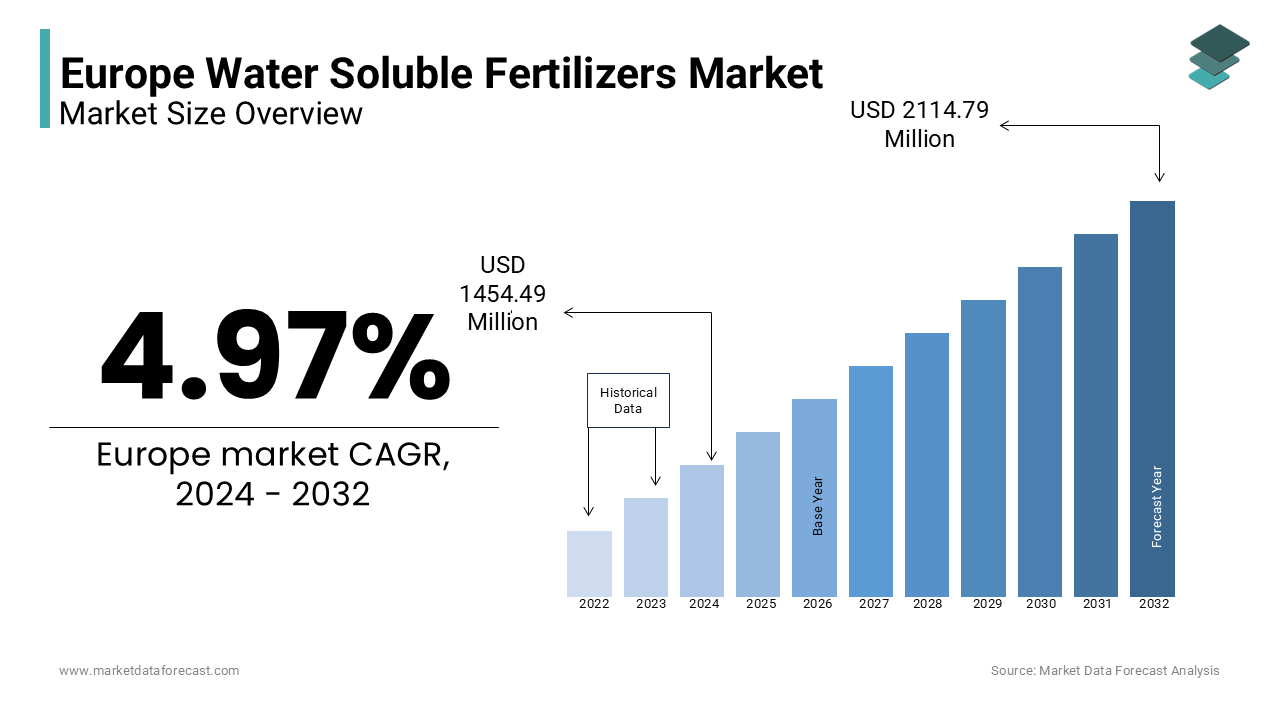
- Market Valuation: Valued at USD 1,526.78 million (2025), estimated at USD 1,602.66 million (2026), and projected to reach USD 2,362.45 million by 2034, registering a steady CAGR of 4.97% (2026–2034).
- Primary Growth Drivers: Protected horticulture precision nutrient delivery, EU Farm to Fork Strategy mandates reducing nutrient losses, digital agronomy tool convergence, and bio-based soluble formulations using biodegradable chelating agents. Restraints include high production costs and fragmented national registration requirements.
Key Market Segment Metrics (2026–2034)
| Category | Leading Segment / Region (Position) | Fastest-Growing Segment |
|---|---|---|
| By Crop Type & Application | Horticultural crops (accounted for 58.3% share via intensive protected cultivation) & Fertigation application segment (dominated through seamless irrigation compatibility) | Field Crops (witnessing a CAGR of 11.4% via subsurface drip adoption) & Foliar application (CAGR of 13.2%) |
| By Innovation & Technology | Digital agronomy tools with embedded nutrient recommendation engines and high-purity NPK blends | Bio-based soluble formulations using biodegradable chelating agents aligned with circular economy principles |
| By Region / Country | Spain (top performer with 21.8% share due to vast horticulture and recurrent droughts) & The Netherlands (17.3% share via world-leading greenhouse horticulture and closed-loop recycling) | European regions adopting precision fertigation to meet strict EU nutrient reduction compliance targets |
Major Market Players & Market Structure
Market Structure: Highly specialized European fertilizer ecosystem characterized by vertically integrated production capabilities, digital farming platform investments, precision nutrient portfolio expansions, and agritech partnerships.
Key Companies: PR Agro Nutri Private Ltd., CF Industries, ICL Group Ltd, Haifa Group, Yara International ASA, Americas Petrogas, and Sirius Minerals.
Europe Water-Soluble Fertilizers Market Size
The European water-soluble fertilizers market size was valued at USD 1526.78 million in 2025 and is anticipated to reach USD 1602.66 million in 2026 and reach USD 2362.45 million by 2034, growing at a CAGR of 4.97% during the forecast period from 2026 to 2034.
Water-soluble fertilizers are fertilizers that completely dissolve in water, are highly efficient, and are used for direct plant nourishment through methods like fertigation and foliar spraying. These products enable precise nutrient delivery aligned with crop growth stages, minimizing leaching and maximizing uptake efficiency. Unlike conventional granular fertilizers, water-soluble variants are engineered for compatibility with modern irrigation systems and high-value cropping systems where nutrient timing and placement are critical.
As of 2025, their adoption is accelerating due to regulatory and environmental imperatives across the European agricultural landscape. According to the European Environment Agency, agriculture accounted for 10-12% of the EU’s total greenhouse gas emissions, with synthetic fertilizer use being a major contributor to nitrous oxide release. In response, the European Commission’s Farm to Fork Strategy mandates a 20 percent reduction in fertilizer use by 2030 and a 50 percent cut in nutrient losses. Furthermore, as per sources, the area under protected cultivation, including greenhouses and tunnels, with countries like the Netherlands and Spain leading in high-tech horticulture that relies almost exclusively on fertigation. These structural shifts toward precision and sustainability position water-soluble fertilizers as a cornerstone of Europe’s nutrient management transition.
MARKET DRIVERS
Expansion of Protected and High Value Horticulture Systems
The rapid growth of greenhouse and tunnel farming is a primary driver for the growth of theEuropeane water-soluble fertilizers market. According to sources, there is a clear trend of increasing protected cultivation in the EU, driven by advancements in technology and a focus on high-value crops. Tomatoes, peppers, cucumbers, and berries are among the most common crops grown in these advanced greenhouse systems. These crops require frequent and precise nutrient applications that only water-soluble formulations can deliver through drip or micro irrigation systems. According to research, greenhouse cultivation in the Netherlands has achieved near-universal adoption of water-soluble nutrient blends within closed-loop fertigation systems, reflecting high technological advancement and sustainability in horticultural production. Similarly, as per sources, intensive greenhouse farming regions in Spain, such as Almería, are major consumers of water-soluble fertilizers, driven by large-scale, export-oriented vegetable production that operates continuously throughout the year. This intensive production model, driven by consumer demand for off-season fresh produce, ensures consistent and high-intensity fertilizer uptake.
EU Policy Mandates for Nutrient Use Efficiency and Pollution Reduction
Binding regulatory frameworks also fuel the expansion of the European water-soluble fertilizers market. As per sources, the Farm to Fork Strategy establishes ambitious targets for 2030, including a reduction in nutrient losses and a reduction in overall fertilizer use. According to research, the upcoming European Soil Health Law aims to limit nitrogen use in environmentally sensitive areas and enforce strict reporting on fertilizer application, promoting more sustainable nutrient management practices. As per sources, new regulations in Germany are encouraging the transition toward controlled fertigation systems by setting nutrient application limits and offering financial incentives through agricultural policy frameworks. These top-down policies transform water-soluble fertilizers from optional inputs into compliance tools, which ensures institutional demand across diverse cropping systems.
MARKET RESTRAINTS
High Production and Application Costs Relative to Conventional Fertilizers
High production and application costs hamper the growth of the European water-soluble fertilizers market. This is due to complex manufacturing processes, stringent purity requirements, and specialized handling needs. The cost differential is prohibitive for extensive crops like wheat and barley, where margins are thin. Apart from these, effective use requires investment in fertigation infrastructure, drip lines, pumps, and injectors. The high capital outlay prevents most conventional farmers from adopting this technology unless they receive subsidies or premium crop contracts, thus limiting market penetration to high-value horticulture and not the dominant arable sector.
Limited Technical Knowledge and Advisory Support Among Conventional Farmers
The lack of agronomic expertise required to manage soluble fertilizer programs effectively also affects the expansion of the European water-soluble fertilizers market. As per studies, the adoption of advanced fertigation and nutrient management techniques among non-horticultural farmers in Southern and Eastern Europe remains limited, primarily due to gaps in training and technical knowledge. Misapplication, such as incorrect pH adjustment or excessive salinity, can cause root burn or clog emitters, leading to crop damage and distrust in the technology. According to sources, in Italy, many small-scale olive and vineyard producers discontinue the use of soluble fertilizers after limited trial periods, which emphasizes the need for improved advisory support and proper application guidance. Extension services remain underfunded. Sustaining product benefits is impossible without local, practical support, and its absence ensures that simpler, less powerful options remain the norm.
MARKET OPPORTUNITIES
Integration with Digital Farming and Precision Nutrient Management Platforms
The convergence of water-soluble fertilizers with digital agronomy tools gives a potential opportunity for the growth of the European water-soluble fertilizers market. Leading European agtech firms now embed nutrient recommendation engines into farm management software that prescribe soluble blends based on real-time soil sensor data, satellite imagery, and weather forecasts. In addition, Germany’s “xarvio” by BASF includes a soluble fertilizer module that alerts farmers to optimal application windows based on crop growth stage and root zone conditions. These digital layers mitigate over-application risks and demonstrate measurable ROI, which makes soluble fertilizers more accessible to risk-averse arable farmers.
Development of Bio-Based and Chelated Micronutrient-Enhanced Formulations
Innovation in sustainable chemistry is opening new performance and environmental benefits for water-soluble fertilizers, and this generates fresh prospects for the expansion of the European water-soluble fertilizers market. European research institutions are pioneering formulations that combine traditional NPK with biodegradable chelating agents and bio-stimulants derived from seaweed or amino acids. According to research, field trials across Southern Europe have shown that advanced soluble nutrient blends containing chelated micronutrients can significantly enhance crop yields under challenging soil conditions, particularly in regions with alkaline soils. As per sources, leading fertilizer manufacturers in Europe are introducing bio-based soluble formulations developed from organic acid byproducts of fermentation processes, which aligns with industry efforts to reduce carbon emissions and improve sustainability performance. These advanced formulations address historical limitations of micronutrient availability and environmental impact, positioning water-soluble fertilizers as high-performance, eco-efficient inputs aligned with circular economy principles.
MARKET CHALLENGES
Fragmented Regulatory Classification and Registration Requirements
The absence of a harmonized regulatory pathway impedes the growth of the European water-soluble fertilizers market. As per the European Bioeconomy Forum, a single NPK soluble blend may require up to six separate national authorizations to be sold across major EU markets, with approval timelines ranging from 6 months in the Netherlands to over 20 months in Italy. This fragmentation stems from the current classification of many products under national fertilizer or biostimulant laws rather than a unified EU framework. Although the EU Fertilising Products Regulation (EU 2019/1009) includes a category for water-soluble fertilizers, only 15 member states had fully transposed its provisions into national law by early 2025, according to the European Commission. Consequently, startups face prohibitive compliance costs. A 2024 analysis by Fertilizers Europe found that SMEs spend an average of 280000 euros and 16 months navigating divergent national dossiers. Innovation and cross-border expansion in the EU will not be fully realized until a centralized authorization system is in place.
Competition from Established Granular Fertilizer Supply Chains and Pricing Pressure
The entrenched infrastructure and pricing power of the conventional fertilizer industry pose a challenge to the European water-soluble fertilizers market. Europe’s granular fertilizer market remains highly consolidated, with a few major producers maintaining extensive distribution networks that cover most arable farming operations across the region, according to sources. These companies offer bundled services including soil testing, agronomic advice, and credit financing—advantages that most soluble fertilizer firms cannot match. Moreover, the easing of energy market pressures has contributed to a recent decline in synthetic fertilizer prices, improving affordability and stabilizing input costs for European growers, as per studies. In Eastern Europe, where farm margins are thin, this price sensitivity is acute. Water-soluble fertilizers cannot compete on price in commodity crop segments unless they have support for distribution partnerships or input cost subsidies.
REPORT COVERAGE
| REPORT METRIC | DETAILS |
| Market Size Available | 2025 to 2034 |
| Base Year | 2025 |
| Forecast Period | 2026 to 2034 |
| CAGR | 4.97% |
| Segments Covered | By Type of Crop, Application, Type of WSF, And By Country |
| Various Analyses Covered | Global, Regional, and Country Level Analysis, Segment-Level Analysis, DROC, PESTLE Analysis, Porter’s Five Forces Analysis, Competitive Landscape, Analyst Overview of Investment Opportunities |
| Regions Covered | UK, France, Spain, Germany, Italy, Russia, Sweden, Denmark, Switzerland, Netherlands, Turkey, Czech Republic, & Rest of Europe |
| Market Leaders Profiled | include PR Agro Nutri Private Ltd. (India), CF Industries (US), The Mosaic Company (US), Israel Chemicals (Israel), Eurochem (Switzerland), Terra Nitrogen Company (US), PT Petrokimia Gresik (Indonesia), Sinofert Holdings (Hong Kong), Americas Petrogas (Canada), and Sirius Minerals (UK). |
SEGMENT ANALYSIS
By Crop Insights
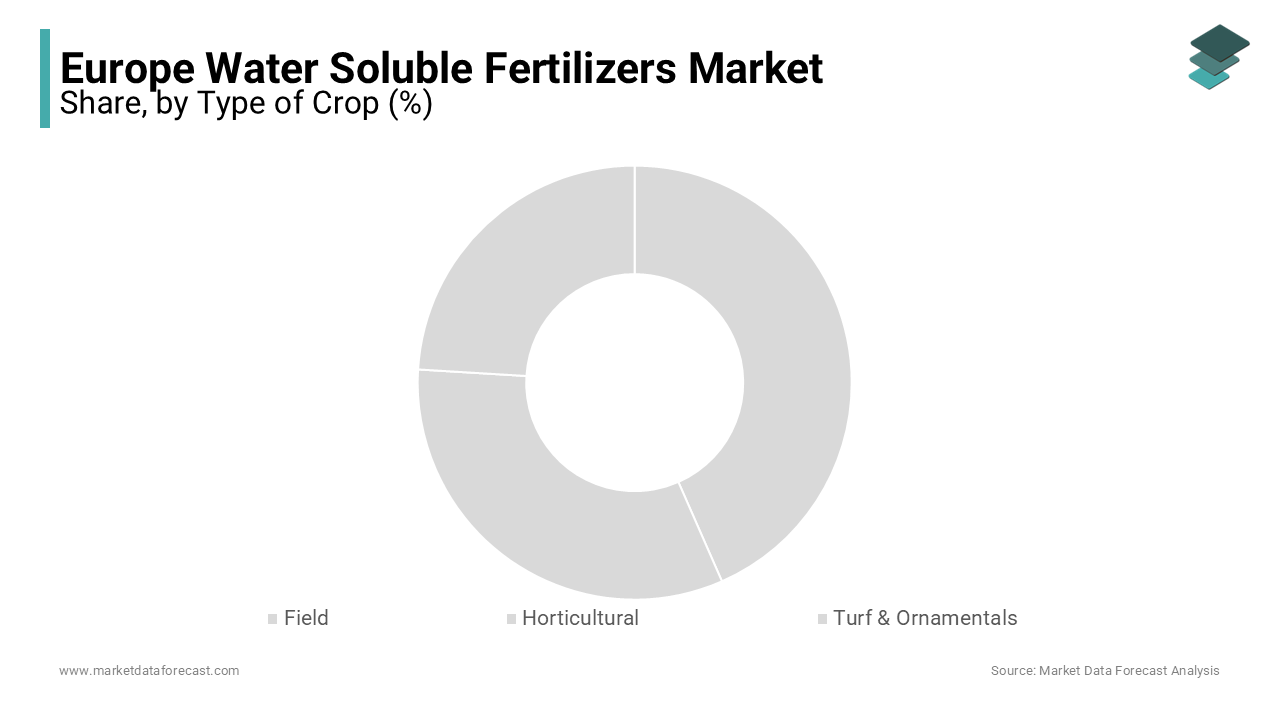
In 2024, the horticultural crops segment led theEuropeane water-soluble fertilizers market by accounting for 58.3% share. Intensive protected cultivation requiring precision nutrient delivery has contributed to the growth of the horticultural crops segment. Horticultural crops dominate water-soluble fertilizer consumption due to their cultivation in high-input, controlled environments where nutrient timing and placement are critical. According to research, the total area under protected cultivation in the European Union continues to expand, with vegetables and berries representing the majority of crops grown in controlled environments such as greenhouses and tunnels. These systems rely almost exclusively on fertigation, necessitating fully soluble NPK and micronutrient blends. As per sources, greenhouse vegetable producers in the Netherlands have widely adopted closed-loop fertigation systems using water-soluble fertilizers, which reflects the country’s advanced approach to efficient and sustainable horticultural practices. This intensive model, driven by consumer demand for off-season fresh produce and premium quality, ensures consistent and high-intensity fertilizer uptake unmatched by field systems. Horticultural producers face stringent cosmetic and residue standards from retailers and consumers, making precise nutrient management nonoptional. Water-soluble fertilizers enable controlled delivery of calcium, magnesium, and micronutrients that prevent disorders like blossom end rot in tomatoes or tip burn in lettuce, defects that lead to rejection by supermarket chains. Besides, the EU’s Maximum Residue Levels regulation increasingly scrutinizes nitrate accumulation in leafy greens, making split applications of soluble nitrogen essential for compliance. This market-driven quality imperative cements horticulture as the anchor segment for water-soluble fertilizer innovation and volume.
Fastest Growing Segment: Field Crops
The Field Crops segment is on the rise and is expected to be the fastest-growing segment in the global market by witnessing a CAGR of 11.4% from 2025 to 2033. The growth of the Field Crops segment is led by a policy-driven shift toward precision fertigation in arable systems. Field crop growth is propelled by EU mandates to reduce nutrient losses and improve efficiency in extensive agriculture. According to research, the European Union’s Farm to Fork Strategy is driving all member states toward adopting precision nutrient management practices, linking financial support programs to verified implementation of efficient fertilization methods. As per sources, policy updates in Germany are promoting the use of soluble starter fertilizers in major crops through targeted incentives under agricultural eco-schemes designed to enhance nutrient efficiency and reduce environmental impact. These policies transform soluble fertilizers from horticultural luxuries into arable compliance tools, especially for high-value rotations like maize silage or protein peas, where early-season nutrient availability directly impacts yield. Water scarcity is accelerating fertigation adoption in Southern Europe, creating new demand for soluble inputs in field crops. These systems deliver water and nutrients directly to the root zone by reducing usage compared to broadcast application. The growing stress from climate change will make soluble fertilizers a key tool for sustainable field crop production, particularly where water resources are limited.
By Application Insights
The fertigation segment dominated the European water-soluble fertilizer market by capturing a substantial share in 2025. The prominence of the fertigation segment is due to the integration with modern irrigation infrastructure in high-value agriculture. Fertigation dominates due to its seamless compatibility with Europe’s expanding drip and micro irrigation networks, which enable precise water and nutrient delivery directly to the root zone. According to sources, millions of hectares of EU farmland are used for drip or micro irrigation, driven by water scarcity and policy incentives. This infrastructure shift, supported by EU Common Agricultural Policy funding, makes fertigation the default application method in modern, efficient agriculture. EU environmental policies explicitly favor fertigation as a best management practice for reducing nutrient runoff. As per studies, nitrate leaching from agriculture contributes to a portion of nitrogen pollution in EU groundwater, prompting strict application controls. The proposed EU Soil Health Law mandates that high-risk zones adopt precision techniques like fertigation to minimize losses. These regulatory and financial levers transform fertigation from a technical choice into a compliance necessity, ensuring sustained demand for compatible water-soluble formulations across diverse cropping systems.
The Foliar application segment is expected to exhibit a noteworthy CAGR of 13.2% from 2025 to 2033. The rapid expansion of the Foliar application segment is fuelled by the rising use of micronutrient and bio-stimulant blends for stress mitigation. Foliar application is surging due to its effectiveness in delivering micronutrients and bio-stimulants during critical growth stages or abiotic stress events. According to research, a portion of EU wheat and barley fields showed zinc or manganese deficiency due to high pH soils and reduced organic matter. Foliar sprays provide immediate correction without soil fixation. This tactical use for rapid response ensures robust growth in foliar adoption. The integration of foliar fertilization with drone-based and variable rate spraying is accelerating uptake among tech-forward farmers. As per sources, agricultural drone use grew, with nutrient application being the second most common function after scouting. These technologies enable targeted delivery to deficient zones identified by satellite or sensor data, minimizing waste and environmental impact. Hence, foliar application is poised to become a key component of smart, responsive nutrient management strategies.
By Type Insights
The nitrogenous fertilizers segment held the leading share of 38.7% share in 2025. The growth of the nitrogenous fertilizers segment is propelled by its critical role in vegetative growth and yield formation across all crops. Nitrogenous water-soluble fertilizers dominate due to nitrogen’s fundamental role in chlorophyll synthesis, protein production, and overall biomass accumulation. According to sources, nitrogen is the most limiting nutrient in a portion of EU arable and horticultural soils, which necessitates frequent and split applications to match crop demand curves. This universal agronomic necessity, combined with nitrogen’s high mobility in soil, makes soluble nitrogen the most consistently demanded nutrient category across all production systems. EU policies increasingly favor advanced nitrogenous formulations that reduce emissions and improve efficiency. As per research, agriculture accounts for a portion of EU nitrogen surpluses, driving adoption of inhibitors like DMPP and NBPT. These regulations transform basic nitrogen salts into value-added, environmentally compliant products, sustaining demand for technologically enhanced nitrogenous water-soluble fertilizers across the region.
The micronutrients segment is predicted to witness the highest CAGR of 15.6% during the forecast period, owing to the widespread soil deficiencies due to intensive cropping and PH imbalance. Micronutrient demand is surging due to documented deficiencies across European farmland caused by decades of high-yielding farming and soil alkalinity. According to studies, a portion of EU agricultural soils are deficient in zinc, in iron,n and in manganese, primarily due to high pH and low organic matter. These agronomic realities create urgent and growing demand for highly available chelated micronutrient formulations. Innovation in sustainable micronutrient delivery is accelerating adoption through enhanced efficacy and eco credentials. European researchers are replacing synthetic EDTA with biodegradable chelators like EDDHA IDH, A, and lignosulfonates derived from paper industry byproducts. Companies offer micronutrient lines using organic acids from fermentation waste, which reduces environmental persistence. Thus, micronutrients are transitioning from corrective inputs to proactive, high-value components of precision nutrition programs.
COUNTRY ANALYSIS
Spain Water Soluble Fertilizers Market Analysis
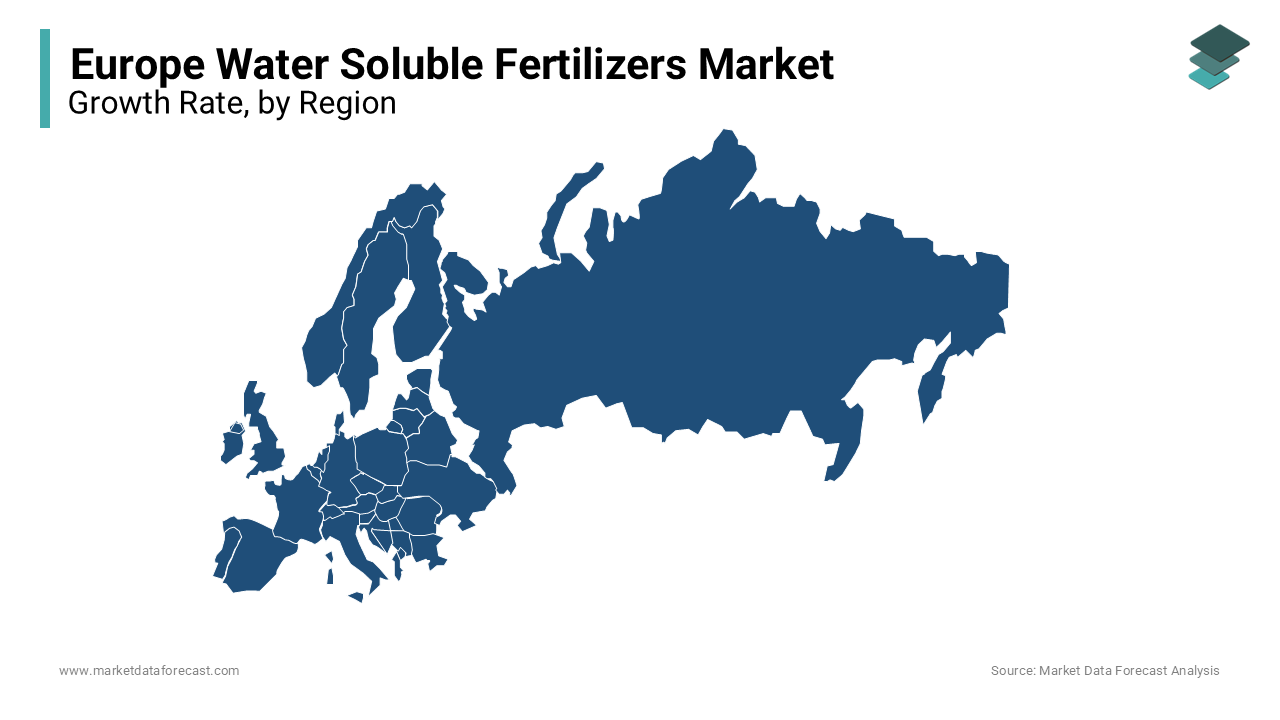
Spain was the top performer in the European Water Soluble Fertilizers Market by accounting for 21.8% share in 2024. The prominence of Spain is because of its vast horticulturalsectoror extensive irrigation infrastructure andclimate-drivenn need for efficient nutrient management. The country operates a large number of hectares of greenhouses and open field drip systems primarily in Almería, Murcia, and the Ebro Valley, producing tomatoes, peppers, and citrus for EU and global markets. According to research, notable tonswater-soluble fertilizers were consumed, with a portion used in fertigation. Furthermore, recurrent droughts and EU nitrate vulnerable zone designations compel precise nutrient application,n making Spain a high-intensity policy-driven market for advanced soluble formulations.
Nether Lands Water-Soluble Fertilizers Market Analysis
The Netherlands followed closely in the European water-soluble fertilizers market,e t capturinga 17.3% share in 2024. The growth of the Netherlands is due to world-leading greenhouse horticulture and closed-loop nutrient recycling. The country’s hectares of glass greenhouses produce a portion of Europe’s vegetables using fully automated fertigation that requires ultra-pure water-soluble NPK and micronutrient blends. The Netherlands also serves as a hub for agritech innovation,n with companies like Priva and Ridder integrating fertilizer dosing into climate control platforms. Strict groundwater protection laws and phosphate rights trading further incentivize efficiency, ensuring the Netherlands remains a premium technology-intensive market for high-performance soluble nutrients.
France Water-Soluble Fertilizers Market Analysis
France grew consistently in the Eurowater-solubleble fertilizers market with its large arable base, policy-driven precision agriculture adoption, and expanding horticultural exports. France is Europe’s largest producer of potatoes and sugar beet, both increasingly using drip irrigation and soluble starter fertilizers in nitrate vulnerable zones. Apart from these, the country’s fruit sector, particularly apples and kiwis in the Rhône Valley, relies on chelated micronutrients to combat pH-induced deficiencies. The national initiative also promotes soluble nitrogen for legume inoculation support. This blend of extensive and intensive systems supported by strong public investment sustains France’s position as a diversified, high-volume market.
Italy Water Soluble Fertilizers Market Analysis
Italy expanded moderately in the Eurowater-solubleble fertilizers market owing to h-value horticulture water scarcity and EU-funded modernization. The country’s Po Valley is Europe’s largest maize belt, while Southern regions produce olives, citrus, and tomatoes under protected cultivation. Italy also leads in micronutrients, with a portion of olive growers applying soluble boron and zinc to mitigate heat stress, as reported by the Italian National Institute for Agricultural Economics. This combination of climate pressure and policy support ensures robust growth in both fertigation and foliar segments.
Germany Water-Soluble Fertilizers Market Analysis
Germany is likely to grow in the Europwater-solublele fertilizers market from 2025 to 2033 due to stringent environmental regulati,,ons advanced arable fa, rm, ing and growing horticultural innovation. Germany is Europe’s largest maize and wheat producer, er with increasing use of subsurface drip and soluble starter fertilizers for early vigour. Besides, the country hosts leading research institutions like the Julius Kühn Institute, driving the adoption of stabilized nitrogen and chelated micronutrients. The Common Agricultural Policy eco schemes provide direct payments for precision nutrient management, further incentivizing soluble fertilizer use. Science-based regulatory approach and large arable base position ihigh-compliancece high-technology market within the European landscape.
COMPETITIVE LANDSCAPE
The Europwater-soluble fertilizer market features intense competition among multinational corporations and regional specialists. Leading companies differentiate themselves through advanced formulations tailored to specific crops and growing systems such as hydroponics and greenhouse farming. Regulatory compliance, particularly under the EU Fertilising Products Regulationdrives innovation in non-biodegradable prodproductionich isrtis her shaped by investments in digital agronomy tools that provide real-time nutrient recommendations, enhancing product stickiness. Companies also focus on vertical integration to secure raw material supply and maintain cost efficiency. The market sees frequent collaborations with research institutions to validate product efficacy and sustainability claims. Regional variations in crop patterns and irrigation infrastructure necessitate localized go-to-market strategies. Overall, the competitive landscape emphasizes technological sophistication, sustainability credentials, and service-oriented business models to capture value in a maturing yet dynamic market environment.
KEY MARKET PLAYERS
A few of the market players in the European water-soluble fertilizers market include
- PR Agro Nutri Private Ltd. (India)
- CF Industries (US)
- ICL Group Ltd
- Haifa Group
- Yara International ASA
- The Mosaic Company (US)
- Israel Chemicals (Israel)
- Eurochem (Switzerland)
- Terra Nitrogen Company (US)
- PT Petrokimia Gresik (Indonesia)
- Sinofert Holdings (Hong Kong)
- Americas Petrogas (Canada)
- Sirius Minerals (UK).
Top Players in the Market
Yara International ASA is a leading global provider of water-soluble fertilizers with a strong presence across Europe. The company focuses on delivering nutrient-efficient solutions tailored to precision agriculture. In recent years, Yara has invested in digital farming platforms and expanded its NPKwater-soluble fertilizer portfolio to meet evolving European agronomic needs. Its innovation centers in Norway and Germany support product development aligned with sustainability mandates.
ICL Group Ltd plays a pivotal role in the European soluble fertilizers market through its specialty nutrient solutions. The company leverages its vertically integrated production capabilities to supply high-purity potassium phosphorus-based formulations. ICL has strengthened its European footprint by enhancing distribution networks in Spain and Italy and investing in controlled release technologies.
Haifa Group is recognized globally for its expertise in potassium nitrate and specialty water-soluble fertilizers. The company serves European markets with tailored formulations for fertigation and foliar applications. Haifa emphasizes agronomic support and digital tools to optimize nutrient use efficiency. To reinforce its position in Europe, the company partnered with local agritech firms and expanded its technical service teams.
Top Strategies Used By The Key Market Participants
Key players in the Europewater-soluble fertilizers market prioritize product innovation through research and development to meet stringent environmental regulations and evolving agronomic demands. Companies invest in digital agriculture solutions to offer integrated nutrient management services, enhancing customer engagement. Strategic partnerships with distributors and agritech firms enable broader market reach and localized support. Expansion of production and blending facilities within Europe ensures supply chain resilience and faster response to regional needs. Sustainability-driven initiatives, such as low-carbon formulations and recyclable packaging, align with the objective, strengthening credibility and regulatory compliance across member states.
MARKET SEGMENTATION
This research report on the European water-soluble fertilizers market is segmented and sub-segmented based on type of crop, Application, Type of WSF, and Country.
By Type of Crop
- Field
- Horticultural
- Turf & Ornamentals
By Application
- Fertigation
- Foliar method
By Type of WSF
-
Nitrogenous
- Potassic
- Phosphatic
- Micronutrients
By Country
- Germany
- France
- Switzerland
- Italy
- UK
- Spain
- Russia
- Belgium
- Netherland
- Others