- Product Description Description
- Table of Contents TOC
- List of Table & Figure LOT
- Get Free Sample PDF Sample PDF
Market Size, 2025
$22.79 BnMarket Estimate, 2026
$24.09 BnMarket Forecast, 2034
$37.50 BnCAGR, 2026–2034
5.69%Global Water-Soluble Fertilizers Market Size, Share, Trends & Forecast (2026–2034)
- Market Scope: Comprehensive global water-soluble fertilizers market analysis covering product types, application methods, crop segments, regional leadership frameworks, growth drivers, and competitive landscapes.
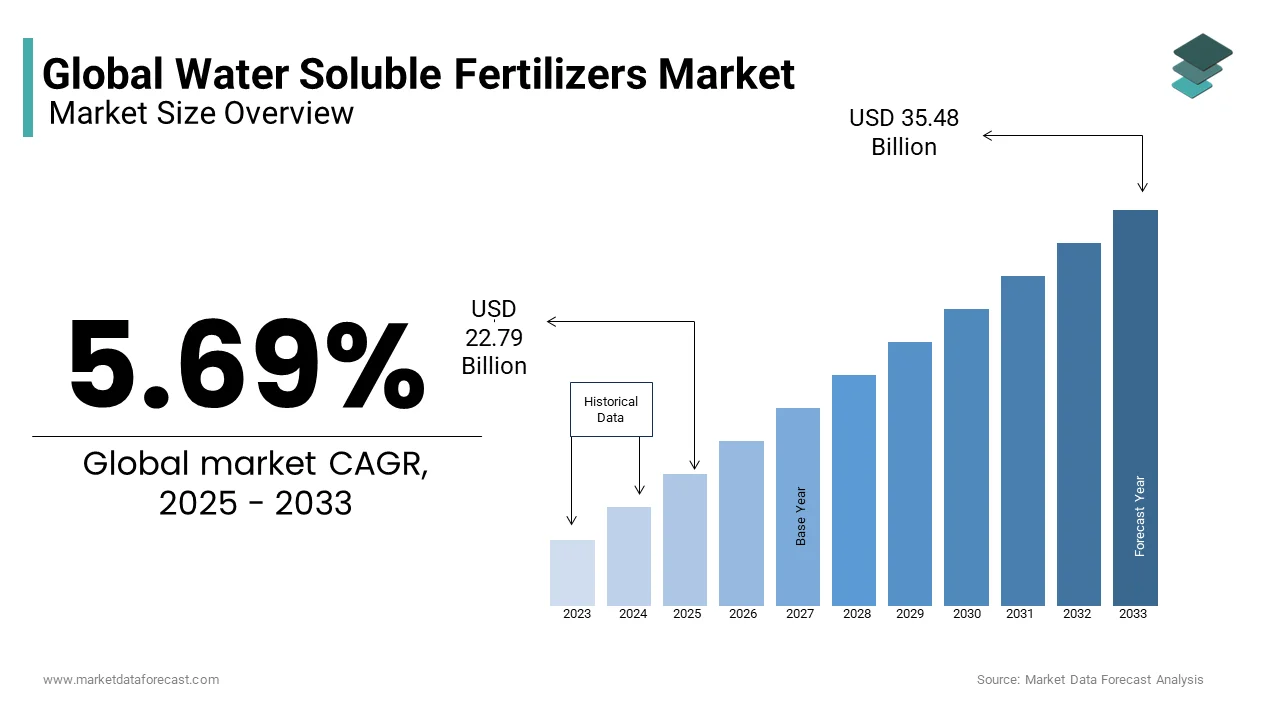
- Market Valuation: Valued at USD 22.79 billion (2025), estimated at USD 24.09 billion (2026), and projected to reach USD 37.50 billion by 2034, registering a robust CAGR of 5.69% (2026–2034).
- Primary Growth Drivers: Expansion of micro-irrigation infrastructure and fertigation adoption, rising demand for high-value horticultural produce, and policy-driven nutrient efficiency mandates in arid and semi-arid regions.
Key Global Water-Soluble Fertilizers Segment Metrics (2026–2034)
| Category | Leading Segment (2025 Position) | Fastest-Growing Segment |
|---|---|---|
| By Type | Nitrogenous formulations (held 35.4% market share) | Micronutrients (projected to register a 9.3% CAGR) |
| By Application | Fertigation (largest segment holding 62.3% market share) | Foliar application (projected to register an 8.4% CAGR) |
| By Crop | Horticultural crops (held a significant share due to high economic value) | Turf and ornamentals (growing at the fastest 9.2% CAGR) |
| By Region | Asia-Pacific (top performer with 39.2% of global market share) | Middle East and Africa (driven by extreme water scarcity and food security) |
Major Market Players, Structure & Strategic Landscape
Market Structure: Highly competitive specialty fertilizer landscape featuring multinational producers and diversified agrochemicals competing on product purity, high solubility, digital agronomy platforms, and vertical integration.
Key Companies: ICL Group Ltd, Haifa Group, Yara International ASA, CF Industries, The Mosaic Company, Israel Chemicals, Eurochem, Terra Nitrogen Company, PT Petrokimia Gresik, Sinofert Holdings, Americas Petrogas, and Sirius Minerals.
Global Water-soluble Fertilizers Market Size
The global water-soluble fertilizers market was valued at USD 22.79 billion in 2025 and is anticipated to reach USD 24.09 billion in 2026 from USD 37.50 billion by 2034, growing at a CAGR of 5.69% during the forecast period from 2026 to 2034.
The water-soluble fertilizers are highly refined nutrient formulations designed for complete dissolution in irrigation water, enabling precise and uniform delivery of essential macro and micronutrients directly to plant roots or foliage. Their composition typically includes nitrogen,n phosphorus, potassium, and chelated trace elements in ratios optimized for specific crop phenological stages. According to the Food and Agriculture Organization of the United Nations, 300 million hectares of global cropland now utilize some form of controlled irrigation, with more than 65 million hectares equipped for fertigation.
MARKET DRIVERS
Expansion of Micro Irrigation Infrastructure Drives Fertigation Adoption
The global proliferation of micro irrigation systems has created a structural dependency on water-soluble fertilizers due to their solubility, purity, and compatibility with emitter technologies, which is fuelling the growth of the Water Soluble Fertilizers Market. In India, the Pradhan Mantri Krishi Sinchayee Yojana has subsidized micro irrigation on more than 7 million hectares since 20,15, requiring the use of fully soluble fertilizers to prevent clogging. Similarly, in Calif, where over 80% of almond and pistachio orchards employ drip systems. In Israel, wastewater for agriculture is integrated into every major crop’s nutrient regimen to ensure precise dosing under saline water conditions.
Rising Demand for High-Value Horticultural Produce Intensifies Nutrient Precision Needs
The global surge in consumption of fruits, vegetables, nuts, and berries has elevated the agronomic requirement for nutrient timing and balance, which only water-soluble fertilizers can reliably deliver. This attributexpectednally to fuel the growth of the Water Soluble Fertilizers Market. According to some reports, global per capita fruit and vegetable consumption increased by 22% between 2010 and 2024, driven by urbanization and health awareness. Protected cultivation with hydroponic and soilless systems dominates greenhouse production in Europe and the Middle East.
MARKET RESTRAINTS
High Production and Formulation Costs Limit Accessibility for Smallholders
Water-soluble fertilizers entail significantly higher manufacturing expenses compared to conventional fertilizers due to stringent requirements for purity, particle size, and absence of insoluble residues, which restricts the growth of the water-soluble fertilizers Market. According to the International Fertilizer Association, the production cost of fully soluble NPK grades is higher than standard granular equivalents owing to additional processing steps such as spray drying, chelation,n and filtration. Moreover, the need for compatible irrigation infrastructure further compounds the investment burden as drip systems require a minimum of 500 US dollars per hectare.
Risk of Nutrient Leaching and Groundwater Contamination Under Improper Management
The water-soluble fertilizers pose environmental risks when applied without calibrated scheduling or soil monitoring, leading to nitrate and phosphate leaching into aquifers, which is limiting the growth of the water-soluble fertilizers market. According to the United States Geological Survey, nitrate concentrations in agricultural groundwater exceeded the World Health Organization limit of fifty milligrams per liter in monitored wells in California’s Central Valley, where intensive fertigation is practiced. In China, the excessive soluble nitrogen application in greenhouse vegetable belts contributed to groundwater nitrate levels averaging 82 milligrams per liter in Shandong Province.
MARKET OPPORTUNITIES
Integration with Controlled Environment Agriculture Opens Premium Application Avenues
The rapid scaling of vertical farms, greenhouses, a nd container-based growing systems for specialized water-soluble fertilizers tailored to soilless media and recirculating nutrient solutions. This is specifically to enhance the growth of the Water-Soluble Fertilizers Market. These systems demand ultra-pure fertilizers free of sodium chloride and heavy metals to prevent system corrosion and plant toxicity. Similarly, in the United Arab Emirates, the National Food Security Strategy mandates the use of recirculating hydroponics in desert agriculture, where water-soluble fertilizers are dosed via AI-controlled systems to achieve high nutrient use efficiency.
Policy Mandates for Fertigation in Water-Stressed Regions Create Structured Demand
The governments in arid and semi-arid zones are institutionalizing the use of water-soluble fertilizers through irrigation modernization programs, and water use efficiency regulations are additionally expected to escalate the growth of the water-soluble fertilizers market. According to the World Resources Institute, 17 countries, including Spain, Aino, and Australia, have enacted policies that link water allocation permits to the adoption of micro irrigation and fertigation.
MARKET CHALLENGES
Inconsistent Raw Material Quality Compromises Product Performance and Farmer Trust
The efficacy of water-soluble fertilizers is highly sensitive to the purity and consistency of raw materials, such as potassium nitrate, phosphoric acid, and chelating a, wagentsichgents is a challenge for the growth of the Water Soluble Fertilizers Market. In Kenya, a study by the International Institute of Tropical Agriculture revealed that greenhouse tomato farmers using soluble fertilizers experienced leaf tip burn due to incorrect calcium to potassium ratios in their nutrient solutions.
REPORT COVERAGE
| REPORT METRIC | DETAILS |
| Market Size Available | 2025 to 2034 |
| Base Year | 2025 |
| Forecast Period | 2026 to 2034 |
| CAGR | 5.69% |
| Segments Covered | By Type of Crop, By Application, By Type, And Region |
| Various Analyses Covered | Global, Regional, & Country Level Analysis; Segment-Level Analysis, DROC; PESTLE Analysis; Porter’s Five Forces Analysis, Competitive Landscape; Analyst Overview of Investment Opportunities |
| Regions Covered | North America, Europe, APAC, Latin America, Middle East & Africa |
| Market Leaders Profiled | PR Agro Nutri Private Ltd. (India), CF Industries (United States), The Mosaic Company (United States), Israel Chemicals (Israel), Eurochem ( Switzerland), Terra Nitrogen Company (United States), PT Petrokimia Gresik (Indonesia), Sinofert Holdings (Hong Kong), Americas Petrogas (Canada), and Sirius Minerals (United Kingdom). |
SEGMENTAL ANALYSIS
By Type Insights
The nitrogenous formulations segment held 35.4% of the global water-soluble fertilizers market share in 2024. Nitrogen remains the most extracted nutrient by crops, with global removal rates of 110 million tons annually. In high-yielding systems such as maize, rice,,ce,d, wheat, nitrogen accounts for total nutrient uptake, making its timely and soluble delivery critical. According to the University of Nebraska-Lincoln, water-soluble urea ammonium nitrate solutions increase nitrogen use efficiency compared to broadcast urea by minimizing volatilization and enabling split applications aligned with crop demand curves.
The micronutrients segment is anticipated to register a CAGR of 9.3% during the forecast period. Intensive farming has depleted soil micronutrient reserves globally, with, on, and boron deficiencies now affecting over 50% of cultivated soils in Asia and Africa. Water-soluble chelated micronutrients such as EDTA Fe and EDDHA Zn offer immediate correction through fertigation or foliar routes, where soil application proves ineffective due to fixation. Furthermore, the European Union’s Farm to Fork Strategy mandates reduced macro nutrient use, which indirectly elevates the importance of micronutrient optimization to maintain productivity.
By Application Insights
The fertigation segment was the largest and held 62.3% of the global water-soluble fertilizers market share in 2024. The installed base of micro irrigation systems has grown to over 115 million hectares worldwide, with drip and micro sprinkler technologies now standard in high-value crop production. Similarly, greenhouse vegetable farms in Almería rely on automated fertigation with real-time electrical conductivity monitoring to maintain optimal nutrient concentrations. In India, the Pradhan Mantri Krishi Sinchayee Yojana has subsidized drip irrigation on more than 8 million hectares since 2015, mandating the use of fully soluble fertilizers to prevent emitter clogging.
The foliar application segment is likely to register a CAGR of 8.4% during the forecast period, with the need for rapid nutrient correction during critical growth stages and compatibility with aerial and drone-based delivery systems. Foliar feeding provides an immediate bypass to soil nutrient limitations during reproductive phases when root uptake is insufficient or impaired. According to the International Rice Research Institute, foliar application of zinc sulfate at panicle initiation increased rice grain zinc concentration in flooded fields with high pH soils. Moreover, the rise of drone technology has revolutionized foliar delivery with agricultural drones operating in Asia by enabling targeted application with 90% less water than ground rigs.
By Crop Insights
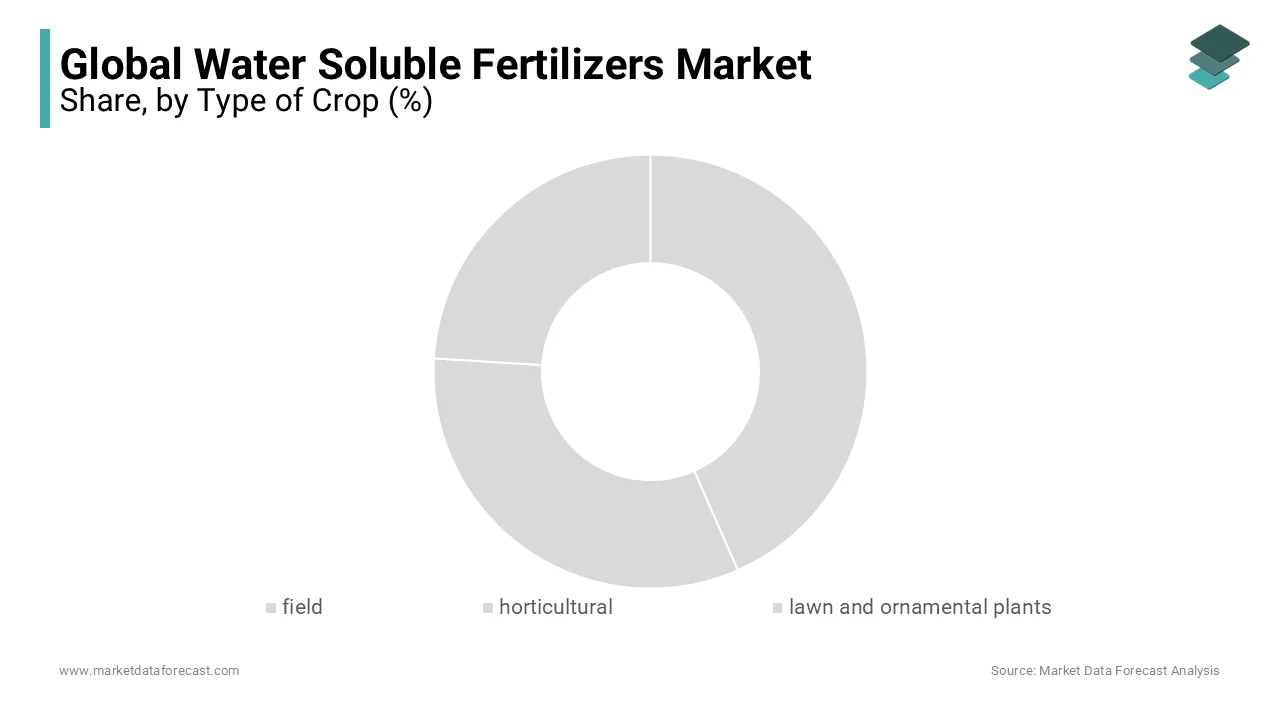
The horticultural crops segment held a significant share of the water-soluble fertilizers market in 2024, with the high economic value of fruits, ts vegetables, leaves, nd berries, which demand precise nutrient scheduling to achieve marketable quality, shelf life, and yield consistency. Horticultural producers operate under stringent quality benchmfor sizesizez, color, or firmness and nutritional content that can only be met through controlled nutrient delivery. According to the World Trade Organization, over 200 technical barriers to trade exist for fresh produce, nutrient-related parameters such as Brix levels, titratable acidityaciditynd mineral content frequently specified by importers.
The turf and ornamentals segment is growing at the fastest CAGR of 9.2% throughout the forecast period. Rapid urbanization has intensified demand for managed green spaces, with the global urban population projected to reach 6.7 billion by 2030. In the Gulf Cooperation Council, municipal spending on landscaping exceeds 15 billion US dollars annually, with golf courses, parks,s, and residential complexes requiring year-round aesthetic quality. In China, the Ministry of Housing and Urban Rural Development mandates green coverage ratios of 35% in all new cities, driving demand for soluble micronutrient blends to sustain ornamental shrubs in compacted urban soils. Additionally, major sporting events such as the FIFA World Cup and Olympic Games require tournament-ready turf maintained exclusively with liquid nutrition programs.
REGIONAL ANALYSIS
Asia Pacific Market Analysis
Asia Pacific was the top performer of the global water-soluble fertilizers market with 39.2% of the share in 2024, with vast horticultural acreage, government irrigation modernization schemes, and smallholder adoption in high-value cropping systems. India’s Pradhan Mantri Krishi Sinchayee Yojana has facilitated drip irrigation with mandatory use of soluble fertilizers to prevent clogging. As per China’s Ministry of Agriculture, greenhouse vegetable area exceeded 4 million hectares in 2024 with near universal fertigation adoption.

North America Market Analysis
North America was positioned next to the Asia-Pacific by capturing 21.3% of the water-soluble fertilizer market in 2024, with the large-scale adoption in specialty crops, row ops, and turf management. California alone consumes over 30% of US water-soluble fertilizers due to its $50 billion frnut nu,t, and vegetable sector operating under severe water constraints. The Environmental Protection Agency’s Groundwater Protection Program has incentivized fertigation to reduce nitrate leaching in the Central Valley, with over eight million acres using drip or micro sprinklers.
Europe Market Analysis
The solublee fertilizer market growth is likely to have significant growth opportunities throughout the forecast period, with the stringent environmental regulations, protected cultivation, and policy-driven nutrient efficiency mandates. The European Union’s Nitrates Directive restricts nitrogen application rates in vulnerable zones, compelling growers to adopt split fertigation with soluble sources to stay compliant. Spain’s Almería province alone produces over 3 million tons of vegetables annually under plastic with fertigation as the sole nutrient delivery method.
Latin America Market Analysis
LaAmerica'sater water-soluble fertilizer market growth is likely to be driven by the high-value export crops. Brazil’s ABC Plus Plan promotes drip irrigation in fruit and coffee with soluble potassium nitrate essential for bean quality and fruit size. Chile’s table grape industry, which exports over eight hundred thousand tons annually to the Northern Hemisphere, relies on weekly fertigation with calcium and boron blends to prevent cracking and meet EU phytosanitary standards, as confirmed by the Chilean Fruit Exporters Association.
Middle East and Africa Market Analysis
The Middle East and Africa water-soluble fertilizers market growth is likely to grow with strategic significance due to extreme water scarcity and food security imperatives. In Saudi Arabia, the National Water Strategy mandates a slight reduction in agricultural water use by 2030, driving the adoption of closed-loop hydroponics for vegetable production using imported soluble blends.
COMPETITIVE LANDSCAPE
The water-soluble fertilizers market features intense competition among multinational specialty fertilizer producers, regional manufacturers, and diversified agrochemical companies. Differentiation is primarily achieved through product purity, solubility, speed of dissolution, and compatibility with fertigation systems rather than price alone. Leading firms leverage proprietary production technologies such as nitrophosphate or crystallization processes to ensure low insoluble residue content,t, which is critical for emitter longevity. The market is also shaped by technical service capabilities, with companies offering agronomic support, formulation customization, and digital tools to demonstrate return on investment. Regulatory compliance, particularly regarding heavy metal limits and labeling standards in the European Union and the United States, creates entry barriers for smaller players.
KEY MARKET PLAYERS
A few of the market players in the global water-soluble fertilizers market include
- PR Agro Nutri Private Ltd. (India)
- ICL Group Ltd
- Haifa Group
- Yara International ASA
- CF Industries (United States)
- The Mosaic Company (United States)
- Israel Chemicals (Israel)
- Eurochem ( Switzerland)
- Terra Nitrogen Company (United States)
- PT Petrokimia Gresik (Indonesia)
- Sinofert Holdings (Hong Kong)
- Americas Petrogas (Canada)
- Sirius Minerals (United Kingdom).
Top Players In The Market
- ICL Group Ltd is a global leader in specialty minerals and water-soluble fertilizers, offering a comprehensive portfolio of potassium nitrate and specialty NPK formulations tailored for fertigation and foliar applications. The company leverages its vertically integrated production of potash and phosphate to ensure high purity and consistent quality in its soluble products. It also launched a digital nutrient management platform that integrates soil data and crop models to recommend precise water-soluble fertilizer recipes. These initiatives reinforce ICL’s role as a science-driven solutions provider in high-value agriculture worldwide.
- Yara International ASA plays a pivotal role in the water-soluble fertilizers market through its NPK and nitrogen-based soluble products designed for precision farming and protected cultivation. The company combines its ammonia production capabilities with advanced granulation and dissolution technologies to deliver fully soluble formulations compatible with modern irrigation systems. ems.. It also enhanced its Yara Digital Farming ecosystem to include real-time fertigation scheduling based on satellite imagery and weather forecasts. These efforts underscore Yara’s commitment to improving nutrient use efficiency and supporting climate-resilient food production globally.
- Haifa Group is a pioneer in water-soluble fertilizers with decades of expertise in potassium nitrate and multinutrient formulations for drip irrigation and hydroponics. The company supplies tailored soluble blends to over one hundred countries with a strong focus on horticulture and controlled environment agriculture. It also partnered with agritech firms in Latin America to deploy AI-powered nutrient advisory services for berry and avocado growers.
Top Strategies Used By The Key Market Participants
Key players in the water-soluble fertilizers market focus on vertical integration to secure high-purity raw materials and ensure consistent product quality. They invest in research and development to formulate low salt index chelated and stabilized nutrient blends that address specific crop and soil challenges. Companies are increasingly embedding their products into digital agronomy platforms, enabling data-driven fertigation recommendations. Strategic partnerships with irrigation equipment manufacturers and agritech startups facilitate bundled solutions for precision farming. Additionally, they expand production capacity in high-growth regisuch ons as Asia and Latin America while aligning product portfolios with sustainability mandates like reduced nitrogen leaching and water use efficiency.
MARKET SEGMENTATION
This research report on the global water-soluble fertilizers market is segmented and sub-segmented based on the type of crop, Application, Type, and Region.
By Type Of Crop
- field
- horticultural
- lawn and ornamental plants
By Application
- fertigation
- foliar method
By Type
- nitrogen
- potassium
- phosphate
- micronutrients
By Region
- North America
- Europe
- Asia-Pacific
- Middle East and Asia
- Latin America