Europe Webcams Market Size, Share, Trends, and Growth Analysis Report, Segmented by Webcam Type, Sensor Resolution, End-user, Distribution Channel, and Country – Industry Forecast From 2026 to 2034
Market Size, 2025
$3.04 BnMarket Estimate, 2026
$3.19 BnMarket Forecast, 2034
$4.66 BnCAGR, 2026–2034
4.85%Europe Webcams Market Report Summary
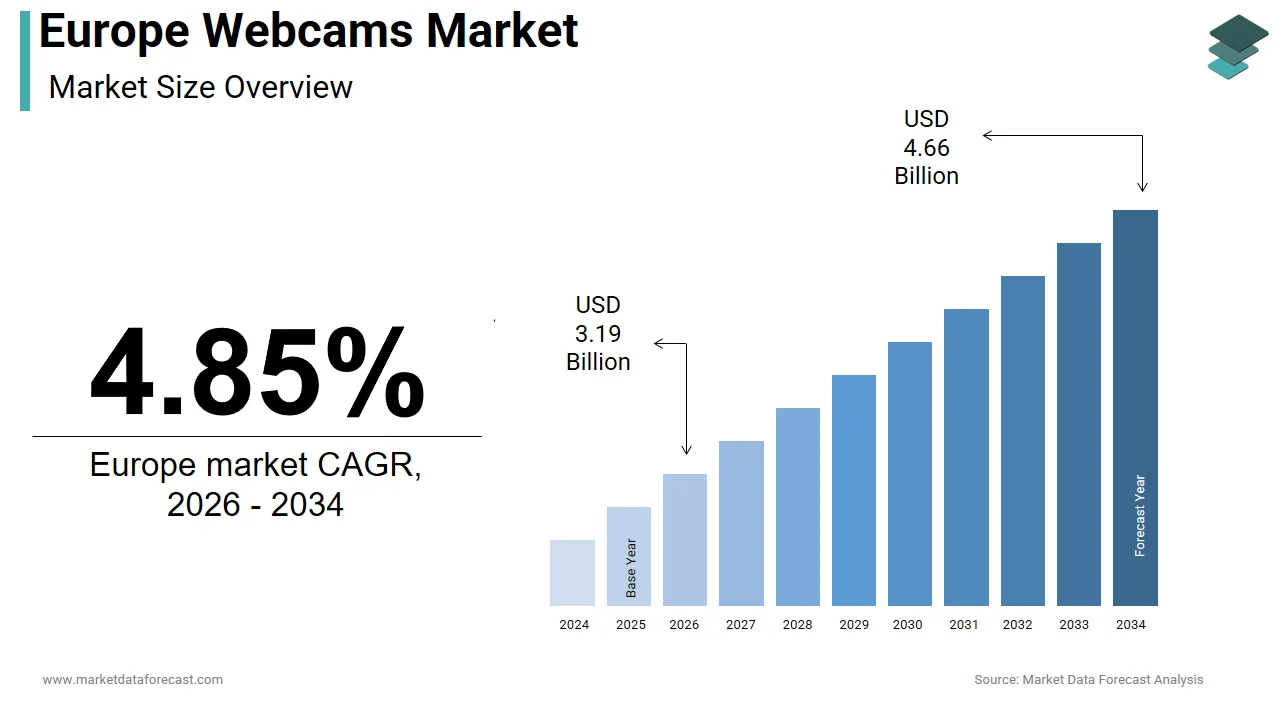
The Europe webcams market was valued at USD 3.04 billion in 2025, is anticipated to reach USD 3.19 billion in 2026, and is projected to reach USD 4.66 billion by 2034, growing at a CAGR of 4.85% from 2026 to 2034. Market growth is driven by the continued adoption of remote and hybrid work models, rising demand for virtual learning solutions, and expanding use of video-based communication platforms. Consumers and enterprises across Europe are investing in high-definition webcams to enhance video conferencing, content creation, and online collaboration. The integration of AI-based image enhancement, noise reduction, and auto-framing features is further supporting market expansion.
Key Market Trends
- Sustained demand for high-definition and 4K webcams for professional and content creation applications.
- Increasing adoption of AI-powered features such as background blur, facial tracking, and auto exposure.
- Rising demand for plug-and-play external webcams for laptops and desktop systems.
- Growth in streaming, gaming, and influencer-driven content creation.
- Expanding use of webcams in telemedicine and virtual customer support services.
Segmental Insights
- Based on webcam type, the external webcam segment held the largest share of the Europe webcams market in 2025, driven by high compatibility, superior video quality, and strong demand from remote professionals and content creators.
- The embedded webcam segment is expected to witness strong growth from 2026 to 2034, supported by increasing integration of advanced camera modules in laptops, tablets, and smart devices.
Regional Insights
The Europe webcams market is witnessing steady growth across major economies, supported by digital workplace adoption, expanding online education platforms, and rising investments in communication technologies.
- Germany was the top performer in 2025, driven by strong enterprise IT spending, high remote work adoption, and growing demand for professional-grade webcams.
- The United Kingdom ranked second in 2025, supported by widespread use of video conferencing in corporate and educational sectors.
- France is expected to register the fastest CAGR over the forecast period, driven by expanding digital learning initiatives and growing adoption of remote healthcare and virtual services.
Competitive Landscape
The Europe webcams market is characterized by strong competition among global electronics manufacturers and peripheral device providers. Market players are focusing on developing high-resolution cameras, enhancing AI-powered video features, and improving cross-platform compatibility. Strategic partnerships, continuous product innovation, and expansion of online distribution channels are shaping competitive dynamics across the region.
Prominent companies operating in the Europe webcams market include Logitech International S.A., AverMedia Technologies, Microsoft Corporation, Lenovo Group Limited, HP Inc., and Dell Technologies Inc.
Europe Webcams Market Size
The size of the Europe webcams market was worth USD 3.04 billion in 2025. The regional market is anticipated to grow at a CAGR of 4.85% from 2026 to 2034 and be worth USD 4.66 billion by 2034 from USD 3.19 billion in 2026.
The webcams are integrated video capture devices designed for real-time visual communication, content creation, surveillance, and remote interaction across consumer, enterprise, and institutional settings. Unlike built-in laptop cameras, dedicated webcams offer superior resolution, advanced autofocus, low-light performance, and compatibility with professional software ecosystems. The market has evolved beyond basic video conferencing to support hybrid work, distance education, live streaming, telehealth, and smart home applications. As per Eurostat, over 86% of European households had access to high-speed broadband in 2024, creating foundational infrastructure for high-quality video transmission. Additionally, the European Commission’s 2024 Digital Decade report noted that 68% of EU enterprises now conduct regular virtual meetings with external stakeholders, while UNESCO’s European office documented that more than 15 million students across the region engaged in synchronous online learning during the 2023–2024 academic year. These behavioral and infrastructural shifts have permanently embedded webcams into daily digital routines, transforming them from peripheral accessories into essential tools of visual connectivity across both professional and personal domains.
MARKET DRIVERS
Pervasive Hybrid Work Models Across European Enterprises
The institutionalization of hybrid and remote work arrangements across European organizations continues to be a primary driving factor for the growth of Europe webcams market. As per Eurofound’s 2024 European Working Conditions Survey, 58% of employees in the EU now operate under some form of hybrid work model, with 32% attending physical offices fewer than two days per week. This structural shift has elevated expectations for professional video presence, driving demand for webcams that offer Full HD or 4K resolution, integrated lighting correction, and noise-reducing microphones. The European Commission’s 2024 Digital Economy and Society Index confirmed that 74% of large enterprises and 41% of small and medium enterprises provide dedicated video conferencing hardware to remote staff, a marked increase from 22% in 2019. Companies are increasingly standardizing on external webcams to ensure brand consistency, reduce support tickets related to poor video quality, and comply with cybersecurity policies that restrict the use of built-in cameras in sensitive meetings. In Germany, the Federal Ministry of Labour mandated in 2023 that all public sector remote workers receive ergonomic and audiovisual equipment allowances, resulting in over 400000 webcam procurements in 2024 alone, according to the Federal Office of Administration.
Rise of Creator Economy and Live Streaming Culture
The rapid expansion of Europe’s digital creator economy for advanced webcams tailored to content production is additionally escalating the growth of Europe webcams market. According to the European Audiovisual Observatory, the number of professional and semi-professional content creators in the EU is growing, now earning income through platforms like YouTube, Twitch, and Instagram. These users require webcams with manual focus control, high frame rates, and clean HDMI output features absent in standard laptop cameras. The European Youth Forum’s 2024 survey revealed that many Europeans aged 18 to 34 have either launched or plan to launch a digital content channel within the next year, signaling sustained future demand. Brands, such as Logitech, Elgato, and Razer, have responded with creator-focused models featuring ring light integration, background replacement software, and AI-driven framing, sold through specialized retail and e-commerce channels. This emergence of entrepreneurship education and platform monetization has transformed webcams from utility devices into creative instruments, expanding both feature expectations and price tolerance across the European consumer base.
MARKET RESTRAINTS
Saturation of Integrated Camera Technology in Laptops
The rapid improvement and ubiquity of high-quality integrated cameras in laptops and monitors are majorly restricting the growth of Europe webcams market. As per the European Hardware Association, 92% of new business and premium consumer laptops shipped in the EU in 2024 featured at least 1080p resolution cameras with improved low-light sensors and Windows Hello compatibility. Apple’s integration of 1080p FaceTime HD cameras across its MacBook Pro and Air lineup, devices that account for over 28% of premium laptop sales in Western Europe according to GfK, has further reduced the perceived need for external peripherals. Additionally, major monitor manufacturers like Dell, HP, and Philips now embed 5 megapixel webcams with dual microphones in their business display lines, eliminating desk clutter while meeting baseline video conferencing standards. The European Consumer Organisation’s 2024 usability study found that 64% of remote workers consider built-in cameras “sufficient” for daily meetings unless they engage in frequent client-facing or creative work. This technological emergence compresses the addressable market for standalone webcams to a narrower segment of power users, thereby limiting volume growth and intensifying competition among external device manufacturers who must justify premium pricing through demonstrable performance differentials.
Stringent Data Privacy and Cybersecurity Regulations
The rigorous data protection framework, with the rising adoption particularly in enterprise and public sector environments, is hampering the growth of Europe webcams market. The General Data Protection Regulation mandates strict controls over biometric and visual data collection, with national supervisory authorities imposing severe penalties for non-compliance. The French National Commission on Informatics and Liberty issued formal guidance requiring all public institutions to disable or physically cover non-essential cameras during non-video sessions, a policy echoed by data protection agencies in Germany and the Netherlands. Furthermore, the European Union Agency for Cybersecurity published a 2024 advisory noting that some of the cybersecurity incidents involving video conferencing stemmed from unsecured peripheral devices, including third-party webcams with outdated firmware. This has led IT departments to restrict procurement to a pre-approved list of vendors that provide regular security patches and end-to-end encryption. In Sweden, the Data Protection Authority fined a municipal healthcare provider 1.2 million euros in early 2024 for using uncertified webcams in teleconsultations without patient consent, with a precedent that heightened institutional caution. These regulatory and security pressures increase compliance costs, lengthen procurement cycles, and discourage deployment in sensitive sectors, such as education, healthcare, and government, thereby capping market expansion despite functional demand.
MARKET OPPORTUNITIES
Integration with Unified Communication and Collaboration Platforms
The deep integration with enterprise unified communication platforms, such as Microsoft Teams, Zoom, and Cisco Webex, is expected to pose new opportunities for the growth of Europe webcam market. Leading webcam manufacturers have responded by developing devices certified under platform-specific programs, such as Microsoft Teams Rooms Certified or Zoom Ready, which offer plug-and-play functionality, automatic framing, and one-touch join capabilities. Logitech alone launched 12 new webcam models with native Teams integration, including AI-powered speaker tracking and background noise suppression calibrated for Microsoft’s audio stack. This ecosystem alignment reduces IT deployment complexity, enhances user experience, and creates vendor lock-in through software firmware synergies. Moreover, the European Telecommunications Standards Institute is developing interoperability protocols for peripheral devices under its Smart Workspaces initiative, expected to further streamline certification by 2026. As European firms prioritize seamless digital collaboration, this strategic alignment with communication ecosystems offers manufacturers a high-value pathway to enterprise procurement and long-term customer retention.
Expansion into Telehealth and Remote Diagnostics Applications
The institutional adoption of webcams in digital health infrastructure represents a high growth opportunity beyond consumer and office use. The expansion into telehealth and remote diagnostics applications is ascribed to bolstering the growth of Europe webcams market. As per the European Health Telematics Observatory, over 42% of primary care providers in the EU conducted at least one video consultation per week in 2024, with countries like Denmark and the Netherlands exceeding 65%. These interactions increasingly require medical-grade visual fidelity for dermatological assessments, wound monitoring, and neurological exams, prompting clinics to upgrade from standard to clinical webcams with color accuracy calibration and high dynamic range imaging. The European Commission’s 2023 Digital Health Action Plan allocated 300 million euros to equip rural and underserved health centers with remote consultation kits, including certified webcams, microphones, and lighting. In Germany, the Statutory Health Insurance system began reimbursing teleconsultation hardware costs in 2024 for practices serving elderly or mobility-limited patients, with a policy expected to drive over 200000 device deployments by 2026, according to the Federal Association of Statutory Health Insurance Physicians. Unlike general-purpose models, these clinical webcams must comply with the EU Medical Devices Regulation and undergo conformity assessments under notified bodies. This regulatory gatekeeping creates a premium segment with higher margins and longer product lifecycles, positioning specialized webcam vendors for sustainable growth in Europe’s expanding telehealth landscape.
MARKET CHALLENGES
Commoditization and Price Erosion in the Consumer Segment
The intense commoditization of entry-level and mid-tier models driven by mass production from Asian manufacturers and aggressive pricing by online retailers is posing as a barrier for the growth of Europe webcams market. According to the European Retail Roundtable, average selling prices for 1080p webcams in the consumer segment declined by 22% between 2021 and 2024 due to oversupply and minimal feature differentiation. This erosion forces established brands to compete primarily on brand trust rather than performance, with thin margins discouraging R&D investment in basic models. The problem is exacerbated by short product lifecycles, where Eurostat data shows that 68% of consumers replace webcams only when their current device fails or when upgrading their entire computing setup rather than seeking incremental improvements. As a result, companies struggle to justify innovation in the sub-50 euro segment, where price sensitivity dominates purchasing decisions.
Fragmented Regulatory Landscape for Electronic Waste and Repairs
The divergent national implementations of the EU’s Right to Repair and Waste Electrical and Electronic Equipment directives, which complicate product lifecycle management is one of the challenges for the growth of Europe webcams market. Although the European Commission proposed a unified repairability scoring system for imaging devices in 2023, as of 2024, only France, Germany, and the Netherlands have enacted national laws requiring manufacturers to supply spare parts and repair manuals for webcams for at least seven years. In contrast, countries like Italy and Spain enforce minimal requirements, creating compliance asymmetry. According to the European Environmental Bureau, 78% of webcams sold in Europe in 2024 were not designed for user-replaceable lenses or sensors, where a design choice that accelerates obsolescence and increases e-waste. The European Recycling Platform estimates that over 12 million webcams reached the end of life in 2024, with less than 15% recycled due to a lack of take-back infrastructure. These fragmented policies hinder circular economy initiatives and expose manufacturers to legal risks as new national repair laws come into force. Until harmonization is achieved, companies must maintain multiple product variants, increasing complexity and costs while undermining sustainability commitments central to the EU’s Green Deal objectives.
REPORT COVERAGE
| REPORT METRIC | DETAILS |
| Market Size Available | 2025 to 2034 |
| Base Year | 2025 |
| Forecast Period | 2026 to 2034 |
| Segments Covered | By Webcam Type, Sensor Resolution, End-user, Distribution Channel, and Country. |
| Various Analyses Covered | Global, Regional, and Country-Level Analysis, Segment-Level Analysis, Drivers, Restraints, Opportunities, Challenges; PESTLE Analysis; Porter’s Five Forces Analysis, Competitive Landscape, Analyst Overview of Investment Opportunities |
| Countries Covered | UK, France, Spain, Germany, Italy, Russia, Sweden, Denmark, Switzerland, Netherlands, Turkey, Czech Republic, and the Rest of Europe. |
| Market Leaders Profiled | Logitech International S.A., AverMedia Technologies, Microsoft Corporation, Lenovo Group Limited, HP Inc., Dell Technologies Inc., and Others. |
SEGMENTAL ANALYSIS
By Webcam Type Insights
The external webcam segment was the largest by holding a prominent share of the Europe webcams market in 2025, with the superior image quality, flexibility in positioning, and widespread adoption across professional, educational, and creative use cases where built-in laptop cameras fall short. The enterprise standardization on high-performance peripherals for hybrid work is also significantly boosting the growth of the Europe webcams market. As per Eurofound’s 2024 survey, 71% of European companies with over 250 employees now issue external webcams as part of official remote work kits to ensure visual consistency and reduce IT support burdens. These organizations prioritize features such as 4K resolution, AI-based auto framing, and integrated privacy shutters, functionalities largely absent in embedded systems. Additionally, the rise of content creation has fueled demand among professionals: the European Audiovisual Observatory reported that over 2.8 million freelancers in media design and education purchased dedicated webcams in 2024 for live streaming and online teaching. Educational institutions further amplify this trend with many EU universities now requiring students in communication and business programs to use external webcams for graded presentations.
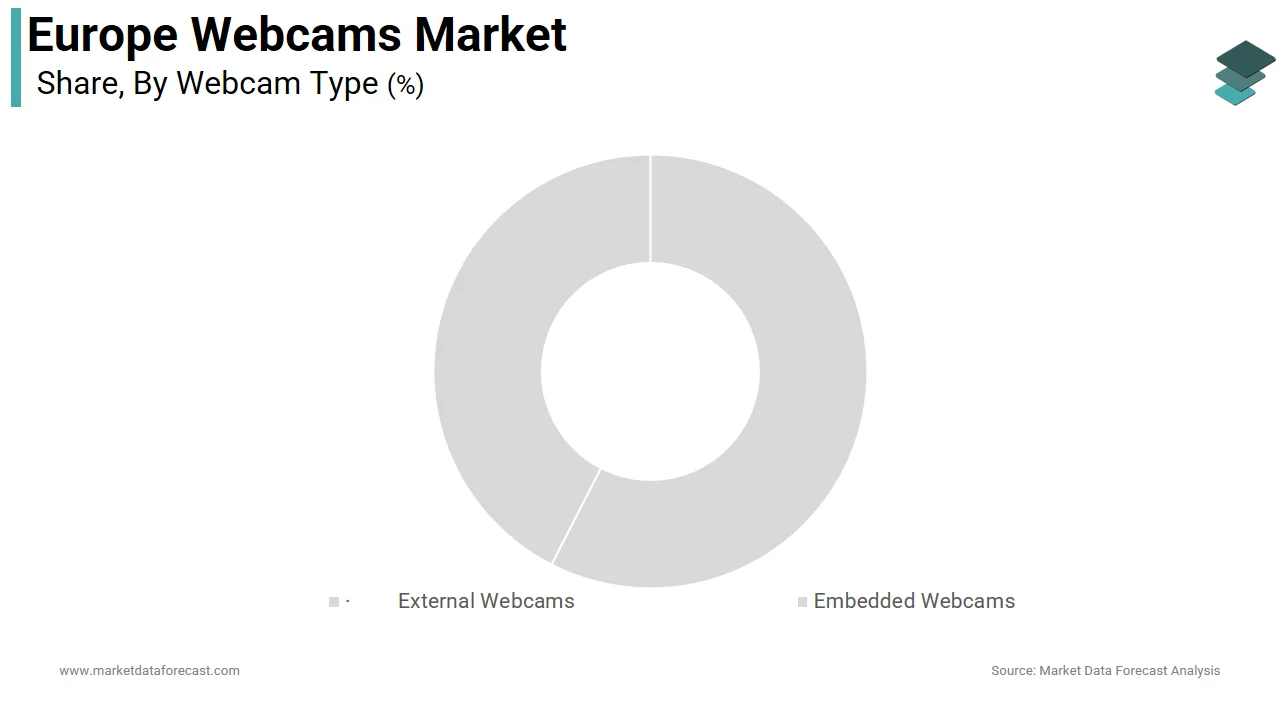
The embedded webcam segment is lucratively growing with an anticipated CAGR of 8.3% from 2026 to 2034, owing to the standalone sales, but by its integration into next-generation laptops, all-in-one PCs, and smart displays. The strategic upgrade of built-in cameras by major OEMs to meet professional standards is additionally fuelling the growth of Europe webcams market. Apple, Dell, HP, and Lenovo collectively shipped over 45 million laptops in Europe with 1080p or higher resolution embedded cameras. Moreover, Windows 11’s integration of AI-powered background blur, eye contact correction, and HDR capture has elevated expectations for embedded performance, pushing manufacturers to adopt larger sensors and improved optics. The European Commission’s Ecodesign Directive also indirectly supports this trend by incentivizing longer device lifespans by reducing the need for peripheral add-ons. As embedded webcams close the quality gap with external models, they increasingly satisfy baseline professional needs, among mobile professionals, students, and casual users, driving organic growth through device bundling rather than discrete purchases.
COUNTRY LEVEL ANALYSIS
Germany Webcams Market Analysis
Germany was the top performer of the Europe webcams market by holding 18.3% of the share in 2024, owing to its robust enterprise sector, stringent data security norms, and high adoption of professional-grade hardware across industries. German companies, particularly in engineering, automotive, and finance, prioritize visual professionalism in client interactions, leading to widespread procurement of external webcams with certified encryption and privacy features. The Federal Office for Information Security reported that 82% of DAX-listed firms mandated external webcam use for external video meetings in 2024 to mitigate risks associated with integrated cameras. Simultaneously, Germany’s dual education system drives demand in vocational schools, where over 1200 technical colleges use webcams for remote lab demonstrations and virtual apprenticeships, as documented by the Federal Institute for Vocational Education and Training. The country also enforces strict e-waste regulations under the ElektroG law, requiring manufacturers to register and report device volumes with a policy that has formalized the market and reduced gray imports.
United Kingdom Webcams Market Analysis
The United Kingdom webcams market was positioned second, capturing 16.2% of the market share in 2024. The UK government’s 2023 Civil Service Digital Directive required all remote civil servants to be equipped with HD webcams, with a policy that triggered over 300000 device deployments across departments. The professional content creators with the British Film Institute estimate 620000 individuals earning income from live streaming, video blogging, or online tutoring in 2024. This creative class drives demand for premium webcams with broadcast-quality features, such as Logitech’s StreamCam and Elgato’s Facecam, both of which saw record UK sales in 2024. Additionally, UK universities have integrated webcam use into assessment protocols with the Quality Assurance Agency for Higher Education mandating live video defenses for postgraduate theses. Despite post Brexit regulatory divergence, the UK maintains alignment with EU cybersecurity standards through the National Cyber Security Centre’s device certification scheme, which enhances consumer trust. This dual engine of public sector digitalization and private sector content innovation sustains the UK’s dynamic and high-value webcam landscape.
France Webcams Market Analysis
France webcams market growth is expected to witness the fastest CAGR throughout the forecast period, through proactive public policy that treats webcam access as a component of digital inclusion and educational equity. The Ministry of National Education’s “Connect for Learning” initiative distributed over 850000 webcam and headset kits to disadvantaged students in 2024 to support synchronous remote instruction, a program expanded from its pandemic origins due to persistent rural connectivity gaps. On the enterprise side, France’s 2023 Telework Charter requires employers to reimburse employees for “essential remote work equipment, including external webcams up to 150 euros a provision utilized by 2.1 million workers, as per the French Labour Ministry. France also enforces the strongest Right to Repair laws in Europe, mandating that all webcams sold, since January 2024, include user-replaceable cables and lens covers with a measure that has spurred local repair networks and reduced e-waste. Furthermore, the National Commission on Informatics and Liberty’s strict guidelines on camera activation have increased demand for models with physical privacy shutters, now standard in 94% of units sold, according to the French Consumer Institute.
Netherlands Webcams Market Analysis
The Netherlands webcams market growth is driven by its advanced digital infrastructure to integrate webcams into smart healthcare education and civic services. In education, the Dutch Ministry of Education’s 2024 “Digital Classroom” program equipped 4200 secondary schools with webcam-enabled smartboards and individual student webcams for interactive lessons. The Netherlands also leads in sustainable electronics policy, where the Dutch Environmental Protection Agency reported that 68% of webcams sold in 2024 carried the national Repairability Index label, influencing consumer choice toward modular designs. Additionally, Amsterdam, Rotterdam, and Utrecht host Europe’s highest concentration of co-working spaces, many of which provide loaner webcams with Teams certification to ensure professional meeting quality. This systemic embedding of webcams into public service delivery and urban digital ecosystems positions the Netherlands as a high functionality high compliance market.
Sweden Webcams Market Analysis
Sweden webcams market growth is likely to be a unique balance between rapid technology adoption and stringent privacy expectations rooted in the country’s strong data protection culture. Swedish enterprises, particularly in tech finance and cleantech, prefer external webcams with hardware-based privacy shutters and end-to-end encryption with a feature set now mandated by the Swedish Data Protection Authority for all public sector video devices. In 2024, the authority issued guidance requiring all webcams used in telehealth to store no local data and to disable microphones when not in active use, a policy that reshaped procurement toward certified medical models. Simultaneously, Sweden’s high broadband penetration, 98% of households as per the study, enables widespread use of 4K webcams for remote collaboration and creative work.
COMPETITIVE LANDSCAPE
Competition in the Europe webcams market is highly dynamic, featuring a mix of global technology leaders, specialized peripheral manufacturers, and integrated computing brands. The market is bifurcated between external webcam vendors competing on image quality, software integration, and security, and OEMs leveraging embedded solutions to enhance device value. Brand reputation, regulatory compliance, and ecosystem compatibility are decisive differentiators as European buyers, especially in enterprise and public sectors, prioritize data sovereignty and long-term support over price alone. The creator economy has intensified innovation in the mid to high-end segment, with companies racing to offer professional features like 4K resolution, HDR, and clean HDMI output. At the same time, entry-level models face pressure from commoditization and built-in laptop cameras. National variations in e-waste rules, privacy enforcement, and public procurement further fragment the landscape, requiring localized go-to-market strategies. Continuous investment in firmware security, AI software, and sustainability credentials defines competitive success in this mature yet evolving market shaped by both technological advancement and stringent European regulatory frameworks.
KEY MARKET PLAYERS
The leading companies operating in the Europe webcams market include:
- Logitech International S.A.
- AverMedia Technologies
- Microsoft Corporation
- Lenovo Group Limited
- HP Inc.
- Dell Technologies Inc.
TOP PLAYERS IN THE MARKET
- Logitech International S.A., headquartered in Switzerland, is a global leader in video collaboration and personal peripherals with a commanding presence in the Europe webcams market. The company supplies a comprehensive portfolio ranging from consumer-grade C920 models to enterprise-ready Rally and MeetUp series certified for Microsoft Teams and Zoom. Logitech reinforced its European position by launching the Brio 500 series with AI-powered framing and RightLight technology optimized for European lighting conditions. It also partnered with Germany’s Fraunhofer Institute to develop low-latency firmware compliant with EU cybersecurity standards. Through localized service centers in the Netherlands and France and sustainability commitments aligned with the EU Green Deal, Logitech continues to shape professional and educational video standards across the continent.
- AverMedia Technologies, a Taiwan-based innovator with strong European distribution, specializes in high-performance webcams and capture devices tailored for creators, streamers, and hybrid professionals. Its Live Streamer and PW513 series have gained traction across Northern and Western Europe due to features like 4K HDR support, clean HDMI output, and real-time chroma keying. In 2024, AverMedia expanded its European footprint by establishing a dedicated R&D collaboration hub in Stockholm focused on low-light imaging algorithms for Nordic climates. The company also introduced RECentral Studio software with GDPR compliant data handling protocols, addressing European privacy concerns.
- HP Inc., though primarily known for computing hardware, plays a strategic role in the Europe webcams market through its integrated and bundled solutions. All HP Elite and Z series laptops and desktops sold in Europe since 2023 feature enhanced embedded webcams with 1080p resolution, physical privacy shutters, and AI noise suppression. HP deepened its ecosystem integration by launching the HP Webcam 300 series exclusively for European enterprise clients, featuring plug-and-play compatibility with HP Wolf Security and automatic Teams optimization. The company also rolled out a take-back and refurbishment program across 20 EU countries in partnership with local e-waste authorities.
TOP STRATEGIES USED BY THE KEY MARKET PARTICIPANTS
Key players in the Europe webcams market focus on platform certification with Microsoft Teams, Zoom, and Google Meet to ensure seamless enterprise integration. They invest in AI-driven features such as auto framing, background blur, and lighting correction to enhance user experience in diverse European environments. Companies prioritize physical privacy shutters and firmware-level security updates to comply with GDPR and national data protection laws. Strategic partnerships with universities, hospitals, and government bodies facilitate bulk procurement and pilot deployments. Additionally, manufacturers are adopting modular designs and repairability labels to align with the EU Right to Repair initiative and reduce electronic waste across the product lifecycle.
MARKET SEGMENTATION
This research report on the Europe webcams market has been segmented and sub-segmented into the following categories.
By Webcam Type
- External Webcams
- Embedded Webcams
By Sensor Resolution
- HD (Greater than 720p)
- Full HD (1080p)
- 4K UHD
- 8K and Above
By End-user
- Consumer / Residential
- Enterprise / Corporate
- Healthcare and Telemedicine
- Education
- Broadcasting and Content Creation
- Security and Surveillance
By Distribution Channel
- Online (E-commerce, Direct Sales)
- Offline (Retail Chains, Value-Added Resellers)
By Country
- United Kingdom
- France
- Spain
- Germany
- Italy
- Russia
- Sweden
- Denmark
- Switzerland
- Netherlands
- Rest of Europe
Frequently Asked Questions
What is the Europe webcams market?
The Europe webcams market provides USB and wireless cameras for conferencing and security. Video conferencing generates largest revenue through enterprise demand.
What drives the Europe webcams market?
Remote work and telemedicine growth propel the Europe webcams market. Live events demand high-quality streaming solutions across urban centers.
Which technologies lead the Europe webcams market?
Digital webcams dominate the Europe webcams market offering superior image quality and data security over analog alternatives.
Why USB webcams popular in the Europe webcams market?
USB webcams provide plug-and-play simplicity in the Europe webcams market suiting corporate video calls and consumer streaming needs.
Which countries lead the Europe webcams market?
Italy holds largest share while UK grows fastest in the Europe webcams market driven by live events and music festivals.
What applications define the Europe webcams market?
Video conferencing, security surveillance, and entertainment lead the Europe webcams market applications across enterprise and consumer segments.
Why wireless webcams emerging in the Europe webcams market?
Wireless models offer positioning flexibility in the Europe webcams market ideal for streaming and multi-camera setups.
How does telemedicine impact the Europe webcams market?
Spain's telemedicine leadership boosts the Europe webcams market requiring reliable HD cameras for remote consultations.
What challenges face the Europe webcams market?
Privacy regulations challenge the Europe webcams market mandating secure data transmission and GDPR-compliant features.
Why video conferencing dominates the Europe webcams market?
Corporate hybrid work drives video conferencing demand in the Europe webcams market prioritizing 4K quality and AI features.
Related Reports
Access the study in MULTIPLE FORMATS
Purchase options starting from
$ 2000
Didn’t find what you’re looking for?
TALK TO OUR ANALYST TEAM
Need something within your budget?
NO WORRIES! WE GOT YOU COVERED!
Call us on: +1 888 702 9696 (U.S Toll Free)
Write to us: sales@marketdataforecast.com