- Product Description Description
- Table of Contents TOC
- List of Table & Figure LOT
- Get Free Sample PDF Sample PDF
Market Size, 2025
$36.71 BnMarket Estimate, 2026
$38.27 BnMarket Forecast, 2034
$53.43 BnCAGR, 2026–2034
4.26%Europe Wet Pet Food Market Size
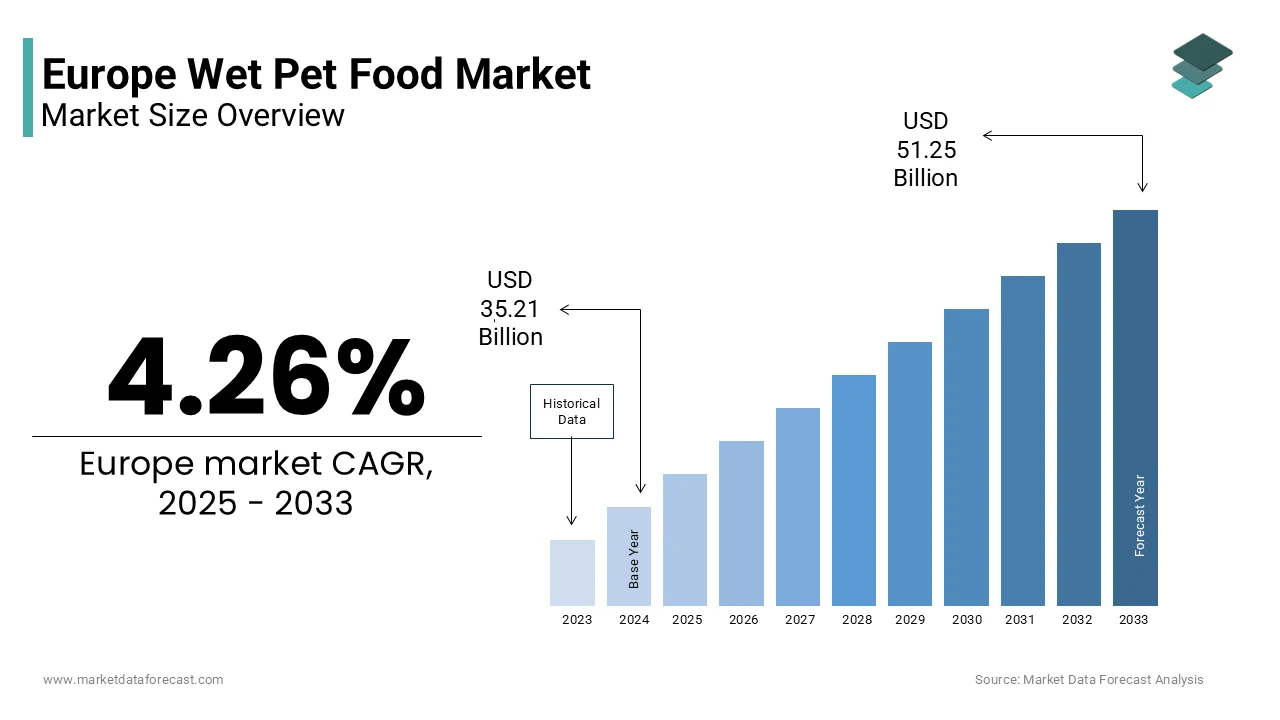
The Europe wet pet food market size was valued at USD 36.71 billion in 2025. The European market is estimated to be worth USD 53.43 billion by 2034 from USD 38.27 billion in 2026, growing at a CAGR of 4.26% from 2026 to 2034.
Wet pet food is pet food that contains a high proportion of water in the range of 75 to 85%. It is often rich in protein and fat and provides the energy and vital nutrients necessary for metabolism. The humanization of pets means that owners are trying to integrate pets into more and more aspects of their human lives, such as vacations, nutrition, medical care, etc. This has led to the commercialization of human-like goods and services for pets, health services, including health insurance and advice, which are one of the main drivers of growth in this market.
Market Drivers and Restraints:
The rapid pace of economic and social change may be related to trends in pet ownership. As the new generation of professionals becomes more isolated, the social comfort, company, safety, and aesthetic sense that pets offer are the top reasons cited for owning a pet. Urbanization is the main factor affecting pet food. The increasing urbanization leads to the decomposition of large homes and the separation of nature. These are often linked to the desire for pets. Prosperous animal welfare programs around the world have the prevailing theme of humanizing pets. Also, emotionally, the owners consider their pets as part of the family and are now very attentive to the food of their animals. This forces the owner to find quality food for their pets, and does not hesitate to make an extra effort in terms of money so that their animals receive adequate nutritional nutrition. Today, pets also eat high-quality, expensive food. However, in fact, personal disposable income (DPI) in European countries is about to grow between an annual growth rate that ranges between 0.9% and 7.0, according to estimates by the Organization for Economic Cooperation operation and development (OECD). As a result, thanks to this healthy DPI, pet owners can now pay for pet food expenses, resulting in better income for the European pet food market. As past trends open up new horizons in the European pet food market, producers struggle to identify demand for normal, organic pet food. In addition, customers of vendors in the pet food sector demand more transparency in terms of ingredients and processing. However, companies strive to retain customers by providing information about their products.
REPORT COVERAGE
| REPORT METRIC | DETAILS |
| Market Size Available | 2025 to 2034 |
| Base Year | 2025 |
| Forecast Period | 2026 to 2034 |
| CAGR | 4.26% |
| Segments Covered | By Product, Packaging Type, Distribution Channel, and Region |
| Various Analyses Covered | Global, Regional, & Country Level Analysis; Segment-Level Analysis; DROC, PESTLE Analysis; Porter’s Five Forces Analysis; Competitive Landscape; Analyst Overview of Investment Opportunities |
| Regions Covered | UK, France, Spain, Germany, Italy, Russia, Sweden, Denmark, Switzerland, Netherlands, Turkey, and the Czech Republic |
| Market Leaders Profiled | Nestlé S.A., Mars, Inc., Unicharm Corporation (DSG International (Thailand) PLC), Thai Union Group PLC, Charoen Pokphand Foods Public Company Limited, General Mills, Inc., The J.M. Smucker Company, Schell & Kampeter, Inc., Farmina Pet Foods Holding B.V., and The Colgate-Palmolive Company |
SEGMENTAL ANALYSIS
The Europe wet pet food market, by type of packaging, is also segmented into boxes, sachets and others. The can segment has dominated the wet pet food market, while the bag segment is expected to grow at the highest growth rate during the forecast period. The growing demand for superior and advanced food packaging by pet owners, along with continuous innovations in packaging materials, is expected to fuel growth in the bag segment. Features such as zipper and lightweight mechanisms, as well as the availability of bags of different sizes provide convenience to customers.
The wet pet food market by distribution channel has been segmented into supermarkets and hypermarkets, specialty pet stores, online and others. Supermarkets and hypermarkets have dominated the wet pet food market, while online they are expected to represent a significant part of the wet pet food market.
REGIONAL ANALYSIS
The Europe Wet Pet Food market has been classified by geography into United Kingdom, Germany, France, Italy, Spain and the rest of Europe. Also, the region is home to countries such as Germany, which is the second largest exporter in the world, with exports representing more than a third of national production. The Wet Pet population in Europe is increasing, especially cats. This increase is attributed to two factors, namely the growth of retirees and a constant decrease in birth rates in the country. Cat food is the most popular pet food, while dog, bird and fish food has declined slightly recently.
KEY MARKET PLAYERS
Some of the key players of the European wet pet food market are
- Nestle S.A
- Mars, Inc.
- Unicharm Corporation (DSG International (Thailand) PLC)
- Thai Union Group PLC
- Charoen Pokphand Foods Public Company Limited
- General Mills, Inc.
- The J.M Smucker Company
- Schell & Kampeter, Inc.
- Farmina Pet Foods Holding B.V.
- The Colgate-Palmolive Company
MARKET SEGMENTATION
This research report on the European wet pet food market has been segmented and sub-segmented based on categories.
By Product
- Cat Food
- Dog Food
- Others
By Packaging Type
- Pouches
- Canned
- Others
By Distribution Channel
- Online
- Specialized Pet Shops
- Supermarkets and Hypermarkets
- Others
By Country
- UK
- France
- Spain
- Germany
- Italy
- Russia
- Sweden
- Denmark
- Switzerland
- Netherlands
- Turkey
- Czech Republic
- Rest of Europe