Europe Wind Farm Market Size, Share, Growth, Trends, And Forecasts Report, Segmented By Type, Application, Component, End-User, And By Country (UK, France, Spain, Germany, Italy, Russia, Sweden, Denmark, Switzerland, Netherlands, Turkey, Czech Republic & Rest of Europe), Industry Analysis From 2026 to 2034
Market Size, 2025
$33.58 BnMarket Estimate, 2026
$36.85 BnMarket Forecast, 2034
$72.04 BnCAGR, 2026–2034
9.69%Europe Wind Farm Market Report Summary
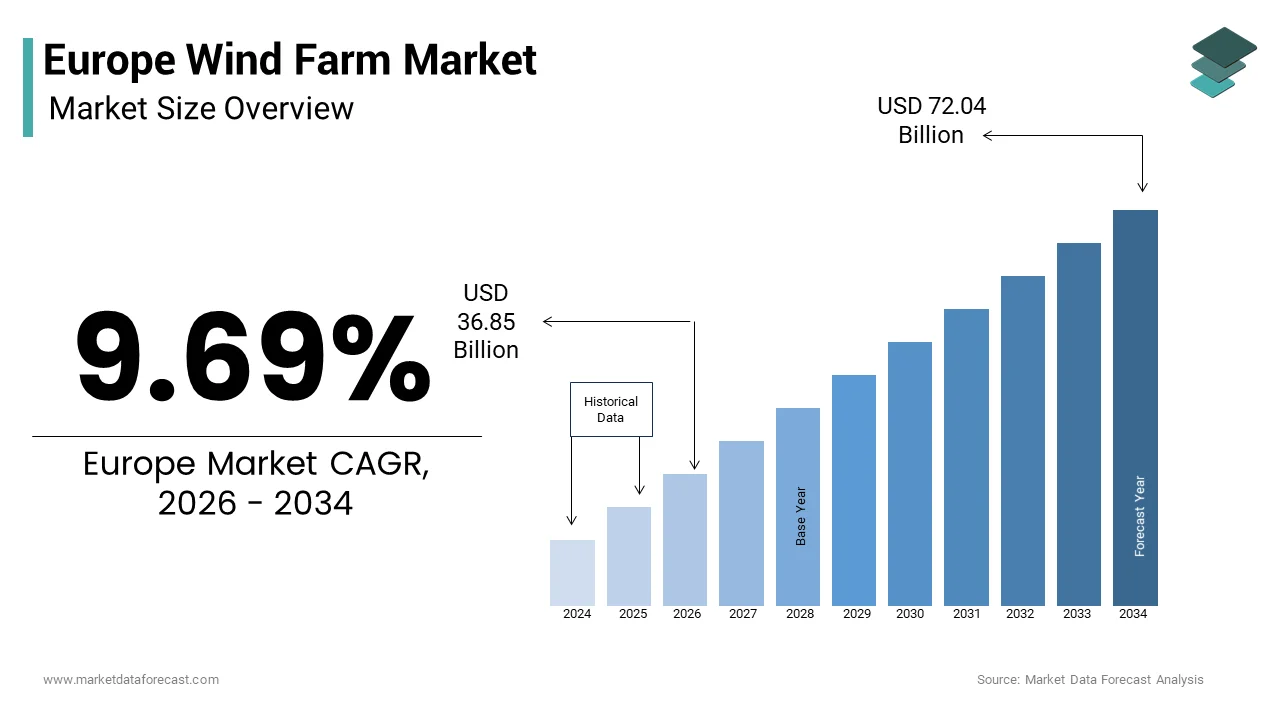
The Europe wind farm market was valued at USD 33.58 billion in 2025, is estimated to reach USD 36.85 billion in 2026, and is projected to reach USD 72.04 billion by 2034, growing at a CAGR of 9.69% during the forecast period from 2026 to 2034. The growth of the European wind farm market is driven by increasing investments in renewable energy infrastructure, strong government commitments to reduce carbon emissions, and supportive regulatory policies encouraging clean energy generation. The expansion of both onshore and offshore wind projects, along with rising electricity demand and energy security concerns, is further accelerating the deployment of wind farms across Europe. In addition, advancements in turbine technologies, improvements in rotor blade efficiency, and increased participation from private and public energy developers are contributing to the steady growth of the wind farm market in the region.
Key Market Trends
- Rapid expansion of onshore wind farms due to lower installation costs and faster deployment timelines.
- Increasing investments in renewable energy infrastructure as European countries pursue carbon neutrality goals.
- Growing adoption of advanced rotor blade technologies to improve turbine efficiency and energy output.
- Rising integration of digital monitoring and predictive maintenance systems to enhance wind farm performance.
- Expansion of large-scale renewable energy projects and cross-border collaborations to strengthen Europe’s clean energy capacity.
Segmental Insights
- Based on type, the onshore wind turbines segment held the largest share of the Europe wind farm market. The dominance of this segment is attributed to lower capital investment requirements, easier installation, and favorable government policies supporting onshore wind energy development.
- Based on application, the power generation segment accounted for 23.2% of the Europe wind farm market share in 2025. Wind farms play a crucial role in generating renewable electricity and supplying power to national grids across European countries.
- Based on component, the rotor blades segment held a significant share of the Europe wind farm market in 2025. Continuous innovations in rotor blade design and materials are improving turbine efficiency and increasing the power generation capacity of wind farms.
- Based on end use, the utility segment held the dominant share of the Europe wind farm market in 2024. Utility companies are actively investing in wind energy projects to diversify their energy portfolios and meet renewable energy targets.
Regional Insights
The European wind farm market is witnessing strong growth across major economies as governments accelerate renewable energy adoption and invest in large-scale wind energy projects.
- Germany was the largest contributor to the Europe wind farm market and accounted for 23.4% of the regional market share in 2024, supported by extensive wind power installations and strong renewable energy policies.
- The United Kingdom ranked second with 14.7% of the Europe wind farm market share in 2024, driven by ambitious clean energy targets and continued expansion of wind power projects.
- Spain is experiencing steady growth in the wind farm market, with installed wind power capacity reaching 35.2 gigawatts in early 2025, supported by favorable wind resources and increasing renewable energy investments.
- France is expected to witness significant growth as the country accelerates wind energy deployment through its Multiannual Energy Program, which targets 50 gigawatts of onshore wind and 18 gigawatts of offshore wind capacity by 2035.
- Sweden is also projected to hold a notable share of the Europe wind farm market due to the expansion of wind energy projects in northern regions with abundant land resources and favorable wind conditions.
Competitive Landscape
The Europe wind farm market is highly competitive and includes several global turbine manufacturers and renewable energy developers. Market participants are focusing on technological innovation, strategic partnerships, and expansion of wind energy projects to strengthen their presence in the region. Increasing investments in high-capacity turbines, digital monitoring systems, and offshore wind farm developments are further shaping the competitive landscape.
Prominent players in the Europe wind farm market include Siemens Gamesa, GE Renewable Energy, Vestas Wind Systems, Nordex, Goldwind, Suzlon Energy, Mingyang Smart Energy, Envision Energy, EDP Renewables, and Acciona Energy.
Europe Wind Farm Market Size
The Europe wind farm market size was valued at USD 33.58 billion in 2025 and is anticipated to reach USD 36.85 billion in 2026 to trach from USD 72.04 billion by 2034, growing at a CAGR of 9.69% during the forecast period from 2026 to 2034.
Current Introduction of the Europe Wind Farm Market
The wind farm is the integrated ecosystem of onshore and offshore installations that harness wind energy to generate electricity across European nations. As of mid-2025 Europe’s cumulative installed wind power capacity stands at 291 gigawatts with the European Union contributing 254 gigawatts of this total, as per the source. This infrastructure now fulfills roughly 20% of the continent’s annual electricity demand, as per WindEurope data. Germany leads in onshore deployment with 68.1 gigawatts while offshore growth is propelled by coordinated EU strategies targeting at least 60 gigawatts by 2030, under the Offshore Renewable Energy Strategy. Over 170000 turbines currently operate across rural landscapes and maritime zones reflecting decades of policy alignment technological refinement and strategic public investment in decarbonized energy infrastructure.
MARKET DRIVERS
Ambitious Continental Decarbonization Mandates Drive Deployment
The European Union’s legally binding climate and energy framework serves is a major driving factor for the growth of Europe win farm market. The revised Renewable Energy Directive mandates a minimum 42.5% share of renewables in final energy consumption by 2030 with an aspirational target of 45% as confirmed by the European Commission. This translates into a requirement for wind capacity to grow from 204 gigawatts in 2022 to over 500 gigawatts by 2030 according to the European Wind Power Action Plan. The REPowerEU initiative further intensifies deployment by calling for 93600 new renewable energy installations by 2030 with wind forming the backbone. National governments have aligned their National Energy and Climate Plans accordingly where Germany targets 115 gigawatts of onshore wind by 2030, while the Netherlands plans 21 gigawatts of offshore capacity. These policy signals create long term revenue certainty for developers and unlock capital flows from both public and private sources thereby directly stimulating project pipelines across the continent.
Strategic Geographic Advantage in Offshore Wind Corridors
The unparalleled natural advantages in specific maritime zones that accelerate offshore wind development is additionally propelling the growth of Europe wind farm market. The North Sea alone hosts approximately 72% of all existing European offshore wind capacity due to its shallow depths high wind speeds and proximity to major load centers, as noted by the German Federal Ministry for Economic Affairs and Climate Action. WindEurope projects the North Sea will accommodate 212 gigawatts of offshore wind by 2050, while the Baltic Sea holds potential for 83 gigawatts owing to similar favorable conditions. The European Commission has formally recognized these regions as strategic energy hubs fostering multilateral cooperation through the North Seas Energy Cooperation and the Baltic Energy Market Interconnection Plan. In January 2024, eight North Sea countries including Germany the United Kingdom and the Netherlands committed to aligning permitting processes and grid integration standards. This geographic concentration enables economies of scale in vessel logistics port infrastructure and supply chain specialization, which collectively reduce levelized costs and shorten project timelines compared to dispersed or deeper water developments elsewhere globally.
MARKET RESTRAINTS
Protracted Permitting Procedures Impede Project Timelines
Despite strong policy support, actual deployment is severely hampered by excessively lengthy and fragmented permitting processes. The protracted permitting procedures impede project timelines is restricting the growth of Europe wind farm market. According to the World Economic Forum, it can take up to nine years to secure full approval for a single wind project in certain member states which is incompatible with energy transition urgency. A staggering 81% of planned wind capacity across the EU remains stuck in various stages of permitting as reported by the same institution in 2024. The European Commission estimates that approximately 80 gigawatts of wind projects are currently navigating these bureaucratic hurdles, which is five times the annual installation rate needed to meet 2030 targets. Although, the EU introduced streamlined permitting rules in 2023 mandating maximum two-year approval timelines for projects in designated go to areas most national governments have failed to implement them effectively as observed by WindEurope in early 2025. This administrative inertia creates significant uncertainty for investors delays grid connection schedules and ultimately constrains the pace at which new clean energy can enter the system.
Inadequate Grid Infrastructure Creates Systemic Bottlenecks
The rapid scaling of wind generation has far outpaced the modernization of Europe’s electricity transmission networks resulting in chronic grid congestion and curtailment. The inadequate grid infrastructure WindEurope identifies grid infrastructure as the single biggest bottleneck to new wind energy integration. Many newly constructed wind farms particularly in high potential regions like northern Germany and the Iberian Peninsula face delayed or partial grid connections because local substations and high voltage lines lack sufficient capacity as detailed in Aurora Energy Research’s 2025 meta-analysis. This leads to operational turbines being switched off during high wind output with a phenomenon known as curtailment, which wastes clean energy and reduces project revenues. The European Commission acknowledges these constraints and has proposed a 1.4 trillion-dollar plan to overhaul cross border electricity grids including eight priority energy highways. However,, execution requires multi-year lead times complex regulatory coordination and substantial public funding meaning grid limitations will continue to suppress effective utilization of wind assets well into the late 2020s.
MARKET OPPORTUNITIES
Repurposing Decommissioned Thermal Sites Offers Strategic Redevelopment Pathways
The converting retired coal and gas fired power plant sites into integrated wind energy hubs leveraging existing grid interconnections land rights and workforce ecosystems. The repurposing decommissioned thermal sites is elevating new opportunities for the growth of Europe wind farm market. Over 200 coal power plants are scheduled for decommissioning across the EU by 2030 under the Industrial Emissions Directive creating a vast inventory of brownfield locations with high voltage grid access already in place. According to Ember, more than 66% of EU member states have identified such sites as priority zones for renewable repowering in their updated National Energy and Climate Plans. Germany’s Coal Exit Law allocates 4 billion euros specifically for structural transformation in lignite regions with several former mining districts now hosting hybrid wind solar and battery projects. This strategy drastically reduces grid reinforcement costs which can account for up to 30% of a new wind farm’s capital expenditure and accelerates permitting by utilizing pre-approved industrial land. Moreover, it facilitates just transition policies by retaining skilled thermal plant workers in new clean energy roles thereby mitigating social opposition and enhancing community acceptance.
Expansion into Underutilized Baltic and Mediterranean Offshore Frontiers
While the North Sea dominates current offshore activity Europe’s secondary maritime basins present vast untapped potential. The expansion into underutilized Baltic and mediterranean offshore frontiers is additionally to fuel the growth of Europe wind farm market. The Baltic Sea alone offers a technical potential of 93 gigawatts by 2050, according to the European Commission driven by shallow waters averaging less than 50 meters and consistent wind resources. Countries like Poland, Lithuania, and Estonia are now advancing their first commercial scale offshore projects with Poland awarding 4.9 gigawatts in contracts during 2024 and targeting 11 gigawatts by 2035. Simultaneously the Mediterranean basin is gaining attention with France accelerating its floating wind roadmap to 10 gigawatts by 2035 and Greece launching its first offshore licensing round in 2025 covering 2 gigawatts. Unlike the crowded North Sea these regions benefit from lower competition for maritime space reduced visual impact concerns and proximity to southern European demand centers that currently rely heavily on imported gas. The European Maritime Spatial Planning Directive provides a harmonized framework for allocating sea use which reduces legal uncertainty and encourages cross border cable interconnections thereby transforming these peripheral seas into new growth corridors.
MARKET CHALLENGES
Skilled Labor Shortages Threaten Installation and Maintenance Capacity
The deployment schedules are colliding with a shortage of specialized personnel required for wind farm construction and servicing is a new challenge for the growth of Europe wind farm market. The European Commission estimates that the renewable energy sector will need to fill 1 million new jobs by 2030 with offshore wind alone requiring over 300000 skilled workers in engineering installation and marine operations. However, vocational training programs and university curricula have not scaled commensurately leading to acute in key trades, such as offshore crane operators turbine technicians and subsea cable engineers. Industry surveys conducted by WindEurope in 2025 indicate that developers report project delays directly attributable to labor shortages, particularly in port logistics and foundation installation phases. The problem is exacerbated by the highly cyclical nature of the industry, which discourages long term career commitments and by competition from other energy sectors, such as nuclear and hydrogen that are also ramping up simultaneously. Without coordinated EU wide reskilling initiatives and standardized certification frameworks the human capital gap could become a binding constraint on physical build out rates.
Supply Chain Volatility and Geopolitical Dependencies Increase Project Risk
The expansion is increasingly vulnerable to disruptions in global supply chains and geopolitical tensions affecting raw materials and components is additionally declining the growth of Europe wind farm market. The continent relies heavily on imports for essential inputs such as rare earth elements used in permanent magnet generators with sourced from China, according to the European Raw Materials Alliance. Similarly, key structural components like castings and forgings for gearboxes and towers are predominantly manufactured in Asia, creating exposure to shipping delays trade restrictions and price fluctuations. Furthermore, the war in Ukraine has heightened energy security concerns and redirected government subsidies toward domestic manufacturing but establishing a resilient European supply chain requires billions in investment and several years of lead time.
REPORT COVERAGE
| REPORT METRIC | DETAILS |
| Market Size Available | 2025 to 2034 |
| Base Year | 2025 |
| Forecast Period | 2026 to 2034 |
| CAGR | 9.69% |
| Segments Covered | By Type, Application, Component, End-User, and Country |
| Various Analyses Covered | Global, Regional, and Country Level Analysis, Segment-Level Analysis; DROC, PESTLE Analysis; Porter’s Five Forces Analysis; Competitive Landscape; Analyst Overview of Investment Opportunities |
| Regions Covered | UK, France, Spain, Germany, Italy, Russia, Sweden, Denmark, Switzerland, Netherlands, Turkey, the Czech Republic, and the Rest of Europe |
| Market Leaders Profiled | Siemens Gamesa (ES), GE Renewable Energy (US), Vestas Wind Systems (DK), Nordex (DE), Goldwind (CN), Suzlon Energy (IN), Mingyang Smart Energy (CN), Envision Energy (CN), EDP Renewables (ES), Acciona Energy (ES) |
SEGMENTAL ANALYSIS
By Type Insights
The onshore wind turbines segment was accounted in holding a dominant share of the Europe wind farm market. The growth of the segment is likely to be driven by the lower installation costs mature permitting frameworks and established grid interconnection protocols compared to offshore alternatives. Germany alone hosts over 68 gigawatts of onshore capacity while Spain and France have accelerated repowering programs replacing aging turbines with higher capacity models. The European Commission’s Net Zero Industry Act designates onshore wind as a strategic net zero technology ensuring priority access to raw materials and streamlined environmental assessments. Additionally, national auctions in Poland Romania and Greece continue to allocate multi gigawatt volumes annually for onshore projects due to their rapid deployment timelines and cost competitiveness with fossil generation.
The offshore wind turbine segment is likely to grow at a fastest CAGR of 17.3% from 2025 to 2033. The growth of the segment is expected to be propelled with the strategic focus on maritime energy corridors where wind resources are stronger and more consistent. In 2024, the United Kingdom commissioned 2.9 gigawatts of new offshore capacity, where the highest in Europe, while Germany awarded contracts for 10 gigawatts under its central scenario for 2030. The North Seas Energy Cooperation involving 9 countries has committed to synchronizing grid planning and port infrastructure to support 200 gigawatts of offshore wind by 2040. Floating offshore technology is also gaining traction with Norway and Portugal launching commercial scale pilots that unlock deep water zones beyond 60 meters depth thereby vastly expanding Europe’s exploitable sea area.
By Application Insights
The power generation segment was the largest by holding 23.2% of the Europe wind farm market share in 2024. This near total dominance arises because modern wind farms are engineered exclusively for electricity injection into national grids under regulatory frameworks like the EU Clean Energy Package, which mandates priority dispatch for renewables. Unlike historical mechanical applications such as water pumping which vanished by the 1980s contemporary wind assets are integrated into wholesale electricity markets through power purchase agreements or merchant exposure. Transmission system operators across Germany, France, and the Netherlands require real time telemetry from wind farms to manage frequency and voltage stability further entrenching their role as pure power generators rather than mechanical work providers.
The hybrid systems segment is expected to witness a fastest CAGR of 22.1% during the forecast period. Though currently representing less than 1% of total capacity this segment is expanding rapidly in non-interconnected territories. The European Union’s Clean Energy for EU Islands initiative has funded 47 hybrid microgrids across Greek, Spanish, and French islands aiming to eliminate diesel dependence by 2030. In 2024, the Faroe Islands inaugurated a 12 megawatt wind plus battery system that reduced fossil fuel consumption by 60%. Similarly, Sweden’s Gotland is piloting a wind powered green hydrogen plant to store surplus energy seasonally. Falling lithium-ion battery prices, which declined 89% between 2010 and 2024, per the International Energy Agency have made these integrations economically viable even in small scale deployments.
By Component Insights
The rotor blades segment held a significant share of the Europe wind farm market in 2024. The single largest cost component in modern wind turbines accounting for roughly 24% of total nacelle and tower expenses, according to a 2025 Aurora Energy Research cost breakdown. Their dominance stems from the direct correlation between blade length and energy capture, today’s average onshore blade exceeds 75 meters while offshore variants reach 115 meters. Longer blades increase swept area quadratically, thus boosting annual energy production without proportional cost increases. Europe hosts over 30 blade manufacturing facilities with major plants in Spain, Germany, and Turkey, operated by Vestas Siemens Gamesa and LM Wind Power. The European Commission’s Raw Materials Act includes glass fiber and carbon fiber as strategic inputs ensuring stable supply chains for composite production essential to blade fabrication.
The control systems segment is estimated to register a fastest CAGR of 14.8% from 2025 to 2033 wth the stringent EU grid code requirements mandating advanced functionalities, such as synthetic inertia fast frequency response and reactive power control. In 2024, the European Network of Transmission System Operators updated its network code to require all new wind farms above 10 megawatts to provide black start capability, where a function managed entirely by software driven control systems. Companies like GE Vernova and Nordex have embedded machine learning algorithms that adjust pitch and yaw in real time based on lidar wind forecasting reducing fatigue loads. Cybersecurity enhancements under the NIS2 Directive further drive investment in hardened control architectures with encrypted communication protocols.
By End Use Insights
The utility segment was the largest by holding a dominant share of the Europe’s wind farm market in 2024. This hegemony reflects the centralized nature of Europe’s power system, where large scale wind farms feed directly into high voltage transmission networks managed by national utilities or independent power producers. Auction mechanisms in Germany, France, and the Netherlands allocate capacity exclusively to utility scale bidders with minimum project sizes of 50 megawatts. Distributed ownership models remain marginal due to complex grid connection rules and lack of feed in tariff support for small scale wind unlike solar PV.
The industrial end use segment is esteemed to grow at a fastest CAGR of 19.4% during the forecast period owing to the corporate decarbonization mandates under the EU Corporate Sustainability Reporting Directive which requires large companies to disclose Scope 2 emissions. In 2024, Volvo signed a 12 year wind power purchase agreement for 500 gigawatt hours annually from a new Swedish onshore farm while ArcelorMittal partnered with Iberdrola to co-develop a 300 megawatt wind asset adjacent to its Belgian steel plant. Rising EU Emissions Trading System prices which averaged 92 euros per ton in 2024 have made renewable self-consumption economically attractive for energy intensive industries seeking to hedge against carbon compliance costs and volatile natural gas prices.
COUNTRY LEVEL ANALYSIS
Germany Wind Farm Market Analysis
Germany was the top performer of the Europe wind farm market by occupying 23.4% of share in 2024. The growth of the market in this country is driven by both onshore and offshore deployment with 68.1 gigawatts onshore and 8.5 gigawatts offshore. The German government’s 2024 Wind Energy Acceleration Package shortened permitting timelines to two years and designated 2% of national land area as wind priority zones. Repowering is a major driver with over 12000 aging turbines slated for replacement by 2030, which will double capacity without expanding footprint. Port investments in Cuxhaven and Emden.
United Kingdom Wind Farm Market Analysis
The United Kingdom wind farm market was ranked second by holding 14.7% of share in 2024 with the almost entirely by its world leading offshore sector, which accounts for 14.7 gigawatts of its 30.2 gigawatts total capacity, as per the Department for Energy Security and Net Zero. The UK’s market status is characterized by competitive Contracts for Difference auctions that have driven offshore levelized costs below 40 pounds per megawatt hour. In 2024, it commissioned the 2.7 GW Hornsea 3 project with the largest single offshore wind farm globally. The government’s 50 gigawatt offshore target by 2030 is backed by the Offshore Transmission Network Review which plans coordinated radial and meshed grid connections to reduce developer costs. Scotland’s deep water zones are now attracting floating wind investments with Hywind Tampen already operational.
Spain Wind Farm Market Analysis
Spain wind farm market is growing steadily during the forecast period with the capacity totaling 35.2 gigawatts, as reported by Red Electrica de Espana in early 2025. The strong private investment and minimal subsidy reliance since 2016 due to excellent wind resources and grid readiness is aso to promote new opportunities for the growth of Europe wind farm market. The 2023 National Integrated Energy and Climate Plan targets 62 gigawatts of wind by 2030 with 5 gigawatts allocated to repowering. Spain’s auction system awarded 3 gigawatts of new capacity in 2024 at record low prices of 22 euros per megawatt hour. Green hydrogen initiatives like the Puertollano project are integrating wind power to produce renewable ammonia thereby creating new demand vectors beyond electricity.
France Wind Farm Market Analysis
France wind market is likely to grow with the accelerated deployment through its Multiannual Energy Program targeting 50 gigawatts of onshore and 18 gigawatts of offshore wind by 2035. The market growth is driven by the transitioning from policy lag to strategic catch up with six offshore projects totaling 8.5 gigawatts under construction in the English Channel and Atlantic coast. France launched its first floating wind tender for 250 megawatts off Brittany leveraging its naval engineering expertise. Streamlined permitting introduced in 2023 reduced approval times from seven to three years.
Sweden Wind Farm Market Analysis
Sweden wind farm market growth is expected to grow with the rapid northern expansion where vast forested and coastal regions offer high-capacity factors exceeding 45%. The government’s 2024 Fossil Free Sweden initiative allocates 10 billion kronor to grid reinforcements in Norrland to unlock 20 gigawatts of additional wind potential. Corporate power purchase agreements dominate financing with Google Microsoft and SSAB signing long term deals for new wind farms.
COMPETITIVE LANDSCAPE
The Europe wind farm market features intense competition among vertically integrated developers original equipment manufacturers and specialized offshore engineering firms. Established players like Vestas Siemens Gamesa and Orsted compete not only on turbine technology but also on full lifecycle services grid integration capabilities and environmental stewardship. New entrants from Asia are attempting to gain footholds through competitive pricing yet face regulatory and localization barriers. Competition is further intensified by tightening profit margins due to rising raw material costs and auction-based pricing mechanisms that pressure returns. Differentiation now hinges on digital offerings sustainability credentials and execution speed particularly in offshore zones where port infrastructure vessel availability and maritime expertise create high entry thresholds. Collaborative ecosystems involving governments research institutions and financial entities are becoming critical to de risk large scale projects and maintain Europe’s technological leadership in global wind energy markets.
KEY MARKET PLAYERS
A dominating players that are in the Europe wind market are
- Siemens Gamesa (ES)
- GE Renewable Energy (US)
- Vestas Wind Systems (DK)
- Orsted A S
- Nordex (DE)
- Goldwind (CN)
- Suzlon Energy (IN)
- Mingyang Smart Energy (CN)
- Envision Energy (CN)
- EDP Renewables (ES)
- Acciona Energy (ES)
Top Players In The Market
- Vestas is a Danish multinational and a cornerstone of Europe’s wind energy infrastructure with extensive manufacturing logistics and service operations across the continent. The company plays a pivotal role globally by supplying turbines to over 85 countries and pioneering innovations in turbine efficiency and serviceability. In recent years Vestas has reinforced its European position by launching its EnVentus platform which supports both onshore and offshore applications with modular architecture. It also signed strategic framework agreements with major European utilities for long term service and repowering projects. Additionally, Vestas has invested in digital twin technology to enhance predictive maintenance and asset performance across its installed base.
- Siemens Gamesa headquartered in Spain is a leading force in both onshore and offshore wind segments within Europe and worldwide. The company contributes significantly to global decarbonization through its advanced direct drive offshore turbines which are deployed in key countries, including the United Kingdom, Germany, and Taiwan. It recently introduced its SG 14 222 DD offshore turbine featuring 14 megawatts of capacity and recyclable blade technology. The firm also deepened partnerships with grid operators to integrate AI driven grid support functionalities into its control systems.
- Orsted a Danish energy group transformed from a fossil fuel-based utility into the world’s largest offshore wind developer. In Europe it operates more than 30 offshore wind farms and continues to lead project development in the North and Baltic Seas. Orsted’s global influence extends to the United States Asia and Australia where it replicates its integrated development model. Recently the company secured rights to develop the 3 GW Thor offshore wind farm in Denmark scheduled for commissioning by 2027. It also launched a green hydrogen pilot linked to offshore wind in Germany and enhanced its biodiversity strategy by deploying artificial reef foundations around turbine bases to support marine ecosystems.
Top Strategies Used By The Key Market Participants
Key players in the Europe wind farm market are prioritizing vertical integration to secure supply chains and reduce dependency on external vendors. They are investing heavily in digitalization through advanced analytics remote monitoring and AI to optimize turbine performance and maintenance scheduling. Strategic repowering of aging wind sites with higher capacity modern turbines is another core focus to maximize land use and grid connectivity. Companies are also forming joint ventures with local partners to navigate complex permitting landscapes and community engagement requirements. Additionally, they are accelerating sustainability initiatives by developing recyclable blades circular economy protocols and biodiversity positive construction practices to align with EU green taxonomy standards.
MARKET SEGMENTATION
This research report on the Europe wind farm market is segmented and sub-segmented into the following categories.
By Type
- Horizontal Axis Wind Turbine
- Vertical Axis Wind Turbine
- Offshore Wind Turbine
- Onshore Wind Turbine
By End-Use
- Utility
- Commercial
- Industrial
- Residential
By Component
- Rotor Blades
- Gearbox
- Generator
- Control System
- Tower
By Application
- Power Generation
- Mechanical Power
- Hybrid Systems
By Country
- UK
- France
- Spain
- Germany
- Italy
- Russia
- Sweden
- Denmark
- Switzerland
- Netherlands
- Turkey
- Czech Republic
- Rest of Europe
Frequently Asked Questions
What makes wind farms a key pillar of Europe’s renewable energy transition?
They generate large-scale electricity without emitting greenhouse gases during operation.
Which locations in Europe are most suitable for wind farm development?
Coastal regions and open plains with strong, consistent wind conditions are ideal.
What determines the electricity output of a wind farm?
Wind speed, turbine capacity, and site design directly influence power generation levels.
Which factors guide the placement of wind turbines within a farm?
Engineers position turbines to avoid airflow disruption between machines.
What role do offshore wind farms play in Europe’s energy strategy?
They utilize stronger ocean winds to produce higher and more stable electricity output.
Which technologies improve efficiency in modern wind farms?
Advanced blade design and digital monitoring systems enhance turbine performance.
What challenges must developers address when building wind farms?
Grid connection, environmental impact assessments, and community acceptance are key considerations.
Which industries benefit indirectly from wind farm expansion?
Manufacturing, logistics, and engineering services support turbine production and installation.
What maintenance practices keep wind farms operating efficiently?
Routine inspections and predictive monitoring prevent unexpected turbine downtime.
Which European countries are known for large wind energy investments?
Nations with strong renewable policies and favorable wind resources lead development.
Related Reports
Access the study in MULTIPLE FORMATS
Purchase options starting from
$ 2000
Didn’t find what you’re looking for?
TALK TO OUR ANALYST TEAM
Need something within your budget?
NO WORRIES! WE GOT YOU COVERED!
Call us on: +1 888 702 9696 (U.S Toll Free)
Write to us: sales@marketdataforecast.com