- Product Description Description
- Table of Contents TOC
- List of Table & Figure LOT
- Get Free Sample PDF Sample PDF
Market Size, 2025
$105.81 BnMarket Estimate, 2026
$111.60 BnMarket Forecast, 2034
$170.88 BnCAGR, 2026–2034
5.47%Executive Summary: Europe Wine Market
- Market Scope: Comprehensive regional market analysis covering color segments, product types, distribution channels, country-level leadership frameworks, and premiumization metrics for the European wine sector.
- Market Valuation: Valued at USD 105.81 billion (2025), estimated at USD 111.60 billion (2026), and projected to reach USD 170.88 billion by 2034, registering a robust CAGR of 5.47% (2026–2034).
- Primary Growth Drivers: Resurgence of domestic consumption among younger consumers viewing wine as cultural identity, strong premiumization driven by health consciousness, expanding e-commerce platforms, and climate-resilient viticulture investments. Market challenges include supply chain volatility and climate pressures, while opportunities lie in rosé wine popularity, sparkling wine affordability, and digital retail expansion.
Key Market Segment Metrics (2026–2034)
| Category | Leading Segment Position | Fastest-Growing Segment |
|---|---|---|
| By Color / Product Type | Red wine (held 58.2% share) & Still wine (dominant share due to entrenched cultural traditions) | Rosé wine (fastest CAGR of 7.2% driven by millennials/Gen Z) & Sparkling wine (fastest CAGR of 8.5% for celebration) |
| By Distribution Channel | Offline channels (led the market via established retail and hospitality networks) | Online distribution channel (deemed to register the fastest CAGR of 19.3% during the forecast period) |
| By Region / Country | France (dominated with a 22.3% share, followed closely by Italy and Spain) | Southern European and export-driven viticultural hubs leveraging protected designations |
Major Market Players & Market Structure
Market Structure: Highly competitive European beverage alcohol landscape centering on luxury branding, sustainability storytelling, water recycling initiatives, cold chain logistics integrity, and aggressive digital commerce integration.
Key Companies: E&J Gallo Winery, Constellations Brand, The Wine Group, Compagnia Del Vino SRL, Bacardi Limited, Caviro, Torres, Grupo Peñaflor SA, Treasury Wine Estates, Castel Group, LVMH, and Pernod Ricard.
Europe Wine Market Size
The size of the Europe Wine Market was expected to be worth USD 105.81 billion in 2025 and is anticipated to be worth USD 170.88 billion by 2034, from USD 111.60 billion in 2026, growing at a CAGR of 5.47% during the forecast period.
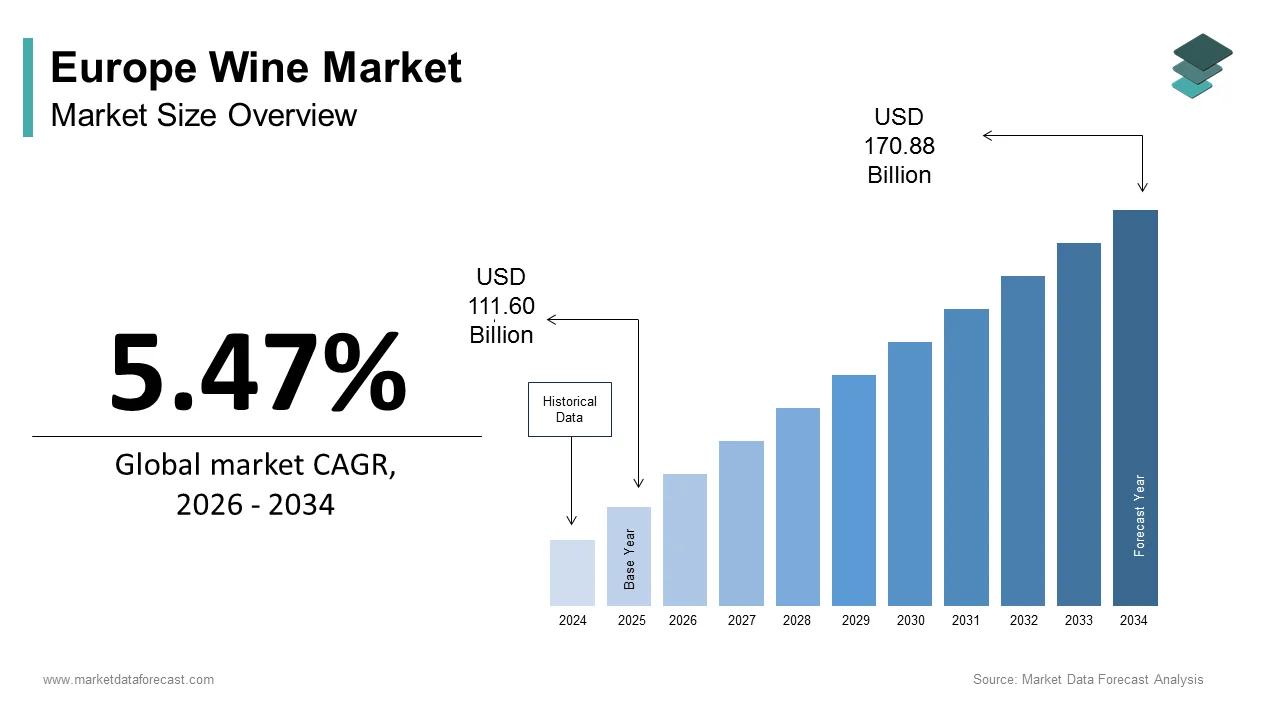
The wine is a sophisticated confluence of historical legacy, regulatory structure, and evolving consumer dynamics. Rooted in millennia-old viticultural traditions, the region remains the epicenter of global wine production and cultural influence. Encompassing iconic wine nations such as France, Italy, and Spain, collectively responsible for over half of the world’s wine output, the market growth thrives on geographical diversity, appellation systems, and deeply embedded consumption rituals. According to the International Organisation of Vine and Wine, Europe produced nearly 60% of the world’s wine in 2025. Beyond volume, European societies demonstrate some of the highest per capita wine consumption globally, where the World Health Organization’s Global Status Report on Alcohol and Health notes that adults in Portugal and France consume more than 40 liters annually on average. Additionally, the European Union administers over 1,300 registered geographical indications for wine, as documented by the European Commission’s Directorate General for Agriculture and Rural Development.
MARKET DRIVERS
Resurgence of Domestic Consumption Driven by Cultural Reconnection
The reengagement of younger consumers, who increasingly view wine as an expression of cultural identity rather than just an alcoholic beverage, is driving the growth of Europe wine market. Contrary to narratives of declining youth interest, empirical evidence reveals active participation in wine-related experiences. The European Social Survey reported in 2024 that 42% of adults aged 25 to 34 in Southern Europe attend regional wine festivals or visit local vineyards annually. This trend is amplified by digital storytelling: heritage estates leverage social media to showcase artisanal methods, fostering emotional ties across generations. In France, vineyard tourism grew by 18% between 2022 and 2025, according to Atout France, the national tourism agency. Educational initiatives further reinforce this revival—enrollment in certified sommelier programs rose by 31% across Italy and Spain since 2021, as confirmed by the Union of Italian Sommeliers and the Spanish Wine Federation. Such grassroots reconnection ensures continuity of domestic demand, particularly in regions where winemaking is interwoven with local identity, thereby insulating the market from external volatility.
Premiumization Trend Fueled by Rising Disposable Incomes and Health Consciousness
The shift toward premium wine segments is accelerating due to rising household purchasing power and growing awareness of wine’s potential health attributes. Data indicate that real household final consumption expenditure in the EU increased by 4.7% in 2025 compared to pre-pandemic levels, enabling greater spending on high-quality beverages. Simultaneously, scientific validation has bolstered consumer confidence, where the European Food Safety Authority published findings in early 2025 linking moderate consumption of polyphenol-rich red wines to reduced cardiovascular risk, a message resonating strongly in Germany and Nordic countries. This emergence has spurred demand for organic, biodynamic, and low-intervention wines. Producers are responding with refined packaging, transparent sourcing, and enhanced traceability by aligning product offerings with ethical and wellness-oriented values.
MARKET RESTRAINTS
Declining Agricultural Labor Force Threatening Vineyard Sustainability
The long-term viability is the severe shortage of agricultural labor in the rural wine region, which is restraining the growth of Europe wine market. Eurostat data from 2025 shows that the average age of EU farm holders exceeds 55 years, with fewer than 6% under 35. In Italy and Spain, two of the world’s largest wine producers, over 40% of vineyard owners are above retirement age and lack successors, according to ISMEA and Spain’s Ministry of Agriculture (MAPA). Mechanization remains impractical in many historic appellations due to steep terrain and fragmented landholdings, perpetuating dependence on manual harvesting. Without targeted incentives, such as vocational training grants or rural entrepreneurship schemes, younger generations remain disinclined to enter viticulture. Consequently, small and medium-sized estates face existential threats, risking the erosion of terroir-specific knowledge and biodiversity essential to Europe’s wine identity.
Stringent Regulatory Frameworks Constraining Innovation and Export Flexibility
The rigorous regulatory environment, while protective of quality and origin, imposes significant barriers to innovation and international competitiveness, hampering the growth of Europe wine market. Compliance with EU wine regulations requires producers to navigate an average of 14 administrative procedures, varying widely between member states, as highlighted in a 2024 review by the European Court of Auditors. Marketing restrictions further limit adaptability; terms like “light” or “low alcohol” are prohibited unless strictly defined under Regulation (EU) No 1308/2013, hindering entry into fast-growing functional beverage categories. Moreover, the Protected Designation of Origin (PDO) system, though valuable for authenticity, extends export certification timelines by up to 30% compared to New World competitors, according to the Organisation for Economic Co-operation and Development. These bureaucratic hurdles increase operational costs and reduce responsiveness to shifting global preferences in Asia, where consumers favor approachable labeling and flexible formats.
MARKET OPPORTUNITIES
Expansion of E-Commerce Platforms Enabling Direct-to-Consumer Engagement
The rapid maturation of digital retail producers to bypass intermediaries and build direct relationships with consumers is setting up new opportunities for the growth of Europe wine market. This channel empowers small and niche estates, especially those in lesser-known appellations, to access pan-European audiences without relying on distributors. Advances in cold-chain logistics have resolved earlier concerns about quality degradation during transit by enabling reliable delivery of temperature-sensitive products. Furthermore, digital platforms generate rich consumer insights on flavor preferences, price sensitivity, and occasion-based buying data previously inaccessible to traditional producers.
Growing Demand for Climate-Resilient Viticulture Opening New Investment Avenues
Climate change, while a threat, is simultaneously catalyzing innovation through investment in adaptive viticulture. Public and private stakeholders are collaborating on scalable solutions to ensure long-term resilience. The European Commission’s Joint Research Centre reported that over 70 pilot projects focused on drought-tolerant rootstocks, soil moisture sensors, and precision irrigation were launched across Southern Europe in 2025, backed by more than €220 million in Horizon Europe funding. These initiatives align with consumer demand, where NielsenIQ data from 2025 shows that wines bearing recognized eco-certifications like EU Organic or Terra Vitis enjoy a 34% higher repeat purchase rate. Financial mechanisms are also evolving cooperatives in Languedoc (France) and Alentejo (Portugal) have issued green bonds to finance solar-powered cellars and water-recycling infrastructure. Producers who integrate climate-smart practices not only mitigate risk but also differentiate their brands in an increasingly values-driven marketplace.
MARKET CHALLENGES
Climate Change Inducing Unpredictable Harvest Yields and Quality Variability
Climate instability is disrupting centuries-old growing patterns, and compromising wine typicity is one of the challenges for the growth of Europe wine market. The Copernicus Climate Change Service confirms that average growing season temperatures in major wine regions have risen by 1.8°C since 1980, accelerating sugar accumulation while decoupling it from phenolic maturity. This imbalance affects color, aroma, and aging potential. Similarly, Germany’s Mosel region saw Riesling yields drop in 2025, following heatwaves that degraded acidity essential for the variety’s signature freshness, according to the German Wine Institute. Such volatility not only impacts revenue but also challenges the very definition of appellation character. Without coordinated adaptation, including revised planting zones, genetic research, and insurance mechanisms, the sensory identity of Europe’s most revered wines may become increasingly inconsistent.
Intensifying Competition from New World Producers Undermining Price Leadership
The mounting pressure from agile New World competitors who combine cost efficiency, clear branding, and digital savvy to capture market share. UN Comtrade data shows that EU imports of Chilean, Australian, and South African wines rose by 15% in volume between 2022 and 2025. These producers benefit from favorable exchange rates, flat terrain enabling mechanization, and streamlined supply chains that reduce time-to-shelf. Their labeling strategies, featuring prominent grape varieties and approachable tasting notes, resonate with younger or less experienced consumers, unlike Europe’s often cryptic appellation-based labels. In supermarkets across the UK, the Netherlands, and Scandinavia, New World wines now dominate mid-tier shelves. Additionally, the International Wine & Spirit Record 2025 report reveals that New World exporters allocate revenue to digital marketing among European estates by limiting the latter’s visibility in online discovery ecosystems.
REPORT COVERAGE
| REPORT METRIC | DETAILS |
| Market Size Available | 2025 to 2034 |
| Base Year | 2025 |
| Forecast Period | 2026 to 2034 |
| CAGR | 5.47% |
| Segments Covered | By Color, Product Type, Distribution Channel, And Region |
| Various Analyses Covered | Global, Regional & Country Level Analysis; Segment-Level Analysis; DROC, PESTLE Analysis; Porter’s Five Forces Analysis; Competitive Landscape; Analyst Overview of Investment Opportunities |
| Regions Covered | UK, France, Spain, Germany, Italy, Russia, Sweden, Denmark, Switzerland, Netherlands, Turkey, and the Czech Republic |
| Market Leaders Profiled | E&J Gallo Winery, Constellations Brand, The Wine Group, Compagnia Del Vino SRL, Bacardi Limited, Caviro, Torres, Grupo Peñaflor SA, Treasury Wine Estates, and Castel Group |
SEGMENTAL ANALYSIS
By Color Insights
The red wine segment was the largest by holding 58.2% of the European Wine Market in 2024, due to deeply ingrained cultural traditions, particularly in Southern Europe, where red wine is integral to daily meals and social rituals. In countries like Italy and France, per capita annual consumption of red wine exceeds 25 liters, as documented by the World Health Organization’s Global Alcohol Report. Additionally, scientific studies have reinforced consumer preference with the European Food Safety Authority confirming in 2024 that moderate intake of red wine polyphenols correlates with improved endothelial function and reduced oxidative stress. These health affirmations have sustained demand even among middle-aged urban professionals who prioritize wellness without abstaining from alcohol. Furthermore, red wine’s compatibility with Europe’s diverse culinary heritage, from Spanish tapas to Italian pasta, ensures consistent household penetration. Premium red varietals such as Cabernet Sauvignon, Tempranillo, and Sangiovese also command strong export value, reinforcing domestic production incentives.
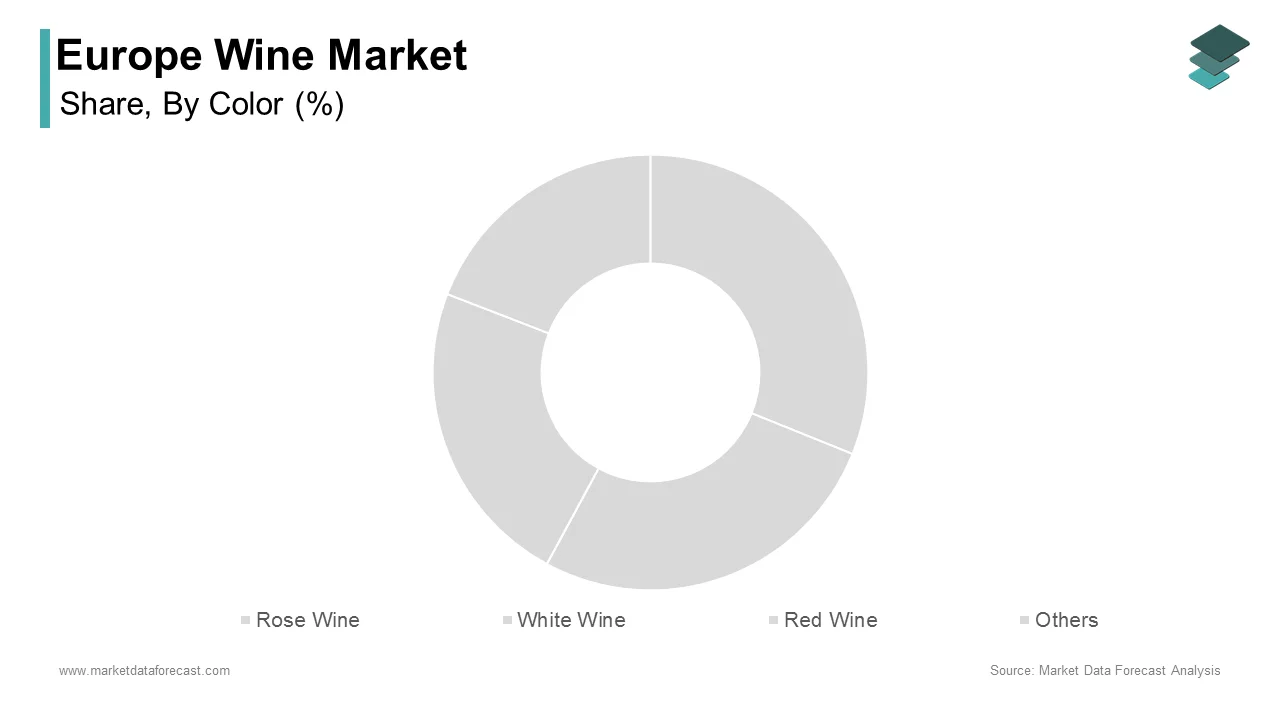
The rose wine segment is anticipated to witness the fastest CAGR of 7.2% from 2025 to 2033, with the shifting lifestyle preferences, particularly among urban millennials and Gen Z consumers, who associate rose with leisure modernity and aesthetic appeal. Social media platforms have amplified this perception with rose-themed content generating over 12 million engagements annually in Western Europe, according to a 2025 study. Seasonality also plays a role as warmer summers increase outdoor dining and al fresco consumption, with rosé sales peaking between May and September. Moreover, Rose’s versatility bridges the gap between white and red wine drinkers, offering a lighter body than reds yet more complexity than many whites. Retailers have responded by expanding shelf space with supermarkets in Germany and the Netherlands dedicating up to 25% of their wine sections to rosé variants in the summer months, as per the survey.
By Product Type Insights
The still wine segment was the largest by holding a dominant share of the European wine market in 2024, with its embedded role in everyday European life, where still wine is routinely consumed with meals across households from Lisbon to Budapest. Unlike occasion-driven categories, wine still functions as a staple beverage, particularly in Mediterranean countries where wine is viewed as part of balanced nutrition rather than indulgence. Regulatory frameworks also favor still wine, with the vast majority of Protected Designation of Origin labels applying to non-sparkling varieties, ensuring quality consistency and consumer trust. Additionally, still wine benefits from lower production costs compared to sparkling or fortified alternatives, enabling competitive pricing in both premium and value segments. These structural, economic, and cultural pillars ensure the stability of wine despite emerging competition from other formats.
The sparkling wine segment is likely to grow at the fastest CAGR of 8.5% from 2025 to 2033, with its strong association with celebration gifting and experiential consumption, especially among younger demographics seeking affordable luxury. Its approachable flavor profile, lower price point compared to Champagne, and effective branding have made it a default choice for casual gatherings. Meanwhile, traditional method sparkling wines from regions like Cava in Spain and Cremant in France are gaining traction in premium on-trade channels, with restaurant placements rising by 22% year on year, as per CGA by NIQ’s 2025 On Premise Tracker. Moreover, the rise of low-dose and organic sparkling variants caters to health-conscious consumers, further broadening appeal. These dynamics transform sparkling wine from a niche celebratory item into a versatile and aspirational category.
By Distribution Channel Insights
The offline distribution segment was the largest by capturing a significant share of the Europe wine market in 2024. Supermarkets alone generate high alcohol sales with chains like Carrefour, Edeka, and Tesco offering extensive selections often supported by promotional pricing and loyalty programs, as verified by Kantar Worldpanel’s 2025 FMCG Alcoholic Beverages Report. Simultaneously, the on-trade channel thrives on experiential consumption where sommelier-curated lists and food pairing elevate wine beyond commodity status. In France and Italy, over 40% of premium wine is sold through restaurants, according to national hospitality federations. Consumer trust in physical inspection, label reading, and immediate possession further reinforces offline preference, particularly among older demographics.
The online distribution channel segment is deemed to register the fastest CAGR of 19.3% during the forecast period, with the growing, heightened demand for convenience personalization and discovery, particularly among digitally native consumers. Platforms now offer AI-driven recommendations, curated subscription boxes, and virtual tasting events, creating immersive experiences that transcend physical limitations. Logistics advancements have also mitigated historical barriers, with over 90% of European urban centers now served by temperature-controlled delivery within 48 hours, as confirmed by LogiWine Europe’s 2025 Infrastructure Report. Regulatory harmonization under the EU Digital Single Market Strategy has further simplified cross-border sales, enabling small producers in Portugal or Greece to reach consumers in Sweden or Finland without intermediary markups. These enablers position e-commerce not as a supplement but as a core engine of future market expansion.
REGIONAL ANALYSIS
France Wine Market Analysis
France was the largest contributor to the Europe Wine Market by holding 22.3% of the share in 2024, with its unparalleled viticultural legacy encompassing globally recognized regions, such as Bordeaux, Burgundy, and Champagne, which collectively produce over 7 billion bottles annually, as reported by FranceAgriMer. Government support through the Common Agricultural Policy ensures vineyard sustainability while strict appellation laws preserve typicity and premium value. The nation’s dual strength in volume, quality, and brand equity solidifies its position as Europe’s wine capital.
Italy Wine Market Analysis
Italy Wine Market growth is expected to grow with its extraordinary diversity, boasting over 350 authorized grape varieties and 75 DOCG appellations, the highest in the world. This variety enables tailored offerings for every global palate from bold Barolo to crisp Pinot Grigio. Italy is also the world’s largest wine exporter by volume, shipping 22.3 million hectoliters in 2025, as confirmed by the ICE Italian Trade Agency. Domestically, wine consumption remains resilient, with average per capita intake at 39 liters annually per WHO data. The cooperative model prevalent in regions like Veneto and Emilia Romagna ensures cost efficiency and scale, allowing small growers to access international markets. Recent investments in sustainable certification and e-commerce have further enhanced competitiveness, particularly in North America and Northern Europe.
Spain Wine Market Analysis
Spain wine market is likely to grow with prominent growth opportunities from 2025 to 2033. Key regions like Rioja, Ribera del Duero, and Priorat drive premium recognition while bulk exports from La Mancha satisfy value segment demand. Domestically, wine consumption is stable, with 45% of adults drinking weekly per CIS Centro de Investigaciones Sociologicas surveys. Spain is at the forefront of climate-adaptive viticulture, utilizing drought-resistant Garnacha and Monastrell varieties and investing in water-efficient irrigation. These strategies mitigate yield volatility while aligning with EU Green Deal objectives. Additionally, the rise of Cava as a Prosecco alternative has opened new growth avenues, with sparkling wine exports growing by 16% year on year. Spain’s blend of affordability, resilience, and innovation secures its strategic importance in the continental market.
Germany Wine Market Analysis
Germany's wine market growth is expected to have a prominent growth opportunity in the coming years. This import dependency reflects limited domestic production constrained by cool climate, though regions like Mosel and Pfalz excel in aromatic whites, notably Riesling. German consumers exhibit a strong preference for quality, with over 70% of wine purchases falling in the mid to premium price range, as per GfK’s 2025 Beverage Consumption Report. Sustainability is a decisive factor, with 52% of buyers prioritizing organic or eco-certified labels per a Forsa Institute survey. The on-trade sector is highly developed, with wine bars and gastro pubs driving the discovery of international varieties.
United Kingdom Wine Market Analysis
The United Kingdom wine market is likely to grow in the coming years. The country relies almost entirely on imports, with over 90% of wine sourced from EU nations despite post Brexit customs complexities, which increased average clearance time by 36 hours, as noted by HM Revenue and Customs. Sparkling wines, particularly Prosecco and English sparkling has seen exceptional growth with domestic production reaching 15 million bottles in 2025.
COMPETITION OVERVIEW
The Europe Wine Market features intense competition characterized by a blend of historic family estates, multinational conglomerates, and agile boutique producers. Legacy brands leverage centuries-old terroir reputations and protected designations to command premium pricing, while newer entrants differentiate through innovative packaging, low alcohol formulations, and digital native marketing. Multinationals compete on scale, distribution, reach, and sustainability credentials, whereas small wineries emphasize authenticity, craftsmanship, and local storytelling. Regulatory complexity creates uneven playing fields with differing national interpretations of EU wine laws affecting labeling and export procedures. Simultaneously, climate change forces all players to adapt rapidly through varietal experimentation, irrigation innovation, and insurance mechanisms. Consumer fragmentation further intensifies rivalry as preferences diverge between traditionalists seeking appellation purity and modernists favoring approachable fruit-forward styles.
KEY MARKET PLAYERS
A few major players of the Europe wine market include
- E&J Gallo Winery
- Constellations Brand
- The Wine Group
- Compagnia Del Vino SRL
- Bacardi Limited
- Caviro
- Torres
- Grupo Peñaflor SA
- Treasury Wine Estates
- Castel Group
Top Strategies Used by the Key Market Participants
Key players in the Europe Wine Market prioritize premiumization through organic certification and limited-edition releases to capture high-margin segments. They invest heavily in sustainable viticulture, adopting regenerative farming, water conservation, and renewable energy to meet EU Green Deal standards. Digital transformation is central with companies deploying AI-driven e-commerce platforms,s and blockchain traceability. Geographic diversification mitigates climate risk by expanding vineyard holdings into cooler northern zones like England and southern Sweden. Strategic partnerships with hospitality and retail chains ensure prominent shelf placement and curated tasting experiences that drive brand discovery and repeat purchase behavior among discerning consumers.
Leading Players in the Europe Wine Market
- LVMH is a dominant force in the European wine and spirits sector through its prestigious portfolio, including Champagne houses such as Moet and Chandon, Dom Perignon, and Krug. The company leverages its luxury branding expertise to position its wines as premium global symbols of celebration and sophistication. In recent years, LVMH has intensified sustainability initiatives across its vineyards, implementing regenerative agriculture practices in Champagne and reducing carbon emissions in logistics. It also expanded digital engagement through virtual tastings and NFT-linked bottle authentication to attract younger, affluent consumers.
- Pernod Ricard holds significant influence in the Europe Wine Market through its extensive wine assets, including Jacob’s Creek, Campo Viejo, and Brancott Estate. The company emphasizes responsible consumption and environmental stewardship, aligning its European operations with science-based emissions targets validated by the Science Based Targets initiative. Recently, Pernod Ricard accelerated its e-commerce strategy, launching direct-to-consumer platforms in France, Germany, and Spain, featuring personalized recommendations and subscription models. It also invested in water recycling systems at its Spanish wineries and introduced lightweight glass bottles across its portfolio to reduce transport emissions.
- Although headquartered in the United States, Constellation Brands maintains a strong footprint in Europe primarily through its imported premium wine portfolio, including Kim Crawford, Meiomi, and The Prisoner. The company actively tailors its marketing to European consumer preferences, focusing on sustainability storytelling and experiential retail. In 2025, it launched a pan-European campaign highlighting low-intervention winemaking and partnered with Michelin-starred restaurants to showcase food pairings. Constellation also enhanced its cold chain logistics to ensure quality integrity during distribution across the Nordic and Benelux regions. By blending New World innovation with Old World sensibilities, it continues to carve a distinctive niche in Europe’s competitive wine landscape.
MARKET SEGMENTATION
This research report on the Europe wine market is segmented and sub-segmented based on color, product type, distribution channel, and region.
By Color
- Rose Wine
- White Wine
- Red Wine
- Others
By Product Type
- Still Wine
- Sparkling Wine
- Dessert Wine
- Fortified Wine
By Distribution Channel
- Online
- Offline
By Region
- United Kingdom
- Spain
- Germany
- Italy
- France
- Russia
- Sweden
- Denmark
- Switzerland
- Netherlands
- Turkey
- Czech Republic