- Product Description Description
- Table of Contents TOC
- List of Table & Figure LOT
- Get Free Sample PDF Sample PDF
Market Size, 2025
$6.97 BnMarket Estimate, 2026
$7.23 BnMarket Forecast, 2034
$9.66 BnCAGR, 2026–2034
3.7%Executive Summary: Europe Workwear Market
- Market Scope: Regional European workwear market analysis covering product categories, application sectors, country leadership frameworks, and occupational safety adoption metrics.
- Market Valuation: Valued at USD 6.97 billion in 2025, estimated at USD 7.23 billion in 2026, and projected to reach USD 9.66 billion by 2034, registering a CAGR of 3.70% from 2026 to 2034.
- Primary Growth Drivers: Stringent EU occupational health and safety regulations mandating certified workwear, growth in infrastructure and renewable energy projects across Europe, rising demand from construction, manufacturing, logistics, and healthcare sectors, and increasing adoption of smart and sustainable workwear solutions.
Key Market Segment Metrics (2026–2034)
| Category | Leading Segment (Position) | Fastest-Growing / Key Growth Segment |
|---|---|---|
| By Product Segment | Apparel (largest product segment) | Footwear (projected at an 8.2% CAGR) |
| By Application Segment | Construction (accounted for 34.8% market share) | Healthcare (projected at a 9.6% CAGR) |
| By Technology & Innovation | Standard protective apparel and traditional workwear fabrics | Smart textiles with digital connectivity, circular workwear programs, and connected PPE monitoring |
| By Region / Country | Germany (largest country with 25.3% market share) | Expanding industrial and healthcare hubs across the rest of Europe |
Major Market Players & Market Structure
Market Structure: Highly competitive European professional apparel and PPE landscape characterized by EN ISO-compliant product development, investments in smart workwear, circular textile initiatives, durability/ergonomics innovation, and strategic industrial distribution partnerships.
Key Companies: Engelbert Strauss, Fristads, Hultafors Group, Honeywell, 3M, VF Corporation (Timberland PRO, Dickies), Williamson-Dickie, Carhartt, Ansell, Portwest, Mascot, Lakeland, Helly Hansen, U-Power, and Protective Industrial Products (PIP).
Europe Workwear Market Size
The Europe Workwear Market is projected to grow from USD 6.97 billion in 2025 to USD 7.23 billion in 2026 and reach USD 9.66 billion by 2034, registering a CAGR of 3.70% from 2026 to 2034.
Workwear is protective and functional garments designed for occupational use across construction, manufacturing, logistics, healthcare, and utilities sectors, engineered to meet stringent safety, ergonomic, and durability standards. As per the European Committee for Standardisation mandates that all workwear used in hazardous environments must comply with EN ISO norms, for instance, EN ISO 20471 for high visibility garments and EN 11612 for heat and flame resistance. EU enterprises in high-risk sectors conducted mandatory personal protective equipment audits in 2023, up from 29% in 2020. Furthermore, the EU’s Strategic Framework on Health and Safety at Work 2021–2027 requires member states to enforce employer obligations for providing suitable workwear, with non-compliance subject to fines and operational penalties.
MARKET DRIVERS
Stringent Occupational Health and Safety Regulations Mandating Certified Workwear
The comprehensive and enforceable occupational safety legislation that compels employers to supply certified protective garments based on workplace risk assessments is driving the growth of the European workwear market. The EU’s Personal Protective Equipment Regulation 2016 425 classifies workwear as Category II or III PPE requiring third-party certification by notified bodies and CE marking before market placement. In Germany, the Occupational Safety and Health Act mandates that construction workers wear EN ISO 20471-compliant high-visibility vests, while chemical plant staff must use EN 13034-certified chemical splash suits. France’s Labour Code requires annual PPE replacement and documentation of garment performance testing. These rules create non-negotiable demand across 27 jurisdictions. The European Commission’s 2023 update to the Framework Directive further obliges employers to consult workers on PPE suitability, ensuring continuous replacement cycles.
Growth in Infrastructure and Renewable Energy Projects Driving Sectoral Demand
The surge in public and private infrastructure investment is generating robust demand for specialised workwear in the construction, energy and transport sectors. The growth in infrastructure and renewable energy projects, driving sectoral demand, is propelling the growth of the European workwear market. Each large-scale project employs thousands of workers requiring certified protective clothing, such as arc flash suits for electrical installers flame flame-resistant coveralls for oil and gas technicians and anti-static garments for semiconductor cleanrooms. Similarly, the EU’s Solar Rooftop Initiative mandates solar panel installation on public buildings, creating demand for fall protection integrated workwear.
MARKET RESTRAINTS
High Compliance Costs and Certification Complexity for SMEs
The disproportionate regulatory burden on small and medium enterprises, which lack resources to navigate the complex certification and procurement process, is restricting the growth of the European workwear market. For SMEs, employing fewer than 50 workers, representing 99% of EU businesses are these costs are prohibitive. Many rely on generic suppliers without verified EN certification, risking fines and liability. National variations exacerbate the challenge, while Germany mandates annual PPE audits, ts Italy allows self-declaration for low-risk tasks. This fragmentation increases administrative overhead for multi-country operators.
Volatility in Raw Material Prices and Supply Chain Disruptions
The fluctuating costs of technical textiles and imported raw materials essential for protective performance are degrading the growth of the European workwear market. High tenacity polyester aramid fibres and modacrylic blends, which provide flame resistance, cut protection and thermal insulation. Between 2021 and 2023, the price of meta-aramid fibre surged by 45% due to energy costs and supply concentration in the United States and China, as per some studies. Simultaneously, the EU’s Carbon Border Adjustment Mechanism imposes indirect costs on imported yarns and fabrics. Workwear manufacturers like Engelbert Strauss and Fristads reported 8 to 12% price increases in 2023 to offset input volatility. This rigidity limits cost pass-through and compresses margins, particularly formid-tierr brands serving price-sensitive sectors like logistics and warehousing.
MARKET OPPORTUNITIES
Integration of Smart Textiles and Digital Connectivity Features
The adoption of smart textiles embedded with sensor connectivity and data analytics capabilities to enhance worker safety and operational efficiency is creating new opportunities for the growth of the European workwear market. Garments integrated with biometric monitors, GPS trackers and environmental sensors can alert supervisors to heat stress falls or hazardous gas exposure in real time. Companies like Volta and Sordin now offer EN-certified jackets with built-in communication systems compliant with ATEX directives for explosive environments. German automotive plants use connected coveralls to track worker proximity to robots, reducing collision risks. As per reports, mandates occupational health metrics from 2024, enterprises are incentivised to adopt data-driven safety solutions.
Expansion of Circular Workwear Programs Under EU Textile Strategy
The EU’s 2022 Strategy for Sustainable and Circular textiles for workwear manufacturers to develop take-back leasing and recycling models that align with corporate sustainability mandates, which is another attribute fuelling the growth of the European workwear market. Unlike consumer apparel, workwear has predictable end-of-life timelines and uniform material composition, making it ideal for circular systems. Companies like Arco and UVEX now offer garment leasing programs where used items are collected, cleaned, repaired, and redeployed or mechanically recycled into new yarns. The Dutch government’s Circular Textiles Program certified the first industrial workwear recycling line in 2023, capable of separating zippers and flame-retardant treatments. The EU’s upcoming Ecodesign for Sustainable Products Regulation will require all workwear to include recycled content and digital product passports by 2027.
MARKET CHALLENGES
Counterfeit and Non-Compliant Workwear Infiltrating Distribution Channels
The proliferation of counterfeit and falsely certified garments that undermine safety and market integrity is a challenge for the growth of the European workwear market. These products often originate from unregulated online marketplaces and budget suppliers offering prices 30 to 50% below certified equivalents. Similarly, the French Directorate General for Competition Policy detected flame-resistant coveralls that ignited at 180 degrees Celsius, far below 8the 00-degree standard. Such failures pose life-threatening risks and expose employers to liability. Enforcement remains fragmented, with customs authorities focused on import compliance while workplace audits lack forensic testing capacity.
Shortage of Skilled Labour in Technical Textile Manufacturing
The declining availability of skilled workers in technical textile production and garment engineering is impeding the growth of the European workwear market. According to a recent survey, the sector will face a shortfall of 27000 trained technicians by 2027 due to ageing workforces and a lack of vocational interest. Modern workwear requires specialised sewing techniques for laminated membranes, conductive threads, and multi-layer flame barriers that cannot be automated. In Portugal and Romania, key EU garment manufacturing hu, bs over 40% of textile factories report production delays due labourbor shortages as per the European Apparel and Textile Confederation. Simultaneously, the shift toward smart workwear demands hybrid skills in electronics integration and data systems, absent in traditional curricula. The European Commission’s Skills Agenda identifies technical textiles as a priority, but implementation lags with only six member states offering dedicated PPE manufacturing programs.
REPORT COVERAGE
| REPORT METRIC | DETAILS |
| Market Size Available | 2025 to 2034 |
| Base Year | 2025 |
| Forecast Period | 2026 to 2034 |
| Segments Covered | By Product, Gender, Application Region. |
| Various Analyses Covered | Global, Regional, and Country-Level Analysis, Segment-Level Analysis, Drivers, Restraints, Opportunities, Challenges; PESTLE Analysis; Porter’s Five Forces Analysis, Competitive Landscape, Analyst Overview of Investment Opportunities |
| Countries Covered | UK, France, Spain, Germany, Italy, Russia, Sweden, Denmark, Switzerland, Netherlands, Turkey, Czech Republic, Rest of Europe |
| Market Leaders Profiled | Engelbert Strauss GmbH & Co. KG, Fristads Kansas Group, Hultafors Group AB, Honeywell International Inc., 3M Company, VF Corporation (Timberland PRO, Dickies), Williamson-Dickie Europe Ltd., Carhartt Inc., Kwintet Group (Fristads, Bragard, Acode), Ansell Limited, Aramark Corporation, Cintas Corporation, DuPont de Nemours, Inc., Lakeland Industries, Inc., Mascot International A/S, Dassy Europe Workwear, Portwest Ltd., Helly Hansen AS, U-Power Group S.p.A., Protective Industrial Products, Inc. (PIP) |
SEGMENTAL ANALYSIS
By Product Insights
The apparel segment was the largest by holding a significant share of the European workwear market in 2025. European occupational safety legislation mandates comprehensive upper and lower body protection in high-risk workplaces. According to the European Agency for Safety and Health at Work, national laws in Germany, France and the Netherlands require workers in coconstructionchemicals and utilities to wear certified full-body garments that meet specific EN ISO standards. For example, EN 11612 mandates flame-resistant coveralls for oil and gas personnel, while EN 13034 requires chemical splash protection for pesticide handlers in agriculture. The EU’s Framework Directive obliges employers to replace non-compliant or degraded garments immediately, creating recurring procurement cycles.
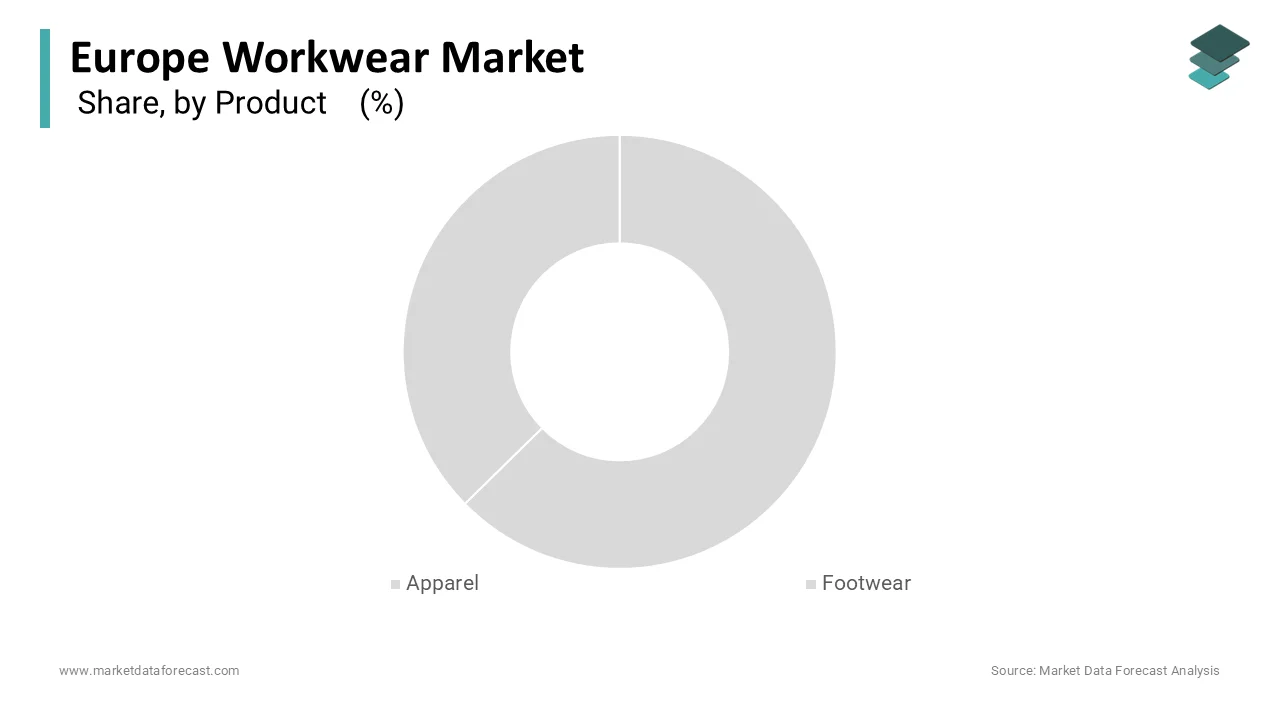
The footwear segment is projected to grow at the fastest CAGR of 8.2% throughout the forecast period. The explosive growth of warehousing and last-mile delivery has intensified regulatory focus on foot protection. In response, national labour inspectorates have ramped up enforcement of EN ISO 20345, which mandates steel or composite toe cap puncture-resistant midsoles and slip resistance. The UK’s Health and Safety Executive issued 1200 footwear-related fines in 2023 following inspections at Amazon and DHL facilities. Germany’s DGUV now requires anti-fatigue insoles for workers standing for over four hours daily. These mandates are shifting procurement from basic safety shoes to advanced models with energy return and ergonomic support.
By Gender Insights
The men's segment accounted in holding a prominent share of the European workwear market in 2025. Men dominate sectors with the highest workwear penetration due to regulatory requirements. These roles require full EN-certified PPE, including flame-resistant coveralls high high-visibility vests and safety footwear. National laws in Germany, France, and Poland explicitly tie workwear provision to job risk assessment, which is concentrated in male employment. Historically, workwear sizing and performance testing have been developed using male body dimensions. This has resulted in limited availability of properly fitting garments for women, reinforcing male market dominance. Major brands only began offering women-specific lines after sustained pressure from trade unions and equality bodies.
The women segment is expected to witness the fastest CAGR of 11.4% throughout the forecast period. EU and national initiatives are actively increasing female participation in construction, energy, and skilled trades. Programs like Germany’s Women in Crafts and France’s Mixité dans le BTP have trained over 50000 women for technical roles since 2021. These workers require properly fitting certified workwear; neither unisex nor men’s downsized versions meet ergonomic or safety standards. In response, companies like Arco and Fristads now offer women-specific lines with narrower shoulders, shorter torsos hip-adjusted cuts, creating dedicated demand unsupported by legacy portfolios.
The EU’s 2023 update to the Framework Directive on Safety and Health explicitly requires employers to provide PPE that fits all workers regardless of gender. Simultaneously, corporate ESG frameworks like the Corporate Sustainability Reporting Directive mandate gender inclusive procurement metrics. Companies such as Siemens and Vinci now require suppliers to certify women’s size availability in tenders.
By Application Insights
The construction segment held 34.8% of the European workwear market share in 2025. European construction sites require EN ISO 20471 compliant high visibility apparel and EN 14404 certified knee protection for all personnel. According to the sources, over 12.3 million workers were employed in construction in 2023, with each requiring 3 to 4 apparel sets and 2 footwear pairs annually due to abrasion and contamination. The EU’s Construction Products Regulation further links workwear to site safety plans audited by inspectors.
The healthcare segment is expected to witness the fastest CAGR of 9.6% throughout the forecast period. Post-pandemic, the EU has embedded stringent infection prevention measures in all healthcare settings. According to reports, 85% of EU hospitals now enforce daily garment changes for nurses and orderlies with single-use or hospital-laundered workwear. Germany’s KRINKO guidelines require fluid-resistant scrubs in all patient areas, while France’s National Health Insurance mandates antimicrobial finishes ageing population is driving expansion in nursing homes and domiciliary care. These settings require certified workwear for infection control, yet operate outside hospital laundry systems. Private care providers like Orpea and DomusVi now issue branded antimicrobial uniforms compliant with EN 13795 for surgical clothing. The EU’s upcoming Medical Textiles Regulation will extend EN standards to all care environments by 2026.
COUNTRY LEVEL ANALYSIS
Germany Workwear Market Analysis
Germany was the top performer in the European workwear market by accounting for 25.3% of the share in 2025 due to its industrial density, stringent labour laws, and leadership in technical textile innovation. Germany’s DGUV regulations mandate detailed PPE risk assessments with annual audits and immediate replacement of damaged garments, creating high turnover. The nation hosts global workwear brands like Engelbert Strauss and Fristads alongside technical textile mills producing flame-resistant and high-visibility fabrics.
France Workwear Market Analysis
The French workwear market was positioned second by capturing 18.2% of share in 2025, driven by strong state enforcement of occupational safety and large public infrastructure programs. The French Labour Code requires employers to provide certified workwear at no cost to employees, with detailed documentation of garment specifications and replacement schedules. The government’s France Relance plan invested 22 billion euros in construction and energy projects in 202,3, employing over 1.5 million workers requiring standardised protective clothing. France also leads in women-specific workwear with brands like Arco offering 50-plus SKUs compliant with NF EN ISO standards. The National Research and Safety Institute continuously updates technical guidelines for sectors like nuclear and rail, ensuring continuous innovation.
United Kingdom Workwear Market Analysis
The United Kingdom workwear market growth is driven by the robust demand through its mature health and safety enforcement and logistics boom. According to the Office for National Statistics, 1.1 million workers were employed in warehousing in 2023, with foot and back injuries driving ddemandor ntinon-fatigueotwear aergonomicgarments. The UK’s retained EU PPE regulations ensure continued alignment with EN standards despite Brexit. Major retailers like Tesco and Amazon enforce centralised workwear procurement for their fulfilment networks, creating bulk demand. This combination of regulatory continuity, sectoral growth, and institutional procurement ensures the UK remains a stable and significant workwear market.
Italy Workwear Market Analysis
Italy's workwear market growth is likely to grow with its large construction base, fashion-driven technical textile sector, and evolving safety culture. The country employs over 1.8 million construction workers, with recent reforms strengthening PPE enforcement after a 2022 Supreme Court ruling held employers criminally liable for inadequate workwear. Additionally, Italy’s growing logistics hubs near Milan and Genoa require standardised safety footwear and high visibility apparel for e-commerce fulfilment.
Spain Workwear Market Analysis
Spain's workwear market growth is likely to grow with its construction resurgence, renewable energy expansion, and agricultural workforce. Each worker requires EN 343 waterproof outerwear for frequent rain and EN ISO 20471 vests for roadwork. Additionally, the agricultural sector employs 850000 workers as per the Ministry of Agriculture, requiring EN 13034 chemical splash suits for pesticide handling. The government’s 2023 PPE subsidy program allocated 45 million euros to SMEs for certified workwear procurement.
COMPETITIVE LANDSCAPE
The European workwear market features a competitive landscape combining large integrated B2B specialists, regional champions, and niche technical apparel providers. Competition is defined by certification rigour, product durability, and compliance integration rather than price alone. Incumbents like Engelbert Strauss and Fristads leverage scale, direct sourcing and proprietary e-commerce platforms to offer end-to-end PPE solutions, while smaller players differentiate through sector-specific expertise or sustainable innovation. The EU’s stringent EN ISO standards create high barriers to entry, favouring established brands with certified testing infrastructure and notified body relationships. At the same time, my rising demand for women-specific and smart workwear is attracting new entrants from the fashion and tech sectors. The market is consolidating as large enterprises demand unified procurement across borders, pushing suppliers to expand geographically and enhance digital capabilities.
KEY MARKET PLAYERS
Some of the companies that are playing a dominating role in the global European workwear market include
- Engelbert Strauss GmbH & Co. KG
- Fristads Kansas Group
- Hultafors Group AB
- Honeywell International Inc.
- 3M Company
- VF Corporation (Timberland PRO, Dickies)
- Williamson-Dickie Europe Ltd.
- Carhartt Inc.
- Kwintet Group (Fristads, Bragard, Acode)
- Ansell Limited
- Aramark Corporation
- Cintas Corporation
- DuPont de Nemours, Inc.
- Lakeland Industries, Inc.
- Mascot International A/S
- Dassy Europe Workwear
- Portwest Ltd.
- Helly Hansen AS
- U-Power Group S.p.A.
- Protective Industrial Products, Inc. (PIP)
TOP LEADING PLAYERS IN THE MARKET
- Engelbert Strauss is a German headquartered workwear specialist and one of Europe’s largest B2B providers of occupational clothing, footwear, and personal protective equipment. The company serves over 1.5 million business customers across 18 European countries with a portfolio of more than 20000 certified products compliant with EN ISO safety standards. Engelbert Strauss contributes globally by setting benchmarks in ergonomic design,gn sustainable sourcing, and digital procurement through its proprietary e-commerce platform used by major industrial clients.
- Fristads is a leading European workwear brand headquartered in Sweden with a strong presence in construction, manufacturing, and technical services across Northern and Central Europe. The company is renowned for its high durability,flame-resistant, high-visibility garments developed in collaboration with industrial end users and safety experts. Fristads contributes globally through its sustainability initiatives, including the “Wear More” program, promoting garment longevity and the use of bio-based and recycled materials in over 65% of its 2023 collection.
- Arco is a UK-based provider of safety equipment and workwear with operations across Europe, serving sectors including oil and gas, utilities, healthcare, and logistics. The company offers a comprehensive range of EN-certified apparel, footwear, a accessories, supported by risk assessment consulting and compliance management services. Arco contributes globally by pioneering gender inclusive PPE design and digital inventory solutions that ensure regulatory adherence across multi-site operations.
TOP STRATEGIES USED BY THE KEY MARKET PARTICIPANTS
Key players in the European workwear market focus on developing gender inclusive and ergonomically optimised designs to address the growing female workforce and reduce injury risks. They invest in sustainable materials and circular business models such as take-back leasing and recycling to align with the EU Strategy for Sustainable Textiles. Companies enhance digital procurement platforms with compliance tracking, inventory management, and ESG reporting features to serve large enterprise clients. Strategic partnerships with occupational health researchers and standardisation bodies ensure early adoption of updated EN ISO norms. Additionally, firms integrate smart textile technologies like biometric and environmental sensors to create premium safety solutions for high-risk sectors. These strategies collectively address regulatory, technical and demographic shifts shaping Europe’s evolving workwear landscape.
MARKET SEGMENTATION
This research report on the European workwear market is segmented and sub-segmented into the following categories.
By Product
- Apparel
- Footwear
By Gender
- Men
- Women
By Application
- Construction
- Healthcare
By Country
- Germany
- France
- United Kingdom
- Italy
- Spain
- Rest of Europe