Europe Healthcare Cybersecurity Market Size, Share, Trends & Growth Forecast Report By Offering (Solutions, Services), Threat Type (Malware, Ransomware, Phishing, DDoS, APT, Spyware, Lost/Stolen Devices, Others), Security Type (Network, Cloud, Application, Endpoint & IoT, Content Security), End User, Deployment Mode (On-Premises, Cloud-Based), and Country (UK, France, Spain, Germany, Italy, Russia, Sweden, Denmark, Switzerland, Netherlands, Turkey, Czech Republic, Rest of Europe) – Industry Analysis, 2026 to 2034
Market Size, 2025
$5.18 BnMarket Estimate, 2026
$6.07 BnMarket Forecast, 2034
$21.61 BnCAGR, 2026–2034
17.2%Europe Healthcare Cybersecurity Market Size
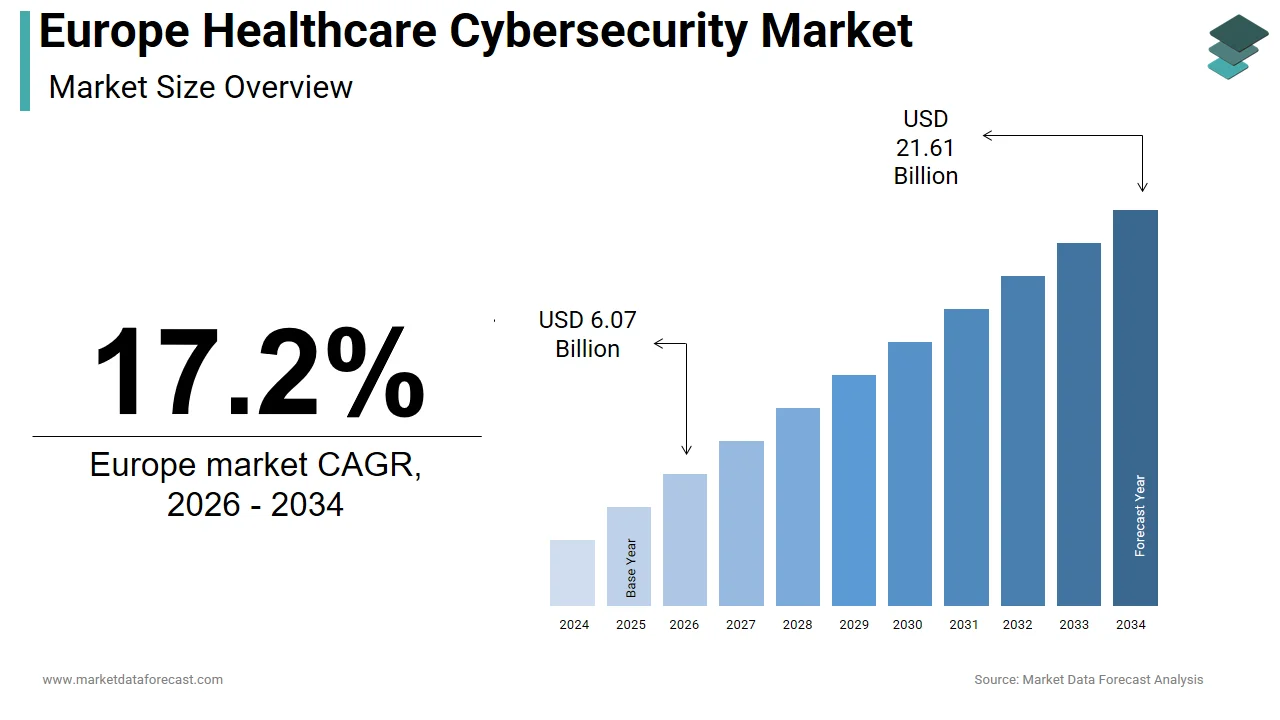
The size of the Europe healthcare cybersecurity market was valued at USD 5.18 billion in 2025. This market is expected to grow at a CAGR of 17.2% from 2026 to 2034 and be worth USD 21.61 billion by 2034, up from USD 6.07 billion in 2026.
Healthcare cybersecurity is are technology service and governance framework designed to protect electronic health records, medical devices, health information exchanges, and digital care platforms from cyber threats. As healthcare systems across the continent undergo rapid digital transformation through electronic health record adoption, telemedicine expansion, and Internet of Medical Things integration, the attack surface has grown exponentially. According to the European Union Agency for Cybersecurity, a portion of healthcare organizations in the European Union experienced a cyber incident with ransomware remaining the predominant threat vector. The sensitivity of health data imposes stringent legal obligations on data controllers and processors. Furthermore, the Network and Information Security Directive requires hospitals and digital health service providers to adopt risk based security measures and report significant incidents. This regulatory and operational landscape defines a market driven not by commercial opportunity alone but by legal necessity and ethical duty to safeguard patient safety and data integrity.
MARKET DRIVERS
Escalating Frequency and Sophistication of Ransomware Attacks on Hospitals
The relentless surge in ransomware incidents targeting European healthcare infrastructure serves as a primary driver for the growth of the Europe healthcare cybersecurity market. These attacks often cripple clinical operations. As per sources, affected hospitals experienced disruption of several hours in radiology services and in laboratory reporting, directly compromising patient outcomes. Moreover, the Portuguese National Health Service faced a coordinated attack that forced emergency departments to revert to paper records. The Tactics, Techniques and Procedures used by threat actors have evolved to include double and triple extortion, where data is exfiltrated before encryption and threatened with public release. This persistent and adaptive threat environment compels institutions to prioritize proactive defense mechanisms.
Mandatory Compliance with Evolving EU Data Protection and Cyber Resilience Regulations
Stringent and expanding regulatory requirements compel European healthcare organizations to institutionalize cybersecurity as a core operational function, which in turn bolsters the expansion of the Europe healthcare cybersecurity market. The General Data Protection Regulation imposes fines for breaches involving health data and mandates data protection impact assessments for high-risk processing activities. Complementing this, the revised Network and Information Security Directive, which entered into force, extends cybersecurity obligations to a broader set of health entities, including private clinics and digital health startups. It requires implementation of specific technical measures such as multi-factor authentication secure system monitoring, and incident response planning. These overlapping legal frameworks transform cybersecurity from an optional IT expenditure into a non-negotiable compliance imperative with significant reputational and financial consequences for non-adherence.
MARKET RESTRAINTS
Fragmented Legacy Infrastructure Hinders Comprehensive Security Implementation
The pervasive reliance on outdated and heterogeneous IT systems across healthcare institutions in the region creates persistent vulnerabilities that impede the growth of the Europe healthcare cybersecurity market. According to sources, a portion of hospital medical devices in Europe operate on unsupported operating systems that no longer receive security patches. Integrating these legacy assets into unified security architectures is technically complex and financially burdensome particularly for publicly funded systems operating under tight budgets. Moreover, the absence of standardized interoperability protocols means security policies cannot be uniformly enforced across electronic health record platforms, laboratory information systems, and connected devices. This technological fragmentation results in security gaps that adversaries actively exploit through lateral movement once initial access is gained, affecting even advanced perimeter defenses.
Shortage of Specialized Healthcare Cybersecurity Talent Constrains Operational Maturity
An important deficit of professionals skilled in both clinical workflows and cybersecurity principles limits the effective deployment and management of security controls, which hampers the expansion of the Europe healthcare cybersecurity market. According to sources, only a small number of hospitals in Europe have specialized cybersecurity experts who understand medical operations and clinical workflows. As per studies, the broader shortage of cybersecurity professionals across the continent is particularly severe in healthcare because of limited resources and less competitive pay compared to other industries. This gap forces IT departments to manage complex threats without understanding the clinical impact of security decisions. For instance, blocking a legitimate diagnostic application due to unrecognized traffic patterns.
MARKET OPPORTUNITIES
Integration of Artificial Intelligence for Proactive Threat Detection
The adoption of artificial intelligence and machine learning offers new opportunities for the growth of the Europe healthcare cybersecurity market. This gives a transformative prospect to enhance threat detection and response capabilities across European healthcare networks. Unlike rule-based systems AI AI-driven platforms can analyze vast streams of network logs, user behavior, and device telemetry in real time to identify anomalous patterns indicative of zero-day attacks or insider threats. These systems are particularly valuable in protecting distributed environments such as home-based telemonitoring, where traditional perimeter defenses are ineffective. Moreover, AI enables automated incident triage, allowing overstretched security teams to prioritize high-risk events. The European Union Agency for Cybersecurity endorses AI as a key enabler of the 2030 Cybersecurity Strategy. As a result, healthcare providers are increasingly embedding these technologies into their security operations centers to achieve resilience beyond reactive compliance.
Expansion of Cross-Border Health Data Exchange Under the European Health Data Space
The imminent rollout of the European Health Data Space creates a strategic opening for advanced cybersecurity solutions that enable secure federated data sharing across member states, and thereby generate fresh opportunities for the expansion of the Europe healthcare cybersecurity market. This initiative aims to grant citizens seamless access to their health records throughout the European Union while facilitating secondary use of anonymized data for research and policy making. The technical architecture mandates decentralized data storage with cryptographic consent controls, ensuring patients retain sovereignty over their information. This paradigm shift demands next-generation security tools such as homomorphic encryption, which allows computation on encrypted data without decryption and zero-trust architectures that verify every access request regardless of origin. Companies offering compliant solutions for secure data linkage, pseudonymization, and cross-border audit logging are positioned to support this historic integration effort, transforming cybersecurity from a defensive cost into an enabler of pan-European health innovation.
MARKET CHALLENGES
Proliferation of Internet of Medical Things Expands Attack Surface Exponentially
The rapid deployment of connected medical devices, from infusion pumps to remote cardiac monitors, has dramatically increased the number of potential entry points for cyber adversaries, which challenges the growth of the Europe healthcare cybersecurity market. These vulnerabilities are actively exploited. Unlike traditional IT assets, many of these devices cannot support endpoint protection software or frequent patching due to regulatory constraints on software validation. This creates persistent risks where a single unsecured device can serve as a pivot point to access entire hospital networks. The challenge is compounded by unclear responsibility boundaries between device manufacturers, healthcare providers, and third party service vendors, leaving important gaps in vulnerability management and incident response coordination.
Inconsistent National Implementation of EU Cybersecurity Directives
Divergent interpretation and enforcement of European Union cybersecurity mandates across member states create regulatory fragmentation, which further slows down the expansion of the Europe healthcare cybersecurity market. This affects collective resilience. The Network and Information Security Directive establishes a common baseline. Its transposition into national law has resulted in significant variations in scope, enforcement mechanisms, and penalty structures. Countries like Germany and France maintain stringent sector-specific rules, whereas others apply minimal thresholds excluding smaller clinics and digital health startups. This inconsistency enables threat actors to target jurisdictions. Furthermore, the absence of a unified certification framework for health cybersecurity products means a solution approved in one country may not meet technical standards in another delaying procurement and interoperability. The European healthcare ecosystem will remain vulnerable to jurisdictional arbitrage by malicious actors until harmonization is achieved through binding implementing acts and peer review mechanisms.
REPORT COVERAGE
| REPORT METRIC | DETAILS |
| Market Size Available | 2025 to 2034 |
| Base Year | 2025 |
| Forecast Period | 2026 to 2034 |
| Segments Covered | By Offering, Threat Type, Security Type, End User, Deployment Mode, and Country. |
| Various Analyses Covered | Global, Regional and Country-Level Analysis, Segment-Level Analysis, Drivers, Restraints, Opportunities, Challenges; PESTLE Analysis; Porter’s Five Forces Analysis, Competitive Landscape, Analyst Overview of Investment Opportunities |
| Countries Covered | UK, France, Spain, Germany, Italy, Russia, Sweden, Denmark, Switzerland, Netherlands, Turkey, Czech Republic, and the Rest of Europe. |
| Market Leaders Profiled | McAfee, LLC, FireEye, Atos SE, Palo Alto Networks, Inc., Cisco Systems, Inc., Fortified Health Security, Lockheed Martin Corporation, Palo Alto Networks, Inc., Booz Allen Hamilton, Inc. and IBM Corporation. |
SEGMENTAL ANALYSIS
By Threat Type Insights
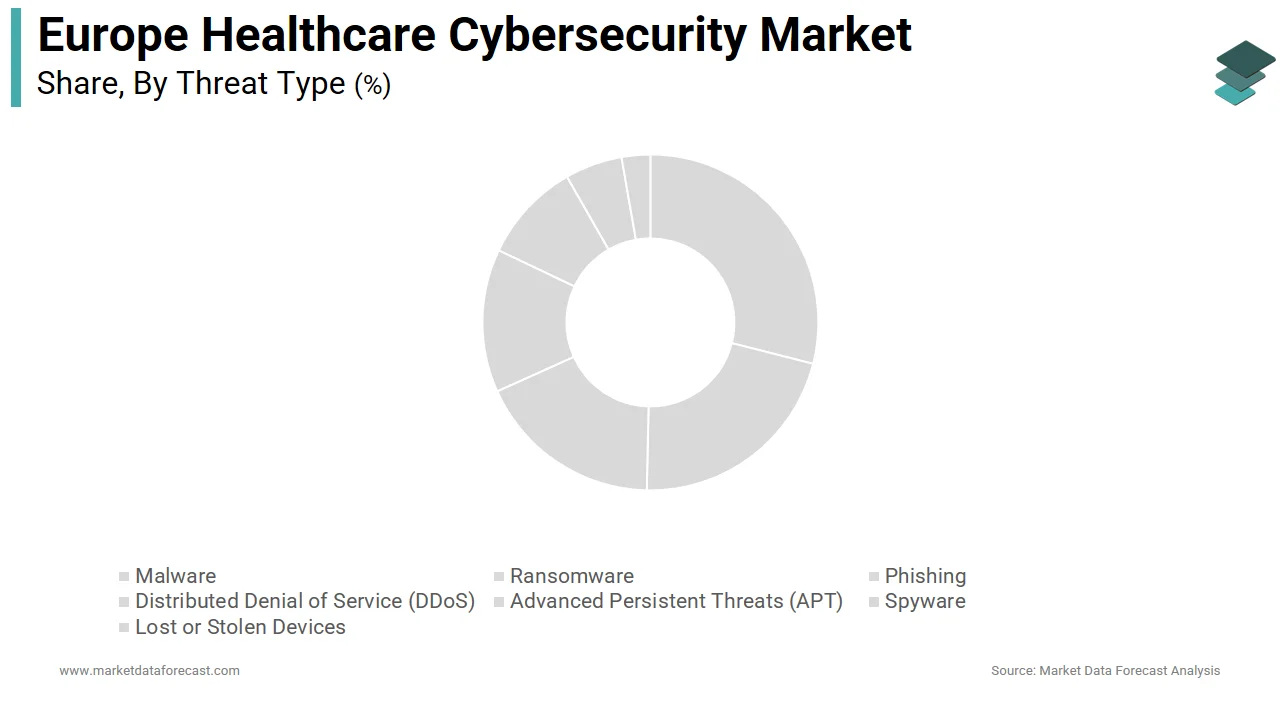
The ransomware segment is leading with the largest shares of the Europe healthcare cybersecurity market. The European Union Agency for Cybersecurity issued a caution, highlighting that, despite ransomware being the foremost threat to the European healthcare sector, there is an increasing frequency of distributed denial-of-service attacks associated with hacktivist organizations in the region. Hence, the distributed denial-of-service segment is expected to increase its market share in the coming years.
By Security Type Insights
In 2024, the network security segment led the Europe healthcare cybersecurity market and accounted for a 34.6% share in 2024. Factors like its foundational role in defending hospital IT infrastructures against external intrusions have largely contributed to the dominance of the network security segment. Healthcare organizations are expanding digital services such as telemedicine and cloud-based electronic health records. They rely heavily on firewalls, intrusion detection systems, and secure web gateways to monitor and filter traffic. Furthermore, the rise of distributed denial of service attacks targeting hospital appointment systems has accelerated investment in scalable network defense layers. This persistent threat landscape ensures network security remains the cornerstone of healthcare cyber defense architectures.
The cloud security segment is anticipated to witness the fastest CAGR of 18.7% from 2025 to 2033 due to the rapid migration of health data to cloud platforms. As per sources, a portion of hospitals in the European Union now store electronic health records partially or fully in cloud environments, a figure projected to surge. This shift is accelerated by the European Health Data Space initiative, which promotes federated cloud infrastructures for cross-border data sharing. However, cloud adoption introduces shared responsibility model complexities. In addition, providers are deploying cloud workload protection platforms and cloud access security brokers to enforce encryption access controls and compliance. These regulatory and operational imperatives fuel exceptional growth in this segment.
By End Users Insights
The hospitals segment was the largest segment in the Europe healthcare cybersecurity market and captured 56.9% share in 2024. The prominence of the hospitals segment is fuelled by their extensive digital footprint and high concentration of sensitive patient data. According to sources, hospitals across Europe rely on complex digital networks that connect health records, diagnostic platforms, and medical devices. As per studies, the large volume of patient data managed by these institutions makes them attractive targets for cybercriminals seeking financial gain. As per research, healthcare facilities experience a significant share of reported cybersecurity breaches, often linked to outdated systems and the critical nature of clinical operations. These systemic risks and policy mandates strengthen hospitals as the primary demand driver.
The medical device manufacturers segment is likely to experience the fastest CAGR of 21.3% during the forecast period, owing to stringent regulatory requirements for device security. The European Union Medical Device Regulation, which became fully applicable in 2021, mandates that all Class IIa and higher devices demonstrate cybersecurity risk management throughout their lifecycle. Companies have established dedicated product security incident response teams to comply with these obligations. This regulatory transformation turns cybersecurity from an afterthought into a core engineering requirement, driving unprecedented investment in this segment.
COUNTRY LEVEL ANALYSIS
Germany Market Analysis
Germany was the top performer in the Europe healthcare cybersecurity market in 2024 and accounted for 24.6% of the global market share. The domination of Germany is driven by its advanced digital health infrastructure and proactive regulatory stance. The country’s Hospital Future Act, launched in 2020, allocated funds to modernize hospital IT systems with cybersecurity as a mandatory criterion for funding disbursement. Germany also hosts Europe’s densest concentration of medical device manufacturers who must comply with both the Medical Device Regulation and the Cyber Resilience Act. These coordinated public-private initiatives create a high-maturity ecosystem that anchors Germany’s prominent position.
United Kingdom Market Analysis
The United Kingdom followed closely in the European healthcare cybersecurity market by capturing a 19.5% share in 2024. The growth of the United Kingdom is propelled by the centralized structure of the National Health Service and its history of high-profile cyberattacks. According to sources, major cyber incidents in the past have driven significant improvements in the cybersecurity framework of national health services. As per studies, healthcare institutions in the United Kingdom are required to follow comprehensive security standards that ensure stronger data protection. The UK also leads in threat intelligence sharing through the Cyber Security Information Sharing Partnership. Post Brexit, the UK has maintained alignment with EU cybersecurity standards while accelerating its own certification schemes for health software. This blend of regulatory rigor, operational centralization, and lessons from past breaches sustains the UK’s strong market position.
France Market Analysis
France experienced consistent growth in the Europe healthcare cybersecurity market due to its national health data strategy and robust public health infrastructure. The French Health Data Hub, launched in 2021, serves as a centralized platform for anonymized health data access by researchers and requires all connected entities to implement certified cybersecurity protocols. The country also enforces strict incident reporting. France’s Agency for Digital Health conducts annual penetration tests on regional health information systems, identifying and remediating vulnerabilities proactively. Apart from these, the French military cyber command collaborates with civilian health authorities on threat intelligence given the strategic value of health data. These integrated national efforts position France as a high compliance high high-investment market.
Italy Market Analysis
Italy expanded moderately in the European healthcare cybersecurity market, with growth driven by post-pandemic digitalization and regional coordination efforts. The National Recovery and Resilience Plan allocated funds to healthcare digitization with cybersecurity as a cross-cutting requirement across all projects. According to studies, many hospitals implemented Security Operations Centres as part of the initiative. Italy faces elevated ransomware risk. In response, the government established the National Health Cybersecurity Unit to coordinate defense across twenty-one regional health systems. The unit mandates the adoption of the European Union Agency for Cybersecurity’s healthcare baseline security controls and provides subsidized threat detection tools to small clinics. This combination of EU funding, national coordination, and threat burden is rapidly elevating Italy’s cybersecurity posture.
Netherlands Market Analysis
The Netherlands is predicted to grow in the Europe healthcare cybersecurity market from 2025 to 203,3, owing to its advanced health data exchange ecosystem and public-private collaboration model. The country’s National Electronic Health Record system connects over ninety-five percent of general practitioners and hospitals, requiring end-to-end encryption and strict access logging. According to sources, healthcare organizations participate in the Vital Sector Cybersecurity Program which provides free vulnerability scanning and incident response support. Dutch hospitals also lead in adopting zero trust architectures. With high digital maturity, strong regulatory enforcement, and a culture of information sharing, the Netherlands maintains a disproportionately influential role in shaping European healthcare cybersecurity standards.
COMPETITIVE LANDSCAPE
The Europe healthcare cybersecurity market features intense competition among global technology leaders and specialized regional vendors, all vying to address the sector’s unique risk profile. Unlike generic IT security, the healthcare domain demands deep clinical workflow understanding regulatory fluency, and the ability to secure legacy medical devices alongside modern cloud platforms. Competition is driven by solution efficacy, compliance readiness, and the capacity to deliver managed services tailored to resource constrained public health systems. Major players differentiate through healthcare specific threat intelligence zero zero-trust implementation frameworks and partnerships with national health authorities. At the same time, niche European firms gain traction by offering localized language support, rapid incident response and alignment with country specific digital health strategies. The market is further shaped by stringent EU regulations that raise entry barriers but also create opportunities for certified compliant solutions.
KEY MARKET PLAYERS
Some of the companies that are playing a dominating role in the Europe healthcare cybersecurity market include
- McAfee, LLC
- FireEye
- Atos SE
- Palo Alto Networks, Inc.
- Cisco Systems, Inc.
- Fortified Health Security
- Lockheed Martin Corporation
- Booz Allen Hamilton, Inc.
- IBM Corporation
Top Players in the Europe Healthcare Cybersecurity Market
- Palo Alto Networks is a global leader in cybersecurity that has significantly expanded its footprint in the European healthcare sector through its specialized healthcare security framework. The company offers integrated solutions, including next-generation firewalls, cloud security, and endpoint protection tailored to protect electronic health records and medical devices. It also partnered with the European Health Telematics Observatory to develop security benchmarks for digital health platforms. These initiatives support its role as a strategic enabler of cyber resilience across the region.
- Fortinet plays a pivotal role in securing European healthcare infrastructure through its Security Fabric platform,m which unifies network endpoint and cloud security under a single management console. The company actively supports public health systems in Germany, France, and the Netherlands by providing scalable security solutions for both large hospitals and regional clinics. Fortinet has integrated its systems with major electronic health record vendors to ensure seamless protection without disrupting clinical workflows. It also contributed to the development of the European Union Agency for Cybersecurity’s healthcare baseline security controls. These efforts position Fortinet as a trusted partner in building coordinated cyber defense capabilities across diverse European health ecosystems.
- IBM Security leverages its advanced artificial intelligence and consulting expertise to address complex cybersecurity challenges in European healthcare. IBM works closely with academic medical centers and national health services to design incident response playbooks and conduct cyber resilience simulations. The company also published a joint white paper with the European Institute of Innovation and Technology on securing federated health data under the European Health Data Space. This blend of technology and strategic advisory services enhances its influence in shaping secure digital health transformation.
Top Strategies Used by the Key Market Participants
Key players in the Europe healthcare cybersecurity market prioritize regulatory alignment by embedding GDPR, NIS2, and Medical Device Regulation requirements into their solution architectures. They invest heavily in sector-specific threat intelligence to anticipate ransomware and supply chain attacks targeting clinical environments. Strategic partnerships with electronic health record vendors and medical device manufacturers enable seamless integration of security controls into existing workflows. Companies establish regional healthcare security centers to provide localized training incident response, and compliance support. They also develop cloud native and zero-trust solutions to address the shift toward decentralized care and cross-border data exchange. Continuous innovation in artificial intelligence-driven anomaly detection and automated response further differentiates their offerings in a high stakes operational landscape.
MARKET SEGMENTATION
This Europe healthcare cybersecurity market research report is segmented and sub-segmented into the following categories.
By Offering
-
Solutions
-
Identity and Access Management (IAM)
-
Risk and Compliance Management
-
Antivirus and Antimalware
-
DDoS Mitigation
-
Security Information and Event Management (SIEM)
-
Intrusion Detection/Prevention Systems (IDS/IPS)
-
Encryption and Tokenization
-
Patch Management
-
Other Solutions (e.g., data backup and recovery, asset identification)
-
-
Services
-
Professional Services
-
Managed Services
-
By Threat Type
- Malware
- Ransomware
- Phishing
- Distributed Denial of Service (DDoS)
- Advanced Persistent Threats (APT)
- Spyware
- Lost or Stolen Devices
- Other Threats (e.g., unauthorized access, code injection)
By Security Type
- Network Security
- Cloud Security
- Application Security
- Endpoint and IoT Security
- Content Security
By End User
- Hospitals and Healthcare Facilities
- Medical Device Manufacturers
- Pharmaceuticals and Biotechnology Companies
- Health Insurance Providers and Payers
- Telehealth and Digital Health Providers
- Government Healthcare Agencies
- Others
By Deployment Mode
- On-Premises
- Cloud-Based
By Country
- UK
- France
- Spain
- Germany
- Italy
- Russia
- Sweden
- Denmark
- Switzerland
- Netherlands
- Turkey
- Czech Republic
- Rest of Europe
Frequently Asked Questions
1. What is the Europe Healthcare Cybersecurity Market and why is it important?
The Europe Healthcare Cybersecurity Market involves solutions and services that protect healthcare organizations from cyber threats such as ransomware, phishing, and data theft. It is vital due to the increasing reliance on digital health systems and sensitive patient data
2. What are the major factors driving the Europe Healthcare Cybersecurity Market?
Key growth drivers include the surge in cyberattacks on hospitals, implementation of healthcare digitalization projects, and stricter GDPR compliance requirements
3. What types of cyber threats are most common in the Europe Healthcare Cybersecurity Market?
Common threats include ransomware, malware, phishing, advanced persistent threats (APTs), and data breaches targeting electronic health records
4. Which segments dominate the Europe Healthcare Cybersecurity Market?
Hospitals were the largest end-use segment in 2023, while the pharma and chemicals sector is expected to show the fastest growth
5. How does GDPR impact the Europe Healthcare Cybersecurity Market?
GDPR mandates strict data protection and security measures, driving investment in encryption, risk management, and compliance software across European healthcare organizations
6. Who are the leading players in the Europe Healthcare Cybersecurity Market?
Key players include Cisco Systems, IBM Corporation, Intel, Trend Micro, Kaspersky Lab, Palo Alto Networks, Fortified Health Security, Lockheed Martin, and Atos SE
7. What role does cloud technology play in the Europe Healthcare Cybersecurity Market?
Cloud-based cybersecurity solutions enhance flexibility, scalability, and centralized data protection for healthcare organizations migrating to hybrid or cloud infrastructures
8. How are European governments supporting the Healthcare Cybersecurity Market?
Policies such as the EU Cybersecurity Strategy, initiatives by ENISA and the EU Cybercrime Centre, and funding programs under the Digital Agenda for Europe are bolstering the region’s cybersecurity framework
9. What challenges are restraining growth in the Europe Healthcare Cybersecurity Market?
High implementation costs, shortage of skilled professionals, and evolving nature of cyber threats hinder efficient adoption of cybersecurity measures
10. Which deployment modes are preferred in the Europe Healthcare Cybersecurity Market?
Both on-premise and cloud-based models are in demand, with cloud deployments growing due to cost-effectiveness and ease of management
Related Reports
Access the study in MULTIPLE FORMATS
Purchase options starting from
$ 2000
Didn’t find what you’re looking for?
TALK TO OUR ANALYST TEAM
Need something within your budget?
NO WORRIES! WE GOT YOU COVERED!
Call us on: +1 888 702 9696 (U.S Toll Free)
Write to us: sales@marketdataforecast.com