- Product Description Description
- Table of Contents TOC
- List of Table & Figure LOT
- Get Free Sample PDF Sample PDF
Market Size, 2025
$1.52 BnMarket Estimate, 2026
$1.62 BnMarket Forecast, 2034
$2.74 BnCAGR, 2026–2034
6.81%Global Extruded Polypropylene (XPP) Foam Market Size
The Extruded Polypropylene (XPP) Foam market size was calculated to be USD 1.52 billion in 2025 and is anticipated to be worth USD 2.74 billion by 2034, from USD 1.62 billion in 2026, growing at a CAGR of 6.81% during the forecast period.
Extruded Polypropylene (XPP) Foam is a high-performance thermoplastic material known for its excellent mechanical properties, thermal insulation, chemical resistance, and energy absorption capabilities. Unlike other foam materials, XPP foam is produced through an extrusion process that results in a closed-cell structure, offering superior durability and lightweight characteristics. These attributes make it a preferred choice across industries such as automotive, packaging, construction, and consumer goods.
The global shift toward sustainable and recyclable materials has significantly contributed to the growing adoption of XPP foamAlso, polypropylene-based products are among the most widely recycled polymers, aligning with global environmental goals. In addition, XPP foam’s ability to withstand extreme temperatures and resist moisture makes it especially valuable in applications where performance under stress is critical.
In the automotive sector, XPP foam is increasingly used for interior components, door panels, and acoustic insulation due to its lightweight nature and noise-reduction properties.
Moreover, in the packaging industry, particularly for electronics and perishables, XPP foam offers an eco-friendly alternative to expanded polystyrene (EPS). Its non-toxic composition and recyclability support the growing demand for sustainable packaging solutions, reinforcing its expanding role in modern industrial applications.
MARKET DRIVERS
Growing Demand from the Automotive Industry
Rising demand from the automotive industry, particularly for lightweight, durable, and thermally stable components, is one of the primary drivers of the extruded polypropylene (xpp) foam market. The increasing need to reduce vehicle weight to enhance fuel efficiency and lower emissions has prompted automakers to adopt advanced polymer-based materials like XPP foam in both structural and non-structural applications.
XPP foam, with its closed-cell structure and high impact resistance, has become a preferred material for manufacturing door panels, instrument clusters, headliners, and under-the-hood insulation components.
Also, Japanese automakers such as Toyota and Honda have integrated XPP foam into hybrid and electric vehicle designs to improve cabin comfort while reducing overall vehicle weight. These developments underscore the automotive sector’s pivotal role in driving the growth of the XPP foam market globally.
Expansion of E-commerce and Sustainable Packaging Needs
Another significant driver of the extruded polypropylene (xpp) foam market is the rapid expansion of e-commerce and the corresponding surge in demand for sustainable packaging solutions. With the rise in online retail, there is an increasing need for protective, lightweight, and environmentally friendly packaging materials that can ensure product safety during transit without contributing to plastic waste.
This boom has intensified the demand for high-performance cushioning materials, with XPP foam emerging as a viable alternative to traditional expanded polystyrene (EPS), which is less recyclable and environmentally harmful.
Leading packaging companies such as Sealed Air and Sonoco have started incorporating XPP foam into protective inserts for electronics, pharmaceuticals, and temperature-sensitive goods.
Besides, regulatory initiatives such as the EU’s Single-Use Plastics Directive and similar policies in North America and Asia-Pacific are pushing manufacturers to adopt recyclable materials, further boosting the adoption of XPP foam in the packaging industry.
MARKET RESTRAINTS
High Production Costs Compared to Alternative Foams
A key restraint affecting the extruded polypropylene (xpp) foam market is its relatively high production cost compared to alternative foaming materials such as expanded polystyrene (EPS) and expanded polyethylene (EPE). The extrusion process required to produce XPP foam involves precise temperature control, specialized equipment, and high-quality raw materials, all of which contribute to elevated manufacturing expenses.
According to a report by Smithers Pira, the production cost of XPP foam is approximately 25–30% higher than that of EPS, making it less attractive for price-sensitive applications, particularly in developing markets. While XPP foam offers superior performance in terms of durability and recyclability, many small and medium-sized enterprises (SMEs) continue to opt for cheaper alternatives despite their environmental drawbacks.
Furthermore, fluctuations in polypropylene resin prices—driven by crude oil market volatility—add another layer of economic uncertainty for XPP foam producers.
Unless there is a significant reduction in production costs or stronger policy incentives promoting sustainable materials, the affordability gap may continue to hinder widespread adoption of XPP foam in cost-driven industries.
Limited Awareness and Technical Expertise in Emerging Markets
A different key restraint impeding the growth of the extruded polypropylene (XPP) foam market is the limited awareness and technical expertise regarding its benefits in emerging economies. Many manufacturers in regions such as Southeast Asia, Africa, and parts of Latin America remain unfamiliar with the advantages of XPP foam, continuing to rely on conventional foam materials due to entrenched supply chains and a lack of local technical support.
According to the International Trade Centre (ITC), only 15% of SMEs in Southeast Asia had adopted high-performance polymer foams by 2023, largely due to knowledge gaps and inadequate training on processing techniques. Unlike established markets in Europe and North America, these regions often lack localized distribution networks and expert guidance for integrating XPP foam into existing manufacturing processes.
Besides, regional trade associations and industry bodies have not yet prioritized educational campaigns on sustainable foam alternatives, limiting the dissemination of best practices and application guidelines. The absence of standardized certifications for XPP foam usage in certain countries further complicates procurement decisions for potential adopters.
MARKET OPPORTUNITIES
Increasing Use in Renewable Energy Applications
A promising opportunity for the Extruded Polypropylene (XPP) Foam Market lies in its expanding application within the renewable energy sector, particularly in wind turbine blade manufacturing and solar panel insulation. As governments worldwide intensify efforts to transition toward clean energy sources, demand for durable, lightweight, and thermally efficient materials is surging.
According to the International Renewable Energy Agency (IRENA), global wind power capacity is expected to more than double by 2030, reaching over 2,000 GW. XPP foam, with its excellent strength-to-weight ratio and resistance to moisture and corrosion, is increasingly being used as a core material in wind turbine blades to enhance aerodynamic performance and reduce maintenance needs.
Leading wind turbine manufacturers such as Vestas and Siemens Gamesa have incorporated XPP foam into newer blade designs, citing improved fatigue resistance and longer operational life cycles. In addition, XPP foam’s compatibility with composite lamination techniques allows for seamless integration into large-scale production lines.
Similarly, in the solar energy sector, XPP foam is gaining traction as an insulating material for photovoltaic panel backsheets, helping maintain optimal operating temperatures and prolonging system longevity.
Advancements in 3D Printing and Additive Manufacturing
One more significant opportunity shaping the extruded polypropylene (xpp) foam market is the rapid advancement of 3D printing and additive manufacturing technologies. As industries move toward more customized, on-demand production models, the demand for versatile, printable foam materials is rising, particularly in aerospace, medical devices, and prototyping applications.
XPP foam, with its favorable melt flow characteristics and recyclability, is well-suited for filament extrusion and selective laser sintering methods used in industrial 3D printing.
Also, XPP foam-based filaments exhibit superior impact resistance and dimensional stability compared to traditional thermoplastic elastomers, making them ideal for producing lightweight, shock-absorbing components.
Moreover, medical device manufacturers are exploring XPP foam for patient-specific prosthetics and orthotics, leveraging its biocompatibility and ease of customization. Companies such as Materialise and Stratasys have already initiated pilot programs integrating XPP foam derivatives into their production workflows.
MARKET CHALLENGES
Regulatory Pressure and Compliance Requirements
A major challenge facing the Extruded Polypropylene (XPP) Foam Market is the increasing regulatory scrutiny surrounding plastic materials, even those deemed recyclable. Governments and environmental agencies worldwide are implementing stricter regulations aimed at reducing plastic waste, mandating extended producer responsibility (EPR), and enforcing recyclability standards, which pose compliance challenges for foam manufacturers.
According to the Organisation for Economic Co-operation and Development (OECD), over 120 countries have introduced plastic-related legislation since 2020, including bans on certain single-use plastics and mandatory recycling quotas. Although XPP foam is technically recyclable, its current recycling rates remain low due to limited collection infrastructure and sorting inefficiencies in municipal waste systems.
In the European Union, the Circular Economy Action Plan requires all plastic packaging placed on the market to be reusable or recyclable by 2030. Meeting these targets demands additional investments from XPP foam producers in closed-loop recycling technologies and product redesign strategies.
Furthermore, labeling requirements and sustainability certifications—such as Cradle to Cradle and Recyclability by Design—are becoming essential for market access, adding complexity to product development and supply chain logistics.
Technological Complexity in Processing and Molding
An additional critical challenge influencing the extruded polypropylene (xpp) foam market is the technological complexity associated with its processing and molding. Unlike conventional foams that can be easily shaped using standard techniques, XPP foam requires specialized equipment and expertise due to its high melting point, controlled cell structure, and sensitivity to processing conditions.
According to the Society of Plastics Engineers (SPE), achieving consistent foam density and mechanical properties during extrusion necessitates precise temperature management, pressure control, and nucleation agent optimization. This increases capital expenditures for manufacturers seeking to integrate XPP foam into existing production lines.
Moreover, post-processing steps such as thermoforming, cutting, and bonding demand advanced tooling and automation, which many small-scale producers may find financially prohibitive. Apart from these, workforce training and technical know-how play a crucial role in ensuring product quality and minimizing production defects. Without adequate skill development programs, the adoption of XPP foam remains restricted to larger, technologically equipped firms.
Addressing these technical barriers will require targeted investments in R&D, collaboration with academic institutions, and enhanced support for manufacturers transitioning to high-performance foam technologies.
REPORT COVERAGE
| REPORT METRIC | DETAILS |
| Market Size Available | 2025 to 2034 |
| Base Year | 2025 |
| Forecast Period | 2026 to 2034 |
| CAGR | 6.81% |
| Segments Covered | By Type, End Use Industry, and Region. |
| Various Analyses Covered | Global, Regional, and Country-Level Analysis; Segment-Level Analysis; DROC; PESTLE Analysis; Porter’s Five Forces Analysis; Competitive Landscape; Analyst Overview of Investment Opportunities |
| Regions Covered | North America, Europe, APAC, Latin America, Middle East & Africa |
| Market Leaders Profiled | Mitsui Chemicals (Japan), Sekisui Voltek (United States of America), Sonoco (United States of America), Sohner Plastics (Germany), NMC SA (Belgium), Pregis (United States of America), Sumitomo Chemical (Japan), and others |
SEGMENTAL ANALYSIS
By Type Insights
Low-density XPP foam held the largest share, i.e., 64.2% share of the global market in 2025. This dominance is primarily driven by its extensive use in applications that require lightweight materials with good thermal and acoustic insulation properties, such as packaging, automotive interiors, and consumer goods.
Its ability to provide impact resistance without adding significant weight makes it highly attractive for e-commerce and logistics sectors.
Also, in the automotive industry, low-density XPP foam is increasingly used in door panels, headliners, and seating components. As per the European Plastics Converters (EuPC), more than 45% of European car manufacturers integrated low-density XPP foam into at least one interior component in new vehicle models launched between 2020 and 2023.
Moreover, regulatory support for sustainable materials has further boosted demand. These factors collectively reinforce low-density XPP foam’s leadership in the market.
High-density XPP foam is the fastest-growing segment in the market, projected to expand at a CAGR of 9.3%. This growth is attributed to its increasing utilization in structural and load-bearing applications across industries such as construction, renewable energy, and industrial manufacturing.
In addition, high-density XPP foam is gaining traction as a core material in wind turbine blades due to its excellent mechanical strength, moisture resistance, and compatibility with composite lamination techniques. Leading manufacturers like Vestas and Siemens Gamesa have reported using high-density XPP foam in a notable share of their latest blade designs, contributing significantly to market expansion.
In the construction sector, the product is being adopted for insulation panels and flooring underlays where higher compressive strength is required. According to the data from the Global Construction Outlook, green building certifications have encouraged the use of high-performance insulation materials, boosting XPP foam consumption.
Furthermore, the rise of electric vehicles (EVs) has spurred demand for high-density XPP foam in battery housing systems. As per the International Energy Agency (IEA), EV production surged by 55% globally in 2023, driving innovation in protective materials, including high-density foam variants. This combination of technical performance and expanding application scope positions high-density XPP foam as a key growth driver in the market.
By End Use Industry Insights
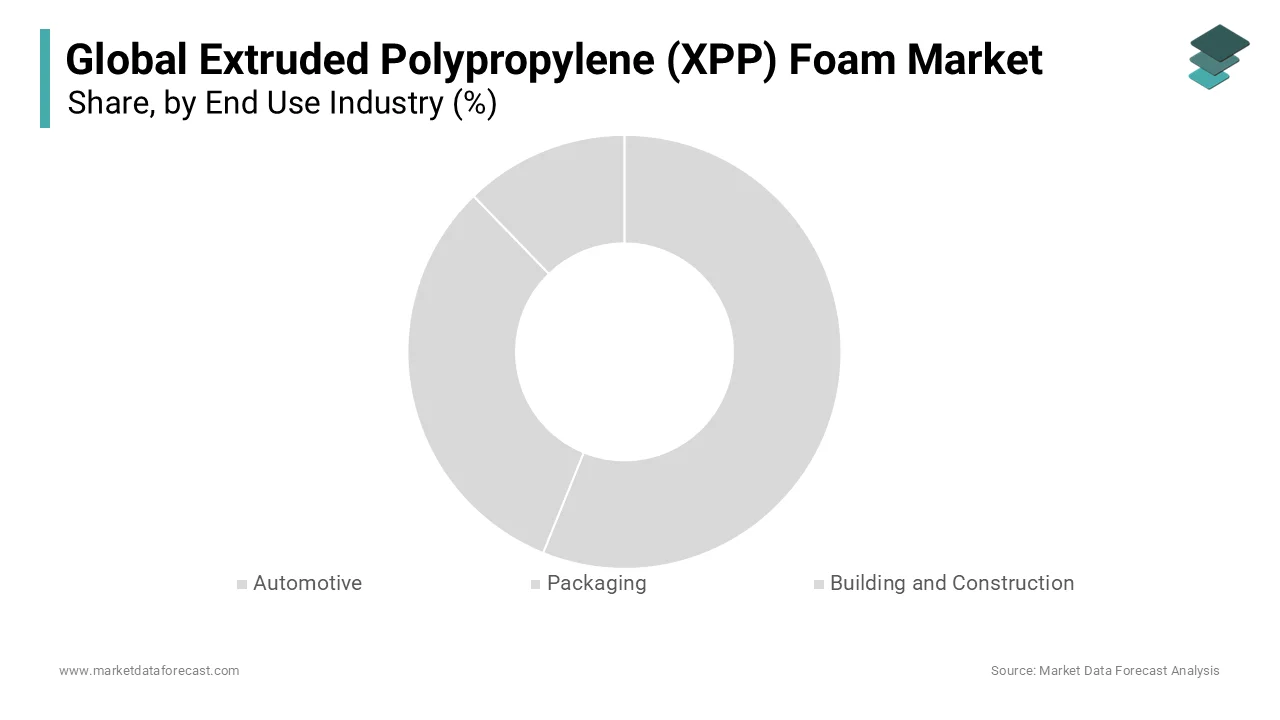
The automotive sector accounted for the largest segment of the XPP foam market, capturing 38.7% of total market value in 2025. This dominance is because of the growing demand for lightweight, durable, and thermally stable materials in vehicle manufacturing aimed at improving fuel efficiency and reducing emissions.
Japanese automakers, including Toyota and Honda, have also incorporated XPP foam into hybrid and electric vehicle platforms to enhance cabin comfort while minimizing vehicle mass.
Also, regulatory mandates such as the European Union’s CO₂ emission targets have accelerated the shift toward lighter materials. In addition, automakers are investing heavily in alternative materials to meet stringent fuel efficiency goals, reinforcing XPP foam’s strategic importance in the automotive supply chain. These developments underscore the automotive industry’s pivotal role in shaping the trajectory of the XPP foam market.
Electrical & Electronics
The electrical and electronics industry is emerging as the fastest-growing end-use segment for XPP foam, projected to expand at a CAGR of around 10.1% in the future. This rapid growth is fueled by rising demand for lightweight, thermally insulating, and shock-absorbing materials in electronic device manufacturing, particularly in portable and wearable technologies.
These devices increasingly incorporate XPP foam in protective casings and internal padding to prevent mechanical damage during transport and usage.
Leading electronics companies such as Apple and Samsung have been integrating XPP foam into packaging inserts and internal component supports, citing its non-abrasive nature and recyclability. Moreover, advancements in 5G infrastructure and IoT-enabled devices have created additional demand for XPP foam in telecom equipment enclosures and sensor housings. These applications benefit from the material’s electromagnetic interference shielding capabilities and resistance to environmental stressors. With continued miniaturization of electronic components and expansion of smart technology markets, the electrical and electronics segment is positioned for sustained high-growth performance.
REGIONAL ANALYSIS
Europe
Europe led the extruded polypropylene (xpp) foam market with a share of 29.2%, driven by strong automotive and packaging industries along with progressive environmental regulations. The region's emphasis on sustainability has prompted widespread adoption of recyclable materials, positioning XPP foam as a preferred alternative to expanded polystyrene (EPS).
Germany, France, and Italy remain key contributors, with major automotive suppliers like BASF and Covestro expanding their XPP foam production capacities to meet local demand.
In addition, the packaging sector benefits from the EU’s Single-Use Plastics Directive, which encourages the use of recyclable materials. With ongoing investments in circular economy initiatives and polymer recycling infrastructure, Europe continues to maintain its leadership position in the XPP foam market.
North America
North America remains a key player in the global XPP foam market, supported by robust industrial activity, technological innovation, and regulatory incentives favoring sustainable materials. The United States remains the dominant player, particularly in automotive and electronics applications.
Major automakers such as Tesla and Ford have incorporated XPP foam into next-generation EV designs to enhance safety and reduce vehicle weight. The electronics sector also contributes significantly to market growth. Moreover, the U.S. Environmental Protection Agency (EPA) has endorsed the use of XPP foam as an environmentally preferable alternative to EPS, encouraging wider adoption across multiple industries. With strong R&D investments and a focus on clean mobility, North America remains a key growth hub for the XPP foam industry.
Asia Pacific
Asia Pacific is a lucrative landscape in the XPP foam market, driven by rapid industrialization, expanding automotive production, and growing e-commerce activities in countries like China, Japan, and South Korea.
China, the largest consumer in the region, has seen a surge in XPP foam adoption due to its expanding electric vehicle (EV) industry. Japan and South Korea have also embraced XPP foam in electronics and transportation sectors. Also, government-backed initiatives promoting lightweight materials in automotive manufacturing are accelerating regional adoption. With rising investment in smart cities and renewable energy infrastructure, the Asia Pacific is poised for continued growth in the XPP foam market.
Latin America
Latin America is an XPP foam market, with Brazil leading in both production and consumption. The region’s growth is primarily driven by expanding automotive manufacturing and packaging industries.
Companies like BASF and Dow have expanded their foam processing facilities in São Paulo and Rio de Janeiro to serve regional OEMs. In the packaging sector, the rise of e-commerce platforms such as MercadoLibre and Amazon Brazil has contributed to increased demand for protective, recyclable materials. Despite economic fluctuations, Latin America’s market is expected to grow steadily as awareness of sustainable materials increases and local manufacturing capabilities expand.
Middle East & Africa
The Middle East and Africa account for a smaller share of the global XPP foam market, with limited but growing adoption driven by industrial diversification efforts and infrastructure development projects.
In the UAE, the push for sustainable construction practices has led to increased use of XPP foam in insulation panels and flooring systems. Also, South Africa has also shown potential, particularly in the automotive sector, where local manufacturers are exploring lightweight alternatives to improve fuel efficiency. However, challenges such as raw material availability, limited technical expertise, and fragmented distribution networks continue to constrain market growth in the region. Despite these hurdles, ongoing urbanization and industrial policy reforms present opportunities for future expansion.
KEY MARKET PLAYERS AND COMPETITIVE LANDSCAPE
Mitsui Chemicals (Japan), Sekisui Voltek (United States of America), Sonoco (United States of America), Sohner Plastics (Germany), NMC SA (Belgium), Pregis (United States of America), and Sumitomo Chemical (Japan) are the key players in the global Extruded Polypropylene Foam Market.
The competition in the Extruded Polypropylene (XPP) Foam Market is characterized by a mix of global chemical giants, regional polymer producers, and niche specialty foam manufacturers striving to capture market share through innovation and strategic positioning. While large multinational corporations dominate due to their extensive R&D capabilities and established distribution networks, mid-sized players are increasingly leveraging localized production and customized solutions to gain traction. The market remains moderately fragmented, allowing multiple players to coexist based on technical expertise, industry specialization, and geographic focus. As sustainability becomes a central theme across industries, competitive differentiation is shifting toward eco-friendly product development, recyclability improvements, and integration into circular economy models. Additionally, advancements in foam processing technologies and growing demand from high-performance sectors such as electric mobility and green building are reshaping competitive dynamics. Companies that can align their offerings with evolving regulatory standards and end-user requirements are likely to maintain a strong foothold in this evolving market landscape.
TOP PLAYERS IN THE MARKET
BASF SE
BASF is a global leader in chemical solutions and plays a pivotal role in the Extruded Polypropylene (XPP) Foam Market through its high-performance polymer products and extensive R&D capabilities. The company offers specialized XPP foam formulations tailored for automotive, packaging, and insulation applications. BASF’s contributions to the global market include the development of advanced foam technologies that combine sustainability with functional performance. Its commitment to innovation and strategic partnerships has enabled the expansion of XPP foam use across industries, particularly in Europe and North America.
Dow Inc.
Dow is a major player in the XPP foam industry, known for its expertise in polymer science and material engineering. The company provides high-quality polypropylene-based foam solutions that cater to diverse industrial needs, including transportation, consumer goods, and construction. Dow actively collaborates with downstream manufacturers to enhance product performance and recyclability. Its global presence and technological leadership have positioned it as a key contributor to the advancement of XPP foam applications, especially in the lightweighting and thermal management sectors.
JSP Corporation
JSP Corporation is a leading manufacturer of expanded and extruded polypropylene foams, with a strong focus on sustainable materials and process innovation. The company has pioneered several foam technologies that are widely used in automotive interiors, electronics packaging, and industrial components. JSP plays a crucial role in shaping global XPP foam standards by integrating environmental considerations into product design. Its continuous investment in manufacturing infrastructure and application development supports broader adoption of XPP foam across international markets.
TOP STRATEGIES USED BY KEY MARKET PLAYERS
- One of the primary strategies employed by key players in the Extruded Polypropylene (XPP) Foam Market is product innovation and differentiation. Companies are investing heavily in research and development to create customized foam variants that offer enhanced mechanical properties, improved recyclability, and better processing efficiency to meet evolving customer demands.
- Another critical approach is expanding production capacities and regional footprints, particularly in emerging markets where demand for lightweight and sustainable materials is rising. Major firms are establishing new manufacturing units, forming joint ventures, and acquiring local companies to strengthen their supply chain resilience and reduce logistical costs.
- Lastly, market participants are focusing on collaborating with end-use industries and regulatory bodies to promote the adoption of XPP foam in high-growth sectors such as electric vehicles, renewable energy, and smart packaging. These collaborations help align product development with industry trends and support policy advocacy for environmentally responsible materials.
RECENT HAPPENINGS IN THE MARKET
- In January 2025, BASF announced the launch of a new line of bio-based XPP foam materials designed for automotive interiors, aiming to enhance sustainability while maintaining structural integrity and thermal performance.
- In March 2025, Dow Inc. expanded its polypropylene foam production facility in Texas, reinforcing its supply chain capabilities and strengthening its ability to meet growing demand from the North American automotive sector.
- In June 2025, JSP Corporation formed a strategic partnership with a European automotive supplier to integrate its XPP foam technology into next-generation battery enclosures for electric vehicles, supporting lightweighting and thermal management goals.
- In September 2025, RTP Company introduced a series of conductive XPP foam compounds engineered for electromagnetic interference (EMI) shielding in electronic device manufacturing, expanding the material’s application scope in the electronics industry.
- In December 2025, Sekisui Chemical Co., Ltd. acquired a European foam processing firm to enhance its regional footprint and accelerate the adoption of XPP foam in high-value insulation and packaging applications across the continent.
MARKET SEGMENTATION
This research report on the global extruded polypropylene (XPP) foam market has been segmented and sub-segmented based on type, end-use industry, and region.
By Type
- Low density
- High density
By End Use Industry
- Automotive
- Packaging
- Building and Construction
By Region
- North America
- Asia Pacific
- Europe
- Latin America
- Middle East and Africa