- Product Description Description
- Table of Contents TOC
- List of Table & Figure LOT
- Get Free Sample PDF Sample PDF
Market Size, 2025
$4.18 BnMarket Estimate, 2026
$4.52 BnMarket Forecast, 2034
$8.50 BnCAGR, 2026–2034
8.21%Executive Summary: Global Fabric Filters Market
- Market Scope: Comprehensive global analysis of the fabric filters market covering filter media types, end-use industries, regional dynamics, stringent environmental regulations, and pollution control standards.
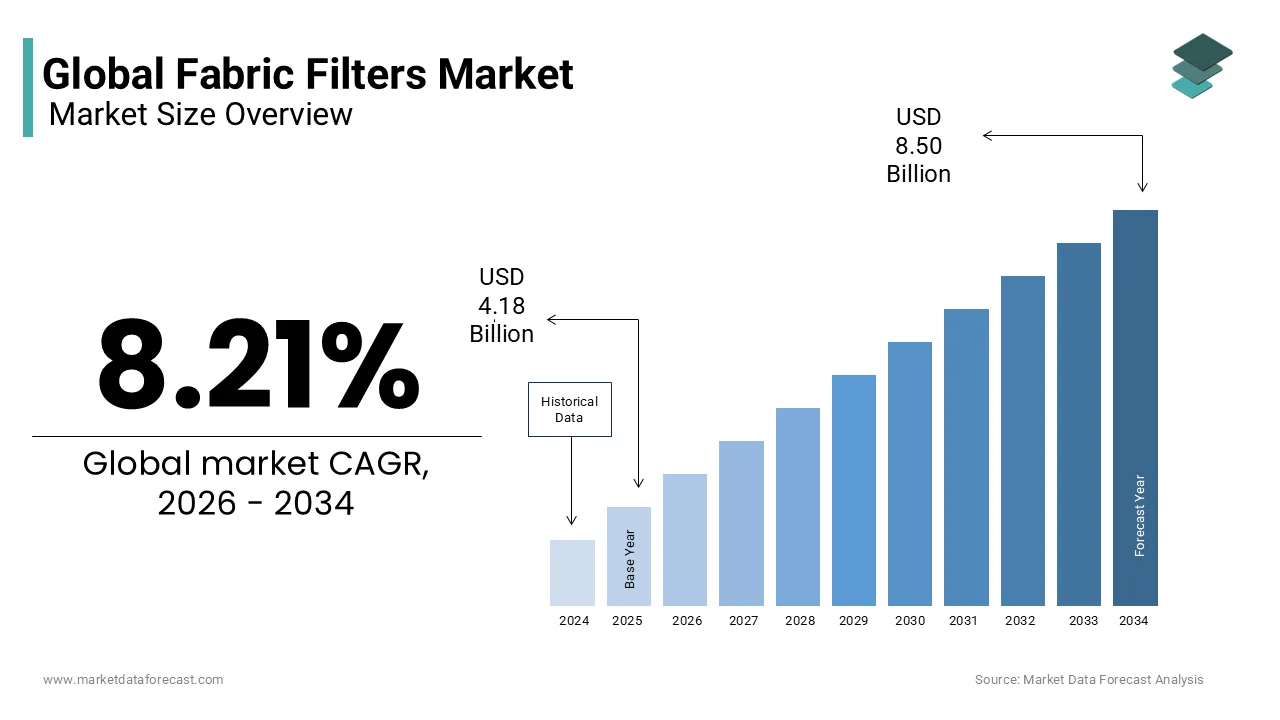
- Market Valuation: Valued at USD 4.18 billion in 2025, estimated at USD 4.52 billion in 2026, and projected to reach USD 8.50 billion by 2034, registering a solid CAGR of 8.21% from 2026 to 2034.
- Primary Growth Drivers: Stringent government regulations governing industrial emissions and effluent treatment; high collection efficiency of fabric filters; and rising awareness regarding worker health and indoor/outdoor air quality.
Key Market Segment Metrics (2026–2034)
| Category | Leading Segment / Position | Segment Details / Breakdown |
|---|---|---|
| By Type | Liquid Filter Media (Nonwoven Fabrics) & Air Filter Media | Liquid filter media is significant for solid-liquid separation, with nonwoven fabrics registering the highest growth rate; pulse jet technology leads air filtration. |
| By End-Use | Food & Beverage, Metal & Mining, Chemical, Pharmaceutical, Power Generation & Others | Food & beverage is the fastest-growing end-use sector driven by processed foods, while power generation, chemicals, and mining maintain steady industrial demand. |
| By Region | Asia-Pacific (Largest and Fastest-Growing Market) | Anchored by increasing manufacturing investments, rising purchasing power, and industrial expansion in economies like China and India. |
Major Market Players & Market Structure
Market Structure: Highly competitive landscape saturated by globally established industrial filtration firms focusing on technological advancements, high collection efficiency, and localized manufacturing operations.
Key Companies: Nederman Corporation Inc., Pall Corporation, Siemens AG, Affinia Group, Camfil AB, Donaldson Company, Cummins, Clarcor Inc., and Parker-Hannifin Corporation.
Global Fabric Filters Market Size
The global fabric filters market size was valued at USD 4.18 billion in 2025 and is expected to reach USD 8.50 billion by 2034 from USD 4.52 billion in 2026. The market is projected to grow at a CAGR of 8.21%.
Fabric filters, commonly known as baghouses, are industrial air pollution control devices designed to remove dust, particulates, and solid particles from contaminated gas streams. According to the World Health Organisation, ambient (outdoor) air pollution is estimated to cause 4.2 million premature deaths worldwide annually, leading major industrial sectors to deploy high-efficiency baghouses and bag filters to capture particulate matter. As per the International Energy Agency, the global cement sector directly accounts for about 7% of total energy-related CO2 emissions, driving cement plants to heavily invest in advanced energy efficiency improvements, alternative fuels, and modern clinker production processes to meet emissions targets. This market is distinct due to its critical role in enabling heavy industries such as power generation, steel production and chemical processing to operate within legal emission limits while maintaining operational efficiency. Current dynamics reflect a shift toward high-temperature-resistant materials and automated cleaning mechanisms that reduce maintenance downtime and extend filter life cycles. These technological advancements align with broader sustainability goals as industries seek to minimise their environmental footprint while adhering to increasingly rigorous air quality mandates imposed by governmental bodies worldwide.
MARKET DRIVERS
Stringent Environmental Regulations Mandate Particulate Control Adoption
Stricter industrial emissions benchmarks are being imposed by global regulatory bodies, which drive the growth of the fabric filter market. As a result, manufacturing and power generation facilities must adopt advanced particulate control systems. According to the United States Environmental Protection Agency, the primary annual National Ambient Air Quality Standard for fine particulate matter was lowered from 12.0 to 9.0 micrograms per cubic meter, prompting modern industrial operators to heavily implement advanced dust collection filters and baghouses. This regulatory pressure directly correlates with market growth because non-compliance results in severe financial penalties and potential operational shutdowns for non-conforming entities. As per the European Environment Agency, 96% of Europe's urban population remains exposed to concentrations of fine particulate matter above the World Health Organisation's guideline levels, driving member states to continually enforce aggressive zero-pollution industrial actions and municipal mitigation frameworks. Such legislative frameworks create non-discretionary demand for high-efficiency fabric filters as they offer superior capture rates compared to alternative technologies for submicron particles. Consequently, the tightening of air quality laws serves as a primary driver that compels industries to invest in advanced filtration solutions, thereby sustaining consistent procurement volumes and fostering innovation in filter media technologies within the Fabric Filters Market.
Expansion of Heavy Industrial Manufacturing Drives Volume Demand
Heavy industrial sectors like cement, chemicals, and metal processing are growing rapidly, which in turn propels the expansion of the global fabric filters market. This rapid expansion is fueling a surge in volume demand for high-capacity fabric filter systems. As per the United Nations Industrial Development Organisation, global manufacturing value added grew minimally at 1.6% in 2023, shifting regional production dynamics as sub-Saharan African economies expanded their local manufacturing value added at a 2.1% annual pace. The industrial expansion generates substantial demand for fabric filters because these facilities require robust particulate control systems to manage dust generated during raw material handling and processing stages. According to the World Bank, global private participation in infrastructure investment reached 86 billion dollars in 2023, leading municipal developers to diversify capital commitments across transport, water, and heavy energy generation projects. Each new plant represents a significant capital expenditure opportunity for filter manufacturers who supply both initial installation equipment and ongoing replacement bags. Therefore, the continuous growth of heavy industry acts as a fundamental volume driver that anchors the Fabric Filters Market to global economic development trends and infrastructure modernisation efforts across expanding industrial hubs.
MARKET RESTRAINTS
High Initial Capital Investment Deters Small-Scale Adopters
Acquiring and installing industrial fabric filter systems requires substantial upfront capital, which ultimately hampers the growth of the fabric filters market. This high initial cost presents a significant financial barrier for small-to-medium enterprises (SMEs) with limited budgets. According to the International Finance Corporation, micro, small, and medium-sized enterprises comprise over 90% of all firms worldwide, prompting international finance institutions to heavily scale up global liquid funding platforms to bridge a multi-trillion-dollar credit shortfall. The financial barrier limits market penetration among smaller industrial players who may opt for cheaper, less efficient alternatives or delay upgrades until regulatory enforcement becomes unavoidable. As per the United Nations Conference on Trade and Development, interest rates on external loans for developing nations reached a record high average of 4.9% in 2024, driving multilateral institutions to explore structural policy adaptations to mitigate high domestic borrowing costs. Such economic constraints slow down the adoption rate of modern filtration technologies, particularly in price-sensitive markets where operational costs are prioritised over long term environmental compliance. Thus, high upfront costs function as a persistent restraint that fragments the market and prevents uniform adoption of best practice filtration standards across all industrial segments within the Fabric Filters Market.
Complex Maintenance Requirements Increase Operational Burdens
Sustaining fabric filter efficiency requires intricate and frequent maintenance protocols, which hinders the expansion of the global market. These demanding routines impose significant ongoing operational burdens and cost pressures on industrial plant managers. As per the Occupational Safety and Health Administration, general manufacturing facilities are rapidly executing automated inspections and strict lockout/tagout protocols to systematically lower overall confined space entry hazards during industrial plant operation. The safety risk increases operational complexity and labour costs because specialised training and protective equipment are mandatory for personnel performing routine inspections and replacements. According to the Society of Automotive Engineers, global automotive manufacturing plants are widely deploying predictive maintenance algorithms and real-time sensor diagnostics to actively mitigate severe machinery downtime losses across automated assembly lines. When operators view fabric filters as burdensome assets rather than reliable components, they may resist upgrading to newer models despite efficiency gains. Hence, the perceived maintenance burden acts as a significant restraint that influences purchasing decisions and encourages some industries to explore alternative filtration technologies with lower operational demands within the Fabric Filters Market landscape.
MARKET OPPORTUNITIES
Integration with Digital Monitoring Systems Enhances Efficiency
IoT-driven digital platforms are merging with traditional filtration systems, which offer major opportunities for the global fabric filters market. This convergence allows heavy industries to track efficiency in real-time and perform predictive maintenance. According to the International Data Corporation, China's total national spending on Internet of Things solutions reached approximately 300 billion dollars by 2024, prompting global technology providers to significantly expand cellular and satellite infrastructure connectivity. The technological convergence creates opportunities for fabric filter manufacturers to offer smart systems that alert operators to pressure drops or bag failures before they impact production efficiency. According to the McKinsey Global Institute, the adoption of advanced manufacturing analytics typically reduces overall machine downtime by 30 to 50 percent and increases total equipment life by 20 to 40 percent, driving heavy industrial enterprises to rapidly integrate predictive algorithmic modeling. Such value-added features differentiate products in a competitive market and allow suppliers to command premium pricing based on operational savings rather than just hardware costs. Therefore, the integration of digital intelligence presents a transformative opportunity for stakeholders who position their fabric filters as part of broader Industry 4.0 initiatives within the Fabric Filters Market ecosystem.
Growing Demand in Emerging Waste to Energy Sector
The rapid proliferation of waste-to-energy facilities worldwide is creating a lucrative new avenue of growth for the fabric filters market. This growth is driven by the fact that these plants require advanced filtration to capture hazardous combustion byproducts. As per the International Energy Agency, total global renewable power capacity additions are projected to increase to almost 890 gigawatts by 2030, leading utility operators to scale up massive solar photovoltaic and wind installations. The sector relies heavily on fabric filters to remove toxic particulates and dioxins from incineration exhaust gases, ensuring compliance with strict environmental standards for public health protection. According to the World Bank, global municipal solid waste generation is projected to rise by 50 percent by 2050 to reach 3.9 billion tonnes, pushing municipal governments to scale up digital waste monitoring and cost-effective sorting infrastructure. Each new facility represents a significant procurement opportunity for filter manufacturers who can tailor solutions to handle the unique chemical composition of waste-derived flue gases. Hence, the rapid expansion of waste to energy infrastructure generates a distinct opportunity stream for specialized fabric filter applications targeting this high growth environmental management segment within the Fabric Filters Market.
MARKET CHALLENGES
Supply Chain Volatility for Specialised Filter Media
Unpredictable fluctuations in the global supply and pricing of specialized raw materials, such as high-temperature polymers and fiberglass, present a severe logistical barrier to manufacturers in the fabric filters market. According to the United Nations Conference on Trade and Development, high-efficiency industrial baghouses are seeing widespread global deployment to comply with increasingly stringent environmental emission rules across key maritime ports and heavy industrial hubs. The volatility creates uncertainty for manufacturers who struggle to maintain consistent pricing and delivery schedules for customers operating on tight production timelines. As per the International Chamber of Commerce, global automotive and manufacturing supply chains are adopting digital parts-tracking platforms and localized inventory storage to counter persistent market vulnerabilities and the threat of counterfeit components. When supply chains are unpredictable, operators may hesitate to commit to long-term contracts or switch to local alternatives with potentially lower quality standards. Thus, supply chain instability represents a systemic challenge that constrains market stability and forces manufacturers to hold excessive inventory buffers, which tie up working capital within the Fabric Filters Market value chain.
Technical Limitations in Extreme Operating Conditions
Standard filter media suffer severe operational degradation under extreme temperatures, high moisture, or corrosive gas exposure, which challenge the growth of the fabric filters market. This vulnerability remains a critical technical bottleneck for industrial applications. As per the American Society of Mechanical Engineers, modern flue gas filtration systems are heavily optimized using precise flue gas analysis instruments and automated cooling bypasses to systematically control inlet temperatures. The technical constraint restricts market expansion into sectors like metal smelting and glass manufacturing where extreme thermal conditions are common and alternative filtration methods may be preferred. According to the National Institute of Standards and Technology, advanced materials testing laboratories are widely utilising fully instrumented outdoor exposure sites and laboratory-controlled accelerated testing to map long-term structural performance and material failure modes. When filters cannot withstand process conditions reliably industries may opt for electrostatic precipitators or other technologies despite higher initial costs. Therefore, material limitations under extreme conditions act as a persistent challenge that segments the market and requires continuous research and development investments to expand the operational envelope of fabric filtration technologies within the Fabric Filters Market.
REPORT COVERAGE
| REPORT METRIC | DETAILS |
| Market Size Available | 2025 to 2034 |
| Base Year | 2025 |
| Forecast Period | 2026 to 2034 |
| CAGR | 8.21% |
| Segments Covered | By Type, End Use, and Region. |
| Various Analyses Covered | Global, Regional & Country Level Analysis, Segment-Level Analysis, DROC, PESTLE Analysis, Porter’s Five Forces Analysis, Competitive Landscape, Analyst Overview of Investment Opportunities |
| Regions Covered | North America, Europe, APAC, Latin America, Middle East & Africa |
| Market Leaders Profiled | Nederman Corporation Inc., Pall Corporation, Siemens AG, Affinia Group, Camfil AB, Donaldson Company, Cummins, Clarcor Inc., and Parker-Hannifin Corporation |
SEGMENTAL ANALYSIS
By Type Insights
The air filter media segment dominated the Fabric Filters Market and accounted for a substantial share in 2025. This dominance of the segment was driven by its extensive application in controlling particulate emissions from industrial combustion and manufacturing processes. Global regulatory frameworks primarily target airborne pollutants in the power generation, cement, and metal industries. Because these strict rules necessitate high-volume filtration solutions, this specific segment holds the largest share. According to the International Energy Agency, the industrial sector accounts for approximately 37% of global final energy consumption, driving modern manufacturing plants to prioritize automated process controls and efficiency optimization. The statistical reality directly translates to market dominance because every coal fired power plant, steel mill and cement factory must install baghouses equipped with air filter media to operate legally. As per the United States Environmental Protection Agency, the primary annual National Ambient Air Quality Standard for fine particulate matter was lowered from 12.0 to 9.0 micrograms per cubic meter, prompting modern industrial operators to heavily implement advanced dust collection filters and baghouses. Such stringent limits ensure that air filter media remains a critical consumable item with high replacement frequency due to continuous exposure to harsh flue gases. Consequently, the sheer scale of industrial infrastructure subject to emission controls sustains the leading position of this segment by creating a non discretionary and recurring demand base that outweighs other application types in terms of total volume and revenue generation within the global market.
According to the International Energy Agency, global electricity demand is projected to grow by 3.6% annually between 2026 and 2030, with emerging economies accounting for nearly 80% of additional demand. The continued reliance on fossil fuel based energy production ensures steady demand for air filter media as these facilities require constant filtration to remove fly ash and sulfur compounds from exhaust streams. As per the International Energy Agency, global low-emissions electricity generation is projected to expand significantly to supply around 50% of the world's power by 2030. Each megawatt of thermal capacity installed represents a significant long-term contract for filter suppliers who provide both initial installation and ongoing maintenance services. Therefore, the persistent role of thermal power in the global energy mix acts as a fundamental anchor that secures the dominance of air filter media within the Fabric Filters Market despite the gradual transition toward cleaner energy sources.
The liquid filter media segment is predicted to witness the highest CAGR of 5.8% during the forecast period due to increasing purity requirements in the pharmaceutical and food processing industries. This rapid expansion shows shifting consumer preferences toward high-quality processed goods and stricter hygiene regulations in manufacturing environments. According to the Food and Agriculture Organization, an estimated 13 percent of the world's food is lost between harvest and retail, pushing global supply chains to deploy improved cold-chain infrastructure and mechanized sorting equipment. The operational need drives demand for liquid filter media capable of removing microscopic impurities from beverages, oils and dairy products without altering taste or nutritional value. As per the World Health Organization, an estimated 600 million people fall ill after eating contaminated food each year, leading municipal safety boards to rigorously monitor regional supply chains and processing plants. Such regulatory pressure creates a compelling business case for upgrading from traditional methods to high-efficiency fabric filters that offer superior consistency and reliability. Hence, the intersection of public health concerns and quality assurance requirements fuels the accelerated growth of liquid filter media consumption throughout the food and beverage sector within the regional market.
As per the United States Food and Drug Administration, sterile drug products manufactured by aseptic processing must undergo validated final filtration procedures to remove microorganisms before fill and finish operations. The critical quality attribute necessitates the use of specialized liquid filter media made from high purity materials like polypropylene and polyester which can withstand rigorous sterilization procedures. According to the European Federation of Pharmaceutical Industries and Associations, European pharmaceutical production values reached over 340 billion euros, driving companies to actively scale up automated synthesis and localized formulation plants. Each new drug formulation or production line expansion requires validation of filtration processes, ensuring long term contracts for suppliers who meet exacting industry standards. Therefore, the growth of the pharmaceutical industry combined with uncompromising quality mandates positions liquid filter media as the fastest expanding segment within the Fabric Filters Market landscape.
By End Use Insights
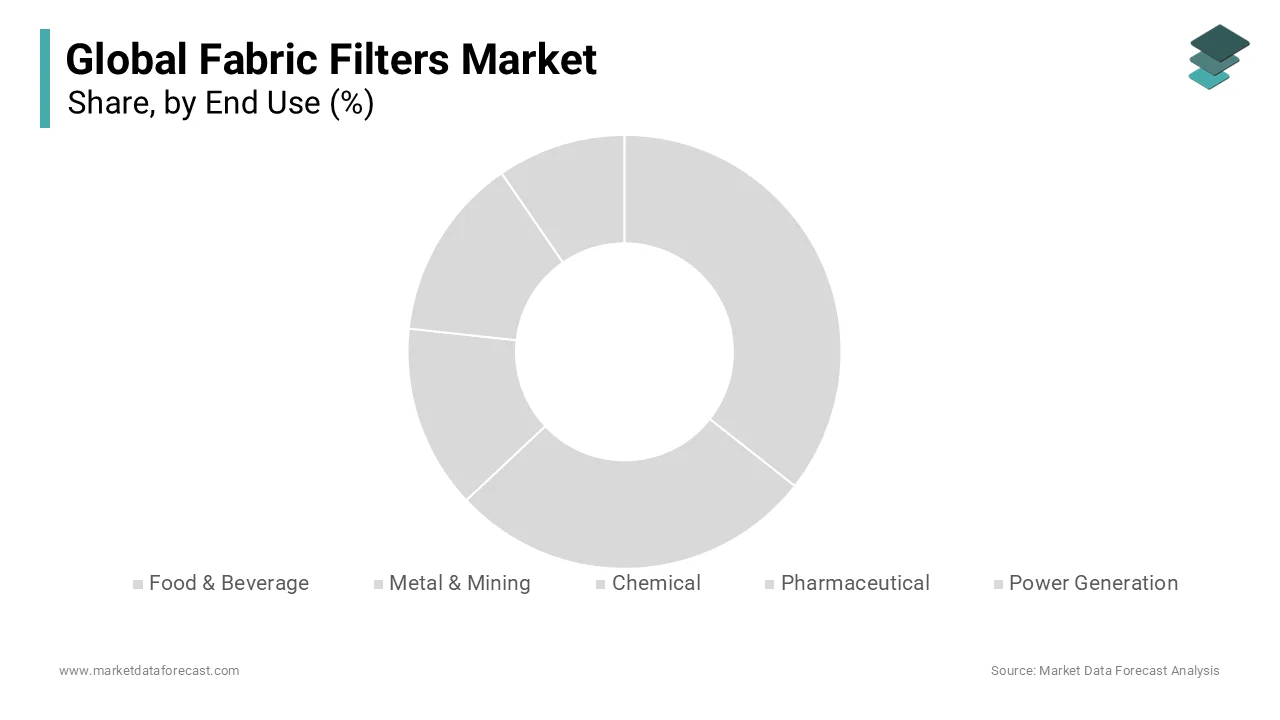
The power generation end-use segment led the fabric filters market and captured a significant share in 2025. This leading position of the segment was attributed to the massive scale of coal- and biomass-fired power plants, which require extensive particulate control systems. This dominance is also sustained by global energy security priorities and the continued operation of existing thermal infrastructure despite renewable energy transitions. According to the International Energy Agency, global coal demand for power generation is projected to plateau as the fuel's role shifts towards system adequacy and flexibility rather than expanding baseload capacity. The substantial share ensures that thousands of power plants worldwide continue to operate baghouse filtration systems requiring regular replacement of filter bags to maintain efficiency and compliance. As per the International Energy Agency, the commissioning of newly constructed coal power plants accelerated significantly, prompting major utility operators to purchase advanced environmental dust and particulate controls. Such large scale projects drive significant revenue for manufacturers who supply both original equipment and maintenance services. Therefore, the enduring role of coal in the global energy mix acts as a primary driver that maintains the leadership position of the power generation segment within the regional market structure.
According to the United States Energy Information Administration, more than three-quarters of the operating coal power capacity in the United States is at least 30 years old, pushing power producers to deploy specialised engineering retrofits. The aging infrastructure creates a robust aftermarket for fabric filters as utilities upgrade existing electrostatic precipitators to baghouses for better particulate capture efficiency. As per the United States Environmental Protection Agency, industrial facilities are lowering emissions by retrofitting older boilers with high-efficiency particulate air systems rather than purchasing new infrastructure. These upgrades often involve custom engineered filter solutions that address specific spatial and operational constraints of legacy facilities. Consequently, the need to modernise existing assets generates consistent demand for specialised filtration products and services, thereby reinforcing the dominance of the power generation segment in the Fabric Filters Market.
The metal and mining segment is estimated to register the fastest CAGR of 6.2% from 2026 to 2034 owing to increasing environmental scrutiny of mining operations and rising demand for metals used in green technologies. Such acceleration mirrors global industrial trends favoring green resource extraction and tight regulatory oversight on dust emission. According to the International Energy Agency, total mineral demand from clean energy technologies is projected to at least double by 2040, driving heavy industrial mining operators to scale up state-of-the-art particulate filters and baghouses. The surge in mining activity generates substantial particulate matter during crushing, grinding and smelting processes, necessitating advanced fabric filtration systems to protect workers and surrounding communities. According to the World Bank Group, a new 20 million dollar facility called RISE+ was launched to help developing nations scale up private capital mobilization for critical minerals supply chains. Each new facility requires comprehensive dust management solutions, including baghouses equipped with high-durability filter media capable of handling abrasive mineral dust. Thus, the boom in green technology metals creates a distinct opportunity stream for fabric filter suppliers targeting the mining sector within the global market.
As per the United States Mine Safety and Health Administration, a unified final rule requires mining operations to maintain strict engineering controls and dust suppression to protect workers from respirable crystalline silica hazards. These health mandates require mining companies to implement effective engineering controls such as fabric filters at transfer points and processing areas to reduce airborne dust concentrations. According to the United States Mine Safety and Health Administration, enforcement and safety and health impact inspections at surface and underground mining operations have increased to rigorously monitor respirable dust compliance. Such enforcement actions create urgent demand for reliable filtration solutions that can consistently maintain safe working conditions. Therefore, the focus on worker health and safety acts as a powerful catalyst for the rapid adoption of fabric filters in the metal and mining industry.
REGIONAL ANALYSIS
North America Fabric Filters Market Analysis
North America held a stable position in the Fabric Filters Market in 2025. This position was supported by stringent environmental regulations and a strong focus on industrial modernization. According to the United States Environmental Protection Agency, national average concentrations of fine particulate matter (PM2.5) dropped by 46 percent between 2000 and 2024, prompting modern industrial facilities to aggressively scale up state-of-the-art dust collection systems. The regulatory framework ensures consistent demand for high-efficiency fabric filters, particularly in the power generation and chemical sectors. As per Environment and Climate Change Canada, mandatory industrial air pollutant emission standards continue to enforce consistent national limits on heavy industry to reduce fine particulate matter precursors. Additionally, the region benefits from advanced technological adoption with many facilities integrating smart monitoring systems to optimise filter performance and reduce maintenance costs. These factors combine to sustain a steady market characterised by replacement demand and technological upgrades rather than new capacity additions.
Latin America Fabric Filters Market Analysis
Latin America is an emerging region in the fabric filters market. This regional growth is primarily driven by expanding mining activities and increasing environmental awareness in key economies. According to the Economic Commission for Latin America and the Caribbean, the value of the region's goods exports is recovering, with agricultural products and mining leading the volume expansion, driving raw material logistics hubs to implement advanced heavy particulate control systems. Brazil and Chile are leading adopters of advanced filtration technologies as they seek to improve their environmental credentials and access international markets with strict sustainability requirements. As per the Inter-American Development Bank, the institution is aggressively scaling green and climate finance to reach 50% of total public sector lending by 2030, driving regional governments to accelerate infrastructure adaptation. However, market growth is sometimes constrained by economic volatility and limited access to financing for small and medium-sized enterprises. Despite these challenges, the long term trend toward responsible resource extraction supports steady expansion of the fabric filters market in the region.
Europe Fabric Filters Market Analysis
Europe was the top performer in the Fabric Filters Market and captured a substantial share in 2025. This dominance of the European market was fuelled by high technological sophistication and strict adherence to European Union environmental directives. According to the European Environment Agency, large-scale industrial installations are actively restructuring operations under updated EU rules to strictly align with dynamic, sector-specific Best Available Techniques Conclusions. The regulatory certainty drives continuous innovation in filter media materials such as PTFE membranes that offer superior efficiency and longevity. Germany and France are major consumers due to their large chemical and automotive manufacturing bases, which require precise air quality control. As per the European Commission, the updated Circular Economy Action Plan is aggressively accelerating product circularity, textile collection mandates, and secondary raw material markets to eliminate corporate operational waste. Additionally, the region sees strong demand for retrofitting older industrial plants to meet newer standards, ensuring a robust aftermarket for replacement filters and maintenance services.
Asia Pacific Fabric Filters Market Analysis
Asia-Pacific is the fastest-growing region in the Fabric Filters Market due to rapid industrialization and increasing government focus on air quality improvement. According to the World Bank Group, environmental degradation, including outdoor and household air pollution, costs South Asia's regional gross domestic product an estimated 10 percent annually, forcing municipal networks to heavily deploy robust industrial emission filters. China and India are the primary drivers, with China implementing ultra-low emission standards for power plants and India enforcing stricter norms for cement and steel industries. As per the World Bank, East Asia and the Pacific's regional gross domestic product grew by approximately 5 per cent in 2023, driving regional production complexes to update standard infrastructure assets. Additionally, growing awareness of health impacts is driving public support for cleaner industrial practices, encouraging companies to adopt advanced filtration systems voluntarily. This combination of regulatory pressure and economic growth creates a dynamic market with significant opportunities for both local and international filter manufacturers.
Middle East and Africa Fabric Filters Market Analysis
The Middle East and Africa region is expected to grow further in the fabric filters market from 2026 to 2034 owing to expanding cement production and oil and gas processing activities. According to the African Development Bank, comprehensive climate and adaptation finance commitments reached over 5 billion dollars annually, pushing member nations to integrate sustainable and green technology frameworks across heavy construction sectors. Saudi Arabia and the United Arab Emirates are investing heavily in industrial diversification under vision plans that include environmental sustainability components mandating the use of modern pollution control technologies. As per the Saudi Green Initiative, the Kingdom is aggressively transforming its domestic energy mix to reach 50 percent renewable energy capacity by 2030, forcing utility and manufacturing platforms to displace liquid fuels and lower heavy gaseous emissions. However, market growth is often hindered by limited technical expertise and supply chain challenges in remote locations. Despite these obstacles, the commitment to industrial modernization and environmental protection is gradually driving adoption of fabric filters across the region.
COMPETITIVE LANDSCAPE
The competition in the fabric filters market is characterized by a mix of established global corporations and specialized regional manufacturers who compete on technology quality and service reliability. Large multinational companies leverage their extensive research and development capabilities to introduce innovative filter media and smart monitoring systems that offer superior performance and efficiency. Meanwhile smaller players often focus on niche applications or specific industries where they can provide highly customized solutions at competitive prices. The market remains fragmented due to the diverse nature of industrial applications and varying regulatory requirements across different regions which prevents any single entity from dominating completely. Competitors increasingly emphasize sustainability and energy efficiency as key differentiators to appeal to environmentally conscious customers. Strategic collaborations and mergers are common as companies seek to expand their product portfolios and geographic reach. This dynamic environment drives continuous improvement in filtration technologies and service offerings benefiting end users through better performance and lower total cost of ownership.
KEY MARKET PLAYERS
Some of the key players in the global fabric filters market are
- Nederman Corporation Inc.
- Pall Corporation
- Siemens AG
- Affinia Group
- Camfil AB
- Donaldson Company
- Cummins
- Clarcor Inc.
- Parker-Hannifin Corporation
Top Players in the Market
- Donaldson Company Inc maintains a strong presence in the Fabric Filters Market through its extensive portfolio of industrial dust collection solutions and high performance filter media. The company focuses on providing customized filtration systems for heavy industries such as mining cement and power generation. Recently Donaldson enhanced its digital capabilities by launching smart monitoring tools that predict filter life and optimize maintenance schedules. These innovations help customers reduce downtime and lower operational costs while ensuring compliance with environmental regulations. By investing in research and development for advanced nanofiber technologies Donaldson strengthens its ability to capture ultrafine particles effectively. This commitment to technological advancement and customer support ensures long term loyalty and solidifies its reputation as a reliable partner in the global industrial filtration sector.
- Camfil AB contributes significantly to the Fabric Filters Market by offering sustainable and energy efficient air filtration solutions for various industrial applications. The company actively promotes circular economy principles by developing recyclable filter materials and reducing the carbon footprint of its manufacturing processes. Camfil recently expanded its production facilities in Asia to better serve growing markets in China and India where industrial emissions are under increasing scrutiny. This strategic expansion allows the company to respond quickly to local demand while maintaining high quality standards. Additionally Camfil collaborates with industry partners to develop specialized filters for harsh environments such as high temperature and corrosive conditions. These efforts reinforce its position as a leader in innovative and environmentally responsible filtration technologies across diverse global markets.
- Parker Hannifin Corporation serves as a key supplier in the Fabric Filters Market leveraging its broad engineering expertise to deliver robust filtration systems for demanding industrial processes. The company integrates its filtration products with motion and control technologies to provide comprehensive solutions that enhance overall plant efficiency. Parker recently acquired several niche filtration companies to expand its product range and technical capabilities in specific sectors like pharmaceuticals and food processing. These acquisitions enable the company to offer more specialized and high value added services to its customers. By focusing on integration and customization Parker strengthens its competitive advantage and ensures it can meet the unique requirements of complex industrial applications worldwide.
Top Strategies Used by Key Market Participants
Key players in the fabric filters market primarily employ product innovation and strategic acquisitions to strengthen their competitive positions. Companies focus on developing advanced filter media with higher efficiency and longer life spans to meet stringent environmental regulations and reduce customer operating costs. Another major strategy involves expanding geographic presence through partnerships with local distributors and establishing manufacturing facilities in emerging markets like Asia Pacific and Latin America. Manufacturers also invest in digital technologies such as predictive maintenance software to offer value added services that enhance customer retention and differentiate their offerings. Additionally firms engage in sustainability initiatives by creating recyclable products and reducing energy consumption in filtration processes. These approaches collectively help participants address regulatory pressures and operational challenges while capitalizing on growing demand for cleaner industrial operations globally.
MARKET SEGMENTATION
This research report on the global fabric filters market is segmented and sub-segmented into the following categories.
By Type
- Liquid Filter Media
- Woven Fabrics
- Multifilament
- Monofilament
- Nonwoven Fabrics
- Needle Felt
- Melt Blown
- Air Filter Media
- Nonwoven Fabrics
- Fiberglass
- Filter Paper
By End Use
- Food & Beverage
- Metal & Mining
- Chemical
- Pharmaceutical
- Power Generation
By Region
- North America
- Europe
- Asia Pacific
- Latin America
- Middle East and Africa