- Product Description Description
- Table of Contents TOC
- List of Table & Figure LOT
- Get Free Sample PDF Sample PDF
Market Size, 2025
$238.65 BnMarket Estimate, 2026
$300.93 BnMarket Forecast, 2034
$1,923.92 BnCAGR, 2026–2034
26.1%Global Face Mask Market Size, Growth, Trends & Forecast (2026–2034)
The global face mask market size was valued at USD 238.65 billion in 2025, is anticipated to reach USD 300.93 billion in 2026, and is projected to scale up to USD 1,923.92 billion by 2034, registering a compound annual growth rate (CAGR) of 26.1% during the forecast period from 2026 to 2034. Driven by ongoing post-pandemic health awareness, expanding workplace safety regulations, and rising investments in smart wearable health technology, the protective respiratory equipment industry continues to expand significantly worldwide.
Key Executive Metrics (At-a-Glance)
- 2025 Base Valuation: USD 238.65 Billion
- 2026 Current Valuation: USD 300.93 Billion
- 2034 Forecast Valuation: USD 1,923.92 Billion
- Compound Annual Growth Rate (CAGR): 26.1% (2026–2034)
- Dominant Product Type: Disposable & Protective/Dust Masks (holding major market volume supported by rigorous industrial compliance)
- Dominant Application Segment: Industrial Applications (holding 59.7% of market share driven by mandatory factory and construction safety codes)
- Fastest-Growing Application Segment: Personal-Use Masks (projected at a 14.1% CAGR, propelled by urban lifestyle habits and routine daily commuting protection)
- Dominant Region: Asia-Pacific (accounting for 52.7% market share, backed by high population density, regional manufacturing scale, and air quality mandates)
Core Market Drivers
- Post-Pandemic Health Awareness: Institutional and consumer behavioral shifts ensuring consistent year-over-year respiratory protection replenishment cycles.
- Occupational Safety Regulations: Expanded legal mandates requiring employers across heavy industries, mining, and construction to supply regular protective gear.
- Smart Technology Integration: Development of sensor-enabled next-generation masks providing real-time biometric tracking and pathogen detection.
Primary Market Restraints & Challenges
- Environmental Impact & Waste: Accumulation of single-use plastic waste triggering stringent regulatory compliance, such as extended producer responsibility schemes.
- Counterfeit Distribution: Proliferation of substandard or uncertified products across informal markets undermining consumer trust and safety.
Global Face Mask Market Segmentation Breakdown
| Segment Category | Leading Sub-Segment (2025 Base) | Fastest-Growing Sub-Segment (2026–2034) |
|---|---|---|
| By Product Type | Disposable & Protective/Dust Masks (dominant volume leaders due to regulatory hygiene compliance) | Non-Woven & Smart Biosensor Masks (exhibiting a 12.4% CAGR driven by pollution control needs) |
| By Application | Industrial (holding 59.7% major share supported by heavy industry and energy sector mandates) | Personal-Use / Individual (fastest-growing category expanding at a 14.1% CAGR) |
| By Distribution Channel | Offline Channels (dominant share anchored by institutional procurement and medical distributors) | Online Channels (fastest-growing regional/global market expanding at an 18.7% CAGR) |
| By Region | Asia-Pacific (commanding 52.7% market share driven by high population and industrial scale) | North America (fastest-growing regional market driven by emergency stockpiling and strict compliance) |
Major Industry Players Profiled
Key enterprises shaping the competitive global face mask market include Moldex, Shanghai Dasheng, Kimberly-Clark, BDS, Gerson, Halyard Healthcare, SAS Safety Corp, and Honeywell.
Global Face Mask Market Size
The global face mask market size was valued at USD 238.65 billion in 2025, and the market size is expected to be worth USD 1923.92 billion by 2034 from USD 300.93 billion by 2026. The market is growing at a CAGR of 26.1% From 2026 to 2034.
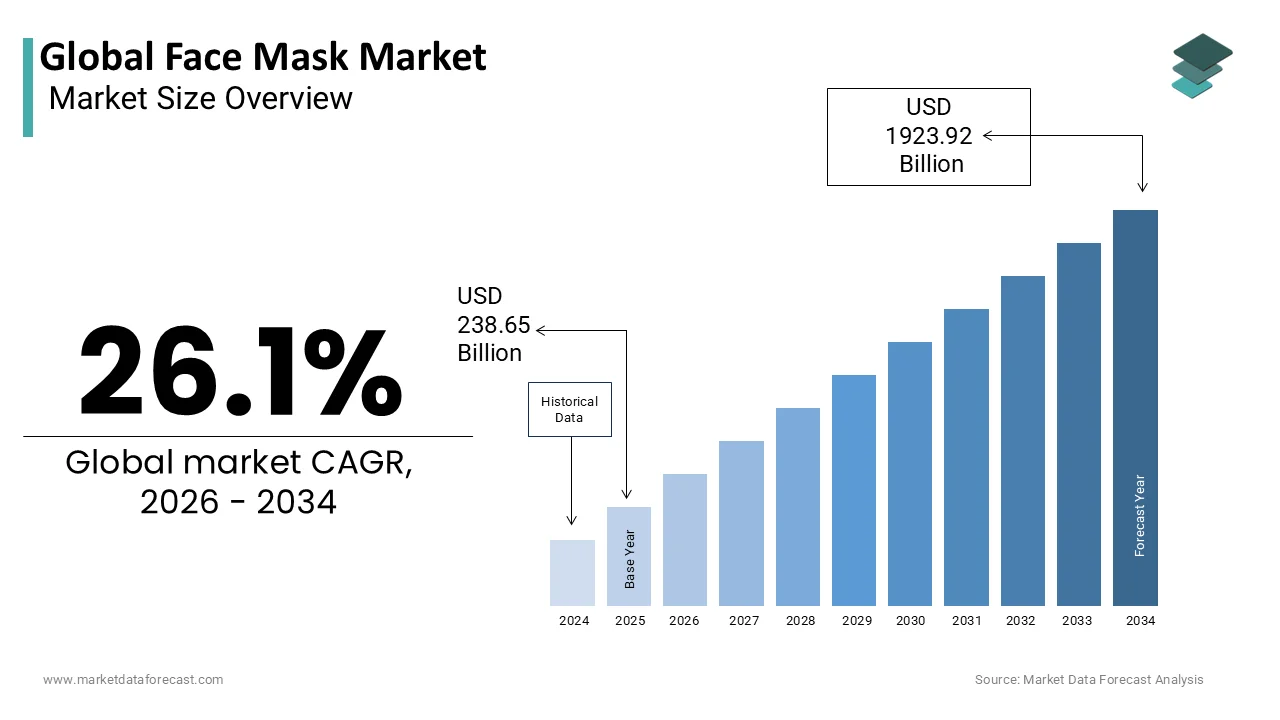
Face mask was the personal protective equipment intended to filter airborne particles, block respiratory droplets, and mitigate pathogen transmission across healthcare, industrial, and consumer settings. Unlike medical devices governed by stringent regulatory benchmarks, the broader segment includes reusable cloth masks, surgical-grade disposables, and N95-equivalents engineered for varying levels of filtration efficiency. As per the study, global demand for respiratory protection surged billions of units annually during the peak of the COVID-19 pandemic, with a portion of this volume consumed.
MARKET DRIVERS
Post-Pandemic Health Awareness Driving Mask Demand
The sustained elevation in public health awareness following global pandemics are majorly driving the growth of the face mask market. This behavioral inertia has translated into consistent year-over-year consumption growth, with the U.S. seeing large number of masks sold annually post-pandemic, according to research. Educational campaigns by national health agencies, strengthened by school policies and workplace mandates in sectors like aviation and elder care, have embedded mask usage into daily hygiene rituals. This cultural normalization sustains demand even in absence of acute outbreaks, which transforms what was once crisis-driven procurement into a habitual consumer practice supported by recurring retail replenishment cycles and institutional bulk purchasing.
Occupational Safety Regulations Boost Face Mask Consumption
The expansion of occupational safety regulations in emerging economies is fuelling the growth rate of the face mask market. As per the research, millions of workers across Southeast Asia, Latin America, and Sub-Saharan Africa were newly covered under mandatory respiratory protection standards between 2020 and 2023, particularly in construction, mining, and textile manufacturing. Countries enacted amendments to their Factory Acts requiring employers to provide at least two disposable masks per worker weekly, an obligation that collectively generated additional units of annual demand. These mandates are enforced through labor inspections and penalties, which creates structured and non-discretionary markets distinct from voluntary consumer purchases.
MARKET RESTRAINTS
Environmental Impact of Single-Use Masks Hinders Growth
The environmental burden of single-use plastic-based masks hampers the expansion of the face mask market. According to research, large number of disposable masks were consumed globally each month during the pandemic’s height, with lesser share being properly collected for disposal, resulting in notable metric tons of mask-related plastic waste entering oceans and waterways annually. This ecological footprint has triggered regulatory backlash. The European Union’s Single-Use Plastics Directive classifies contaminated masks as hazardous waste in certain member states, by imposing extended producer responsibility schemes that increase compliance costs for manufacturers.
Fragmented Regulatory Standards Impede Global Trade
Inconsistent regulatory harmonization across jurisdictions are further impeding the growth of the face mask market. As per the study, many distinct certification standards exist for face masks globally, ranging from China’s GB2626-2019 to the U.S. NIOSH N95 and Europe’s EN 149:2001+A1:2009. This fragmentation impedes cross-border trade, with customs authorities rejecting shipments due to minor deviations in labeling, filtration testing methodology, or material declarations. According to the study, a portion of mask exports from low-cost producers were detained or destroyed at ports due to non-conformity, costing exporters notable amount in lost revenue annually.
MARKET OPPORTUNITIES
Smart Masks with Biosensors Create Premium Market Segment
The integration of smart textile technologies into next-generation masks are paving the wat for new opportunities for the face mask market. According to research, prototype masks embedded with micro-sensors capable of detecting airborne pathogens in real-time have demonstrated high accuracy in controlled trials using SARS-CoV-2 and influenza A simulants. Companies are piloting wearable biosensing masks with Bluetooth connectivity by transmitting health analytics to public health dashboards. The integration of biometric monitoring and protective function opens a premium segment where unit prices can rise fivefold without compromising utility.
Circular Economy Models Promote Sustainable Mask Usage
Circular economy models driven by municipal recycling partnerships is providing a growth driver for the expansion of the face mask market. Copenhagen, and Melbourne have launched programs collecting used masks through dedicated bins, then processing them via pyrolysis into raw polymer pellets for reuse in non-medical products like park benches and road surfacing materials. These initiatives recover up a portion of the polypropylene content by reducing landfill dependency and lowering carbon footprints per ton processed. Municipal contracts awarded to firms have created new revenue streams for waste management agencies while enabling mask producers to meet Extended Producer Responsibility targets without capital-intensive redesigns.
MARKET CHALLENGES
Counterfeit Masks Undermine Market Trust and Safety
The proliferation of counterfeit and substandard masks in informal markets is a significant obstacle for the face mask market. In Nigeria, there are large number of fake masks distributed through street vendors and e-commerce platforms, many bearing falsified CE or FDA logos. These products not only hampers public trust but also expose users to heightened infection risks, triggering legal liabilities for distributors and eroding confidence in legitimate brands. Enforcement remains fragmented due to limited forensic testing capabilities and jurisdictional gaps by allowing counterfeit networks to rebrand and relocate faster than regulators can adapt.
Skilled Workforce Shortages Restrict Mask Production
Workforce shortages in vital upstream manufacturing segments is restricting the growth of the face mask market. As per research, the global shortage of skilled technicians trained in melt-blown extrusion and electrostatic charging processes exceeds notable number of positions, with vacancies concentrated in India, Bangladesh, and Mexico, the very regions relied upon for cost-efficient scale. Training pipelines have not kept pace with post-pandemic demand stabilization, as vocational institutions prioritize robotics and AI over legacy textile engineering. Consequently, production barriers occur during seasonal flu surges or regional outbreaks, delaying delivery windows by several days on average, as per research. This labor gap constrains inventory agility, increases reliance on automated systems prone to calibration errors, and elevates operational costs, which erodes price competitiveness against low-margin commodity suppliers who bypass quality controls entirely.
REPORT COVERAGE
| REPORT METRIC | DETAILS |
| Market Size Available | 2026 to 2034 |
| Base Year | 2025 |
| Forecast Period | 2026 to 2034 |
| Segments Covered | By Product, Application, Distribution Channel and Region |
| Various Analyses Covered | Global, Regional and country Level Analysis, Segment-Level Analysis, DROC, PESTLE Analysis, Porter’s Five Forces Analysis, Competitive Landscape, Analyst Overview of Investment Opportunities |
| Regions Covered | North America, Europe, Asia Pacific, Latin America, Middle East & Africa |
| Market Leaders Profiled | Moldex, Shanghai Dasheng, Kimberly-Clark, BDS, Gerson, Halyard Healthcare, SAS Safety Corp and Honeywell |
SEGMENTAL ANALYSIS
By Product Insights
The disposable masks segment occupied the prominent share of the global face mask market in 2025. The dominance of the disposable masks in the global market is mainly fuelled by pandemic legacy and systemic integration into occupational hygiene protocols across high-risk sectors. In India, millions of construction workers are mandated under the Occupational Safety, Health and Working Conditions Code, 2020, to use disposable masks daily, an obligation enforced through labor audits that collectively drive billions of unit consumption per year. Similarly, Japan requires all food processing employees to wear disposable masks during shifts, which results in per-worker annual usage surging in notable units. The economic efficiency of disposables, low unit cost, zero laundering burden, and compliance simplicity, makes them indispensable in environments where worker turnover is high and hygiene compliance is non-negotiable.
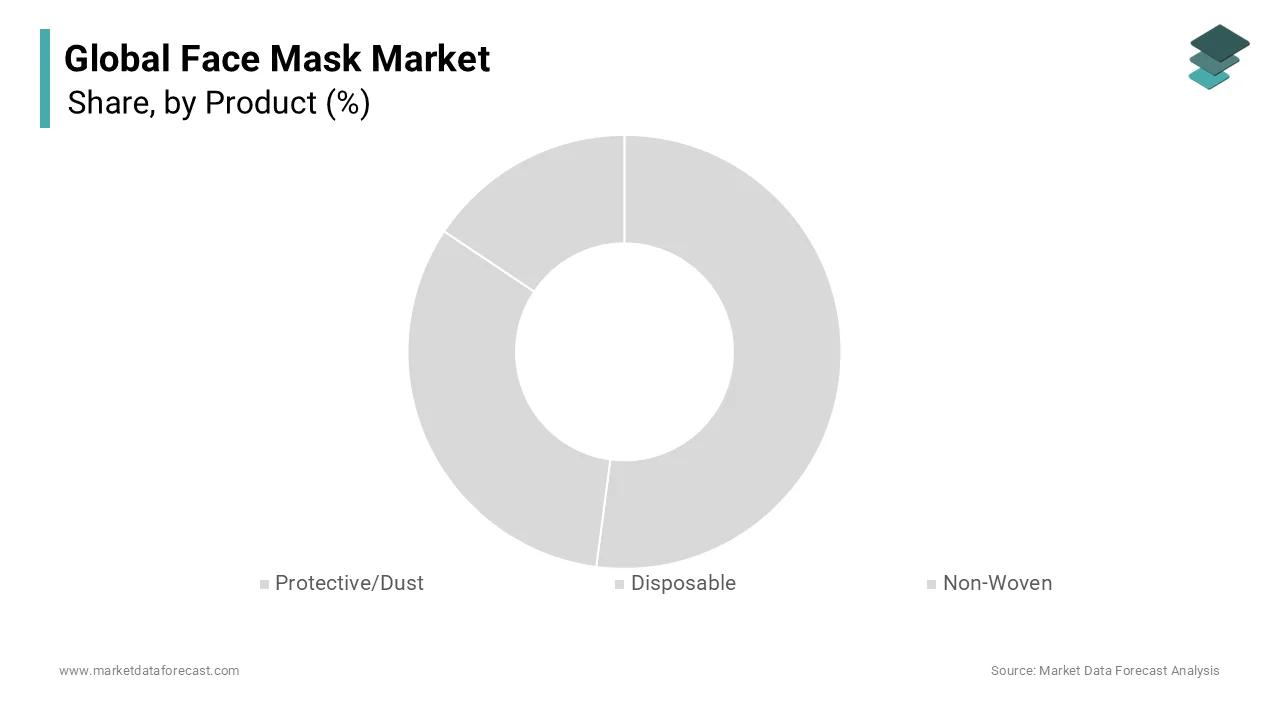
The non-woven masks segment is expected to exhibit a noteworthy CAGR of 12.4% from 2025 to 2033. The rapid growth of the non-woven masks segment in the global market is attributed to the rise of air pollution mitigation in urban Asia and the adoption of medical-grade materials in civilian applications. According to research, a percentage of the global population breathes air exceeding WHO PM2.5 guidelines, with cities recording annual averages above 80 µg/m³. In response, China’s reported an increase in non-woven mask purchases between 2021 and 2023 among urban residents, driven by real-time AQI alerts on mobile platforms.
By Application Insights
The industrial applications segment was accounted in holding 59.7% of face mask market share in 2025. The mandatory regulations across heavy industries are largely contributing to the growth of the industrial segment in the global market. In Saudi Arabia, the General Organization for Social Insurance enforces mask usage in all oil refining and petrochemical facilities under Regulation No. 204/2021, covering large number of workers. The growth of industrial segment is further amplified by emerging economies. Indonesia’s mandates mask provision in textile mills employing large number of workers, which generates billions of units of annual demand.
The personal-use mask segment is expected to register a CAGR of 14.1% from 2025 to 2033. In Brazil, a portion of urban dwellers now routinely wear masks during rush hour commutes, a behavior up from that in 2020, driven by persistent ozone and particulate exposure in São Paulo and Rio de Janeiro. Crucially, this growth is not crisis-dependent as it reflects a cultural recalibration where masking is no longer associated solely with illness but with civic responsibility and self-care.
By Distribution Channel Insights
The offline channels segment was the largest by occupying a dominant share of the face mask market share in 2025 due to the institutional procurement systems and supply chain reliability. In the United States, a portion of hospital-grade masks are procured through centralized medical suppliers such as McKesson and Cardinal Health, who maintain physical inventory hubs tied to state health departments. Even in digitally advanced economies, offline remains primary due to regulatory mandates requiring traceability, batch labeling, and physical verification for medical-grade products. The absence of digital certification interoperability and stringent import controls on PPE prevent full digitization of supply chains.
The online channel segment is likely to experience the fastest CAGR of 18.7% from 2025 to 2033. The direct-to-consumer innovation and algorithm-driven health commerce are primarily driving the growth of the online channel segment in the global market. In India, platforms offer subscription-based mask delivery services linked to local air quality indices, with user retention rates surging among urban professionals. Crucially, social media influencers in Southeast Asia have transformed mask selection into a fashion statement. This isn’t just convenience, it’s identity-driven consumption, where masks function as both shield and style accessory.
REGIONAL ANALYSIS
North America Market Analysis
North America was the top performer in the face mask market due to institutionalized healthcare procurement and stringent regulatory frameworks. According to study, a percentage of acute care hospitals maintain a minimum 90-day inventory of N95 respirators post-pandemic. Medicare and Medicaid reimburse providers for bulk mask distribution in long-term care facilities, driving notable amount in annual institutional spending. Beyond healthcare, wildfire smoke events in California and Oregon triggered record mask sales, with a spike in retail purchases during peak fire season. Consumer trust in certified products remains high, with a portion of buyers preferring NIOSH-approved masks over uncertified alternatives.
Europe Market Analysis
Europe face mask market growth is likely to grow owing to the harmonized regulation and sustainability-driven transition. As per study, a portion of masks sold in the EU must now comply with REACH chemical restrictions, which pushs manufacturers toward bio-based alternatives. Germany’s laws require mask producers to fund collection and recycling programs, increasing production costs but enhancing brand credibility among eco-conscious consumers. Nordic countries lead in adoption of biodegradable mask prototypes.
Asia Pacific Market Analysis
Asia Pacific dominated the face mask market with 52.7% of share in 2025. The prominence of the Asia Pacific in the global market is largely driven by population density, regulatory expansion, and manufacturing scale. China accounts for a portion of global production and consumption, according to study, with millions of workers legally required to wear masks in manufacturing zones under revised Work Safety Law amendments. India’s National Air Quality Index triggers mandatory mask issuance in major cities when PM2.5 exceeds 150 µg/m³, fueling daily consumption of millions of units. Japan’s aging society has accelerated demand, a portion of citizens over 65 wear masks regularly outside homes, as per the study.
Latin America Market Analysis
Latin America is growing steadily in the face mask market due to the rising urban pollution and weak formal healthcare access. Mexico saw an increase in mask distribution to construction and mining workers between 2021 and 2023 under updated NOM-027 standards. Brazil’s government launched a Clean Air Initiative, providing free non-woven masks at transit stations, reaching large number of daily commuters.
Middle East & Africa Market Analysis
The Middle East and Africa is likely to grow in the face mask market during the forecast period. Moreover, it is constrained by economic disparity but showing nascent resilience through targeted interventions. In Saudi Arabia, it mandates mask usage during dust storms, which occur several days annually, driving institutional bulk procurement of large number of units yearly. South Africa distributed millions of surgical masks to township clinics, which fills gaps left by underfunded public hospitals. Nigeria saw a rise in mask imports since. However, counterfeit penetration exceeds in informal markets.
COMPETITIVE LANDSCAPE
KEY MARKET PLAYERS
Some of the key players dominating the global face mask market are
- Moldex
- Shanghai Dasheng
- Kimberly-Clark
- BDS
- Gerson
- Halyard Healthcare
- SAS Safety Corp
- Honeywell
TOP STRATEGIES USED BY KEY MARKET PLAYERS
Key players are advancing through vertical integration, technological differentiation, and behavioral alignment. Leading firms now own upstream polymer extrusion facilities to ensure material consistency and reduce supply volatility. Strategic alliances with public health authorities enable embedded distribution beyond retail by turning masks into institutional infrastructure. Investment in sensor-integrated and biodegradable materials transforms products from disposable items into sustainable health tools. Companies are leveraging data analytics to anticipate regional pollution or outbreak spikes, which enables just-in-time logistics.
COMPETITION OVERVIEW
Competition in the face mask market has evolved from price-driven commoditization to ecosystem dominance. Players now compete on regulatory agility, material innovation, and behavioral influence rather than unit volume. The entry of tech-enabled startups, circular economy advocates, and industrial hygiene specialists has fragmented the value chain. Traditional manufacturers face burden to adopt traceable sourcing, carbon-neutral logistics, and real-time compliance monitoring. Governments increasingly act as co-designers of product specifications, turning procurement into a tool for public health policy.
TOP PLAYERS IN THE MARKET
- 3M has anchored its global presence in the face mask market through relentless innovation in filtration media and industrial-grade respirator design. In recent years, it launched the N95 HealthGuard series with antimicrobial finishes and adaptive fit technology, tailored for high-pollution urban environments. The company partnered with municipal health agencies across Southeast Asia to deploy reusable mask refill stations in public transit hubs, which is strengthening institutional trust.
- Honeywell has expanded its footprint by integrating smart manufacturing protocols into mask production lines, enabling real-time quality validation at scale. It introduced the H910 series with integrated sensor tags that verify filter integrity via mobile app connectivity. The company forged exclusive supply agreements with railway networks in Germany and Japan to provide certified masks to frontline staff, which embeds its products into daily operational workflows. Honeywell also launched a closed-loop recycling initiative for used masks in its European facilities, which transforms post-consumer material into industrial insulation.
- Alpha Pro Tech has carved a niche by specializing in high-performance non-woven masks for industrial and pharmaceutical environments. It pioneered the use of biodegradable melt-blown substrates derived from corn-based polymers, securing certification for compostability. Its focus on regulatory compliance in emerging markets has made it a preferred partner for governments prioritizing both safety and environmental accountability.
MARKET SEGMENTATION
This research report on the global face mask market has been segmented and sub-segmented based on product, application, distribution channel and region.
By Product
- Protective/Dust
- Disposable
- Non-Woven
By Application
- Industrial
- Personal
By Distribution Channel
- Offline
- Online
By Region
- North America
- Europe
- Asia Pacific
- Latin America
- Middle East and Africa