- Product Description Description
- Table of Contents TOC
- List of Table & Figure LOT
- Get Free Sample PDF Sample PDF
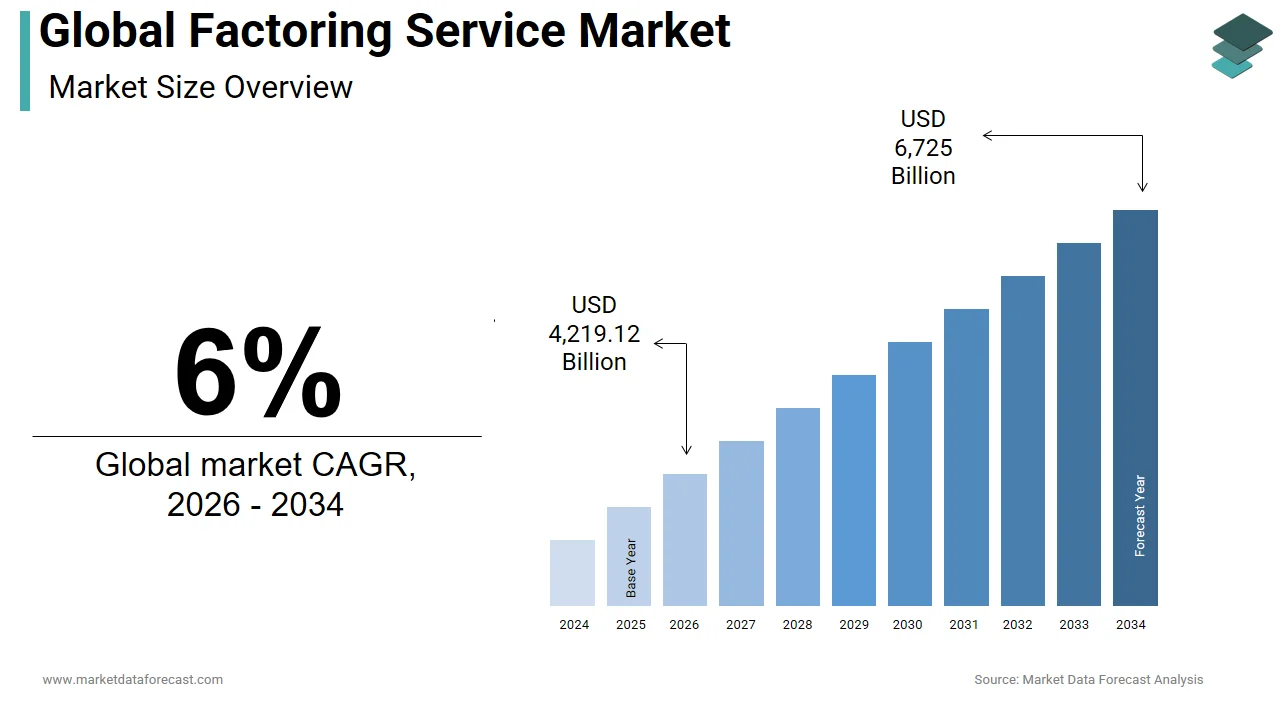
Market Size, 2025
$3,980.3 BnMarket Estimate, 2026
$4,219.12 BnMarket Forecast, 2034
$6,725 BnCAGR, 2026–2034
6%Global Factoring Service Market Size
The global factoring service market was valued at USD 3,980.3 billion in 2025. The global market is predicted to reach USD 4,219.12 billion in 2026 and USD 6,725 billion by 2034, growing at a CAGR of 6% during the forecast period.
Factoring is a financial service offered by banks or third-party financial service providers in which a seller sells their accounts receivables to a factor at a discounted rate to raise funds. The factor retains custody of the invoice and earns a small profit, while the seller receives prompt payment for the receivable. There are three parties involved: the seller, the buyer, and the factor. While the factor checks the invoices, the seller sells the items to the buyer, prepares invoices, and submits them to the factor for funding. After the buyer pays the factor, the seller receives 80% of the cash, and the buyer receives the remaining 20%, with the interest charged paid at the same time or in arrears, depending on the type of agreement. The quantity of financing and the credit quality of invoices affect the cost of factoring.
MARKET DRIVERS
The global factoring service market is fueled by a growing knowledge of fintech advancements such as money transfer and payments, budgeting and financial planning, borrowing, saving and investing, and insurance. Because most banks are hesitant to provide a large number of paychecks, Fintech solution providers provide an automated option. Fintech companies provide low-cost bulk payment services. This enables SMEs to approach fintech firms, boosting the factors' return on investments (RoI), such as banks or third-party insurers.
The introduction of information technology has had a huge impact on the financial sector. The factoring industry's transaction procedure has been automated thanks to an innovative financial solution. Furthermore, the use of automated solutions has improved not only the financial sector but also the security and planning solutions. The use of crypto-solutions has increased the accuracy of transactions and protected the critical information of both parties (i.e., suppliers and purchasers in the factoring process), preventing financial fraud.
One of the blockchain solution providers has discovered some of the application areas where most organizations are using the blockchain in the factoring process. Furthermore, one of the most important features of factory procedures is a secure and fast workflow process. As a result, by integrating smart contracts in the factoring business, blockchain enhances financial transactions in a centralized and encrypted manner.
MARKET RESTRAINTS
Antiquated rules that impede the expansion of receivables buy programs, such as the continued usage of stamp duty tax, legislation prohibiting assignment rights, and foreign currency limitations, are likely to discourage demand for factoring in emerging markets.
REPORT COVERAGE
| REPORT METRIC | DETAILS |
| Market Size Available | 2025 to 2034 |
| Base Year | 2025 |
| Forecast Period | 2026 to 2034 |
| CAGR | 6% |
| Segments Covered | By Category, Type, Financial Institution, End User, and Region |
|
Various Analyses Covered | Global, Regional, & Country Level Analysis, Segment-Level Analysis, DROC, PESTLE Analysis, Porter’s Five Forces Analysis, Competitive Landscape, Analyst Overview on Investment Opportunities |
| Regions Covered | North America, Europe, APAC, Latin America, Middle East & Africa |
|
Market Leaders Profiled | Cisco, Aruba, Extreme Network, Arista, Purple, Enea, Boingo, Cloud-Fi, GoZone, Netgear, GlobalReach, Adentro, IronWifi, Cloud4Wi, Nexnet Solutions, Performance Network, Anuvu, Spotipo, and others. |
SEGMENTAL ANALYSIS
By Category Insights
In 2024, the domestic segment dominated the factoring services industry, accounting for around 70% of total revenue. The primary element driving the segment's growth is high domestic demand in nations like China, thanks to the government's initiatives to boost private consumption. Banks' easy risk coverage, as well as inexpensive fees and prices relative to overseas offers, are fueling expansion. Domestic factoring business operations are simple to carry out, assuming the buyer's credit risk and ability to pay, and the seller can acquire funding and other factoring services by submitting the relevant documentation and invoices.
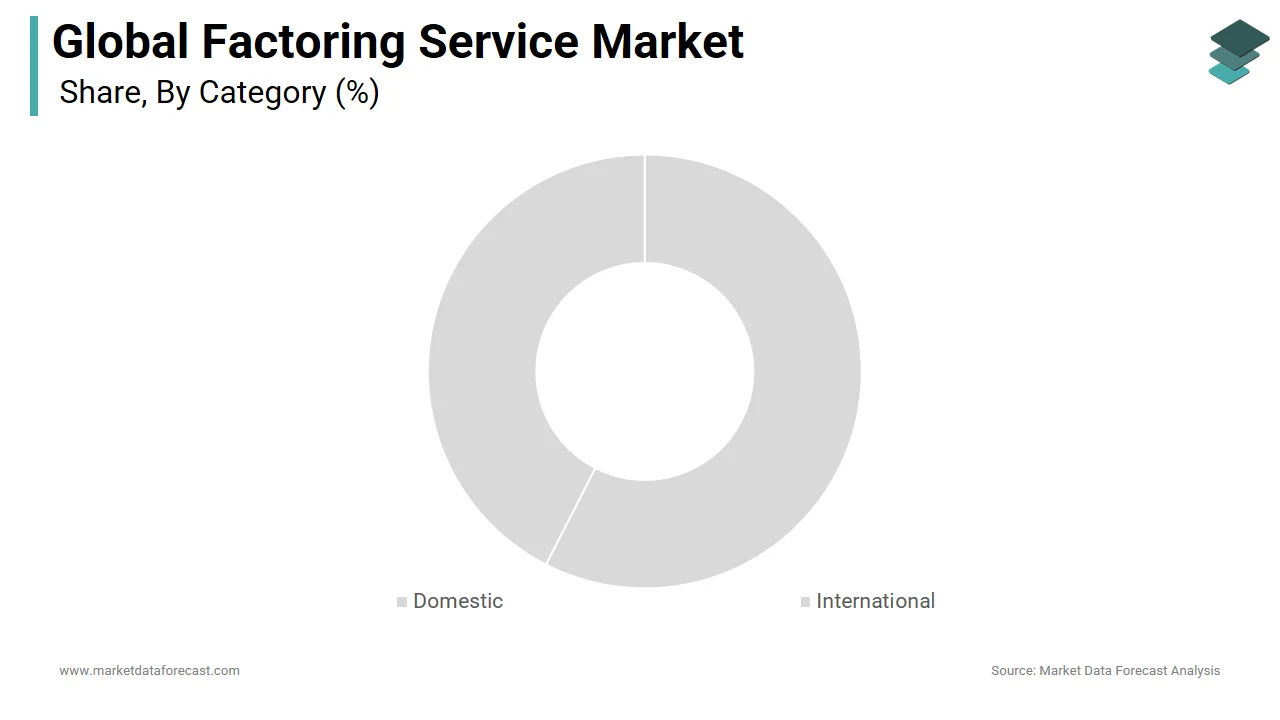
The international category has grown significantly due to the development in open account trading, particularly from emerging-market suppliers. Big importers in developed nations are considering factoring as a viable alternative to traditional forms of trade finance, which is driving demand for the services. In addition, as global trade and understanding among export-import businesses expand, so does the demand for international factoring services.
By Type Insights
In 2024, the recourse segment had the biggest market share, around 55 percent. All services, except debt protection, are provided via recourse factoring. The client's obligation to the factor does not end until the dues are paid in full. In industrialized regions and more organized markets, recourse factoring is widely utilized.
Under non-recourse factoring, which insures against bad debts, the finance firm is responsible for the risks of unpaid invoices. The non-recourse category is likely to grow significantly over the forecast period because of the widespread use of non-recourse factoring in emerging markets. SMEs are expected to be the key adopters of this financing option because interest rates for both recourse and non-recourse factoring are practically identical around the world. Demand for non-recourse loans is expected to expand as short-term credit provides debt stability, employment, and economic opportunities in developing countries.
By Financial Institution Insights
In 2024, the banking segment had the biggest market share, estimated to be over 80%. Due to the use of technology such as distributed ledgers, banks have become the world's largest financial institutions and are increasingly offering factoring services. Several banks worldwide are creating blockchain technology platforms to satisfy their clients' financial demands.
By End-User Insights
Regarding market revenue, the manufacturing category held the largest share of the market in 2020, accounting for more than 30%. Factoring Services in the manufacturing segment are primarily driven by the rise of the manufacturing sector in nations such as India and other South and Southeast Asian countries. Over the projected period, the other segment, including businesses such as transportation, logistics, and healthcare, is expected to increase significantly. Medical factoring aids businesses in overcoming cash flow issues caused by late payments. Medical experts and healthcare providers are the primary users of the services.
REGIONAL ANALYSIS
In 2024, Europe accounted for around 60% of total sales. More than two-thirds of the regional market was accounted for by France, Italy, Germany, and the United Kingdom. The strategic relevance of receivables funded by commercial banking might be ascribed to the growth. Factoring services are in high demand in the region due to current trade inside the European Economic Zone and rising trade with fast-growing markets in Eastern Bloc nations.
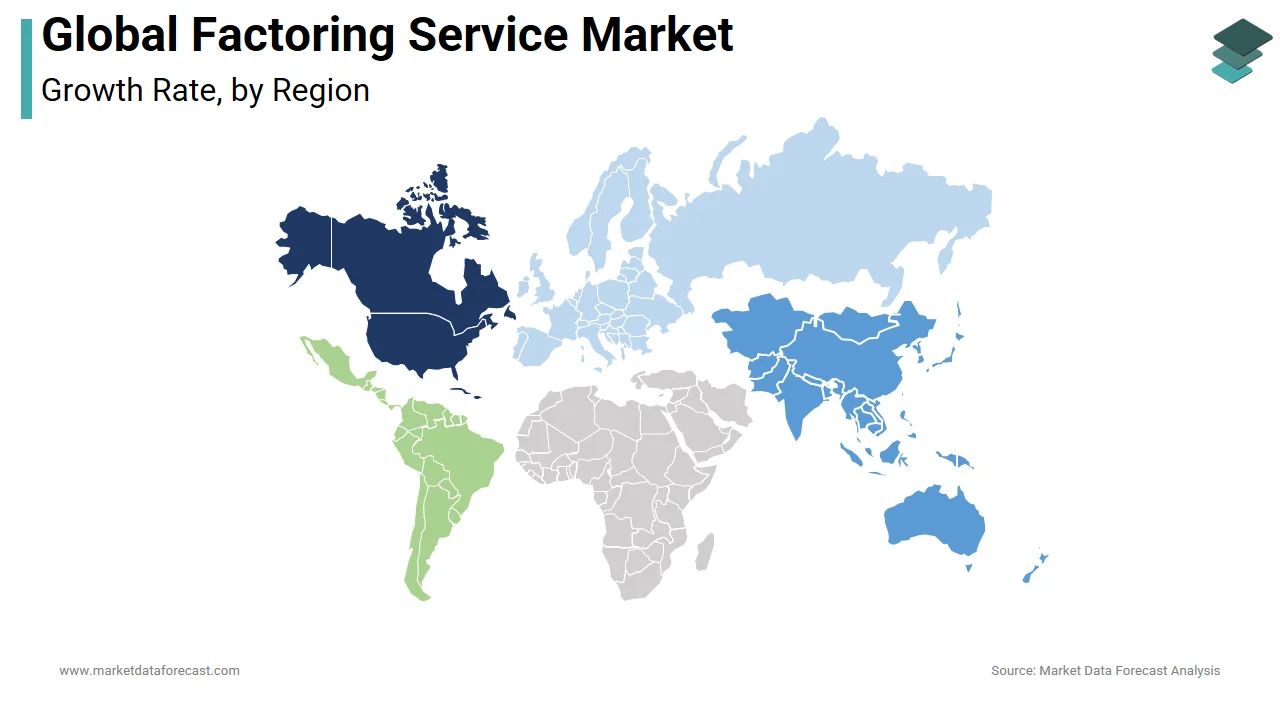
Market prospects are rising in regions such as the Asia Pacific and Latin America, thanks to the promising development rate of regional economies and a huge increase in trade activity. In the Asia Pacific, more than 5,000 companies provide factoring services, followed by North America. China, India, Malaysia, Indonesia, the Philippines, and Thailand are just a few of the rapidly rising economies in the Asia Pacific. Because established markets are saturated, these countries are attracting investments from established markets, searching for new opportunities in the region.
KEY MARKET PARTICIPANTS
The major companies operating in the global factoring service market include Barclays Bank (UK), HSBC (UK), BNP Paribas (France), China Construction Bank Cooperation (China), Deutsche Factoring Bank (Germany), Eurobank (Greece), Hitachi Capital (Japan), Mitsubishi UFJ Financial Group (Japan), KB Financial (South Korea), DBS Bank (Singapore), and others.
RECENT MARKET HAPPENINGS
-
Barclays has invested in fossil fuel projects more than any other UK bank. Despite rising international warnings that any new fossil developments would destroy all chances of avoiding a catastrophic climate breakdown, the bank financed USD 5.6 billion (£4.1 billion) for new fossil fuel projects from January 2021 to the eve of the UN climate summit.
-
In response to investor demand for tactical ESG strategies and exposure amid market stress, BNP Paribas has expanded its product line by launching defensive funds on its THEAM Quant platform.
-
Eurobank, one of Greece's four major banks, has agreed to sell a portion of the mezzanine and junior notes of a non-performing loan portfolio securitisation for 5.2 billion euros (USD 6 billion) to credit servicer doValue.
-
HSBC has inked a multi-year agreement with CloudBees, a DevOps platform, to standardise software delivery for over 23,000 developers around the world. The deal covers all CloudBees platform components, including continuous integration, continuous delivery, release orchestration, and feature management.
MARKET SEGMENTATION
This research report on the global factoring service market has been segmented and sub-segmented based on the category, type, financial institution, end user, and region.
By Category
- Domestic
- International
By Type
- Recourse
- Non-Recourse
By Financial Institution
- Banking
- Non-Banking
By End-User
- Manufacturing
- Transport & Logistics
- IT
- Healthcare
- Construction
- Others
By Region
-
North America
-
The United States
-
Canada
-
Rest of North America
-
-
Europe
-
The United Kingdom
-
Spain
-
Germany
-
Italy
-
France
-
Rest of Europe
-
-
The Asia Pacific
-
India
-
Japan
-
China
-
Australia
-
Singapore
-
Malaysia
-
South Korea
-
New Zealand
-
Southeast Asia
-
-
Latin America
-
Brazil
-
Argentina
-
Mexico
-
Rest of LATAM
-
-
The Middle East and Africa
-
Saudi Arabia
-
UAE
-
Lebanon
-
Jordan
-
Cyprus
-